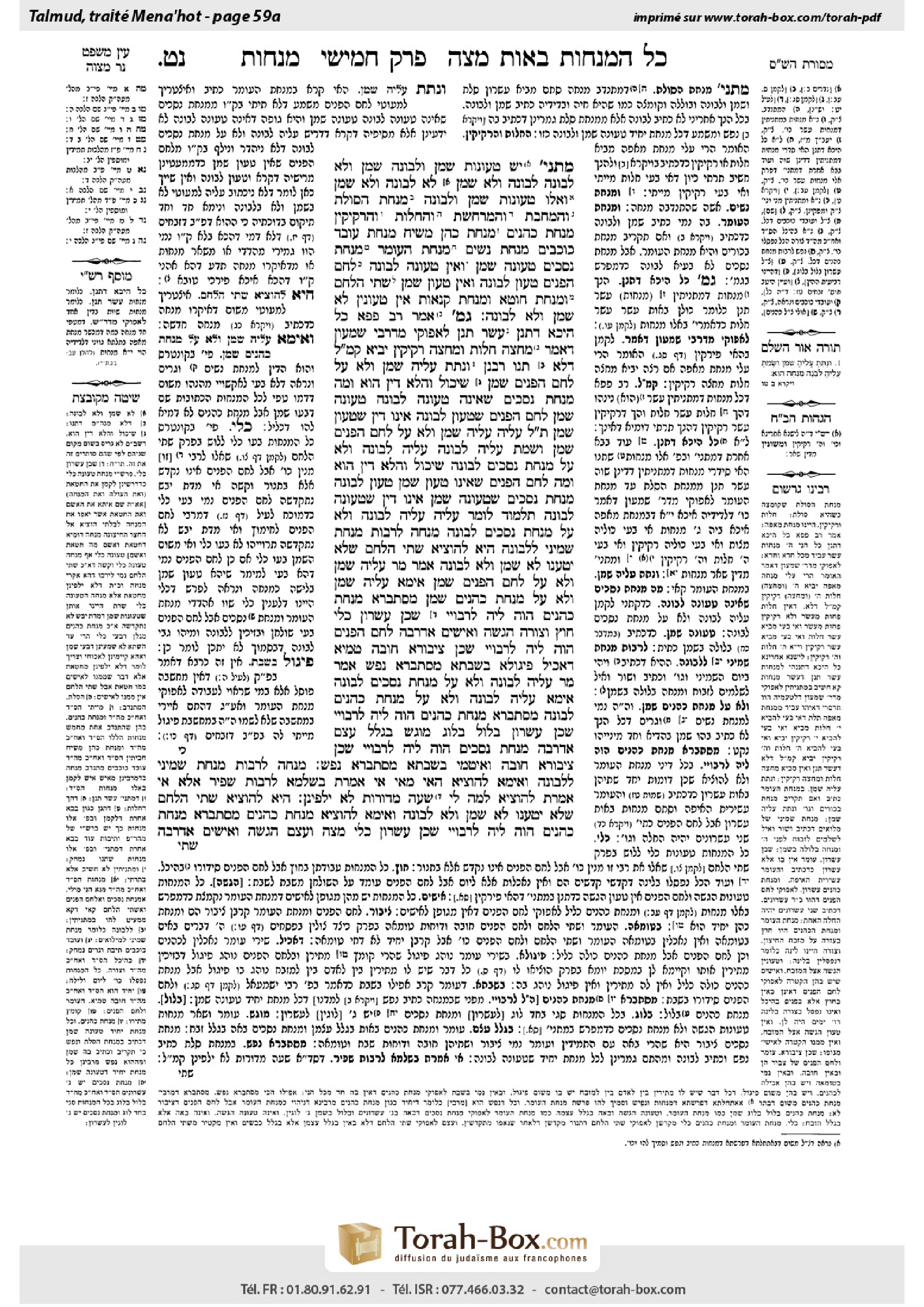
Menachot 59a: Talmud study for Daf Yomi
Daf Yomi is the daily study of one Talmud folio. Explore 37 tractates with scans, Hebrew text, Sefaria English and AI-generated French translations where annotated.
Passage selection and English or AI-generated French translation are available where the scan has annotations. Daf Study is independent of Torah-Box and Sefaria.
Browse Menachot · מנחות · All tractatesMenachot 59a text and translations
This page of Menachot includes the Aramaic text, an English translation and an AI-generated French translation, alongside the scan above.
מנחות נ״ט א · Aramaic and Hebrew text
מַתְנִי׳ יֵשׁ טְעוּנוֹת שֶׁמֶן וּלְבוֹנָה, שֶׁמֶן וְלֹא לְבוֹנָה, לְבוֹנָה וְלֹא שֶׁמֶן, לֹא לְבוֹנָה וְלֹא שֶׁמֶן.
וְאֵלּוּ טְעוּנוֹת שֶׁמֶן וּלְבוֹנָה: מִנְחַת הַסּוֹלֶת, וְהַמַּחֲבַת, וְהַמַּרְחֶשֶׁת, וְהַחַלּוֹת, וְהָרְקִיקִין.
מִנְחַת כֹּהֲנִים, מִנְחַת כֹּהֵן מָשִׁיחַ, מִנְחַת גּוֹי, מִנְחַת נָשִׁים, מִנְחַת הָעוֹמֶר.
מִנְחַת נְסָכִים טְעוּנָה שֶׁמֶן, וְאֵין טְעוּנָה לְבוֹנָה. לֶחֶם הַפָּנִים טָעוּן לְבוֹנָה, וְאֵין טָעוּן שֶׁמֶן.
שְׁתֵּי הַלֶּחֶם, וּמִנְחַת חוֹטֵא, וּמִנְחַת קְנָאוֹת – אֵין טְעוּנִין לֹא שֶׁמֶן וְלֹא לְבוֹנָה.
גְּמָ׳ אָמַר רַב פָּפָּא: כֹּל הֵיכָא דִּתְנַן עֶשֶׂר – תְּנַן, לְאַפּוֹקֵי מִדְּרַבִּי שִׁמְעוֹן דְּאָמַר: מֶחֱצָה חַלּוֹת וּמֶחֱצָה רְקִיקִין יָבִיא, קָא מַשְׁמַע לַן דְּלָא.
תָּנוּ רַבָּנַן: ״וְנָתַתָּ עָלֶיהָ שֶׁמֶן״ – וְלֹא עַל לֶחֶם הַפָּנִים שֶׁמֶן.
שֶׁיָּכוֹל – וַהֲלֹא דִּין הוּא: וּמָה מִנְחַת נְסָכִים שֶׁאֵינָהּ טְעוּנָה לְבוֹנָה טְעוּנָה שֶׁמֶן, לֶחֶם הַפָּנִים שֶׁטָּעוּן לְבוֹנָה – אֵינוֹ דִּין שֶׁטָּעוּן שֶׁמֶן! תַּלְמוּד לוֹמַר ״עָלֶיהָ״ – עָלֶיהָ שֶׁמֶן, וְלֹא עַל לֶחֶם הַפָּנִים שֶׁמֶן.
״וְשַׂמְתָּ עָלֶיהָ לְבֹנָה״ – עָלֶיהָ לְבוֹנָה, וְלֹא עַל מִנְחַת נְסָכִים לְבוֹנָה.
שֶׁיָּכוֹל, וַהֲלֹא דִּין הוּא: וּמָה לֶחֶם הַפָּנִים שֶׁאֵינוֹ טָעוּן שֶׁמֶן – טָעוּן לְבוֹנָה, מִנְחַת נְסָכִים שֶׁטְּעוּנָה שֶׁמֶן – אֵינוֹ דִּין שֶׁטְּעוּנָה לְבוֹנָה? תַּלְמוּד לוֹמַר ״עָלֶיהָ״ – עָלֶיהָ לְבוֹנָה, וְלֹא עַל מִנְחַת נְסָכִים לְבוֹנָה.
״מִנְחָה״ – לְרַבּוֹת מִנְחַת שְׁמִינִי לִלְבוֹנָה, ״הִיא״ – לְהוֹצִיא שְׁתֵּי הַלֶּחֶם, שֶׁלֹּא יִטְעֲנוּ לֹא שֶׁמֶן וְלֹא לְבוֹנָה.
אָמַר מָר: ״עָלֶיהָ שֶׁמֶן״ – וְלֹא עַל לֶחֶם הַפָּנִים שֶׁמֶן. אֵימָא: ״עָלֶיהָ שֶׁמֶן״ – וְלֹא עַל מִנְחַת כֹּהֲנִים שֶׁמֶן!
מִסְתַּבְּרָא מִנְחַת כֹּהֲנִים הֲוָה לֵיהּ לְרַבּוֹיֵי, שֶׁכֵּן עִשָּׂרוֹן, כְּלִי,
חוּץ, וְצוּרָה, הַגָּשָׁה,
וְאִישִּׁים.
אַדְּרַבָּה, לֶחֶם הַפָּנִים הֲוָה לֵיהּ לְרַבּוֹיֵי, שֶׁכֵּן צִיבּוּרָא, חוֹבָה, טַמְיָא.
דְּאָכֵיל פִּיגּוּלָא, בְּשַׁבְּתָא.
מִסְתַּבְּרָא ״נֶפֶשׁ״.
אָמַר מָר: ״עָלֶיהָ לְבֹנָה״ – וְלֹא עַל מִנְחַת נְסָכִים לְבוֹנָה. אֵימָא: ״עָלֶיהָ לְבֹנָה״ – וְלֹא עַל מִנְחַת כֹּהֲנִים לְבוֹנָה!
מִסְתַּבְּרָא מִנְחַת כֹּהֲנִים הֲוָה לֵיהּ לְרַבּוֹיֵי, שֶׁכֵּן עִשָּׂרוֹן בָּלוּל בְּלוֹג.
מוּגָּשׁ, בִּגְלַל עֶצֶם.
אַדְּרַבָּה, מִנְחַת נְסָכִים הֲוָה לֵיהּ לְרַבּוֹיֵי, שֶׁכֵּן צִיבּוּרָא,
חוֹבָה, וְאִיטַּמִּי. בְּשַׁבְּתָא.
מִסְתַּבְּרָא ״נֶפֶשׁ״.
״מִנְחָה״ – לְרַבּוֹת מִנְחַת שְׁמִינִי לִלְבוֹנָה, וְאֵימָא – לְהוֹצִיא? הַאי מַאי? אִי אָמְרַתְּ בִּשְׁלָמָא לְרַבּוֹת – שַׁפִּיר.
אֶלָּא אִי אָמְרַתְּ לְהוֹצִיא – לְמָה לִי? שָׁעָה מִדּוֹרוֹת לָא יָלְפִינַן.
״הִיא״ – לְהוֹצִיא שְׁתֵּי הַלֶּחֶם, שֶׁלֹּא יִטְעֲנוּ לֹא שֶׁמֶן וְלֹא לְבוֹנָה. וְאֵימָא לְהוֹצִיא מִנְחַת כֹּהֲנִים? מִסְתַּבְּרָא מִנְחַת כֹּהֲנִים הֲוָה לֵיהּ לְרַבּוֹיֵי, שֶׁכֵּן עִשָּׂרוֹן,
כְּלִי, מַצָּה, וְעֶצֶם, הַגָּשָׁה, וְאִישִּׁים.
אַדְּרַבָּה,
Menachot 59a · English translation
MISHNA: There are four types of meal offerings: Those that require both oil and frankincense, those that require oil but not frankincense, those that require frankincense but not oil, and those that require neither frankincense nor oil.
The mishna elaborates: And these are the meal offerings that require both oil and frankincense: The fine-flour meal offering, as it is stated: “And he shall pour oil upon it, and put frankincense thereon” (Leviticus 2:1); the meal offering prepared in a pan (see Leviticus 2:5–6); the meal offering prepared in a deep pan (see Leviticus 2:7–10); and the meal offering baked in an oven, which can be brought in the form of loaves or in the form of wafers (see Leviticus 2:4).
Additional meal offerings that require both oil and frankincense are the meal offering of priests; the meal offering of the anointed priest, i.e., the griddle-cake offering brought by the High Priest every day, half in the morning and half in the evening; the meal offering of a gentile; a meal offering brought by women; and the omer meal offering (see Leviticus 23:15).
The meal offering brought with libations that accompany burnt offerings and peace offerings requires oil but does not require frankincense. The shewbread requires frankincense but does not require oil.
The two loaves brought on the festival of Shavuot (see Leviticus 23:17), the meal offering of a sinner, and the meal offering of jealousy brought by a sota require neither oil nor frankincense. The two loaves do not require oil or frankincense because these additions are not mentioned with regard to it. The meal offering of a sinner does not require them, as it is written: “He shall not put oil upon it, neither shall he give any frankincense upon it; for it is a sin offering” (Leviticus 5:11). With regard to the meal offering brought by a sota, it is similarly written: “He shall pour no oil upon it, nor give frankincense upon it, for it is a meal offering of jealousy, a meal offering of memorial, bringing iniquity to remembrance” (Numbers 5:15).
GEMARA: Rav Pappa stated a principle with regard to all the mishnayot in tractate Menaḥot: Anywhere that we learned in a mishna that one brings a meal offering, we learned that one must bring ten items of the same type, either loaves or wafers. The Gemara explains: This statement of Rav Pappa serves to exclude the opinion of Rabbi Shimon, who says: One who takes a vow to bring a meal offering baked in an oven must bring ten items. If he wishes, he may bring ten loaves or ten wafers, and if he wishes he may bring half of them as loaves and the other half as wafers. Rav Pappa teaches us that the tanna of the mishna maintains that one may not do so; all ten must be of the same type.
§ The mishna teaches that the omer meal offering requires both oil and frankincense. With regard to this meal offering, the Sages taught in a baraita: The verse states: “And you shall put oil upon it and lay frankincense upon it; it is a meal offering” (Leviticus 2:15). From this it can be inferred: One must put oil specifically “upon it,” but one does not place oil upon the shewbread.
As one might have thought: Could this not be derived through an a fortiori inference, to conclude that the shewbread should require oil? The baraita explains: And if the meal offering brought with libations that accompany burnt offerings and peace offerings, which does not require frankincense, nevertheless requires oil, then with regard to the shewbread, for which the halakha is more stringent in that it requires frankincense, is it not logical that it should also require oil? Therefore, the verse states “upon it,” which indicates that one places oil upon it, the omer meal offering, but one does not place oil upon the shewbread.
Similarly, the phrase “and lay frankincense upon it” indicates that one must place frankincense “upon it,” but one does not place frankincense upon the meal offering brought with libations.
As one might have thought: Could this not be derived through an a fortiori inference? And if the shewbread, for which the halakha is more lenient than the meal offering brought with libations in that it does not require oil, nevertheless requires frankincense, then concerning the meal offering brought with libations, which does require oil, is it not logical that it should also require frankincense? Therefore, the verse states “upon it,” to indicate that one places frankincense upon it, the omer meal offering, but one does not place frankincense upon the meal offering brought with libations.
In the phrase “it is a meal offering,” the term “meal offering” serves to include in the obligation of frankincense the meal offering of the eighth day of the inauguration of the Tabernacle in the wilderness. With regard to that offering the verse states: “And a meal offering mixed with oil” (Leviticus 9:4), but it does not mention frankincense. Therefore, the term “meal offering” written in the context of the omer meal offering serves to apply the requirement of frankincense to the meal offering of the eighth day of inauguration. And the term “it is” in the same phrase serves to exclude the two loaves sacrificed on Shavuot, to indicate that they will require neither oil nor frankincense.
The Gemara analyzes the halakhot stated in the baraita: The Master said that the phrase: “And you shall put oil upon it,” teaches that one places oil upon the omer meal offering, but one does not place oil on the shewbread. The Gemara raises a difficulty: Why does the baraita conclude that this verse excludes the shewbread? One can say instead: “Upon it” you shall place oil, but one does not place oil on the meal offering of priests.
The Gemara answers: It stands to reason that the meal offering of priests should be included in the requirement of oil, as the meal offering of priests is similar in many ways to the omer meal offering that is the subject of the verse. The Gemara details the points of similarity between the two types of meal offerings: Both are prepared from a tenth of an ephah of flour, whereas each of the twelve loaves of the shewbread is prepared from two-tenths of an ephah. Furthermore, both are kneaded and consecrated in a service vessel, whereas the shewbread is not consecrated in a service vessel but rather is baked in an oven in the Temple courtyard.
Thirdly, both the meal offering of priests and the omer meal offering are sacrificed outside the Sanctuary on the outer altar, whereas the shewbread is placed on the Table inside the Sanctuary. And in both cases the halakha of a change in form applies, i.e., if they were left overnight without being sacrificed they are disqualified, whereas the shewbread is left on the Table for a week. Furthermore, in both cases there is the obligation of bringing the meal offering near to the lower part of the altar, at the southwest corner, an obligation that does not apply to the shewbread.
And finally, some portion of both the meal offering of priests and the omer meal offering is placed in the fire, as the handful of the omer meal offering is sacrificed, while the entire meal offering of a priest is burned on the altar. By contrast, the shewbread is not sacrificed on the altar at all. In total, there are therefore six points of similarity between the meal offering of priests and the omer meal offering, all of which are not shared by the shewbread. Consequently, the requirement of oil stated with regard to the omer meal offering should also apply to the meal offering of priests, not to the shewbread.
The Gemara counters: On the contrary [adderabba], it stands to reason that the shewbread, not the meal offering of priests, should be included in the requirement of oil, as the shewbread has points of similarity with the omer meal offering in that both the shewbread and the omer meal offering are communal meal offerings, whereas the meal offering of priests is an individual meal offering. Furthermore, they are both obligatory offerings, whereas the meal offering of priests is voluntary. Additionally, both can sometimes be sacrificed in a state of ritual impurity, as the prohibition against performing the Temple service in a state of impurity is disregarded in cases involving the public. Like the offering of an individual, the meal offering of priests is not brought in a state of impurity.
Also, there is the halakha that both the shewbread and the omer meal offering are eaten by priests, while the meal offering of priests is entirely burned on the altar. Furthermore, the halakha of an offering that was sacrificed with the intent to consume it after its designated time [piggul] applies to both the shewbread and the omer meal offering, but not to the meal offering of priests. And finally, both the shewbread and the omer meal offering are brought even on Shabbat, as they are communal offerings, whereas the meal offering of priests is not sacrificed on Shabbat. Accordingly, there are also six points of similarity between the shewbread and the omer meal offering. Why, then, isn’t the verse interpreted as including the shewbread in the requirement of oil, and excluding the meal offering of priests?
The Gemara answers: Even so, it stands to reason that one should include the meal offering of priests, as in the same passage that deals with the omer meal offering the verse states: “And when anyone brings a meal offering to the Lord, his offering shall be of fine flour” (Leviticus 2:1). This verse includes all meal offerings of individuals in the halakhot of meal offerings stated in this chapter, including the meal offering of priests.
The Gemara further analyzes the baraita. The Master said: The phrase: “And lay frankincense upon it” (Leviticus 2:15), teaches that one must place frankincense upon the omer meal offering, but one does not place frankincense upon the meal offering brought with libations. The Gemara asks: Why does the baraita state that this verse excludes the meal offering brought with libations? One can say: One places frankincense upon the omer meal offering, but one does not place frankincense upon the meal offering of priests.
The Gemara answers: It stands to reason that the meal offering of priests should be included in the requirement of frankincense, as the meal offering of priests is similar in many respects to the omer meal offering. The Gemara elaborates: Both are prepared from a tenth of an ephah of flour, whereas the libations that accompany meal offerings come in various amounts, depending on the type of animal offering they accompany. Furthermore, in both cases the flour is mixed with a log of oil, whereas in the case of the meal offering brought with libations, the amount of oil mixed with the flour depends on the type of animal offering it accompanies.
Additionally, both the meal offering of priests and the omer meal offering are brought near to the altar, a ritual that is not performed with the meal offering brought with libations. And finally, both are sacrificed due to themselves, i.e., they do not accompany any other offering, whereas meal offerings brought with libations accompany animal offerings. There are therefore four points of similarity between the meal offering of priests and the omer meal offering that do not apply to the meal offering brought with libations.
The Gemara counters: On the contrary, it stands to reason that the meal offering brought with libations and not the meal offering of priests should be included in the requirement of frankincense. This is because the meal offering brought with libations is similar to the omer meal offering in that both the meal offering brought with libations and the omer meal offering are communal meal offerings, whereas the meal offering of priests is that of an individual.
Furthermore, both the meal offering brought with libations and the omer meal offering are obligatory offerings, while the meal offering of priests is a gift offering. And both may sometimes be sacrificed in a state of ritual impurity, as the prohibition against performing the Temple service in a state of impurity is disregarded in cases involving the public; whereas the meal offering of priests must be brought in a state of purity because it is an offering of an individual. Finally, both are brought even on Shabbat, whereas the meal offering of priests may not be brought on Shabbat. Accordingly, as there are also four points of similarity between the meal offering brought with libations and the omer meal offering, one can ask why the meal offering brought with libations is not included in the requirement of frankincense.
The Gemara answers: It stands to reason that one should include the meal offering of priests in the requirement of frankincense, as the verse states: “Anyone” (Leviticus 2:1), which is referring to all meal offerings of individuals.
The baraita teaches that the term: “Meal offering” (Leviticus 2:15), serves to include the meal offering of the eighth day of the inauguration of the Tabernacle in the requirement of frankincense. The Gemara raises a difficulty: But one can say that this term serves to exclude the meal offering of the eighth day from the requirement of frankincense. The Gemara is puzzled by this suggestion: What is this suggestion? Granted, if you say that the verse serves to include the meal offering of the eighth day of inauguration in the requirement of frankincense, it works out well. This is because the only reason one could know that the requirement of frankincense applies would be that the halakha of this meal offering, which was brought on one occasion, is derived from the halakha of a meal offering that is brought in all generations.
But if you say that the verse serves to exclude the meal offering of the eighth day of the inauguration of the Tabernacle from the requirement of frankincense, why do I need a verse for this purpose? There is a principle that we do not learn the requirements of transitory offerings from the requirement of offerings of later generations. In other words, even without this verse one would not have thought that the requirement of frankincense applies to the meal offering of the eighth day, so there is no need for the verse to exclude this possibility.
The baraita teaches that the term: “It is” (Leviticus 2:15), serves to exclude the two loaves sacrificed on Shavuot, to indicate that they will require neither oil nor frankincense. The Gemara raises a difficulty: But one can say that this serves to exclude the meal offering of priests from the requirements of oil and frankincense. The Gemara answers: It stands to reason that the meal offering of priests should be included in these requirements, while the two loaves should be excluded, as the meal offering of priests is similar to the omer meal offering in several respects that do not apply to the two loaves. The Gemara elaborates: Both are prepared from a tenth of an ephah of flour, unlike the two loaves, which are prepared from two-tenths.
Furthermore, both are consecrated in a service vessel, unlike the two loaves, which are consecrated by being baked in an oven. Both come as matza, whereas the two loaves are leaven. And both come due to themselves, not with any other offering, whereas the two loaves come together with the lambs on Shavuot. With regard to both the meal offering of priests and the omer meal offering, there is an obligation to bring them near to the altar, which does not apply to the two loaves. And finally, they are both placed in the fire atop the altar, whereas the two loaves are not sacrificed on the altar.
The Gemara counters: On the contrary,
Menachot 59a · Traduction française (IA)
MICHNA : Il existe quatre catégories d’offrandes de farine : celles qui requièrent à la fois de l’huile et de l’encens, celles qui requièrent de l’huile mais pas d’encens, celles qui requièrent de l’encens mais pas d’huile, et celles qui ne requièrent ni encens ni huile.
La Michna précise : Voici les offrandes de farine qui requièrent à la fois de l’huile et de l’encens : l’offrande de farine fine, comme il est dit : « Il versera de l’huile dessus et y déposera de l’encens » (Lévitique 2,1) ; l’offrande de farine préparée à la poêle (voir Lévitique 2,5-6) ; l’offrande de farine préparée dans une poêle profonde (voir Lévitique 2,7-10) ; et l’offrande de farine cuite au four, qui peut être apportée sous forme de pains ou de galettes (voir Lévitique 2,4).
Parmi les autres offrandes de farine qui requièrent à la fois de l’huile et de l’encens figurent l’offrande de farine des prêtres ; l’offrande de farine du prêtre oint, c’est-à-dire l’offrande de galettes préparée sur une plaque, que le Grand Prêtre apporte chaque jour, la moitié le matin et la moitié le soir ; l’offrande de farine d’un non-Juif ; une offrande de farine apportée par des femmes ; et l’offrande de farine de l’omer (voir Lévitique 23,15).
L’offrande de farine apportée avec les libations qui accompagnent les holocaustes et les sacrifices de paix requiert de l’huile, mais pas d’encens. Les pains de proposition requièrent de l’encens, mais pas d’huile.
Les deux pains apportés à la fête de Chavouot (voir Lévitique 23,17), l’offrande de farine d’un pécheur et l’offrande de farine de jalousie apportée par une sota ne requièrent ni huile ni encens. Les deux pains ne requièrent ni huile ni encens, car ces éléments ne sont pas mentionnés à leur sujet. L’offrande de farine d’un pécheur ne les requiert pas, comme il est écrit : « Il n’y mettra pas d’huile et n’y déposera pas d’encens, car c’est un sacrifice expiatoire » (Lévitique 5,11). À propos de l’offrande de farine apportée par une sota, il est écrit de même : « Il n’y versera pas d’huile et n’y déposera pas d’encens, car c’est une offrande de jalousie, une offrande commémorative, qui rappelle la faute » (Nombres 5,15).
GUEMARA : Rav Pappa a énoncé un principe concernant toutes les michnayot du traité Menachot : partout où nous avons appris dans une Michna qu’on apporte une offrande de farine, nous avons appris qu’il faut en apporter dix unités du même type, soit des pains, soit des galettes. La Guemara explique : Cette déclaration de Rav Pappa vise à exclure l’opinion de Rabbi Chimon, qui dit : Celui qui fait le vœu d’apporter une offrande de farine cuite au four doit en apporter dix unités. S’il le souhaite, il peut apporter dix pains ou dix galettes ; s’il le souhaite, il peut en apporter la moitié sous forme de pains et l’autre moitié sous forme de galettes. Rav Pappa nous enseigne que le tanna de la Michna estime qu’on ne peut pas agir ainsi : les dix unités doivent toutes être du même type.
§ La Michna enseigne que l’offrande de farine de l’omer requiert à la fois de l’huile et de l’encens. À propos de cette offrande, les Sages ont enseigné dans une baraïta : Le verset dit : « Tu y mettras de l’huile et y déposeras de l’encens ; c’est une offrande de farine » (Lévitique 2,15). On peut en déduire qu’il faut mettre de l’huile précisément « dessus », mais qu’on ne met pas d’huile sur les pains de proposition.
On aurait pu penser : ne peut-on pas le déduire par raisonnement a fortiori, et conclure que les pains de proposition devraient requérir de l’huile ? La baraïta explique : Si l’offrande de farine apportée avec les libations qui accompagnent les holocaustes et les sacrifices de paix, qui ne requiert pas d’encens, requiert néanmoins de l’huile, alors, en ce qui concerne les pains de proposition, pour lesquels la halakha est plus rigoureuse puisqu’ils requièrent de l’encens, n’est-il pas logique qu’ils requièrent également de l’huile ? C’est pourquoi le verset dit « dessus », indiquant qu’on met de l’huile dessus, sur l’offrande de farine de l’omer, mais qu’on ne met pas d’huile sur les pains de proposition.
De même, l’expression « et y déposeras de l’encens » indique qu’il faut déposer de l’encens « dessus », mais qu’on n’en dépose pas sur l’offrande de farine apportée avec les libations.
On aurait pu penser : ne peut-on pas le déduire par raisonnement a fortiori ? Si les pains de proposition, pour lesquels la halakha est plus clémente que celle de l’offrande de farine apportée avec les libations puisqu’ils ne requièrent pas d’huile, requièrent néanmoins de l’encens, alors, en ce qui concerne l’offrande de farine apportée avec les libations, qui requiert de l’huile, n’est-il pas logique qu’elle requière également de l’encens ? C’est pourquoi le verset dit « dessus », pour indiquer qu’on dépose de l’encens dessus, sur l’offrande de farine de l’omer, mais qu’on n’en dépose pas sur l’offrande de farine apportée avec les libations.
Dans l’expression « c’est une offrande de farine », le terme « offrande de farine » sert à inclure dans l’obligation d’encens l’offrande de farine du huitième jour de l’inauguration du Tabernacle dans le désert. À propos de cette offrande, le verset dit : « une offrande de farine pétrie avec de l’huile » (Lévitique 9,4), mais ne mentionne pas l’encens. Ainsi, le terme « offrande de farine », écrit dans le contexte de l’offrande de farine de l’omer, sert à appliquer l’obligation d’encens à l’offrande de farine du huitième jour de l’inauguration. Et le terme « c’est », dans la même expression, sert à exclure les deux pains offerts à Chavouot, indiquant qu’ils ne requièrent ni huile ni encens.
La Guemara analyse les halakhot énoncées dans la baraïta : Le Maître a dit que l’expression « Tu y mettras de l’huile » enseigne qu’on met de l’huile sur l’offrande de farine de l’omer, mais pas sur les pains de proposition. La Guemara soulève une difficulté : Pourquoi la baraïta conclut-elle que ce verset exclut les pains de proposition ? On pourrait plutôt dire : « Dessus », tu mettras de l’huile, mais tu n’en mettras pas sur l’offrande de farine des prêtres.
La Guemara répond : Il est raisonnable d’inclure l’offrande de farine des prêtres dans l’obligation d’huile, car elle ressemble à bien des égards à l’offrande de farine de l’omer visée par le verset. La Guemara détaille les points communs entre les deux types d’offrandes de farine : toutes deux sont préparées avec un dixième d’épha de farine, tandis que chacun des douze pains de proposition est préparé avec deux dixièmes d’épha. De plus, toutes deux sont pétries et consacrées dans un ustensile de service, tandis que les pains de proposition ne sont pas consacrés dans un ustensile de service, mais cuits au four dans la cour du Temple.
Troisièmement, l’offrande de farine des prêtres comme celle de l’omer sont sacrifiées à l’extérieur du Sanctuaire, sur l’autel extérieur, tandis que les pains de proposition sont placés sur la Table, à l’intérieur du Sanctuaire. Dans les deux cas, la halakha du changement de forme s’applique : s’ils sont restés toute la nuit sans être sacrifiés, ils sont invalidés, tandis que les pains de proposition restent une semaine sur la Table. De plus, dans les deux cas, il faut approcher l’offrande de farine de la partie inférieure de l’autel, à l’angle sud-ouest ; cette obligation ne s’applique pas aux pains de proposition.
Enfin, une partie de l’offrande de farine des prêtres comme de celle de l’omer est placée dans le feu : la poignée de l’offrande de farine de l’omer est sacrifiée, tandis que l’offrande de farine d’un prêtre est entièrement brûlée sur l’autel. En revanche, les pains de proposition ne sont pas du tout sacrifiés sur l’autel. Il y a donc au total six points communs entre l’offrande de farine des prêtres et celle de l’omer, que les pains de proposition ne partagent pas. Par conséquent, l’obligation d’huile énoncée à propos de l’offrande de farine de l’omer devrait également s’appliquer à l’offrande de farine des prêtres, et non aux pains de proposition.
La Guemara objecte : Au contraire [adderabba], il est raisonnable d’inclure les pains de proposition, et non l’offrande de farine des prêtres, dans l’obligation d’huile, car les pains de proposition présentent des points communs avec l’offrande de farine de l’omer : les uns comme l’autre sont des offrandes de farine communautaires, tandis que l’offrande de farine des prêtres est une offrande individuelle. De plus, ce sont dans les deux cas des offrandes obligatoires, tandis que l’offrande de farine des prêtres est volontaire. En outre, toutes deux peuvent parfois être sacrifiées en état d’impureté rituelle, car l’interdiction d’accomplir le service du Temple en état d’impureté est écartée lorsqu’il s’agit d’offrandes publiques. Comme l’offrande d’un particulier, l’offrande de farine des prêtres n’est pas apportée en état d’impureté.
En outre, les pains de proposition comme l’offrande de farine de l’omer sont consommés par les prêtres, tandis que l’offrande de farine des prêtres est entièrement brûlée sur l’autel. De plus, la halakha d’une offrande sacrifiée avec l’intention de la consommer après le temps qui lui est assigné [piggul] s’applique aussi bien aux pains de proposition qu’à l’offrande de farine de l’omer, mais pas à l’offrande de farine des prêtres. Enfin, les pains de proposition et l’offrande de farine de l’omer sont apportés même le Chabbat, car ce sont des offrandes communautaires, tandis que l’offrande de farine des prêtres n’est pas sacrifiée le Chabbat. Ainsi, il y a également six points communs entre les pains de proposition et l’offrande de farine de l’omer. Pourquoi, dès lors, le verset n’est-il pas interprété comme incluant les pains de proposition dans l’obligation d’huile et excluant l’offrande de farine des prêtres ?
La Guemara répond : Malgré cela, il est raisonnable d’inclure l’offrande de farine des prêtres, car, dans le même passage qui traite de l’offrande de farine de l’omer, le verset dit : « Si quelqu’un apporte une offrande de farine à l’Éternel, son offrande sera de farine fine » (Lévitique 2,1). Ce verset inclut toutes les offrandes de farine individuelles dans les halakhot concernant les offrandes de farine énoncées dans ce chapitre, y compris l’offrande de farine des prêtres.
La Guemara poursuit l’analyse de la baraïta. Le Maître a dit que l’expression « et y déposeras de l’encens » (Lévitique 2,15) enseigne qu’il faut déposer de l’encens sur l’offrande de farine de l’omer, mais pas sur l’offrande de farine apportée avec les libations. La Guemara demande : Pourquoi la baraïta dit-elle que ce verset exclut l’offrande de farine apportée avec les libations ? On pourrait dire : on dépose de l’encens sur l’offrande de farine de l’omer, mais pas sur l’offrande de farine des prêtres.
La Guemara répond : Il est raisonnable d’inclure l’offrande de farine des prêtres dans l’obligation d’encens, car elle ressemble à bien des égards à l’offrande de farine de l’omer. La Guemara développe : toutes deux sont préparées avec un dixième d’épha de farine, tandis que les libations qui accompagnent les offrandes animales sont de quantités diverses, selon le type d’offrande animale qu’elles accompagnent. De plus, dans les deux cas, la farine est mélangée à un log d’huile, alors que, pour l’offrande de farine apportée avec les libations, la quantité d’huile mélangée à la farine dépend du type d’offrande animale qu’elle accompagne.
En outre, l’offrande de farine des prêtres comme celle de l’omer sont approchées de l’autel, rituel qui n’est pas accompli pour l’offrande de farine apportée avec les libations. Enfin, toutes deux sont offertes pour elles-mêmes, c’est-à-dire qu’elles n’accompagnent aucune autre offrande, tandis que les offrandes de farine apportées avec les libations accompagnent des offrandes animales. Il y a donc quatre points communs entre l’offrande de farine des prêtres et celle de l’omer qui ne s’appliquent pas à l’offrande de farine apportée avec les libations.
La Guemara objecte : Au contraire, il est raisonnable d’inclure l’offrande de farine apportée avec les libations, et non l’offrande de farine des prêtres, dans l’obligation d’encens. En effet, l’offrande de farine apportée avec les libations ressemble à l’offrande de farine de l’omer en ceci que l’une comme l’autre sont des offrandes de farine communautaires, tandis que l’offrande de farine des prêtres est une offrande individuelle.
De plus, l’offrande de farine apportée avec les libations comme celle de l’omer sont des offrandes obligatoires, tandis que l’offrande de farine des prêtres est une offrande volontaire. Toutes deux peuvent parfois être sacrifiées en état d’impureté rituelle, car l’interdiction d’accomplir le service du Temple en état d’impureté est écartée lorsqu’il s’agit d’offrandes publiques ; l’offrande de farine des prêtres, en revanche, doit être apportée en état de pureté, car c’est une offrande individuelle. Enfin, toutes deux sont apportées même le Chabbat, tandis que l’offrande de farine des prêtres ne peut pas être apportée le Chabbat. Ainsi, puisqu’il y a également quatre points communs entre l’offrande de farine apportée avec les libations et celle de l’omer, on peut demander pourquoi l’offrande de farine apportée avec les libations n’est pas incluse dans l’obligation d’encens.
La Guemara répond : Il est raisonnable d’inclure l’offrande de farine des prêtres dans l’obligation d’encens, car le verset dit : « quiconque » (Lévitique 2,1), ce qui désigne toutes les offrandes de farine individuelles.
La baraïta enseigne que le terme « offrande de farine » (Lévitique 2,15) sert à inclure l’offrande de farine du huitième jour de l’inauguration du Tabernacle dans l’obligation d’encens. La Guemara soulève une difficulté : Mais on pourrait dire que ce terme sert à exclure l’offrande de farine du huitième jour de l’obligation d’encens. La Guemara s’étonne de cette suggestion : Quelle est cette suggestion ? Certes, si l’on dit que le verset sert à inclure l’offrande de farine du huitième jour de l’inauguration dans l’obligation d’encens, cela convient. En effet, la seule raison pour laquelle on pourrait savoir que l’obligation d’encens s’applique est que la halakha de cette offrande de farine, apportée une seule fois, est déduite de la halakha d’une offrande de farine apportée dans toutes les générations.
Mais si l’on dit que le verset sert à exclure l’offrande de farine du huitième jour de l’inauguration du Tabernacle de l’obligation d’encens, pourquoi faut-il un verset à cette fin ? Il existe un principe selon lequel on ne déduit pas les exigences relatives aux offrandes temporaires de celles qui concernent les offrandes des générations ultérieures. Autrement dit, même sans ce verset, on n’aurait pas pensé que l’obligation d’encens s’applique à l’offrande de farine du huitième jour ; il n’est donc pas nécessaire que le verset exclue cette possibilité.
La baraïta enseigne que le terme « c’est » (Lévitique 2,15) sert à exclure les deux pains offerts à Chavouot, indiquant qu’ils ne requièrent ni huile ni encens. La Guemara soulève une difficulté : Mais on pourrait dire que ce terme sert à exclure l’offrande de farine des prêtres des obligations d’huile et d’encens. La Guemara répond : Il est raisonnable d’inclure l’offrande de farine des prêtres dans ces obligations et d’en exclure les deux pains, car l’offrande de farine des prêtres ressemble à celle de l’omer sous plusieurs aspects qui ne s’appliquent pas aux deux pains. La Guemara développe : toutes deux sont préparées avec un dixième d’épha de farine, contrairement aux deux pains, préparés avec deux dixièmes.
De plus, toutes deux sont consacrées dans un ustensile de service, contrairement aux deux pains, consacrés par leur cuisson au four. Toutes deux sont des pains sans levain, tandis que les deux pains sont levés. Toutes deux sont apportées pour elles-mêmes, sans accompagner une autre offrande, tandis que les deux pains sont apportés avec les agneaux de Chavouot. Pour l’offrande de farine des prêtres comme pour celle de l’omer, il faut les approcher de l’autel, ce qui ne s’applique pas aux deux pains. Enfin, toutes deux sont placées dans le feu sur l’autel, tandis que les deux pains ne sont pas sacrifiés sur l’autel.
La Guemara objecte : Au contraire,
Traduction française générée par IA à partir de l’édition anglaise de Sefaria. Vérifie toujours un passage avec le texte source.
Text from Sefaria: William Davidson Edition - Vocalized Aramaic (unknown); William Davidson Edition - English (CC BY NC).