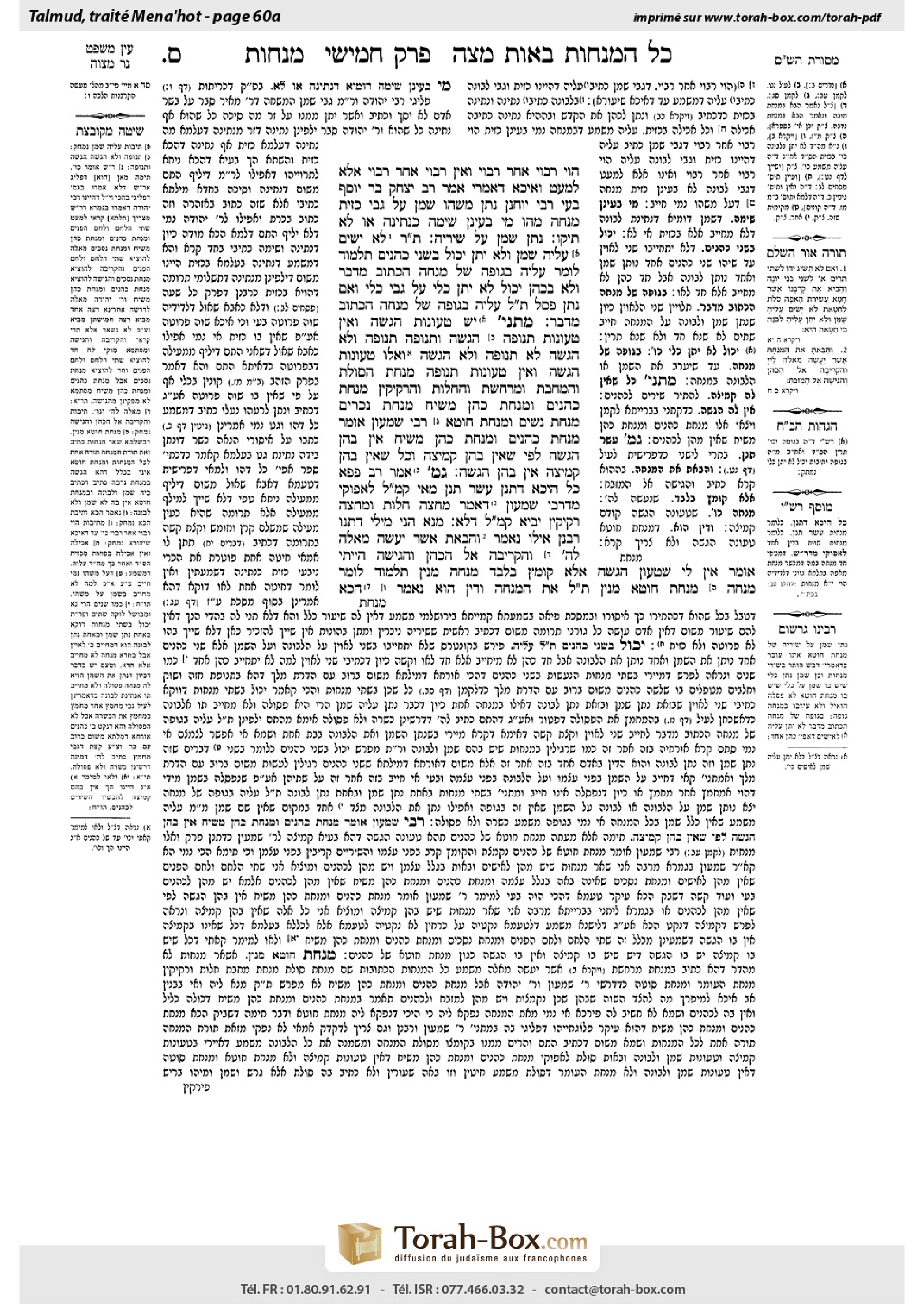
Menachot 60a: Talmud study for Daf Yomi
Daf Yomi is the daily study of one Talmud folio. Explore 37 tractates with scans, Hebrew text, Sefaria English and AI-generated French translations where annotated.
Passage selection and English or AI-generated French translation are available where the scan has annotations. Daf Study is independent of Torah-Box and Sefaria.
Browse Menachot · מנחות · All tractatesMenachot 60a text and translations
This page of Menachot includes the Aramaic text, an English translation and an AI-generated French translation, alongside the scan above.
מנחות ס׳ א · Aramaic and Hebrew text
הָוֵי רִבּוּי אַחַר רִבּוּי, וְאֵין רִבּוּי אַחַר רִבּוּי אֶלָּא לְמַעֵט.
וְאִיכָּא דְּאָמְרִי, אָמַר רַב יִצְחָק בַּר יוֹסֵף: בָּעֵי רַבִּי יוֹחָנָן: נָתַן מַשֶּׁהוּ שֶׁמֶן עַל גַּבֵּי כְּזַיִת מִנְחָה, מַהוּ? מִי בָּעֵינַן שִׂימָה כִּנְתִינָה אוֹ לָא? תֵּיקוּ.
נָתַן שֶׁמֶן עַל שְׁיָרֶיהָ, תָּנוּ רַבָּנַן: ״לֹא יָשִׂים עָלֶיהָ שֶׁמֶן וְלֹא יִתֵּן״, יָכוֹל בִּשְׁנֵי כֹּהֲנִים.
תַּלְמוּד לוֹמַר ״עָלֶיהָ״, בְּגוּפָהּ שֶׁל מִנְחָה הַכָּתוּב מְדַבֵּר, וְלֹא בְּכֹהֵן.
יָכוֹל לֹא יִתֵּן כְּלִי עַל גַּבֵּי כְּלִי, וְאִם נָתַן – פָּסַל? תַּלְמוּד לוֹמַר ״עָלֶיהָ״, בְּגוּפָהּ שֶׁל מִנְחָה הַכָּתוּב מְדַבֵּר.
מַתְנִי׳ יֵשׁ טְעוּנוֹת הַגָּשָׁה, וְאֵין טְעוּנוֹת תְּנוּפָה. הַגָּשָׁה וּתְנוּפָה. תְּנוּפָה וְלֹא הַגָּשָׁה. לֹא תְּנוּפָה וְלֹא הַגָּשָׁה.
וְאֵלּוּ טְעוּנוֹת הַגָּשָׁה וְאֵין טְעוּנוֹת תְּנוּפָה: מִנְחַת הַסּוֹלֶת, וְהַמַּחֲבַת, וּמַרְחֶשֶׁת, וְהַחַלּוֹת, וְהָרְקִיקִין, מִנְחַת כֹּהֲנִים, וּמִנְחַת כֹּהֵן מָשִׁיחַ, מִנְחַת גּוֹיִם, מִנְחַת נָשִׁים, וּמִנְחַת חוֹטֵא.
רַבִּי שִׁמְעוֹן אוֹמֵר: מִנְחַת כֹּהֲנִים וּמִנְחַת כֹּהֵן מָשִׁיחַ אֵין בָּהֶן הַגָּשָׁה, לְפִי שֶׁאֵין בָּהֶן קְמִיצָה, וְכֹל שֶׁאֵין בָּהֶן קְמִיצָה אֵין בָּהֶן הַגָּשָׁה.
גְּמָ׳ אָמַר רַב פָּפָּא: כֹּל הֵיכָא דִּתְנַן עֶשֶׂר – תְּנַן. מַאי קָא מַשְׁמַע לַן?
לְאַפּוֹקֵי מִדְּרַבִּי שִׁמְעוֹן, דְּאָמַר: מֶחֱצָה חַלּוֹת וּמֶחֱצָה רְקִיקִין יָבִיא, קָא מַשְׁמַע לַן דְּלָא.
מְנָא הָנֵי מִילֵּי? דְּתָנוּ רַבָּנַן: אִילּוּ נֶאֱמַר ״וְהֵבֵאתָ אֲשֶׁר יֵעָשֶׂה מֵאֵלֶּה לַה׳ וְהִקְרִיבָהּ אֶל הַכֹּהֵן וְהִגִּישָׁהּ״, הָיִיתִי אוֹמֵר: אֵין לִי שֶׁטָּעוּן הַגָּשָׁה אֶלָּא קוֹמֶץ בִּלְבָד.
מִנְחָה, מִנַּיִן? תַּלְמוּד לוֹמַר ״מִנְחָה״. מִנְחַת חוֹטֵא מִנַּיִן? תַּלְמוּד לוֹמַר ״אֶת הַמִּנְחָה״.
וְדִין הוּא: נֶאֱמַר הָבֵא
Menachot 60a · English translation
this is one amplificatory expression after another, one in the context of the oil and the other in the context of the frankincense. And there is a principle that one amplificatory expression after another serves only to restrict. Consequently, the placement of frankincense on any amount of a meal offering of a sinner disqualifies the meal offering.
And there are those who say there is a different version of the discussion: Rav Yitzḥak bar Yosef says that Rabbi Yoḥanan raises a dilemma: If one placed oil of any amount on top of an olive-bulk of a meal offering of a sinner, what is the halakha? The Gemara clarifies: Since the Torah states with regard to oil: “He shall place no oil upon it,” whereas with regard to frankincense it states: “Neither shall he give any frankincense upon it,” do we require that the placing of the oil must be like the giving of the frankincense, which must be an olive-bulk, or not? No answer was found, and therefore the Gemara states that the dilemma shall stand unresolved.
§ The mishna teaches: If one placed oil on the remainder of a meal offering of a sinner or a meal offering of jealousy brought by a sota, he does not violate a prohibition. Concerning this, the Sages taught in a baraita: When the verse states: “He shall place no oil upon it, neither shall he give any frankincense upon it,” one might have thought that this separation into two distinct prohibitions applies only where two priests perform these actions, one of whom places oil on the meal offering while the other puts frankincense. Perhaps in this case each of them is separately liable to receive lashes, but if one priest put both oil and frankincense on a meal offering, one might have thought he receives only one set of lashes.
Therefore, the verse states: “Upon it,” with regard to both the oil and the frankincense, which indicates that the verse is speaking of the meal offering itself, and it is not referring to the priest who performs the service. Since both prohibited actions can be performed on the same meal offering, an individual who does both is liable to receive two sets of lashes.
Furthermore, one might have thought this verse means one may not even place a vessel containing oil or frankincense on top of a vessel that contains the meal offering, and that if one placed such a vessel on the meal offering he has thereby disqualified it. Therefore, the verse states “upon it,” which indicates that the verse is speaking about the meal offering itself. One may not place oil or frankincense on the meal offering itself, but it is not prohibited to place a vessel containing oil or frankincense upon a vessel that contains the meal offering.
MISHNA: There are four categories of meal offerings: Those that require bringing near, a rite that requires the priests to carry the offering in their hands and bring it near the southwest corner of the altar, but do not require waving; those that require both bringing near and waving; those that require waving but not bringing near; and those that require neither waving nor bringing near.
The mishna elaborates: And these are the meal offerings that require bringing near but do not require waving: The fine-flour meal offering; the meal offering prepared in a pan; the meal offering prepared in a deep pan; the meal offering baked in an oven, which can be brought in the form of loaves or in the form of wafers; the meal offering of priests; the meal offering of the anointed priest; the meal offering of gentiles; a meal offering brought by women; and the meal offering of a sinner.
Rabbi Shimon says: The meal offering of priests and the meal offering of the anointed priest do not require bringing of the meal offering near to the altar, due to the fact that there is no removal of a handful in their sacrifice, and there is a principle that with regard to any meal offering where there is no removal of a handful in their sacrifice, there is also no bringing near.
GEMARA: Rav Pappa stated a principle with regard to all the mishnayot in tractate Menaḥot: Anywhere that we learned in a mishna that one brings a meal offering, we learned that one must bring ten items of the same type, either loaves or wafers. The Gemara asks: What is Rav Pappa teaching us?
The Gemara explains: This statement of Rav Pappa serves to exclude the opinion of Rabbi Shimon, who says: One who takes a vow to bring a meal offering baked in an oven must bring ten items. If he wishes he may bring ten loaves or ten wafers, and if he wishes he may bring half of them as loaves and the other half as wafers. Rav Pappa teaches us that the tanna of the mishna maintains that one may not do so; all ten must be of the same type.
§ The mishna teaches that the first tanna and Rabbi Shimon disagree about whether the meal offering of priests and the meal offering of the anointed priest require the ritual of bringing near. The Gemara asks: From where are these matters derived? The Gemara answers: As the Sages taught in a baraita: A verse discussing the meal offering prepared in the pan states: “And you shall bring the meal offering that is made of these to the Lord, and it shall be drawn near to the priest, and he shall bring it near to the altar” (Leviticus 2:8). If the verse had stated only: And you shall bring that which is made of these to the Lord and it shall be drawn near to the priest and he shall bring it near to the altar, omitting the words: The meal offering, I would say: I have derived only that the handful that is sacrificed on the altar alone requires bringing near.
From where is it derived that this halakha applies to the entire meal offering? The verse states the superfluous term: “The meal offering,” which indicates that one must bring the entire meal offering to the altar prior to the removal of the handful. The baraita further asks: From where is it derived that this halakha applies to the meal offering of a sinner? The verse states: “The meal offering.” The addition of the definite article serves to include the meal offering of a sinner.
The baraita raises a difficulty: Why is a verse necessary to teach that the requirement of bringing near applies to the meal offering of a sinner? But this halakha is capable of being derived by logical inference. The baraita elaborates: The procedure of bringing a meal offering is stated here, in the context of the meal offering of a sinner,
Menachot 60a · Traduction française (IA)
Il s’agit d’une expression amplificatrice après l’autre : l’une à propos de l’huile, l’autre à propos de l’encens. Or, selon un principe, deux expressions amplificatrices successives ne servent qu’à restreindre. Par conséquent, le dépôt d’encens, quelle qu’en soit la quantité, sur une offrande végétale d’un pécheur invalide cette offrande.
Certains rapportent une autre version de la discussion : Rav Yitzḥak bar Yosef dit que Rabbi Yoḥanan soulève une question : si l’on a déposé une quantité quelconque d’huile sur un volume d’olive d’une offrande végétale d’un pécheur, quelle est la halakha ? La Guemara précise : puisque la Torah dit au sujet de l’huile : « Il ne mettra pas d’huile dessus », tandis qu’au sujet de l’encens elle dit : « Il n’y mettra pas non plus d’encens », exige-t-on que le dépôt d’huile soit comparable à celui de l’encens, qui doit être d’un volume d’olive, ou non ? Aucune réponse n’ayant été trouvée, la Guemara conclut que la question reste sans réponse.
§ La Michna enseigne : si l’on a déposé de l’huile sur le reste d’une offrande végétale d’un pécheur ou d’une offrande végétale de jalousie apportée par une sota, on ne transgresse pas d’interdit. À ce sujet, les Sages enseignent dans une baraïta : lorsque le verset dit : « Il ne mettra pas d’huile dessus, et il n’y mettra pas non plus d’encens », on aurait pu penser que cette distinction entre deux interdits distincts ne s’applique que lorsque deux prêtres accomplissent ces actes, l’un déposant de l’huile sur l’offrande végétale et l’autre y mettant de l’encens. On aurait pu penser que, dans ce cas, chacun d’eux est passible séparément de flagellation, mais que si un seul prêtre mettait à la fois de l’huile et de l’encens sur une offrande végétale, il ne serait passible que d’une seule série de flagellations.
Le verset dit donc, à propos de l’huile comme de l’encens : « dessus », ce qui indique qu’il parle de l’offrande végétale elle-même et non du prêtre qui accomplit le rite. Puisque les deux actes interdits peuvent être accomplis sur la même offrande végétale, celui qui accomplit les deux est passible de deux séries de flagellations.
En outre, on aurait pu penser que ce verset signifie qu’il est interdit de poser même un récipient contenant de l’huile ou de l’encens sur un récipient contenant l’offrande végétale, et que, si l’on posait un tel récipient sur l’offrande végétale, celle-ci serait ainsi invalidée. Le verset dit donc : « dessus », ce qui indique qu’il parle de l’offrande végétale elle-même. Il est interdit de déposer de l’huile ou de l’encens sur l’offrande végétale elle-même, mais il n’est pas interdit de poser un récipient contenant de l’huile ou de l’encens sur un récipient qui contient l’offrande végétale.
MICHNA : Il existe quatre catégories d’offrandes végétales : celles qui exigent la présentation, rite au cours duquel les prêtres portent l’offrande dans leurs mains et l’approchent de l’angle sud-ouest de l’autel, mais qui n’exigent pas le balancement ; celles qui exigent à la fois la présentation et le balancement ; celles qui exigent le balancement, mais pas la présentation ; et celles qui n’exigent ni le balancement ni la présentation.
La Michna détaille : voici les offrandes végétales qui exigent la présentation, mais pas le balancement : l’offrande de farine fine ; l’offrande végétale préparée dans une poêle ; l’offrande végétale préparée dans une marmite profonde ; l’offrande végétale cuite au four, qui peut être apportée sous forme de pains ou de galettes ; l’offrande végétale des prêtres ; l’offrande végétale du prêtre oint ; l’offrande végétale des non-Juifs ; l’offrande végétale apportée par des femmes ; et l’offrande végétale d’un pécheur.
Rabbi Shimon dit : l’offrande végétale des prêtres et celle du prêtre oint n’exigent pas que l’offrande soit présentée à l’autel, car leur sacrifice ne comporte pas de prélèvement d’une poignée. Or, selon un principe, toute offrande végétale dont le sacrifice ne comporte pas de prélèvement d’une poignée n’exige pas non plus de présentation.
GUEMARA : Rav Pappa énonce un principe concernant toutes les Michnayot du traité Menachot : partout où une Michna enseigne que l’on apporte une offrande végétale, on apprend qu’il faut en apporter dix éléments du même type, soit des pains, soit des galettes. La Guemara demande : qu’est-ce que Rav Pappa nous enseigne ?
La Guemara explique : cette déclaration de Rav Pappa vient exclure l’opinion de Rabbi Shimon, qui dit : celui qui fait le vœu d’apporter une offrande végétale cuite au four doit en apporter dix éléments. S’il le souhaite, il peut apporter dix pains ou dix galettes ; s’il le souhaite, il peut en apporter la moitié sous forme de pains et l’autre moitié sous forme de galettes. Rav Pappa nous enseigne que le tanna de la Michna considère qu’on ne peut pas agir ainsi : les dix éléments doivent tous être du même type.
§ La Michna enseigne que le premier tanna et Rabbi Shimon sont en désaccord sur la question de savoir si l’offrande végétale des prêtres et celle du prêtre oint exigent le rite de présentation. La Guemara demande : d’où tire-t-on ces règles ? La Guemara répond : comme les Sages l’ont enseigné dans une baraïta : un verset concernant l’offrande végétale préparée dans une poêle dit : « Tu apporteras au Seigneur l’offrande végétale faite de ces choses, elle sera présentée au prêtre, et celui-ci l’approchera de l’autel » (Lévitique 2, 8). Si le verset avait seulement dit : « Tu apporteras au Seigneur ce qui est fait de ces choses, cela sera présenté au prêtre, et celui-ci l’approchera de l’autel », sans les mots « l’offrande végétale », j’aurais dit que j’avais appris seulement que la poignée sacrifiée sur l’autel exige la présentation.
D’où apprend-on que cette halakha s’applique à l’offrande végétale entière ? Le verset emploie le terme superflu « l’offrande végétale », ce qui indique qu’il faut présenter toute l’offrande végétale à l’autel avant le prélèvement de la poignée. La baraïta demande en outre : d’où apprend-on que cette halakha s’applique à l’offrande végétale d’un pécheur ? Le verset dit : « l’offrande végétale ». L’ajout de l’article défini sert à inclure l’offrande végétale d’un pécheur.
La baraïta soulève une difficulté : pourquoi faut-il un verset pour enseigner que l’obligation de présentation s’applique à l’offrande végétale d’un pécheur ? Cette halakha ne peut-elle pas être déduite par raisonnement logique ? La baraïta détaille : la procédure de présentation d’une offrande végétale est énoncée ici, dans le contexte de l’offrande végétale d’un pécheur,
Traduction française générée par IA à partir de l’édition anglaise de Sefaria. Vérifie toujours un passage avec le texte source.
Text from Sefaria: William Davidson Edition - Vocalized Aramaic (unknown); William Davidson Edition - English (CC BY NC).