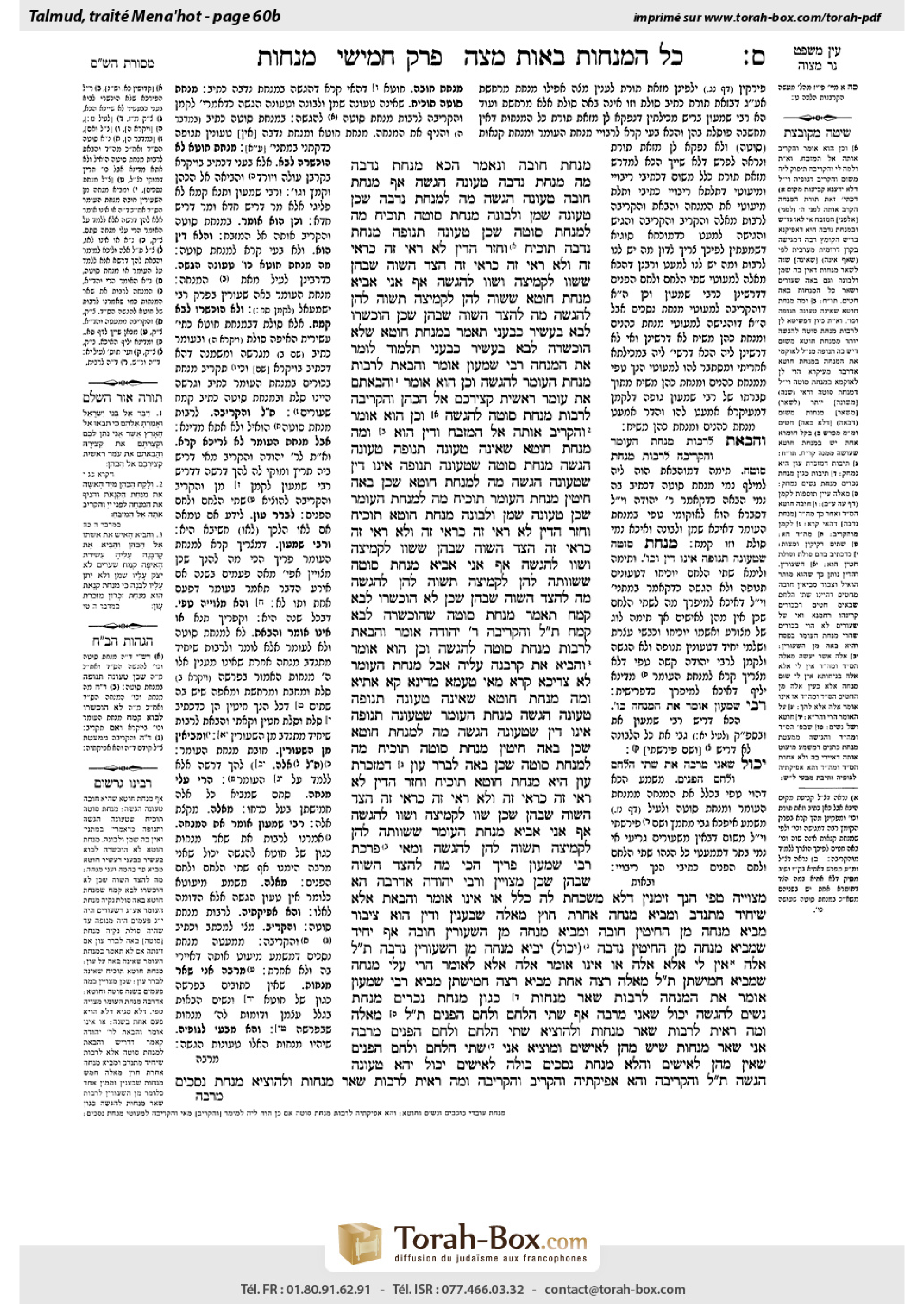
Menachot 60b: Talmud study for Daf Yomi
Daf Yomi is the daily study of one Talmud folio. Explore 37 tractates with scans, Hebrew text, Sefaria English and AI-generated French translations where annotated.
Passage selection and English or AI-generated French translation are available where the scan has annotations. Daf Study is independent of Torah-Box and Sefaria.
Browse Menachot · מנחות · All tractatesMenachot 60b text and translations
This page of Menachot includes the Aramaic text, an English translation and an AI-generated French translation, alongside the scan above.
מנחות ס׳ ב · Aramaic and Hebrew text
מִנְחַת חוֹבָה, וְנֶאֱמַר הָבֵא מִנְחַת נְדָבָה. מָה מִנְחַת נְדָבָה טְעוּנָה הַגָּשָׁה – אַף מִנְחַת חוֹבָה טְעוּנָה הַגָּשָׁה!
מָה לְמִנְחַת נְדָבָה, שֶׁכֵּן טְעוּנָה שֶׁמֶן וּלְבוֹנָה? מִנְחַת סוֹטָה תּוֹכִיחַ!
מָה לְמִנְחַת סוֹטָה שֶׁכֵּן טְעוּנָה תְּנוּפָה? מִנְחַת נְדָבָה תּוֹכִיחַ.
וְחָזַר הַדִּין, לֹא רְאִי זֶה כִרְאִי זֶה, וְלֹא רְאִי זֶה כִּרְאִי זֶה. הַצַּד הַשָּׁוֶה שֶׁבָּהֶן – שֶׁשָּׁווּ לִקְמִיצָה, וְשָׁווּ לְהַגָּשָׁה. אַף אֲנִי אָבִיא מִנְחַת חוֹטֵא שֶׁשָּׁוָה לָהֶן לִקְמִיצָה, תַּשְׁוֶה לָהֶן לְהַגָּשָׁה!
מָה לְהַצַּד הַשָּׁוֶה שֶׁבָּהֶן, שֶׁכֵּן הוּכְשְׁרוּ לָבֹא בְּעָשִׁיר כִּבְעָנִי, תֹּאמַר בְּמִנְחַת חוֹטֵא שֶׁלֹּא הוּכְשְׁרָה לָבֹא בְּעָשִׁיר כִּבְעָנִי? תַּלְמוּד לוֹמַר ״אֶת הַמִּנְחָה״.
רַבִּי שִׁמְעוֹן אוֹמֵר: ״וְהֵבֵאתָ״ – לְרַבּוֹת מִנְחַת הָעוֹמֶר לְהַגָּשָׁה, וְכֵן הוּא אוֹמֵר: ״וַהֲבֵאתֶם אֶת עֹמֶר רֵאשִׁית קְצִירְכֶם אֶל הַכֹּהֵן״, ״וְהִקְרִיבָהּ״ – לְרַבּוֹת מִנְחַת סוֹטָה לְהַגָּשָׁה, וְכֵן הוּא אוֹמֵר: ״וְהִקְרִיב אֹתָהּ אֶל הַמִּזְבֵּחַ״.
וְדִין הוּא: וּמָה מִנְחַת חוֹטֵא, שֶׁאֵינָהּ טְעוּנָה תְּנוּפָה – טְעוּנָה הַגָּשָׁה, מִנְחַת סוֹטָה, שֶׁטְּעוּנָה תְּנוּפָה – אֵינוֹ דִּין שֶׁטְּעוּנָה הַגָּשָׁה! מָה לְמִנְחַת חוֹטֵא, שֶׁכֵּן בָּאָה חִיטִּין!
מִנְחַת הָעוֹמֶר תּוֹכִיחַ. מָה לְמִנְחַת הָעוֹמֶר, שֶׁכֵּן טְעוּנָה שֶׁמֶן וּלְבוֹנָה? מִנְחַת חוֹטֵא תּוֹכִיחַ.
וְחָזַר הַדִּין, לֹא רְאִי זֶה כִּרְאִי זֶה, וְלֹא רְאִי זֶה כִּרְאִי זֶה. הַצַּד הַשָּׁוֶה שֶׁבָּהֶן, שֶׁשָּׁווּ לִקְמִיצָה וְשָׁווּ לְהַגָּשָׁה, אַף אֲנִי אָבִיא מִנְחַת סוֹטָה שֶׁשָּׁוְותָה לָהֶן לִקְמִיצָה – תִּשְׁוֶה לָהֶן לְהַגָּשָׁה!
מָה לְהַצַּד הַשָּׁוֶה שֶׁבָּהֶן, שֶׁכֵּן לֹא הוּכְשְׁרוּ לָבֹא קֶמַח, תֹּאמַר מִנְחַת סוֹטָה שֶׁהוּכְשְׁרָה לָבֹא קֶמַח? תַּלְמוּד לוֹמַר ״וְהִקְרִיבָהּ״.
רַבִּי יְהוּדָה אוֹמֵר: ״וְהֵבֵאתָ״ – לְרַבּוֹת מִנְחַת סוֹטָה לְהַגָּשָׁה, וְכֵן הוּא אוֹמֵר: ״וְהֵבִיא אֶת קׇרְבָּנָהּ עָלֶיהָ״.
אֲבָל מִנְחַת הָעוֹמֶר לָא צְרִיכָא קְרָא, מַאי טַעְמָא? מִדִּינָא קָא אָתְיָא: וּמָה מִנְחַת חוֹטֵא שֶׁאֵינָהּ טְעוּנָה תְּנוּפָה – טְעוּנָה הַגָּשָׁה, מִנְחַת הָעוֹמֶר שֶׁטְּעוּנָה תְּנוּפָה – אֵינוֹ דִּין שֶׁטְּעוּנָה הַגָּשָׁה!
מָה לְמִנְחַת חוֹטֵא שֶׁכֵּן בָּאָה חִיטִּין? מִנְחַת סוֹטָה תּוֹכִיחַ. מָה לְמִנְחַת סוֹטָה שֶׁכֵּן בָּאָה לְבָרֵר עָוֹן, דְּ״מַזְכֶּרֶת עָוֹן״ הִיא! מִנְחַת חוֹטֵא תּוֹכִיחַ.
וְחָזַר הַדִּין, לֹא רְאִי זֶה כִרְאִי זֶה, וְלֹא רְאִי זֶה כִּרְאִי זֶה, הַצַּד הַשָּׁוֶה שֶׁבָּהֶן, שֶׁכֵּן שָׁווּ לִקְמִיצָה, וְשָׁווּ לְהַגָּשָׁה, אַף אֲנִי אָבִיא מִנְחַת הָעוֹמֶר שֶׁשָּׁוְותָה לָהֶן לִקְמִיצָה, תִּשְׁוֶה לָהֶן לְהַגָּשָׁה.
וּמַאי פָּרְכַתְּ? רַבִּי שִׁמְעוֹן פָּרֵיךְ הָכִי: מָה לְהַצַּד הַשָּׁוֶה שֶׁבָּהֶן, שֶׁכֵּן מְצוּיִין.
וְרַבִּי יְהוּדָה, אַדְּרַבָּה, הָא מְצוּיָיה טְפֵי, הָנָךְ זִימְנִין דְּלָא מַשְׁכַּחַתְּ לַהּ כְּלָל.
אוֹ אֵינוֹ אוֹמֵר ״וְהֵבֵאתָ״ אֶלָּא שֶׁיָּחִיד מִתְנַדֵּב וּמֵבִיא מִנְחָה אַחֶרֶת, חוּץ מֵאֵלֶּה שֶׁבָּעִנְיָן.
וְדִין הוּא: צִיבּוּר מֵבִיא מִנְחָה מִן הַחִיטִּין חוֹבָה, וּמֵבִיא מִנְחָה מִן הַשְּׂעוֹרִין חוֹבָה, אַף יָחִיד שֶׁמֵּבִיא מִנְחָה מִן הַחִיטִּין נְדָבָה – יָכוֹל יָבִיא מִנְחָה מִן הַשְּׂעוֹרִין נְדָבָה? תַּלְמוּד לוֹמַר ״אֵלֶּה״ – אֵין לִי אֶלָּא אֵלֶּה.
אוֹ אֵינוֹ אוֹמֵר ״אֵלֶּה״ אֶלָּא לָאוֹמֵר ״הֲרֵי עָלַי מִנְחָה״, שֶׁמֵּבִיא חֲמִישְׁתָּן? תַּלְמוּד לוֹמַר ״מֵאֵלֶּה״ – רָצָה אַחַת מֵבִיא, רָצָה חֲמִישְׁתָּן מֵבִיא.
רַבִּי שִׁמְעוֹן אוֹמֵר: ״אֶת הַמִּנְחָה״ – לְרַבּוֹת שְׁאָר מְנָחוֹת, כְּגוֹן מִנְחַת גּוֹיִם מִנְחַת נָשִׁים, לְהַגָּשָׁה. יָכוֹל שֶׁאֲנִי מְרַבֶּה אַף שְׁתֵּי הַלֶּחֶם וְלֶחֶם הַפָּנִים? תַּלְמוּד לוֹמַר ״מֵאֵלֶּה״.
וּמָה רָאִיתָ לְרַבּוֹת שְׁאָר מְנָחוֹת, וּלְהוֹצִיא שְׁתֵּי הַלֶּחֶם וְלֶחֶם הַפָּנִים? מְרַבֶּה אֲנִי שְׁאָר מְנָחוֹת, שֶׁיֵּשׁ מֵהֶן לָאִישִּׁים, וּמוֹצִיא אֲנִי שְׁתֵּי הַלֶּחֶם וְלֶחֶם הַפָּנִים, שֶׁאֵין מֵהֶן לָאִישִּׁים.
וַהֲלֹא מִנְחַת נְסָכִים כּוּלָּהּ לָאִישִּׁים, יָכוֹל (יְהֵא) [תְּהֵא] טְעוּנָה הַגָּשָׁה? תַּלְמוּד לוֹמַר ״וְהִקְרִיבָהּ״.
וְהָא אַפֵּיקְתֵּיהּ ״וְהִקְרִיב״ ״וְהִקְרִיבָהּ״, וּמָה רָאִיתָ לְרַבּוֹת שְׁאָר מְנָחוֹת וּלְהוֹצִיא מִנְחַת נְסָכִים?
Menachot 60b · English translation
which is an obligatory meal offering; and it is stated there, with regard to the deep-pan meal offering, which is a voluntary meal offering. Just as a voluntary meal offering requires bringing near, so too an obligatory meal offering, such as the meal offering of a sinner, requires bringing near.
The baraita rejects this inference: What is notable about a voluntary meal offering? It is notable in that it requires oil and frankincense upon it, rendering its halakha more stringent than that of the meal offering of a sinner, which does not include oil and frankincense. Therefore, it would be logical to suggest that a voluntary meal offering requires bringing near but the meal offering of a sinner does not. The baraita responds: The meal offering brought by a sota, i.e., the meal offering of jealousy, can prove that this factor is not decisive, as it does not include oil and frankincense either, and yet it requires bringing near.
The baraita rejects this claim: One cannot derive the halakha of the meal offering of a sinner from the meal offering brought by a sota, as there is another requirement that applies to the meal offering brought by a sota but not to the meal offering of a sinner: What is notable about the meal offering brought by a sota? It is notable in that it requires waving, whereas the meal offering of a sinner does not. The baraita responds: The voluntary meal offering can prove that waving is not the decisive factor, as a voluntary meal offering does not require waving and yet it requires bringing near.
Therefore, the inference has reverted to its starting point, as the aspect of this case is not like the aspect of that case and the aspect of that case is not like the aspect of this case; their common element is that the voluntary meal offering and the meal offering brought by a sota are equal with regard to the requirement of the removal of a handful, and similarly they are equal with regard to the requirement of bringing near. I will also bring the additional case of the meal offering of a sinner, which is equal to them with regard to the requirement of the removal of a handful, and conclude that it should likewise be equal to them with regard to the requirement of bringing near.
The baraita rejects this suggestion: What is notable about the common element of the voluntary meal offering and the meal offering brought by a sota? It is notable in that they are suited to come as the meal offering of a wealthy person just as they are suited to come as the meal offering of a poor person. Shall you say the same with regard to the meal offering of a sinner, which is not suitable to come either as the meal offering of a wealthy person or as the meal offering of a poor person, since a sinner who is not poor does not bring a meal offering but a different offering (see Leviticus 5:6–11)? Therefore, the verse states: “The meal offering” (Leviticus 2:8), with the addition of the definite article, to include the meal offering of a sinner in the requirement of bringing near.
Rabbi Shimon adds to the logical inference and says that other cases are included in the derivation from the verse, as the term “and you shall bring” serves to include the omer meal offering in the requirement of bringing near to the altar; and so the verse states with regard to the omer meal offering: “Then you shall bring the omer, the first of your harvest to the priest” (Leviticus 23:10). Furthermore, “and it shall be drawn near” serves to include the meal offering brought by a sota in the requirement of bringing near; and so the verse states with regard to the meal offering brought by a sota: “And draw it near to the altar” (Numbers 5:25).
The baraita challenges: But this halakha is capable of being derived a fortiori by logical inference: And if the meal offering of a sinner, which includes a lenient aspect, as it does not require waving, nevertheless requires bringing near, then with regard to the meal offering brought by a sota, which does require waving, is it not logical to conclude that it should require bringing near? The baraita rejects this logical inference, as there is a stringency that applies to the meal offering of a sinner which does not apply to the meal offering brought by a sota: What is notable about the meal offering of a sinner? It is notable in that it comes from wheat, whereas the meal offering brought by a sota comes from barley, an inferior product.
The baraita responds: The omer meal offering can prove that this factor is not decisive, as it also comes from barley, and yet it requires bringing near. Therefore, the same should apply to the meal offering brought by a sota. The baraita rejects this claim: What is notable about the omer meal offering? It is notable in that it requires oil and frankincense, whereas the meal offering brought by a sota does not. The baraita answers: The meal offering of a sinner can prove that the requirement of oil and frankincense is not a decisive factor, as the meal offering of a sinner does not require oil and frankincense and yet it requires bringing near.
Consequently, the inference has reverted to its starting point, as the aspect of this case is not like the aspect of that case and the aspect of that case is not like the aspect of this case; their common element is that both the omer meal offering and the meal offering of a sinner are equal with regard to the requirement of the removal of a handful, and they are equal with regard to the requirement of bringing near. I will also bring the additional case of the meal offering brought by a sota, which is equal to them with regard to the requirement of the removal of a handful, and conclude that it should likewise be equal to them with regard to the requirement of bringing near.
The baraita rejects this suggestion: What is notable about the common element of the omer meal offering and the meal offering of a sinner? It is notable in that they are both not suited to come as coarse flour, but only as fine flour. Shall you say the same with regard to the meal offering brought by a sota, which is suited to come as coarse flour? Therefore, the verse states: “And draw it near,” which serves to include the meal offering brought by a sota in the requirement of bringing near.
It was stated that Rabbi Shimon derives from the term “and you shall bring” (Leviticus 2:8), written in the context of the deep-pan meal offering, that the omer meal offering is included in the requirement of bringing near. Conversely, Rabbi Yehuda says: The term “and you shall bring” serves to include the meal offering brought by a sota in the requirement of bringing near; and so the verse states with regard to the meal offering brought by a sota: “Then the man shall bring his wife to the priest, and shall bring her offering for her, a tenth of an ephah of barley flour; he shall pour no oil upon it, nor give frankincense upon it, for it is a meal offering of jealousy, a meal offering of memorial, bringing iniquity to remembrance” (Numbers 5:15).
But with regard to the omer meal offering, a verse is not needed to teach that it requires bringing near. The baraita asks: What is the reason that no verse is needed for the omer meal offering? It is because this halakha is derived a fortiori by logical inference: And if the meal offering of a sinner, which includes a lenient aspect, as it does not require waving, nevertheless requires bringing near, then with regard to the omer meal offering, which includes a stringent aspect, as it does require waving, is it not logical to conclude that it should require bringing near?
The baraita rejects this inference: What is notable about the meal offering of a sinner? It is notable in that it comes from wheat, whereas the omer meal offering comes from barley. The baraita responds: The meal offering brought by a sota can prove that this factor is not decisive, as it comes from barley and yet it requires bringing near. The same should apply to the omer meal offering. The baraita rejects this claim: What is notable about the meal offering brought by a sota? It is notable in that it comes to clarify whether or not the wife committed the transgression of adultery, as it is described with the phrase: “Bringing iniquity to remembrance,” whereas the omer meal offering does not come to clarify whether or not one transgressed. The baraita answers: The meal offering of a sinner can prove otherwise, as it does not come to clarify transgression and yet it requires bringing near.
Therefore, the inference has reverted to its starting point, as the aspect of this case is not like the aspect of that case and the aspect of that case is not like the aspect of this case; their common element is that both the meal offering brought by a sota and the meal offering of a sinner are equal with regard to the requirement of the removal of a handful, and they are equal with regard to the requirement of bringing near. I will also bring the additional case of the omer meal offering, which is equal to them with regard to the requirement of the removal of a handful, and conclude that it should likewise be equal to them with regard to the requirement of bringing near. In this manner the requirement of bringing the omer meal offering near to the altar is derived jointly from the meal offering brought by a sota and the meal offering of a sinner.
The Gemara asks: And how would you refute this logical inference? In other words, there is no refutation of this claim, and it is therefore unclear why it was necessary for Rabbi Shimon to derive the requirement of bringing near concerning the omer meal offering from the term: “And you shall bring.” The Gemara answers: Rabbi Shimon refutes the claim in this manner: What is notable about the common element of the meal offering brought by a sota and the meal offering of a sinner? It is notable in that they are common offerings, i.e., they can be brought many times over the course of a year, whereas the omer offering is sacrificed only once a year.
The Gemara asks: And how does Rabbi Yehuda respond to this claim? He maintains that this is not a valid refutation, as on the contrary, this omer meal offering is more common than the meal offering brought by a sota and the meal offering of a sinner. The omer meal offering is definitely brought once a year, whereas in the case of these offerings, there may be times when you do not find it at all, if no poor sinners come forward and no women are accused of adultery by their husbands.
The Gemara cites a baraita: Or perhaps when the verse states: “And you shall bring,” this does not serve to teach about the requirement of bringing near but rather is written for a different reason: To indicate that an individual Jew may donate and bring a different kind of meal offering, one made from barley, apart from these five meal offerings, all made from wheat, which the verse mentions with regard to this matter (see Leviticus 2:1–13). The five offerings are the fine-flour meal offering, the meal offering prepared in the pan, the meal offering prepared in the deep pan, and the meal offering baked in the oven, either in the form of loaves or in the form of wafers.
And this halakha is necessary because the opposite conclusion could otherwise have been derived by logical inference based on juxtaposition: The community brings an obligatory meal offering from wheat, i.e., the two loaves brought on the festival of Shavuot, and the community also brings an obligatory meal offering from barley, the omer meal offering. So too an individual, who brings a meal offering from wheat as a voluntary gift offering, can likewise bring a meal offering from barley as a voluntary gift offering. Therefore, to prevent this inference, the verse states: “And you shall bring the meal offering that is made of these to the Lord” (Leviticus 2:8), which teaches: I have nothing other than these five meal offerings as individual meal offerings.
The baraita raises a difficulty: Or perhaps the verse states “these” not in order to exclude other individual meal offerings but rather to teach a halakha with regard to one who takes a vow to bring a meal offering and says: It is incumbent upon me to bring a meal offering, without specifying a particular type of meal offering, and it teaches that he must bring all five of them. The baraita explains: The verse states: “Of these,” which indicates that if the one who took a vow wants, he brings one meal offering, and if he wants, he brings all five of them.
The baraita continues: Rabbi Shimon says: When the verse states: “The meal offering” (Leviticus 2:8), this serves to include the other meal offerings, for example the meal offering of gentiles and a meal offering brought by women, with regard to the requirement of bringing near. One might have thought that I should include from this verse even the two loaves and the shewbread. Therefore, the verse states: “Of these,” which indicates that not all meal offerings are included in the requirement of bringing near.
The baraita asks: And what did you see that led you to include the other meal offerings in the requirement of bringing near, and to exclude the two loaves and the shewbread from this halakha? One could suggest the opposite conclusion, to include these two offerings while excluding the others. The baraita answers: I include the other meal offerings, as there is a portion of them burned in the fire on the altar, and I exclude the two loaves and the shewbread from the requirement of bringing near, as there is no portion of them burned in the fire on the altar. Rather, they are eaten by the priests in their entirety.
The baraita asks: But with regard to the meal offering brought with libations, which is entirely burned in the fire, by this logic one might have thought that it should require bringing near. The baraita answers: The verse states: “And you shall bring the meal offering that is made of these to the Lord, and it shall be drawn near to the priest, and he shall bring it near to the altar” (Leviticus 2:8). This indicates that the requirement of bringing near applies only to those meal offerings listed in this chapter, not to the meal offering brought with libations, which is not mentioned.
The baraita asks: But didn’t you already derive from the term: “And it shall be drawn near,” that the meal offering brought by a sota is included in the requirement of bringing near? The baraita answers: As the verse could have stated: And shall be drawn near, and instead it states: “And it shall be drawn near,” this addition serves to exclude the meal offering brought with libations from the requirement of bringing near. The baraita asks: And what did you see that led you to include the other meal offerings in the requirement of bringing near and to exclude the meal offering brought with libations from this requirement?
Menachot 60b · Traduction française (IA)
qui est une offrande végétale obligatoire ; et il est dit là, au sujet de l’offrande végétale préparée dans une poêle profonde, qui est une offrande végétale volontaire. De même qu’une offrande végétale volontaire doit être présentée, de même une offrande végétale obligatoire, telle que l’offrande végétale d’un pécheur, doit être présentée.
La baraïta rejette cette déduction : Qu’y a-t-il de remarquable dans une offrande végétale volontaire ? Elle se distingue par le fait qu’elle requiert de l’huile et de l’encens, ce qui rend sa halakha plus rigoureuse que celle de l’offrande végétale d’un pécheur, qui ne comporte ni huile ni encens. On pourrait donc logiquement suggérer qu’une offrande végétale volontaire doit être présentée, mais que l’offrande végétale d’un pécheur n’a pas à l’être. La baraïta répond : L’offrande végétale apportée par une sota prouve que ce facteur n’est pas déterminant, car elle non plus ne comporte ni huile ni encens, et pourtant elle doit être présentée.
La baraïta rejette cette affirmation : On ne peut déduire la halakha de l’offrande végétale d’un pécheur de celle de l’offrande végétale apportée par une sota, car une autre exigence s’applique à l’offrande de la sota, mais pas à celle d’un pécheur : qu’y a-t-il de remarquable dans l’offrande végétale apportée par une sota ? Elle se distingue par le fait qu’elle requiert le balancement, contrairement à l’offrande végétale d’un pécheur. La baraïta répond : L’offrande végétale volontaire prouve que le balancement n’est pas le facteur déterminant, car elle ne requiert pas le balancement et doit pourtant être présentée.
La déduction revient donc à son point de départ, car l’aspect de ce cas n’est pas semblable à celui de l’autre, et l’aspect de l’autre n’est pas semblable à celui de ce cas ; leur point commun est que l’offrande végétale volontaire et l’offrande végétale apportée par une sota sont semblables en ce qui concerne l’obligation de prélever une poignée, et qu’elles le sont également en ce qui concerne l’obligation d’être présentées. J’ajouterai aussi le cas de l’offrande végétale d’un pécheur, qui leur est semblable en ce qui concerne l’obligation de prélever une poignée, et j’en conclurai qu’elle doit également leur être semblable en ce qui concerne l’obligation d’être présentée.
La baraïta rejette cette suggestion : Qu’y a-t-il de remarquable dans le point commun entre l’offrande végétale volontaire et celle apportée par une sota ? Elles se distinguent par le fait qu’elles peuvent être apportées aussi bien comme offrande végétale d’un riche que comme offrande végétale d’un pauvre. En diriez-vous autant de l’offrande végétale d’un pécheur, qui ne peut être apportée ni comme offrande végétale d’un riche ni comme offrande végétale d’un pauvre, puisqu’un pécheur qui n’est pas pauvre n’apporte pas d’offrande végétale, mais une autre offrande (voir Lévitique 5:6–11) ? C’est pourquoi le verset dit : « L’offrande végétale » (Lévitique 2:8), avec l’article défini, afin d’inclure l’offrande végétale d’un pécheur dans l’obligation d’être présentée.
Rabbi Shimon ajoute d’autres cas à cette déduction logique et dit qu’ils sont inclus dans la dérivation tirée du verset, car l’expression « et tu apporteras » sert à inclure l’offrande végétale de l’omer dans l’obligation d’être présentée à l’autel ; le verset dit ainsi, au sujet de l’offrande végétale de l’omer : « Alors tu apporteras l’omer, prémices de ta récolte, au prêtre » (Lévitique 23:10). De plus, l’expression « et elle sera présentée » sert à inclure l’offrande végétale apportée par une sota dans l’obligation d’être présentée ; le verset dit ainsi, au sujet de l’offrande végétale de la sota : « Et présente-la à l’autel » (Nombres 5:25).
La baraïta objecte : Mais cette halakha peut être déduite a fortiori par raisonnement logique : si l’offrande végétale d’un pécheur, qui comporte un aspect moins rigoureux puisqu’elle ne requiert pas le balancement, doit néanmoins être présentée, alors, pour l’offrande végétale apportée par une sota, qui requiert le balancement, n’est-il pas logique de conclure qu’elle doit être présentée ? La baraïta rejette ce raisonnement, car l’offrande végétale d’un pécheur comporte un aspect plus rigoureux qui ne s’applique pas à celle apportée par une sota : qu’y a-t-il de remarquable dans l’offrande végétale d’un pécheur ? Elle se distingue par le fait qu’elle est faite de blé, tandis que l’offrande végétale de la sota est faite d’orge, un produit de qualité inférieure.
La baraïta répond : L’offrande végétale de l’omer prouve que ce facteur n’est pas déterminant, car elle aussi est faite d’orge et doit pourtant être présentée. Il devrait donc en être de même pour l’offrande végétale apportée par une sota. La baraïta rejette cette affirmation : Qu’y a-t-il de remarquable dans l’offrande végétale de l’omer ? Elle se distingue par le fait qu’elle requiert de l’huile et de l’encens, contrairement à l’offrande végétale apportée par une sota. La baraïta répond : L’offrande végétale d’un pécheur prouve que l’obligation d’apporter de l’huile et de l’encens n’est pas déterminante, car elle ne requiert ni huile ni encens et doit pourtant être présentée.
La déduction revient donc à son point de départ, car l’aspect de ce cas n’est pas semblable à celui de l’autre, et l’aspect de l’autre n’est pas semblable à celui de ce cas ; leur point commun est que l’offrande végétale de l’omer et celle d’un pécheur sont toutes deux semblables en ce qui concerne l’obligation de prélever une poignée, et qu’elles le sont également en ce qui concerne l’obligation d’être présentées. J’ajouterai aussi le cas de l’offrande végétale apportée par une sota, qui leur est semblable en ce qui concerne l’obligation de prélever une poignée, et j’en conclurai qu’elle doit également leur être semblable en ce qui concerne l’obligation d’être présentée.
La baraïta rejette cette suggestion : Qu’y a-t-il de remarquable dans le point commun entre l’offrande végétale de l’omer et celle d’un pécheur ? Elles se distinguent par le fait qu’elles ne peuvent être apportées sous forme de farine grossière, mais seulement sous forme de farine fine. En diriez-vous autant de l’offrande végétale apportée par une sota, qui peut être apportée sous forme de farine grossière ? C’est pourquoi le verset dit : « Et présente-la », ce qui sert à inclure l’offrande végétale de la sota dans l’obligation d’être présentée.
Il a été enseigné que Rabbi Shimon déduit de l’expression « et tu apporteras » (Lévitique 2:8), écrite au sujet de l’offrande végétale préparée dans une poêle profonde, que l’offrande végétale de l’omer est incluse dans l’obligation d’être présentée. À l’inverse, Rabbi Yehuda dit : L’expression « et tu apporteras » sert à inclure l’offrande végétale apportée par une sota dans l’obligation d’être présentée ; le verset dit ainsi, au sujet de l’offrande végétale de la sota : « Alors l’homme amènera sa femme au prêtre et apportera pour elle son offrande, un dixième d’épha de farine d’orge ; il ne versera pas d’huile dessus et n’y mettra pas d’encens, car c’est une offrande végétale de jalousie, une offrande végétale de souvenir, qui rappelle l’iniquité » (Nombres 5:15).
Mais, pour l’offrande végétale de l’omer, aucun verset n’est nécessaire pour enseigner qu’elle doit être présentée. La baraïta demande : Pourquoi aucun verset n’est-il nécessaire pour l’offrande végétale de l’omer ? Parce que cette halakha se déduit a fortiori par raisonnement logique : si l’offrande végétale d’un pécheur, qui comporte un aspect moins rigoureux puisqu’elle ne requiert pas le balancement, doit néanmoins être présentée, alors, pour l’offrande végétale de l’omer, qui comporte un aspect plus rigoureux puisqu’elle requiert le balancement, n’est-il pas logique de conclure qu’elle doit être présentée ?
La baraïta rejette cette déduction : Qu’y a-t-il de remarquable dans l’offrande végétale d’un pécheur ? Elle se distingue par le fait qu’elle est faite de blé, tandis que l’offrande végétale de l’omer est faite d’orge. La baraïta répond : L’offrande végétale apportée par une sota prouve que ce facteur n’est pas déterminant, car elle est faite d’orge et doit pourtant être présentée. Il devrait en être de même pour l’offrande végétale de l’omer. La baraïta rejette cette affirmation : Qu’y a-t-il de remarquable dans l’offrande végétale apportée par une sota ? Elle se distingue par le fait qu’elle sert à déterminer si l’épouse a commis ou non la faute d’adultère, comme l’indique l’expression : « qui rappelle l’iniquité », tandis que l’offrande végétale de l’omer ne sert pas à déterminer si quelqu’un a transgressé ou non. La baraïta répond : L’offrande végétale d’un pécheur prouve le contraire, car elle ne sert pas à déterminer si une transgression a été commise et doit pourtant être présentée.
La déduction revient donc à son point de départ, car l’aspect de ce cas n’est pas semblable à celui de l’autre, et l’aspect de l’autre n’est pas semblable à celui de ce cas ; leur point commun est que l’offrande végétale apportée par une sota et celle d’un pécheur sont toutes deux semblables en ce qui concerne l’obligation de prélever une poignée, et qu’elles le sont également en ce qui concerne l’obligation d’être présentées. J’ajouterai aussi le cas de l’offrande végétale de l’omer, qui leur est semblable en ce qui concerne l’obligation de prélever une poignée, et j’en conclurai qu’elle doit également leur être semblable en ce qui concerne l’obligation d’être présentée. Ainsi, l’obligation de présenter l’offrande végétale de l’omer à l’autel se déduit conjointement de l’offrande végétale apportée par une sota et de celle d’un pécheur.
La Guemara demande : Et comment réfuteriez-vous ce raisonnement logique ? Autrement dit, il n’y a aucune réfutation possible de cette affirmation ; on ne comprend donc pas pourquoi Rabbi Shimon devait déduire l’obligation de présenter l’offrande végétale de l’omer de l’expression « et tu apporteras ». La Guemara répond : Rabbi Shimon réfute l’affirmation de la manière suivante : Qu’y a-t-il de remarquable dans le point commun entre l’offrande végétale apportée par une sota et celle d’un pécheur ? Elles se distinguent par le fait qu’il s’agit d’offrandes courantes, c’est-à-dire qu’elles peuvent être apportées de nombreuses fois au cours d’une année, tandis que l’offrande de l’omer n’est apportée qu’une fois par an.
La Guemara demande : Et comment Rabbi Yehuda répond-il à cette affirmation ? Il estime que ce n’est pas une réfutation valable, car, au contraire, l’offrande végétale de l’omer est plus courante que celle apportée par une sota et celle d’un pécheur. L’offrande végétale de l’omer est assurément apportée une fois par an, tandis que, pour ces autres offrandes, il peut arriver qu’on n’en trouve aucune, si aucun pécheur pauvre ne se présente et si aucun mari n’accuse sa femme d’adultère.
La Guemara cite une baraïta : Ou peut-être que, lorsque le verset dit « et tu apporteras », cette expression ne sert pas à enseigner l’obligation d’être présentée, mais répond à une autre raison : indiquer qu’un particulier peut offrir et apporter une autre sorte d’offrande végétale, faite d’orge, en plus de ces cinq offrandes végétales, toutes faites de blé, que le verset mentionne à ce sujet (voir Lévitique 2:1–13). Ces cinq offrandes sont l’offrande végétale de farine fine, celle préparée dans une poêle, celle préparée dans une poêle profonde et celle cuite au four, sous forme de pains ou de galettes.
Cette halakha est nécessaire, car on aurait autrement pu déduire la conclusion opposée par raisonnement logique fondé sur le rapprochement des textes : la communauté apporte une offrande végétale obligatoire faite de blé, à savoir les deux pains apportés lors de la fête de Chavouot, et elle apporte également une offrande végétale obligatoire faite d’orge, l’offrande végétale de l’omer. De même, un particulier qui apporte une offrande végétale de blé comme don volontaire peut également apporter une offrande végétale d’orge comme don volontaire. Pour empêcher cette déduction, le verset dit : « Et tu apporteras au Seigneur l’offrande végétale préparée de ces façons » (Lévitique 2:8), ce qui enseigne : Je n’ai que ces cinq offrandes végétales comme offrandes végétales individuelles.
La baraïta soulève une difficulté : Ou peut-être le verset dit-il « ces » non pas pour exclure d’autres offrandes végétales individuelles, mais pour enseigner une halakha au sujet de celui qui fait vœu d’apporter une offrande végétale et dit : « Je suis tenu d’apporter une offrande végétale », sans préciser de type particulier ; il lui enseigne alors qu’il doit apporter les cinq. La baraïta explique : Le verset dit « de ces », ce qui indique que celui qui a fait le vœu peut, s’il le souhaite, apporter une seule offrande végétale ou, s’il le souhaite, les apporter toutes les cinq.
La baraïta poursuit : Rabbi Shimon dit : Lorsque le verset dit « l’offrande végétale » (Lévitique 2:8), cela sert à inclure les autres offrandes végétales, par exemple celle des non-Juifs et celle apportée par les femmes, dans l’obligation d’être présentées. On aurait pu penser que ce verset inclut aussi les deux pains et le pain de proposition. C’est pourquoi le verset dit « de ces », ce qui indique que toutes les offrandes végétales ne sont pas incluses dans l’obligation d’être présentées.
La baraïta demande : Qu’avez-vous vu qui vous amène à inclure les autres offrandes végétales dans l’obligation d’être présentées et à exclure de cette halakha les deux pains et le pain de proposition ? On pourrait suggérer la conclusion opposée : inclure ces deux offrandes et exclure les autres. La baraïta répond : J’inclus les autres offrandes végétales, car une partie en est brûlée sur l’autel, et j’exclus les deux pains et le pain de proposition de l’obligation d’être présentés, car aucune partie n’en est brûlée sur l’autel. Au contraire, les prêtres les mangent entièrement.
La baraïta demande : Mais, quant à l’offrande végétale apportée avec les libations, qui est entièrement brûlée, on aurait pu penser, selon cette logique, qu’elle doit être présentée. La baraïta répond : Le verset dit : « Et tu apporteras au Seigneur l’offrande végétale préparée de ces façons ; elle sera présentée au prêtre, et il la présentera à l’autel » (Lévitique 2:8). Cela indique que l’obligation d’être présentées ne s’applique qu’aux offrandes végétales énumérées dans ce chapitre, et non à l’offrande végétale apportée avec les libations, qui n’y est pas mentionnée.
La baraïta demande : Mais n’avez-vous pas déjà déduit de l’expression « et elle sera présentée » que l’offrande végétale apportée par une sota est incluse dans l’obligation d’être présentée ? La baraïta répond : Le verset aurait pu dire « et sera présentée », mais il dit plutôt « et elle sera présentée » ; cet ajout sert à exclure l’offrande végétale apportée avec les libations de l’obligation d’être présentée. La baraïta demande : Qu’avez-vous vu qui vous amène à inclure les autres offrandes végétales dans l’obligation d’être présentées et à exclure de cette obligation l’offrande végétale apportée avec les libations ?
Traduction française générée par IA à partir de l’édition anglaise de Sefaria. Vérifie toujours un passage avec le texte source.
Text from Sefaria: William Davidson Edition - Vocalized Aramaic (unknown); William Davidson Edition - English (CC BY NC).