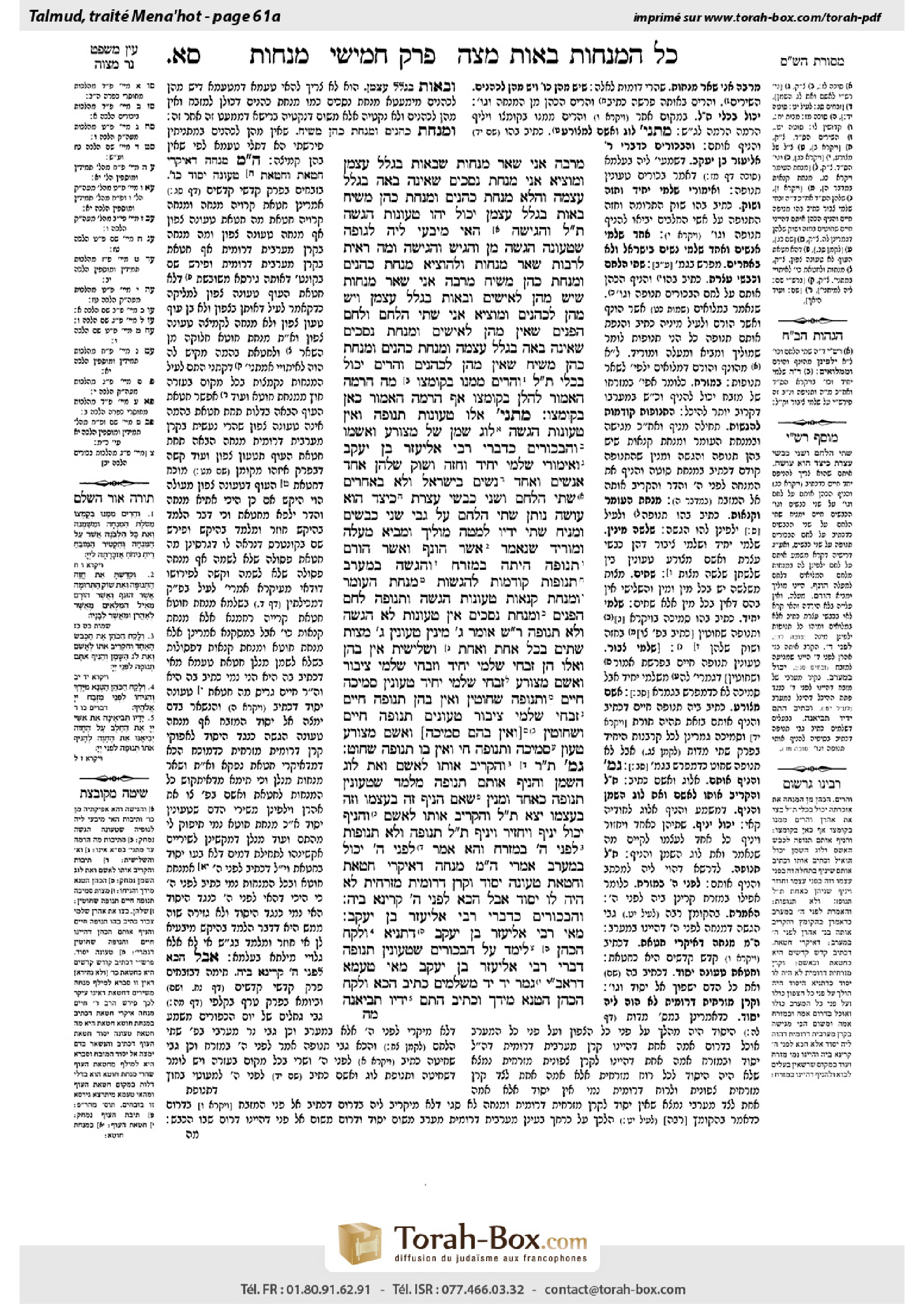
Menachot 61a: Talmud study for Daf Yomi
Daf Yomi is the daily study of one Talmud folio. Explore 37 tractates with scans, Hebrew text, Sefaria English and AI-generated French translations where annotated.
Passage selection and English or AI-generated French translation are available where the scan has annotations. Daf Study is independent of Torah-Box and Sefaria.
Browse Menachot · מנחות · All tractatesMenachot 61a text and translations
This page of Menachot includes the Aramaic text, an English translation and an AI-generated French translation, alongside the scan above.
מנחות ס״א א · Aramaic and Hebrew text
מְרַבֶּה אֲנִי שְׁאָר מְנָחוֹת שֶׁבָּאוֹת בִּגְלַל עַצְמָן, וּמוֹצִיא אֲנִי מִנְחַת נְסָכִים שֶׁאֵינָהּ בָּאָה בִּגְלַל עַצְמָהּ. וַהֲלֹא מִנְחַת כֹּהֲנִים וּמִנְחַת כֹּהֵן מָשִׁיחַ בָּאוֹת בִּגְלַל עַצְמָן, יָכוֹל יְהוּ טְעוּנוֹת הַגָּשָׁה?
תַּלְמוּד לוֹמַר ״וְהִגִּישָׁהּ״. הַאי מִיבְּעֵי לֵיהּ לְגוּפָהּ, שֶׁטְּעוּנָה הַגָּשָׁה! מִן ״וְהִגִּישׁ״ ״וְהִגִּישָׁהּ״.
וּמָה רָאִיתָ לְרַבּוֹת שְׁאָר מְנָחוֹת, וּלְהוֹצִיא מִנְחַת כֹּהֲנִים וּמִנְחַת כֹּהֵן מָשִׁיחַ? מְרַבֶּה אֲנִי שְׁאָר מְנָחוֹת, שֶׁיֵּשׁ מֵהֶן לָאִישִּׁים, וּבָאוֹת בִּגְלַל עַצְמָן, וְיֵשׁ מֵהֶן לַכֹּהֲנִים. וּמוֹצִיא אֲנִי שְׁתֵּי הַלֶּחֶם וְלֶחֶם הַפָּנִים, שֶׁאֵין מֵהֶן לָאִישִּׁים. וּמִנְחַת נְסָכִים שֶׁאֵינָהּ בָּאָה בִּגְלַל עַצְמָהּ. וּמִנְחַת כֹּהֲנִים וּמִנְחַת כֹּהֵן מָשִׁיחַ, שֶׁאֵין מֵהֶן לַכֹּהֲנִים.
״וְהֵרִים״ – יָכוֹל בִּכְלִי? תַּלְמוּד לוֹמַר: ״וְהֵרִים מִמֶּנּוּ בְּקֻמְצוֹ״, מָה הֲרָמָה הָאָמוּר לְהַלָּן בְּקוּמְצוֹ, אַף הֲרָמָה הָאָמוּר כָּאן בְּקוּמְצוֹ.
מַתְנִי׳ אֵלּוּ טְעוּנוֹת תְּנוּפָה וְאֵין טְעוּנוֹת הַגָּשָׁה: לוֹג שֶׁמֶן שֶׁל מְצוֹרָע, וַאֲשָׁמוֹ, וְהַבִּכּוּרִים כְּדִבְרֵי רַבִּי אֱלִיעֶזֶר בֶּן יַעֲקֹב, וְאֵימוּרֵי שַׁלְמֵי יָחִיד, וְחָזֶה וָשׁוֹק שֶׁלָּהֶן.
אֶחָד אֲנָשִׁים וְאֶחָד נָשִׁים, בְּיִשְׂרָאֵל וְלֹא בַּאֲחֵרִים. שְׁתֵּי הַלֶּחֶם וּשְׁנֵי כִּבְשֵׂי עֲצֶרֶת.
כֵּיצַד הוּא עוֹשֶׂה? נוֹתֵן שְׁתֵּי הַלֶּחֶם עַל גַּבֵּי שְׁנֵי כְּבָשִׂים, וּמַנִּיחַ שְׁתֵּי יָדָיו לְמַטָּה, מוֹלִיךְ וּמֵבִיא, מַעֲלֶה וּמוֹרִיד, שֶׁנֶּאֱמַר: ״אֲשֶׁר הוּנַף וַאֲשֶׁר הוּרָם״. תְּנוּפָה הָיְתָה בַּמִּזְרָח, וְהַגָּשָׁה בַּמַּעֲרָב. תְּנוּפוֹת קוֹדְמוֹת לַהַגָּשׁוֹת.
מִנְחַת הָעוֹמֶר וּמִנְחַת קְנָאוֹת טְעוּנוֹת הַגָּשָׁה וּתְנוּפָה. לֶחֶם הַפָּנִים וּמִנְחַת נְסָכִים אֵין טְעוּנוֹת לֹא הַגָּשָׁה וְלֹא תְּנוּפָה.
רַבִּי שִׁמְעוֹן אוֹמֵר: שְׁלֹשָׁה מִינִין טְעוּנִין שָׁלֹשׁ מִצְוֹת, שְׁתַּיִם בְּכׇל אַחַת וְאַחַת, וּשְׁלִישִׁית אֵין בָּהֶן. וְאֵלּוּ הֵן: זִבְחֵי שַׁלְמֵי יָחִיד, וְזִבְחֵי שַׁלְמֵי צִיבּוּר, וַאֲשַׁם מְצוֹרָע.
זִבְחֵי שַׁלְמֵי יָחִיד – טְעוּנִין סְמִיכָה חַיִּים, וּתְנוּפָה שְׁחוּטִין, וְאֵין בָּהֶן תְּנוּפָה חַיִּים. זִבְחֵי שַׁלְמֵי צִיבּוּר – טְעוּנִים תְּנוּפָה חַיִּים וּשְׁחוּטִין, [וְאֵין בָּהֶם סְמִיכָה]. וַאֲשַׁם מְצוֹרָע – טָעוּן סְמִיכָה וּתְנוּפָה חַי, וְאֵין בּוֹ תְּנוּפָה שָׁחוּט.
גְּמָ׳ תָּנוּ רַבָּנַן: ״וְהִקְרִיב אֹתוֹ לְאָשָׁם וְאֶת לֹג הַשָּׁמֶן וְהֵנִיף אֹתָם תְּנוּפָה״ – מְלַמֵּד שֶׁטְּעוּנִין תְּנוּפָה כְּאֶחָד.
וּמִנַּיִן שֶׁאִם הֵנִיף זֶה בְּעַצְמוֹ וְזֶה בְּעַצְמוֹ יָצָא? תַּלְמוּד לוֹמַר ״וְהִקְרִיב אֹתוֹ לְאָשָׁם וְהֵנִיף״. יָכוֹל יָנִיף וְיַחְזִיר וְיָנִיף? תַּלְמוּד לוֹמַר ״תְּנוּפָה״, וְלֹא תְּנוּפוֹת.
״לִפְנֵי ה׳״ – בַּמִּזְרָח. וְהָא אָמַר: ״לִפְנֵי ה׳״ – יָכוֹל בַּמַּעֲרָב!
אָמְרִי: הָנֵי מִילֵּי מִנְחָה, דְּאִיקְּרִי ״חַטָּאת״, וְחַטָּאת טְעוּנָה יְסוֹד, וְקֶרֶן דְּרוֹמִית מִזְרָחִית לֹא הָיָה לוֹ יְסוֹד, אֲבָל הָכָא ״לִפְנֵי ה׳״ קָרֵינָא בֵּיהּ.
וְהַבִּכּוּרִים, כְּדִבְרֵי רַבִּי אֱלִיעֶזֶר בֶּן יַעֲקֹב. מַאי רַבִּי אֱלִיעֶזֶר בֶּן יַעֲקֹב? דְּתַנְיָא: ״וְלָקַח הַכֹּהֵן״, לִימֵּד עַל הַבִּכּוּרִים שֶׁטְּעוּנִין תְּנוּפָה, דִּבְרֵי רַבִּי אֱלִיעֶזֶר בֶּן יַעֲקֹב.
מַאי טַעְמָא דְּרַבִּי אֱלִיעֶזֶר בֶּן יַעֲקֹב? גָּמַר יָד יָד מִשְּׁלָמִים, כְּתִיב הָכָא ״וְלָקַח הַכֹּהֵן הַטֶּנֶא מִיָּדֶךָ״, וּכְתִיב הָתָם ״יָדָיו תְּבִיאֶנָּה״.
Menachot 61a · English translation
The baraita answers: I include from this verse the other meal offerings, as they come due to themselves, i.e., they do not accompany other offerings, and I exclude the meal offering brought with libations, as it does not come due to itself but rather together with an animal offering. The baraita challenges: But the meal offering of priests and the meal offering of the anointed priest also come due to themselves, and according to this logic one might have thought that they too would require bringing near.
Therefore, the verse states: “And he shall bring it near to the altar” (Leviticus 2:8), to exclude the meal offering of priests and the meal offering of the anointed priest from the requirement of bringing near. The baraita raises a difficulty: But that verse is required for its own sake, i.e., to teach the basic halakha that a meal offering requires bringing near to the altar. The baraita answers: This halakha is derived from the fact that the verse could have stated just: “And he shall bring,” and instead it states: “And he shall bring it.”
The baraita asks: And what did you see that led you to include the other meal offerings in the requirement of bringing near and to exclude the meal offering of priests and the meal offering of the anointed priest? The baraita answers: I include the other meal offerings, as there is a part of them burned in the fire of the altar, and they come due to themselves, and there is a part of them given to the priests to eat. And I exclude the two loaves and the shewbread, as there is no part of them burned in the fire. And I exclude the meal offering brought with libations, as it does not come due to itself, and I also exclude the meal offering of priests and the meal offering of the anointed priest, as there is no part of them given to the priests.
The baraita continues: The verse states: “And the priest shall take off from the meal offering its memorial-part, and shall make it smoke upon the altar, an offering made by fire, of a pleasing aroma to the Lord” (Leviticus 2:9). With regard to the phrase: “And the priest shall take off,” one might have thought the priest may perform this action even with a vessel. Therefore, the verse states: “And this is the law of the meal offering: The sons of Aaron shall offer it before the Lord, in front of the altar. And he shall take off from it his handful” (Leviticus 6:7–8). Just as the taking off that is stated below is performed specifically with the priest’s handful and not with a vessel, so too, the taking off that is stated here must be performed with the priest’s handful, not with a vessel.
MISHNA: These are the items that require waving and do not require bringing near to the altar: The log of oil that accompanies the guilt offering of a recovered leper and his guilt offering itself, as it is written: “And the priest shall take one of the lambs and sacrifice it for a guilt offering, and the log of oil, and wave them for a wave offering before the Lord” (Leviticus 14:12); and the first fruits, in accordance with the statement of Rabbi Eliezer ben Ya’akov; and the sacrificial portions of the peace offerings of an individual and their breast and thigh, as it is written: “The thigh of heaving and the breast of waving shall they bring with the offerings of the portions consumed by fire, to wave it for a wave offering before the Lord” (Leviticus 10:15).
This requirement applies to peace offerings belonging both to men and to women, by male Jews and not by others. The Gemara will explain this seemingly contradictory statement on 61b. In addition, the two loaves and the accompanying peace offering of two lambs brought on Shavuot also do not require bringing near but do require waving, as it is written: “And the priest shall wave them with the bread of the first fruits for a wave offering before the Lord, with the two lambs” (Leviticus 23:20).
How does one perform this waving? He places the two loaves on top of the two lambs and places his two hands below the loaves and the lambs, extends the offerings to each of the four directions and brings them back, then raises and lowers them, as it is stated with regard to the waving of the ram of the inauguration of the priests: “Which is waved, and which is heaved up” (Exodus 29:27); i.e., waved back and forth, and heaved up and down. Waving was able to be performed to the east of the altar, but the bringing near of meal offerings had to be done to the west, i.e., the southwest corner of the altar. Also, with regard to all meal offerings, the wavings precede the actions of bringing near.
The omer meal offering and the meal offering of jealousy brought by a sota require both bringing near and waving. The meal offering of the omer requires waving, as it is written: “And he shall wave the omer before the Lord” (Leviticus 23:11), and likewise with regard to the meal offering brought by a sota it is written: “And the priest shall take the meal offering of jealousy out of the woman’s hand and shall wave the meal offering before the Lord” (Numbers 5:25). The requirement of bringing near is derived as explained earlier. The shewbread and the meal offering brought with libations require neither bringing near nor waving.
Rabbi Shimon says: There are three types of offerings that require performance of three mitzvot. Two mitzvot are performed on each and every one of them, but the third mitzva is not performed in their sacrifice, meaning that each of these offerings requires two out of the same three mitzvot, but not necessarily the same two as the others. And these are the three offerings: Peace offerings brought as gift offerings by an individual, communal peace offerings, i.e., the two lambs brought with the two loaves on Shavuot, and the guilt offering of a leper (see Leviticus 14:12–14).
Peace offerings brought by individuals require placing hands on the head of the animals while the animals are still alive, and waving when they are slaughtered, but there is no obligation of waving them while they are alive. Communal peace offerings require waving both while the animals are still alive and after they are slaughtered, but there is no obligation of placing hands on them. And the guilt offering of a leper requires placing hands and waving while the animal is still alive, but there is no obligation of waving it after it is slaughtered.
GEMARA: The mishna teaches that both the log of oil that accompanies the guilt offering of a recovered leper and the guilt offering itself require waving. The Sages taught in a baraita: The verse states: “And the priest shall take one of the lambs and sacrifice it for a guilt offering, and the log of oil, and wave them for a wave offering before the Lord” (Leviticus 14:12). The plural form “them” teaches that the log of oil and the offering require waving, and that this should be performed with both of them together.
And from where is it derived that if the priest waved this one by itself and that one by itself that he has fulfilled his obligation? The same verse states, in the singular form: “And sacrifice it for a guilt offering…and wave.” The Gemara inquires: Since parts of this verse are in the singular and parts are in the plural, one might have thought that he should wave both together, and then wave each one separately. Therefore, the verse states: “A wave offering,” which indicates that he should perform one waving, but not multiple wavings.
With regard to the phrase: “A wave offering before the Lord,” the baraita states that this teaches that waving can be performed to the east of the altar, as taught in the mishna. The Gemara raises a difficulty: But doesn’t the tanna of a baraita cited earlier in the tractate (19b) say, concerning a verse discussing the bringing near of a meal offering, which states: “Before the Lord” (Leviticus 6:7), that one might have thought one brings it to the west of the altar, as this is the side facing the Sanctuary? That tanna proceeds to explain that the phrase: “In front of the altar” (Leviticus 6:7), is a reference to the south, where one ascends the altar, and therefore the meal offering must be brought to the southwest corner. This indicates, though, that the expression “before the Lord” is a reference to the west.
The Gemara answers: The Sages say in response: This statement, that the expression “before the Lord” is a reference to the west and not to the east, applies only with regard to the meal offering, which is called “a sin offering,” as the verse states: “It is most sacred, like the sin offering” (Leviticus 6:10), and the sin offering requires its remaining blood to be poured out on the base of the altar. Therefore, the meal offering must also be brought to a part of the altar where there is a base, and as the southeast corner of the altar did not have a base, the meal offering must be brought to the southwest corner. In this manner one fulfills both the requirement of “in front of the altar,” i.e., to the south, and the requirement of “before the Lord.” But here, with regard to the log of oil and guilt offering of a leper, we call any side of the altar “before the Lord.”
§ The mishna teaches: The first fruits also require waving, in accordance with the statement of Rabbi Eliezer ben Ya’akov. The Gemara asks: What is the statement of Rabbi Eliezer ben Ya’akov, alluded to here? The Gemara answers that it is as it is taught in a baraita: The verse states with regard to the first fruits: “And the priest shall take the basket from your hand, and place it before the altar of the Lord your God” (Deuteronomy 26:4). This taught a halakha concerning the first fruits, that they require waving; this is the statement of Rabbi Eliezer ben Ya’akov.
The Gemara asks: What is the reason for the opinion of Rabbi Eliezer ben Ya’akov, as the verse is not explicitly referring to waving? The Gemara explains: The matter is derived by means of a verbal analogy from “hand,” written with regard to first fruits, and from “hand,” written with regard to a peace offering. It is written here, with regard to first fruits: “And the priest shall take the basket from your hand” (Deuteronomy 26:4), and it is written there: offering “He who offers his peace offering to God…his hands shall bring it, the fire of God…to raise it as a waving before God” (Leviticus 7:29–30).
Menachot 61a · Traduction française (IA)
La baraïta répond : J’inclus, sur la base de ce verset, les autres offrandes végétales, puisqu’elles sont apportées pour elles-mêmes, c’est-à-dire qu’elles n’accompagnent pas d’autres offrandes, et j’exclus l’offrande végétale apportée avec les libations, puisqu’elle n’est pas apportée pour elle-même, mais avec une offrande animale. La baraïta objecte : Mais l’offrande végétale des prêtres et celle du prêtre oint sont elles aussi apportées pour elles-mêmes ; selon cette logique, on aurait pu penser qu’elles aussi doivent faire l’objet de la présentation.
C’est pourquoi le verset dit : « Et il la présentera près de l’autel » (Lévitique 2, 8), afin d’exclure l’offrande végétale des prêtres et celle du prêtre oint de l’obligation de présentation. La baraïta soulève une difficulté : Mais ce verset est nécessaire en lui-même, c’est-à-dire pour enseigner la halakha fondamentale selon laquelle une offrande végétale doit être présentée près de l’autel. La baraïta répond : Cette halakha se déduit du fait que le verset aurait pu dire simplement : « Et il présentera », mais qu’il dit plutôt : « Et il la présentera ».
La baraïta demande : Qu’as-tu vu qui t’a conduit à inclure les autres offrandes végétales dans l’obligation de présentation et à exclure l’offrande végétale des prêtres et celle du prêtre oint ? La baraïta répond : J’inclus les autres offrandes végétales, puisqu’une partie en est brûlée sur l’autel, qu’elles sont apportées pour elles-mêmes et qu’une partie en est donnée aux prêtres pour qu’ils la mangent. J’exclus les deux pains et le pain de proposition, puisqu’aucune partie n’en est brûlée sur l’autel. J’exclus l’offrande végétale apportée avec les libations, puisqu’elle n’est pas apportée pour elle-même, et j’exclus également l’offrande végétale des prêtres et celle du prêtre oint, puisqu’aucune partie n’en est donnée aux prêtres.
La baraïta poursuit : Le verset dit : « Le prêtre prélèvera sur l’offrande végétale sa part commémorative et la fera fumer sur l’autel, offrande consumée par le feu, d’agréable odeur pour le Seigneur » (Lévitique 2, 9). À propos de l’expression « le prêtre prélèvera », on aurait pu penser que le prêtre peut effectuer ce prélèvement à l’aide d’un récipient. C’est pourquoi le verset dit : « Voici la loi de l’offrande végétale : les fils d’Aaron la présenteront devant le Seigneur, devant l’autel. Il en prélèvera une poignée » (Lévitique 6, 7-8). De même que le prélèvement mentionné plus loin s’effectue précisément avec une poignée du prêtre et non à l’aide d’un récipient, de même, le prélèvement mentionné ici doit s’effectuer avec une poignée du prêtre et non à l’aide d’un récipient.
MICHNA : Voici les éléments qui exigent une ondulation rituelle, mais pas de présentation près de l’autel : le log d’huile qui accompagne le sacrifice de culpabilité d’un lépreux guéri, ainsi que son sacrifice de culpabilité lui-même, comme il est écrit : « Le prêtre prendra l’un des agneaux et l’offrira comme sacrifice de culpabilité, avec le log d’huile, et les agitera en offrande d’ondulation devant le Seigneur » (Lévitique 14, 12) ; les prémices, conformément à l’avis de Rabbi Eliezer ben Ya’akov ; et les portions des sacrifices de paix d’un particulier destinées à l’autel, ainsi que leur poitrine et leur cuisse, comme il est écrit : « Ils apporteront la cuisse prélevée et la poitrine agitée, avec les offrandes des portions consumées par le feu, pour les agiter en offrande d’ondulation devant le Seigneur » (Lévitique 10, 15).
Cette règle s’applique aux sacrifices de paix appartenant aussi bien à des hommes qu’à des femmes, et elle est mise en œuvre par des hommes juifs, mais pas par d’autres. La Guemara expliquera en 61b cette affirmation apparemment contradictoire. En outre, les deux pains et le sacrifice de paix accompagnant les deux agneaux offerts à Chavouot n’exigent pas non plus de présentation près de l’autel, mais exigent une ondulation, comme il est écrit : « Le prêtre les agitera avec le pain des prémices, en offrande d’ondulation devant le Seigneur, avec les deux agneaux » (Lévitique 23, 20).
Comment procède-t-on à cette ondulation ? Le prêtre place les deux pains sur les deux agneaux et met ses deux mains sous les pains et les agneaux ; il tend les offrandes dans chacune des quatre directions, puis les ramène, ensuite les lève et les abaisse, comme il est dit au sujet de l’ondulation du bélier de l’investiture des prêtres : « qui est agité et élevé » (Exode 29, 27), c’est-à-dire agité d’avant en arrière et élevé puis abaissé. L’ondulation pouvait être effectuée à l’est de l’autel, mais la présentation des offrandes végétales devait se faire à l’ouest, c’est-à-dire à l’angle sud-ouest de l’autel. De plus, pour toutes les offrandes végétales, l’ondulation précède la présentation.
L’offrande végétale de l’omer et l’offrande végétale de jalousie apportée par une sota exigent à la fois présentation et ondulation. L’offrande végétale de l’omer exige une ondulation, comme il est écrit : « Il agitera l’omer devant le Seigneur » (Lévitique 23, 11) ; de même, à propos de l’offrande végétale apportée par une sota, il est écrit : « Le prêtre prendra des mains de la femme l’offrande végétale de jalousie et agitera l’offrande végétale devant le Seigneur » (Nombres 5, 25). L’obligation de présentation se déduit comme cela a été expliqué précédemment. Le pain de proposition et l’offrande végétale apportée avec les libations n’exigent ni présentation ni ondulation.
Rabbi Shimon dit : Il existe trois sortes d’offrandes auxquelles s’appliquent trois mitsvot. Deux mitsvot s’accomplissent pour chacune d’entre elles, mais pas la troisième ; autrement dit, chacune de ces offrandes exige deux des trois mêmes mitsvot, mais pas nécessairement les mêmes deux que les autres. Voici ces trois offrandes : les sacrifices de paix apportés comme offrandes volontaires par un particulier, les sacrifices de paix communautaires, c’est-à-dire les deux agneaux apportés avec les deux pains à Chavouot, et le sacrifice de culpabilité d’un lépreux (voir Lévitique 14, 12-14).
Les sacrifices de paix apportés par des particuliers exigent que l’on pose les mains sur la tête des animaux lorsqu’ils sont encore vivants et qu’on les agite après leur abattage, mais il n’est pas obligatoire de les agiter lorsqu’ils sont vivants. Les sacrifices de paix communautaires exigent qu’on les agite aussi bien lorsqu’ils sont encore vivants qu’après leur abattage, mais il n’est pas obligatoire de poser les mains sur eux. Le sacrifice de culpabilité d’un lépreux exige que l’on pose les mains sur l’animal et qu’on l’agite lorsqu’il est encore vivant, mais il n’est pas obligatoire de l’agiter après son abattage.
GUEMARA : La Michna enseigne que le log d’huile qui accompagne le sacrifice de culpabilité d’un lépreux guéri et le sacrifice de culpabilité lui-même exigent tous deux une ondulation rituelle. Les Sages ont enseigné dans une baraïta : Le verset dit : « Le prêtre prendra l’un des agneaux et l’offrira comme sacrifice de culpabilité, avec le log d’huile, et les agitera en offrande d’ondulation devant le Seigneur » (Lévitique 14, 12). Le pluriel « les » enseigne que le log d’huile et le sacrifice de culpabilité exigent une ondulation et qu’il faut les agiter ensemble.
Et d’où déduit-on que, si le prêtre a agité l’un séparément et l’autre séparément, il s’est acquitté de son obligation ? Le même verset dit, au singulier : « Il l’offrira comme sacrifice de culpabilité… et agitera. » La Guemara demande : Puisque certaines parties de ce verset sont au singulier et d’autres au pluriel, aurait-on pu penser qu’il doit agiter les deux ensemble, puis agiter chacun séparément ? C’est pourquoi le verset dit : « Une offrande d’ondulation », ce qui indique qu’il doit effectuer une seule ondulation et non plusieurs.
À propos de l’expression « une offrande d’ondulation devant le Seigneur », la baraïta enseigne qu’elle indique que l’ondulation peut être effectuée à l’est de l’autel, comme l’enseigne la Michna. La Guemara soulève une difficulté : Mais le tanna d’une baraïta citée plus tôt dans le traité (19b) ne dit-il pas, au sujet d’un verset traitant de la présentation d’une offrande végétale et contenant l’expression « devant le Seigneur » (Lévitique 6, 7), qu’on aurait pu penser qu’on la présente à l’ouest de l’autel, puisque c’est le côté tourné vers le Sanctuaire ? Ce tanna explique ensuite que l’expression « devant l’autel » (Lévitique 6, 7) désigne le sud, où l’on monte sur l’autel, et que l’offrande végétale doit donc être présentée à l’angle sud-ouest. Cela indique pourtant que l’expression « devant le Seigneur » désigne l’ouest.
La Guemara répond : Les Sages expliquent que cette affirmation, selon laquelle l’expression « devant le Seigneur » désigne l’ouest et non l’est, ne concerne que l’offrande végétale, qui est appelée « sacrifice expiatoire », comme le dit le verset : « Elle est très sainte, comme le sacrifice expiatoire » (Lévitique 6, 10). Or le sacrifice expiatoire exige que le sang restant soit versé à la base de l’autel. L’offrande végétale doit donc, elle aussi, être présentée à une partie de l’autel où se trouve une base ; comme l’angle sud-est de l’autel n’avait pas de base, elle doit être présentée à l’angle sud-ouest. On satisfait ainsi à la fois à l’exigence de « devant l’autel », c’est-à-dire au sud, et à celle de « devant le Seigneur ». Mais ici, en ce qui concerne le log d’huile et le sacrifice de culpabilité d’un lépreux, nous appelons n’importe quel côté de l’autel « devant le Seigneur ».
§ La Michna enseigne que les prémices exigent également une ondulation rituelle, conformément à l’avis de Rabbi Eliezer ben Ya’akov. La Guemara demande : Quel est l’avis de Rabbi Eliezer ben Ya’akov auquel il est fait allusion ici ? La Guemara répond qu’il s’agit de ce qui est enseigné dans une baraïta : Le verset dit au sujet des prémices : « Le prêtre prendra la corbeille de ta main et la déposera devant l’autel du Seigneur ton Dieu » (Deutéronome 26, 4). Cela enseigne que les prémices doivent faire l’objet d’une ondulation rituelle. Telle est la déclaration de Rabbi Eliezer ben Ya’akov.
La Guemara demande : Quelle est la raison de l’avis de Rabbi Eliezer ben Ya’akov, puisque le verset ne parle pas explicitement d’ondulation ? La Guemara explique : Cela se déduit au moyen d’une analogie verbale entre le terme « main », employé à propos des prémices, et le terme « main », employé à propos d’un sacrifice de paix. Ici, à propos des prémices, il est écrit : « Le prêtre prendra la corbeille de ta main » (Deutéronome 26, 4) ; et là, à propos de l’offrande, il est écrit : « Celui qui offre son sacrifice de paix à Dieu… ses mains l’apporteront, avec l’offrande consumée par le feu pour Dieu… afin de l’élever en ondulation devant Dieu » (Lévitique 7, 29-30).
Traduction française générée par IA à partir de l’édition anglaise de Sefaria. Vérifie toujours un passage avec le texte source.
Text from Sefaria: William Davidson Edition - Vocalized Aramaic (unknown); William Davidson Edition - English (CC BY NC).