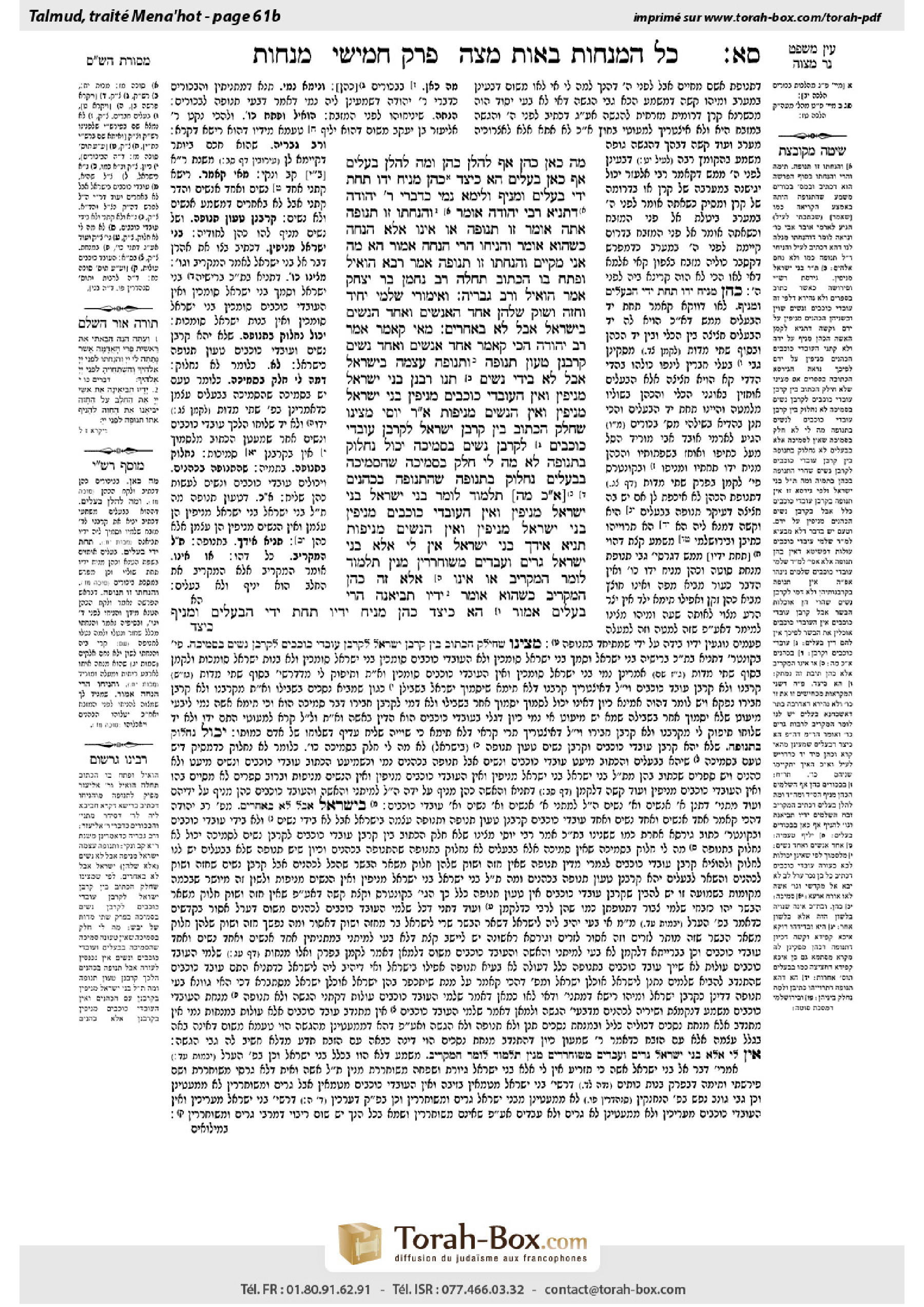
Menachot 61b: Talmud study for Daf Yomi
Daf Yomi is the daily study of one Talmud folio. Explore 37 tractates with scans, Hebrew text, Sefaria English and AI-generated French translations where annotated.
Passage selection and English or AI-generated French translation are available where the scan has annotations. Daf Study is independent of Torah-Box and Sefaria.
Browse Menachot · מנחות · All tractatesMenachot 61b text and translations
This page of Menachot includes the Aramaic text, an English translation and an AI-generated French translation, alongside the scan above.
מנחות ס״א ב · Aramaic and Hebrew text
מָה כָּאן כֹּהֵן – אַף לְהַלָּן כֹּהֵן, וּמָה לְהַלָּן בְּעָלִים אַף כָּאן בְּעָלִים. הָא כֵּיצַד? כֹּהֵן מַנִּיחַ יָדוֹ תַּחַת יְדֵי בְּעָלִים וּמֵנִיף.
וְלֵימָא נָמֵי כְּדִבְרֵי רַבִּי יְהוּדָה, דְּתַנְיָא: רַבִּי יְהוּדָה אוֹמֵר: ״וְהִנַּחְתּוֹ״ – זוֹ תְּנוּפָה, אַתָּה אוֹמֵר זוֹ תְּנוּפָה, אוֹ אֵינוֹ אֶלָּא הַנָּחָה?
כְּשֶׁהוּא אוֹמֵר ״וְהִנִּיחוֹ״, הֲרֵי הַנָּחָה אָמוּר; הָא מָה אֲנִי מְקַיֵּים ״וְהִנַּחְתּוֹ״ – זוֹ תְּנוּפָה.
אָמַר רָבָא: הוֹאִיל וּפָתַח בּוֹ הַכָּתוּב תְּחִלָּה. רַב נַחְמָן בַּר יִצְחָק אָמַר: הוֹאִיל וְרַב גֻּבְרֵיהּ.
וְאֵימוּרֵי שַׁלְמֵי יָחִיד, וְחָזֶה וָשׁוֹק שֶׁלָּהֶן – אֶחָד הָאֲנָשִׁים וְאֶחָד הַנָּשִׁים, בְּיִשְׂרָאֵל אֲבָל לֹא בַּאֲחֵרִים. מַאי קָאָמַר?
אָמַר רַב יְהוּדָה: הָכִי קָאָמַר – אֶחָד אֲנָשִׁים וְאֶחָד נָשִׁים, קׇרְבָּנָן טָעוּן תְּנוּפָה, וּתְנוּפָה עַצְמָהּ בְּיִשְׂרָאֵל, אֲבָל לֹא בִּידֵי נָשִׁים.
תָּנוּ רַבָּנַן: בְּנֵי יִשְׂרָאֵל מְנִיפִין, וְאֵין הַגּוֹיִם מְנִיפִין. בְּנֵי יִשְׂרָאֵל מְנִיפִין, וְאֵין הַנָּשִׁים מְנִיפוֹת.
אָמַר רַבִּי יוֹסֵי: מָצִינוּ שֶׁחִלֵּק הַכָּתוּב בֵּין קׇרְבַּן יִשְׂרָאֵל לְקׇרְבַּן גּוֹיִם לְקׇרְבַּן נָשִׁים בִּסְמִיכָה, יָכוֹל נַחְלוֹק בִּתְנוּפָה?
לָא, מָה לִי חִלֵּק בִּסְמִיכָה, שֶׁהַסְּמִיכָה בִּבְעָלִים.
נַחְלוֹק בִּתְנוּפָה, שֶׁהַתְּנוּפָה בְּכֹהֲנִים, אִם כֵּן מָה תַּלְמוּד לוֹמַר ״בְּנֵי יִשְׂרָאֵל״? בְּנֵי יִשְׂרָאֵל מְנִיפִין וְאֵין הַגּוֹיִם מְנִיפִין, בְּנֵי יִשְׂרָאֵל מְנִיפִין וְאֵין הַנָּשִׁים מְנִיפוֹת.
תַּנְיָא אִידַּךְ: ״בְּנֵי יִשְׂרָאֵל״ – אֵין לִי אֶלָּא בְּנֵי יִשְׂרָאֵל, גֵּרִים וַעֲבָדִים מְשׁוּחְרָרִין מִנַּיִן? תַּלְמוּד לוֹמַר ״הַמַּקְרִיב״.
אוֹ אֵינוֹ אֶלָּא זֶה כֹּהֵן הַמַּקְרִיב? כְּשֶׁהוּא אוֹמֵר ״יָדָיו תְּבִיאֶינָה״, הֲרֵי בְּעָלִים אָמוּר. הָא כֵּיצַד? כֹּהֵן מַנִּיחַ יָדָיו תַּחַת יְדֵי הַבְּעָלִים וּמֵנִיף.
Menachot 61b · English translation
Just as here, in the case of first fruits, it is the priest who takes the basket in his hand and waves it, so too there, in the case of the peace offering, a priest performs the waving. Just as there, with regard to a peace offering, it is the owner who performs the waving, as it is written: “He who offers…his hands shall bring it,” so too here, the owner waves the first fruits. How so; how can the waving be performed by both the priest and the owner? The priest places his hands beneath the hands of the owner and waves the first fruits together with the owner.
The Gemara asks: And let the mishna also say that the halakha that first fruits require waving is in accordance with the statement of Rabbi Yehuda, as it is taught in a baraita: Rabbi Yehuda says with regard to the verse written in the portion of first fruits: “And you shall place it before the Lord your God” (Deuteronomy 26:10), the reference is not to the placement of the fruits alongside the altar. Rather, this is a reference to waving the first fruits. Do you say that this is a reference to waving, or perhaps it is a reference only to actual placement of the first fruits?
He explains: When it states earlier: “And the priest shall take the basket from your hand, and place it before the altar of the Lord your God” (Deuteronomy 26:4), placement alongside the altar is already stated; how do I realize the meaning of: “And you shall place it”? This is a reference to waving. It is therefore clear that Rabbi Eliezer ben Ya’akov is not the only tanna who holds that there is a requirement of waving the first fruits, as indicated by the mishna; Rabbi Yehuda also maintains this opinion.
Rava says: The tanna of the mishna could have said that this halakha is in accordance with the opinion of Rabbi Yehuda. He preferred to ascribe this opinion to Rabbi Eliezer ben Ya’akov, since the verse opened first with the phrase cited by Rabbi Eliezer ben Ya’akov as the source for the requirement of waving the first fruits, as Rabbi Eliezer ben Ya’akov derives this halakha from the verse: “And the priest shall take the basket from your hand” (Deuteronomy 26:4); whereas Rabbi Yehuda derives it from the later verse: “And you shall place it before the Lord your God” (Deuteronomy 26:10). Rav Naḥman bar Yitzḥak says: The tanna preferred to cite this halakha in the name of Rabbi Eliezer ben Ya’akov since his strength in Torah is great, as the halakha is invariably in accordance with his opinion.
§ The mishna teaches: And the sacrificial portions of the peace offerings of an individual, which are consumed on the altar, and their breast and thigh, which are eaten by the priests, require waving. This requirement applies to peace offerings belonging both to men and to women, by male Jews and not by others. The Gemara asks: What is the mishna saying? This statement is apparently self-contradictory, as the mishna first states that offerings brought by women require waving, and then it indicates that the offerings of others, including women, do not require waving.
Rav Yehuda said that this is what the tanna of the mishna is saying: Both with regard to men and with regard to women, their offerings require waving, but the waving itself is performed only by male Jews, i.e., if the owner is a male he waves the offering together with a priest. But in the case of offerings brought by women, the female owner does not participate in the waving, as the priest alone performs the mitzva.
§ The Sages taught in a baraita: With regard to peace offerings, the verse states: “Speak to the children of Israel, saying: He who offers his sacrifice of peace offerings to the Lord shall bring his offering out of his sacrifice of peace offerings. His own hands shall bring the offerings of the Lord made by fire. The fat with the breast he shall bring, that the breast may be waved for a wave offering before the Lord” (Leviticus 7:29–30). From the phrase: “The children of [benei] Israel,” it may be derived that the Jewish people wave their offerings, but gentiles who bring their offerings do not wave them. Furthermore, as the term “benei” can also mean: Sons of, it may be derived that only sons of Israel, i.e., males, wave their offerings, but that women do not wave their offerings.
Rabbi Yosei says: We have found that the Torah differentiates between the offering of a Jew and the offering of gentiles and also between the offering of men and the offering of women, with regard to the obligation of placing hands. Placing hands is performed only on offerings of male Jews, not on those brought by gentiles and women. Therefore, one might have thought that a similar distinction should apply to the halakha of waving. Can we therefore differentiate between these different offerings also with regard to waving, and conclude that this requirement also applies only to offerings of male Jews, not those brought by gentiles or women?
Rabbi Yosei explains: No; this conclusion is incorrect, since what is the reason that the Torah differentiates between male Jews on the one hand and gentiles and women on the other hand, with regard to placing hands? The reason is that the case of placing hands is unique, as it is performed only by the owner of the offerings; he cannot appoint an agent to perform this ceremony on his behalf. Therefore, since gentiles and women may not perform this ceremony themselves, it is logical that their offerings are excluded from this requirement.
By contrast, can we differentiate between male Jews on the one hand and gentiles and women on the other hand, with regard to waving as well? Since waving is also performed by priests, there is no reason to distinguish between offerings of male Jews and offerings brought by others, as the priests can wave those on behalf of their owners. If so, what is the meaning when the verse states: “The children of [benei] Israel”? It means that only the Jewish people wave their offerings, but gentiles who bring their offerings do not wave them. Only sons of [benei] Israel, i.e., males, wave their offerings, but women do not wave their offerings.
It is taught in another baraita: With regard to the phrase: “The children of Israel,” I have derived only that the requirement of waving applies to the children of Israel, i.e., those who were born Jewish. From where is it derived that the same applies to converts and to emancipated Canaanite slaves? The verse states, immediately after that phrase: “He who offers [hammakriv] his sacrifice of peace offerings” (Leviticus 7:29), which indicates that the halakha of waving applies to anyone who brings his offering to the Temple, including converts and emancipated slaves.
The baraita challenges: Or perhaps this term does not serve to include converts and emancipated Canaanite slaves, but rather this is referring to the priest who sacrifices [hammakriv] the sacrificial portions on the altar? The baraita answers: This term cannot be referring to the priest, as when it states: “His own hands shall bring the offerings of the Lord made by fire. The fat with the breast he shall bring, that the breast may be waved for a wave offering before the Lord” (Leviticus 7:30), the requirement of waving by the owner is stated. Since the obligation of the owner to wave is stated in this verse, and the obligation of the priest is derived from the verbal analogy from the term “hand” written with regard to a peace offering, evidently both the owner and the priest must wave the offering. The Gemara asks: How so? The Gemara answers: The priest places his hands beneath the hands of the owner and waves the offering together with the owner.
Menachot 61b · Traduction française (IA)
De même qu’ici, dans le cas des prémices, c’est le prêtre qui prend la corbeille dans sa main et l’agite, de même là, dans le cas du sacrifice de paix, un prêtre accomplit l’agitation. De même que là, pour le sacrifice de paix, c’est le propriétaire qui accomplit l’agitation, comme il est écrit : « Celui qui offre… ses mains l’apporteront », de même ici, le propriétaire agite les prémices. Comment cela se fait-il ? Comment l’agitation peut-elle être accomplie à la fois par le prêtre et par le propriétaire ? Le prêtre place ses mains sous celles du propriétaire et agite les prémices avec lui.
La Guemara demande : Que la Michna enseigne également que la halakha selon laquelle les prémices doivent être agités est conforme à l’opinion de Rabbi Yehouda, comme on l’enseigne dans une baraïta : Rabbi Yehouda dit au sujet du verset relatif aux prémices : « Tu le placeras devant l’Éternel, ton Dieu » (Deutéronome 26:10) qu’il ne s’agit pas de placer les fruits à côté de l’autel. Il s’agit plutôt de l’agitation des prémices. Dis-tu qu’il s’agit d’agitation, ou peut-être est-il seulement question de placer effectivement les prémices ?
Il explique : Puisqu’il est déjà écrit plus haut : « Le prêtre prendra la corbeille de ta main et la placera devant l’autel de l’Éternel, ton Dieu » (Deutéronome 26:4), le placement près de l’autel est déjà mentionné ; comment faut-il donc comprendre les mots : « Tu le placeras » ? Ils font référence à l’agitation. Il est donc clair que Rabbi Eliezer ben Ya’akov n’est pas le seul tanna à soutenir que les prémices doivent être agités, comme l’indique la Michna ; Rabbi Yehouda partage également cet avis.
Rava dit : Le tanna de la Michna aurait pu dire que cette halakha est conforme à l’opinion de Rabbi Yehouda. Il a préféré attribuer cette opinion à Rabbi Eliezer ben Ya’akov, puisque le verset commence par l’expression que celui-ci cite comme source de l’obligation d’agiter les prémices. En effet, Rabbi Eliezer ben Ya’akov déduit cette halakha du verset : « Le prêtre prendra la corbeille de ta main » (Deutéronome 26:4), tandis que Rabbi Yehouda la déduit du verset ultérieur : « Tu le placeras devant l’Éternel, ton Dieu » (Deutéronome 26:10). Rav Naḥman bar Yitzḥak dit : Le tanna a préféré citer cette halakha au nom de Rabbi Eliezer ben Ya’akov, car celui-ci est particulièrement éminent en Torah, la halakha étant invariablement conforme à son opinion.
§ La Michna enseigne : Les parties des sacrifices de paix individuels destinées à être consumées sur l’autel, ainsi que leur poitrine et leur cuisse, qui sont mangées par les prêtres, doivent être agitées. Cette obligation s’applique aux sacrifices de paix appartenant aussi bien à des hommes qu’à des femmes, mais l’agitation est accomplie par des hommes juifs, et non par d’autres. La Guemara demande : Que dit la Michna ? Cette déclaration semble se contredire elle-même : elle affirme d’abord que les sacrifices apportés par des femmes doivent être agités, puis laisse entendre que les sacrifices des autres, y compris ceux des femmes, ne doivent pas l’être.
Rav Yehouda dit que voici ce qu’enseigne le tanna de la Michna : les sacrifices des hommes comme ceux des femmes doivent être agités, mais l’agitation elle-même n’est accomplie que par des hommes juifs. Autrement dit, si le propriétaire est un homme, il agite le sacrifice avec un prêtre. En revanche, lorsque le sacrifice est apporté par une femme, celle-ci ne participe pas à l’agitation, car le prêtre accomplit seul la mitsva.
Les Sages enseignent dans une baraïta : Au sujet des sacrifices de paix, le verset dit : « Parle aux enfants d’Israël et dis-leur : Celui qui offre son sacrifice de paix à l’Éternel apportera son offrande prélevée sur son sacrifice de paix. Ses propres mains apporteront les offrandes de l’Éternel faites par le feu. Il apportera la graisse avec la poitrine, afin que la poitrine soit agitée comme offrande d’agitation devant l’Éternel » (Lévitique 7:29–30). De l’expression « enfants [benei] d’Israël », on peut déduire que le peuple juif agite ses sacrifices, mais que les non-Juifs qui apportent des sacrifices ne les agitent pas. En outre, puisque le terme « benei » peut aussi signifier « fils de », on peut déduire que seuls les fils d’Israël, c’est-à-dire les hommes, agitent leurs sacrifices, et non les femmes.
Rabbi Yossei dit : Nous avons constaté que la Torah établit une distinction entre le sacrifice d’un Juif et celui d’un non-Juif, ainsi qu’entre le sacrifice d’un homme et celui d’une femme, en ce qui concerne l’obligation d’imposer les mains. Seuls les hommes juifs imposent les mains sur leurs sacrifices, et non les non-Juifs ni les femmes. On aurait donc pu penser qu’une distinction similaire s’applique à la halakha de l’agitation. Peut-on alors distinguer également ces différents sacrifices en matière d’agitation et conclure que cette obligation ne s’applique qu’aux sacrifices d’hommes juifs, et non à ceux apportés par des non-Juifs ou des femmes ?
Rabbi Yossei explique : Non, cette conclusion est erronée. Quelle est en effet la raison pour laquelle la Torah distingue les hommes juifs, d’une part, des non-Juifs et des femmes, d’autre part, en ce qui concerne l’imposition des mains ? C’est que l’imposition des mains constitue un cas particulier : seul le propriétaire des sacrifices l’accomplit, et il ne peut pas désigner un mandataire pour accomplir cette cérémonie à sa place. Par conséquent, puisque les non-Juifs et les femmes ne peuvent pas accomplir eux-mêmes cette cérémonie, il est logique que leurs sacrifices soient exclus de cette obligation.
En revanche, peut-on aussi établir une distinction entre les hommes juifs, d’une part, et les non-Juifs et les femmes, d’autre part, en ce qui concerne l’agitation ? Puisque les prêtres accomplissent également l’agitation, il n’y a aucune raison de distinguer les sacrifices des hommes juifs de ceux apportés par d’autres, car les prêtres peuvent les agiter pour le compte de leurs propriétaires. Que signifie donc l’expression « enfants [benei] d’Israël » dans le verset ? Elle signifie que seuls les Juifs agitent leurs sacrifices, tandis que les non-Juifs qui apportent des sacrifices ne les agitent pas. Seuls les fils [benei] d’Israël, c’est-à-dire les hommes, agitent leurs sacrifices, et non les femmes.
On enseigne dans une autre baraïta : De l’expression « enfants d’Israël », j’ai seulement déduit que l’obligation d’agiter s’applique aux enfants d’Israël, c’est-à-dire à ceux qui sont nés juifs. D’où déduit-on qu’il en va de même pour les convertis et les esclaves cananéens affranchis ? Le verset dit immédiatement après cette expression : « Celui qui offre [hammakriv] son sacrifice de paix » (Lévitique 7:29), ce qui indique que la halakha de l’agitation s’applique à quiconque apporte son sacrifice au Temple, y compris les convertis et les esclaves affranchis.
La baraïta objecte : Ou peut-être ce terme ne sert-il pas à inclure les convertis et les esclaves cananéens affranchis, mais désigne-t-il plutôt le prêtre qui offre [hammakriv] les parties du sacrifice sur l’autel ? La baraïta répond : Ce terme ne peut pas désigner le prêtre, car le verset poursuit : « Ses propres mains apporteront les offrandes de l’Éternel faites par le feu. Il apportera la graisse avec la poitrine, afin que la poitrine soit agitée comme offrande d’agitation devant l’Éternel » (Lévitique 7:30) ; il énonce ainsi l’obligation du propriétaire d’agiter. Puisque ce verset énonce l’obligation du propriétaire d’agiter, et que l’obligation du prêtre est déduite par analogie verbale à partir du terme « main » employé à propos d’un sacrifice de paix, il est évident que le propriétaire et le prêtre doivent tous deux agiter le sacrifice. La Guemara demande : Comment cela se fait-il ? La Guemara répond : Le prêtre place ses mains sous celles du propriétaire et agite le sacrifice avec lui.
Traduction française générée par IA à partir de l’édition anglaise de Sefaria. Vérifie toujours un passage avec le texte source.
Text from Sefaria: William Davidson Edition - Vocalized Aramaic (unknown); William Davidson Edition - English (CC BY NC).