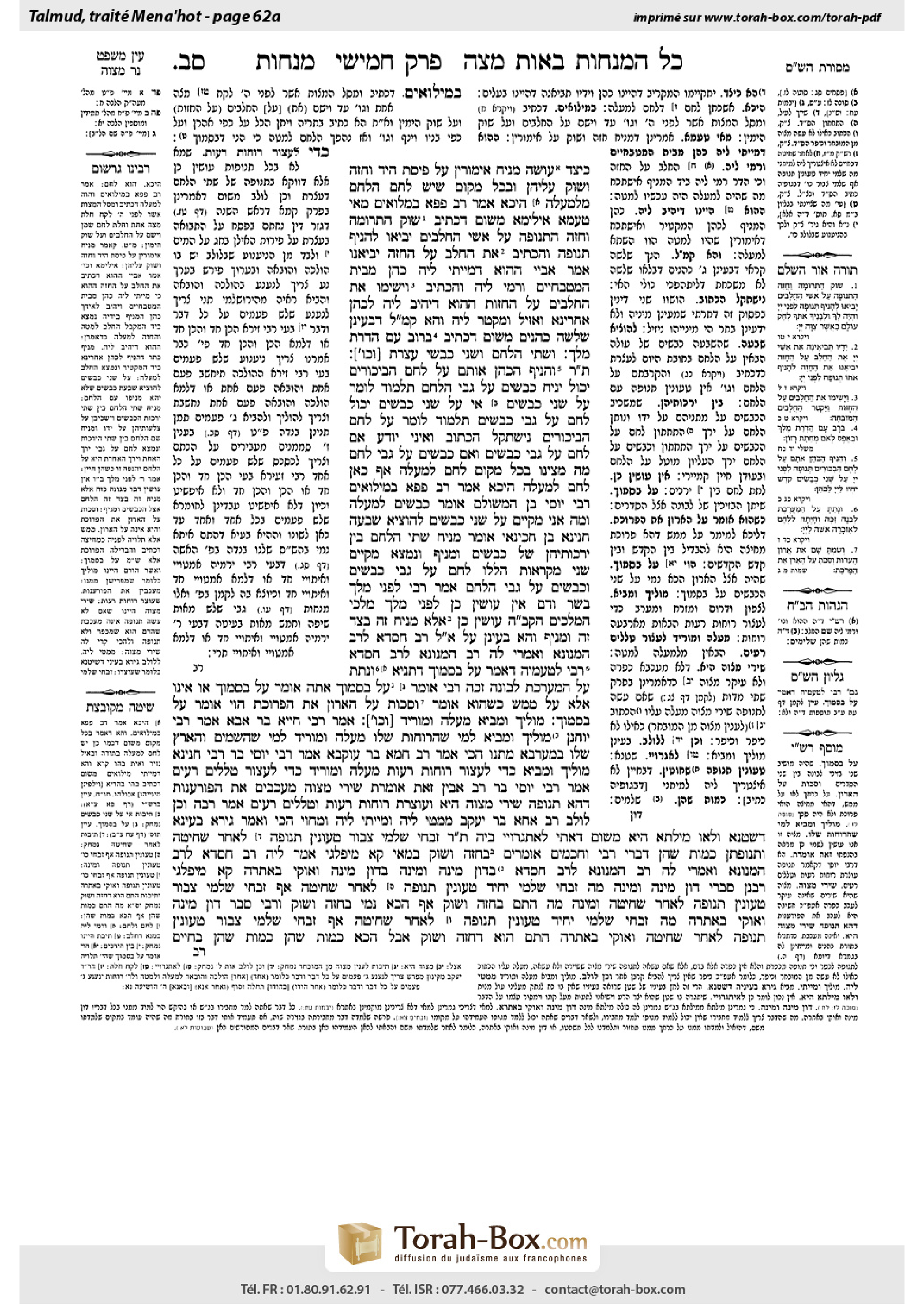
Menachot 62a: Talmud study for Daf Yomi
Daf Yomi is the daily study of one Talmud folio. Explore 37 tractates with scans, Hebrew text, Sefaria English and AI-generated French translations where annotated.
Passage selection and English or AI-generated French translation are available where the scan has annotations. Daf Study is independent of Torah-Box and Sefaria.
Browse Menachot · מנחות · All tractatesMenachot 62a text and translations
This page of Menachot includes the Aramaic text, an English translation and an AI-generated French translation, alongside the scan above.
מנחות ס״ב א · Aramaic and Hebrew text
כֵּיצַד עוֹשֶׂה? מַנִּיחַ אֵימוּרִין עַל פִּיסַּת הַיָּד, וְחָזֶה וָשׁוֹק עֲלֵיהֶן, וּבְכׇל מָקוֹם שֶׁיֵּשׁ לֶחֶם – הַלֶּחֶם מִלְּמַעְלָה.
הֵיכָא? אָמַר רַב פָּפָּא: בְּמִלּוּאִים.
מַאי טַעְמָא? אִילֵּימָא מִשּׁוּם דִּכְתִיב: ״שׁוֹק הַתְּרוּמָה וַחֲזֵה הַתְּנוּפָה עַל אִשֵּׁי הַחֲלָבִים יָבִיאוּ לְהָנִיף תְּנוּפָה״, וְהָכְתִיב: ״אֶת הַחֵלֶב עַל הֶחָזֶה יְבִיאֶנּוּ״!
אָמַר אַבָּיֵי: הָהוּא דְּמַיְיתֵי לֵיהּ כֹּהֵן מִבֵּית הַמִּטְבָּחַיִים, וְרָמֵי לֵיהּ.
וְהָכְתִיב ״וַיָּשִׂימוּ אֶת הַחֲלָבִים עַל הֶחָזוֹת״? הָהוּא דְּיָהֵיב לֵיהּ לְכֹהֵן אַחֲרִינָא, וְאָזֵיל וּמַקְטַר לֵיהּ.
וְהָא קָא מַשְׁמַע לַן, דְּבָעֵינַן שְׁלֹשָׁה כֹּהֲנִים, מִשּׁוּם דִּכְתִיב: ״בְּרׇב עָם הַדְרַת מֶלֶךְ״.
וּשְׁתֵּי הַלֶּחֶם וּשְׁנֵי כִּבְשֵׂי עֲצֶרֶת [וְכוּ׳]. תָּנוּ רַבָּנַן: ״וְהֵנִיף הַכֹּהֵן אֹתָם עַל לֶחֶם הַבִּיכּוּרִים״,
יָכוֹל יַנִּיחַ כְּבָשִׂים עַל גַּבֵּי הַלֶּחֶם? תַּלְמוּד לוֹמַר ״עַל שְׁנֵי כְּבָשִׂים״. אִי ״עַל שְׁנֵי כְּבָשִׂים״ יָכוֹל לֶחֶם עַל גַּבֵּי כְּבָשִׂים? תַּלְמוּד לוֹמַר ״עַל לֶחֶם הַבִּיכּוּרִים״.
נִישְׁתַּקֵּל הַכָּתוּב, וְאֵינִי יוֹדֵעַ אִם לֶחֶם עַל גַּבֵּי כְּבָשִׂים, וְאִם כְּבָשִׂים עַל גַּבֵּי לֶחֶם. מָה מָצִינוּ בְּכׇל מָקוֹם – לֶחֶם לְמַעְלָה, אַף כָּאן לֶחֶם לְמַעְלָה. הֵיכָא? אָמַר רַב פָּפָּא: בְּמִילּוּאִים.
רַבִּי יוֹסֵי בֶּן הַמְשׁוּלָּם אוֹמֵר: כְּבָשִׂים לְמַעְלָה, וּמָה אֲנִי מְקַיֵּים ״עַל שְׁנֵי כְּבָשִׂים״ – לְהוֹצִיא שִׁבְעָה.
חֲנִינָא בֶּן חֲכִינַאי אוֹמֵר: מַנִּיחַ שְׁתֵּי הַלֶּחֶם בֵּין יַרְכוֹתֵיהֶן שֶׁל כְּבָשִׂים וּמֵנִיף, וְנִמְצָא מְקַיֵּים שְׁנֵי מִקְרָאוֹת הַלָּלוּ: לֶחֶם עַל גַּבֵּי כְּבָשִׂים, וּכְבָשִׂים עַל גַּבֵּי הַלֶּחֶם. אָמַר רַבִּי: לִפְנֵי מֶלֶךְ בָּשָׂר וְדָם אֵין עוֹשִׂין כֵּן, לִפְנֵי מֶלֶךְ מַלְכֵי הַמְּלָכִים הַקָּדוֹשׁ בָּרוּךְ הוּא עוֹשִׂין כֵּן?! אֶלָּא מַנִּיחַ זֶה בְּצַד זֶה וּמֵנִיף.
וְהָא בָּעֵינַן ״עַל״, אֲמַר לֵיהּ רַב חִסְדָּא לְרַב הַמְנוּנָא, וְאָמְרִי לַהּ רַב הַמְנוּנָא לְרַב חִסְדָּא: רַבִּי לְטַעְמֵיהּ, דְּאָמַר ״עַל״ בְּסָמוּךְ.
דְּתַנְיָא, ״וְנָתַתָּ עַל הַמַּעֲרֶכֶת לְבֹנָה זַכָּה״, רַבִּי אוֹמֵר: ״עַל״ בְּסָמוּךְ, אַתָּה אוֹמֵר ״עַל״ בְּסָמוּךְ, אוֹ אֵינוֹ אֶלָּא ״עַל״ מַמָּשׁ? כְּשֶׁהוּא אוֹמֵר ״וְסַכֹּתָ עַל הָאָרֹן אֶת הַפָּרֹכֶת״, הֱוֵי אוֹמֵר ״עַל״ בְּסָמוּךְ.
מוֹלִיךְ וּמֵבִיא, מַעֲלֶה וּמוֹרִיד [וְכוּ׳]. אָמַר רַבִּי חִיָּיא בַּר אַבָּא, אָמַר רַבִּי יוֹחָנָן: מוֹלִיךְ וּמֵבִיא – לְמִי שֶׁהָרוּחוֹת שֶׁלּוֹ, מַעֲלֶה וּמוֹרִיד – לְמִי שֶׁהַשָּׁמַיִם וְהָאָרֶץ שֶׁלּוֹ.
בְּמַעְרְבָא מַתְנוּ הָכִי: אָמַר רַב חָמָא בַּר עוּקְבָא, אָמַר רַבִּי יוֹסֵי בַּר רַבִּי חֲנִינָא: מוֹלִיךְ וּמֵבִיא – כְּדֵי לַעֲצוֹר רוּחוֹת רָעוֹת, מַעֲלֶה וּמוֹרִיד – כְּדֵי לַעֲצוֹר טְלָלִים רָעִים.
אָמַר רַבִּי יוֹסֵי בַּר רַב אָבִין: זֹאת אוֹמֶרֶת שְׁיָרֵי מִצְוָה מְעַכְּבִים אֶת הַפּוּרְעָנוּת, דְּהָא תְּנוּפָה שְׁיָרֵי מִצְוָה הִיא, וְעוֹצֶרֶת רוּחוֹת רָעוֹת וּטְלָלִים רָעִים. אָמַר רַבָּה: וְכֵן לוּלָב.
רַב אַחָא בַּר יַעֲקֹב מַמְטֵי לֵיהּ וּמַיְיתֵי לֵיהּ, וּמַחְוֵי הָכִי, וְאָמַר: ״גִּירָא בְּעֵינָא דְשִׂטְנָא״. וְלָאו מִילְּתָא הִיא, מִשּׁוּם דְּאָתֵי לְאִתְגָּרוֹיֵי בֵּיהּ.
תָּנוּ רַבָּנַן: זִבְחֵי שַׁלְמֵי צִבּוּר טְעוּנִין תְּנוּפָה לְאַחַר שְׁחִיטָה, וּתְנוּפָתָן כְּמוֹת שֶׁהֵן – דִּבְרֵי רַבִּי, וַחֲכָמִים אוֹמְרִים: בְּחָזֶה וָשׁוֹק.
בְּמַאי קָא מִיפַּלְגִי? אֲמַר לֵיהּ רַב חִסְדָּא לְרַב הַמְנוּנָא, וְאָמְרִי לַהּ רַב הַמְנוּנָא לְרַב חִסְדָּא: בְּדוּן מִינַּהּ וּמִינַּהּ, בְּדוּן מִינַּהּ וְאוֹקֵי בְאַתְרַהּ – קָא מִיפַּלְגִי.
רַבָּנַן סָבְרִי: דּוּן מִינַּהּ וּמִינַּהּ – מָה זִבְחֵי שַׁלְמֵי יָחִיד טְעוּנִין תְּנוּפָה לְאַחַר שְׁחִיטָה, אַף זִבְחֵי שַׁלְמֵי צִבּוּר טְעוּנִין תְּנוּפָה לְאַחַר שְׁחִיטָה, וּמִינַּהּ – מָה הָתָם בְּחָזֶה וָשׁוֹק, אַף הָכָא נָמֵי בְּחָזֶה וָשׁוֹק.
וְרַבִּי סָבַר: דּוּן מִינַּהּ וְאוֹקֵי בְאַתְרַהּ – מָה זִבְחֵי שַׁלְמֵי יָחִיד טְעוּנִין תְּנוּפָה לְאַחַר שְׁחִיטָה, אַף זִבְחֵי שַׁלְמֵי צִבּוּר טְעוּנִין תְּנוּפָה לְאַחַר שְׁחִיטָה, וְאוֹקֵי בְּאַתְרַהּ – הָתָם הוּא דְּחָזֶה וָשׁוֹק, אֲבָל הָכָא כְּמוֹת שֶׁהֵן, כְּמוֹת שֶׁהֵן בַּחַיִּים.
Menachot 62a · English translation
The Gemara asks: How does one perform the ritual of waving? First he places the sacrificial portions on the palm of the hand, and puts the breast and the thigh on them. And in any place, i.e., with regard to any offering, where there are loaves brought with together with the animal, the loaves are placed on the top.
The Gemara asks: Where is it stated that the loaves must be placed on the top? Rav Pappa says: This is stated explicitly with regard to the ram offered at the inauguration of the priests, as the verse states: “And he took the fat, and the tail, and all the fat that was upon the inward, and the lobe of the liver, and the two kidneys, and their fat, and the right thigh. And out of the basket of matzot that was before the Lord he took one matza, and one cake of oiled bread, and one wafer, and placed them on the fat, and upon the right thigh. And he put it all upon the hands of Aaron, and upon the hands of his sons, and waved them for a wave offering before the Lord” (Leviticus 8:25–27).
The Gemara inquires: What is the reason, i.e., from where is it learned, that the sacrificial portions should be placed on the bottom, and the breast and thigh on top of them? If we say it is because it is written: “The thigh of heaving and the breast of waving they shall bring upon the offerings of the fat made by fire, to wave it for a wave offering before the Lord” (Leviticus 10:15), which indicates that the breast and thigh are placed on top of the fats, that is insufficient: But isn’t it written elsewhere: “The fat upon the breast he shall bring, that the breast may be waved for a wave offering before the Lord” (Leviticus 7:30)? That verse leads to the opposite conclusion, as it indicates that the fats are to be placed on top of the breast.
Abaye said: That second verse is not referring to the placement of the portions for waving. Rather, it describes their placement when the priest brings the parts of the offering from the slaughtering area in order to be waved. This priest carries the breast and thigh below the fats, and accordingly, when he overturns these parts onto the hand of the priest who will wave them, the fat will be under the breast and thigh.
The Gemara asks: But isn’t it written: “And they put the fat upon the breasts” (Leviticus 9:20), which also indicates that the fat is to be on top of, not beneath, the breast and thigh? The Gemara answers: That verse is referring to the stage when the priest who waved them gives them to another priest, who brings the sacrificial portions up to the altar. Once again the parts are turned over in this exchange, so that the sacrificial fats are on top of the breast. And this third priest then goes and burns the sacrificial portions on the altar.
The Gemara adds: And this teaches us that we require three priests to perform this service: One to bring the parts from the slaughtering area, one to wave them, and a third to burn them upon the altar. The reason why all three acts cannot be performed by a single priest is because it is written: “In the multitude of people is the King’s glory” (Proverbs 14:28). If a larger number of priests are involved in the Temple service, this represents greater glory for God. Therefore, it is preferable for the service to be carried out by three priests rather than one.
§ The mishna teaches: And the two loaves and the accompanying peace offering of two lambs brought on Shavuot also require waving. With regard to this waving, the Sages taught in a baraita: The verse states: “And the priest shall wave them upon the bread of the first fruits for a wave offering before the Lord, upon the two lambs; they shall be holy to the Lord for the priest” (Leviticus 23:20).
One might have thought that the priest who performs the waving must place the lambs on top of the bread for the waving. Therefore, the verse states: “A wave offering before the Lord upon the two lambs,” which indicates that the two loaves must be on top of the lambs. If the verse had stated only: “Upon the two lambs,” one might have thought the priest must place the bread on top of the lambs. Therefore, the verse states: “Upon the bread of the first fruits,” which indicates that the loaves are to be placed under the lambs for waving.
Consequently, the verse is evenly balanced, as two contradictory conclusions can be derived from it, and I do not know whether the bread should be on top of the lambs, or whether the lambs should be on top of the bread. The baraita resolves the contradiction: Just as we find everywhere that waving is performed that the bread is placed above the other portions, so too, in the case of the two loaves and the two lambs, the bread is placed above the lambs. The Gemara interrupts its citation of the baraita to ask: Where is it stated that the loaves must be placed on top? Rav Pappa says: This is stated explicitly with regard to the ram offered at the inauguration of the priests.
The Gemara resumes its citation of the baraita. Rabbi Yosei ben HaMeshullam disagrees with the previous ruling, and says: It is the lambs that are placed above, and the two loaves underneath them. And how do I realize the meaning of the phrase: “Upon the two lambs,” which seems to indicate that the two loaves are to be placed above the lambs and not under them? Rabbi Yosei ben HaMeshullam explains: This verse teaches that the requirement to wave the lambs together with the loaves applies only to the two lambs sacrificed as communal peace offerings on Shavuot, to exclude the seven other lambs, brought as burnt offerings, which are not to be waved with the loaves.
Ḥanina ben Ḥakhinai says there is a different answer: The priest places the two loaves between the thighs of the two lambs and waves them. And in this manner it is found that he realizes the meaning of both of these two verses, as the bread is on top of the lambs and the lambs are also on top of the bread. Rabbi Yehuda HaNasi says, in objection to this opinion: One would not do so, i.e., place bread that had been placed between the thighs of lambs, before a flesh and blood king; should one do so before the King of kings, the Holy One, Blessed be He? Rather, he places the two loaves and the two lambs alongside each other, and waves them together, and thereby fulfills the requirements of the verses in a respectful manner.
The Gemara raises an objection to the opinion of Rabbi Yehuda HaNasi: But we require fulfillment of the term “upon [al]” in the verse, either by placing the bread upon the lambs or the lambs upon the bread. In response, Rav Ḥisda says to Rav Hamnuna, and some say that Rav Hamnuna says to Rav Ḥisda: With this opinion, Rabbi Yehuda HaNasi conforms to his standard line of reasoning, as he says that the word al can mean next to.
This is as it is taught in a baraita: With regard to the shewbread, the verse states: “And you shall put pure frankincense upon [al] each row” (Leviticus 24:7). Rabbi Yehuda HaNasi says: Al in this instance means: Next to. The baraita asks: Do you say that al means: Next to? Or perhaps it means only actually upon? The baraita explains: When it says: “And you shall put there the Ark of the Testimony, and you shall place a cover over [al] the Ark with the Curtain” (Exodus 40:3), the word al cannot mean upon, as the Curtain that separated the Sanctuary from the Holy of Holies was hanging near the Ark, not placed on top of it. Therefore, you must say that al means next to.
§ The mishna teaches that the two loaves and the two lambs are waved in the following manner: The priest places his two hands below the lambs, extends them to each of the four directions and brings them back, then raises and lowers them. Rabbi Ḥiyya bar Abba says that Rabbi Yoḥanan says: He extends the lambs and brings them back in order to dedicate them to He to Whom the four directions belong. He raises and lowers them in order to dedicate them to He to Whom the heavens and the earth belong.
In the West, Eretz Yisrael, they taught the idea like this: Rabbi Ḥama bar Ukva says that Rabbi Yosei bar Rabbi Ḥanina says: He extends the lambs and brings them back in order to request a halt to harmful winds and storms that come from all directions. Similarly, he raises and lowers them in order to halt harmful dews and rains that come from above.
Rabbi Yosei bar Rav Avin says: That is to say, i.e., it can be derived from here, that a non-essential mitzva helps prevent calamity, as waving is a non-essential mitzva; even if one failed to wave the loaves he has fulfilled his obligation, and nevertheless waving halts harmful winds and dews. Rava says: And one should conduct himself similarly with a lulav on the festival of Sukkot, i.e., he should extend and bring back and raise and lower the lulav, for the same reasons.
The Gemara relates: Rav Aḥa bar Ya’akov would extend and bring back the lulav in this manner, and would say: I am hereby shooting an arrow in the eye of Satan, as despite Satan’s best efforts, the Jewish people continue to fulfill mitzvot joyously. The Gemara comments: It is not correct to say this, because this will induce Satan to come to incite the Jewish people to sin. Gloating about his victory over the evil inclination will lead Satan to redouble its efforts to corrupt them.
§ The Gemara continues to discuss halakhot concerning the waving of offerings: The Sages taught in a baraita: The communal peace offerings, which were brought on the festival of Shavuot and which must be waved while the animals are still alive, also require waving after their slaughter, and their waving after they are slaughtered is to be performed as they are, meaning that the whole animal must be waved, as was done when it was alive; this is the statement of Rabbi Yehuda HaNasi. And the Rabbis say: One does not wave the whole animal; rather, the waving is performed only with the breast and thigh.
The Gemara inquires: With regard to what principle do Rabbi Yehuda HaNasi and the Rabbis disagree? Rav Ḥisda said to Rav Hamnuna, and some say Rav Hamnuna said to Rav Ḥisda: They disagree with regard to a principle about the application of verbal analogies. One adopts the exegetical principle: Infer from it and derive the details from it, meaning that when one case is derived from another by means of a verbal analogy, all the details of the source case are applied to the second case. The other Sage accepts the principle: Infer from it but interpret the halakha according to its own place, meaning that one derives only the specific detail referred to by the verbal analogy, and all other aspects of the source case are not applied to the other case.
The Gemara elaborates: The waving of communal peace offerings is derived from the waving of individual peace offerings through a verbal analogy. The Rabbis maintain: Infer from it and derive the details from it, leading to the conclusion: Just as individual peace offerings require waving after slaughter, so too, communal peace offerings require waving after slaughter. And derive the details from it: Just as there, in the case of individual peace offerings, the waving is performed with the breast and thigh alone, so too here, with regard to communal peace offerings as well, the waving is with the breast and thigh alone.
And Rabbi Yehuda HaNasi maintains: Infer from it but interpret the halakha according to its own place, meaning that the basic halakha of the verbal analogy is accepted: Just as individual peace offerings require waving after slaughter, so too, communal peace offerings require waving after slaughter. But interpret the halakha according to its own place: It is only there, in the case of individual peace offerings, that the waving is performed with the breast and thigh alone. But here, in the case of communal peace offerings, the waving is as they are, i.e., the animals are waved whole, as they were when they were alive.
Menachot 62a · Traduction française (IA)
La Guemara demande : Comment accomplit-on le rite de la tenoufa ? On place d’abord les parties sacrificielles sur la paume de la main, puis on pose dessus la poitrine et la cuisse. Et partout où des pains sont apportés avec l’animal, c’est-à-dire pour toute offrande de ce type, les pains sont placés au-dessus.
La Guemara demande : Où est-il indiqué que les pains doivent être placés au-dessus ? Rav Pappa dit : Cela est explicitement indiqué à propos du bélier offert lors de l’inauguration des prêtres, comme le dit le verset : « Il prit la graisse, la queue, toute la graisse qui recouvrait les entrailles, le lobe du foie, les deux rognons et leur graisse, ainsi que la cuisse droite. Du panier de pains azymes qui se trouvait devant le Seigneur, il prit un pain azyme, un gâteau de pain huilé et une galette, et les plaça sur la graisse et sur la cuisse droite. Il plaça le tout sur les mains d’Aaron et sur les mains de ses fils, et les agita en offrande de tenoufa devant le Seigneur » (Lévitique 8, 25-27).
La Guemara demande : Quelle est la raison, c’est-à-dire d’où apprend-on que les parties sacrificielles doivent être placées en dessous et la poitrine et la cuisse au-dessus ? Si l’on répond que cela découle du verset : « La cuisse prélevée et la poitrine de la tenoufa, ils les apporteront avec les offrandes de graisse consumées par le feu, afin de les agiter en offrande de tenoufa devant le Seigneur » (Lévitique 10, 15), ce qui indique que la poitrine et la cuisse sont placées au-dessus des graisses, cela ne suffit pas. N’est-il pas écrit ailleurs : « Il apportera la graisse qui est sur la poitrine, afin que la poitrine soit agitée en offrande de tenoufa devant le Seigneur » (Lévitique 7, 30) ? Ce verset mène à la conclusion opposée, puisqu’il indique que les graisses doivent être placées au-dessus de la poitrine.
Abayé dit : Ce second verset ne concerne pas la disposition des parties lors de la tenoufa. Il décrit plutôt leur disposition lorsque le prêtre apporte les parties de l’offrande depuis le lieu de l’abattage pour qu’elles soient agitées. Ce prêtre porte la poitrine et la cuisse sous les graisses ; par conséquent, lorsqu’il retourne ces parties sur la main du prêtre qui les agitera, les graisses se trouveront sous la poitrine et la cuisse.
La Guemara demande : Mais n’est-il pas écrit : « Ils placèrent la graisse sur les poitrines » (Lévitique 9, 20), ce qui indique également que la graisse doit se trouver au-dessus, et non en dessous, de la poitrine et de la cuisse ? La Guemara répond : Ce verset concerne le moment où le prêtre qui les a agitées les remet à un autre prêtre, lequel apporte les parties sacrificielles à l’autel. Lors de cet échange, les parties sont de nouveau retournées, de sorte que les graisses sacrificielles se trouvent au-dessus de la poitrine. Ce troisième prêtre va ensuite brûler les parties sacrificielles sur l’autel.
La Guemara ajoute : Cela nous enseigne que trois prêtres sont nécessaires pour accomplir ce service : l’un apporte les parties depuis le lieu de l’abattage, un autre les agite, et un troisième les brûle sur l’autel. Si un seul prêtre ne peut accomplir ces trois actes, c’est parce qu’il est écrit : « Dans la multitude du peuple est la gloire du Roi » (Proverbes 14, 28). Si un plus grand nombre de prêtres participe au service du Temple, cela représente une plus grande gloire pour Dieu. Il est donc préférable que le service soit accompli par trois prêtres plutôt que par un seul.
§ La Michna enseigne que les deux pains et l’offrande de paix qui les accompagne, composée de deux agneaux apportés à Chavouot, requièrent eux aussi la tenoufa. À propos de cette tenoufa, les Sages ont enseigné dans une baraïta : Le verset dit : « Le prêtre les agitera sur le pain des prémices, en offrande de tenoufa devant le Seigneur, avec les deux agneaux ; ils seront consacrés au Seigneur, pour le prêtre » (Lévitique 23, 20).
On aurait pu penser que le prêtre qui accomplit la tenoufa doit placer les agneaux au-dessus du pain pour les agiter. C’est pourquoi le verset dit : « En offrande de tenoufa devant le Seigneur, sur les deux agneaux », ce qui indique que les deux pains doivent se trouver au-dessus des agneaux. Si le verset avait seulement dit : « Sur les deux agneaux », on aurait pu penser que le prêtre doit placer le pain au-dessus des agneaux. C’est pourquoi le verset dit : « Sur le pain des prémices », ce qui indique que les pains doivent être placés sous les agneaux pour la tenoufa.
Par conséquent, le verset est ambigu, puisqu’on peut en tirer deux conclusions contradictoires, et je ne sais pas si le pain doit être au-dessus des agneaux ou si les agneaux doivent être au-dessus du pain. La baraïta résout cette contradiction : de même que, partout où la tenoufa est accomplie, le pain est placé au-dessus des autres parties, de même, dans le cas des deux pains et des deux agneaux, le pain est placé au-dessus des agneaux. La Guemara interrompt la citation de la baraïta pour demander : Où est-il indiqué que les pains doivent être placés au-dessus ? Rav Pappa dit : Cela est explicitement indiqué à propos du bélier offert lors de l’inauguration des prêtres.
La Guemara reprend la citation de la baraïta. Rabbi Yossei ben HaMeshullam conteste la décision précédente et dit : Ce sont les agneaux qui sont placés au-dessus, et les deux pains en dessous. Comment, alors, comprendre l’expression « sur les deux agneaux », qui semble indiquer que les deux pains doivent être placés au-dessus des agneaux, et non en dessous ? Rabbi Yossei ben HaMeshullam explique : Ce verset enseigne que l’obligation d’agiter les agneaux avec les pains ne s’applique qu’aux deux agneaux sacrifiés comme offrandes de paix communautaires à Chavouot ; il exclut les sept autres agneaux, apportés comme holocaustes, qui ne doivent pas être agités avec les pains.
Ḥanina ben Ḥakhinai donne une autre réponse : Le prêtre place les deux pains entre les cuisses des deux agneaux et les agite. De cette manière, les deux versets sont satisfaits : le pain est au-dessus des agneaux, et les agneaux sont aussi au-dessus du pain. Rabbi Yehouda HaNassi objecte à cette opinion : On ne ferait pas cela — placer du pain entre les cuisses d’agneaux — devant un roi de chair et de sang ; le ferait-on devant le Roi des rois, le Saint, béni soit-Il ? Il place plutôt les deux pains et les deux agneaux côte à côte et les agite ensemble, satisfaisant ainsi aux exigences des versets de manière respectueuse.
La Guemara objecte à l’opinion de Rabbi Yehouda HaNassi : Il faut pourtant que le terme « sur » [al] du verset soit respecté, soit en plaçant le pain sur les agneaux, soit en plaçant les agneaux sur le pain. En réponse, Rav Ḥisda dit à Rav Hamnuna — et certains disent que Rav Hamnuna dit à Rav Ḥisda : Par cette opinion, Rabbi Yehouda HaNassi reste fidèle à son principe habituel, car il affirme que le mot al peut signifier « à côté de ».
C’est ce qui est enseigné dans une baraïta : À propos du pain de proposition, le verset dit : « Tu mettras de l’encens pur sur [al] chaque rangée » (Lévitique 24, 7). Rabbi Yehouda HaNassi dit : Ici, al signifie « à côté de ». La baraïta demande : Dis-tu que al signifie « à côté de » ? Ou signifie-t-il peut-être uniquement « sur » au sens propre ? La baraïta explique : Lorsqu’il est écrit : « Tu y placeras l’Arche du Témoignage, et tu mettras un voile sur [al] l’Arche » (Exode 40, 3), le mot al ne peut pas signifier « sur », car le voile qui séparait le Sanctuaire du Saint des Saints était suspendu près de l’Arche et non posé sur elle. Il faut donc dire que al signifie « à côté de ».
§ La Michna enseigne que les deux pains et les deux agneaux sont agités de la manière suivante : Le prêtre place ses deux mains sous les agneaux, les tend dans chacune des quatre directions puis les ramène, et ensuite les élève et les abaisse. Rabbi Ḥiyya bar Abba dit au nom de Rabbi Yoḥanan : Il tend les agneaux et les ramène afin de les consacrer à Celui à qui appartiennent les quatre directions. Il les élève et les abaisse afin de les consacrer à Celui à qui appartiennent les cieux et la terre.
En Occident, en Terre d’Israël, on enseignait cette idée ainsi : Rabbi Ḥama bar Ukva dit au nom de Rabbi Yossei bar Rabbi Ḥanina : Il tend les agneaux et les ramène afin de demander l’arrêt des vents violents et des tempêtes nuisibles qui viennent de toutes les directions. De même, il les élève et les abaisse afin de faire cesser les rosées et les pluies nuisibles qui viennent d’en haut.
Rabbi Yossei bar Rav Avin dit : Cela signifie, c’est-à-dire qu’on peut en déduire, qu’une mitsva non indispensable contribue à prévenir un malheur ; la tenoufa est une mitsva non indispensable, car même si l’on omet d’agiter les pains, on s’est acquitté de son obligation, et pourtant la tenoufa arrête les vents violents et les rosées nuisibles. Rava dit : On doit agir de même avec un loulav pendant la fête de Souccot, c’est-à-dire le tendre, le ramener, l’élever et l’abaisser, pour les mêmes raisons.
La Guemara rapporte : Rav Aḥa bar Ya’akov tendait le loulav et le ramenait de cette manière, en disant : « Je tire ainsi une flèche dans l’œil de Satan », car malgré tous les efforts de Satan, le peuple juif continue d’accomplir joyeusement les mitsvot. La Guemara commente : Il ne convient pas de dire cela, car cela incitera Satan à venir pousser le peuple juif à pécher. Se vanter de sa victoire sur le penchant mauvais conduira Satan à redoubler d’efforts pour le corrompre.
§ La Guemara poursuit son examen des halakhot concernant la tenoufa des offrandes : Les Sages ont enseigné dans une baraïta : Les offrandes de paix communautaires apportées à la fête de Chavouot, qui doivent être agitées alors que les animaux sont encore vivants, requièrent également une tenoufa après leur abattage. Après l’abattage, elles sont agitées telles qu’elles sont, c’est-à-dire que l’animal entier doit être agité comme lorsqu’il était vivant. Telle est l’opinion de Rabbi Yehouda HaNassi. Les Sages disent : On n’agite pas l’animal entier ; on agite seulement la poitrine et la cuisse.
La Guemara demande : Sur quel principe Rabbi Yehouda HaNassi et les Sages sont-ils en désaccord ? Rav Ḥisda dit à Rav Hamnuna — et certains disent que Rav Hamnuna dit à Rav Ḥisda : Ils sont en désaccord au sujet d’un principe concernant l’application des analogies verbales. L’un adopte le principe d’exégèse suivant : « Déduis-en et applique les détails qui en découlent », ce qui signifie que lorsqu’un cas est déduit d’un autre au moyen d’une analogie verbale, tous les détails du cas source s’appliquent au second cas. L’autre Sage accepte le principe suivant : « Déduis-en, mais interprète la halakha selon son propre contexte », ce qui signifie qu’on ne déduit que le détail précis auquel renvoie l’analogie verbale, sans appliquer les autres aspects du cas source à l’autre cas.
La Guemara développe : La tenoufa des offrandes de paix communautaires est déduite de celle des offrandes de paix individuelles au moyen d’une analogie verbale. Les Sages soutiennent le principe : « Déduis-en et applique les détails qui en découlent », d’où la conclusion suivante : de même que les offrandes de paix individuelles requièrent une tenoufa après l’abattage, de même les offrandes de paix communautaires requièrent une tenoufa après l’abattage. Applique aussi les détails qui en découlent : de même que, dans le cas des offrandes de paix individuelles, la tenoufa est accomplie avec la seule poitrine et la seule cuisse, de même, ici aussi, pour les offrandes de paix communautaires, la tenoufa est accomplie avec la seule poitrine et la seule cuisse.
Rabbi Yehouda HaNassi soutient le principe : « Déduis-en, mais interprète la halakha selon son propre contexte », ce qui signifie que le principe fondamental de l’analogie verbale est accepté : de même que les offrandes de paix individuelles requièrent une tenoufa après l’abattage, de même les offrandes de paix communautaires requièrent une tenoufa après l’abattage. Mais il faut interpréter la halakha selon son propre contexte : c’est uniquement là, dans le cas des offrandes de paix individuelles, que la tenoufa est accomplie avec la seule poitrine et la seule cuisse. Ici, en revanche, dans le cas des offrandes de paix communautaires, la tenoufa est accomplie avec les animaux tels qu’ils sont, c’est-à-dire qu’ils sont agités entiers comme lorsqu’ils étaient vivants.
Traduction française générée par IA à partir de l’édition anglaise de Sefaria. Vérifie toujours un passage avec le texte source.
Text from Sefaria: William Davidson Edition - Vocalized Aramaic (unknown); William Davidson Edition - English (CC BY NC).