Menachot 62b: Talmud study for Daf Yomi
Daf Yomi is the daily study of one Talmud folio. Explore 37 tractates with scans, Hebrew text, Sefaria English and AI-generated French translations where annotated.
Passage selection and English or AI-generated French translation are available where the scan has annotations. Daf Study is independent of Torah-Box and Sefaria.
Browse Menachot · מנחות · All tractatesMenachot 62b text and translations
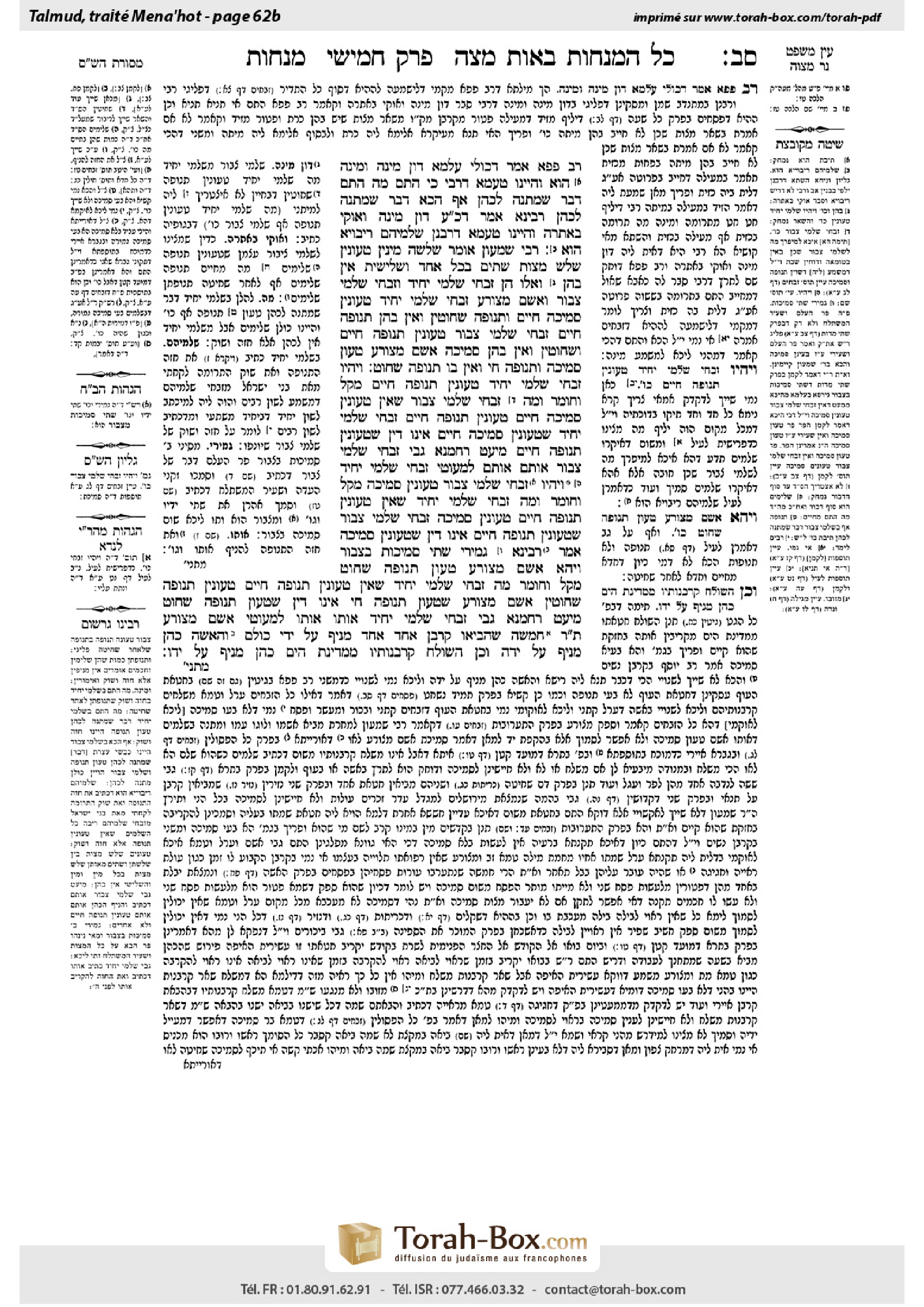
This page of Menachot includes the Aramaic text, an English translation and an AI-generated French translation, alongside the scan above.
מנחות ס״ב ב · Aramaic and Hebrew text
רַב פָּפָּא אָמַר: דְּכוּלֵּי עָלְמָא דּוּן מִינַּהּ וּמִינַּהּ הוּא, וְהַיְינוּ טַעְמָא דְּרַבִּי – כִּי הָתָם, מָה הָתָם דָּבָר שֶׁמַּתָּנָה לְכֹהֵן, אַף הָכָא דָּבָר שֶׁמַּתָּנָה לַכֹּהֵן.
רָבִינָא אָמַר, דְּכוּלֵּי עָלְמָא דּוּן מִינַּהּ וְאוֹקֵי בְאַתְרַהּ, וְהַיְינוּ טַעְמָא דְּרַבָּנַן: ״שַׁלְמֵיהֶם״ רִיבּוּיָא הוּא.
רַבִּי שִׁמְעוֹן אוֹמֵר: שְׁלֹשָׁה מִינִין טְעוּנִין שָׁלֹשׁ מִצְוֹת, שְׁתַּיִם בְּכׇל אֶחָד וּשְׁלִישִׁית אֵין בָּהֶן, וְאֵלּוּ הֵן: זִבְחֵי שַׁלְמֵי יָחִיד, וְזִבְחֵי שַׁלְמֵי צִבּוּר, וַאֲשַׁם מְצוֹרָע.
זִבְחֵי שַׁלְמֵי יָחִיד טְעוּנִין סְמִיכָה חַיִּים, וּתְנוּפָה שְׁחוּטִין, וְאֵין בָּהֶן תְּנוּפָה חַיִּים. זִבְחֵי שַׁלְמֵי צִבּוּר טְעוּנִין תְּנוּפָה חַיִּים וּשְׁחוּטִין, וְאֵין בָּהֶן סְמִיכָה. אֲשַׁם מְצוֹרָע טָעוּן סְמִיכָה וּתְנוּפָה חַי, וְאֵין בּוֹ תְּנוּפָה שָׁחוּט.
וְיִהְיוּ זִבְחֵי שַׁלְמֵי יָחִיד טְעוּנִין תְּנוּפָה חַיִּים, מִקַּל וְחוֹמֶר: וּמָה זִבְחֵי שַׁלְמֵי צִבּוּר, שֶׁאֵין טְעוּנִין סְמִיכָה חַיִּים, טְעוּנִין תְּנוּפָה חַיִּים – זִבְחֵי שַׁלְמֵי יָחִיד, שֶׁטְּעוּנִין סְמִיכָה חַיִּים, אֵינוֹ דִּין שֶׁטְּעוּנִין תְּנוּפָה חַיִּים!
מִיעֵט רַחֲמָנָא גַּבֵּי זִבְחֵי שַׁלְמֵי צִבּוּר, ״אֹתָם״, ״אוֹתָם״ – לְמַעוֹטֵי זִבְחֵי שַׁלְמֵי יָחִיד.
וְיִהְיוּ זִבְחֵי שַׁלְמֵי צִבּוּר טְעוּנִין סְמִיכָה, מִקַּל וָחוֹמֶר: וּמָה זִבְחֵי שַׁלְמֵי יָחִיד, שֶׁאֵין טְעוּנִין תְּנוּפָה חַיִּים – טְעוּנִין סְמִיכָה, זִבְחֵי שַׁלְמֵי צִבּוּר שֶׁטְּעוּנִין תְּנוּפָה חַיִּים – אֵינוֹ דִּין שֶׁטְּעוּנִין סְמִיכָה? אָמַר רָבִינָא: גְּמִירִי שְׁתֵּי סְמִיכוֹת בְּצִבּוּר.
וִיהֵא אֲשַׁם מְצוֹרָע טָעוּן תְּנוּפָה שָׁחוּט, מִקַּל וְחוֹמֶר: מָה זִבְחֵי שַׁלְמֵי יָחִיד שֶׁאֵין טְעוּנִין תְּנוּפָה חַיִּים, טְעוּנִין תְּנוּפָה שְׁחוּטִין – אֲשַׁם מְצוֹרָע שֶׁטָּעוּן תְּנוּפָה חַי, אֵינוֹ דִּין שֶׁטָּעוּן תְּנוּפָה שָׁחוּט!
מִיעֵט רַחֲמָנָא גַּבֵּי זִבְחֵי שַׁלְמֵי יָחִיד, ״אֹתוֹ״, ״אוֹתוֹ״ לְמַעוֹטֵי אֲשַׁם מְצוֹרָע.
תָּנוּ רַבָּנַן: חֲמִשָּׁה שֶׁהֵבִיאוּ קׇרְבָּן אֶחָד – אֶחָד מֵנִיף עַל יְדֵי כּוּלָּם, וְהָאִשָּׁה – כֹּהֵן מֵנִיף עַל יָדָהּ, וְכֵן הַשּׁוֹלֵחַ קׇרְבְּנוֹתָיו מִמְּדִינַת הַיָּם – כֹּהֵן מֵנִיף עַל יָדוֹ.
Menachot 62b · English translation
Rav Pappa said there is a different explanation of the dispute between Rabbi Yehuda HaNasi and the Rabbis: Everyone, even Rabbi Yehuda HaNasi, agrees that with regard to a verbal analogy, the guiding principle is: Infer from it and derive the details from it. And this is the reason for Rabbi Yehuda HaNasi’s ruling that after the slaughter of the communal peace offering one waves the entire body offering, not just the breast and thigh: It is done here like it is done there, in the case of individual peace offerings: Just as there, one waves the item that is a gift to the priest, as the breast and thigh are given to the priests to eat, so too here, with regard to the communal peace offerings, one waves the item that is a gift to the priest. Since the communal peace offerings are given to the priests in their entirety, they are also waved in their entirety.
Ravina said an explanation which is the opposite of Rav Pappa’s: Everyone, even the Rabbis, agrees that the guiding principle is: Infer from it but interpret the halakha according to its own place. And this is the reason for the ruling of the Rabbis that one waves only the breast and thigh of communal peace offerings: The verse states with regard to individual peace offerings: “For the breast of waving and the thigh of heaving I have taken from the children of Israel out of their sacrifices of peace offerings, and have given them to Aaron the priest and to his sons as an eternal portion from among the children of Israel” (Leviticus 7:34). The term: “Their sacrifices of peace offerings,” is in the plural, despite the fact that the verse is referring to individual peace offerings. This is an amplification, which teaches that the same halakha applies to communal peace offerings, i.e., that only the breast and the thigh are to be waved.
§ The mishna teaches: Rabbi Shimon says: There are three types of offerings that require performance of three mitzvot. Two mitzvot are performed on each and every one of them, but the third mitzva is not performed in their sacrifice, meaning that each of these offerings requires two out of the same three mitzvot, but not necessarily the same two as the others. And these are the three offerings: Peace offerings brought as gift offerings by an individual, communal peace offerings, i.e., the two lambs brought with the two loaves on the festival of Shavuot, and the guilt offering of a leper.
The mishna continues: Peace offerings brought by individuals require placing hands on the head of the animals while the animals are still alive, and waving after they are slaughtered, but there is no obligation of waving them while they are alive. Communal peace offerings require waving both while they are still alive and after they are slaughtered, but there is no obligation of placing hands on them. And the guilt offering of a leper requires placing hands and waving it while it is still alive, but there is no obligation of waving it after it is slaughtered.
The Gemara challenges: And let peace offerings brought by an individual require waving while still alive, as this can be derived via an a fortiori inference: And if communal peace offerings, whose halakha is more lenient than that of individual peace offerings in that they do not require placing hands on the head of offerings while they are alive, nevertheless require waving when alive, then with regard to peace offerings brought by an individual, which do require placing hands while alive, is it not logical to conclude that they require waving when alive?
The Gemara answers: This a fortiori inference is not accepted, because the Merciful One excluded peace offerings brought by an individual, as the verse states with regard to communal peace offerings: “And the priest shall wave them with the bread of the first fruits for a wave offering before the Lord, with the two lambs” (Leviticus 23:20). The word “them” serves to exclude peace offerings brought by an individual from the requirement of waving while the animal is alive.
The Gemara asks: And let communal peace offerings require placing hands, as this can be derived via an a fortiori inference: And if peace offerings brought by an individual, whose halakha is more lenient than that of communal peace offerings in that they do not require waving while alive, nevertheless require placing hands, then with regard to communal peace offerings, which do require waving when alive, is it not logical to conclude that they require placing hands? Ravina said: This a fortiori inference is not accepted, as it is learned as a tradition from Sinai that there are only two cases of placing hands in communal offerings: The scapegoat on Yom Kippur and the bull brought for an unwitting communal sin.
The Gemara further asks: And let the guilt offering of a leper require waving after the animal has been slaughtered, as this can be derived via an a fortiori inference: And if peace offerings brought by an individual, whose halakha is more lenient than that of the guilt offering of a leper in that they do not require waving when alive, nevertheless require waving after they are slaughtered, then with regard to the guilt offering of a leper, which requires waving while alive, is it not logical to conclude that it also requires waving after it is slaughtered?
The Gemara answers: The Merciful One excluded the guilt offering of a leper, as the verse states with regard to peace offerings brought by an individual: “His own hands shall bring the offerings of the Lord made by fire; the fat with the breast shall he bring; the breast, to wave it before the Lord” (Leviticus 7:30). The word “it” serves to exclude the guilt offering of a leper from the requirement of waving after the animal has been slaughtered.
§ The Sages taught: With regard to five people who brought one offering together, one of them waves the offering on behalf of all of them. And in the case of a woman who brings an offering, the priest waves the offering on her behalf. And similarly, with regard to one who sends his offerings from overseas, the priest waves them on his behalf.
Menachot 62b · Traduction française (IA)
Rav Pappa dit qu’il existe une autre explication au désaccord entre Rabbi Yehouda HaNassi et les Rabbins : tous, y compris Rabbi Yehouda HaNassi, conviennent que, dans le cas d’une analogie verbale, le principe directeur est le suivant : on en déduit une règle et on en tire les détails. Telle est la raison de la décision de Rabbi Yehouda HaNassi : après l’abattage de l’offrande de paix communautaire, on agite l’offrande entière, et pas seulement la poitrine et la cuisse. On procède ici comme là, dans le cas des offrandes de paix individuelles : de même que là, on agite ce qui est donné au prêtre — car la poitrine et la cuisse sont données aux prêtres pour qu’ils les mangent —, de même ici, pour les offrandes de paix communautaires, on agite ce qui est donné au prêtre. Puisque les offrandes de paix communautaires sont données aux prêtres dans leur intégralité, elles sont également agitées dans leur intégralité.
Ravina donne une explication opposée à celle de Rav Pappa : tous, y compris les Rabbins, conviennent que le principe directeur est le suivant : on en déduit une règle, mais on interprète la halakha selon son contexte propre. Telle est la raison de la décision des Rabbins : on agite seulement la poitrine et la cuisse des offrandes de paix communautaires. Le verset dit à propos des offrandes de paix individuelles : « Car j’ai pris, sur leurs sacrifices de paix, la poitrine destinée à l’agitation et la cuisse destinée à être élevée, parmi les enfants d’Israël, et je les ai données à Aaron le prêtre et à ses fils comme part perpétuelle, prélevée sur les enfants d’Israël » (Lévitique 7:34). L’expression « leurs sacrifices de paix » est au pluriel, bien que le verset se rapporte aux offrandes de paix individuelles. C’est une extension qui enseigne que la même halakha s’applique aux offrandes de paix communautaires, c’est-à-dire que seule la poitrine et la cuisse doivent être agitées.
§ La Michna enseigne : Rabbi Shimon dit : Il existe trois catégories d’offrandes qui requièrent l’accomplissement de trois mitsvot. Deux mitsvot sont accomplies pour chacune d’elles, mais la troisième mitsva n’est pas accomplie lors de leur sacrifice ; autrement dit, chacune de ces offrandes requiert deux des trois mêmes mitsvot, mais pas nécessairement les deux mêmes que les autres. Voici ces trois offrandes : les offrandes de paix apportées par un particulier comme offrandes volontaires, les offrandes de paix communautaires — c’est-à-dire les deux agneaux apportés avec les deux pains lors de la fête de Chavouot — et le sacrifice de culpabilité d’un lépreux.
La Michna poursuit : les offrandes de paix apportées par des particuliers requièrent qu’on pose les mains sur la tête des animaux alors qu’ils sont encore vivants, puis qu’on les agite après leur abattage ; mais il n’est pas obligatoire de les agiter lorsqu’ils sont vivants. Les offrandes de paix communautaires requièrent qu’on les agite aussi bien lorsqu’elles sont encore vivantes qu’après leur abattage, mais il n’est pas obligatoire de poser les mains sur elles. Le sacrifice de culpabilité d’un lépreux requiert qu’on pose les mains sur lui et qu’on l’agite alors qu’il est encore vivant, mais il n’est pas obligatoire de l’agiter après son abattage.
La Guemara objecte : ne faudrait-il pas exiger que les offrandes de paix apportées par un particulier soient agitées alors qu’elles sont encore vivantes, en le déduisant par un raisonnement a fortiori ? Si les offrandes de paix communautaires, dont la halakha est plus clémente que celle des offrandes de paix individuelles, puisqu’elles ne requièrent pas qu’on pose les mains sur leur tête lorsqu’elles sont encore vivantes, doivent néanmoins être agitées alors qu’elles sont vivantes, à plus forte raison les offrandes de paix apportées par un particulier, qui requièrent qu’on pose les mains sur elles lorsqu’elles sont vivantes, ne devraient-elles pas être agitées alors qu’elles sont vivantes ?
La Guemara répond : ce raisonnement a fortiori n’est pas retenu, car le Miséricordieux a exclu les offrandes de paix apportées par un particulier, comme le dit le verset au sujet des offrandes de paix communautaires : « Le prêtre les agitera avec le pain des prémices, en offrande d’agitation devant le Seigneur, avec les deux agneaux » (Lévitique 23:20). Le mot « les » sert à exclure les offrandes de paix apportées par un particulier de l’obligation d’agiter l’animal lorsqu’il est vivant.
La Guemara demande : ne faudrait-il pas exiger qu’on pose les mains sur les offrandes de paix communautaires, en le déduisant par un raisonnement a fortiori ? Si les offrandes de paix apportées par un particulier, dont la halakha est plus clémente que celle des offrandes de paix communautaires, puisqu’elles ne requièrent pas d’être agitées lorsqu’elles sont vivantes, requièrent néanmoins qu’on pose les mains sur elles, à plus forte raison les offrandes de paix communautaires, qui doivent être agitées lorsqu’elles sont vivantes, ne devraient-elles pas requérir qu’on pose les mains sur elles ? Ravina dit : ce raisonnement a fortiori n’est pas retenu, car une tradition remontant au Sinaï enseigne qu’il n’y a que deux cas où l’on pose les mains sur des offrandes communautaires : le bouc émissaire de Yom Kippour et le taureau apporté pour une faute involontaire de la communauté.
La Guemara demande encore : ne faudrait-il pas exiger que le sacrifice de culpabilité d’un lépreux soit agité après l’abattage de l’animal, en le déduisant par un raisonnement a fortiori ? Si les offrandes de paix apportées par un particulier, dont la halakha est plus clémente que celle du sacrifice de culpabilité d’un lépreux, puisqu’elles ne requièrent pas d’être agitées lorsqu’elles sont vivantes, doivent néanmoins être agitées après leur abattage, à plus forte raison le sacrifice de culpabilité d’un lépreux, qui requiert d’être agité lorsqu’il est vivant, ne devrait-il pas également être agité après son abattage ?
La Guemara répond : le Miséricordieux a exclu le sacrifice de culpabilité d’un lépreux, comme le dit le verset à propos des offrandes de paix apportées par un particulier : « De ses propres mains, il apportera les offrandes du Seigneur faites par le feu ; il apportera la graisse avec la poitrine ; la poitrine, pour l’agiter devant le Seigneur » (Lévitique 7:30). Le mot « la » sert à exclure le sacrifice de culpabilité d’un lépreux de l’obligation d’agiter l’animal après son abattage.
§ Les Sages ont enseigné : lorsque cinq personnes apportent ensemble une seule offrande, l’une d’elles l’agite au nom de toutes. Dans le cas d’une femme qui apporte une offrande, le prêtre l’agite en son nom. De même, lorsqu’une personne envoie ses offrandes depuis l’étranger, le prêtre les agite en son nom.
Traduction française générée par IA à partir de l’édition anglaise de Sefaria. Vérifie toujours un passage avec le texte source.
Text from Sefaria: William Davidson Edition - Vocalized Aramaic (unknown); William Davidson Edition - English (CC BY NC).