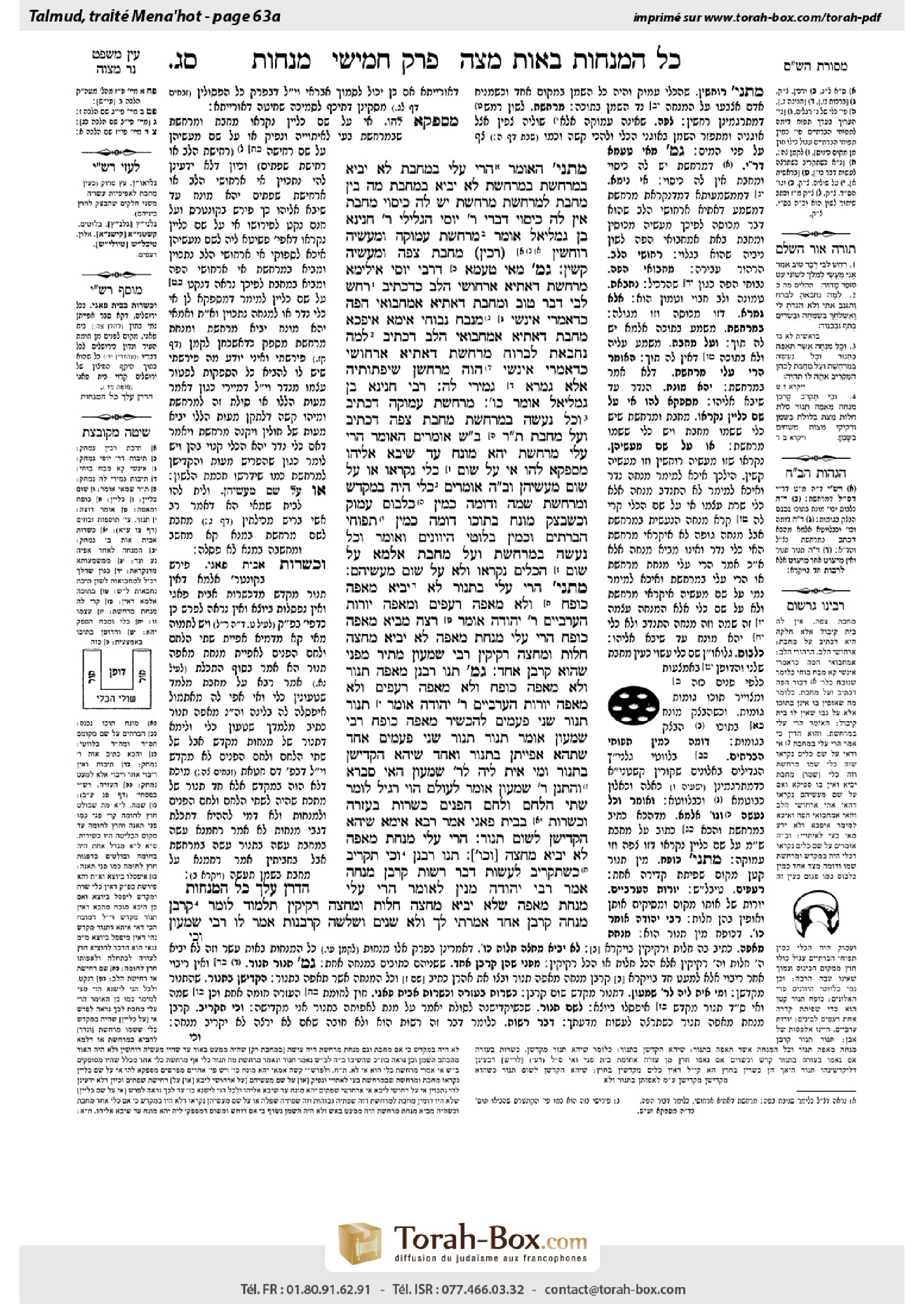
Menachot 63a: Talmud study for Daf Yomi
Daf Yomi is the daily study of one Talmud folio. Explore 37 tractates with scans, Hebrew text, Sefaria English and AI-generated French translations where annotated.
Passage selection and English or AI-generated French translation are available where the scan has annotations. Daf Study is independent of Torah-Box and Sefaria.
Browse Menachot · מנחות · All tractatesMenachot 63a text and translations
This page of Menachot includes the Aramaic text, an English translation and an AI-generated French translation, alongside the scan above.
מנחות ס״ג א · Aramaic and Hebrew text
מַתְנִי׳ הָאוֹמֵר ״הֲרֵי עָלַי בְּמַחֲבַת״ – לֹא יָבִיא בְּמַרְחֶשֶׁת, ״בְּמַרְחֶשֶׁת״ – לֹא יָבִיא בְּמַחֲבַת. מָה בֵּין מַחֲבַת לְמַרְחֶשֶׁת? מַרְחֶשֶׁת יֵשׁ לָהּ כִּיסּוּי, מַחֲבַת אֵין לָהּ כִּיסּוּי, דִּבְרֵי רַבִּי יוֹסֵי הַגְּלִילִי. רַבִּי חֲנִינָא בֶּן גַּמְלִיאֵל אוֹמֵר: מַרְחֶשֶׁת עֲמוּקָּה וּמַעֲשֶׂיהָ רוֹחֲשִׁין (רַכִּין), מַחֲבַת צָפָה וּמַעֲשֶׂיהָ קָשִׁין.
גְּמָ׳ מַאי טַעְמָא דְּרַבִּי יוֹסֵי? אִילֵּימָא מַרְחֶשֶׁת, דְּאָתְיָא אַרִחוּשֵׁי הַלֵּב, כְּדִכְתִיב: ״רָחַשׁ לִבִּי דָּבָר טוֹב״, וּמַחֲבַת, דְּאָתְיָא אַמַּחְבּוֹאֵי הַפֶּה, כִּדְאָמְרִי אִינָשֵׁי: ״מְנַבַּח נַבּוֹחֵי״.
אֵימָא אִיפְּכָא: מַחֲבַת, דְּאָתְיָא אַמַּחְבּוֹאֵי הַלֵּב, דִּכְתִיב ״לָמָּה נַחְבֵּאתָ לִבְרֹחַ״; מַרְחֶשֶׁת, דְּאָתְיָא אַרִחוּשֵׁי [הַפֶּה], כִּדְאָמְרִי אִינָשֵׁי: ״הֲוָה מְרַחֲשָׁן שִׂיפְוָותֵיהּ״. אֶלָּא גְּמָרָא גְּמִירִי לַהּ.
רַבִּי חֲנִינָא בֶּן גַּמְלִיאֵל אוֹמֵר כּוּ׳. מַרְחֶשֶׁת עֲמוּקָּה – דִּכְתִיב ״וְכׇל נַעֲשָׂה בַמַּרְחֶשֶׁת״, מַחֲבַת צָפָה – דִּכְתִיב ״וְעַל מַחֲבַת״.
תָּנוּ רַבָּנַן: בֵּית שַׁמַּאי אוֹמְרִים: הָאוֹמֵר ״הֲרֵי עָלַי מַרְחֶשֶׁת״ יְהֵא מוּנָּח עַד שֶׁיָּבֹא אֵלִיָּהוּ.
מְסַפְּקָא לְהוּ, אִי עַל שׁוּם כְּלִי נִקְרְאוּ, אוֹ עַל שׁוּם מַעֲשֵׂיהֶן.
וּבֵית הִלֵּל אוֹמְרִים: כְּלִי הָיָה בַּמִּקְדָּשׁ, וּ״מַרְחֶשֶׁת״ שְׁמוֹ, וְדוֹמֶה כְּמִין כַּלְבּוֹס עָמוֹק, וּכְשֶׁבָּצֵק מוּנָּח בְּתוֹכוֹ – דּוֹמֶה כְּמִין תַּפּוּחֵי הַבָּרָתִים וּכְמִין בִּלְוָטֵי הַיְּוָונִים.
וְאוֹמֵר: ״וְכׇל נַעֲשָׂה בַמַּרְחֶשֶׁת וְעַל מַחֲבַת״, אַלְמָא עַל שׁוּם הַכֵּלִים נִקְרְאוּ, וְלֹא עַל שׁוּם מַעֲשֵׂיהֶם.
מַתְנִי׳ הֲרֵי עָלַי בְּתַנּוּר – לֹא יָבִיא מַאֲפֵה כוּפָּח, וְלֹא מַאֲפֵה רְעָפִים, וּמַאֲפֵה יוֹרוֹת הָעַרְבִיִּים. רַבִּי יְהוּדָה אוֹמֵר: רָצָה – מֵבִיא מַאֲפֵה כוּפָּח.
הֲרֵי עָלַי מִנְחַת מַאֲפֶה – לֹא יָבִיא מֶחֱצָה חַלּוֹת וּמֶחֱצָה רְקִיקִין; רַבִּי שִׁמְעוֹן מַתִּיר, מִפְּנֵי שֶׁהוּא קׇרְבָּן אֶחָד.
גְּמָ׳ תָּנוּ רַבָּנַן: ״מַאֲפֵה תַנּוּר״, וְלֹא מַאֲפֵה כוּפָּח, וְלֹא מַאֲפֵה רְעָפִים, וְלֹא מַאֲפֵה יוֹרוֹת הָעַרְבִיִּים.
רַבִּי יְהוּדָה אוֹמֵר: ״תַּנּוּר״ ״תַּנּוּר״ שְׁנֵי פְּעָמִים, לְהַכְשִׁיר מַאֲפֵה כוּפָּח. רַבִּי שִׁמְעוֹן אוֹמֵר: ״תַּנּוּר״ ״תַּנּוּר״ שְׁנֵי פְּעָמִים, אֶחָד שֶׁתְּהֵא אֲפִיָּיתָן בְּתַנּוּר, וְאֶחָד שֶׁיְּהֵא הֶקְדֵּישָׁן בַּתַּנּוּר.
וּמִי אִית לֵיהּ לְרַבִּי שִׁמְעוֹן הַאי סְבָרָא? וְהָתְנַן: רַבִּי שִׁמְעוֹן אוֹמֵר: לְעוֹלָם הֱוֵי רָגִיל לוֹמַר שְׁתֵּי הַלֶּחֶם וְלֶחֶם הַפָּנִים כְּשֵׁרוֹת בָּעֲזָרָה, וּכְשֵׁרוֹת בְּבֵית פָּאגֵי.
אָמַר רָבָא: אֵימָא, שֶׁיְּהֵא הֶקְדֵּישָׁן לְשׁוּם תַּנּוּר.
הֲרֵי עָלַי מִנְחַת מַאֲפֵה, לֹא יָבִיא מֶחֱצָה [וְכוּ׳]. תָּנוּ רַבָּנַן: ״וְכִי תַּקְרִיב״ – כְּשֶׁתַּקְרִיב, לַעֲשׂוֹת דְּבַר רְשׁוּת.
״קׇרְבַּן מִנְחָה״ – אָמַר רַבִּי יְהוּדָה: מִנַּיִן לְאוֹמֵר ״הֲרֵי עָלַי מִנְחַת מַאֲפֶה״, שֶׁלֹּא יָבִיא מֶחֱצָה חַלּוֹת וּמֶחֱצָה רְקִיקִין? תַּלְמוּד לוֹמַר ״קׇרְבָּן מִנְחָה״ – קׇרְבָּן אֶחָד אָמַרְתִּי לָךְ, וְלֹא שְׁנַיִם וּשְׁלֹשָׁה קׇרְבָּנוֹת.
אָמַר לוֹ רַבִּי שִׁמְעוֹן:
Menachot 63a · English translation
MISHNA: One who takes a vow to bring a meal offering to the Temple and says: It is incumbent upon me to bring a meal offering prepared in a maḥavat, may not bring one prepared in a marḥeshet. Similarly, if he says: It is incumbent upon me to bring a meal offering prepared in a marḥeshet, he may not bring one prepared in a maḥavat. The mishna clarifies: What is the difference between a maḥavat and a marḥeshet? A marḥeshet has a cover, whereas a maḥavat does not have a cover; this is the statement of Rabbi Yosei HaGelili. Rabbi Ḥanina ben Gamliel says: A marḥeshet is deep, and due to the large amount of oil, its product is soft because it moves about [roḥashin] in the oil. A maḥavat is flat, as the sides of the pan are level with the pan, and due to the small amount of oil, its product is hard.
GEMARA: The Gemara inquires: As the Torah does not describe the different vessels, what is the reason for the interpretation of Rabbi Yosei HaGelili, explaining that a marḥeshet has a cover and a maḥavat does not have a cover? If we say that the term marḥeshet indicates that the offering comes to atone for the sinful musings [raḥashei] of the heart, as it is written: “My heart muses [raḥash] on a goodly matter” (Psalms 45:2), and therefore this meal offering must be prepared in a covered vessel just as the thoughts of the heart are hidden, this interpretation is insufficient. And if we say that the term maḥavat indicates that the offering comes to atone for transgressions committed with the corners of [ammaḥavo’ei] the mouth, as people say with regard to someone who speaks loudly: He is barking [minbaḥ nevuḥei], and therefore this meal offering must be prepared in an open vessel, this interpretation is also insufficient.
The reason these interpretations are insufficient is that one can also say the opposite, and suggest that the name maḥavat indicates that the offering must be prepared in a closed vessel, as it comes to atone for the secret musings of the heart, as it is written that Laban said to Jacob: “Why did you flee secretly [naḥbeita]” (Genesis 31:27). Likewise, with regard to marḥeshet, one can say that it must be prepared in an open vessel, as it comes to atone for whispers [reḥushei] of the mouth which are heard and revealed, as people say: His lips were whispering [meraḥashan]. Therefore, Rabbi Yosei HaGelili cannot derive the meanings of the terms marḥeshet and maḥavat from the verses; rather, his interpretation is learned as a tradition.
§ The mishna teaches: Rabbi Ḥanina ben Gamliel says that a marḥeshet is deep, whereas a maḥavat is flat. The Gemara explains the reason for this opinion: A marḥeshet is deep, as it is written with regard to this meal offering: “And all that is made in the marḥeshet” (Leviticus 7:9). The use of the term “in” indicates that this meal offering is prepared inside a vessel, i.e., a deep container. Conversely, a maḥavat is flat, with the sides of the pan level with the pan, as it is written with regard to this meal offering: “And on the maḥavat” (Leviticus 7:9). The use of the term “on” indicates that it is prepared on the vessel, not inside it. Therefore, a flat vessel is required.
§ The mishna teaches that if one vows: It is incumbent upon me to bring a meal offering prepared in a marḥeshet, he is obligated to bring a meal offering of that type. With regard to this, the Sages taught that Beit Shammai say: With regard to one who says: It is incumbent upon me to bring a marḥeshet, without using the term: Meal offering, or the preposition: In, in such a case the money for the meal offering should be placed in a safe place until the prophet Elijah comes heralding the Messiah, and clarifies what should be done.
The Gemara elaborates: Beit Shammai are uncertain with regard to the source of the terms marḥeshet and maḥavat, whether the offerings are called these names due to the specific vessel in which each meal offering is prepared, or whether they are called these names due to the manner of their preparation. The significance of this distinction is that if the term marḥeshet is referring to a specific type of vessel, then if one takes a vow: It is incumbent upon me to bring a marḥeshet, he must bring an actual vessel of that type, whereas if the term is referring to the manner of preparation of the meal offering then he is obligated to bring that type of meal offering. Since Beit Shammai are uncertain which is the correct interpretation, they rule that he must wait until the prophet Elijah comes.
And Beit Hillel say that there is no uncertainty about this matter, as there was a particular vessel in the Temple, and its name was marḥeshet. And this vessel resembled a type of deep kelabus, which is a vessel with indentations, and when dough is placed inside it, it gets pressed against the indentations and takes their shape. The dough resembles a type of apple of berotim trees, or a type of acorn [balutei] of the Greek oak trees. Therefore, one who takes a vow: It is incumbent upon me to bring a marḥeshet, must bring this type of vessel to the Temple as a donation.
And the verse states two different prepositions with regard to these vessels: “And all that is made in the marḥeshet and on the maḥavat” (Leviticus 7:9). It does not state simply: And all that is made in the marḥeshet and the maḥavat. Since it seems from the verse that when using the marḥeshet the meal offering is prepared inside the vessel and when using the maḥavat it is prepared on the vessel, evidently they are called these names due to the vessel in which the meal offering is prepared, not due to the manner of their preparation.
MISHNA: If one says: It is incumbent upon me to bring a meal offering baked in an oven, he may not bring a meal offering baked on a small oven [kupaḥ], nor a meal offering baked on roofing tiles, nor a meal offering baked in the baking pits of the Arabs. Rabbi Yehuda says: If he so wishes, he may bring a meal offering baked on a kupaḥ.
If one says: It is incumbent upon me to bring a baked meal offering, without specifying loaves or wafers, he may not bring half the required offering in the form of loaves and the other half in the form of wafers; rather, they must all be of one form or the other. Rabbi Shimon deems this permitted, due to the fact that both loaves and wafers are written with regard to this meal offering, which indicates that it is one offering of two possible forms.
GEMARA: The Sages taught in a baraita: When the verse states: “And when you bring a meal offering baked in an oven” (Leviticus 2:4), this emphasizes that it must be prepared in an oven, and not baked on a kupaḥ, nor baked on roofing tiles, nor baked in the baking pits of the Arabs, in accordance with the opinion of the first tanna in the mishna.
Rabbi Yehuda says: In this verse it states “oven,” and it also states “oven” in another verse: “And every meal offering that is baked in the oven” (Leviticus 7:9). Since it is written two times, and these terms are restrictions, one follows the hermeneutical principle that a restrictive expression following a restrictive expression serves only to amplify the halakha and include additional cases. Consequently, this derivation serves to render fit a meal offering baked on a kupaḥ, and it too is deemed an oven. Rabbi Shimon says: The terms “oven” and “oven,” which are written a total of two times, serve to teach two halakhot: One instance teaches that their baking should be in an oven, and the other one teaches that their consecration is in an oven, i.e., meal offerings are not consecrated in service vessels but rather in the oven.
The Gemara asks: And does Rabbi Shimon hold in accordance with this line of reasoning? But didn’t we learn in a mishna (95b) that Rabbi Shimon says: One should always be accustomed to say that the two loaves and the shewbread are valid if they are kneaded, shaped, or baked in the Temple courtyard, and that they are also valid if they are prepared in the place called Beit Pagei, which is outside the walls of the Temple Mount? As these offerings are not disqualified by being taken outside the Temple, evidently they are not consecrated in the oven.
Rava said in response: Rabbi Shimon maintains that the oven does not consecrate meal offerings, and as for his statement in the baraita concerning the two derivations, one should say that the other derivation from the term “oven” teaches that their consecration by the owner must be explicit, i.e., from the outset he must say that he is sanctifying his meal offering for the sake of a meal offering baked in an oven.
§ The mishna teaches that if one says: It is incumbent upon me to bring a baked meal offering, he may not bring half the required offering in the form of loaves and half in the form of wafers, whereas Rabbi Shimon deems this permitted, as it is one offering. The Sages taught in a baraita: The verse states: “And when you bring a meal offering baked in an oven” (Leviticus 2:4). The phrase: “And when you bring,” indicates that this offering is not obligatory. Rather, when you wish you may bring, i.e., the verse teaches how to perform the meal offering baked in an oven as a voluntary matter.
With regard to the term: “A meal offering,” Rabbi Yehuda says: From where is it derived with regard to one who says: It is incumbent upon me to bring a baked meal offering, that he must not bring half of the bread in the form of loaves and half in the form of wafers? The verse states: “A meal offering,” which indicates: I told you to bring one offering, i.e., all ten loaves from one type, and not two or three offerings of different types, as allowed by Rabbi Shimon.
The baraita continues: Rabbi Shimon said to Rabbi Yehuda:
Menachot 63a · Traduction française (IA)
MICHNA : Celui qui fait le vœu d’apporter au Temple une offrande de farine et dit : « Je suis tenu d’apporter une offrande de farine préparée dans une maḥavat » ne peut pas en apporter une préparée dans une marḥeshet. De même, s’il dit : « Je suis tenu d’apporter une offrande de farine préparée dans une marḥeshet », il ne peut pas en apporter une préparée dans une maḥavat. La Michna précise : quelle est la différence entre une maḥavat et une marḥeshet ? Une marḥeshet a un couvercle, tandis qu’une maḥavat n’en a pas ; telle est l’opinion de Rabbi Yosei HaGelili. Rabbi Ḥanina ben Gamliel dit : une marḥeshet est profonde et, en raison de la grande quantité d’huile, ce qu’on y prépare est tendre, car cela remue [roḥashin] dans l’huile. Une maḥavat est plate, ses bords étant au même niveau que le fond ; en raison de la faible quantité d’huile, ce qu’on y prépare est dur.
GUEMARA : La Guemara demande : puisque la Torah ne décrit pas les différents ustensiles, sur quoi Rabbi Yosei HaGelili fonde-t-il son interprétation selon laquelle une marḥeshet a un couvercle et une maḥavat n’en a pas ? Si l’on dit que le terme marḥeshet indique que l’offrande vient expier les pensées pécheresses [raḥashei] du cœur, comme il est écrit : « Mon cœur médite [raḥash] une belle parole » (Psaumes 45,2), et que cette offrande de farine doit donc être préparée dans un récipient couvert, de même que les pensées du cœur sont cachées, cette interprétation ne suffit pas. Et si l’on dit que le terme maḥavat indique que l’offrande vient expier les transgressions commises avec les commissures [ammaḥavo’ei] de la bouche, car on dit de quelqu’un qui parle fort : « Il aboie [minbaḥ nevuḥei] », et que cette offrande de farine doit donc être préparée dans un récipient découvert, cette interprétation ne suffit pas non plus.
La raison pour laquelle ces interprétations ne suffisent pas est que l’on pourrait aussi soutenir le contraire et suggérer que le nom maḥavat indique que l’offrande doit être préparée dans un récipient fermé, puisqu’elle vient expier les pensées secrètes du cœur, comme il est écrit que Laban dit à Jacob : « Pourquoi t’es-tu enfui secrètement [naḥbeita] ? » (Genèse 31,27). De même, à propos de la marḥeshet, on pourrait dire qu’elle doit être préparée dans un récipient découvert, puisqu’elle vient expier les murmures [reḥushei] de la bouche, qui sont entendus et révélés, comme on dit : « Ses lèvres murmuraient [meraḥashan]. » Rabbi Yosei HaGelili ne peut donc pas déduire le sens des termes marḥeshet et maḥavat des versets ; son interprétation repose plutôt sur une tradition.
§ La Michna enseigne que, selon Rabbi Ḥanina ben Gamliel, une marḥeshet est profonde, tandis qu’une maḥavat est plate. La Guemara explique le fondement de cet avis : une marḥeshet est profonde, comme il est écrit au sujet de cette offrande de farine : « Et tout ce qui est préparé dans la marḥeshet » (Lévitique 7,9). L’emploi de la préposition « dans » indique que cette offrande de farine est préparée à l’intérieur d’un récipient, c’est-à-dire dans un récipient profond. À l’inverse, une maḥavat est plate, ses bords étant au même niveau que le fond, comme il est écrit au sujet de cette offrande de farine : « Et sur la maḥavat » (Lévitique 7,9). L’emploi de la préposition « sur » indique qu’elle est préparée sur le récipient, et non à l’intérieur. Il faut donc un récipient plat.
§ La Michna enseigne que si quelqu’un fait le vœu suivant : « Je suis tenu d’apporter une offrande de farine préparée dans une marḥeshet », il est tenu d’apporter une offrande de farine de ce type. À ce sujet, les Sages ont enseigné que Beit Shammaï dit : lorsqu’un homme dit : « Je suis tenu d’apporter une marḥeshet », sans employer le terme « offrande de farine » ni la préposition « dans », l’argent destiné à l’offrande de farine doit être placé en lieu sûr jusqu’à ce que le prophète Élie vienne annoncer le Messie et clarifier ce qu’il convient de faire.
La Guemara développe : Beit Shammaï ne sait pas avec certitude si les termes marḥeshet et maḥavat désignent les offrandes en raison du récipient particulier dans lequel chacune est préparée, ou en raison de leur mode de préparation. Cette distinction est importante : si le terme marḥeshet désigne un type précis de récipient, alors celui qui fait le vœu suivant : « Je suis tenu d’apporter une marḥeshet » doit apporter un véritable récipient de ce type ; en revanche, si le terme désigne le mode de préparation de l’offrande de farine, il est tenu d’apporter une offrande de farine de ce type. Comme Beit Shammaï ne sait pas quelle interprétation est la bonne, il statue qu’il faut attendre la venue du prophète Élie.
Beit Hillel dit qu’il n’y a aucune incertitude à ce sujet, car il y avait dans le Temple un récipient particulier appelé marḥeshet. Ce récipient ressemblait à une sorte de kelabus profond, c’est-à-dire un récipient comportant des creux ; lorsqu’on y plaçait de la pâte, celle-ci était pressée contre ces creux et en prenait la forme. La pâte ressemblait à une sorte de pomme des arbres berotim ou à une sorte de gland [balutei] des chênes grecs. Par conséquent, celui qui fait le vœu suivant : « Je suis tenu d’apporter une marḥeshet » doit apporter au Temple, à titre de don, un récipient de ce type.
Et le verset emploie deux prépositions différentes à propos de ces récipients : « Et tout ce qui est préparé dans la marḥeshet et sur la maḥavat » (Lévitique 7,9). Il ne dit pas simplement : « Et tout ce qui est préparé dans la marḥeshet et la maḥavat. » Puisque le verset semble indiquer que, lorsqu’on utilise la marḥeshet, l’offrande de farine est préparée à l’intérieur du récipient, tandis que, lorsqu’on utilise la maḥavat, elle est préparée sur le récipient, il ressort qu’elles portent ces noms en raison du récipient dans lequel l’offrande de farine est préparée, et non de son mode de préparation.
MICHNA : Si quelqu’un dit : « Je suis tenu d’apporter une offrande de farine cuite au four », il ne peut pas apporter une offrande de farine cuite sur un petit four [kupaḥ], ni une offrande de farine cuite sur des tuiles, ni une offrande de farine cuite dans les fosses de cuisson des Arabes. Rabbi Yehuda dit : s’il le souhaite, il peut apporter une offrande de farine cuite sur un kupaḥ.
Si quelqu’un dit : « Je suis tenu d’apporter une offrande de farine cuite », sans préciser s’il s’agit de pains ou de galettes, il ne peut pas apporter la moitié de l’offrande requise sous forme de pains et l’autre moitié sous forme de galettes ; tous les éléments doivent être d’un seul type ou de l’autre. Rabbi Shimon estime que cela est permis, étant donné que les pains et les galettes sont tous deux mentionnés à propos de cette offrande de farine, ce qui indique qu’il s’agit d’une seule offrande pouvant prendre l’une ou l’autre de ces deux formes.
GUEMARA : Les Sages ont enseigné dans une baraïta : lorsque le verset dit : « Et lorsque tu apportes une offrande de farine cuite au four » (Lévitique 2,4), il souligne qu’elle doit être préparée dans un four, et non cuite sur un kupaḥ, sur des tuiles ou dans les fosses de cuisson des Arabes, conformément à l’avis du premier tanna de la Michna.
Rabbi Yehuda dit : dans ce verset, il est écrit « four », et le terme « four » apparaît également dans un autre verset : « Et toute offrande de farine cuite au four » (Lévitique 7,9). Puisque le terme apparaît deux fois et que ces expressions sont restrictives, on applique le principe herméneutique selon lequel une expression restrictive qui suit une autre expression restrictive sert à élargir la halakha et à inclure des cas supplémentaires. Cette déduction permet donc de valider une offrande de farine cuite sur un kupaḥ, qui est lui aussi considéré comme un four. Rabbi Shimon dit : les termes « four » et « four », qui apparaissent au total deux fois, enseignent deux halakhot : l’un indique que la cuisson doit avoir lieu dans un four, et l’autre que la consécration doit se faire dans un four, c’est-à-dire que les offrandes de farine ne sont pas consacrées dans des ustensiles de service, mais dans le four.
La Guemara demande : Rabbi Shimon défend-il vraiment ce raisonnement ? N’avons-nous pas appris dans une Michna (95b) que Rabbi Shimon dit : on doit toujours être prêt à dire que les deux pains et le pain de proposition sont valides s’ils sont pétris, façonnés ou cuits dans la cour du Temple, et qu’ils sont également valides s’ils sont préparés à l’endroit appelé Beit Pagei, qui se trouve à l’extérieur des murs du mont du Temple ? Puisque ces offrandes ne sont pas invalidées lorsqu’elles sont emportées hors du Temple, il ressort qu’elles ne sont pas consacrées dans le four.
Rava répondit : Rabbi Shimon soutient que le four ne consacre pas les offrandes de farine. Quant à sa déclaration dans la baraïta au sujet des deux déductions, il faut dire que l’autre déduction tirée du terme « four » enseigne que la consécration par le propriétaire doit être explicite : dès le départ, celui-ci doit dire qu’il consacre son offrande de farine en vue d’une offrande de farine cuite au four.
§ La Michna enseigne que si quelqu’un dit : « Je suis tenu d’apporter une offrande de farine cuite », il ne peut pas apporter la moitié de l’offrande requise sous forme de pains et l’autre moitié sous forme de galettes, tandis que Rabbi Shimon estime que cela est permis, puisqu’il s’agit d’une seule offrande. Les Sages ont enseigné dans une baraïta : le verset dit : « Et lorsque tu apportes une offrande de farine cuite au four » (Lévitique 2,4). L’expression « lorsque tu apportes » indique que cette offrande n’est pas obligatoire. Autrement dit, tu peux l’apporter quand tu le souhaites ; le verset enseigne donc comment présenter à titre volontaire l’offrande de farine cuite au four.
Au sujet du terme « une offrande de farine », Rabbi Yehuda dit : d’où déduit-on que celui qui dit : « Je suis tenu d’apporter une offrande de farine cuite » ne doit pas apporter la moitié du pain sous forme de pains et l’autre moitié sous forme de galettes ? Le verset dit : « Une offrande de farine », ce qui signifie : je t’ai dit d’apporter une seule offrande, c’est-à-dire les dix pains d’un seul type, et non deux ou trois offrandes de types différents, comme le permet Rabbi Shimon.
La baraïta poursuit : Rabbi Shimon dit à Rabbi Yehuda :
Traduction française générée par IA à partir de l’édition anglaise de Sefaria. Vérifie toujours un passage avec le texte source.
Text from Sefaria: William Davidson Edition - Vocalized Aramaic (unknown); William Davidson Edition - English (CC BY NC).