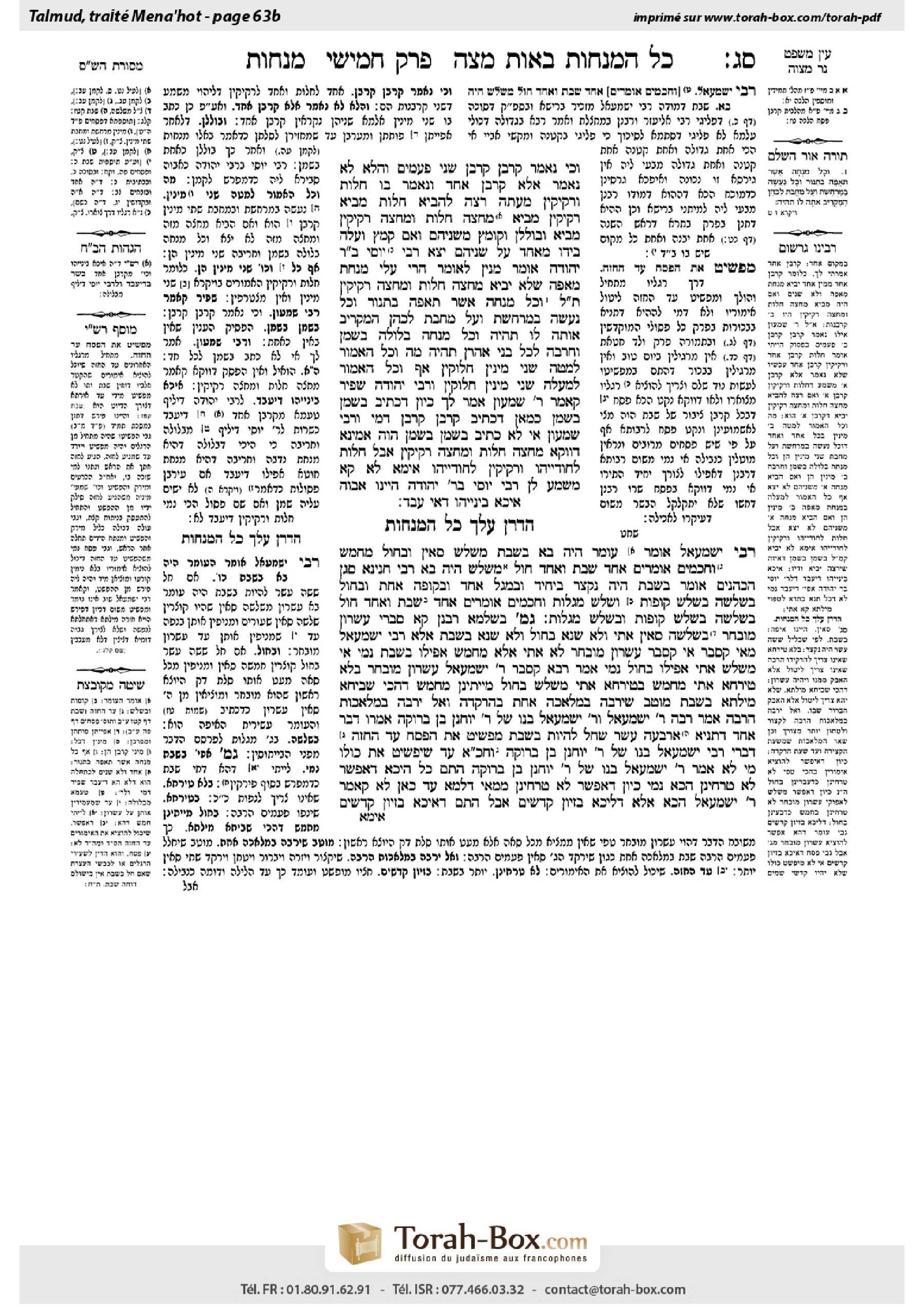
Menachot 63b: Talmud study for Daf Yomi
Daf Yomi is the daily study of one Talmud folio. Explore 37 tractates with scans, Hebrew text, Sefaria English and AI-generated French translations where annotated.
Passage selection and English or AI-generated French translation are available where the scan has annotations. Daf Study is independent of Torah-Box and Sefaria.
Browse Menachot · מנחות · All tractatesMenachot 63b text and translations
This page of Menachot includes the Aramaic text, an English translation and an AI-generated French translation, alongside the scan above.
מנחות ס״ג ב · Aramaic and Hebrew text
וְכִי נֶאֱמַר ״קׇרְבָּן״ ״קׇרְבָּן״ שְׁנֵי פְּעָמִים? וַהֲלֹא לֹא נֶאֱמַר אֶלָּא קׇרְבָּן אֶחָד, וְנֶאֱמַר בּוֹ חַלּוֹת וּרְקִיקִין.
מֵעַתָּה, רָצָה לְהָבִיא חַלּוֹת – מֵבִיא, רְקִיקִין – מֵבִיא, מֶחֱצָה חַלּוֹת וּמֶחֱצָה רְקִיקִין – מֵבִיא, וּבוֹלְלָן וְקוֹמֵץ מִשְּׁנֵיהֶם, וְאִם קָמַץ וְעָלָה בְּיָדוֹ מֵאֶחָד עַל שְׁנֵיהֶם – יָצָא.
רַבִּי יוֹסֵי בַּר רַבִּי יְהוּדָה אוֹמֵר: מִנַּיִן לְאוֹמֵר ״הֲרֵי עָלַי מִנְחַת מַאֲפֶה״, שֶׁלֹּא יָבִיא מֶחֱצָה חַלּוֹת וּמֶחֱצָה רְקִיקִין? תַּלְמוּד לוֹמַר: ״וְכׇל מִנְחָה אֲשֶׁר תֵּאָפֶה בַּתַּנּוּר״, ״וְכׇל נַעֲשָׂה בַמַּרְחֶשֶׁת וְעַל מַחֲבַת לַכֹּהֵן הַמַּקְרִיב אֹתָהּ לוֹ תִהְיֶה״, ״וְכׇל מִנְחָה בְלוּלָה בַשֶּׁמֶן וַחֲרֵבָה לְכׇל בְּנֵי אַהֲרֹן תִּהְיֶה״.
מָה ״וְכׇל״ הָאָמוּר לְמַטָּה שְׁנֵי מִינִין חֲלוּקִין, אַף ״וְכׇל״ הָאָמוּר לְמַעְלָה שְׁנֵי מִינִין חֲלוּקִין.
וְרַבִּי יְהוּדָה, שַׁפִּיר קָאָמַר רַבִּי שִׁמְעוֹן? אָמַר לָךְ: כֵּיוָן דִּכְתִיב ״בַּשֶּׁמֶן״ ״בַּשֶּׁמֶן״, כְּמַאן דִּכְתִיב ״קׇרְבָּן״ ״קׇרְבָּן״ דָּמֵי.
וְרַבִּי שִׁמְעוֹן, אִי לָא כְּתִיב ״בְּשֶׁמֶן״ ״בְּשֶׁמֶן״, הֲוָה אָמֵינָא דַּוְוקָא מֶחֱצָה חַלּוֹת וּמֶחֱצָה רְקִיקִין, אֲבָל חַלּוֹת לְחוֹדַיְיהוּ וּרְקִיקִין לְחוֹדַיְיהוּ אֵימָא לָא, קָא מַשְׁמַע לַן.
רַבִּי יוֹסֵי בְּרַבִּי יְהוּדָה הַיְינוּ אֲבוּהּ? אִיכָּא בֵּינַיְיהוּ דְּאִי עֲבַד.
הֲדַרַן עֲלָךְ כׇּל הַמְּנָחוֹת.
מַתְנִי׳ רַבִּי יִשְׁמָעֵאל אוֹמֵר: עוֹמֶר הָיָה בָּא בַּשַּׁבָּת מִשָּׁלֹשׁ סְאִין, וּבַחוֹל מֵחָמֵשׁ, וַחֲכָמִים אוֹמְרִים: אֶחָד שַׁבָּת וְאֶחָד חוֹל מִשָּׁלֹשׁ הָיָה בָּא.
רַבִּי חֲנִינָא סְגַן הַכֹּהֲנִים אוֹמֵר: בַּשַּׁבָּת הָיָה נִקְצָר בְּיָחִיד, וּבְמַגָּל אֶחָד, וּבְקוּפָּה אַחַת, וּבַחוֹל – בִּשְׁלֹשָׁה, בְּשָׁלֹשׁ קוּפּוֹת, וְשָׁלֹשׁ מַגָּלוֹת. וַחֲכָמִים אוֹמְרִים: אֶחָד שַׁבָּת וְאֶחָד חוֹל – בִּשְׁלֹשָׁה, בְּשָׁלֹשׁ קוּפּוֹת, וּבְשָׁלֹשׁ מַגָּלוֹת.
גְּמָ׳ בִּשְׁלָמָא רַבָּנַן קָא סָבְרִי: עִשָּׂרוֹן מוּבְחָר (בִּשְׁלֹשָׁה) [מִשָּׁלֹשׁ] סְאִין אָתֵי, וְלָא שְׁנָא בְּחוֹל וְלָא שְׁנָא בְּשַׁבָּת.
אֶלָּא רַבִּי יִשְׁמָעֵאל, מַאי קָסָבַר? אִי קָסָבַר: עִשָּׂרוֹן מוּבְחָר לָא אָתֵי אֶלָּא מֵחָמֵשׁ – אֲפִילּוּ בְּשַׁבָּת נָמֵי! אִי מִשָּׁלֹשׁ אָתֵי – אֲפִילּוּ בַּחוֹל נָמֵי!
אָמַר רָבָא: קָסָבַר רַבִּי יִשְׁמָעֵאל, עִשָּׂרוֹן מוּבְחָר בְּלָא טִירְחָא אָתֵי מֵחָמֵשׁ, בְּטִירְחָא אָתֵי מִשָּׁלֹשׁ. בַּחוֹל מַיְיתִינַן מֵחָמֵשׁ, דְּהָכִי שְׁבִיחָא מִילְּתָא. בְּשַׁבָּת – מוּטָב שֶׁיַּרְבֶּה בִּמְלָאכָה אַחַת בְּהַרְקָדָה, וְאַל יַרְבֶּה בִּמְלָאכוֹת הַרְבֵּה.
אָמַר רַבָּה: רַבִּי יִשְׁמָעֵאל וְרַבִּי יִשְׁמָעֵאל בְּנוֹ שֶׁל רַבִּי יוֹחָנָן בֶּן בְּרוֹקָה אָמְרוּ דָּבָר אֶחָד, דְּתַנְיָא: אַרְבָּעָה עָשָׂר שֶׁחָל לִהְיוֹת בְּשַׁבָּת – מַפְשִׁיט אֶת הַפֶּסַח עַד הֶחָזֶה, דִּבְרֵי רַבִּי יִשְׁמָעֵאל בְּנוֹ שֶׁל רַבִּי יוֹחָנָן בֶּן בְּרוֹקָה. וַחֲכָמִים אוֹמְרִים: עַד שֶׁיַּפְשִׁיט אֶת כּוּלּוֹ.
מִי לָא אָמַר רַבִּי יִשְׁמָעֵאל בְּנוֹ שֶׁל רַבִּי יוֹחָנָן בֶּן בְּרוֹקָה הָתָם, כֹּל הֵיכָא דְּאֶפְשָׁר לָא טָרְחִינַן? הָכָא נָמֵי, כֵּיוָן דְּאֶפְשָׁר – לָא טָרְחִינַן.
מִמַּאי? דִּלְמָא עַד כָּאן לָא קָאָמַר רַבִּי יִשְׁמָעֵאל הָכָא, אֶלָּא דְּלֵיכָּא בִּזְיוֹן קָדָשִׁים, אֲבָל הָתָם דְּאִיכָּא בִּזְיוֹן קֳדָשִׁים,
Menachot 63b · English translation
And is it stated with regard to a meal offering baked in an oven: “Offering,” and again: Offering, for a total of two times, once in connection to a meal offering of loaves and once in connection to a meal offering of wafers? If that were the case, it would indicate that these are two types of offerings. But doesn’t it actually say “offering” only one time: “And when you bring a meal offering baked in an oven, it shall be unleavened loaves of fine flour mixed with oil, or unleavened wafers spread with oil” (Leviticus 2:4)? And it is stated with regard to this meal offering both loaves and wafers, which indicates that these are two varieties of the same offering.
Rabbi Shimon continues: From now it may be inferred that if one wants to bring ten loaves he may bring ten loaves, and if he prefers to bring ten wafers, he may bring ten wafers, and if he decides that half of them should be loaves and half of them wafers, he may bring it in this manner. And if he brings part as loaves and part as wafers, how does he proceed? He mingles all of them and removes a handful from both of them. And if he removed a handful and it happened that only part of one type, either loaves or wafers, came up in his hand for both of them, he has fulfilled his obligation, as they are both part of a single offering.
Rabbi Yosei bar Rabbi Yehuda says: From where is it derived with regard to one who says: It is incumbent upon me to bring a baked meal offering, that he may not bring half of the offering as loaves and half as wafers? He answers: The verse states: “And every meal offering that is baked in an oven, and every one that is made in the deep pan, and on the shallow pan, shall belong to the priest who sacrifices it. And every meal offering, mixed with oil, or dry, shall belong to all the sons of Aaron, one as well as another” (Leviticus 7:9–10).
The verses juxtapose the meal offering baked in an oven to the meal offering prepared on the pan and the meal offering prepared in the deep pan, and similarly to the meal offering brought as a gift, alluded to by the phrase: “Mixed with oil,” and to the meal offering of a sinner, which is called: “Dry.” This teaches that just as the term: “And every” (Leviticus 7:10), stated below with regard to those meal offerings, is referring to two different types of meal offering, so too, the term: “And every” (Leviticus 7:9), stated above, with regard to the two forms of meal offering baked in an oven, is referring to two different types of meal offering, and therefore one may not bring part as loaves and part as wafers.
The Gemara asks: And how does Rabbi Yehuda, who maintains that loaves and wafers are two different types of meal offerings baked in an oven, respond to Rabbi Shimon’s proof? After all, Rabbi Shimon is saying well when he points out that the verse mentions “offering” only once. The Gemara explains: Rabbi Yehuda could have said to you: Since it is written: “With oil,” and: “With oil,” in the verse: “It shall be unleavened loaves of fine flour mixed with oil, or unleavened wafers spread with oil” (Leviticus 2:4), it is considered as though it is written “offering” and “offering,” and therefore these are deemed two different types of meal offering.
The Gemara asks: And how does Rabbi Shimon respond to this claim? The Gemara answers: Rabbi Shimon maintains that the repetition of the term “with oil” teaches a different halakha. If it were not written “with oil,” and again “with oil,” I would say that a meal offering baked in an oven must be specifically brought half as loaves and half as wafers, and if he wanted to bring only loaves alone or wafers alone, I would say that he may not bring a meal offering in this manner. The repetition of the term “with oil” teaches us that a meal offering baked in an oven can comprise ten loaves, or ten wafers, or a combination of both types.
The Gemara further inquires: The baraita states that Rabbi Yosei, son of Rabbi Yehuda, holds that loaves and wafers are two different types of meal offerings. The opinion of Rabbi Yosei, son of Rabbi Yehuda, is the same as that of his father, Rabbi Yehuda, whose opinion is also mentioned in the baraita. Why is it necessary to cite Rabbi Yosei bar Rabbi Yehuda’s opinion separately? The Gemara explains: It is necessary to cite the opinion of Rabbi Yosei bar Rabbi Yehuda, because there is a practical difference between his ruling and that of his father; as, if someone transgressed and performed the sacrifice of a meal offering baked in an oven by bringing a mixture of loaves and wafers, according to Rabbi Yehuda the offering is valid after the fact, whereas Rabbi Yosei bar Rabbi Yehuda deems it not valid even after the fact.
MISHNA: Rabbi Yishmael says: When the day of the sacrifice of the omer meal offering would occur on Shabbat, the labors performed that would otherwise be prohibited were kept to a minimum, and the one-tenth of an ephah of flour that was brought as an offering was processed from three se’a of reaped barley. And if it occurred during the week, the flour was processed from five se’a of reaped barley. And the Rabbis say: Both on Shabbat and during the week, the omer offering would come from three se’a of reaped barley.
Rabbi Ḥanina, the deputy High Priest, says: On Shabbat the barley was reaped by an individual and with one sickle and with one basket into which the barley was placed; and during the week, it was reaped by three people with three baskets and three sickles. And the Rabbis say: Both on Shabbat and during the week, it was reaped by three people with three baskets and with three sickles.
GEMARA: Rabbi Yishmael and the Rabbis disagree in the mishna with regard to how many se’a of barley were reaped for the omer meal offering on Shabbat. According to Rabbi Yishmael three se’a were reaped when the offering was brought on a Shabbat, and five se’a were reaped when the offering was brought on a weekday. The Rabbis maintain that both during the week and on Shabbat, three se’a were reaped. The Gemara asks: Granted the opinion of the Rabbis is clear, as they maintain that a select tenth of an ephah of flour comes from three se’a of reaped barley, and therefore there is no difference whether the barley is reaped during the week or whether it is reaped on Shabbat, as a select tenth is required.
Rather, there is a question with regard to the opinion of Rabbi Yishmael, who differentiates between Shabbat and during the week. What does he hold? If he holds that a select tenth of an ephah of flour can come only from five se’a of reaped barley, then even on Shabbat five se’a should also be required. And if the select tenth of an ephah of flour can come from even three se’a, then even on a weekday three should suffice.
Rava said: Rabbi Yishmael holds that a select tenth of an ephah of flour can come without exertion from five se’a, and with exertion from three. Therefore, on a weekday we reap and bring flour from five se’a, as this produces a better final product, since only the highest-quality flour of each se’a is selected. On Shabbat, it is preferable that one should increase the effort involved in one prohibited labor, that of sifting the flour numerous times, and one should not increase the number of prohibited acts involved in performing many prohibited labors, such as reaping and winnowing, which are required for the processing of five se’a.
§ Rabba said: Rabbi Yishmael and Rabbi Yishmael, son of Rabbi Yoḥanan ben Beroka, said the same thing. As it is taught in a baraita: If the fourteenth of Nisan occurs on Shabbat, when the Paschal offering is sacrificed but not roasted until Shabbat ends, one flays the Paschal offering up to the breast, to enable removal of the parts of the animal that are sacrificed upon the altar on Shabbat, and flays the rest of the animal after Shabbat. Further skinning is only to facilitate eating the animal and therefore it does not override Shabbat. This is the statement of Rabbi Yishmael, son of Rabbi Yoḥanan ben Beroka. And the Rabbis say: One has not performed the obligation properly unless he flays it in its entirety.
The Gemara explains why the statements of Rabbi Yishmael and Rabbi Yishmael, son of Rabbi Yoḥanan ben Beroka, are the same. Didn’t Rabbi Yishmael, son of Rabbi Yoḥanan ben Beroka, say there that anywhere that it is possible to perform the necessary task without an additional action, we do not exert ourselves on Shabbat? Here, too, since it is possible to perform the necessary task without the extra flaying, we do not exert ourselves.
The Gemara rejects this comparison: From where is this conclusion reached? Perhaps Rabbi Yishmael states his ruling only here, in the case of reaping three se’a on Shabbat, where there is no degradation of consecrated items. But there, where there is degradation of consecrated items, as the animal will be left half-flayed overnight,
Menachot 63b · Traduction française (IA)
Est-il dit, au sujet d’une offrande de farine cuite au four, « offrande », puis de nouveau « offrande », soit deux occurrences, l’une concernant une offrande de farine sous forme de pains et l’autre une offrande de farine sous forme de galettes ? Si tel était le cas, cela indiquerait qu’il s’agit de deux sortes d’offrandes. Mais le texte ne dit-il pas en réalité « offrande » une seule fois : « Lorsque tu apporteras une offrande de farine cuite au four, elle sera faite de pains sans levain de farine fine pétrie à l’huile, ou de galettes sans levain enduites d’huile » (Lévitique 2,4) ? Le texte mentionne, au sujet de cette offrande de farine, à la fois les pains et les galettes, ce qui indique qu’il s’agit de deux variantes d’une même offrande.
Rabbi Shimon poursuit : On peut dès lors déduire que celui qui veut apporter dix pains peut en apporter dix, que celui qui préfère apporter dix galettes peut en apporter dix, et que celui qui décide d’en apporter la moitié sous forme de pains et l’autre moitié sous forme de galettes peut procéder ainsi. Et s’il en apporte une partie sous forme de pains et une partie sous forme de galettes, comment procède-t-il ? Il les mélange tous et prélève une poignée des deux sortes. Et s’il a prélevé une poignée et qu’il se trouve que seule une partie d’une sorte, soit des pains, soit des galettes, est venue dans sa main pour les deux sortes, il s’est acquitté de son obligation, car les deux font partie d’une seule offrande.
Rabbi Yossei bar Rabbi Yehouda dit : D’où déduit-on que celui qui déclare : « Je m’engage à apporter une offrande de farine cuite au four » ne peut pas en apporter la moitié sous forme de pains et l’autre moitié sous forme de galettes ? Il répond : Le verset dit : « Toute offrande de farine cuite au four, ainsi que toute offrande préparée dans la poêle profonde ou sur la plaque, appartiendra au prêtre qui l’offre. Et toute offrande de farine pétrie à l’huile ou sèche appartiendra à tous les fils d’Aaron, à l’un comme à l’autre » (Lévitique 7,9-10).
Les versets rapprochent l’offrande de farine cuite au four de celle préparée sur la plaque et de celle préparée dans la poêle profonde, ainsi que de l’offrande de farine apportée comme don, évoquée par l’expression « pétrie à l’huile », et de l’offrande de farine du pécheur, appelée « sèche ». Cela enseigne que, de même que l’expression « toute » (Lévitique 7,10), énoncée plus loin à propos de ces offrandes de farine, désigne deux sortes différentes d’offrandes de farine, de même l’expression « toute » (Lévitique 7,9), énoncée plus haut à propos des deux formes d’offrande de farine cuite au four, désigne deux sortes différentes d’offrandes de farine ; on ne peut donc pas en apporter une partie sous forme de pains et une partie sous forme de galettes.
La Guemara demande : Que répond Rabbi Yehouda, qui soutient que les pains et les galettes sont deux sortes différentes d’offrandes de farine cuites au four, à la preuve de Rabbi Shimon ? Après tout, Rabbi Shimon avance un argument convaincant lorsqu’il souligne que le verset ne mentionne qu’une fois le terme « offrande ». La Guemara explique : Rabbi Yehouda pourrait te répondre : Puisqu’il est écrit « à l’huile », puis de nouveau « à l’huile », dans le verset « elle sera faite de pains sans levain de farine fine pétrie à l’huile, ou de galettes sans levain enduites d’huile » (Lévitique 2,4), c’est comme si le texte disait « offrande » et « offrande » ; ces deux formes sont donc considérées comme deux sortes différentes d’offrandes de farine.
La Guemara demande : Et que répond Rabbi Shimon à cet argument ? La Guemara répond : Rabbi Shimon soutient que la répétition de l’expression « à l’huile » enseigne une autre halakha. Si le texte ne disait pas « à l’huile », puis de nouveau « à l’huile », je dirais qu’une offrande de farine cuite au four doit précisément être apportée pour moitié sous forme de pains et pour moitié sous forme de galettes ; et, si quelqu’un voulait n’apporter que des pains ou que des galettes, je dirais qu’il ne peut pas apporter ainsi une offrande de farine. La répétition de l’expression « à l’huile » nous enseigne qu’une offrande de farine cuite au four peut se composer de dix pains, de dix galettes, ou d’un mélange des deux sortes.
La Guemara s’interroge encore : La baraïta dit que Rabbi Yossei, fils de Rabbi Yehouda, considère que les pains et les galettes sont deux sortes différentes d’offrandes de farine. L’avis de Rabbi Yossei, fils de Rabbi Yehouda, est identique à celui de son père, Rabbi Yehouda, dont l’avis est également mentionné dans la baraïta. Pourquoi faut-il citer séparément l’avis de Rabbi Yossei bar Rabbi Yehouda ? La Guemara explique : Il est nécessaire de citer l’avis de Rabbi Yossei bar Rabbi Yehouda, car sa décision diffère concrètement de celle de son père : si quelqu’un a transgressé et a accompli le sacrifice d’une offrande de farine cuite au four en apportant un mélange de pains et de galettes, selon Rabbi Yehouda, l’offrande est valide après coup, tandis que Rabbi Yossei bar Rabbi Yehouda la considère invalide même après coup.
MICHNA : Rabbi Yishmaël dit : Lorsque le jour du sacrifice de l’offrande de farine de l’omer tombait un Chabbat, on réduisait au minimum les travaux qui auraient autrement été interdits, et le dixième d’épha de farine apporté en offrande était préparé à partir de trois séa d’orge moissonné. Et si ce jour tombait en semaine, la farine était préparée à partir de cinq séa d’orge moissonné. Les Sages disent : aussi bien le Chabbat qu’en semaine, l’offrande de l’omer provenait de trois séa d’orge moissonné.
Rabbi Ḥanina, le suppléant du grand prêtre, dit : Le Chabbat, l’orge était moissonné par une seule personne, avec une seule faucille et un seul panier dans lequel on déposait l’orge ; en semaine, il était moissonné par trois personnes, avec trois paniers et trois faucilles. Les Sages disent : aussi bien le Chabbat qu’en semaine, il était moissonné par trois personnes, avec trois paniers et trois faucilles.
GUEMARA : Dans la Michna, Rabbi Yishmaël et les Sages sont en désaccord sur la quantité de séa d’orge moissonnée pour l’offrande de farine de l’omer le Chabbat. Selon Rabbi Yishmaël, trois séa étaient moissonnés lorsque l’offrande était apportée un Chabbat, et cinq séa lorsqu’elle était apportée un jour de semaine. Les Sages soutiennent qu’on moissonnait trois séa aussi bien en semaine que le Chabbat. Il est évident que l’avis des Sages s’explique : ils soutiennent qu’un dixième d’épha de farine de choix provient de trois séa d’orge moissonné ; il n’y a donc pas de différence entre moissonner l’orge en semaine et le moissonner le Chabbat, puisqu’il faut une quantité de choix.
La question porte donc sur l’avis de Rabbi Yishmaël, qui distingue le Chabbat des jours de semaine. Quelle est sa position ? S’il soutient qu’un dixième d’épha de farine de choix ne peut provenir que de cinq séa d’orge moissonné, alors cinq séa devraient également être nécessaires le Chabbat. Et si un dixième d’épha de farine de choix peut même provenir de trois séa, alors trois séa devraient suffire même en semaine.
Rava dit : Rabbi Yishmaël soutient qu’un dixième d’épha de farine de choix peut être obtenu sans effort à partir de cinq séa, et avec effort à partir de trois. C’est pourquoi, en semaine, on moissonne et on prépare la farine à partir de cinq séa, car cela donne un meilleur résultat final, puisque seule la farine de la plus haute qualité de chaque séa est sélectionnée. Le Chabbat, il est préférable d’augmenter l’effort consacré à un seul travail interdit, celui de tamiser la farine de nombreuses fois, plutôt que d’augmenter le nombre d’actes interdits en effectuant plusieurs travaux interdits, tels que la moisson et le vannage, nécessaires au traitement de cinq séa.
§ Rabba dit : Rabbi Yishmaël et Rabbi Yishmaël, fils de Rabbi Yoḥanan ben Beroka, ont énoncé le même principe. En effet, il est enseigné dans une baraïta : Si le quatorze Nissan tombe un Chabbat, jour où l’offrande pascale est sacrifiée mais n’est rôtie qu’à la fin du Chabbat, on dépouille l’offrande pascale jusqu’à la poitrine, afin de pouvoir retirer les parties de l’animal qui sont sacrifiées sur l’autel le Chabbat, et l’on dépouille le reste de l’animal après le Chabbat. Le dépouillement supplémentaire ne sert qu’à faciliter la consommation de l’animal et ne repousse donc pas le Chabbat. Telle est la déclaration de Rabbi Yishmaël, fils de Rabbi Yoḥanan ben Beroka. Les Sages disent : on ne s’est pas acquitté correctement de l’obligation à moins de le dépouiller entièrement.
La Guemara explique pourquoi les déclarations de Rabbi Yishmaël et de Rabbi Yishmaël, fils de Rabbi Yoḥanan ben Beroka, expriment le même principe. Rabbi Yishmaël, fils de Rabbi Yoḥanan ben Beroka, n’a-t-il pas dit là-bas que, partout où il est possible d’accomplir la tâche nécessaire sans action supplémentaire, on ne s’impose pas d’effort le Chabbat ? Ici aussi, puisqu’il est possible d’accomplir la tâche nécessaire sans le dépouillement supplémentaire, on ne s’impose pas d’effort.
La Guemara rejette cette comparaison : d’où tire-t-on cette conclusion ? Peut-être Rabbi Yishmaël ne formule-t-il sa décision que dans ce cas, celui de la moisson de trois séa le Chabbat, où il n’y a pas de dégradation d’objets consacrés. Mais dans l’autre cas, où il y a dégradation d’objets consacrés, puisque l’animal restera à moitié dépouillé pendant la nuit,
Traduction française générée par IA à partir de l’édition anglaise de Sefaria. Vérifie toujours un passage avec le texte source.
Text from Sefaria: William Davidson Edition - Vocalized Aramaic (unknown); William Davidson Edition - English (CC BY NC).