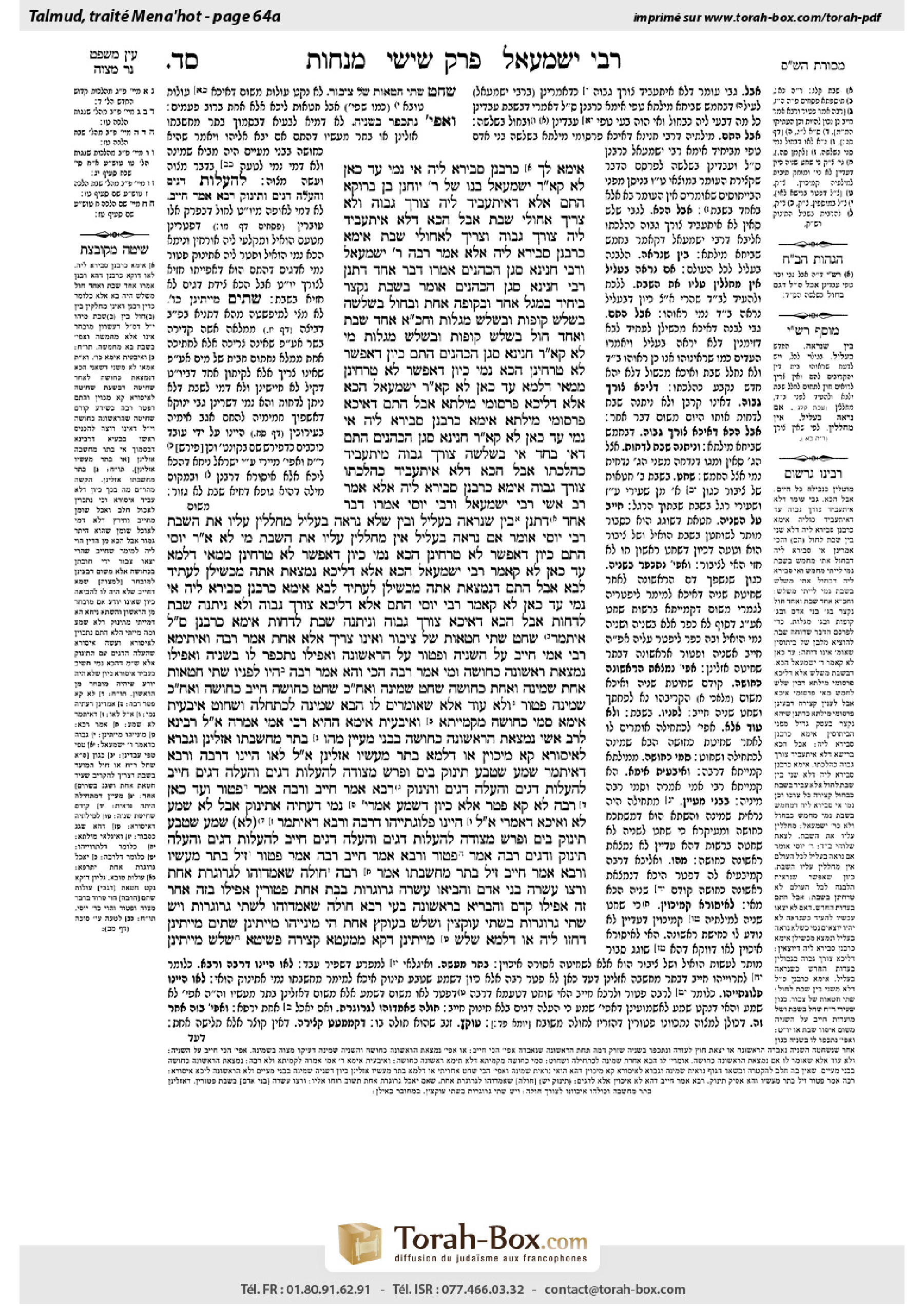
Menachot 64a: Talmud study for Daf Yomi
Daf Yomi is the daily study of one Talmud folio. Explore 37 tractates with scans, Hebrew text, Sefaria English and AI-generated French translations where annotated.
Passage selection and English or AI-generated French translation are available where the scan has annotations. Daf Study is independent of Torah-Box and Sefaria.
Browse Menachot · מנחות · All tractatesMenachot 64a text and translations
This page of Menachot includes the Aramaic text, an English translation and an AI-generated French translation, alongside the scan above.
מנחות ס״ד א · Aramaic and Hebrew text
אֵימָא לָךְ כְּרַבָּנַן סְבִירָא לֵיהּ.
אִי נָמֵי, עַד כָּאן לָא קָאָמַר רַבִּי יִשְׁמָעֵאל בְּנוֹ שֶׁל רַבִּי יוֹחָנָן בֶּן בְּרוֹקָא הָתָם, אֶלָּא דְּאִיתְעֲבִיד לֵיהּ צוֹרֶךְ גָּבוֹהַּ, וְלָא צְרִיךְ אַחוֹלֵי שַׁבָּת, אֲבָל הָכָא, דְּלָא אִיתְעֲבִיד לֵיהּ צוֹרֶךְ גָּבוֹהַּ, וּצְרִיךְ לְאַחוֹלֵי שַׁבָּת – אֵימָא כְּרַבָּנַן סְבִירָא לֵיהּ.
אֶלָּא אָמַר רַבָּה: רַבִּי יִשְׁמָעֵאל וְרַבִּי חֲנִינָא סְגַן הַכֹּהֲנִים אָמְרוּ דָּבָר אֶחָד, דִּתְנַן: רַבִּי חֲנִינָא סְגַן הַכֹּהֲנִים אוֹמֵר: בַּשַּׁבָּת נִקְצָר בְּיָחִיד, בְּמַגָּל אֶחָד וּבְקוּפָּה אַחַת, וּבַחוֹל – בִּשְׁלֹשָׁה, בְּשָׁלֹשׁ קוּפּוֹת וּבְשָׁלֹשׁ מַגָּלוֹת. וַחֲכָמִים אוֹמְרִים: אֶחָד שַׁבָּת וְאֶחָד חוֹל – בְּשָׁלֹשׁ קוּפּוֹת וּבְשָׁלֹשׁ מַגָּלוֹת.
מִי לָא קָאָמַר רַבִּי חֲנִינָא סְגַן הַכֹּהֲנִים הָתָם, כֵּיוָן דְּאֶפְשָׁר – לָא טָרְחִינַן, הָכָא נָמֵי, כֵּיוָן דְּאֶפְשָׁר – לָא טָרְחִינַן.
מִמַּאי? דִּלְמָא עַד כָּאן לָא קָאָמַר רַבִּי יִשְׁמָעֵאל הָכָא, אֶלָּא דְּלֵיכָּא פַּרְסוֹמֵי מִילְּתָא, אֲבָל הָתָם, דְּאִיכָּא פַּרְסוֹמֵי מִילְּתָא – אֵימָא כְּרַבָּנַן סְבִירָא לֵיהּ.
אִי נָמֵי, עַד כָּאן לָא קָאָמַר רַבִּי חֲנִינָא סְגַן הַכֹּהֲנִים הָתָם, דְּאִי בְּחַד אִי בִּשְׁלֹשָׁה – צוֹרֶךְ גָּבוֹהַּ מִיתְעֲבִיד כְּהִלְכָתוֹ, אֲבָל הָכָא, דְּלָא אִיתְעֲבִיד כְּהִלְכָתוֹ צוֹרֶךְ גָּבוֹהַּ – אֵימָא כְּרַבָּנַן סְבִירָא לֵיהּ.
אֶלָּא אָמַר רַב אָשֵׁי: רַבִּי יִשְׁמָעֵאל וְרַבִּי יוֹסֵי אָמְרוּ דָּבָר אֶחָד, דִּתְנַן: בֵּין שֶׁנִּרְאָה בַּעֲלִיל וּבֵין שֶׁלֹּא נִרְאָה בַּעֲלִיל – מְחַלְּלִין עָלָיו אֶת הַשַּׁבָּת. רַבִּי יוֹסֵי אוֹמֵר: אִם נִרְאָה בַּעֲלִיל – אֵין מְחַלְּלִין עָלָיו אֶת הַשַּׁבָּת.
מִי לָא אָמַר רַבִּי יוֹסֵי הָתָם, כֵּיוָן דְּאֶפְשָׁר – לָא טָרְחִינַן, הָכָא נָמֵי, כֵּיוָן דְּאֶפְשָׁר – לָא טָרְחִינַן.
מִמַּאי? דִּלְמָא עַד כָּאן לָא קָאָמַר רַבִּי יִשְׁמָעֵאל הָכָא, אֶלָּא דְּלֵיכָּא נִמְצֵאתָ אַתָּה מַכְשִׁילָן לֶעָתִיד לָבֹא, אֲבָל הָתָם, דְּנִמְצֵאתָ אַתָּה מַכְשִׁילָן לֶעָתִיד לָבֹא, אֵימָא כְּרַבָּנַן סְבִירָא לֵיהּ.
אִי נָמֵי, עַד כָּאן לָא קָאָמַר רַבִּי יוֹסֵי הָתָם, אֶלָּא דְּלֵיכָּא צוֹרֶךְ גָּבוֹהַּ, וְלֹא נִיתְּנָה שַׁבָּת לִדָּחוֹת, אֲבָל הָכָא, דְּאִיכָּא צוֹרֶךְ גָּבוֹהַּ, וְנִיתְּנָה שַׁבָּת לִדָּחוֹת – אֵימָא כְּרַבָּנַן סְבִירָא לֵיהּ.
אִיתְּמַר: שָׁחַט שְׁתֵּי חַטָּאוֹת שֶׁל צִיבּוּר, וְאֵינוֹ צָרִיךְ אֶלָּא אַחַת. אֲמַר רַבָּה, וְאִיתֵּימָא רַבִּי אַמֵּי: חַיָּיב עַל הַשְּׁנִיָּה, וּפָטוּר עַל הָרִאשׁוֹנָה. וַאֲפִילּוּ נִתְכַּפֵּר לוֹ בַּשְּׁנִיָּה, וַאֲפִילּוּ נִמְצֵאת רִאשׁוֹנָה כְּחוּשָׁה.
וּמִי אָמַר רַבָּה הָכִי? וְהָא אָמַר רַבָּה: הָיוּ לְפָנָיו שְׁתֵּי חַטָּאוֹת, אַחַת שְׁמֵינָה וְאַחַת כְּחוּשָׁה – שָׁחַט שְׁמֵינָה וְאַחַר כָּךְ שָׁחַט כְּחוּשָׁה – חַיָּיב, כְּחוּשָׁה וְאַחַר כָּךְ שְׁמֵינָה – פָּטוּר, וְלֹא עוֹד אֶלָּא שֶׁאוֹמְרִים לוֹ: הָבֵא שְׁמֵינָה לְכַתְּחִלָּה וּשְׁחוֹט!
אִיבָּעֵית אֵימָא: סְמִי כְּחוּשָׁה מִקַּמָּיְיתָא, וְאִיבָּעֵית אֵימָא: הָהִיא – רַבִּי אַמֵּי אַמְרַהּ.
אֲמַר לֵיהּ רָבִינָא לְרַב אָשֵׁי: נִמְצֵאת הָרִאשׁוֹנָה כְּחוּשָׁה בִּבְנֵי מֵעַיִין, מַהוּ? בָּתַר מַחְשַׁבְתּוֹ אָזְלִינַן, וְגַבְרָא לְאִיסּוּרָא קָא מִיכַּוֵּין, אוֹ דִלְמָא בָּתַר מַעֲשָׂיו אָזְלִינַן?
אֲמַר לֵיהּ: לָאו הַיְינוּ דְּרַבָּה וְרָבָא? דְּאִיתְּמַר: שָׁמַע שֶׁטָּבַע תִּינוֹק בַּיָּם, וּפָרַשׂ מְצוּדָה לְהַעֲלוֹת דָּגִים וְהֶעֱלָה דָּגִים – חַיָּיב. לְהַעֲלוֹת דָּגִים, וְהֶעֱלָה דָּגִים וְתִינוֹק – רָבָא אָמַר: חַיָּיב, וְרַבָּה אָמַר: פָּטוּר.
וְעַד כָּאן רַבָּה לָא קָא פָּטַר אֶלָּא כֵּיוָן דְּשָׁמַע, אָמְרִינַן נָמֵי דַּעְתֵּיהּ אַתִּינוֹק, אֲבָל לֹא שָׁמַע – לָא.
וְאִיכָּא דְאָמְרִי, אֲמַר לֵיהּ: הַיְינוּ פְּלוּגְתַּיְיהוּ דְּרַבָּה וְרָבָא, דְּאִיתְּמַר: שָׁמַע שֶׁטָּבַע תִּינוֹק בַּיָּם, וּפָרַשׂ מְצוּדָה לְהַעֲלוֹת דָּגִים וְהֶעֱלָה דָּגִים – חַיָּיב, לְהַעֲלוֹת דָּגִים וְהֶעֱלָה תִּינוֹק וְדָגִים – רַבָּה אָמַר: פָּטוּר, וְרָבָא אָמַר: חַיָּיב. רַבָּה אָמַר פָּטוּר – זִיל בָּתַר מַעֲשָׂיו, וְרָבָא אָמַר חַיָּיב – זִיל בָּתַר מַחְשַׁבְתּוֹ.
אָמַר רַבָּה: חוֹלֶה שֶׁאֲמָדוּהוּ לִגְרוֹגֶרֶת אַחַת, וְרָצוּ עֲשָׂרָה בְּנֵי אָדָם וְהֵבִיאוּ עֲשָׂרָה גְּרוֹגְרוֹת בְּבַת אַחַת – פְּטוּרִין, אֲפִילּוּ בְּזֶה אַחַר זֶה, אֲפִילּוּ קָדַם וְהִבְרִיא בָּרִאשׁוֹנָה.
בָּעֵי רָבָא: חוֹלֶה שֶׁאֲמָדוּהוּ לִשְׁתֵּי גְּרוֹגְרוֹת, וְיֵשׁ שְׁתֵּי גְּרוֹגְרוֹת בִּשְׁתֵּי עוּקְצִין, וְשָׁלֹשׁ בְּעוֹקֶץ אַחַת – הֵי מִינַּיְיהוּ מַיְיתִינַן? שְׁתַּיִם מַיְיתִינַן, דְּחָזוּ לֵיהּ, אוֹ דִלְמָא שָׁלֹשׁ מַיְיתִינַן, דְּקָא מְמַעֲטָא קְצִירָה?
פְּשִׁיטָא, שָׁלֹשׁ מַיְיתִינַן,
Menachot 64a · English translation
I could say to you that he holds in accordance with the opinion of the Rabbis that the entire animal should be flayed.
Alternatively, it is possible that Rabbi Yishmael, son of Rabbi Yoḥanan ben Beroka, states his ruling only there, in the case of the Paschal offering, where the requirements for the Most High, i.e., the Temple service, have been fulfilled, and therefore there is no need to desecrate the Shabbat. But here, where the community must bring a select tenth of an ephah and therefore the requirements for the Most High have not been fulfilled, and it is necessary to desecrate the Shabbat, say that he holds in accordance with the opinion of the Rabbis, that one reaps the same amount of barley on Shabbat as during the week.
Rather, Rabba said: Rabbi Yishmael and Rabbi Ḥanina, the deputy High Priest, said the same thing. As we learned in the mishna that Rabbi Ḥanina, the deputy High Priest, says: On Shabbat the barley was reaped by an individual with one sickle and with one basket into which the barley was placed; and during the week, it was reaped by three people with three baskets and with three sickles. And the Rabbis say: Both on Shabbat and during the week, it was reaped by three people with three baskets and with three sickles.
The Gemara explains Rabba’s comparison: Doesn’t Rabbi Ḥanina, the deputy High Priest, say there, with regard to the process of gathering the barley, that since it is possible to reap by means of one person, we do not exert ourselves to reap it by means of three? Here, too, Rabbi Yishmael maintains that since it is possible to bring the omer meal offering from three se’a of barley, we do not exert ourselves on Shabbat to bring it from five se’a.
The Gemara rejects this comparison: From where is this conclusion reached? Perhaps Rabbi Yishmael states his ruling only here, because there is no greater publicity of the event achieved by using five se’a rather than three. But there, in the case of reaping the barley, where there is greater publicity of the event through the involvement of more people, one can say that he holds in accordance with the opinion of the Rabbis.
Alternatively, perhaps Rabbi Ḥanina, the deputy High Priest, states his ruling only there, as whether one individual or three people reap, the rite is still being performed in its proper manner for the requirement of the Most High. But here, when only three se’a are used, and the rite is not being performed in its proper manner for the requirement of the Most High, as five se’a are usually needed, say that he holds in accordance with the opinion of the Rabbis that on Shabbat the mitzva is performed in the same manner as on a weekday.
Rather, Rav Ashi said: Rabbi Yishmael and Rabbi Yosei said the same thing. As we learned in a mishna (Rosh HaShana 21b): Whether the new moon was seen clearly [ba’alil] by everyone or whether it was not seen clearly, one may desecrate the Shabbat in order to testify about its appearance. Rabbi Yosei says: If the moon was clearly seen, witnesses may not desecrate the Shabbat for it, as other witnesses located nearer to the court will certainly testify. If these distant witnesses go to court to testify, they will desecrate Shabbat unnecessarily.
The Gemara explains Rav Ashi’s comparison: Didn’t Rabbi Yosei say there: Since it is possible to receive testimony about the new moon without further witnesses, we do not exert ourselves and travel on Shabbat? Here, too, Rabbi Yishmael holds that since it is possible to bring the omer meal offering from three se’a of barley, we do not exert ourselves on Shabbat to bring it from five se’a.
The Gemara rejects this comparison: From where do you draw this conclusion? Perhaps Rabbi Yishmael states only here that three se’a are brought on Shabbat, as there is no concern that ultimately you will cause people to stumble in the future and refrain from bringing the omer offering. But there, in the case of witnesses testifying about the new moon, he concedes that all potential witnesses may travel on Shabbat because if not, you will cause them to stumble in the future. People will say: Why should we go to such trouble, as our testimony is unnecessary? Yet at some point they will be needed, and no witnesses will come to the court. Therefore, in that case one can say that Rabbi Yishmael agrees with this reasoning and holds in accordance with the opinion of the Rabbis.
Alternatively, it is possible that Rabbi Yosei states his ruling only there, with regard to the new moon, as this is not a requirement for the Most High, and therefore Shabbat may not be desecrated. But here, as the omer meal offering is a requirement for the Most High, and therefore Shabbat may be desecrated for it, say that Rabbi Yosei holds in accordance with the opinion of the Rabbis that on Shabbat the mitzva is performed in the same manner as on a weekday.
§ It was stated in a baraita (Tosefta, Pesaḥim 5:7): If one mistakenly slaughtered two communal sin offerings, e.g., the goat offerings of a Festival, on a Festival that occurred on Shabbat, and only one was required, Rabba said, and some say it was Rabbi Ami who said: He is liable for the second, superfluous communal sin offering, but is exempt for the first. And this is the halakha even if he achieved atonement with the second offering, e.g., if the blood of the first offering was spilled after the slaughter of the second. And this is the halakha even if the first offering was found to be gaunt and thereby disqualified as an offering, which meant that only the second offering was fit.
The Gemara asks: And in a case where the first animal was found to be gaunt, did Rabba really say this? But doesn’t Rabba say that if one had before him two communal sin offerings on Shabbat, one choice animal and one gaunt, and he slaughtered the choice one and then slaughtered the gaunt one, he is liable for the gaunt animal, as it should not have been slaughtered. But if he first slaughtered the gaunt one and subsequently slaughtered the choice animal, he is exempt for slaughtering the choice animal. And moreover, members of the court say to him after he slaughtered the gaunt animal: Bring the choice animal and slaughter it ab initio. If so, in a case where the first animal was found to be gaunt, he certainly should not be liable for slaughtering the second.
The Gemara answers: If you wish, say: Remove [semei] the clause with regard to the gaunt animal from the first statement of Rabba. In other words, Rabba merely said that he is exempt for the slaughter of the first animal; he did not state a ruling about the second animal. And if you wish, say instead that the ruling that he is liable for the slaughter of the second animal was stated by Rabbi Ami, not Rabba.
Ravina said to Rav Ashi: If the first offering is found to be gaunt, i.e., weakened, in its intestines after it was slaughtered, what is the halakha? Do we follow his intention and hold him accountable, and this man, who was unaware at the time of its slaughter that the first animal was gaunt, intended to transgress the Shabbat prohibition by slaughtering the second offering? Or perhaps we follow his actions and exempt him from liability, as the first offering had been disqualified when he brought the second.
Rav Ashi said to Ravina: Isn’t this the same as a case subject to a disagreement between Rabba and Rava, and in fact both agree that in this case he is liable? As it was stated: If one heard that a child was drowning at sea, and he spread a net to raise fish and the result was that he raised only fish, he is liable for transgressing the Shabbat prohibition of trapping. If he intended to raise fish, and he raised both fish and the child, Rava says: He is liable, as his intention was to transgress a prohibition, and Rabba says: He is exempt, as his act saved a life and was therefore permitted on Shabbat.
The Gemara explains why everyone would agree that one is liable in the case involving two offerings. And Rabba deemed him exempt only there, since the one who spread the net heard that a child had fallen in, and therefore we say that his intention in spreading the net was also to save the child. But had he not heard that the child had fallen in, he would not be exempt. This is comparable to the case of two offerings, where he could not have known before its slaughter that the first animal had weak intestines.
And there are those who say that Rav Ashi said to Ravina conclusively: This is subject to the disagreement between Rabba and Rava. As it was stated: If one heard that a child was drowning at sea, and he spread a net to raise fish and the result was that he raised only fish, he is liable for transgressing the Shabbat prohibition of trapping. If he intended to raise fish, and he raised both fish and the child, Rava says: He is liable, and Rabba says: He is exempt. Rav Ashi adds that Rabba did not exempt him because he heard that a child was drowning. Rather, Rabba says that he is exempt because one follows his actions, whereas Rava says that he is liable because one follows his intention. Consequently, the same dispute applies to the case of two offerings.
§ The Gemara continues its discussion concerning performing extra prohibited labor on Shabbat in extenuating circumstances where the desecration of Shabbat is allowed. Rabba says: With regard to a dangerously ill person on Shabbat whom the doctors evaluated as needing to eat one fig to regain his health, and ten men ran and each cut and brought ten figs simultaneously, one each, they are all exempt from liability for transgressing the prohibition of reaping on Shabbat. This applies even in a case where the ten come one after the other, and even if the ill person had already recovered his health by eating the first fig.
Rava raises a dilemma: In the case of a dangerously ill person on Shabbat whom the doctors evaluated as needing to eat two figs to regain his health, and there are two figs attached to a tree by two stems [okatzin] and another three figs attached to the tree by one stem, which one of them do we bring? Do we bring two figs, as that is the amount that is fit for him, i.e., this is the number of figs the ill person needs? Or perhaps we bring the three figs, as although he requires only two, this serves to limit the labor of reaping, as the three figs are attached to the tree by a single stem.
The Gemara answers: It is obvious that we bring the three figs,
Menachot 64a · Traduction française (IA)
Je pourrais te répondre qu’il suit l’opinion des Sages, selon laquelle il faut dépouiller l’animal tout entier.
Autre possibilité : Rabbi Yishmael, fils de Rabbi Yoḥanan ben Beroka, ne donne sa décision que là-bas, dans le cas de l’offrande pascale, où les exigences du Très-Haut, c’est-à-dire du service du Temple, ont été satisfaites ; il n’est donc pas nécessaire de profaner le Chabbat. Mais ici, puisque la communauté doit apporter un dixième d’épha de choix, les exigences du Très-Haut n’ont pas été satisfaites et il est nécessaire de profaner le Chabbat. Dis donc qu’il suit l’opinion des Sages : on récolte la même quantité d’orge le Chabbat que pendant la semaine.
Rabba dit plutôt : Rabbi Yishmael et Rabbi Ḥanina, le vice-grand prêtre, sont du même avis. En effet, nous avons appris dans la Michna que Rabbi Ḥanina, le vice-grand prêtre, dit : Le Chabbat, l’orge était récoltée par une seule personne, avec une seule faucille et un seul panier dans lequel on déposait l’orge ; pendant la semaine, elle était récoltée par trois personnes, avec trois paniers et trois faucilles. Les Sages disent, eux : aussi bien le Chabbat que pendant la semaine, elle était récoltée par trois personnes, avec trois paniers et trois faucilles.
La Guemara explique le rapprochement fait par Rabba : Rabbi Ḥanina, le vice-grand prêtre, ne dit-il pas là-bas, au sujet de la récolte de l’orge, que puisqu’il est possible de la récolter avec une seule personne, on ne se donne pas la peine de la récolter à trois ? Ici aussi, Rabbi Yishmael soutient que puisqu’il est possible d’apporter l’offrande de l’omer avec trois séa d’orge, on ne se donne pas la peine, le Chabbat, de l’apporter avec cinq séa.
La Guemara rejette ce rapprochement : D’où tire-t-on cette conclusion ? Peut-être Rabbi Yishmael ne donne-t-il sa décision qu’ici, car utiliser cinq séa plutôt que trois ne rend pas l’événement plus public. Mais là-bas, dans le cas de la récolte de l’orge, où la participation d’un plus grand nombre de personnes rend l’événement plus public, on peut dire qu’il suit l’opinion des Sages.
Autre possibilité : Rabbi Ḥanina, le vice-grand prêtre, ne donne sa décision que là-bas, car que la récolte soit effectuée par une seule personne ou par trois, le rite est accompli comme il convient pour satisfaire aux exigences du Très-Haut. Mais ici, lorsqu’on n’utilise que trois séa, le rite n’est pas accompli comme il convient pour satisfaire aux exigences du Très-Haut, puisque cinq séa sont normalement nécessaires. Dis donc qu’il suit l’opinion des Sages : le Chabbat, la mitsva s’accomplit de la même manière que pendant la semaine.
Rav Ashi dit plutôt : Rabbi Yishmael et Rabbi Yosei sont du même avis. En effet, nous avons appris dans une Michna (Roch Hachana 21b) : Que la nouvelle lune ait été vue clairement [ba’alil] par tous ou qu’elle n’ait pas été vue clairement, on peut profaner le Chabbat afin de témoigner de son apparition. Rabbi Yosei dit : Si la lune a été vue clairement, les témoins ne doivent pas profaner le Chabbat pour elle, car d’autres témoins, situés plus près du tribunal, témoigneront certainement. Si ces témoins éloignés se rendent au tribunal pour témoigner, ils profaneront le Chabbat inutilement.
La Guemara explique le rapprochement fait par Rav Ashi : Rabbi Yosei ne dit-il pas là-bas que puisqu’il est possible de recevoir le témoignage sur la nouvelle lune sans témoins supplémentaires, on ne se donne pas la peine de voyager le Chabbat ? Ici aussi, Rabbi Yishmael soutient que puisqu’il est possible d’apporter l’offrande de l’omer avec trois séa d’orge, on ne se donne pas la peine, le Chabbat, de l’apporter avec cinq séa.
La Guemara rejette ce rapprochement : D’où tirez-vous cette conclusion ? Peut-être Rabbi Yishmael dit-il seulement ici qu’on apporte trois séa le Chabbat, car rien ne fait craindre qu’on amène finalement les gens à trébucher à l’avenir et à s’abstenir d’apporter l’offrande de l’omer. Mais là-bas, dans le cas des témoins qui déposent au sujet de la nouvelle lune, il admet que tous les témoins potentiels peuvent se rendre au tribunal le Chabbat, car sinon, on les amènerait à trébucher à l’avenir. Les gens diraient : « Pourquoi nous donner tant de peine, puisque notre témoignage est inutile ? » Pourtant, un jour, on aura besoin d’eux et aucun témoin ne se présentera au tribunal. Par conséquent, dans ce cas, on peut dire que Rabbi Yishmael est d’accord avec ce raisonnement et suit l’opinion des Sages.
Autre possibilité : Rabbi Yosei ne donne sa décision que là-bas, au sujet de la nouvelle lune, car il ne s’agit pas d’une exigence du Très-Haut ; le Chabbat ne peut donc pas être profané. Mais ici, puisque l’offrande de l’omer est une exigence du Très-Haut, le Chabbat peut être profané pour elle. Dis donc que Rabbi Yosei suit l’opinion des Sages : le Chabbat, la mitsva s’accomplit de la même manière que pendant la semaine.
§ Il a été enseigné dans une baraïta (Tosefta, Pessaḥim 5:7) : Si quelqu’un a par erreur égorgé deux sacrifices expiatoires communautaires, par exemple les boucs expiatoires d’une fête qui tombait un Chabbat, alors qu’un seul était nécessaire, Rabba a dit — certains disent que c’est Rabbi Ami qui l’a dit : il est passible pour le second sacrifice expiatoire communautaire, qui était superflu, mais exempt pour le premier. Cela reste la halakha même s’il a obtenu l’expiation grâce au second sacrifice, par exemple si le sang du premier s’est répandu après l’égorgement du second. Cela reste également la halakha même si l’on a constaté que le premier sacrifice était maigre et donc impropre à être offert, de sorte que seul le second était apte.
La Guemara demande : Mais Rabba a-t-il vraiment dit cela dans le cas où l’on a constaté que le premier animal était maigre ? Rabba ne dit-il pas que si quelqu’un avait devant lui, le Chabbat, deux sacrifices expiatoires communautaires, l’un de choix et l’autre maigre, et qu’il avait égorgé d’abord celui de choix, puis le maigre, il était passible pour l’égorgement de l’animal maigre, car il n’aurait pas dû l’égorger ? Mais s’il avait égorgé d’abord le maigre, puis l’animal de choix, il était exempt pour l’égorgement de ce dernier. De plus, après qu’il a égorgé l’animal maigre, les membres du tribunal lui disent : « Apporte l’animal de choix et égorge-le d’emblée. » Si tel est le cas, lorsque l’on constate que le premier animal était maigre, il ne devrait certainement pas être passible pour l’égorgement du second.
La Guemara répond : Si tu veux, dis : retranche [semei] la clause concernant l’animal maigre de la première déclaration de Rabba. Autrement dit, Rabba a simplement dit qu’il était exempt pour l’égorgement du premier animal ; il n’a rien dit au sujet du second. Ou bien, si tu veux, dis plutôt que la décision selon laquelle il est passible pour l’égorgement du second animal a été énoncée par Rabbi Ami, et non par Rabba.
Ravina dit à Rav Ashi : Si, après l’égorgement de la première offrande, on découvre que ses intestins étaient faibles, quelle est la halakha ? Faut-il suivre son intention et le tenir pour responsable, puisque cet homme, qui ignorait au moment de l’égorgement que le premier animal avait les intestins faibles, avait l’intention de transgresser l’interdit du Chabbat en égorgeant la seconde offrande ? Ou faut-il plutôt se fonder sur ses actes et l’exempter, puisque la première offrande était disqualifiée lorsqu’il a apporté la seconde ?
Rav Ashi dit à Ravina : N’est-ce pas le même cas que celui qui fait l’objet d’un désaccord entre Rabba et Rava, et, en fait, tous deux conviennent qu’ici, il est passible ? Car il a été enseigné : Si quelqu’un a entendu qu’un enfant se noyait en mer, a jeté un filet pour attraper des poissons et n’a finalement pris que des poissons, il est passible d’avoir transgressé l’interdit du Chabbat consistant à capturer. S’il avait l’intention d’attraper des poissons et qu’il a pris à la fois des poissons et l’enfant, Rava dit : Il est passible, car son intention était de transgresser un interdit ; Rabba dit : Il est exempt, car son acte a sauvé une vie et était donc permis le Chabbat.
La Guemara explique pourquoi tous seraient d’accord pour le déclarer passible dans le cas des deux offrandes. Rabba ne l’a exempté que là-bas, car celui qui avait jeté le filet avait entendu qu’un enfant était tombé à l’eau ; on considère donc qu’en jetant le filet, il avait également l’intention de sauver l’enfant. Mais s’il n’avait pas entendu que l’enfant était tombé à l’eau, il n’aurait pas été exempt. Cela correspond au cas des deux offrandes, où il ne pouvait pas savoir, avant l’égorgement, que les intestins du premier animal étaient faibles.
Et certains rapportent que Rav Ashi a affirmé à Ravina : Ce cas relève du désaccord entre Rabba et Rava. Car il a été enseigné : Si quelqu’un a entendu qu’un enfant se noyait en mer, a jeté un filet pour attraper des poissons et n’a finalement pris que des poissons, il est passible d’avoir transgressé l’interdit du Chabbat consistant à capturer. S’il avait l’intention d’attraper des poissons et qu’il a pris à la fois des poissons et l’enfant, Rava dit : Il est passible, et Rabba dit : Il est exempt. Rav Ashi ajoute que Rabba ne l’a pas exempté parce qu’il avait entendu qu’un enfant se noyait. Rabba dit plutôt qu’il est exempt parce qu’on se fonde sur ses actes, tandis que Rava dit qu’il est passible parce qu’on se fonde sur son intention. Par conséquent, le même désaccord s’applique au cas des deux offrandes.
§ La Guemara poursuit son examen des travaux interdits supplémentaires effectués le Chabbat dans des circonstances exceptionnelles où la profanation du Chabbat est permise. Rabba dit : À propos d’un malade en danger le Chabbat, que les médecins ont estimé devoir manger une figue pour retrouver la santé, si dix hommes se sont précipités et ont chacun cueilli et apporté dix figues en même temps, une figue chacun, ils sont tous exempts d’avoir transgressé l’interdit de la récolte le Chabbat. Cela vaut même si les dix arrivent l’un après l’autre, et même si le malade avait déjà retrouvé la santé après avoir mangé la première figue.
Rava soulève une question : Dans le cas d’un malade en danger le Chabbat, que les médecins ont estimé devoir manger deux figues pour retrouver la santé, deux figues sont attachées à un arbre par deux tiges [okatzin], tandis que trois autres figues y sont attachées par une seule tige. Lesquelles apporte-t-on ? Apporte-t-on deux figues, puisque c’est la quantité qui lui convient, c’est-à-dire le nombre dont le malade a besoin ? Ou apporte-t-on les trois figues, car, bien qu’il n’ait besoin que de deux, cela permet de réduire le travail de récolte, puisque les trois figues sont attachées à l’arbre par une seule tige ?
La Guemara répond : Il est évident que l’on apporte les trois figues,
Traduction française générée par IA à partir de l’édition anglaise de Sefaria. Vérifie toujours un passage avec le texte source.
Text from Sefaria: William Davidson Edition - Vocalized Aramaic (unknown); William Davidson Edition - English (CC BY NC).