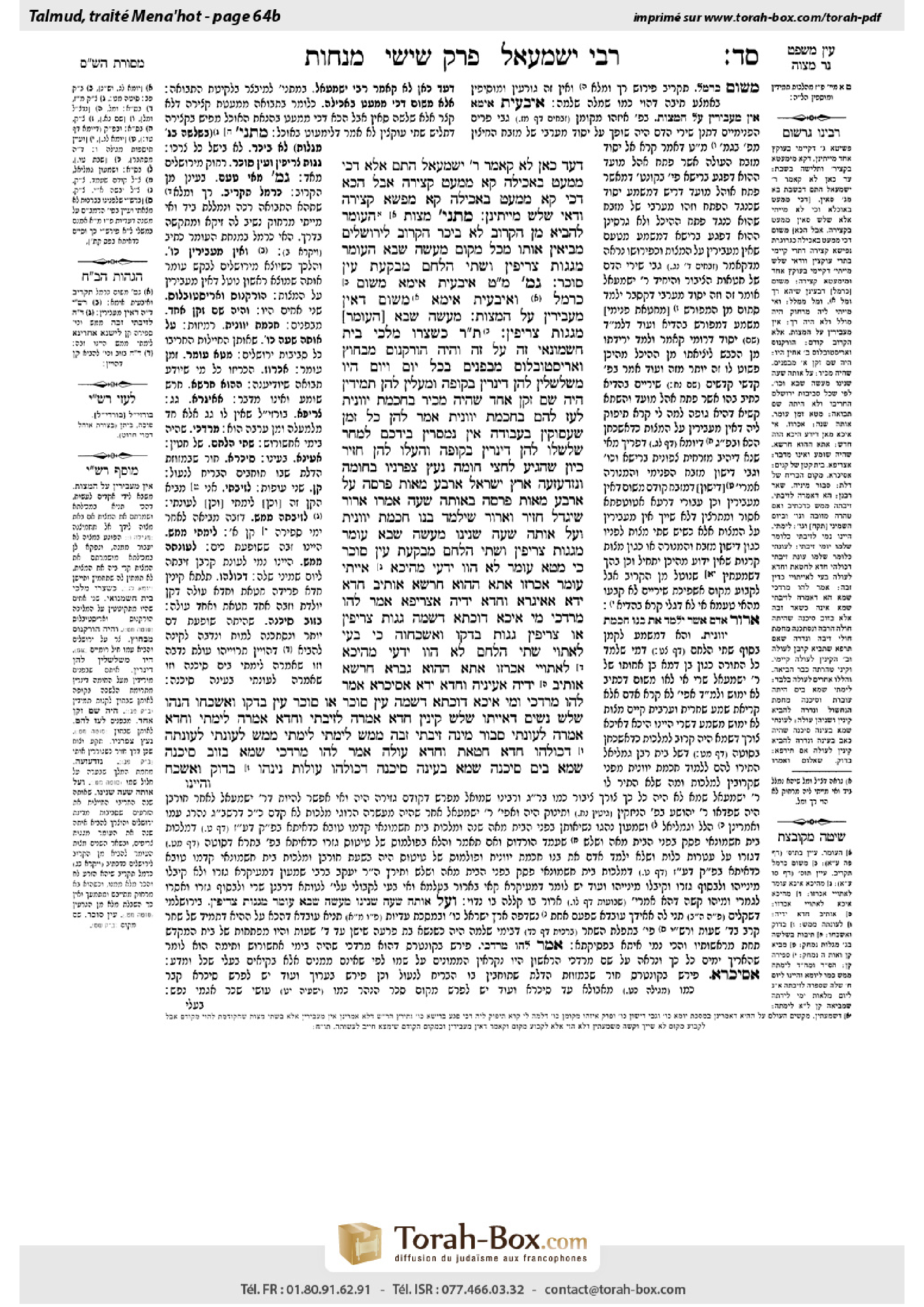
Menachot 64b: Talmud study for Daf Yomi
Daf Yomi is the daily study of one Talmud folio. Explore 37 tractates with scans, Hebrew text, Sefaria English and AI-generated French translations where annotated.
Passage selection and English or AI-generated French translation are available where the scan has annotations. Daf Study is independent of Torah-Box and Sefaria.
Browse Menachot · מנחות · All tractatesMenachot 64b text and translations
This page of Menachot includes the Aramaic text, an English translation and an AI-generated French translation, alongside the scan above.
מנחות ס״ד ב · Aramaic and Hebrew text
דְּעַד כָּאן לָא קָאָמַר רַבִּי יִשְׁמָעֵאל הָתָם, אֶלָּא דְּכִי מְמַעֵט בַּאֲכִילָה קָא מְמַעֵט קְצִירָה, אֲבָל הָכָא דְּכִי קָא מְמַעֵט בַּאֲכִילָה קָא מַפְּשָׁא קְצִירָה, וַדַּאי שָׁלֹשׁ מַיְיתִינַן.
מַתְנִי׳ מִצְוַת הָעוֹמֶר לְהָבִיא מִן הַקָּרוֹב, לֹא בִּיכֵּר הַקָּרוֹב לִירוּשָׁלַיִם – מְבִיאִין אוֹתוֹ מִכׇּל מָקוֹם. מַעֲשֶׂה שֶׁבָּא הָעוֹמֶר מִגַּגּוֹת צְרִיפִין, וּשְׁתֵּי הַלֶּחֶם מִבִּקְעַת עֵין סוֹכֵר.
גְּמָ׳ מַאי טַעְמָא? אִיבָּעֵית אֵימָא מִשּׁוּם ״כַּרְמֶל״.
וְאִיבָּעֵית אֵימָא, מִשּׁוּם דְּאֵין מַעֲבִירִין עַל הַמִּצְוֹת.
מַעֲשֶׂה שֶׁבָּא [הָעוֹמֶר] מִגַּגּוֹת צְרִיפִין. תָּנוּ רַבָּנַן: כְּשֶׁצָּרוּ מַלְכֵי בֵּית חַשְׁמוֹנַאי זֶה עַל זֶה, וְהָיָה הוּרְקָנוֹס מִבַּחוּץ וַאֲרִיסְטוֹבְּלוּס מִבִּפְנִים, בְּכׇל יוֹם וָיוֹם הָיוּ מְשַׁלְשְׁלִין לָהֶן דִּינָרִין בְּקוּפָּה וּמַעֲלִין לָהֶן תְּמִידִין.
הָיָה שָׁם זָקֵן אֶחָד שֶׁהָיָה מַכִּיר בְּחׇכְמַת יְוָונִית, לָעַז לָהֶם בְּחׇכְמַת יְוָונִית, אָמַר לָהֶן: כׇּל זְמַן שֶׁעֲסוּקִין בַּעֲבוֹדָה אֵין נִמְסָרִין בְּיֶדְכֶם. לְמָחָר שִׁלְשְׁלוּ לָהֶן דִּינָרִין בְּקוּפָּה, וְהֶעֱלוּ לָהֶן חֲזִיר. כֵּיוָן שֶׁהִגִּיעַ לַחֲצִי חוֹמָה, נָעַץ צִפׇּרְנָיו בַּחוֹמָה, וְנִזְדַּעְזְעָה אֶרֶץ יִשְׂרָאֵל אַרְבַּע מֵאוֹת פַּרְסָה עַל אַרְבַּע מֵאוֹת פַּרְסָה.
בְּאוֹתָהּ שָׁעָה אָמְרוּ: אָרוּר שֶׁיְּגַדֵּל חֲזִיר, וְאָרוּר שֶׁיְּלַמֵּד בְּנוֹ חׇכְמַת יְוָונִית. וְעַל אוֹתָהּ שָׁעָה שָׁנִינוּ: מַעֲשֶׂה שֶׁבָּא עוֹמֶר מִגַּגּוֹת צְרִיפִין, וּשְׁתֵּי הַלֶּחֶם מִבִּקְעַת עֵין סוֹכֵר.
כִּי מְטָא עוֹמֶר, לָא הֲווֹ יָדְעִי מֵהֵיכָא אַיְיתִי עוֹמֶר. אַכְרֻזוֹ, אֲתָא הָהוּא חַרְשָׁא, אוֹתֵיב חֲדָא יְדָא אַאִיגָּרָא וַחֲדָא יְדֵיהּ אַצְּרִיפָא. אֲמַר לְהוּ מׇרְדֳּכַי: מִי אִיכָּא דּוּכְתָּא דִּשְׁמֵהּ ״גַּגּוֹת צְרִיפִין״ אוֹ ״צְרִיפִין גַּגּוֹת״? בְּדַקוּ וְאַשְׁכְּחוּהּ.
כִּי בָּעֵי לְאֵתוֹיֵי שְׁתֵּי הַלֶּחֶם, לָא הֲווֹ יָדְעִי מֵהֵיכָא לְאֵתוֹיֵי, אַכְרוּז. אֲתָא הָהוּא גַּבְרָא חַרְשָׁא, אוֹתֵיב יְדֵיהּ אַעֵינֵיהּ וַחֲדָא יְדָא אַסִּיכְרָא. אֲמַר לְהוּ מׇרְדֳּכַי: וּמִי אִיכָּא דּוּכְתָּא דִּשְׁמֵהּ ״עֵין סוֹכֵר״ אוֹ ״סוֹכֵר עַיִן״? בְּדַקוּ וְאַשְׁכַּחוּ.
הָנְהוּ שָׁלֹשׁ נָשִׁים דְּאַיְיתוֹ שָׁלֹשׁ קִינִּין, חֲדָא אָמְרָה: ״לְזִיבָתִי״, וַחֲדָא אָמְרָה: ״לְיַמָּתִי״, וַחֲדָא אָמְרָה: ״לְעוֹנָתִי״.
סְבוּר מִינָּה ״זִיבָתִי״ – זָבָה מַמָּשׁ, ״לְיַמָּתִי״ – לְיַמָּתִי מַמָּשׁ, ״לְעוֹנָתִי״ – לְעוֹנָתָהּ, דְּכוּלְּהוּ חֲדָא חַטָּאת וַחֲדָא עוֹלָה.
אֲמַר לְהוּ מׇרְדֳּכַי: שֶׁמָּא בְּזוֹב סִיכְּנָה, שֶׁמָּא בַּיָּם סִיכְּנָה, שֶׁמָּא בְּעֵינָהּ סִיכְּנָה, דְּכוּלְּהוּ עוֹלוֹת נִינְהוּ. בְּדוּק וְאַשְׁכֻּח.
Menachot 64b · English translation
as Rabbi Yishmael states only there, in the mishna, that three se’a of barley are reaped on Shabbat, as in that case when one limits the amount available for eating, he likewise limits the amount of reaping. But here, when one limits the amount of eating by bringing the two figs, he also increases the amount of reaping. Therefore is it certain that we bring the ill person the three figs attached by a single stem.
MISHNA: The mitzva of the omer is to bring the barley reaped for the meal offering from fields proximate to Jerusalem. If the barley did not ripen in the fields proximate to Jerusalem, one brings it from any place in Eretz Yisrael. There was an incident where the omer came from Gaggot Tzerifin and the wheat for the two loaves on Shavuot came from the valley of Ein Sokher.
GEMARA: The Gemara asks: What is the reason that the barley reaped for the omer meal offering should ideally be brought from fields proximate to Jerusalem? The Gemara answers: If you wish, say that it is because the verse states: “And if you bring a meal offering of first fruits to the Lord, you shall bring for the meal offering of your first fruits grain in the ear parched with fire, even groats of the fresh ear [karmel]” (Leviticus 2:14). This indicates that the grain should be soft and fresh. Consequently it should be brought from close by, not from a place where it might become stale and hardened during a long journey.
And if you wish, say instead that the reason is due to the principle that one does not postpone performance of the mitzvot. When presented with the opportunity to perform a mitzva, one should perform it immediately. Therefore, the barley for the mitzva of the omer meal offering in the Temple should be brought from the first crop encountered outside of Jerusalem.
§ The mishna teaches: There was an incident where the omer came from Gaggot Tzerifin and the two loaves on Shavuot came from the valley of Ein Sokher. The Sages taught a baraita that provides the background of this event: When the kings of the Hasmonean monarchy besieged each other in their civil war, Hyrcanus was outside of Jerusalem, besieging it, and Aristoblus was inside. On each and every day they would lower dinars in a box from inside the city, and those on the outside would send up animals for them to bring the daily offerings in the Temple.
A certain elderly man was there, in Jerusalem, who was familiar with Greek wisdom. He communicated to those on the outside by using words understood only by those proficient in Greek wisdom. The elderly man said to them: As long as they are engaged with the Temple service, they will not be delivered into your hands. Upon hearing this, on the following day, when they lowered dinars in a box, they sent up a pig to them. Once the pig reached halfway up the wall, it inserted its hooves into the wall and Eretz Yisrael shuddered four hundred parasangs by four hundred parasangs.
When the Sages saw this, they said at that time: Cursed is he who raises pigs, and cursed is he who teaches his son Greek wisdom. And it is with regard to that time of civil war, in which the land was destroyed, that we learned: An incident occurred in which the omer, the measure of barley brought as a communal offering on the sixteenth of Nisan, came from Gaggot Tzerifim, and the two loaves offered on Shavuot came from the valley of Ein Sokher. Since no fresh barley grain was found in the fields immediately surrounding Jerusalem, it had to be brought from these outlying areas.
§ The Gemara relates another tradition with regard to that occasion when the omer came from Gaggot Tzerifin and the two loaves from the valley of Ein Sokher: When it came time to bring the omer meal offering, they did not know from where they could bring the omer grain, as all the surrounding fields were looted and ruined. The court publicly proclaimed their difficulty. A certain deaf-mute [ḥersha] came forward and stretched out one hand toward a roof, gag in Hebrew, and one hand toward a hut [atzerifa]. Mordekhai said to the Sages: Is there a place that is called Gaggot Tzerifin or Tzerifin Gaggot? They checked and found that there was such a place, and it contained fields of barley from which they were able to bring the omer meal offering.
A similar incident occurred when they needed to bring the two loaves, and they did not know from where to bring the grain. Again the court publicly proclaimed their difficulty, and a certain deaf-mute came forward and stretched out one hand toward his eye [a’eineih] and one hand toward a door latch [assikhera]. Mordekhai said to the Sages: And is there a place that is called: Ein Sokher, or Sokher Ayin? They checked and found that there was such a place, and it contained fields of wheat from which they were able to bring the two loaves.
The Gemara relates another story that demonstrates Mordekhai’s wisdom: Once, a certain three women brought three nests for their obligatory offerings of pairs of pigeons or doves (see Leviticus 15:29). One of them said: This offering is for my ziva; and one said: This if for my yamma; and the last one said: This is for my ona.
The Sages understood from the first woman’s statement: For my ziva, that she had experienced a discharge of uterine blood when not expecting her menstrual period, which would give her the status of an actual zava. From the second woman’s statement: For my yamma, they understood: My actual yamma, i.e., she was also a ziva, as yam can mean: Sea, or a flow of blood. From the third woman’s statement: For my ona, they came to the conclusion that she needed to bring a sacrifice for her time [ona] of completing her purification process from being a zava. Accordingly, they understood that all these women were obligated to bring one sin offering and one burnt offering.
Mordekhai said to the other Sages: Perhaps the first woman was endangered in the course of her menstrual flow [zov]. Similarly, perhaps the second woman was endangered at sea [yam]. Finally, perhaps the third woman was endangered through her eye [ayin], as ayin is phonetically similar to ona. According to these explanations, each woman sought to bring a voluntary offering to give thanks to God for being saved from danger. If so, the appropriate offering in each case is not a sin offering, as they are all burnt offerings. It was checked and they found that Mordekhai’s interpretation was in fact correct.
Menachot 64b · Traduction française (IA)
Rabbi Yishmael ne dit cela que là, dans la Michna, au sujet de la récolte de trois séa d’orge le Chabbat : dans ce cas, lorsqu’on limite la quantité disponible pour la consommation, on limite également la quantité récoltée. Mais ici, lorsqu’on limite la quantité à manger en apportant les deux figues, on augmente aussi la quantité à récolter. Il est donc certain qu’on apporte au malade les trois figues attachées à une seule tige.
Michna : La mitsva de l’omer consiste à apporter l’orge destinée à l’offrande de farine depuis des champs proches de Jérusalem. Si l’orge n’a pas mûri dans les champs proches de Jérusalem, on l’apporte de n’importe quel endroit du pays d’Israël. Il est arrivé que l’omer provienne de Gaggot Tzerifin et que le blé destiné aux deux pains de Chavouot provienne de la vallée d’Ein Sokher.
Guemara : La Guemara demande : Pourquoi l’orge récoltée pour l’offrande de farine de l’omer doit-elle, de préférence, provenir de champs proches de Jérusalem ? La Guemara répond : Si tu veux, dis que c’est parce que le verset dit : « Si tu apportes au Seigneur une offrande de prémices, tu apporteras comme offrande de tes prémices du grain en épi rôti au feu, des grains frais concassés [karmel] » (Lévitique 2,14). Cela indique que le grain doit être tendre et frais. Il faut donc l’apporter d’un endroit proche, et non d’un lieu où il risquerait de se dessécher et de durcir au cours d’un long trajet.
Et si tu veux, dis plutôt que la raison tient au principe selon lequel on ne diffère pas l’accomplissement des mitsvot. Lorsqu’on a l’occasion d’accomplir une mitsva, on doit l’accomplir immédiatement. Par conséquent, l’orge destinée à la mitsva de l’offrande de farine de l’omer au Temple doit provenir de la première récolte que l’on rencontre en sortant de Jérusalem.
§ La Michna enseigne : Il est arrivé que l’omer provienne de Gaggot Tzerifin et que les deux pains de Chavouot proviennent de la vallée d’Ein Sokher. Les Sages ont enseigné une baraïta qui rapporte le contexte de cet événement : Lorsque les rois de la dynastie hasmonéenne s’assiégèrent mutuellement au cours de leur guerre civile, Hyrcan se trouvait à l’extérieur de Jérusalem, qu’il assiégeait, tandis qu’Aristobule se trouvait à l’intérieur. Chaque jour, on faisait descendre des dinars dans une boîte depuis l’intérieur de la ville, et ceux qui se trouvaient à l’extérieur leur faisaient monter des animaux afin qu’ils puissent offrir les sacrifices quotidiens au Temple.
Un certain vieillard se trouvait là, à Jérusalem, et connaissait la sagesse grecque. Il communiquait avec ceux qui étaient à l’extérieur au moyen de mots que seuls ceux qui maîtrisaient la sagesse grecque pouvaient comprendre. Le vieillard leur dit : « Tant qu’ils s’occupent du service du Temple, ils ne seront pas livrés entre vos mains. » Après avoir entendu cela, le lendemain, lorsqu’ils firent descendre des dinars dans une boîte, ceux qui étaient à l’extérieur leur firent monter un porc. Quand le porc arriva à mi-hauteur du mur, il y enfonça ses sabots, et le pays d’Israël trembla sur une étendue de quatre cents parasanges sur quatre cents parasanges.
Lorsque les Sages virent cela, ils dirent alors : « Maudit soit celui qui élève des porcs, et maudit soit celui qui enseigne la sagesse grecque à son fils. » C’est à propos de cette période de guerre civile, durant laquelle le pays fut dévasté, que nous avons appris : Il arriva que l’omer, la mesure d’orge apportée comme offrande communautaire le seize Nissan, provienne de Gaggot Tzerifin, et que les deux pains offerts à Chavouot proviennent de la vallée d’Ein Sokher. Comme on ne trouvait pas d’orge fraîche dans les champs situés aux abords immédiats de Jérusalem, il fallut l’apporter de ces régions éloignées.
§ La Guemara rapporte une autre tradition au sujet de l’occasion où l’omer provenait de Gaggot Tzerifin et les deux pains de la vallée d’Ein Sokher : au moment d’apporter l’offrande de farine de l’omer, on ne savait pas d’où se procurer le grain nécessaire, car tous les champs alentour avaient été pillés et dévastés. Le tribunal proclama publiquement sa difficulté. Un certain sourd-muet [ḥersha] s’avança et tendit une main vers un toit, gag en hébreu, et l’autre vers une cabane [atzerifa]. Mordekhaï dit aux Sages : « Existe-t-il un endroit appelé Gaggot Tzerifin ou Tzerifin Gaggot ? » Ils vérifièrent et découvrirent qu’un tel endroit existait et qu’il contenait des champs d’orge d’où ils purent apporter l’offrande de farine de l’omer.
Un incident semblable se produisit lorsqu’ils durent apporter les deux pains et ne surent pas d’où se procurer le grain nécessaire. Là encore, le tribunal proclama publiquement sa difficulté, et un certain sourd-muet s’avança et tendit une main vers son œil [a’eineih] et l’autre vers un loquet de porte [assikhera]. Mordekhaï dit aux Sages : « Existe-t-il un endroit appelé Ein Sokher ou Sokher Ayin ? » Ils vérifièrent et découvrirent qu’un tel endroit existait et qu’il contenait des champs de blé d’où ils purent apporter les deux pains.
La Guemara rapporte une autre histoire qui témoigne de la sagesse de Mordekhaï : un jour, trois femmes apportèrent chacune trois nids pour leurs offrandes obligatoires, composées de paires de pigeons ou de tourterelles (voir Lévitique 15,29). L’une d’elles dit : « Cette offrande est pour ma ziva » ; une autre dit : « Celle-ci est pour mon yamma » ; et la dernière dit : « Celle-ci est pour mon ona. »
D’après les paroles de la première femme — « pour ma ziva » —, les Sages comprirent qu’elle avait eu un écoulement de sang utérin en dehors de la période attendue de ses règles, ce qui lui conférait le statut de véritable zava. D’après les paroles de la deuxième femme — « pour mon yamma » —, ils comprirent : « Mon véritable yamma », c’est-à-dire qu’elle aussi était une zava, car yam peut signifier « mer » ou « écoulement de sang ». Quant aux paroles de la troisième femme — « pour mon ona » —, ils en conclurent qu’elle devait apporter un sacrifice pour la période [ona] où elle achevait son processus de purification après avoir été zava. Ils comprirent donc que toutes ces femmes avaient l’obligation d’apporter un sacrifice expiatoire et un holocauste.
Mordekhaï dit aux autres Sages : « Peut-être la première femme avait-elle été en danger au cours de son écoulement menstruel [zov]. De même, peut-être la deuxième femme avait-elle été en danger en mer [yam]. Enfin, peut-être la troisième femme avait-elle été en danger à cause de son œil [ayin], car ayin ressemble phonétiquement à ona. » Selon ces interprétations, chacune de ces femmes souhaitait apporter une offrande volontaire pour remercier Dieu de l’avoir sauvée du danger. Dans ce cas, l’offrande appropriée n’est pas un sacrifice expiatoire, puisqu’il s’agit dans chaque cas d’un holocauste. On vérifia et l’on découvrit que l’interprétation de Mordekhaï était effectivement correcte.
Traduction française générée par IA à partir de l’édition anglaise de Sefaria. Vérifie toujours un passage avec le texte source.
Text from Sefaria: William Davidson Edition - Vocalized Aramaic (unknown); William Davidson Edition - English (CC BY NC).