Menachot 65a: Talmud study for Daf Yomi
Daf Yomi is the daily study of one Talmud folio. Explore 37 tractates with scans, Hebrew text, Sefaria English and AI-generated French translations where annotated.
Passage selection and English or AI-generated French translation are available where the scan has annotations. Daf Study is independent of Torah-Box and Sefaria.
Browse Menachot · מנחות · All tractatesMenachot 65a text and translations
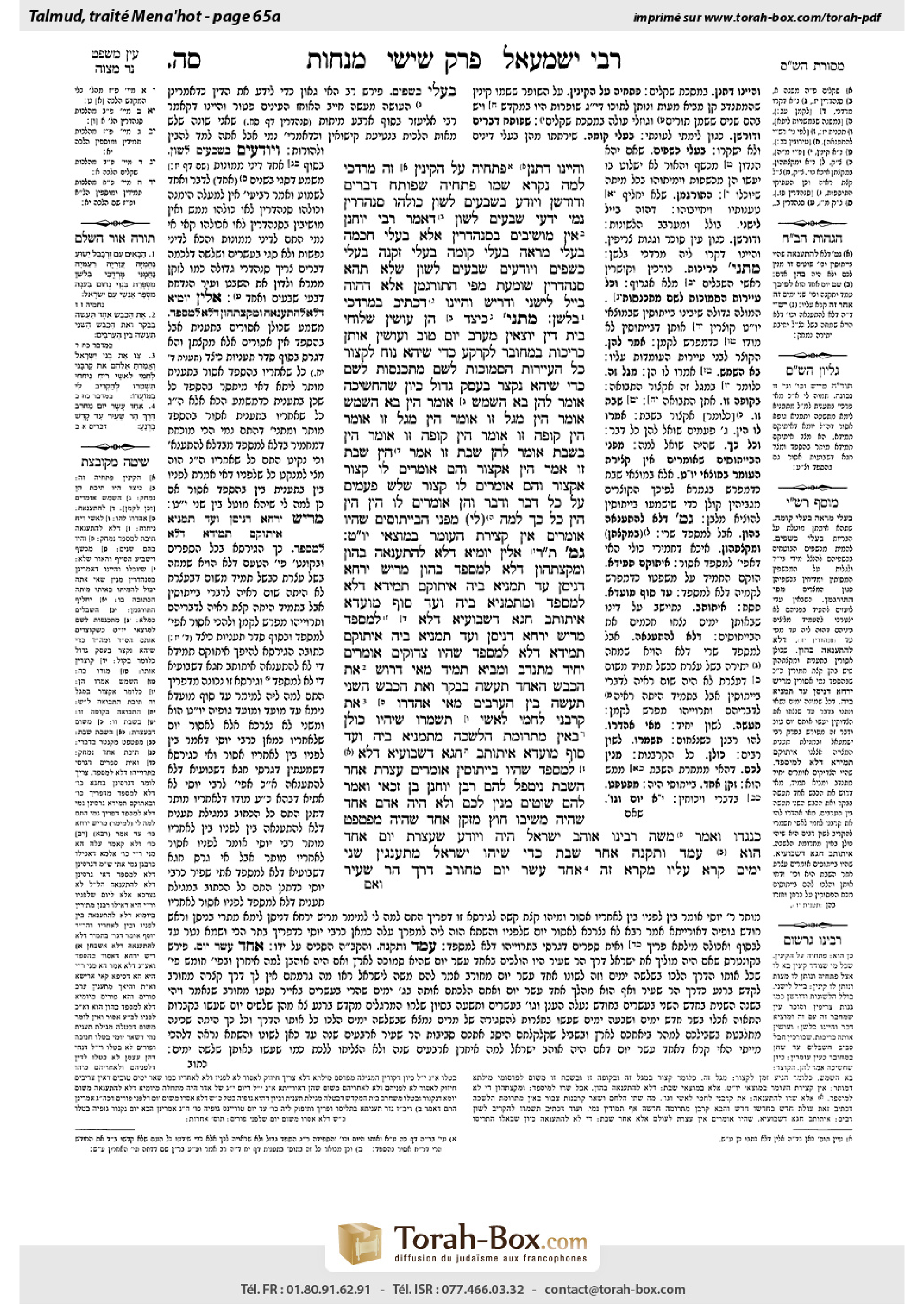
This page of Menachot includes the Aramaic text, an English translation and an AI-generated French translation, alongside the scan above.
מנחות ס״ה א · Aramaic and Hebrew text
וְהַיְינוּ דִּתְנַן: פְּתַחְיָה עַל הַקִּינִּין זֶה מָרְדֳּכַי, לָמָּה נִקְרָא שְׁמוֹ פְּתַחְיָה – שֶׁפּוֹתֵחַ דְּבָרִים וְדוֹרְשָׁן, וְיוֹדֵעַ בְּשִׁבְעִים לָשׁוֹן.
כּוּלְּהוּ סַנְהֶדְרִין נָמֵי יָדְעִי שִׁבְעִים לָשׁוֹן! דְּאָמַר רַבִּי יוֹחָנָן: אֵין מוֹשִׁיבִים בַּסַּנְהֶדְרִין אֶלָּא בַּעֲלֵי חׇכְמָה, בַּעֲלֵי מַרְאֶה, בַּעֲלֵי קוֹמָה, בַּעֲלֵי זִקְנָה, בַּעֲלֵי כְשָׁפִים, וְיוֹדְעִים שִׁבְעִים לָשׁוֹן, שֶׁלֹּא תְּהֵא סַנְהֶדְרִין שׁוֹמַעַת מִפִּי הַתּוּרְגְּמָן.
אֶלָּא, דַּהֲוָה בָּיֵיל לִישָּׁנֵי וְדָרֵישׁ, וְהַיְינוּ דִּכְתִיב בְּמׇרְדֳּכַי ״בִּלְשָׁן״.
מַתְנִי׳ כֵּיצַד הֵן עוֹשִׂין שְׁלוּחֵי בֵּית דִּין יוֹצְאִין מֵעֶרֶב יוֹם טוֹב, וְעוֹשִׂין אוֹתָן כְּרִיכוֹת בִּמְחוּבָּר לְקַרְקַע, כְּדֵי שֶׁיְּהֵא נוֹחַ לִקְצוֹר. כׇּל הָעֲיָירוֹת הַסְּמוּכוֹת לְשָׁם מִתְכַּנְּסוֹת לְשָׁם, כְּדֵי שֶׁיְּהֵא נִקְצָר בְּעֵסֶק גָּדוֹל.
כֵּיוָן שֶׁהֶחְשִׁיכָה, אוֹמֵר לָהֶן: ״בָּא הַשֶּׁמֶשׁ?״ אוֹמֵר: ״הֵין״. ״בָּא הַשֶּׁמֶשׁ?״ אוֹמֵר: ״הֵין״. ״מַגָּל זוֹ?״ אוֹמֵר: ״הֵין״. ״מַגָּל זוֹ?״ אוֹמֵר: ״הֵין״. ״קוּפָּה זוֹ?״ אוֹמֵר: ״הֵין״. ״קוּפָּה זוֹ?״ אוֹמֵר: ״הֵין״.
בַּשַּׁבָּת, אוֹמֵר לָהֶן: ״שַׁבָּת זוֹ?״ אֹמֵר: ״הֵין״. ״שַׁבָּת זוֹ?״ אֹמֵר: ״הֵין״. ״אֶקְצוֹר?״ וְהֵם אוֹמְרִים לוֹ: ״קְצוֹר״. ״אֶקְצוֹר?״ וְהֵם אוֹמְרִים לוֹ: ״קְצוֹר״.
שָׁלֹשׁ פְּעָמִים עַל כׇּל דָּבָר וְדָבָר, וְהֵן אוֹמְרִים לוֹ: הֵין, הֵין, הֵין. כׇּל כָּךְ לָמָּה לִי? מִפְּנֵי הַבַּיְיתּוֹסִים, שֶׁהָיוּ אוֹמְרִים: אֵין קְצִירַת הָעוֹמֶר בְּמוֹצָאֵי יוֹם טוֹב.
גְּמָ׳ תָּנוּ רַבָּנַן: אִלֵּין יוֹמַיָּא דְּלָא לְהִתְעַנָּאָה בְּהוֹן, וּמִקְצָתְהוֹן דְּלָא לְמִסְפַּד בְּהוֹן. מֵרֵישׁ יַרְחָא דְּנִיסָן עַד תְּמָנְיָא בֵּיהּ – אִיתּוֹקַם תְּמִידָא דְּלָא לְמִסְפַּד, וּמִתְּמָנְיָא בֵּיהּ וְעַד סוֹף מוֹעֲדָא – אִיתּוֹתַב חַגָּא דְשָׁבוּעַיָּא דְּלָא לְמִסְפַּד.
מֵרֵישׁ יַרְחָא דְּנִיסָן וְעַד תְּמָנְיָא בֵּיהּ אִיתּוֹקַם תְּמִידָא, דְּלָא לְמִסְפַּד – שֶׁהָיוּ צַדּוּקִים אוֹמְרִים: יָחִיד מִתְנַדֵּב וּמֵבִיא תָּמִיד. מַאי דְּרוּשׁ? ״אֶת הַכֶּבֶשׂ הָאֶחָד תַּעֲשֶׂה בַבֹּקֶר וְאֵת הַכֶּבֶשׂ הַשֵּׁנִי תַּעֲשֶׂה בֵּין הָעַרְבָּיִם״.
מַאי אַהְדַּרוּ? ״אֶת קׇרְבָּנִי לַחְמִי לְאִשַּׁי תִּשְׁמְרוּ״, שֶׁיִּהְיוּ כּוּלָּן בָּאִין מִתְּרוּמַת הַלִּשְׁכָּה.
מִתְּמָנְיָא בֵּיהּ, וְעַד סוֹף מוֹעֲדָא, אִיתּוֹתַב חַגָּא דְשָׁבוּעַיָּא, דְּלָא לְמִסְפַּד, שֶׁהָיוּ בַּיְיתּוֹסִין אוֹמְרִים: עֲצֶרֶת אַחַר הַשַּׁבָּת.
נִיטְפַּל לָהֶם רַבָּן יוֹחָנָן בֶּן זַכַּאי, וְאָמַר לָהֶם: שׁוֹטִים, מִנַּיִן לָכֶם? וְלֹא הָיָה אָדָם אֶחָד שֶׁהָיָה מְשִׁיבוֹ, חוּץ מִזָּקֵן אֶחָד שֶׁהָיָה מְפַטְפֵּט כְּנֶגְדּוֹ, וְאָמַר: מֹשֶׁה רַבֵּינוּ אוֹהֵב יִשְׂרָאֵל הָיָה, וְיוֹדֵעַ שֶׁעֲצֶרֶת יוֹם אֶחָד הוּא, עָמַד וְתִקְּנָהּ אַחַר שַׁבָּת כְּדֵי שֶׁיְּהוּ יִשְׂרָאֵל מִתְעַנְּגִין שְׁנֵי יָמִים. קָרָא עָלָיו מִקְרָא זֶה: ״אַחַד עָשָׂר יוֹם מֵחוֹרֵב דֶּרֶךְ הַר שֵׂעִיר״.
Menachot 65a · English translation
And this is as we learned in a mishna (Shekalim 13b): Petaḥya was responsible for the nests of birds, i.e., the doves or pigeons brought by a zav, a zava, a woman after childbirth, and a leper. These individuals would place the appropriate sum of money into the horn designated for this purpose, and each day Petaḥya oversaw the purchase of birds from that money and their sacrifice in the proper manner. This Sage is Mordekhai; and why was he called Petaḥya, which resembles the word for opening [petaḥ]? The reason is that he would open, i.e., elucidate, difficult topics and interpret them to the people, and because he knew all seventy languages known in that region at the time.
The Gemara asks: What was unique about Petaḥya? All of the members of the Sanhedrin also know all seventy languages. As Rabbi Yoḥanan says: They place on the Great Sanhedrin only men of wisdom, and of pleasant appearance, and of high stature, and of suitable age so that they will be respected. And they must also be masters of sorcery, i.e., they know the nature of sorcery, so that they can judge sorcerers, and they must know all seventy languages in order that the Sanhedrin will not need to hear testimony from the mouth of a translator in a case where a witness speaks a different language.
The Gemara answers: Rather, Petaḥya was unique as he not only knew all seventy languages, but also had the ability to combine various languages and interpret them. This is the meaning of that which is written with regard to Mordekhai: “Bilshan” (Nehemiah 7:7). Bilshan is interpreted as another name for Mordekhai, as he would combine [balil] languages [lashon].
MISHNA: How would they perform the rite of the harvest of the omer? Emissaries of the court would emerge on the eve of the festival of Passover and fashion the stalks of barley into sheaves while the stalks were still attached to the ground, so that it would be convenient to reap them. The residents of all the towns adjacent to the site of the harvest would assemble there, so that it would be harvested with great fanfare.
Once it grew dark, the court emissary says to those assembled: Did the sun set? The assembly says in response: Yes. The emissary repeats: Did the sun set? They again say: Yes. The court emissary next says to those assembled: Shall I reap the sheaves with this sickle? The assembly says in response: Yes. The emissary repeats: With this sickle? The assembly says: Yes. The court emissary then says to those assembled: Shall I place the gathered sheaves in this basket? The assembly says in response: Yes. The emissary repeats: In this basket? The assembly says: Yes.
If the sixteenth of Nisan occurs on Shabbat, the court emissary says to the assembled: Shall I cut the sheaves on this Shabbat? The assembly says in response: Yes. The emissary repeats: On this Shabbat? The assembly says: Yes. The court emissary says to those assembled: Shall I cut the sheaves? And they say to him in response: Cut. The emissary repeats: Shall I cut the sheaves? And they say to him: Cut.
The emissary asks three times with regard to each and every matter, and the assembly says to him: Yes, yes, yes. The mishna asks: Why do I need those involved to publicize each stage of the rite to that extent? The mishna answers: It is due to the Boethusians, as they deny the validity of the Oral Law and would say: There is no harvest of the omer at the conclusion of the first Festival day of Passover unless it occurs at the conclusion of Shabbat. The publicity was to underscore that the sixteenth of Nisan was the proper time for the omer harvest.
GEMARA: The Sages taught in a baraita: These are the days on which fasting is prohibited, and on some of them eulogizing is prohibited as well: From the New Moon of Nisan until the eighth of the month, the proper sacrifice of the daily offering was established, and therefore it was decreed not to eulogize on these dates. And furthermore, from the eighth of Nisan until the end of the festival of Passover, the correct date for the festival of Shavuot was restored, and it was similarly decreed not to eulogize during this period.
The Gemara discusses the baraita: From the New Moon of Nisan until the eighth of the month the proper sacrifice of the daily offering was established, and therefore it was decreed not to eulogize on these dates. The Gemara explains that the Sadducees would say: An individual may donate and bring the daily offering, in opposition to the accepted tradition that the daily offering must be brought from communal funds. What verse did the Sadducees expound? “The one lamb shall you offer [ta’aseh] in the morning, and the other lamb shall you offer in the afternoon” (Numbers 28:4). Since the verse is in the singular form, the Sadducees maintained that even an individual may donate the daily offering.
The Gemara asks: What did the Sages reply to refute the argument of the Sadducees? They cited the verse: “Command the children of Israel, and say to them: My food that is presented to Me for offerings made by fire, of a pleasing aroma unto Me, you shall observe [tishmeru] to offer to Me in its due season” (Numbers 28:2). The term: “You shall observe” is in the plural form, which indicates that all of the daily offerings should come from the collection of the Temple treasury chamber. Since during that period, between the New Moon of Nisan and the eighth of Nisan, the Sages overruled the Sadducees, it was established as a period of rejoicing, and it was prohibited to eulogize on those dates.
The Gemara discusses the next period listed in the baraita: From the eighth of Nisan until the end of the festival of Passover, the correct date for the festival of Shavuot was restored, and it was similarly decreed not to eulogize during this period. As the Boethusians would say that the festival of Shavuot always occurs after Shabbat, on a Sunday. Their reasoning was that the verse states, with regard to the omer offering and the festival of Shavuot that follows seven weeks later: “And you shall count for you from the morrow after the day of rest [hashabbat], from the day that you brought the sheaf [omer] of the waving; seven weeks shall there be complete” (Leviticus 23:15). Disregarding the oral tradition, the Boethusians interpreted the phrase “from the morrow after the day of rest [hashabbat]” literally, as referring to Shabbat, not the Festival day.
At the time, Rabban Yoḥanan ben Zakkai joined the discussion with the Boethusians and said to them: Fools! From where have you derived this? And there was no man who answered him, except for one elderly man who was prattling [mefatpet] at him, and he said: Moses, our teacher, was a lover of the Jewish people and he knew that Shavuot is only one day. Therefore, he arose and established it after Shabbat, in order that the Jewish people would enjoy themselves for two days. Rabban Yoḥanan ben Zakkai recited this verse in response to that old man: “It is eleven days’ journey from Horeb to Kadesh Barnea by the way of Mount Seir” (Deuteronomy 1:2).
Menachot 65a · Traduction française (IA)
Et c’est ce que nous avons appris dans une Michna (Shekalim 13b) : Petahya était chargé des nids d’oiseaux, c’est-à-dire des colombes ou des pigeons apportés par un zav, une zava, une femme après l’accouchement et un lépreux. Ces personnes déposaient la somme requise dans la corne prévue à cet effet, et chaque jour Petahya veillait à acheter des oiseaux avec cet argent et à les sacrifier comme il convient. Ce Sage est Mordekhaï. Pourquoi l’appelait-on Petahya, nom qui rappelle le mot « ouverture » [petaḥ] ? Parce qu’il ouvrait, c’est-à-dire élucidait, les sujets difficiles et les expliquait au peuple, et parce qu’il connaissait les soixante-dix langues connues dans cette région à l’époque.
La Guemara demande : Qu’y avait-il de particulier chez Petahya ? Tous les membres du Sanhédrin connaissaient eux aussi les soixante-dix langues. En effet, Rabbi Yoḥanan dit : On ne nomme au Grand Sanhédrin que des hommes sages, d’apparence agréable, de haute stature et d’un âge convenable, afin qu’ils soient respectés. Ils doivent aussi être experts en sorcellerie, c’est-à-dire en connaître la nature, afin de pouvoir juger les sorciers, et connaître les soixante-dix langues, afin que le Sanhédrin n’ait pas à entendre le témoignage par l’intermédiaire d’un interprète lorsqu’un témoin parle une autre langue.
La Guemara répond : Petahya se distinguait en ce qu’il ne se contentait pas de connaître les soixante-dix langues : il était également capable de les combiner et de les interpréter. C’est le sens de ce qui est écrit au sujet de Mordekhaï : « Bilshan » (Néhémie 7:7). Bilshan est interprété comme un autre nom de Mordekhaï, car il combinait [balil] les langues [lashon].
MICHNA : Comment accomplissait-on le rite de la récolte du omer ? À la veille de la fête de Pessa’h, des émissaires du tribunal sortaient et liaient en gerbes les tiges d’orge alors qu’elles étaient encore attachées au sol, afin qu’il soit plus facile de les moissonner. Les habitants de toutes les villes voisines du lieu de la récolte s’y rassemblaient, afin que la moisson se déroule en grande pompe.
À la tombée de la nuit, l’émissaire du tribunal demande aux personnes rassemblées : « Le soleil s’est-il couché ? » L’assemblée répond : « Oui. » L’émissaire répète : « Le soleil s’est-il couché ? » L’assemblée répond encore : « Oui. » L’émissaire du tribunal demande ensuite aux personnes rassemblées : « Dois-je moissonner les gerbes avec cette faucille ? » L’assemblée répond : « Oui. » L’émissaire répète : « Avec cette faucille ? » L’assemblée répond : « Oui. » L’émissaire du tribunal demande alors aux personnes rassemblées : « Dois-je placer les gerbes récoltées dans cette corbeille ? » L’assemblée répond : « Oui. » L’émissaire répète : « Dans cette corbeille ? » L’assemblée répond : « Oui. »
Si le seize Nissan tombe un Chabbat, l’émissaire du tribunal demande aux personnes rassemblées : « Dois-je couper les gerbes en ce Chabbat ? » L’assemblée répond : « Oui. » L’émissaire répète : « En ce Chabbat ? » L’assemblée répond : « Oui. » L’émissaire du tribunal demande aux personnes rassemblées : « Dois-je couper les gerbes ? » Elles lui répondent : « Coupe. » L’émissaire répète : « Dois-je couper les gerbes ? » Elles lui répondent : « Coupe. »
L’émissaire pose trois fois chaque question, et l’assemblée lui répond : « Oui, oui, oui. » La Michna demande : Pourquoi faut-il que les personnes concernées rendent publics chacun des stades du rite avec une telle insistance ? La Michna répond : C’est à cause des Boéthusiens, qui nient la validité de la Torah orale et affirmaient qu’on ne moissonne le omer à la fin du premier jour de fête de Pessa’h que lorsque celui-ci tombe à la fin d’un Chabbat. Cette publicité visait à souligner que le seize Nissan était le moment approprié pour la récolte du omer.
GUEMARA : Les Sages ont enseigné dans une baraïta : Voici les jours durant lesquels il est interdit de jeûner et, pour certains d’entre eux, également interdit de prononcer des oraisons funèbres : depuis la nouvelle lune de Nissan jusqu’au huit du mois, la bonne manière d’offrir le sacrifice quotidien fut établie ; il fut donc décrété qu’on ne prononce pas d’oraisons funèbres à ces dates. De plus, depuis le huit Nissan jusqu’à la fin de la fête de Pessa’h, la date correcte de la fête de Chavouot fut rétablie, et il fut pareillement décrété qu’on ne prononce pas d’oraisons funèbres durant cette période.
La Guemara examine la baraïta : depuis la nouvelle lune de Nissan jusqu’au huit du mois, la bonne manière d’offrir le sacrifice quotidien fut établie ; il fut donc décrété qu’on ne prononce pas d’oraisons funèbres à ces dates. La Guemara explique que les Sadducéens affirmaient qu’un particulier pouvait faire don du sacrifice quotidien et le faire apporter, contrairement à la tradition reçue selon laquelle le sacrifice quotidien doit être financé par des fonds communautaires. Quel verset les Sadducéens interprétaient-ils ? « Tu offriras [ta’aseh] un agneau le matin, et tu offriras l’autre agneau l’après-midi » (Nombres 28:4). Comme le verset est au singulier, les Sadducéens en concluaient qu’un particulier pouvait lui aussi faire don du sacrifice quotidien.
La Guemara demande : Qu’ont répondu les Sages pour réfuter l’argument des Sadducéens ? Ils ont cité le verset : « Ordonne aux enfants d’Israël et dis-leur : Mon offrande, ma nourriture destinée à mes sacrifices consumés par le feu, d’une odeur agréable pour moi, vous l’observerez [tishmeru] afin de me l’offrir en son temps fixé » (Nombres 28:2). Le terme « vous l’observerez » est au pluriel, ce qui indique que tous les sacrifices quotidiens doivent provenir de la collecte de la chambre du trésor du Temple. Puisque, durant cette période, entre la nouvelle lune de Nissan et le huit Nissan, les Sages l’emportèrent sur les Sadducéens, cette période fut instituée comme une période de réjouissance, et il fut interdit de prononcer des oraisons funèbres à ces dates.
La Guemara examine la période suivante mentionnée dans la baraïta : depuis le huit Nissan jusqu’à la fin de la fête de Pessa’h, la date correcte de la fête de Chavouot fut rétablie, et il fut pareillement décrété qu’on ne prononce pas d’oraisons funèbres durant cette période. En effet, les Boéthusiens affirmaient que la fête de Chavouot tombe toujours après le Chabbat, un dimanche. Ils fondaient leur raisonnement sur le verset qui concerne l’offrande du omer et la fête de Chavouot qui suit sept semaines plus tard : « Vous compterez pour vous à partir du lendemain du jour de repos [hashabbat], à partir du jour où vous aurez apporté la gerbe [omer] de présentation ; il y aura sept semaines complètes » (Lévitique 23:15). Sans tenir compte de la tradition orale, les Boéthusiens interprétaient littéralement l’expression « à partir du lendemain du jour de repos [hashabbat] » comme désignant le Chabbat, et non le jour de fête.
À ce moment-là, Rabban Yoḥanan ben Zakkaï prit part à la discussion avec les Boéthusiens et leur dit : « Insensés ! D’où tenez-vous cela ? » Aucun homme ne lui répondit, à l’exception d’un vieillard qui lui parlait à tort et à travers [mefatpet] et dit : « Moïse, notre maître, aimait le peuple juif et savait que Chavouot ne dure qu’un seul jour. Il se leva donc et la fixa après le Chabbat, afin que le peuple juif puisse se réjouir pendant deux jours. » Rabban Yoḥanan ben Zakkaï répondit à ce vieillard en récitant ce verset : « Il y a onze jours de marche depuis Horeb jusqu’à Qadesh-Barnéa, par le chemin du mont Séïr » (Deutéronome 1:2).
Traduction française générée par IA à partir de l’édition anglaise de Sefaria. Vérifie toujours un passage avec le texte source.
Text from Sefaria: William Davidson Edition - Vocalized Aramaic (unknown); William Davidson Edition - English (CC BY NC).