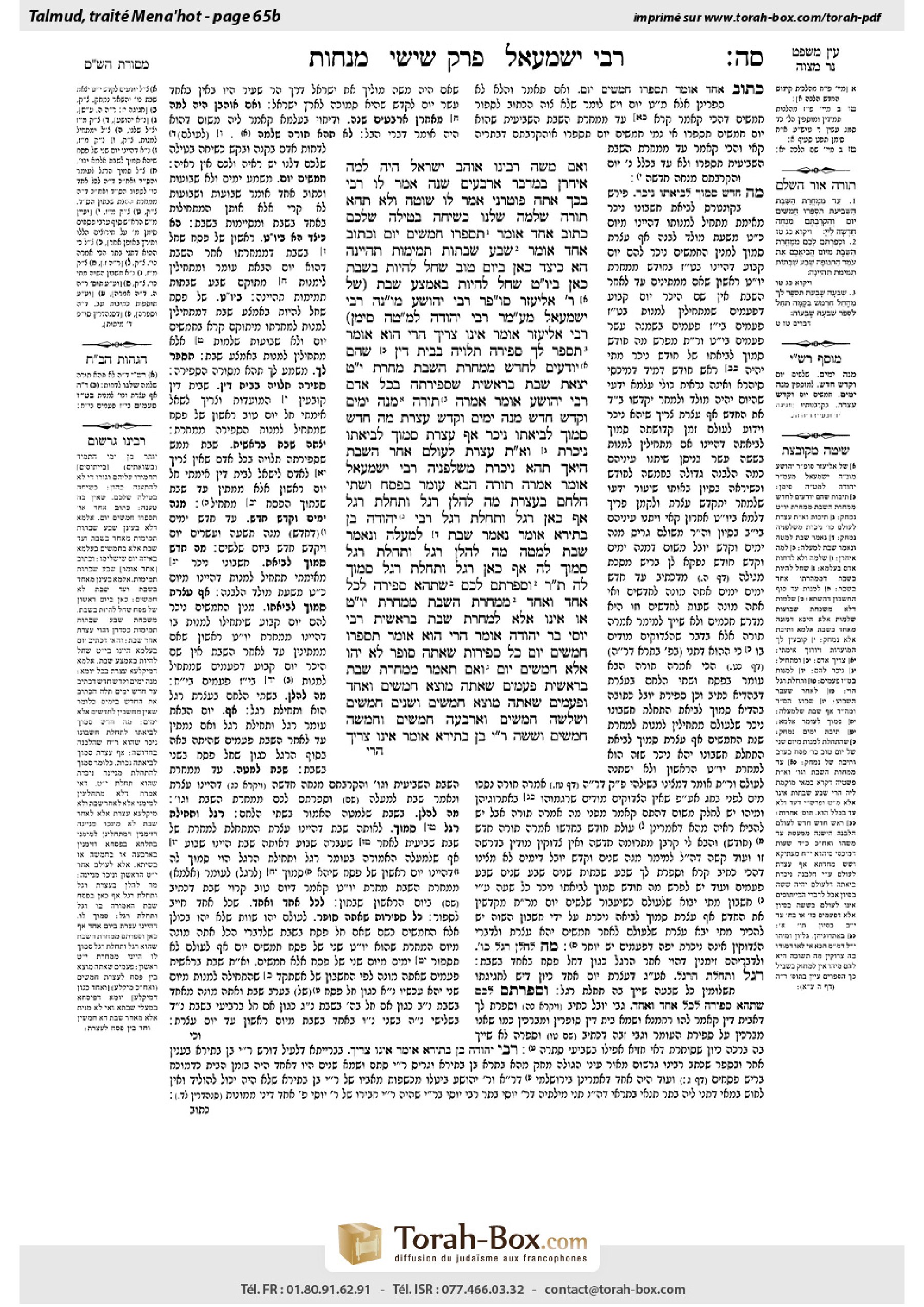
Menachot 65b: Talmud study for Daf Yomi
Daf Yomi is the daily study of one Talmud folio. Explore 37 tractates with scans, Hebrew text, Sefaria English and AI-generated French translations where annotated.
Passage selection and English or AI-generated French translation are available where the scan has annotations. Daf Study is independent of Torah-Box and Sefaria.
Browse Menachot · מנחות · All tractatesMenachot 65b text and translations
This page of Menachot includes the Aramaic text, an English translation and an AI-generated French translation, alongside the scan above.
מנחות ס״ה ב · Aramaic and Hebrew text
וְאִם מֹשֶׁה רַבֵּינוּ אוֹהֵב יִשְׂרָאֵל הָיָה, לָמָּה אִיחֲרָן בְּמִדְבָּר אַרְבָּעִים שָׁנָה? אָמַר לוֹ: רַבִּי, בְּכָךְ אַתָּה פּוֹטְרֵנִי? אָמַר לוֹ: שׁוֹטֶה! וְלֹא תְּהֵא תּוֹרָה שְׁלֵמָה שֶׁלָּנוּ כְּשִׂיחָה בְּטֵילָה שֶׁלָּכֶם!
כָּתוּב אֶחָד אוֹמֵר: ״תִּסְפְּרוּ חֲמִשִּׁים יוֹם״, וְכָתוּב אֶחָד אוֹמֵר: ״שֶׁבַע שַׁבָּתוֹת תְּמִימֹת תִּהְיֶינָה״.
הָא כֵּיצַד? כָּאן – בְּיוֹם טוֹב שֶׁחָל לִהְיוֹת בְּשַׁבָּת, כָּאן – בְּיוֹם טוֹב שֶׁחָל לִהְיוֹת בְּאֶמְצַע שַׁבָּת.
(שֶׁל רַבִּי אֱלִיעֶזֶר: סוֹפֵר, רַבִּי יְהוֹשֻׁעַ: מוֹנֶה, רַבִּי יִשְׁמָעֵאל: מְעַמֵּר, רַבִּי יְהוּדָה: לְמַטָּה – סִימָן.)
רַבִּי אֱלִיעֶזֶר אוֹמֵר: אֵינוֹ צָרִיךְ, הֲרֵי הוּא אוֹמֵר: ״תִּסְפׇּר לָךְ״, סְפִירָה תְּלוּיָה בְּבֵית דִּין, שֶׁהֵם יוֹדְעִים לְחַדֵּשׁ. ״מִמָּחֳרַת הַשַּׁבָּת״ – מָחֳרַת יוֹם טוֹב, יָצָאת שַׁבַּת בְּרֵאשִׁית שֶׁסְּפִירָתָהּ בְּכׇל אָדָם.
רַבִּי יְהוֹשֻׁעַ אוֹמֵר: אָמְרָה תּוֹרָה מְנֵה יָמִים וְקַדֵּשׁ חֹדֶשׁ, מְנֵה יָמִים וְקַדֵּשׁ עֲצֶרֶת. מָה חֹדֶשׁ סָמוּךְ לְבִיאָתוֹ נִיכָּר, אַף עֲצֶרֶת סָמוּךְ לְבִיאָתָהּ נִיכֶּרֶת.
וְאִם תֹּאמַר: עֲצֶרֶת לְעוֹלָם אַחַר הַשַּׁבָּת, הֵיאַךְ תְּהֵא נִיכֶּרֶת מִשֶּׁלְּפָנֶיהָ?
רַבִּי יִשְׁמָעֵאל אוֹמֵר: אָמְרָה תּוֹרָה הָבֵא עוֹמֶר בַּפֶּסַח, וּשְׁתֵּי הַלֶּחֶם בָּעֲצֶרֶת. מָה לְהַלָּן – רֶגֶל וּתְחִלַּת רֶגֶל, אַף כָּאן – רֶגֶל וּתְחִלַּת רֶגֶל.
רַבִּי יְהוּדָה בֶּן בְּתִירָא אוֹמֵר: נֶאֱמַר ״שַׁבָּת״ לְמַעְלָה, וְנֶאֱמַר ״שַׁבָּת״ לְמַטָּה. מָה לְהַלָּן – רֶגֶל, וּתְחִלַּת רֶגֶל סָמוּךְ לָהּ, אַף כָּאן – רֶגֶל, וּתְחִלַּת רֶגֶל סָמוּךְ לָהּ.
תָּנוּ רַבָּנַן: ״וּסְפַרְתֶּם לָכֶם״, שֶׁתְּהֵא סְפִירָה לְכׇל אֶחָד וְאֶחָד.
״מִמָּחֳרַת הַשַּׁבָּת״ – מִמָּחֳרַת יוֹם טוֹב, אוֹ אֵינוֹ אֶלָּא לְמָחֳרַת שַׁבַּת בְּרֵאשִׁית? רַבִּי יוֹסֵי בַּר יְהוּדָה אוֹמֵר: הֲרֵי הוּא אוֹמֵר ״תִּסְפְּרוּ חֲמִשִּׁים יוֹם״, כׇּל סְפִירוֹת שֶׁאַתָּה סוֹפֵר לֹא יְהוּ אֶלָּא חֲמִשִּׁים יוֹם.
וְאִם תֹּאמַר מִמָּחֳרַת שַׁבַּת בְּרֵאשִׁית, פְּעָמִים שֶׁאַתָּה מוֹצֵא חֲמִשִּׁים וְאֶחָד, וּפְעָמִים שֶׁאַתָּה מוֹצֵא חֲמִשִּׁים וּשְׁנַיִם, חֲמִשִּׁים וּשְׁלֹשָׁה, חֲמִשִּׁים וְאַרְבָּעָה, חֲמִשִּׁים וַחֲמִשָּׁה, חֲמִשִּׁים וְשִׁשָּׁה.
רַבִּי יְהוּדָה בֶּן בְּתִירָא אוֹמֵר: אֵינוֹ צָרִיךְ,
Menachot 65b · English translation
And if Moses, our teacher, was a lover of the Jewish people, why did he delay them in the wilderness forty years? The elderly man said to him: My teacher, you dismiss me with this retort? Rabbi Yoḥanan ben Zakkai said to him: Fool! And will our perfect Torah not be as worthy as your frivolous speech? Your claim can easily be refuted.
Rabbi Yoḥanan ben Zakkai cites a proof that Shavuot does not need to occur specifically on a Sunday. One verse states: “Even to the morrow after the seventh week you shall number fifty days; and you shall present a new meal offering to the Lord” (Leviticus 23:16), and one verse, the preceding one, apparently contradicts this when it states: “And you shall count for you from the morrow after the day of rest, from the day that you brought the sheaf of the waving; seven weeks shall there be complete.” Is the festival of Shavuot seven full weeks after Passover, i.e., counting from Sunday through Shabbat seven times; or is it fifty days after Passover?
The Gemara explains: How so, i.e., how can one reconcile these two verses? Here, the verse that mentions seven complete weeks, is referring to a year when the festival of Passover occurs on Shabbat. In such a year, the fifty-day period between Passover and Shavuot contains seven complete weeks, from Sunday through Shabbat. There, the verse that defines the period as fifty days, is referring to a year when the festival of Passover occurs in the middle of the week.
The Gemara presents a mnemonic for several other proofs in refutation of the claim of the Boethusians: That of Rabbi Eliezer: Number; Rabbi Yehoshua: Count; Rabbi Yishmael: From the omer; Rabbi Yehuda: Below.
Rabbi Eliezer says: The previous proof is not necessary, as the verse states: “Seven weeks you shall number for you; from the time the sickle is first put to the standing grain you shall begin to number seven weeks” (Deuteronomy 16:9). The term “for you” indicates that the counting of the weeks is dependent upon the decision of the court, as they know how to calculate the new months, upon which the date of the Festival depends. Therefore, when the verse states: “The morrow after the day of rest [hashabbat]” (Leviticus 23:16), it means: The morrow after the Festival, as the determination of Festivals is by the court. This serves to exclude the interpretation that the counting starts after the Shabbat of Creation, i.e., a regular weekly Shabbat, whose counting can be performed by every person, not exclusively by the court.
Citing a different proof, Rabbi Yehoshua says: The Torah said to count days, as it is stated: “A month of days” (Numbers 11:20), and then sanctify the month with offerings. And the Torah also said to count days from Passover and then sanctify the festival of Shavuot with offerings, as it is stated: “You shall count fifty days” (Leviticus 23:16). From this comparison, one can learn that just as the start of the counting toward the new month is known even before it comes, as one begins counting toward the following new month on the first day of a month, so too the start of the counting toward the festival of Shavuot is known even before it comes, as one begins counting toward Shavuot on a fixed day of the month.
The Gemara elaborates: And if you say that the festival of Shavuot always occurs the day after Shabbat, how is the counting toward Shavuot known based on what came before it? If the occurrence of Shavuot depends upon a Shabbat, there would be no specific date after Passover upon which the counting occurs yearly.
Rabbi Yishmael says there is another refutation of the Boethusian interpretation. The Torah said: Bring the omer offering on the festival on Passover and the two loaves on Shavuot. Just as there, with regard to the offering on the festival of Shavuot, the two loaves are brought at the beginning of the Festival, as it lasts only one day, so too here, with regard to the festival of Passover, the omer must be brought at the beginning of the Festival. If the omer were to always be brought on a Sunday, this might occur at the end of the festival of Passover. For example, if Passover started on a Monday, the omer would be brought only on the next Sunday, at the end of the Festival.
Rabbi Yehuda ben Beteira says there is yet another refutation. It is stated “shabbat” above (Leviticus 23:15), with regard to starting the counting of the omer, and it is also stated “shabbat” below (Leviticus 23:16), with regard to the commencement of the festival of Shavuot. Just as there, with regard to the festival of Shavuot, it is stated: “Even until the morrow after the seventh week [hashabbat] you shall number fifty days,” and the word shabbat is referring to the beginning of the Festival and it immediately follows the end of the seventh week; so too here, with regard to the bringing of the omer, the word shabbat means Festival, so that the omer offering immediately follows the beginning of the Festival, on the second day of Passover. According to the Boethusians, the commencement of the counting could start well after the beginning of Passover. For example, if Passover occurs on a Sunday, the counting of the omer would start only the following Sunday.
The Sages taught in a baraita: The verse states: “And you shall count for you from the morrow after the day of rest [hashabbat], from the day that you brought the sheaf of the waving; seven weeks there shall be complete” (Leviticus 23:15). The phrase: “And you shall count for you,” teaches that the mitzva of counting is not a communal obligation. Rather, there should be a counting by each and every person.
The baraita continues: From the morrow after the day of rest [hashabbat], this means from the morrow after the festival of Passover. Or perhaps this is not the meaning of the verse, but rather it means after the Shabbat of Creation, i.e., Sunday. Rabbi Yosei bar Yehuda says: This cannot be correct, as the verse states: “Even until the morrow after the seventh week you shall number fifty days” (Leviticus 23:16). This teaches that all the countings that you count shall be only fifty days.
Rabbi Yosei bar Yehuda elaborates: And if you say that the clause: “From the morrow after the day of rest [hashabbat],” is referring to the Shabbat of Creation, sometimes you will find a count of fifty-one days from the first day of Passover, which is the date that the count began the previous year, until Shavuot; and sometimes you will find fifty-two, or fifty-three, or fifty-four, or fifty-five, or fifty-six. For example, in one year, Passover occurs on Shabbat, and the counting of the omer would start on Sunday, the sixteenth of Nisan, and Shavuot would occur fifty days later. Another year, Passover occurs on a Friday, and the counting starts on Sunday, then the date that Shavuot will occur this year is fifty-one days from the sixteenth of Nisan. If Passover occurs on a Thursday, and the counting begins on the following Sunday, Shavuot will occur fifty-two days from the sixteenth of Nisan.
Rabbi Yehuda ben Beteira says: That proof is not necessary,
Menachot 65b · Traduction française (IA)
Et si Moïse, notre maître, aimait le peuple juif, pourquoi l’a-t-il fait attendre quarante ans dans le désert ? Le vieil homme lui dit : Maître, tu me congédies avec cette réplique ? Rabbi Yoḥanan ben Zakkaï lui dit : Insensé ! Notre Torah parfaite ne serait-elle pas aussi digne d’intérêt que tes paroles futiles ? Ton argument peut aisément être réfuté.
Rabbi Yoḥanan ben Zakkaï apporte la preuve que Chavouot ne doit pas nécessairement tomber un dimanche. Un verset dit : « Jusqu’au lendemain de la septième semaine, vous compterez cinquante jours, et vous présenterez une nouvelle offrande de céréales à l’Éternel » (Lévitique 23:16). Un autre verset, celui qui le précède, semble le contredire : « Vous compterez pour vous à partir du lendemain du jour de repos, à partir du jour où vous aurez apporté la gerbe de la présentation ; il y aura sept semaines complètes. » La fête de Chavouot a-t-elle lieu sept semaines entières après Pessa’h, c’est-à-dire en comptant sept fois du dimanche au Chabbat, ou cinquante jours après Pessa’h ?
La Guemara explique : Comment concilier ces deux versets ? Le verset qui mentionne sept semaines complètes se rapporte à une année où la fête de Pessa’h tombe un Chabbat. Une telle année, la période de cinquante jours entre Pessa’h et Chavouot comprend sept semaines complètes, du dimanche au Chabbat. L’autre verset, qui définit cette période comme étant de cinquante jours, se rapporte à une année où la fête de Pessa’h tombe au milieu de la semaine.
La Guemara présente un moyen mnémotechnique pour plusieurs autres preuves réfutant l’affirmation des Boéthusiens : celle de Rabbi Eliezer : « Compter » ; celle de Rabbi Yehoshoua : « Dénombrer » ; celle de Rabbi Yishmaël : « À partir de l’omer » ; celle de Rabbi Yehouda : « Plus loin ».
Rabbi Eliezer dit : La preuve précédente n’est pas nécessaire, car le verset dit : « Vous compterez pour vous sept semaines ; à partir du moment où la faucille est mise pour la première fois dans le blé sur pied, vous commencerez à compter sept semaines » (Deutéronome 16:9). L’expression « pour vous » indique que le décompte des semaines dépend de la décision du tribunal, car ses membres savent calculer les nouveaux mois, dont dépend la date de la fête. Par conséquent, lorsque le verset dit : « Le lendemain du jour de repos [hashabbat] » (Lévitique 23:16), cela signifie : le lendemain de la fête, puisque la fixation des fêtes relève du tribunal. Cela exclut l’interprétation selon laquelle le décompte commence après le Chabbat de la Création, c’est-à-dire un Chabbat hebdomadaire ordinaire, que chacun peut déterminer, et non le tribunal seul.
Apportant une autre preuve, Rabbi Yehoshoua dit : La Torah a ordonné de compter les jours, comme il est dit : « Un mois de jours » (Nombres 11:20), puis de sanctifier le mois par des offrandes. La Torah a également ordonné de compter les jours à partir de Pessa’h, puis de sanctifier la fête de Chavouot par des offrandes, comme il est dit : « Vous compterez cinquante jours » (Lévitique 23:16). De cette comparaison, on peut déduire que, de même que le début du décompte en vue du nouveau mois est connu avant même son arrivée, puisqu’on commence à compter en vue du nouveau mois suivant dès le premier jour d’un mois, de même le début du décompte en vue de la fête de Chavouot est connu avant même son arrivée, puisqu’on commence à compter en vue de Chavouot à une date fixe du mois.
La Guemara développe : Et si tu dis que la fête de Chavouot tombe toujours le lendemain du Chabbat, comment peut-on connaître à l’avance le décompte en vue de Chavouot ? Si la date de Chavouot dépend d’un Chabbat, il n’y aurait aucune date précise après Pessa’h à laquelle le décompte s’effectuerait chaque année.
Rabbi Yishmaël dit qu’il existe une autre réfutation de l’interprétation des Boéthusiens. La Torah a ordonné d’apporter l’offrande de l’omer pendant la fête de Pessa’h et les deux pains à Chavouot. De même que, pour l’offrande de la fête de Chavouot, les deux pains sont apportés au début de la fête, puisqu’elle ne dure qu’un jour, de même, pour la fête de Pessa’h, l’omer doit être apporté au début de la fête. Si l’omer devait toujours être apporté un dimanche, cela pourrait se produire à la fin de la fête de Pessa’h. Par exemple, si Pessa’h commençait un lundi, l’omer ne serait apporté que le dimanche suivant, à la fin de la fête.
Rabbi Yehouda ben Beteira dit qu’il existe encore une autre réfutation. Le terme « Chabbat » apparaît plus haut (Lévitique 23:15), à propos du début du décompte de l’omer, et il apparaît également plus loin (Lévitique 23:16), à propos du début de la fête de Chavouot. De même que, dans le cas de la fête de Chavouot, il est dit : « Jusqu’au lendemain de la septième semaine [hashabbat], vous compterez cinquante jours », et que le mot « Chabbat » désigne le début de la fête, qui suit immédiatement la fin de la septième semaine, de même ici, à propos de l’apport de l’omer, le mot « Chabbat » signifie « fête », de sorte que l’offrande de l’omer suit immédiatement le début de la fête, le deuxième jour de Pessa’h. Selon les Boéthusiens, le décompte pourrait commencer bien après le début de Pessa’h. Par exemple, si Pessa’h tombe un dimanche, le décompte de l’omer ne commencerait que le dimanche suivant.
Les Sages ont enseigné dans une baraïta : Le verset dit : « Vous compterez pour vous à partir du lendemain du jour de repos [hashabbat], à partir du jour où vous aurez apporté la gerbe de la présentation ; il y aura sept semaines complètes » (Lévitique 23:15). L’expression « vous compterez pour vous » enseigne que la mitsva du décompte n’est pas une obligation collective. Il faut plutôt que chacun compte individuellement.
La baraïta poursuit : « À partir du lendemain du jour de repos [hashabbat] » signifie : à partir du lendemain de la fête de Pessa’h. Peut-être toutefois ne faut-il pas comprendre ainsi le verset, mais plutôt comme signifiant : après le Chabbat de la Création, c’est-à-dire le dimanche. Rabbi Yossei bar Yehouda dit : Cela ne peut être exact, car le verset dit : « Jusqu’au lendemain de la septième semaine, vous compterez cinquante jours » (Lévitique 23:16). Cela enseigne que tous les décomptes que vous effectuerez ne compteront que cinquante jours.
Rabbi Yossei bar Yehouda développe : Et si tu dis que l’expression « À partir du lendemain du jour de repos [hashabbat] » se rapporte au Chabbat de la Création, tu trouveras parfois un décompte de cinquante et un jours entre le premier jour de Pessa’h, date à laquelle le décompte a commencé l’année précédente, et Chavouot ; parfois cinquante-deux, cinquante-trois, cinquante-quatre, cinquante-cinq ou cinquante-six jours. Par exemple, une année, Pessa’h tombe un Chabbat et le décompte de l’omer commence le dimanche, le seize Nissan ; Chavouot tombe alors cinquante jours plus tard. Une autre année, Pessa’h tombe un vendredi et le décompte commence le dimanche ; cette année-là, Chavouot aura lieu cinquante et un jours après le seize Nissan. Si Pessa’h tombe un jeudi et que le décompte commence le dimanche suivant, Chavouot aura lieu cinquante-deux jours après le seize Nissan.
Rabbi Yehouda ben Beteira dit : Cette preuve n’est pas nécessaire,
Traduction française générée par IA à partir de l’édition anglaise de Sefaria. Vérifie toujours un passage avec le texte source.
Text from Sefaria: William Davidson Edition - Vocalized Aramaic (unknown); William Davidson Edition - English (CC BY NC).