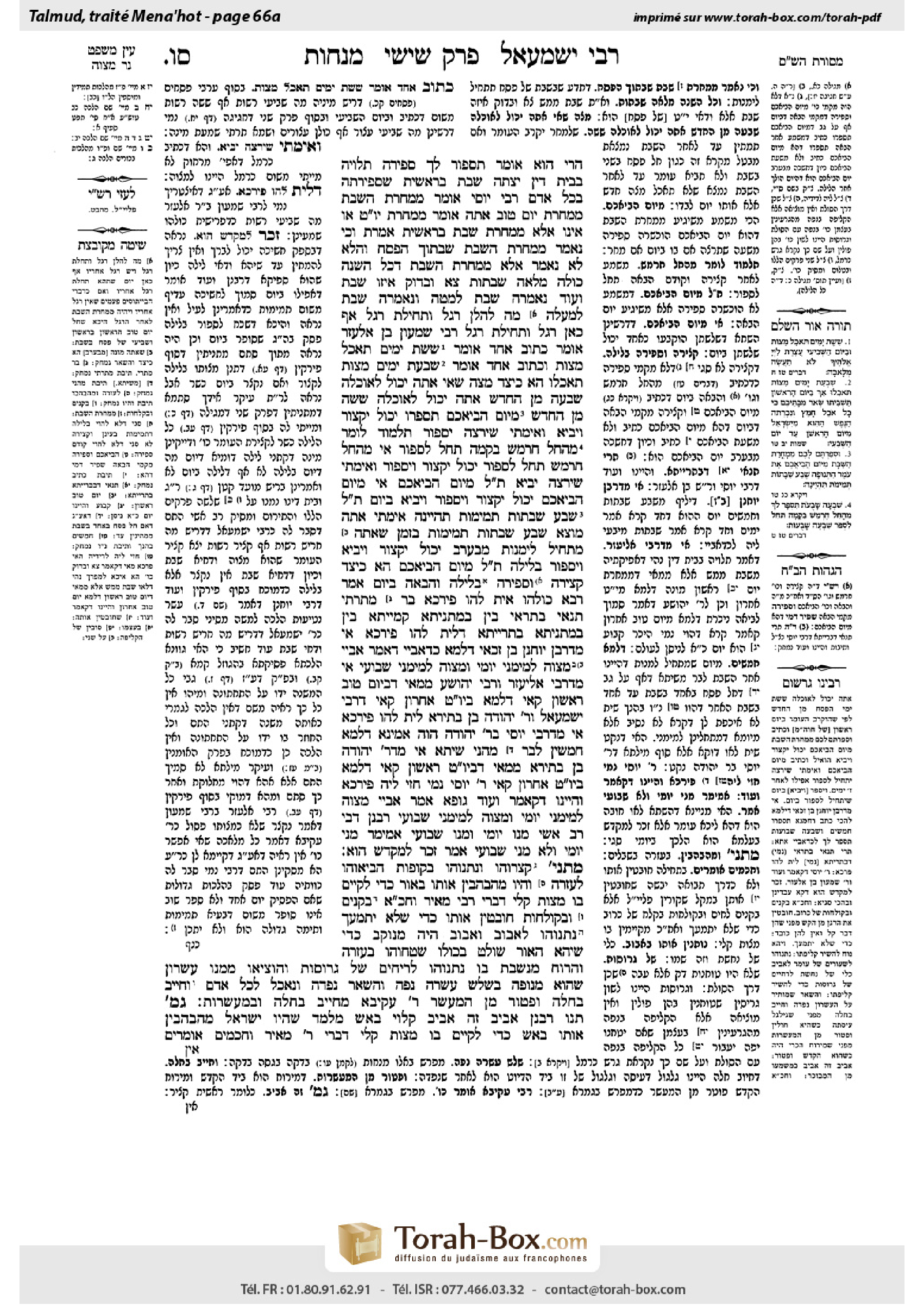
Menachot 66a: Talmud study for Daf Yomi
Daf Yomi is the daily study of one Talmud folio. Explore 37 tractates with scans, Hebrew text, Sefaria English and AI-generated French translations where annotated.
Passage selection and English or AI-generated French translation are available where the scan has annotations. Daf Study is independent of Torah-Box and Sefaria.
Browse Menachot · מנחות · All tractatesMenachot 66a text and translations
This page of Menachot includes the Aramaic text, an English translation and an AI-generated French translation, alongside the scan above.
מנחות ס״ו א · Aramaic and Hebrew text
הֲרֵי הוּא אוֹמֵר: ״תִּסְפׇּר לָךְ״, סְפִירָה תְּלוּיָה בְּבֵית דִּין, יָצְתָה שַׁבַּת בְּרֵאשִׁית שֶׁסְּפִירָתָהּ בְּכׇל אָדָם.
רַבִּי יוֹסֵי אוֹמֵר: ״מִמָּחֳרַת הַשַּׁבָּת״ – מִמָּחֳרַת יוֹם טוֹב. אַתָּה אוֹמֵר מִמָּחֳרַת יוֹם טוֹב, אוֹ אֵינוֹ אֶלָּא מִמָּחֳרַת שַׁבַּת בְּרֵאשִׁית? אָמַרְתָּ: וְכִי נֶאֱמַר ״מִמָּחֳרַת הַשַּׁבָּת שֶׁבְּתוֹךְ הַפֶּסַח״? וַהֲלֹא לֹא נֶאֱמַר אֶלָּא ״מִמָּחֳרַת הַשַּׁבָּת״, דְּכׇל הַשָּׁנָה כּוּלָּהּ מְלֵאָה שַׁבָּתוֹת, צֵא וּבְדוֹק אֵיזוֹ שַׁבָּת.
וְעוֹד, נֶאֶמְרָה ״שַׁבָּת״ לְמַטָּה, וְנֶאֶמְרָה ״שַׁבָּת״ לְמַעְלָה. מָה לְהַלָּן – רֶגֶל וּתְחִילַּת רֶגֶל, אַף כָּאן – רֶגֶל וּתְחִילַּת רֶגֶל.
רַבִּי שִׁמְעוֹן בֶּן אֶלְעָזָר אוֹמֵר: כָּתוּב אֶחָד אוֹמֵר: ״שֵׁשֶׁת יָמִים תֹּאכַל מַצּוֹת״, וְכָתוּב אֶחָד אוֹמֵר: ״שִׁבְעַת יָמִים מַצּוֹת תֹּאכֵלוּ״. הָא כֵּיצַד? מַצָּה שֶׁאִי אַתָּה יָכוֹל לְאוֹכְלָהּ שִׁבְעָה מִן הֶחָדָשׁ – אַתָּה יָכוֹל לְאוֹכְלָהּ שִׁשָּׁה מִן הֶחָדָשׁ.
״מִיּוֹם הֲבִיאֲכֶם ... תִּסְפְּרוּ״ – יָכוֹל יִקְצוֹר וְיָבִיא, וְאֵימָתַי שֶׁיִּרְצֶה יִסְפּוֹר?
תַּלְמוּד לוֹמַר: ״מֵהָחֵל חֶרְמֵשׁ בַּקָּמָה תָּחֵל לִסְפֹּר״. אִי ״מֵהָחֵל חֶרְמֵשׁ תָּחֵל לִסְפּוֹר״ – יָכוֹל יִקְצוֹר וְיִסְפּוֹר, וְאֵימָתַי שֶׁיִּרְצֶה יָבִיא? תַּלְמוּד לוֹמַר: ״מִיּוֹם הֲבִיאֲכֶם״.
אִי ״מִיּוֹם הֲבִיאֲכֶם״ – יָכוֹל יִקְצוֹר וְיִסְפּוֹר וְיָבִיא בַּיּוֹם? תַּלְמוּד לוֹמַר ״שֶׁבַע שַׁבָּתוֹת תְּמִימֹת תִּהְיֶינָה״. אֵימָתַי אַתָּה מוֹצֵא שֶׁבַע שַׁבָּתוֹת תְּמִימוֹת? בִּזְמַן שֶׁאַתָּה מַתְחִיל לִימְנוֹת מִבָּעֶרֶב.
יָכוֹל יִקְצוֹר וְיָבִיא וְיִסְפּוֹר בַּלַּיְלָה? תַּלְמוּד לוֹמַר ״מִיּוֹם הֲבִיאֲכֶם״, הָא כֵּיצַד? קְצִירָה וּסְפִירָה בַּלַּיְלָה, וַהֲבָאָה בַּיּוֹם.
אָמַר רָבָא: כּוּלְּהוּ אִית לְהוּ פִּירְכָא, בַּר מִתַּרְתֵּי תַּנָּאֵי בָּתְרָאֵי, בֵּין בְּמַתְנִיתָא קַמַּיְיתָא בֵּין בְּמַתְנִיתָא בָּתְרָיְיתָא, דְּלֵית לְהוּ פִּירְכָא.
אִי מִדְּרַבָּן יוֹחָנָן בֶּן זַכַּאי, דִּלְמָא כִּדְאַבָּיֵי, דְּאָמַר אַבָּיֵי: מִצְוָה לְמִימְנֵי יוֹמֵי, וּמִצְוָה לְמִימְנֵי שָׁבוּעֵי.
אִי מִדְּרַבִּי אֱלִיעֶזֶר וְרַבִּי יְהוֹשֻׁעַ, מִמַּאי דִּבְיוֹם טוֹב רִאשׁוֹן קָאֵי? דִּלְמָא בְּיוֹם טוֹב אַחֲרוֹן קָאֵי!
דְּרַבִּי יִשְׁמָעֵאל וְרַבִּי יְהוּדָה בֶּן בְּתֵירָא – לֵית לְהוּ פִּירְכָא.
אִי מִדְּרַבִּי יוֹסֵי בְּרַבִּי יְהוּדָה, הֲוָה אָמֵינָא: דִּלְמָא חַמְשִׁין לְבַר מֵהָנֵי שִׁיתָּא.
אִי מִדְּרַבִּי יְהוּדָה בֶּן בְּתֵירָא – מִמַּאי דִּבְיוֹם טוֹב רִאשׁוֹן קָאֵי? דִּלְמָא בְּיוֹם טוֹב אַחֲרוֹן קָאֵי!
רַבִּי יוֹסֵי נָמֵי חָזֵי לֵיהּ פִּירְכָא, וְהַיְינוּ דְּקָאָמַר ״וְעוֹד״.
גּוּפָא, אָמַר אַבָּיֵי: מִצְוָה לְמִימְנֵי יוֹמֵי, וּמִצְוָה לְמִימְנֵי שָׁבוּעֵי. רַבָּנַן דְּבֵי רַב אָשֵׁי מָנוּ יוֹמֵי וּמָנוּ שָׁבוּעֵי, אַמֵּימָר מָנֵי יוֹמֵי וְלָא מָנֵי שָׁבוּעֵי, אָמַר: זֵכֶר לַמִּקְדָּשׁ הוּא.
מַתְנִי׳ קְצָרוּהוּ וּנְתָנוּהוּ בְּקוּפּוֹת, הֱבִיאוּהוּ לָעֲזָרָה, וְהָיוּ מְהַבְהֲבִין אוֹתוֹ בָּאוּר, כְּדֵי לְקַיֵּים בּוֹ מִצְוַת קָלִי, דִּבְרֵי רַבִּי מֵאִיר. וַחֲכָמִים אוֹמְרִים: בְּקָנִים וּבְקוֹלָחוֹת חוֹבְטִין אוֹתוֹ, כְּדֵי שֶׁלֹּא יִתְמַעֵךְ.
נְתָנוּהוּ לְאַבּוּב, וְאַבּוּב הָיָה מְנוּקָּב, כְּדֵי שֶׁיְּהֵא הָאוּר שׁוֹלֵט בְּכוּלּוֹ. שְׁטָחוּהוּ בָּעֲזָרָה, וְהָרוּחַ מְנַשֶּׁבֶת בּוֹ. נְתָנוּהוּ לְרֵיחַיִם שֶׁל גָּרוֹסוֹת, וְהוֹצִיאוּ מִמֶּנּוּ עִשָּׂרוֹן, שֶׁהוּא מְנוּפֶּה בִּשְׁלֹשׁ עֶשְׂרֵה נָפָה, וְהַשְּׁאָר נִפְדֶּה וְנֶאֱכָל לְכׇל אָדָם, וְחַיָּיב בַּחַלָּה, וּפָטוּר מִן הַמַּעֲשֵׂר. רַבִּי עֲקִיבָא מְחַיֵּיב בַּחַלָּה וּבַמַּעַשְׂרוֹת.
גְּמָ׳ תָּנוּ רַבָּנַן: ״אָבִיב״ – זֶה אָבִיב, ״קָלוּי בָּאֵשׁ״ – מְלַמֵּד שֶׁהָיוּ יִשְׂרָאֵל מְהַבְהֲבִין אוֹתוֹ בָּאֵשׁ כְּדֵי לְקַיֵּים בּוֹ מִצְוַת קָלִי, דִּבְרֵי רַבִּי מֵאִיר. וַחֲכָמִים אוֹמְרִים:
Menachot 66a · English translation
as the verse states: “Seven weeks you shall number for you; from the time the sickle is first put to the standing grain you shall begin to number seven weeks” (Deuteronomy 16:9). By using the term “for you,” the verse indicates that the counting of the weeks is dependent upon the decision of the court, as they know how to calculate the new months. This serves to exclude the possibility that the counting starts after the Shabbat of Creation, whose counting can be performed by every person, not only the court.
Rabbi Yosei says that the verse: “And you shall count for you from the morrow after the day of rest [hashabbat]” (Leviticus 23:15), means from the morrow after the festival of Passover. Do you say it means from the morrow after the festival of Passover, or is it only referring to from the morrow after Shabbat of Creation, i.e., Sunday? You can say in response: Is it stated: From the morrow after the day of rest [hashabbat] that is during Passover? No, it is stated only: “From the morrow after the day of rest [hashabbat].” Considering that the entire year is full of Shabbatot, go and try to examine to which Shabbat the verse is referring. How does one know which Shabbat this means? Clearly, then, this “day of rest” is the Festival, not Shabbat.
Rabbi Yosei cites another proof: And furthermore, it is stated “shabbat” below, with regard to the festival of Shavuot (Leviticus 23:16), and it is also stated “shabbat” above (Leviticus 23:15), with regard to starting the counting of the omer. Just as below, with regard to the festival of Shavuot, it is stated: “Even until the morrow after the seventh week [shabbat] you shall number fifty days,” and the word shabbat is referring to a time at the beginning of the Festival; so too here, with regard to the bringing of omer, the word shabbat means Festival, and the counting starts near the beginning of the Festival, on the second day of Passover. According to the Boethusians, sometimes the commencement of the counting is well after the start of Passover.
The baraita continues: Rabbi Shimon ben Elazar says there is yet another proof: One verse states: “Six days you shall eat unleavened bread” (Deuteronomy 16:8), and one verse states: “Seven days you shall eat unleavened bread” (Exodus 12:15). How can these texts be reconciled? Rabbi Shimon ben Elazar explains that there is matza that you are unable to eat for all seven days of Passover, due to the prohibition of harvesting and eating from the new crop of grain that ripened before Passover until after the omer offering. But you are able to eat that same matza for six days, although it is from the new crop, as it is permitted after the bringing of the omer offering on the second day of Passover. This resolution of the verses is possible only if the omer offering is brought on the sixteenth of Nisan, not on any other date.
Rabbi Shimon ben Elazar clarifies another two verses that deal with the counting of the omer: “And you shall count for you from the morrow after the day of rest, from the day that you brought the sheaf [omer] of the waving; seven weeks there shall be complete; even until the morrow after the seventh week you shall number fifty days; and you shall present a new meal offering to the Lord” (Leviticus 23:15–16). One might have thought that although one must harvest and bring the omer meal offering on the second day of Passover, the sixteenth of Nisan, he may start to count the omer from whenever he wishes after that day.
Therefore, the verse states: “Seven weeks you shall number for you; from the time the sickle is first put to the standing grain you shall begin to number seven weeks” (Deuteronomy 16:9). This verse indicates that the counting should commence upon the reaping of the grain for the omer offering. If one would read just this verse: “From the time the sickle is first put to the standing grain you shall begin to number,” one might have thought that one can harvest and count and then bring the omer offering whenever he wishes. Therefore, the other verse states: “From the day that you brought the sheaf of the waving…you shall number fifty days,” indicating that the counting should start on the day the omer offering is brought.
If one would derive the halakha from this verse: “From the day that you brought the sheaf of the waving,” one might have thought that he should harvest and count and bring the omer offering during the day, not on the night of the sixteenth of Nisan. Therefore, the verse states: “From the day that you brought the sheaf of the waving; seven weeks there shall be complete.” When do you find that there are seven complete weeks? You find it at the time when you begin to count from the evening. Only if the counting commences at night, at the start of the sixteenth of Nisan, will the seven weeks of counting be complete, without missing that first evening.
If so, one might have thought that all of the rites of the omer should be at night, and therefore one should harvest and bring the omer offering and start to count at night. Therefore the verse states: From the day that you brought the sheaf of the waving. How can these texts be reconciled? Does one start at night or in the day? Harvesting and counting should be performed at night, and the bringing of the omer offering is during the day.
§ The Gemara has presented two baraitot with ten proofs between them countering the Boethusian claim that the counting of the omer begins on the Sunday after Passover. Rava said: For all of the suggested proofs there is a possible refutation except for those of the two last tanna’im cited, both in the first baraita and in the second baraita, for which there is no refutation.
Rava elaborates: If one seeks to prove from that which Rabban Yoḥanan ben Zakkai said, that there is a contradiction between two verses, as one indicates that there is an obligation to count fifty days and another that the obligation is to count seven weeks, perhaps this contradiction can be resolved in accordance with the statement of Abaye. As Abaye said: It is a mitzva to count days, and it is also a mitzva to count seven weeks. When one counts, he should track both the number of days and the number of weeks.
Rabbi Eliezer derived that the counting is dependent upon the court, not the individual. Therefore, he claimed that when the verse mentions shabbat it must be referring to the Festival, not a regular Shabbat, which does not require a court for its determination. Rabbi Yehoshua derived that just as the counting and sanctifying of the New Moon is performed at a distinct time, so too the counting of the omer and start of Shavuot that follows must occur on a specific date. Rava refutes both of these claims: If the proof is from that which Rabbi Eliezer and Rabbi Yehoshua said, granted that their proofs successfully demonstrate that the counting should start after the Festival, not after Shabbat, but from where does one know that it is referring to the first day of the Festival? Perhaps it is referring to the last day of the Festival, i.e., the seventh day of Passover?
Rava now addresses the statements of the final two tanna’im cited in the first baraita: With regard to the proof given by Rabbi Yishmael from the two loaves that are brought at the beginning of a Festival, and the proof mentioned by Rabbi Yehuda ben Beteira from the usage of the word shabbat in connection with Shavuot, Rava said: They have no refutation.
Continuing with the proofs of the tanna’im from the second baraita, Rava said: If one seeks to disprove the Boethusian claim from that which Rabbi Yosei, son of Rabbi Yehuda, said, that if the counting starts from Shabbat then Shavuot can occur anywhere from fifty to fifty-six days from the date the counting had started the previous year, I would say that perhaps the verse means fifty days excluding these six extra days.
Rava continues: If one seeks to prove from that which Rabbi Yehuda ben Beteira said in the second baraita, that the verse indicates that the counting is dependent upon the decision of the court, not an individual, this can too be refuted: From where does one know that it is referring to the first day of the Festival? Perhaps it is referring to the last day of the Festival, the seventh day of Passover?
Rava concludes: The first proof cited by Rabbi Yosei was that if the counting starts the day after a regular Shabbat then it would be impossible to determine which Shabbat is meant. Rabbi Yosei himself saw that it is also subject to refutation, and this is why Rabbi Yosei continued and said: Furthermore, and suggested a second proof. As Rava declared, the last two proofs cited in the second baraita, the second proof provided by Rabbi Yosei and the proof of Rabbi Shimon ben Elazar, stand without refutation.
§ The Gemara analyzes the matter itself of Abaye’s statement cited in the course of the previous discussion. Abaye said: It is a mitzva to count days, and it is also a mitzva to count weeks. The Gemara notes that in fact the Sages of the study hall of Rav Ashi counted days and they also counted weeks. Ameimar counted days but not weeks. In explanation of his practice, Ameimar said: Since there is no longer an omer offering, the counting is performed only in commemoration of the Temple. Therefore, one does not need to be so scrupulous to count both days and weeks.
MISHNA: After they harvested the omer and placed it in the baskets, they brought it to the Temple courtyard. And they would singe in the fire the kernels of barley while they were still on the stalks, in order to fulfill the mitzva of parched grain, as it is written: “And if you bring a meal offering of first fruits to the Lord, you shall bring for the meal offering of your first fruits grain in the ear parched with fire” (Leviticus 2:14). This is the statement of Rabbi Meir. And the Rabbis say: Prior to parching the kernels, they would remove them from the stalks by beating them with soft, moist reeds and with cabbage stalks, not with sticks, so that the kernels would not be crushed.
They then placed the grain into a hollow vessel [le’abuv], and this vessel was perforated so that the fire would take hold of the grain in its entirety. After parching the kernels, they would spread the kernels in the Temple courtyard and the wind would blow upon the kernels, cooling and drying them. They then placed the kernels in a mill used to grind grits, so that the barley would not be ground so fine that the shell would be mixed with the grain. And they produced from the ground barley a tenth of an ephah of barley flour that was sifted through thirteen sifters, and the rest is redeemed and may be eaten by any person. And dough from this barley flour is obligated in the separation of ḥalla, and the grain is exempt from the separation of tithe. Rabbi Akiva deems this flour obligated in having ḥalla and tithes separated from it.
GEMARA: The mishna cited a disagreement between Rabbi Meir and the Rabbis as to whether the barley kernels were first singed while they were in their stalks or only after they were beaten and removed from their stalks, when they were placed in a hollow vessel. The Sages taught in a baraita with regard to the verse: “And if you bring a meal offering of first fruits to the Lord, you shall bring for the meal offering of your first fruits grain in the ear parched with fire, even groats of the fresh ear” (Leviticus 2:14). “Grain in the ear”; this is a reference to the grain, i.e., the barley kernel. “Parched [kalui] with fire”; this teaches that the Jewish people would singe it in fire, in order to fulfill the mitzva of bringing parched grain. This is the statement of Rabbi Meir. And the Rabbis say:
Menachot 66a · Traduction française (IA)
comme l’énonce le verset : « Tu compteras pour toi sept semaines ; dès que la faucille sera mise pour la première fois dans le blé sur pied, tu commenceras à compter sept semaines » (Deutéronome 16,9). En employant l’expression « pour toi », le verset indique que le compte des semaines dépend de la décision du tribunal, car ses membres savent calculer les nouveaux mois. Cela exclut la possibilité que le compte commence après le Chabbat de la Création, car chacun peut effectuer ce compte, et pas seulement le tribunal.
Rabbi Yossé dit que le verset : « Vous compterez pour vous à partir du lendemain du jour de repos [hashabbat] » (Lévitique 23,15) signifie : à partir du lendemain de la fête de Pessa’h. Peut-on dire qu’il signifie à partir du lendemain de la fête de Pessa’h, ou ne fait-il référence qu’au lendemain du Chabbat de la Création, c’est-à-dire le dimanche ? On peut répondre ainsi : Est-il écrit : « À partir du lendemain du jour de repos [hashabbat] qui tombe pendant Pessa’h » ? Non, il est seulement écrit : « À partir du lendemain du jour de repos [hashabbat]. » Or, puisque toute l’année est ponctuée de Chabbatot, allez donc examiner à quel Chabbat le verset fait référence. Comment sait-on de quel Chabbat il s’agit ? Il est donc clair que ce « jour de repos » désigne la fête, et non le Chabbat.
Rabbi Yossé apporte une autre preuve : en outre, le terme « Chabbat » apparaît plus loin, à propos de la fête de Chavouot (Lévitique 23,16), et aussi plus haut (Lévitique 23,15), à propos du début du compte de l’omer. De même que plus loin, à propos de la fête de Chavouot, il est écrit : « Jusqu’au lendemain de la septième semaine [Chabbat], vous compterez cinquante jours », et que le mot « Chabbat » désigne une période au début de la fête, de même ici, à propos de l’offrande de l’omer, le mot « Chabbat » désigne la fête, et le compte commence près du début de la fête, le deuxième jour de Pessa’h. Selon les Boéthusiens, le compte peut parfois commencer bien après le début de Pessa’h.
La baraïta poursuit : Rabbi Shimon ben Elazar dit qu’il existe encore une autre preuve : un verset dit : « Pendant six jours, tu mangeras des pains sans levain » (Deutéronome 16,8), et un autre : « Pendant sept jours, vous mangerez des pains sans levain » (Exode 12,15). Comment concilier ces textes ? Rabbi Shimon ben Elazar explique qu’il y a de la matsa que l’on ne peut pas manger pendant les sept jours de Pessa’h, en raison de l’interdiction de récolter et de consommer la nouvelle récolte de céréales ayant mûri avant Pessa’h, jusqu’à l’offrande de l’omer. Mais on peut manger cette même matsa pendant six jours, bien qu’elle provienne de la nouvelle récolte, puisqu’elle devient permise après l’offrande de l’omer, le deuxième jour de Pessa’h. Cette conciliation des versets n’est possible que si l’offrande de l’omer est apportée le seize Nissan, et non à une autre date.
Rabbi Shimon ben Elazar explique deux autres versets relatifs au compte de l’omer : « Vous compterez pour vous à partir du lendemain du jour de repos, à partir du jour où vous aurez apporté la gerbe [omer] de l’offrande de balancement ; il y aura sept semaines complètes ; jusqu’au lendemain de la septième semaine, vous compterez cinquante jours ; et vous présenterez une nouvelle offrande de farine à l’Éternel » (Lévitique 23,15-16). On aurait pu penser que, même si l’on doit récolter et apporter l’offrande de farine de l’omer le deuxième jour de Pessa’h, le seize Nissan, on peut commencer à compter l’omer à n’importe quel moment après ce jour.
C’est pourquoi le verset dit : « Tu compteras pour toi sept semaines ; dès que la faucille sera mise pour la première fois dans le blé sur pied, tu commenceras à compter sept semaines » (Deutéronome 16,9). Ce verset indique que le compte doit commencer au moment de la moisson des céréales destinées à l’offrande de l’omer. Si l’on ne lisait que ce verset : « Dès que la faucille sera mise pour la première fois dans le blé sur pied, tu commenceras à compter », on aurait pu penser qu’on peut récolter et compter, puis apporter l’offrande de l’omer quand on le souhaite. C’est pourquoi l’autre verset dit : « À partir du jour où vous aurez apporté la gerbe de l’offrande de balancement… vous compterez cinquante jours », ce qui indique que le compte doit commencer le jour où l’offrande de l’omer est apportée.
Si l’on déduisait la halakha de ce verset : « À partir du jour où vous aurez apporté la gerbe de l’offrande de balancement », on aurait pu penser qu’il faut récolter, compter et apporter l’offrande de l’omer pendant la journée, et non dans la nuit du seize Nissan. C’est pourquoi le verset dit : « À partir du jour où vous aurez apporté la gerbe de l’offrande de balancement ; il y aura sept semaines complètes. » À quel moment trouve-t-on sept semaines complètes ? On les trouve lorsque le compte commence le soir. Ce n’est que si le compte commence la nuit, au début du seize Nissan, que les sept semaines de compte seront complètes, sans omettre cette première soirée.
Dès lors, on aurait pu penser que tous les rites de l’omer doivent avoir lieu la nuit, et qu’il faut donc récolter, apporter l’offrande de l’omer et commencer à compter la nuit. C’est pourquoi le verset dit : « À partir du jour où vous aurez apporté la gerbe de l’offrande de balancement. » Comment concilier ces textes ? La récolte et le compte doivent se faire la nuit, tandis que l’offrande de l’omer est apportée pendant la journée.
§ La Guemara a présenté deux baraïtot, qui proposent au total dix preuves contre l’affirmation des Boéthusiens selon laquelle le compte de l’omer commence le dimanche suivant Pessa’h. Rava dit : Toutes les preuves avancées peuvent être réfutées, à l’exception de celles des deux derniers tannaïm cités, tant dans la première baraïta que dans la seconde, qui ne peuvent être réfutées.
Rava développe : Si l’on veut s’appuyer sur ce que dit Rabban Yoḥanan ben Zakkaï, à savoir qu’il y a une contradiction entre deux versets, l’un indiquant l’obligation de compter cinquante jours et l’autre celle de compter sept semaines, on peut peut-être résoudre cette contradiction conformément à l’enseignement d’Abayé. Car Abayé a dit : C’est une mitsva de compter les jours, et c’est également une mitsva de compter les semaines. Lorsqu’on compte, il faut dénombrer à la fois les jours et les semaines.
Rabbi Eliezer a déduit que le compte dépend du tribunal, et non de l’individu. Il a donc affirmé que lorsque le verset mentionne le Chabbat, il doit s’agir de la fête, et non d’un Chabbat ordinaire, dont la détermination ne nécessite pas l’intervention d’un tribunal. Rabbi Yehoshua a déduit que, de même que le compte et la sanctification de la nouvelle lune ont lieu à une date déterminée, de même le compte de l’omer et le début de Chavouot qui suit doivent avoir lieu à une date précise. Rava réfute ces deux affirmations : si l’on s’appuie sur ce qu’ont dit Rabbi Eliezer et Rabbi Yehoshua, leurs preuves établissent certes que le compte doit commencer après la fête, et non après le Chabbat ; mais d’où sait-on qu’il s’agit du premier jour de la fête ? Peut-être s’agit-il du dernier jour de la fête, c’est-à-dire du septième jour de Pessa’h ?
Rava aborde maintenant les propos des deux derniers tannaïm cités dans la première baraïta : concernant la preuve de Rabbi Yishmaël, fondée sur les deux pains apportés au début d’une fête, et celle de Rabbi Yehouda ben Beteira, fondée sur l’emploi du mot « Chabbat » à propos de Chavouot, Rava dit : Ces preuves ne peuvent être réfutées.
Poursuivant l’examen des preuves des tannaïm de la seconde baraïta, Rava dit : Si l’on veut réfuter l’affirmation des Boéthusiens à partir de ce qu’a dit Rabbi Yossé, fils de Rabbi Yehouda, à savoir que si le compte commence un Chabbat, Chavouot peut tomber entre cinquante et cinquante-six jours après la date à laquelle le compte avait commencé l’année précédente, je répondrais que le verset veut peut-être dire cinquante jours, sans compter ces six jours supplémentaires.
Rava poursuit : Si l’on veut s’appuyer sur ce qu’a dit Rabbi Yehouda ben Beteira dans la seconde baraïta, à savoir que le verset indique que le compte dépend de la décision du tribunal, et non d’un individu, cela aussi peut être réfuté : d’où sait-on qu’il s’agit du premier jour de la fête ? Peut-être s’agit-il du dernier jour de la fête, le septième jour de Pessa’h ?
Rava conclut : La première preuve apportée par Rabbi Yossé était que, si le compte commence le lendemain d’un Chabbat ordinaire, il serait impossible de déterminer de quel Chabbat il s’agit. Rabbi Yossé lui-même a vu que cet argument peut également être réfuté ; c’est pourquoi il a poursuivi en disant : « En outre », puis a proposé une deuxième preuve. Comme l’a déclaré Rava, les deux dernières preuves de la seconde baraïta — la deuxième preuve de Rabbi Yossé et celle de Rabbi Shimon ben Elazar — ne peuvent être réfutées.
§ La Guemara examine le propos même d’Abayé, cité au cours de la discussion précédente. Abayé a dit : C’est une mitsva de compter les jours, et c’est également une mitsva de compter les semaines. La Guemara note qu’en fait, les Sages de l’école de Rav Ashi comptaient les jours et les semaines. Ameimar comptait les jours, mais pas les semaines. Pour expliquer sa pratique, Ameimar a dit : Puisqu’il n’y a plus d’offrande de l’omer, le compte n’est effectué qu’en souvenir du Temple. Il n’est donc pas nécessaire d’être aussi rigoureux en comptant à la fois les jours et les semaines.
MICHNA : Après avoir récolté l’omer et l’avoir placé dans des paniers, on l’apportait dans le parvis du Temple. On faisait griller au feu les grains d’orge alors qu’ils étaient encore sur leurs tiges, afin d’accomplir la mitsva du grain torréfié, comme il est écrit : « Si tu apportes à l’Éternel une offrande de farine de prémices, tu apporteras comme offrande de farine de prémices du grain en épi, torréfié au feu » (Lévitique 2,14). Telle est l’opinion de Rabbi Meïr. Les Sages disent : Avant de griller les grains, on les détachait des tiges en les frappant avec des roseaux souples et humides et avec des tiges de chou, et non avec des bâtons, afin qu’ils ne soient pas écrasés.
On plaçait ensuite le grain dans un récipient creux [le’abuv], qui était perforé afin que le feu atteigne le grain dans son ensemble. Après avoir grillé les grains, on les étalait dans le parvis du Temple, et le vent soufflait dessus pour les refroidir et les sécher. On plaçait ensuite les grains dans un moulin servant à moudre le gruau, afin que l’orge ne soit pas moulue si finement que l’enveloppe se mélange au grain. On obtenait de l’orge moulue un dixième d’épha de farine d’orge, tamisée au moyen de treize tamis ; le reste était racheté et pouvait être consommé par n’importe qui. La pâte faite avec cette farine d’orge était soumise à l’obligation de prélever la ḥalla, et le grain était exempt du prélèvement de la dîme. Rabbi Akiva considère que cette farine est soumise à l’obligation de prélever la ḥalla et les dîmes.
GUEMARA : La Michna cite un désaccord entre Rabbi Meïr et les Sages : les grains d’orge étaient-ils d’abord grillés alors qu’ils se trouvaient encore sur leurs tiges, ou seulement après avoir été battus et détachés des tiges, puis placés dans un récipient creux ? Les Sages ont enseigné dans une baraïta au sujet du verset : « Si tu apportes à l’Éternel une offrande de farine de prémices, tu apporteras comme offrande de farine de prémices du grain en épi, torréfié au feu, c’est-à-dire des gruaux de l’épi frais » (Lévitique 2,14). « Du grain en épi » : cela désigne le grain, c’est-à-dire le grain d’orge. « Torréfié [kalui] au feu » : cela enseigne que le peuple juif le faisait griller au feu, afin d’accomplir la mitsva d’apporter du grain torréfié. Telle est l’opinion de Rabbi Meïr. Les Sages disent :
Traduction française générée par IA à partir de l’édition anglaise de Sefaria. Vérifie toujours un passage avec le texte source.
Text from Sefaria: William Davidson Edition - Vocalized Aramaic (unknown); William Davidson Edition - English (CC BY NC).