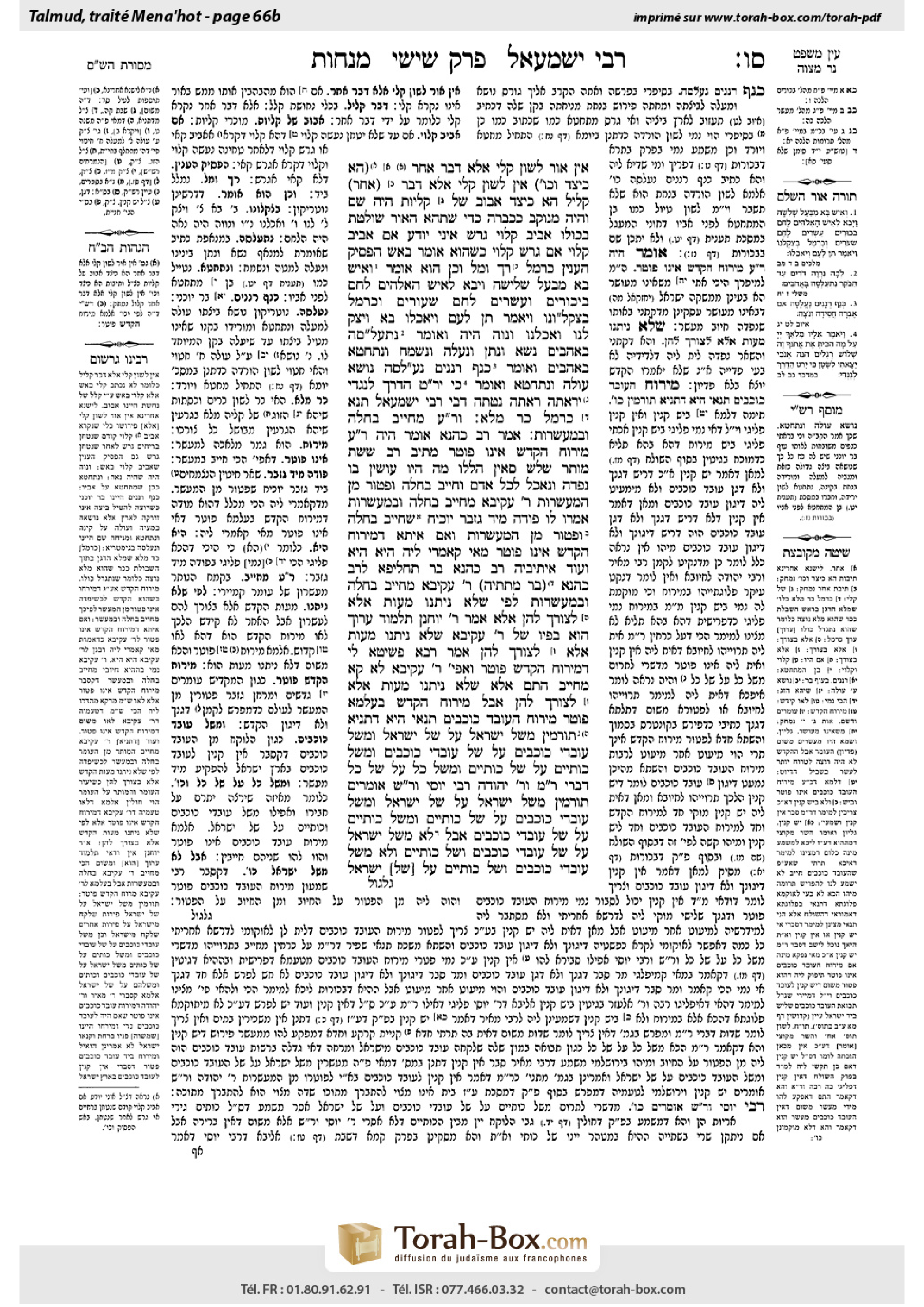
Menachot 66b: Talmud study for Daf Yomi
Daf Yomi is the daily study of one Talmud folio. Explore 37 tractates with scans, Hebrew text, Sefaria English and AI-generated French translations where annotated.
Passage selection and English or AI-generated French translation are available where the scan has annotations. Daf Study is independent of Torah-Box and Sefaria.
Browse Menachot · מנחות · All tractatesMenachot 66b text and translations
This page of Menachot includes the Aramaic text, an English translation and an AI-generated French translation, alongside the scan above.
מנחות ס״ו ב · Aramaic and Hebrew text
אֵין אוּר לְשׁוֹן קָלִי אֶלָּא דָּבָר אַחֵר (הָא כֵּיצַד וְכוּ׳), אֵין לְשׁוֹן קָלִי אֶלָּא דָּבָר (אַחֵר) קָלִיל. הָא כֵּיצַד? אַבּוּב שֶׁל קְלָיוֹת הָיָה שָׁם, וְהָיָה מְנוּקָּב כִּכְבָרָה כְּדֵי שֶׁתְּהֵא הָאוּר שׁוֹלֶטֶת בְּכוּלּוֹ.
״אָבִיב קָלוּי ... גֶּרֶשׂ״, אֵינִי יוֹדֵעַ אִם ״אָבִיב קָלוּי״ אִם ״גֶּרֶשׂ קָלוּי״, כְּשֶׁהוּא אוֹמֵר ״בָּאֵשׁ״ – הִפְסִיק הָעִנְיָן.
״כַּרְמֶל״ – רַךְ וּמָל, וְכֵן הוּא אוֹמֵר: ״וְאִישׁ בָּא מִבַּעַל שָׁלִשָׁה וַיָּבֵא לְאִישׁ הָאֱלֹהִים לֶחֶם בִּכּוּרִים וְעֶשְׂרִים לֶחֶם שְׂעֹרִים וְכַרְמֶל בְּצִקְלֹנוֹ וַיֹּאמֶר תֵּן לָעָם וְיֹאכֵלוּ״, בָּא וְיָצַק לָנוּ וְאָכַלְנוּ, וְנָוֶה הָיָה.
וְאוֹמֵר: ״נִתְעַלְּסָה בָּאֳהָבִים״, נִשֵּׂא וְנִתֵּן, וְנַעֲלֶה, וְנִשְׂמַח וְנִתְחַטֵּא בָּאֳהָבִים.
וְאוֹמֵר: ״כְּנַף רְנָנִים נֶעֱלָסָה״, נוֹשֵׂא, עוֹלֶה, וְנִתְחַטֵּא.
וְאוֹמֵר: ״כִּי יָרַט הַדֶּרֶךְ לְנֶגְדִּי״ – יָרֵאתָה, רָאֲתָה, נָטְתָה.
דְּבֵי רַבִּי יִשְׁמָעֵאל תָּנָא: ״כַּרְמֶל״ – כַּר מָלֵא.
וְרַבִּי עֲקִיבָא מְחַיֵּיב בַּחַלָּה וּבַמַּעַשְׂרוֹת. אָמַר רַב כָּהֲנָא: אוֹמֵר הָיָה רַבִּי עֲקִיבָא: מֵירוּחַ הֶקְדֵּשׁ אֵינוֹ פּוֹטֵר.
מֵתִיב רַב שֵׁשֶׁת: מוֹתַר שָׁלֹשׁ סְאִין הַלָּלוּ, מָה הָיוּ עוֹשִׂין בּוֹ? נִפְדֶּה וְנֶאֱכָל לְכׇל אָדָם, וְחַיָּיב בַּחַלָּה, וּפָטוּר מִן הַמַּעַשְׂרוֹת. רַבִּי עֲקִיבָא מְחַיֵּיב בַּחַלָּה וּבַמַּעַשְׂרוֹת. אָמְרוּ לוֹ: פּוֹדֶה מִיַּד גִּזְבָּר יוֹכִיחַ, שֶׁחַיָּיב בַּחַלָּה וּפָטוּר מִן הַמַּעַשְׂרוֹת.
וְאִם אִיתָא דְּמֵירוּחַ הֶקְדֵּשׁ אֵינוֹ פּוֹטֵר, מַאי קָאָמְרִי לֵיהּ? הִיא הִיא!
וְעוֹד אֵיתִיבֵיהּ רַב כָּהֲנָא בַּר תַּחְלִיפָא לְרַב כָּהֲנָא (בַּר מַתִּתְיָה): רַבִּי עֲקִיבָא מְחַיֵּיב בַּחַלָּה וּבַמַּעַשְׂרוֹת, לְפִי שֶׁלֹּא נִיתְּנוּ מָעוֹת אֶלָּא לְצוֹרֶךְ לָהֶן.
אֶלָּא אָמַר רַבִּי יוֹחָנָן: תַּלְמוּד עָרוּךְ הוּא בְּפִיו שֶׁל רַבִּי עֲקִיבָא, שֶׁלֹּא נִיתְּנוּ מָעוֹת אֶלָּא לְצוֹרֶךְ לָהֶן.
אָמַר רָבָא: פְּשִׁיטָא לִי דְּמֵירוּחַ הֶקְדֵּשׁ פּוֹטֵר, וַאֲפִילּוּ רַבִּי עֲקִיבָא לָא קָא מְחַיֵּיב הָתָם אֶלָּא שֶׁלֹּא נִיתְּנוּ מָעוֹת אֶלָּא לְצוֹרֶךְ לָהֶן, אֲבָל מֵירוּחַ הֶקְדֵּשׁ בְּעָלְמָא פּוֹטֵר.
מֵירוּחַ הַגּוֹי תַּנָּאֵי הִיא, דְּתַנְיָא: תּוֹרְמִין מִשֶּׁל יִשְׂרָאֵל עַל שֶׁל יִשְׂרָאֵל, וּמִשֶּׁל גּוֹיִם עַל שֶׁל גּוֹיִם, וּמִשֶּׁל כּוּתִיִּים עַל שֶׁל כּוּתִיִּים, וּמִשֶּׁל כֹּל עַל שֶׁל כֹּל, דִּבְרֵי רַבִּי מֵאִיר וְרַבִּי יְהוּדָה.
רַבִּי יוֹסֵי וְרַבִּי שִׁמְעוֹן אוֹמְרִים: תּוֹרְמִין מִשֶּׁל יִשְׂרָאֵל עַל שֶׁל יִשְׂרָאֵל, וּמִשֶּׁל גּוֹיִם עַל שֶׁל כּוּתִיִּים, וּמִשֶּׁל כּוּתִיִּים עַל שֶׁל גּוֹיִם, אֲבָל לֹא מִשֶּׁל יִשְׂרָאֵל עַל שֶׁל גּוֹיִם וְשֶׁל כּוּתִיִּים, וְלֹא מִשֶּׁל גּוֹיִם וְשֶׁל כּוּתִיִּים עַל שֶׁל יִשְׂרָאֵל.
Menachot 66b · English translation
Fire is not the proper interpretation of the term kali in the verse. Rather, kali means something else, i.e., the barley was parched inside a receptacle and not directly in the fire. How so? The term kali means only that something else, a vessel made from burnished [kalil] brass was used in the process of parching the grains. How so, i.e., how was this performed? There was a hollow vessel there, in the Temple, which was used for making parched grains. And it was perforated with holes like a sieve, in order to allow the fire to take hold of it in its entirety.
The baraita analyzes the verse: “And if you bring a meal offering of first fruits to the Lord, you shall bring for the meal offering of your first fruits grain in the ear parched with fire, even groats of the fresh ear” (Leviticus 2:14). This indicates that the grain used for the omer offering must be parched with fire, but is unclear if that clause modifies the earlier or later part of the verse. In other words, I do not know if grain in the ear is to be parched before it is ground, or if the ground groats are to be parched. The baraita explains that when the verse states: With fire, it interrupted the previous matter and is now introducing a new clause. Accordingly, the instruction to parch with fire is referring to the grain still in the stalks, not the ground groats.
The verse states that the omer offering should be of the fresh ear [karmel]. The baraita defines karmel as soft and malleable [rakh umal]. And likewise there are other examples of terms that are interpreted as shortened terms, as the verse states: “And there came a man from Baal Shalishah, and brought the man of God bread of the first fruits, twenty loaves of barley, and fresh ears of grain [karmel] in his sack [betziklono]. And he said: Give to the people, that they may eat” (II Kings 4:42). This verse mentions the word karmel in connection with the word betziklono, which is interpreted as an abbreviation for: He came [ba] and he poured for us [veyatzak lanu], and we ate [ve’akhalnu] and it was fine [venaveh haya].
The baraita presents further examples of words that are interpreted as shortened terms of an expanded phrase. And the verse states: “Come, let us take our fill of love until the morning; let us solace ourselves [nitalesa] with love” (Proverbs 7:18). The word nitalesa is short for: We shall converse [nissa veniten] and we shall go up [vena’aleh] to bed and we shall rejoice [venismaḥ] and be pampered [venitḥata] with loves.
The baraita provides an example of a similar shortened word: “The wing of the ostrich beats joyously [ne’elasa]” (Job 39:13). The word ne’elasa is a combination of the words: Carries [noseh], goes up [oleh], and places down [venitḥata]. This bird carries its egg, flies upward, and places it in its nest.
Likewise, the verse states, after Balaam struck his donkey: “And the angel of the Lord said to him: Why did you hit your donkey these three times? Behold I have come out as an adversary because your way is contrary [yarat] against me” (Numbers 22:32). Yarat is also a shortened term: The donkey feared [yirata], it saw [ra’ata], and it turned aside [nateta].
The Gemara returns to discuss the word karmel. The school of Rabbi Yishmael taught that karmel means: A full kernel [kar maleh], i.e., that the shell of the kernel should be filled with the ripened kernel inside.
§ The mishna teaches: Rabbi Akiva deems this flour obligated in having ḥalla and the tithes separated from it. Rav Kahana said that Rabbi Akiva would say: The smoothing of a pile of consecrated grains does not exempt it from the obligation to separate tithes if it is later redeemed for common use. This is despite the halakha that the smoothing of the pile is what causes the obligation of separating tithes to take effect.
Rav Sheshet raises an objection from a baraita: What would they do with the leftover of these three se’a of barley, i.e., the portion not used for the tenth of an ephah of flour for the omer offering? It is redeemed and eaten by any person, and it is obligated in the separation of ḥalla and exempt from the separation of tithes. Rabbi Akiva deems this flour obligated in having ḥalla and the tithes separated from it. The Rabbis said to Rabbi Akiva: The halakha of one who redeems produce from the possession of the Temple treasurer [gizbar] proves otherwise, as he is obligated in the separation of ḥalla but exempt from the separation of tithes.
Rav Sheshet explains his objection: And if it is so that Rabbi Akiva holds that smoothing a pile of consecrated grains does not exempt it from tithes, what is the significance of that which the Rabbis said to him? Rabbi Akiva would simply disagree with their premise, as it is the same ruling itself: Just as a pile of consecrated grains that was smoothed is not exempt from tithes, so too, Rabbi Akiva would maintain that produce redeemed from the Temple treasury is not exempt from tithes.
And furthermore, Rav Kahana bar Taḥlifa raises an objection from a baraita to Rav Kahana bar Matitya, who reported that Rabbi Akiva holds that consecrated grain is not exempt from the obligation to separate tithes. The baraita teaches: Rabbi Akiva obligates one in the separation of ḥalla and in the separation of tithes, as the Temple money designated for the omer crop was given only to cover the cost of that which they required for the offering. Only the requisite tenth of an ephah out of the entire three se’a was paid from the Temple treasury, and was therefore its property. This indicates that had the entire crop been purchased by the Temple, it would be exempt from the obligation to separate tithes.
Rather, Rabbi Yoḥanan says: It is a settled, accepted tradition in the mouth of Rabbi Akiva that the Temple money designated for the omer crop was given only to cover the cost of that which they required for the offering. In other words, Rav Kahana’s version of Rabbi Akiva’s opinion, that in all cases the smoothing of a pile of consecrated grains does not exempt it from tithes, is rejected.
Rava likewise said: It is obvious to me that the smoothing of a pile of consecrated grain exempts one from any subsequent obligation to separate tithes. And even Rabbi Akiva, who requires the separation of tithes from the remainder of the grain not used for the omer offering, obligates one to separate tithes only there, where the money was given only to pay for that which they required for the offering. But he concedes that the smoothing of a pile of consecrated grain generally exempts one from the obligation to separate tithes.
Rava continues: The status of a pile of grain after smoothing performed by a gentile owner is a dispute between tanna’im, as it is taught in a baraita: One separates teruma from produce of a Jew to exempt other produce of a Jew, and from produce bought from gentiles to exempt other produce bought from gentiles, and from produce bought from Samaritans to exempt other produce bought from Samaritans. Furthermore, one may separate teruma from the produce of any of the above to exempt the produce of any of the above. This is the statement of Rabbi Meir and Rabbi Yehuda, as they maintain that produce that belonged to gentiles or Samaritans is obligated in tithes and has the same status as produce that initially belonged to a Jew.
Rabbi Yosei and Rabbi Shimon say: One separates teruma from produce of a Jew to exempt other produce of a Jew, and from produce bought from gentiles to exempt produce bought from Samaritans, and from produce bought from Samaritans to exempt produce bought from gentiles. But one may not separate teruma from produce of a Jew to exempt produce bought from gentiles or from Samaritans, nor from produce bought from gentiles or from Samaritans to exempt produce of a Jew. According to Rabbi Yosei and Rabbi Yishmael, produce that belonged to a gentile or a Samaritan is exempt from the obligation to separate tithes. Therefore one may not separate tithes from produce of a Jew, to which the obligation of tithes applies, to exempt such produce.
Menachot 66b · Traduction française (IA)
Le feu n’est pas la bonne interprétation du terme kali dans le verset. Kali désigne plutôt autre chose : l’orge était grillée dans un récipient, et non directement au feu. Comment cela ? Le terme kali signifie seulement qu’un autre élément intervenait dans le procédé de grillage des grains : un ustensile en laiton poli [kalil]. Comment procédait-on ? Il y avait dans le Temple un récipient creux destiné à faire griller les grains. Il était percé de trous comme un tamis, afin que le feu puisse le saisir dans toute son étendue.
La baraïta analyse le verset : « Et si tu apportes au Seigneur une offrande de prémices, tu apporteras comme offrande de tes prémices du grain en épis grillé au feu, des grains frais concassés » (Lévitique 2,14). Cela indique que le grain destiné à l’offrande du omer doit être grillé au feu, mais on ne sait pas si cette proposition se rapporte à la première ou à la dernière partie du verset. Autrement dit, je ne sais pas si le grain encore en épis doit être grillé avant d’être moulu, ou si ce sont les grains concassés qui doivent être grillés. La baraïta explique que lorsque le verset dit « au feu », il interrompt le sujet précédent et introduit une nouvelle proposition. Par conséquent, l’instruction de griller au feu se rapporte au grain encore en épis, et non aux grains concassés.
Le verset précise que l’offrande du omer doit être faite avec du grain frais [karmel]. La baraïta définit karmel comme « tendre et malléable » [rakh umal]. De même, il existe d’autres exemples de termes interprétés comme des formes abrégées, car le verset dit : « Un homme vint de Baal-Shalisha et apporta à l’homme de Dieu du pain des prémices, vingt pains d’orge, ainsi que des épis frais [karmel] dans son sac [betziklono]. Et il dit : “Donne-les au peuple, qu’ils mangent” » (II Rois 4,42). Ce verset mentionne le mot karmel en lien avec le mot betziklono, interprété comme une abréviation de : il vint [ba], il nous versa [veyatzak lanu], nous mangeâmes [ve’akhalnu] et c’était bon [venaveh haya].
La baraïta donne d’autres exemples de mots interprétés comme des formes abrégées d’une expression développée. Le verset dit : « Viens, rassasions-nous d’amour jusqu’au matin ; réjouissons-nous [nitalesa] dans l’amour » (Proverbes 7,18). Le mot nitalesa est une forme abrégée de : nous converserons [nissa veniten], nous monterons [vena’aleh] nous coucher, nous nous réjouirons [venismaḥ] et nous nous délecterons [venitḥata] de nos amours.
La baraïta donne un exemple d’un mot abrégé de façon semblable : « L’aile de l’autruche bat joyeusement [ne’elasa] » (Job 39,13). Le mot ne’elasa combine les mots : elle porte [noseh], elle monte [oleh] et elle dépose [venitḥata]. Cet oiseau porte son œuf, s’envole et le dépose dans son nid.
De même, après que Balaam eut frappé son ânesse, le verset dit : « L’ange du Seigneur lui dit : “Pourquoi as-tu frappé ton ânesse ces trois fois ? Voici, je suis sorti pour m’opposer à toi, car ta voie est contraire [yarat] à la mienne” » (Nombres 22,32). Yarat est également une forme abrégée : l’ânesse eut peur [yirata], elle vit [ra’ata] et elle s’écarta [nateta].
La Guemara revient au mot karmel. L’école de Rabbi Yishmael enseignait que karmel signifie : un grain plein [kar maleh], c’est-à-dire que l’enveloppe du grain doit être remplie par le grain mûr qui se trouve à l’intérieur.
§ La Michna enseigne : Rabbi Akiva considère que cette farine est soumise à l’obligation de prélever la ḥalla et les dîmes. Rav Kahana dit que, selon Rabbi Akiva, le lissage d’un tas de grains consacrés ne l’exempte pas de l’obligation de prélever les dîmes si le grain est ensuite racheté pour un usage profane. Cela en dépit de la halakha selon laquelle c’est le lissage du tas qui fait entrer en vigueur l’obligation de prélever les dîmes.
Rav Sheshet soulève une objection à partir d’une baraïta : que faisait-on du reste de ces trois séa d’orge, c’est-à-dire de la partie qui n’était pas utilisée pour le dixième d’épha de farine destiné à l’offrande du omer ? On le rachetait et n’importe qui pouvait le manger ; il était soumis à l’obligation de prélever la ḥalla, mais exempt de celle de prélever les dîmes. Rabbi Akiva considère que cette farine est soumise à l’obligation de prélever la ḥalla et les dîmes. Les Sages dirent à Rabbi Akiva : la halakha concernant celui qui rachète des produits agricoles détenus par le trésorier du Temple [gizbar] prouve le contraire, car il est tenu de prélever la ḥalla, mais exempt de prélever les dîmes.
Rav Sheshet explique son objection : si Rabbi Akiva estime que le lissage d’un tas de grains consacrés ne l’exempte pas des dîmes, que signifie ce que les Sages lui ont dit ? Rabbi Akiva se contenterait de contester leur prémisse, car il s’agit exactement de la même règle : de même qu’un tas de grains consacrés dont le lissage a été effectué n’est pas exempt des dîmes, Rabbi Akiva soutiendrait également que des produits agricoles rachetés au trésor du Temple ne sont pas exempts des dîmes.
De plus, Rav Kahana bar Taḥlifa soulève, à partir d’une baraïta, une objection à Rav Kahana bar Matitya, qui rapportait que, selon Rabbi Akiva, le grain consacré n’est pas exempt de l’obligation de prélever les dîmes. La baraïta enseigne : Rabbi Akiva oblige à prélever la ḥalla et les dîmes, car l’argent du Temple affecté à la récolte du omer n’avait été versé que pour couvrir le coût de ce qui était nécessaire à l’offrande. Seul le dixième d’épha requis, prélevé sur les trois séa entiers, avait été payé par le trésor du Temple et lui appartenait donc. Cela indique que, si toute la récolte avait été achetée par le Temple, elle aurait été exemptée de l’obligation de prélever les dîmes.
Rabbi Yoḥanan dit plutôt : il est transmis comme une tradition établie, au nom de Rabbi Akiva, que l’argent du Temple affecté à la récolte du omer n’avait été versé que pour couvrir le coût de ce qui était nécessaire à l’offrande. Autrement dit, la version de Rav Kahana concernant l’opinion de Rabbi Akiva — selon laquelle, dans tous les cas, le lissage d’un tas de grains consacrés ne l’exempte pas des dîmes — est rejetée.
Rava dit également : il m’apparaît clairement que le lissage d’un tas de grains consacrés exempte de toute obligation ultérieure de prélever les dîmes. Même Rabbi Akiva, qui exige que l’on prélève les dîmes sur le reste du grain non utilisé pour l’offrande du omer, n’impose ce prélèvement que dans ce cas, où l’argent n’avait été versé que pour payer ce qui était nécessaire à l’offrande. Mais il reconnaît que, de manière générale, le lissage d’un tas de grains consacrés exempte de l’obligation de prélever les dîmes.
Rava poursuit : le statut d’un tas de grain après son lissage par un propriétaire non juif fait l’objet d’un désaccord entre des tannaïm, comme l’enseigne une baraïta : on prélève la terouma sur des produits agricoles appartenant à un Juif pour en exempter d’autres produits agricoles appartenant à un Juif ; sur des produits achetés à des non-Juifs pour en exempter d’autres produits achetés à des non-Juifs ; et sur des produits achetés à des Samaritains pour en exempter d’autres produits achetés à des Samaritains. En outre, on peut prélever la terouma sur les produits agricoles de n’importe laquelle des catégories précédentes pour en exempter des produits agricoles de n’importe laquelle de ces catégories. Telle est la déclaration de Rabbi Meïr et de Rabbi Yehouda, car ils estiment que les produits agricoles ayant appartenu à des non-Juifs ou à des Samaritains sont soumis aux dîmes et ont le même statut que des produits agricoles ayant appartenu initialement à un Juif.
Rabbi Yosei et Rabbi Shimon disent : on prélève la terouma sur des produits agricoles appartenant à un Juif pour en exempter d’autres produits agricoles appartenant à un Juif ; sur des produits achetés à des non-Juifs pour en exempter des produits achetés à des Samaritains ; et sur des produits achetés à des Samaritains pour en exempter des produits achetés à des non-Juifs. Mais on ne peut pas prélever la terouma sur des produits agricoles appartenant à un Juif pour en exempter des produits achetés à des non-Juifs ou à des Samaritains, ni sur des produits achetés à des non-Juifs ou à des Samaritains pour en exempter des produits agricoles appartenant à un Juif. Selon Rabbi Yosei et Rabbi Yishmael, les produits agricoles ayant appartenu à un non-Juif ou à un Samaritain sont exemptés de l’obligation de prélever les dîmes. On ne peut donc pas prélever les dîmes sur des produits agricoles appartenant à un Juif, auxquels s’applique l’obligation des dîmes, pour en exempter de tels produits.
Traduction française générée par IA à partir de l’édition anglaise de Sefaria. Vérifie toujours un passage avec le texte source.
Text from Sefaria: William Davidson Edition - Vocalized Aramaic (unknown); William Davidson Edition - English (CC BY NC).