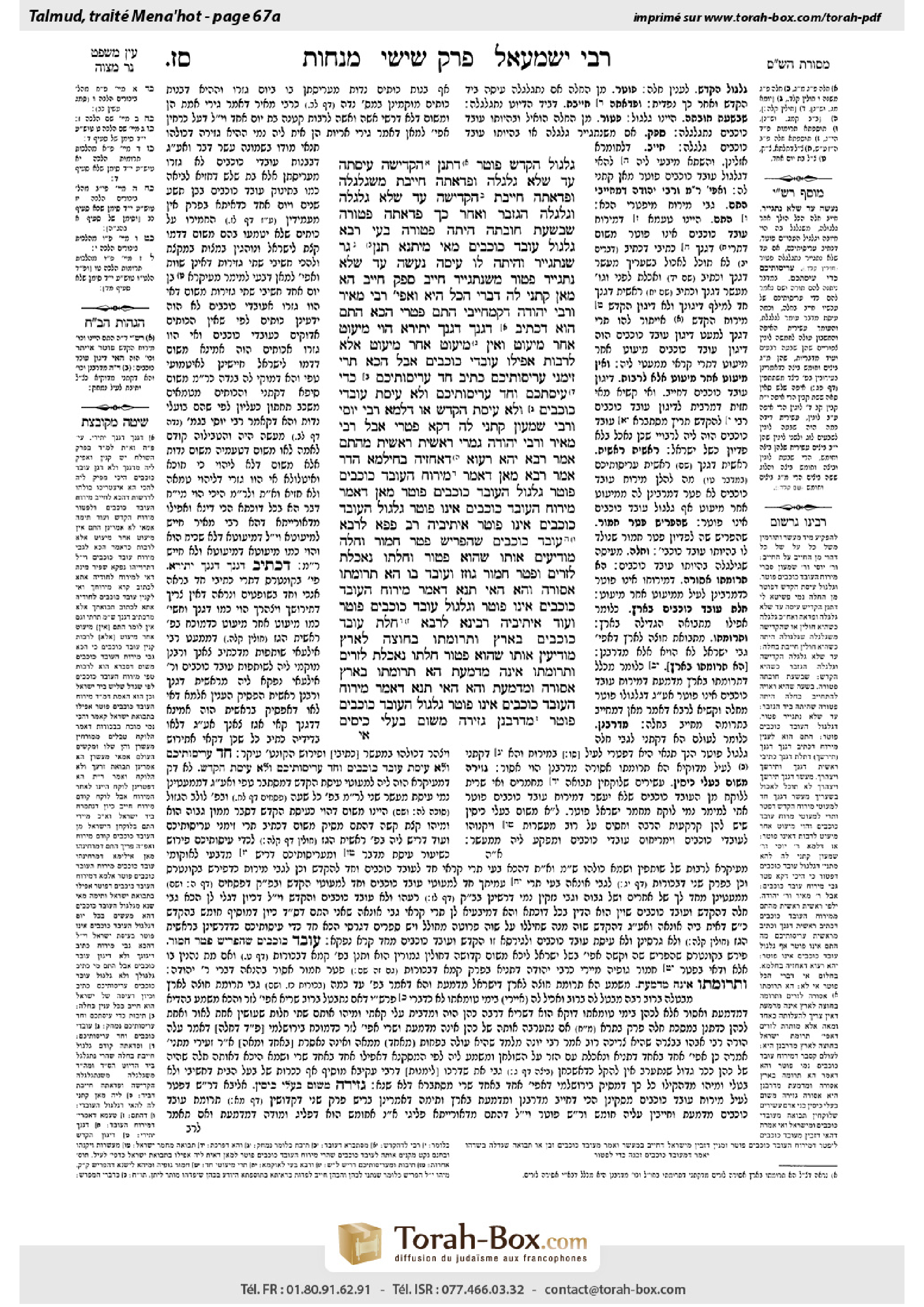
Menachot 67a: Talmud study for Daf Yomi
Daf Yomi is the daily study of one Talmud folio. Explore 37 tractates with scans, Hebrew text, Sefaria English and AI-generated French translations where annotated.
Passage selection and English or AI-generated French translation are available where the scan has annotations. Daf Study is independent of Torah-Box and Sefaria.
Browse Menachot · מנחות · All tractatesMenachot 67a text and translations
This page of Menachot includes the Aramaic text, an English translation and an AI-generated French translation, alongside the scan above.
מנחות ס״ז א · Aramaic and Hebrew text
גִּלְגּוּל הֶקְדֵּשׁ פּוֹטֵר, דִּתְנַן: הִקְדִּישָׁהּ עִיסָּתָהּ עַד שֶׁלֹּא גִּלְגְּלָה וּפְדָאַתָּה – חַיֶּיבֶת, מִשֶּׁגִּלְגְּלָה וּפְדָאַתָּה – חַיֶּיבֶת, הִקְדִּישָׁהּ עַד שֶׁלֹּא גִּלְגְּלָה, וְגִלְגְּלָהּ הַגִּזְבָּר וְאַחַר כָּךְ פְּדָאַתָּה – פְּטוּרָה, שֶׁבִּשְׁעַת חוֹבָתָהּ הָיְתָה פְּטוּרָה.
בָּעֵי רָבָא: גִּלְגּוּל גּוֹי מַאי? מִיתְנָא תְּנַן: גֵּר שֶׁנִּתְגַּיֵּיר וְהָיְתָה לוֹ עִיסָּה, נַעֲשֵׂית עַד שֶׁלֹּא נִתְגַּיֵּיר – פָּטוּר, מִשֶּׁנִּתְגַּיֵּיר – חַיָּיב, סָפֵק – חַיָּיב.
הָא מַאן קָתָנֵי לַהּ? דִּבְרֵי הַכֹּל הִיא, וַאֲפִילּוּ רַבִּי מֵאִיר וְרַבִּי יְהוּדָה דְּקָמְחַיְּיבִי הָתָם – פָּטְרִי הָכָא.
הָתָם הוּא, דִכְתִיב ״דְּגָנְךָ״, ״דְּגָנְךָ״ יַתִּירָא.
הָוֵי מִיעוּט אַחַר מִיעוּט, וְאֵין מִיעוּט אַחַר מִיעוּט אֶלָּא לְרַבּוֹת, אֲפִילּוּ גּוֹי.
אֲבָל הָכָא, תְּרֵי זִימְנֵי ״עֲרִסֹתֵיכֶם״ כְּתִיב, חַד ״עֲרִסֹתֵיכֶם״ כְּדֵי עִיסַּתְכֶם, וְחַד ״עֲרִסֹתֵיכֶם״ וְלֹא עִיסַּת גּוֹיִם וְלֹא עִיסַּת הֶקְדֵּשׁ.
אוֹ דִלְמָא רַבִּי יוֹסֵי וְרַבִּי שִׁמְעוֹן קָתָנֵי לַהּ, דְּקָא פָּטְרִי, אֲבָל רַבִּי מֵאִיר וְרַבִּי יְהוּדָה גָּמְרִי ״רֵאשִׁית״ ״רֵאשִׁית״ מֵהָתָם.
אָמַר רָבָא: יְהֵא רַעֲוָא דְּאֶחְזְיֵהּ בְּחֶילְמָא. הֲדַר אָמַר רָבָא: מַאן דְּאָמַר מֵירוּחַ הַגּוֹי פּוֹטֵר – גִּלְגּוּל הַגּוֹי פּוֹטֵר, מַאן דְּאָמַר מֵירוּחַ הַגּוֹי אֵינוֹ פּוֹטֵר – גִּלְגּוּל הַגּוֹי אֵינוֹ פּוֹטֵר.
אֵיתִיבֵיהּ רַב פָּפָּא לְרָבָא: גּוֹי שֶׁהִפְרִישׁ פֶּטֶר חֲמוֹר וְחַלָּה, מוֹדִיעִים אוֹתוֹ שֶׁהוּא פָּטוּר, וְחַלָּתוֹ נֶאֱכֶלֶת לְזָרִים, וּפֶטֶר חֲמוֹר גּוֹזֵז וְעוֹבֵד בּוֹ.
הָא תְּרוּמָתוֹ אֲסוּרָה, וְהָא הַאי תַּנָּא דְּאָמַר: מֵירוּחַ הַגּוֹי אֵינוֹ פּוֹטֵר, וְגִלְגּוּל גּוֹי פּוֹטֵר.
וְעוֹד אֵיתִיבֵיהּ רָבִינָא לְרָבָא: חַלַּת גּוֹי בָּאָרֶץ, וּתְרוּמָתוֹ בְּחוּצָה לָאָרֶץ – מוֹדִיעִין אוֹתוֹ שֶׁהוּא פָּטוּר, חַלָּתוֹ נֶאֱכֶלֶת לְזָרִים, וּתְרוּמָתוֹ אֵינָהּ מְדַמַּעַת. הָא תְּרוּמָתוֹ בָּאָרֶץ – אֲסוּרָה וּמְדַמַּעַת.
וְהָא הַאי תַּנָּא דְּאָמַר: מֵירוּחַ הַגּוֹי אֵינוֹ פּוֹטֵר, גִּלְגּוּל הַגּוֹי פּוֹטֵר!
מִדְּרַבָּנַן, גְּזֵירָה מִשּׁוּם בַּעֲלֵי כִיסִים.
Menachot 67a · English translation
Rava adds: The kneading of consecrated dough exempts it from the obligation of ḥalla, as we learned in a mishna (Ḥalla 3:3): If a woman consecrated her dough before she kneaded it and she subsequently redeemed it, she is obligated to separate ḥalla. Likewise, if she consecrated it after she kneaded it and then she redeemed it, she is obligated to separate ḥalla. But if she consecrated the dough before she kneaded it and the Temple treasurer kneaded it and then she subsequently redeemed it, she is exempt. The reason is that at the time that its obligation in ḥalla would have taken effect, i.e., at the time of its kneading, it was exempt, because it was Temple property.
Rava raises a dilemma: If dough was kneaded while in the possession of a gentile, what is its status? Is one who acquires it after it has been kneaded obligated to separate ḥalla from it or not? The Gemara answers that this is taught explicitly, as we learned in a mishna (Ḥalla 3:6): With regard to a convert who converted and had dough in his possession, if it was prepared before he converted, he is exempt from the obligation of ḥalla. If it was prepared after he converted, he is obligated. If he is uncertain, he is obligated.
The Gemara asks: Of the Sages who disagreed with regard to the obligation to tithe grain that is smoothed by a gentile, who taught this mishna with regard to ḥalla? Perhaps it is a ruling upon which everyone agrees, and even Rabbi Meir and Rabbi Yehuda, who obligate there, in the case of tithes, exempt here in the case of ḥalla.
The Gemara explains this possibility. There are three verses written with regard to teruma that contain the term “your grain.” They are: “You may not eat within your gates the tithe of your grain” (Deuteronomy 12:17); “And you shall eat before the Lord your God…the tithe of your grain” (Deuteronomy 12:17); and “The first fruits of your grain…you shall give him” (Deuteronomy 18:4). It can therefore be claimed that only there Rabbi Meir and Rabbi Yehuda hold that one is obligated to separate tithes from grain that was owned by a gentile, as in addition to the first reference to “your grain,” which excludes grain that was smoothed while in the Temple’s possession, it is written an additional “your grain,” and then another reference to “your grain.”
The Gemara elaborates: This is an example of a restrictive expression following a restrictive expression. And there is a hermeneutical principle that a restrictive expression following a restrictive expression comes only to include additional cases. In this case, the verses teach that even grain that belonged to gentiles is obligated in the separation of tithes.
But here, with regard to the obligation to separate ḥalla, the term “your dough” is written only twice: “Of the first of your dough you shall set apart a cake for a gift; as that which is set apart of the threshing floor, so shall you set it apart. Of the first of your dough you shall give to the Lord a portion for a gift throughout your generations” (Numbers 15:20–21). One reference to “your dough” teaches that one is obligated to separate ḥalla only from an amount equal to your dough in the wilderness, where the mitzva was commanded, i.e., the volume of one omer. And one reference to “your dough” teaches that only the dough of an ordinary Jew is obligated but not the dough of gentiles nor the dough of consecrated property.
The Gemara continues: Or perhaps it is Rabbi Yosei and Rabbi Shimon who taught that mishna, as they maintain that grain that was smoothed by a gentile owner is exempt from the obligation to separate tithes, and likewise dough kneaded by a gentile owner is likewise exempt from the obligation to separate ḥalla. But Rabbi Meir and Rabbi Yehuda derive by way of verbal analogy the halakha with regard to ḥalla, concerning which it is written: “Of the first of your dough,” from the same expression that appears there, with regard to tithes: “The first fruits of your grain.” Just as in the case of tithes they hold that one is obligated to separate the tithes from a pile of grain that was smoothed by a gentile owner, so too they hold that one is obligated to separate ḥalla from dough that was kneaded by a gentile owner.
Rava said: May it be God’s will that I see the answer to my question in a dream. Rava then said: The one who says that the smoothing of a grain pile by its gentile owner exempts a future Jewish owner from the obligation to separate tithes also maintains that the kneading of dough by its gentile owner exempts a future Jewish owner from any obligation to separate ḥalla. So too the one who says that the smoothing of a grain pile by a gentile owner does not exempt a future Jewish owner from the obligation to separate tithes also maintains that the kneading of dough by a gentile owner does not exempt a future Jewish owner from the obligation to separate ḥalla.
Rav Pappa raised an objection to Rava from a baraita (Tosefta, Terumot 4:13): With regard to a gentile who separated a lamb in order to redeem a firstborn donkey, or if he separated ḥalla from dough that he kneaded, one informs him that he is exempt from these obligations and his ḥalla may be eaten by non-priests and the lamb designated to redeem his firstborn donkey may be sheared and worked.
One can infer: But if a gentile separated teruma, the portion of the produce designated for the priest, from a grain pile that he smoothed, his teruma is prohibited to a non-priest. And this is an example of a tanna who says: The smoothing of a grain pile by a gentile owner does not exempt it from tithes, as the same halakhot apply to tithes as to teruma, and yet he maintains that the kneading of dough by a gentile owner exempts it from the obligation to separate ḥalla. This refutes Rava’s conclusion that one who holds that there is an exemption in the case of tithes likewise holds that an exemption applies to ḥalla.
And Ravina further raised an objection to Rava from a baraita: With regard to ḥalla of a gentile that he separated after kneading his dough in Eretz Yisrael, or his teruma that he separated after smoothing his pile of grain outside Eretz Yisrael, in both cases one informs him that he is exempt from those obligations and his ḥalla may be eaten by non-priests and his teruma does not render a mixture prohibited if it becomes mixed with non-sacred produce. One can infer: But his teruma from his grain in Eretz Yisrael is prohibited to non-priests and renders a mixture prohibited if it becomes mixed with non-sacred produce.
The Gemara explains the objection: And again this is an example of a tanna who says: The smoothing of a grain pile by a gentile owner does not exempt it from tithes, and nevertheless he maintains that the kneading of dough by a gentile owner exempts it from the obligation to separate ḥalla.
The Gemara answers: This ruling that the smoothing of a grain pile by its gentile owner does not exempt it from the obligations of teruma and tithes applies only by rabbinic law. By Torah law, the smoothing of a grain pile by its gentile owner does exempt it from the obligation to separate teruma and tithes. The Sages enacted a decree due to the schemes of people of means. There was a fear that conniving merchants might temporarily transfer ownership of their produce to gentiles while the piles were smoothed, after which the gentiles would return them to their possession, thereby circumventing the obligation to separate teruma and tithes.
Menachot 67a · Traduction française (IA)
Rava ajoute : Le pétrissage d’une pâte consacrée l’exempte de l’obligation de prélever la ‘hallah, comme nous l’avons appris dans une Michna (’Hallah 3:3) : si une femme a consacré sa pâte avant de la pétrir, puis l’a rachetée, elle est tenue d’en prélever la ‘hallah. De même, si elle l’a consacrée après l’avoir pétrie, puis l’a rachetée, elle est tenue d’en prélever la ‘hallah. Mais si elle a consacré la pâte avant de la pétrir, que le trésorier du Temple l’a pétrie, puis qu’elle l’a rachetée, elle en est exemptée. En effet, au moment où l’obligation de prélever la ‘hallah aurait pris effet, c’est-à-dire au moment du pétrissage, la pâte en était exemptée, car elle appartenait au Temple.
Rava soulève un dilemme : quel est le statut d’une pâte pétrie alors qu’elle était en possession d’un non-Juif ? Celui qui l’acquiert après son pétrissage est-il tenu d’en prélever la ‘hallah ou non ? La Guemara répond que cela est enseigné explicitement, comme nous l’avons appris dans une Michna (’Hallah 3:6) : au sujet d’un converti qui s’est converti alors qu’il avait une pâte en sa possession, si elle avait été préparée avant sa conversion, il est exempté de l’obligation de prélever la ‘hallah. Si elle a été préparée après sa conversion, il y est tenu. S’il y a un doute, il y est tenu.
La Guemara demande : Parmi les Sages en désaccord au sujet de l’obligation de prélever la dîme sur du grain dont le lissage a été effectué par un non-Juif, qui a enseigné cette Michna concernant la ‘hallah ? Peut-être s’agit-il d’une décision sur laquelle tous sont d’accord, et même Rabbi Meïr et Rabbi Yehouda, qui imposent cette obligation dans le cas des dîmes, exemptent de celle-ci dans le cas de la ‘hallah.
La Guemara explique cette possibilité. Trois versets concernant la terouma contiennent l’expression « ton grain ». Les voici : « Tu ne pourras pas manger dans tes portes la dîme de ton grain » (Deutéronome 12:17) ; « Tu mangeras devant l’Éternel ton Dieu… la dîme de ton grain » (Deutéronome 12:17) ; et « Les prémices de ton grain… tu les lui donneras » (Deutéronome 18:4). On peut donc soutenir que Rabbi Meïr et Rabbi Yehouda considèrent qu’on est tenu de prélever les dîmes sur du grain ayant appartenu à un non-Juif uniquement dans ce cas : en effet, outre la première occurrence de « ton grain », qui exclut le grain dont le lissage a été effectué alors qu’il appartenait au Temple, une autre occurrence de « ton grain » est écrite, puis une troisième.
La Guemara développe : c’est un exemple d’expression restrictive suivie d’une expression restrictive. Or, un principe herméneutique veut qu’une expression restrictive suivie d’une expression restrictive ne vienne qu’inclure des cas supplémentaires. En l’occurrence, les versets enseignent que même le grain ayant appartenu à des non-Juifs est soumis à l’obligation de prélever les dîmes.
Mais ici, concernant l’obligation de prélever la ‘hallah, l’expression « ta pâte » n’apparaît que deux fois : « Du début de votre pâte, vous prélèverez un gâteau en offrande ; comme ce qui est prélevé sur l’aire de battage, vous le prélèverez. Du début de votre pâte, vous donnerez à l’Éternel une part en offrande, dans toutes vos générations » (Nombres 15:20–21). Une occurrence de « ta pâte » enseigne qu’on n’est tenu de prélever la ‘hallah que sur une quantité équivalente à celle de la pâte des Israélites dans le désert, où la mitsva fut prescrite, c’est-à-dire le volume d’un omer. L’autre occurrence de « ta pâte » enseigne que seule la pâte d’un Juif ordinaire est soumise à cette obligation, mais non celle des non-Juifs ni celle d’un bien consacré.
La Guemara poursuit : ou peut-être est-ce Rabbi Yossi et Rabbi Chim’on qui ont enseigné cette Michna, car ils considèrent qu’un grain dont le lissage a été effectué par son propriétaire non juif est exempté de l’obligation de prélever les dîmes ; de même, une pâte pétrie par son propriétaire non juif est également exemptée de l’obligation de prélever la ‘hallah. Mais Rabbi Meïr et Rabbi Yehouda déduisent, par une analogie verbale, la halakha concernant la ‘hallah, au sujet de laquelle il est écrit « du début de votre pâte », de la même expression employée à propos des dîmes : « les prémices de ton grain ». De même que, pour les dîmes, ils considèrent qu’on est tenu de les prélever sur un tas de grain dont le lissage a été effectué par son propriétaire non juif, de même considèrent-ils qu’on est tenu de prélever la ‘hallah sur une pâte pétrie par son propriétaire non juif.
Rava dit : Puisse Dieu vouloir que je voie en rêve la réponse à ma question. Rava dit alors : celui qui affirme que le lissage d’un tas de grain par son propriétaire non juif exempte un futur propriétaire juif de l’obligation de prélever les dîmes considère également que le pétrissage d’une pâte par son propriétaire non juif exempte un futur propriétaire juif de toute obligation de prélever la ‘hallah. De même, celui qui affirme que le lissage d’un tas de grain par son propriétaire non juif n’exempte pas un futur propriétaire juif de l’obligation de prélever les dîmes considère également que le pétrissage d’une pâte par son propriétaire non juif n’exempte pas un futur propriétaire juif de l’obligation de prélever la ‘hallah.
Rav Pappa objecte à Rava à partir d’une baraïta (Tosefta, Teroumot 4:13) : lorsqu’un non-Juif a mis de côté un agneau pour racheter un âne premier-né, ou s’il a prélevé la ‘hallah sur une pâte qu’il a pétrie, on l’informe qu’il est exempté de ces obligations. Sa ‘hallah peut être consommée par des non-prêtres, et l’agneau destiné à racheter son âne premier-né peut être tondu et utilisé pour le travail.
On peut en déduire que, si un non-Juif a prélevé la terouma — la part des produits destinée au prêtre — sur un tas de grain qu’il a lissé, sa terouma est interdite à un non-prêtre. C’est là un exemple de tanna qui affirme que le lissage d’un tas de grain par son propriétaire non juif ne l’exempte pas des dîmes, car les mêmes halakhot s’appliquent aux dîmes et à la terouma, et qui soutient pourtant que le pétrissage d’une pâte par son propriétaire non juif l’exempte de l’obligation de prélever la ‘hallah. Cela réfute la conclusion de Rava selon laquelle celui qui considère qu’il y a exemption dans le cas des dîmes considère également qu’il y a exemption dans le cas de la ‘hallah.
Ravina objecte également à Rava à partir d’une baraïta : concernant la ‘hallah qu’un non-Juif a prélevée après avoir pétri sa pâte en terre d’Israël, ou la terouma qu’il a prélevée après avoir lissé son tas de grain hors de terre d’Israël, dans les deux cas on l’informe qu’il est exempté de ces obligations. Sa ‘hallah peut être consommée par des non-prêtres, et sa terouma ne rend pas un mélange interdit si elle se trouve mêlée à des produits non consacrés. On peut en déduire que la terouma prélevée sur son grain en terre d’Israël est interdite aux non-prêtres et rend un mélange interdit si elle se trouve mêlée à des produits non consacrés.
La Guemara explique l’objection : là encore, c’est un exemple de tanna qui affirme que le lissage d’un tas de grain par son propriétaire non juif ne l’exempte pas des dîmes, et qui soutient néanmoins que le pétrissage d’une pâte par son propriétaire non juif l’exempte de l’obligation de prélever la ‘hallah.
La Guemara répond : la décision selon laquelle le lissage d’un tas de grain par son propriétaire non juif ne l’exempte pas des obligations relatives à la terouma et aux dîmes ne s’applique que selon le droit rabbinique. Selon la Torah écrite, le lissage d’un tas de grain par son propriétaire non juif l’exempte bien de l’obligation de prélever la terouma et les dîmes. Les Sages ont institué un décret en raison des manœuvres de personnes fortunées. On craignait que des marchands rusés ne transfèrent temporairement la propriété de leurs produits à des non-Juifs pendant le lissage des tas, puis que ceux-ci ne les leur rendent, contournant ainsi l’obligation de prélever la terouma et les dîmes.
Traduction française générée par IA à partir de l’édition anglaise de Sefaria. Vérifie toujours un passage avec le texte source.
Text from Sefaria: William Davidson Edition - Vocalized Aramaic (unknown); William Davidson Edition - English (CC BY NC).