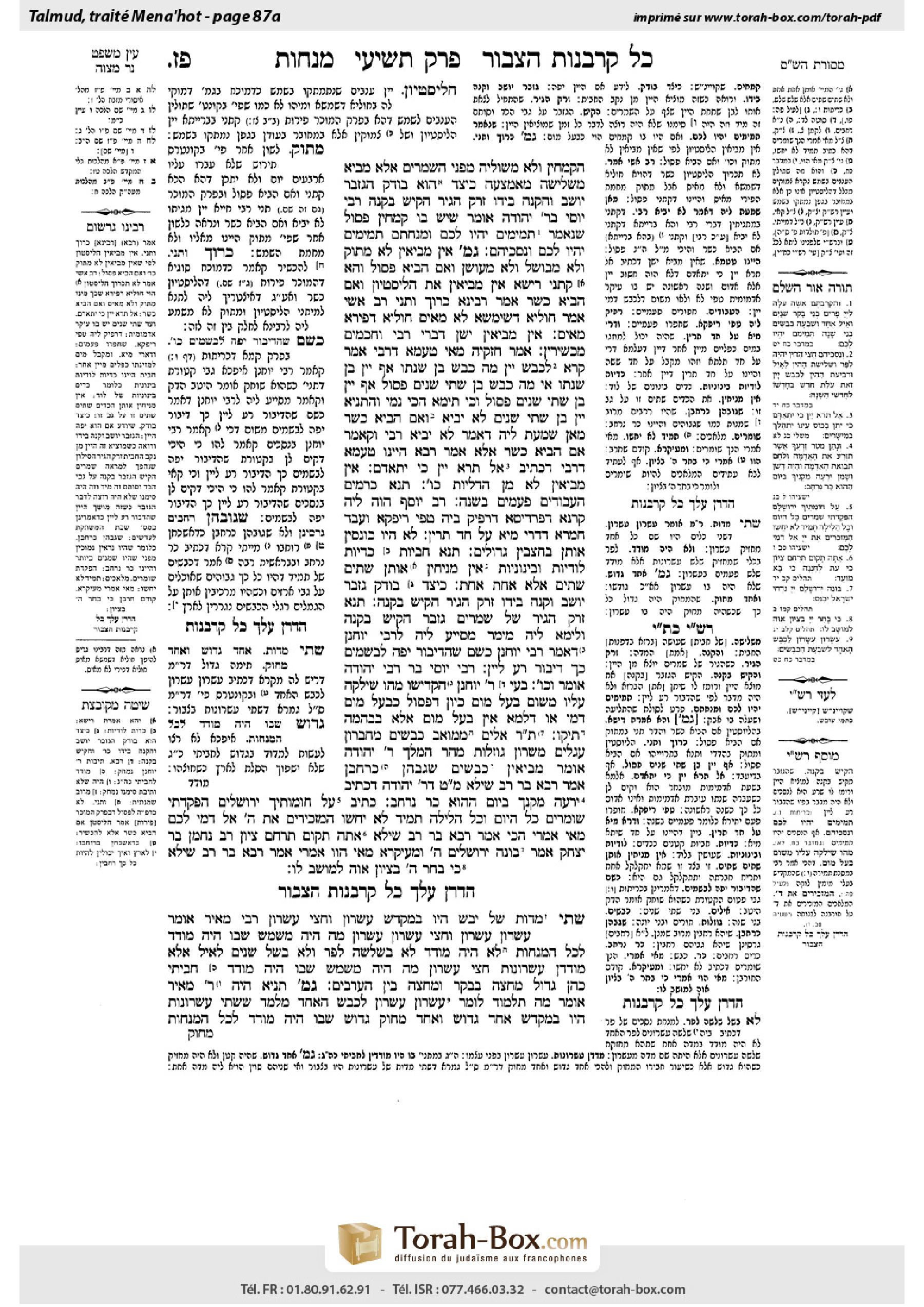
Menachot 87a: Talmud study for Daf Yomi
Daf Yomi is the daily study of one Talmud folio. Explore 37 tractates with scans, Hebrew text, Sefaria English and AI-generated French translations where annotated.
Passage selection and English or AI-generated French translation are available where the scan has annotations. Daf Study is independent of Torah-Box and Sefaria.
Browse Menachot · מנחות · All tractatesMenachot 87a text and translations
This page of Menachot includes the Aramaic text, an English translation and an AI-generated French translation, alongside the scan above.
מנחות פ״ז א · Aramaic and Hebrew text
הַקְּמָחִין, וְלֹא מִשּׁוּלֶיהָ – מִפְּנֵי הַשְּׁמָרִים, אֶלָּא מֵבִיא מִשְּׁלִישָׁהּ מֵאֶמְצָעָהּ.
כֵּיצַד הוּא בּוֹדֵק? הַגִּזְבָּר יוֹשֵׁב, וְהַקָּנֶה בְּיָדוֹ, זָרַק הַגִּיר, הִקִּישׁ בַּקָּנֶה.
רַבִּי יוֹסֵי בְּרַבִּי יְהוּדָה אוֹמֵר: שֶׁיֵּשׁ בּוֹ קְמָחִין – פָּסוּל, שֶׁנֶּאֱמַר: ״תְּמִימִים יִהְיוּ לָכֶם״, ״וּמִנְחָתָם״, ״תְּמִימִים יִהְיוּ לָכֶם וְנִסְכֵּיהֶם״.
גְּמָ׳ אֵין מְבִיאִין לֹא מָתוֹק וְלֹא מְבוּשָּׁל וְלֹא מְעוּשָּׁן, וְאִם הֵבִיא – פָּסוּל. וְהָא קָתָנֵי רֵישָׁא: אֵין מְבִיאִין אֶת הֶלִיסְטְיוֹן, וְאִם הֵבִיא – כָּשֵׁר?
אָמַר רָבִינָא: כְּרוֹךְ וְתָנֵי. רַב אָשֵׁי אָמַר: חוּלְיָא דְּשִׁימְשָׁא – לָא מְאִיס, חוּלְיָא דְּפֵירָא – מְאִיס.
אֵין מְבִיאִין יָשָׁן, דִּבְרֵי רַבִּי, וַחֲכָמִים מַכְשִׁירִין. אָמַר חִזְקִיָּה: מַאי טַעְמָא דְּרַבִּי? אָמַר קְרָא ״לַכֶּבֶשׂ יָיִן״, מָה כֶּבֶשׂ בֶּן שְׁנָתוֹ, אַף יַיִן בֶּן שְׁנָתוֹ.
אִי מָה כֶּבֶשׂ בֶּן שְׁתֵּי שָׁנִים – פָּסוּל, אַף יַיִן בֶּן שְׁתֵּי שָׁנִים – פָּסוּל! וְכִי תֵּימָא הָכִי נָמֵי, וְהָתַנְיָא: יַיִן בֶּן שְׁתֵּי שָׁנִים לֹא יָבִיא, וְאִם הֵבִיא – כָּשֵׁר! מַאן שָׁמְעַתְּ לֵיהּ דְּאָמַר ״לֹא יָבִיא״? רַבִּי, וְקָאָמַר: אִם הֵבִיא – כָּשֵׁר.
אֶלָּא אָמַר רָבָא: הַיְינוּ טַעְמָא דְּרַבִּי, דִּכְתִיב ״אַל תֵּרֶא יַיִן כִּי יִתְאַדָּם״.
אֵין מְבִיאִין לֹא מִן הַדָּלִיּוֹת כּוּ׳. תָּנָא: כְּרָמִים הָעֲבוּדִים פַּעֲמַיִם בַּשָּׁנָה.
רַב יוֹסֵף הֲוָה לֵיהּ קַרְנָא דְּפַרְדֵּיסָא, דְּרָפֵיק בֵּיהּ טְפֵי רִיפְקָא, וְעָבֵד חַמְרָא דְּדָרֵי מַיָּא עַל חַד תְּרֵין.
לֹא הָיוּ כּוֹנְסִין אוֹתָן בַּחֲצָבִין גְּדוֹלִים, תָּנָא: חָבִיּוֹת כַּדִּיּוֹת לוּדִיּוֹת וּבֵינוֹנִיּוֹת.
אֵין מַנִּיחִין אוֹתָן שְׁתַּיִם שְׁתַּיִם, אֶלָּא אַחַת אַחַת.
כֵּיצַד בּוֹדֵק גִּזְבָּר? יוֹשֵׁב וְקָנֶה בְּיָדוֹ. זָרַק הַגִּיר – הִקִּישׁ בַּקָּנֶה. תָּנָא: זָרַק הַגִּיר שֶׁל שְׁמָרִים – גִּזְבָּר הִקִּישׁ בַּקָּנֶה.
וְלֵימָא לֵיהּ מֵימָר? מְסַיַּיע לֵיהּ לְרַבִּי יוֹחָנָן, דְּאָמַר רַבִּי יוֹחָנָן: כְּשֵׁם שֶׁהַדִּיבּוּר יָפֶה לַבְּשָׂמִים, כָּךְ דִּיבּוּר רַע לַיַּיִן.
רַבִּי יוֹסֵי בַּר רַבִּי יְהוּדָה אוֹמֵר וְכוּ׳. בָּעֵי רַבִּי יוֹחָנָן: הִקְדִּישׁוֹ, מַהוּ שֶׁיִּלְקֶה עָלָיו מִשּׁוּם בַּעַל מוּם? כֵּיוָן דְּפָסוּל – כְּבַעַל מוּם דָּמֵי, אוֹ דִלְמָא אֵין בַּעַל מוּם אֶלָּא בִּבְהֵמָה? תֵּיקוּ.
תָּנוּ רַבָּנַן: אֵילִים מִמּוֹאָב, כְּבָשִׂים מֵחֶבְרוֹן, עֲגָלִים מִשָּׁרוֹן, גּוֹזָלוֹת מֵהַר הַמֶּלֶךְ.
רַבִּי יְהוּדָה אוֹמֵר: מְבִיאִין כְּבָשִׂים שֶׁגׇּבְהָן כְּרׇחְבָּן. אָמַר רָבָא בַּר רַב שֵׁילָא: מַאי טַעְמָא דְּרַבִּי יְהוּדָה? דִּכְתִיב: ״יִרְעֶה מִקְנְךָ בַּיּוֹם הַהוּא כַּר נִרְחָב״.
כְּתִיב: ״עַל חוֹמֹתַיִךְ יְרוּשָׁלִַם הִפְקַדְתִּי שֹׁמְרִים כׇּל הַיּוֹם וְכׇל הַלַּיְלָה תָּמִיד לֹא יֶחֱשׁוּ הַמַּזְכִּירִים אֶת ה׳ אַל דֳּמִי לָכֶם״. מַאי אָמְרִי? הָכִי אָמַר רָבָא בַּר רַב שֵׁילָא: ״אַתָּה תָקוּם תְּרַחֵם צִיּוֹן״.
רַב נַחְמָן בַּר יִצְחָק אָמַר: ״בּוֹנֵה יְרוּשָׁלַיִם ה׳״. וּמֵעִיקָּרָא מַאי הֲווֹ אָמְרִי? אָמַר רָבָא בַּר רַב שֵׁילָא: ״כִּי בָחַר ה׳ בְּצִיּוֹן אִוָּהּ לְמוֹשָׁב לוֹ״.
הֲדַרַן עֲלָךְ כׇּל קׇרְבְּנוֹת הַצִּיבּוּר.
מַתְנִי׳ שְׁתֵּי מִדּוֹת שֶׁל יָבֵשׁ הָיוּ בְּמִקְדָּשׁ, עִשָּׂרוֹן וַחֲצִי עִשָּׂרוֹן. רַבִּי מֵאִיר אוֹמֵר: עִשָּׂרוֹן, עִשָּׂרוֹן, וַחֲצִי עִשָּׂרוֹן.
עִשָּׂרוֹן, מֶה הָיָה מְשַׁמֵּשׁ? שֶׁבּוֹ הָיָה מוֹדֵד לְכׇל הַמְּנָחוֹת, לֹא הָיָה מוֹדֵד לֹא בִּשְׁלֹשָׁה לַפָּר, וְלֹא בְּשֶׁל שְׁנַיִם לָאַיִל, אֶלָּא מוֹדְדָן עֶשְׂרוֹנוֹת.
חֲצִי עִשָּׂרוֹן, מָה הָיָה מְשַׁמֵּשׁ? שֶׁבּוֹ הָיָה מוֹדֵד חֲבִיתֵּי כֹּהֵן גָּדוֹל, מֶחֱצָה בַּבֹּקֶר וּמֶחֱצָה בֵּין הָעַרְבַּיִם.
גְּמָ׳ תַּנְיָא: הָיָה רַבִּי מֵאִיר אוֹמֵר: מָה תַּלְמוּד לוֹמַר ״עִשָּׂרוֹן עִשָּׂרוֹן לַכֶּבֶשׂ הָאֶחָד״? מְלַמֵּד שֶׁשְׁתֵּי עֶשְׂרוֹנוֹת הָיוּ בַּמִּקְדָּשׁ, אֶחָד גָּדוּשׁ וְאֶחָד מָחוּק.
גָּדוּשׁ שֶׁבּוֹ הָיָה מוֹדֵד לְכׇל הַמְּנָחוֹת,
Menachot 87a · English translation
the flour-like white scum that floats on the surface, nor from the wine at bottom of the cask due to the sediment that collects there. Rather, one brings from the wine in its middle third.
How does the Temple treasurer inspect the wine to determine that it is from the middle of the cask? The treasurer sits alongside the cask and has the measuring reed in his hand. The spigot is opened and the wine begins to flow. When he sees that the wine emerging draws with it chalk-like scum [hagir], he immediately knocks with the reed to indicate that the spigot should be closed.
Rabbi Yosei, son of Rabbi Yehuda, says: Wine in which there is flour-like white scum is unfit for libations, as it is stated with regard to animal offerings: “Unblemished they shall be for you…and their meal offering shall be fine flour mixed with oil…unblemished they shall be for you, and their libations” (Numbers 28:19–20, 31). This indicates that animal offerings, meal offerings, and libations must all be brought from flawless products. Therefore, the presence of flour-like white scum in wine renders it unfit.
GEMARA: The mishna teaches: One may not bring libations from sweet wine, nor from boiled wine, nor from wine produced from smoked grapes, and if one did bring a libation from such wine, it is not valid. The Gemara asks: But doesn’t the first clause teach: One may not bring libations from sweet wine made from sun-dried grapes, but if one did bring a libation from such wine it is valid? How can one clause teach that a libation of one type of sweet wine is valid, and the other clause teach that a libation of another type of sweet wine is not valid?
Ravina said: The text of the mishna is corrupt. To correct it, combine the two clauses into one and teach with regard to all the wines mentioned that they are unfit to be used for libations. Rav Ashi said: The text of the mishna is correct. The reason for the difference between the two wines is that the sweetness of grapes sweetened by the sun is not objectionable, so libations of wine made from such grapes are valid, while sweetness that results from the sugars of the fruit itself is objectionable, so libations of wine made from such grapes are not valid.
§ The mishna teaches: One may not bring wine aged for one year; this is the statement of Rabbi Yehuda HaNasi, but the Rabbis deem it valid. The Gemara provides the source for Rabbi Yehuda HaNasi’s ruling. Rabbi Ḥizkiyya said: What is the reasoning of Rabbi Yehuda HaNasi? The verse states with regard to the libations that accompany the New Moon offering: “And their libations: Half a hin for a bull, a third of a hin for a ram, and a quarter of a hin for a lamb, of wine” (Numbers 28:14). The juxtaposition of the terms lamb and wine teaches that just as a lamb is fit to be used as an offering only if brought in its first year, so too wine is fit to be used as a libation only if it is in its first year.
The Gemara ask: If so, take the analogy further and conclude that just as if one offers a lamb in its second year, it is not valid, so too a libation of wine in its second year is not valid. And if you would say that this is indeed the halakha, that is difficult: But isn’t it taught in a baraita that wine in its second year may not be brought ab initio, but if one did bring it as a libation, it is valid? That baraita certainly expresses the opinion of Rabbi Yehuda HaNasi, as whom did you hear who said that aged wine may not be brought? Only Rabbi Yehuda HaNasi, who explicitly states this opinion in the mishna. And yet he says in the baraita: If one did bring a libation of aged wine, it is valid. According to Rabbi Ḥizkiyya’s explanation of Rabbi Yehuda HaNasi’s opinion, such an opinion is illogical.
Rather, Rava said: This is the reasoning of Rabbi Yehuda HaNasi: As it is written in the verse exhorting a person not to be enticed by fine wines: “Look not upon the wine when it is red” (Proverbs 23:31). Evidently, the redness of wine is indicative of its quality. After a year, wine begins to lose its redness and so it should not be used, ab initio. Nevertheless, it is still of a sufficient quality to be acceptable, after the fact.
§ The mishna teaches: One may not bring wine produced from grapes suspended on stakes or trees; rather, one brings wine produced from grapes at foot height and from vineyards that are cultivated. The definition of vineyards that are cultivated is clarified in a baraita that taught: Vineyards that are cultivated twice a year. This is done by hoeing the earth underneath the vines.
The Gemara relates the efficacy of cultivating the land twice a year: Rav Yosef had a tract of land that was used as an orchard [depardeisa] to which he used to give an extra hoeing, and consequently it produced wine of such superior quality that when preparing the wine for drinking it required a dilution using twice the amount of water than that which is usually used to dilute wine.
§ The mishna teaches: When people produced wine for libations they would not collect the wine into large barrels, as it causes the wine to spoil; rather, it would be placed in small casks. The Sages taught in a baraita: The casks referred to by the mishna are flasks that are made in Lod and that are medium-sized.
The Gemara adds another halakha: When storing casks containing wine for libations, they should not be placed in twos, i.e., one atop the other, but rather singly, i.e., each one should be placed separately.
§ The mishna teaches: How does the Temple treasurer inspect wine to determine that it is from the middle of the cask? The treasurer sits alongside the cask and has the measuring reed in his hand. The spigot is opened and the wine begins to flow. If he sees that the wine emerging draws with it chalk-like scum, he immediately knocks with the reed to indicate that the spigot should be closed. The precise point at which he knocks is clarified in a baraita that taught: If the wine draws with it chalk-like scum, which comes from the sediment, the treasurer knocks with the reed.
The Gemara challenges: Why does the treasurer knock with the reed; let him simply speak. The Gemara explains: This supports the opinion of Rabbi Yoḥanan, as Rabbi Yoḥanan said: Just as speech is beneficial to the incense spices, so is speech detrimental to wine, and so the treasurer avoids speaking.
§ The mishna teaches: Rabbi Yosei, son of Rabbi Yehuda, says: Wine in which there is flour-like white scum is unfit for libations. Rabbi Yoḥanan raises a dilemma concerning such wine: If one consecrated it to be used as a libation, what is the halakha with regard to whether he should be flogged for consecrating it due to the prohibition against consecrating a flawed item as an offering? Does one say that since it is unfit, it is comparable to a blemished animal? Or perhaps, the prohibition to consecrate a flawed item applies only to an animal. The Gemara concludes: The dilemma shall stand unresolved.
§ Having discussed which flours, oils, and wine are fit to be offered in the Temple, the Gemara considers which animals are of sufficient quality to be used as offerings. The Sages taught in a baraita: The choicest rams are those from Moab; the choicest lambs are those from Hebron; the choicest calves are those from Sharon; and the choicest fledglings, i.e., doves and pigeons, are those from the King’s Mountain.
Rabbi Yehuda says: One should bring lambs whose height is like their width, i.e., they are so robust that they are as wide as they are tall. Rava bar Rav Sheila said: What is the reason of Rabbi Yehuda? As it is written: “And He will give the rain for your seed, with which you sow the ground, and bread of the produce of the ground, and it shall be fat and bountiful; your cattle shall graze in wide pastures [kar nirḥav] on that day” (Isaiah 30:23). The word “kar” can also mean a lamb, and “nirḥav” means wide. Accordingly, Rabbi Yehuda interprets this verse, on a homiletical level, to be alluding to robust sheep.
The chapter concludes by quoting an additional prophecy of Isaiah concerning the rebuilding of Eretz Yisrael: It is written: “I have set watchmen upon your walls, Jerusalem; they shall never be silent day nor night; those who remind the Lord, take no rest” (Isaiah 62:6). This is referring to the angels appointed by God to bring the redemption. The Gemara asks: What do these watchmen say to remind the Lord? This is what Rava bar Rav Sheila said: They recite the verse: “You will arise and have compassion upon Zion; for it is time to be gracious to her, for the appointed time has come” (Psalms 102:14).
Rav Naḥman bar Yitzḥak says: They recite the verse: “The Lord builds up Jerusalem, He gathers together the dispersed of Israel” (Psalms 147:2). The Gemara asks: And initially, when the Temple still stood and the Jewish people were gathered together in Eretz Yisrael, what would the watchmen say? Rava bar Rav Sheila says: They would say: “For the Lord has chosen Zion; He has desired it for His habitation. This is My resting place forever; here will I dwell for I have desired it” (Psalms 132:13–14).
MISHNA: Two sizes of measuring vessels for dry substances were used in the Temple for measuring flour for the meal offerings. One held a tenth of an ephah and the other held one-half of a tenth of an ephah. Rabbi Meir says: There were three measuring vessels; one that held a tenth of an ephah, another one that also held a tenth of an ephah, and a third one that held one-half of a tenth of an ephah.
What purpose did the tenth of an ephah measuring vessel serve? It was the vessel with which one would measure flour for all the meal offerings. One would not measure the flour by using a measuring vessel of a size that held the entire volume of flour required at once, i.e., neither with a vessel of three-tenths of an ephah for the meal offering accompanying the sacrifice of a bull, nor with a vessel of two-tenths of an ephah for the meal offering accompanying the sacrifice of a ram. Rather, one measures the flour for them by repeatedly using the tenth of an ephah measuring vessel to measure the required number of tenths.
What purpose did the one-half of a tenth of an ephah measuring vessel serve? It was the vessel with which one would measure the flour for the High Priest’s griddle-cake offering. A tenth of an ephah was required each day; he sacrificed half of it in the morning and the other half of it in the afternoon.
GEMARA: The Gemara cites a baraita that clarifies Rabbi Meir’s opinion. It is taught in a baraita that Rabbi Meir would say: What is the meaning when the verse states: “A tenth, a tenth, for every lamb” (Numbers 28:29)? The fact the word “tenth” appears twice teaches that there were two measuring vessels that each held a tenth of an ephah in the Temple. One of them held that volume when it was heaped, and the other one was slightly larger and held that same volume when the flour was leveled with the rim.
The one that held a tenth of an ephah when heaped was the vessel with which one would measure the flour for all the meal offerings.
Menachot 87a · Traduction française (IA)
ni de la lie blanche farineuse qui flotte à la surface, ni du vin du fond du tonneau, à cause du dépôt qui s’y accumule. On prélève plutôt le vin du tiers médian.
Comment le trésorier du Temple inspecte-t-il le vin pour déterminer s’il provient du milieu du tonneau ? Le trésorier s’assied à côté du tonneau, le roseau gradué à la main. On ouvre le robinet et le vin commence à couler. Lorsqu’il voit que le vin qui s’écoule entraîne avec lui une lie crayeuse [hagir], il frappe aussitôt avec le roseau pour indiquer qu’il faut fermer le robinet.
Rabbi Yosei, fils de Rabbi Yehuda, dit : Le vin qui contient une lie blanche farineuse est impropre aux libations, comme il est dit à propos des sacrifices animaux : « Ils seront sans défaut pour vous… et leur offrande végétale sera de la fleur de farine mêlée d’huile… ils seront sans défaut pour vous, ainsi que leurs libations » (Nombres 28,19-20 et 31). Cela indique que les sacrifices animaux, les offrandes végétales et les libations doivent tous provenir de produits sans défaut. Par conséquent, la présence d’une lie blanche farineuse rend le vin impropre.
GUEMARA : La Michna enseigne : On ne peut pas apporter de libations à partir de vin doux, ni de vin cuit, ni de vin produit à partir de raisins fumés ; si quelqu’un apporte une libation à partir d’un tel vin, elle n’est pas valide. La Guemara demande : Mais la première partie n’enseigne-t-elle pas qu’on ne peut pas apporter de libations à partir de vin doux fait avec des raisins séchés au soleil, mais que si quelqu’un apporte une libation à partir d’un tel vin, elle est valide ? Comment une partie peut-elle enseigner qu’une libation faite à partir d’un type de vin doux est valide, tandis que l’autre enseigne qu’une libation faite à partir d’un autre type de vin doux ne l’est pas ?
Ravina dit : Le texte de la Michna est corrompu. Pour le corriger, il faut réunir les deux parties et enseigner que tous les vins qui y sont mentionnés sont impropres aux libations. Rav Ashi dit : Le texte de la Michna est correct. La différence entre les deux vins s’explique par le fait que la douceur des raisins adoucis par le soleil n’est pas répréhensible ; les libations faites à partir du vin produit avec de tels raisins sont donc valides. En revanche, la douceur due aux sucres propres au fruit est répréhensible ; les libations faites à partir du vin produit avec de tels raisins ne sont donc pas valides.
§ La Michna enseigne : On ne peut pas apporter de vin vieilli pendant un an ; telle est l’opinion de Rabbi Yehuda HaNassi, mais les Sages le jugent valide. La Guemara donne la source de la décision de Rabbi Yehuda HaNassi. Rabbi Ḥizkiyya dit : Sur quoi se fonde Rabbi Yehuda HaNassi ? Le verset dit, au sujet des libations qui accompagnent le sacrifice de la nouvelle lune : « Et leurs libations : un demi-hin pour un taureau, un tiers de hin pour un bélier et un quart de hin pour un agneau, en vin » (Nombres 28,14). Le rapprochement des termes « agneau » et « vin » enseigne que, de même qu’un agneau n’est propre à être offert que s’il est dans sa première année, de même le vin n’est propre à être offert en libation que s’il est dans sa première année.
La Guemara demande : Si tel est le cas, poussons l’analogie plus loin et concluons que, de même qu’un agneau offert dans sa deuxième année n’est pas valide, de même une libation faite à partir de vin dans sa deuxième année n’est pas valide. Et si tu dis que telle est effectivement la halakha, cela pose problème : n’est-il pas enseigné dans une baraïta que le vin dans sa deuxième année ne peut pas être apporté a priori, mais que si quelqu’un l’apporte en libation, il est valide ? Cette baraïta exprime certainement l’opinion de Rabbi Yehuda HaNassi, car qui d’autre as-tu entendu dire qu’on ne peut pas apporter de vin vieilli ? Seul Rabbi Yehuda HaNassi exprime explicitement cette opinion dans la Michna. Pourtant, dans la baraïta, il dit : Si quelqu’un apporte une libation à partir de vin vieilli, elle est valide. Selon l’explication de Rabbi Ḥizkiyya concernant l’opinion de Rabbi Yehuda HaNassi, une telle opinion est illogique.
Rava dit plutôt : Voici la raison de Rabbi Yehuda HaNassi : le verset dit, dans son avertissement de ne pas se laisser séduire par les vins fins : « Ne regarde pas le vin quand il est rouge » (Proverbes 23,31). Cela montre que la rougeur du vin témoigne de sa qualité. Après un an, le vin commence à perdre sa couleur rouge ; il ne faut donc pas l’utiliser a priori. Néanmoins, sa qualité reste suffisante pour qu’il soit valide a posteriori.
§ La Michna enseigne : On ne peut pas apporter de vin produit à partir de raisins suspendus à des piquets ou à des arbres ; on apporte plutôt du vin produit à partir de raisins poussant à hauteur de pied et de vignobles cultivés. La définition des vignobles cultivés est précisée dans une baraïta : ce sont des vignobles cultivés deux fois par an. Pour cela, on bine la terre au pied des vignes.
La Guemara rapporte l’efficacité de la culture de la terre deux fois par an : Rav Yosef possédait une parcelle utilisée comme verger [depardeisa], qu’il faisait biner une fois de plus. Elle produisait ainsi un vin d’une qualité si supérieure que, pour le préparer à la consommation, il fallait le diluer avec deux fois plus d’eau que la quantité habituellement utilisée pour diluer le vin.
§ La Michna enseigne : Lorsqu’on produisait du vin pour les libations, on ne le recueillait pas dans de grands tonneaux, car cela faisait tourner le vin ; on le plaçait plutôt dans de petits fûts. Les Sages enseignent dans une baraïta : Les fûts auxquels la Michna fait référence sont des flacons fabriqués à Lod et de taille moyenne.
La Guemara ajoute une autre halakha : Lorsqu’on entrepose des fûts contenant du vin destiné aux libations, il ne faut pas les empiler deux par deux, c’est-à-dire l’un au-dessus de l’autre, mais les placer séparément, un par un.
§ La Michna enseigne : Comment le trésorier du Temple inspecte-t-il le vin pour déterminer s’il provient du milieu du tonneau ? Le trésorier s’assied à côté du tonneau, le roseau gradué à la main. On ouvre le robinet et le vin commence à couler. S’il voit que le vin qui s’écoule entraîne avec lui une lie crayeuse, il frappe aussitôt avec le roseau pour indiquer qu’il faut fermer le robinet. Le moment précis où il frappe est précisé dans une baraïta : si le vin entraîne avec lui une lie crayeuse provenant du dépôt, le trésorier frappe avec le roseau.
La Guemara objecte : Pourquoi le trésorier frappe-t-il avec le roseau ? Qu’il parle tout simplement. La Guemara explique : Cela appuie l’opinion de Rabbi Yoḥanan, car Rabbi Yoḥanan a dit : De même que la parole est bénéfique aux aromates de l’encens, de même elle nuit au vin ; le trésorier évite donc de parler.
§ La Michna enseigne : Rabbi Yosei, fils de Rabbi Yehuda, dit : Le vin qui contient une lie blanche farineuse est impropre aux libations. Rabbi Yoḥanan soulève une question à propos de ce vin : si quelqu’un l’a consacré pour qu’il serve de libation, doit-il être flagellé pour l’avoir consacré, en raison de l’interdiction de consacrer comme offrande un objet présentant un défaut ? Doit-on dire que, puisqu’il est impropre, il est comparable à un animal atteint d’un défaut ? Ou peut-être l’interdiction de consacrer un objet présentant un défaut ne s’applique-t-elle qu’à un animal. La Guemara conclut : La question reste sans réponse.
§ Après avoir discuté des farines, des huiles et du vin qui peuvent être offerts dans le Temple, la Guemara examine quels animaux sont d’une qualité suffisante pour être offerts. Les Sages enseignent dans une baraïta : Les meilleurs béliers viennent de Moab ; les meilleurs agneaux, d’Hébron ; les meilleurs veaux, du Sharon ; et les meilleurs oisillons, c’est-à-dire les colombes et les pigeons, viennent de la montagne du Roi.
Rabbi Yehuda dit : Il faut apporter des agneaux dont la hauteur est égale à la largeur, c’est-à-dire si robustes qu’ils sont aussi larges que hauts. Rava bar Rav Sheila dit : Sur quoi se fonde Rabbi Yehuda ? Car il est écrit : « Il donnera la pluie pour tes semences que tu auras mises en terre, et le pain que produira la terre sera riche et abondant ; ton bétail paîtra dans de vastes pâturages [kar nirḥav] en ce jour-là » (Isaïe 30,23). Le mot « kar » peut aussi désigner un agneau, et « nirḥav » signifie « large ». Rabbi Yehuda interprète donc homilétiquement ce verset comme une allusion à des moutons robustes.
Le chapitre se conclut par la citation d’une autre prophétie d’Isaïe concernant la reconstruction d’Eretz Yisrael. Il est écrit : « J’ai posté des gardes sur tes murailles, Jérusalem ; ils ne se tairont jamais, ni jour ni nuit ; vous qui rappelez le souvenir du Seigneur, ne prenez aucun repos » (Isaïe 62,6). Cela fait référence aux anges que Dieu a chargés d’apporter la rédemption. La Guemara demande : Que disent ces gardes pour rappeler le souvenir du Seigneur ? Voici ce que dit Rava bar Rav Sheila : Ils récitent le verset : « Tu te lèveras et tu auras compassion de Sion, car le temps est venu de lui faire grâce, l’heure fixée est arrivée » (Psaumes 102,14).
Rav Naḥman bar Yitzḥak dit : Ils récitent le verset : « Le Seigneur rebâtit Jérusalem, il rassemble les exilés d’Israël » (Psaumes 147,2). La Guemara demande : Et auparavant, lorsque le Temple se dressait encore et que le peuple juif était rassemblé en Eretz Yisrael, que disaient les gardes ? Rava bar Rav Sheila dit : Ils disaient : « Car le Seigneur a choisi Sion, il l’a désirée pour demeure. C’est ici mon lieu de repos à jamais ; j’y habiterai, car je l’ai désiré » (Psaumes 132,13-14).
MICHNA : Le Temple disposait de deux mesures pour les matières sèches, servant à mesurer la farine des offrandes végétales. L’une contenait un dixième d’épha et l’autre un demi-dixième d’épha. Rabbi Meir dit : Il y avait trois mesures : l’une contenait un dixième d’épha, une autre contenait également un dixième d’épha et la troisième contenait un demi-dixième d’épha.
À quoi servait la mesure d’un dixième d’épha ? C’était le récipient avec lequel on mesurait la farine de toutes les offrandes végétales. On ne mesurait pas la farine à l’aide d’un récipient contenant d’un seul coup tout le volume requis, c’est-à-dire ni avec un récipient d’une capacité de trois dixièmes d’épha pour l’offrande végétale accompagnant le sacrifice d’un taureau, ni avec un récipient d’une capacité de deux dixièmes d’épha pour l’offrande végétale accompagnant le sacrifice d’un bélier. On mesurait plutôt leur farine en utilisant à plusieurs reprises la mesure d’un dixième d’épha, afin de mesurer le nombre requis de dixièmes.
À quoi servait la mesure d’un demi-dixième d’épha ? C’était le récipient avec lequel on mesurait la farine de l’offrande de galettes cuites à la poêle du grand prêtre. Un dixième d’épha était requis chaque jour ; il en offrait la moitié le matin et l’autre moitié l’après-midi.
GUEMARA : La Guemara cite une baraïta qui précise l’opinion de Rabbi Meir. Il est enseigné dans une baraïta que Rabbi Meir disait : Quel est le sens du verset : « Un dixième, un dixième, pour chaque agneau » (Nombres 28,29) ? La répétition du mot « dixième » enseigne qu’il y avait dans le Temple deux mesures contenant chacune un dixième d’épha. L’une contenait cette quantité lorsqu’elle était comble ; l’autre, légèrement plus grande, contenait cette même quantité lorsque la farine était arasée au bord.
La mesure qui contenait un dixième d’épha lorsqu’elle était comble était le récipient avec lequel on mesurait la farine de toutes les offrandes végétales.
Traduction française générée par IA à partir de l’édition anglaise de Sefaria. Vérifie toujours un passage avec le texte source.
Text from Sefaria: William Davidson Edition - Vocalized Aramaic (unknown); William Davidson Edition - English (CC BY NC).