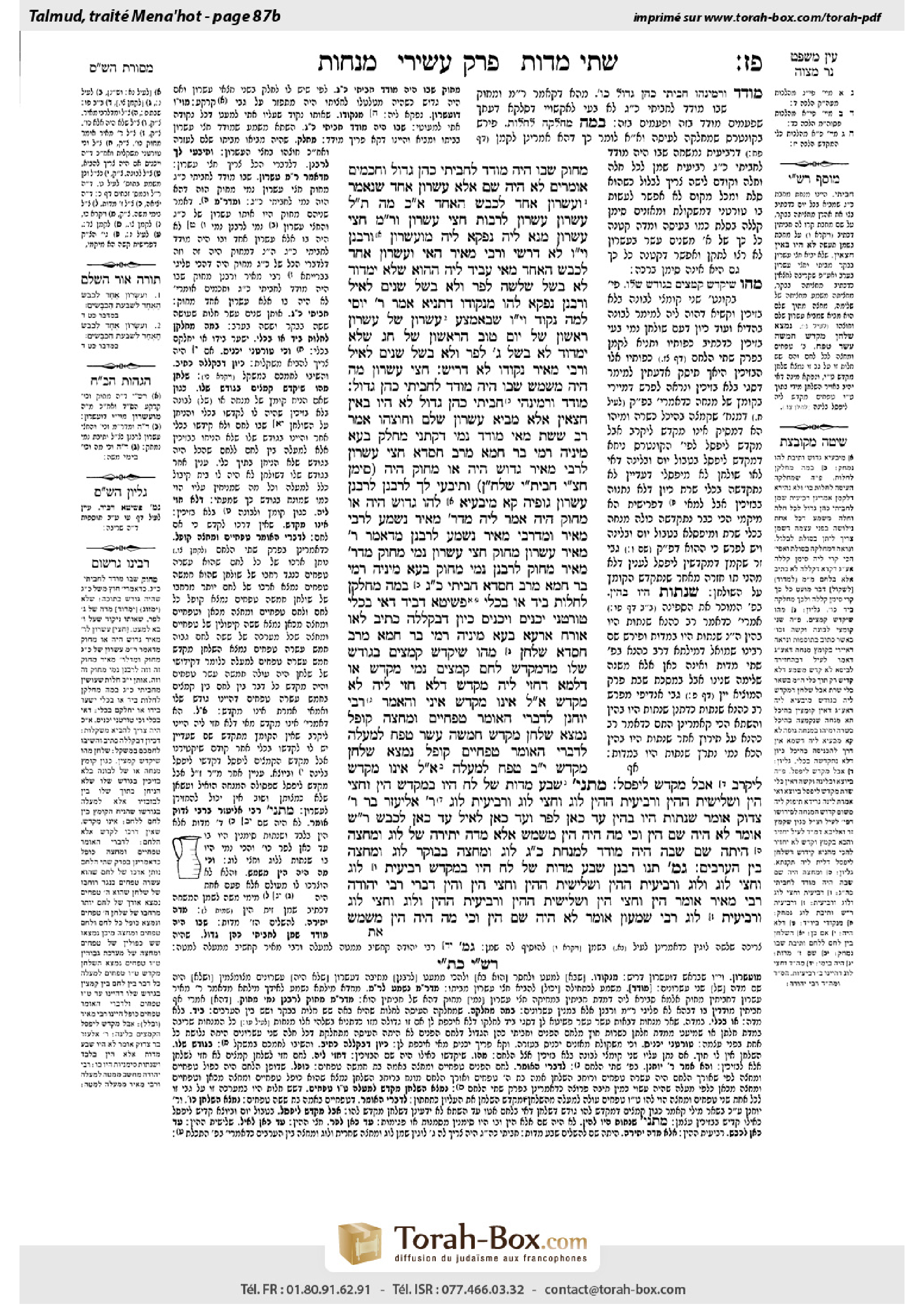
Menachot 87b: Talmud study for Daf Yomi
Daf Yomi is the daily study of one Talmud folio. Explore 37 tractates with scans, Hebrew text, Sefaria English and AI-generated French translations where annotated.
Passage selection and English or AI-generated French translation are available where the scan has annotations. Daf Study is independent of Torah-Box and Sefaria.
Browse Menachot · מנחות · All tractatesMenachot 87b text and translations
This page of Menachot includes the Aramaic text, an English translation and an AI-generated French translation, alongside the scan above.
מנחות פ״ז ב · Aramaic and Hebrew text
מָחוּק שֶׁבּוֹ הָיָה מוֹדֵד לַחֲבִיתֵּי כֹּהֵן גָּדוֹל.
וַחֲכָמִים אוֹמְרִים: לֹא הָיָה שָׁם אֶלָּא עִשָּׂרוֹן אֶחָד, שֶׁנֶּאֱמַר: ״וְעִשָּׂרוֹן אֶחָד לַכֶּבֶשׂ הָאֶחָד״. אִם כֵּן, מָה תַּלְמוּד לוֹמַר ״עִשָּׂרוֹן עִשָּׂרוֹן״? לְרַבּוֹת חֲצִי עִשָּׂרוֹן.
וְרַבִּי מֵאִיר, חֲצִי עִשָּׂרוֹן מְנָא לֵיהּ? נָפְקָא לֵיהּ מִ״וְּעִשָּׂרוֹן״. וְרַבָּנַן, וָי״ו לָא דָּרְשִׁי.
וְרַבִּי מֵאִיר, הַאי ״וְעִשָּׂרוֹן אֶחָד לַכֶּבֶשׂ הָאֶחָד״ מַאי עָבֵיד לֵיהּ? הַהוּא שֶׁלֹּא יִמְדּוֹד לֹא בְּשֶׁל שְׁלֹשָׁה לַפָּר, וְלֹא בְּשֶׁל שְׁנַיִם לָאַיִל.
וְרַבָּנַן, נָפְקָא לְהוּ מִנְּקוּדֵּי, דְּתַנְיָא: אָמַר רַבִּי יוֹסֵי: לָמָּה נָקוּד וָי״ו שֶׁבְּאֶמְצַע ״עִשָּׂרוֹן״ שֶׁל ״עִשָּׂרוֹן״ רִאשׁוֹן שֶׁל יוֹם טוֹב הָרִאשׁוֹן שֶׁל חַג? שֶׁלֹּא יִמְדּוֹד לֹא בְּשֶׁל שְׁלֹשָׁה לְפַר וְלֹא בְּשֶׁל שְׁנַיִם לָאַיִל. וְרַבִּי מֵאִיר נְקוּדֵּי לָא דָּרֵישׁ.
חֲצִי עִשָּׂרוֹן, מָה הָיָה מְשַׁמֵּשׁ? שֶׁבּוֹ הָיָה מוֹדֵד לַחֲבִיתֵּי כֹּהֵן גָּדוֹל.
מוֹדֵד? וּרְמִינְהִי: חֲבִיתֵּי כֹּהֵן גָּדוֹל לֹא הָיוּ בָּאִין חֲצָאִין, אֶלָּא מֵבִיא עִשָּׂרוֹן שָׁלֵם וְחוֹצֵהוּ.
אָמַר רַב שֵׁשֶׁת: מַאי ״מוֹדֵד״ נָמֵי דְּקָתָנֵי? מְחַלֵּק.
בְּעָא מִינֵּיהּ רָמֵי בַּר חָמָא מֵרַב חִסְדָּא: חֲצִי עִשָּׂרוֹן, לְרַבִּי מֵאִיר – גָּדוּשׁ הָיָה אוֹ מָחוּק הָיָה?
(סִימָן: חֲצִי, חֲבִיתֵּי, שֻׁלְחָן).
וְתִיבְּעֵי לָךְ לְרַבָּנַן? לְרַבָּנַן, עִשָּׂרוֹן גּוּפֵיהּ קָא מִיבַּעְיָא לְהוּ: גָּדוּשׁ הָיָה אוֹ מָחוּק הָיָה.
אֲמַר לֵיהּ: מִדְּרַבִּי מֵאִיר נִשְׁמַע לְרַבִּי מֵאִיר, וּמִדְּרַבִּי מֵאִיר נִשְׁמַע לְרַבָּנַן.
מִדְּאָמַר רַבִּי מֵאִיר: עִשָּׂרוֹן מָחוּק, חֲצִי עִשָּׂרוֹן נָמֵי מָחוּק; מִדְּרַבִּי מֵאִיר מָחוּק, לְרַבָּנַן נָמֵי מָחוּק.
בְּעָא מִינֵּיהּ רָמֵי בַּר חָמָא מֵרַב חִסְדָּא: חֲבִיתֵּי כֹּהֵן גָּדוֹל בַּמֶּה מְחַלְּקָן לְחַלּוֹת, בַּיָּד אוֹ בִּכְלִי? פְּשִׁיטָא דִּבְיַד, דְּאִי בִּכְלִי – טוּרְטָנֵי יַכְנִיס?!
וְיַכְנִיס! כֵּיוָן דְּבִקְלָלָה כְּתִיב, לָאו אוֹרַח אַרְעָא.
בְּעָא מִינֵּיהּ רָמֵי בַּר חָמָא מֵרַב חִסְדָּא: שֻׁלְחָן מַהוּ שֶׁיְּקַדֵּשׁ קְמָצִים בְּגוֹדֶשׁ שֶׁלּוֹ? מִדִּמְקַדֵּשׁ לֶחֶם, קְמָצִים נָמֵי מְקַדֵּשׁ, אוֹ דִלְמָא דַּחֲזֵי לֵיהּ מְקַדֵּשׁ, דְּלָא חֲזֵי לֵיהּ לָא מְקַדֵּשׁ?
אֲמַר לֵיהּ: אֵינוֹ מְקַדֵּשׁ. אִינִי? וְהָאָמַר רַבִּי יוֹחָנָן: לְדִבְרֵי הָאוֹמֵר טִפְחַיִים וּמֶחֱצָה קוֹפֵל, נִמְצָא שֻׁלְחָן מְקַדֵּשׁ חֲמִשָּׁה עָשָׂר טֶפַח לְמַעְלָה. לְדִבְרֵי הָאוֹמֵר טִפְחַיִים קוֹפֵל, נִמְצָא שֻׁלְחָן מְקַדֵּשׁ שְׁנֵים עָשָׂר טֶפַח לְמַעְלָה.
אֲמַר לֵיהּ: אֵינוֹ מְקַדֵּשׁ לִיקְרַב, אֲבָל מְקַדֵּשׁ לִיפָּסֵל.
מַתְנִי׳ שֶׁבַע מִדּוֹת שֶׁל לַח הָיוּ בְּמִקְדָּשׁ, הִין, וַחֲצִי הִין, וּשְׁלִישִׁית הַהִין, וּרְבִיעִית הַהִין.
לוֹג, וַחֲצִי לוֹג, וּרְבִיעִית לוֹג.
רַבִּי אֱלִיעֶזֶר בַּר רַבִּי צָדוֹק אוֹמֵר: שְׁנָתוֹת הָיוּ בַּהִין, עַד כָּאן לַפָּר, וְעַד כָּאן לָאַיִל, עַד כָּאן לַכֶּבֶשׂ.
רַבִּי שִׁמְעוֹן אוֹמֵר: לֹא הָיָה שָׁם הִין, וְכִי מֶה הָיָה הִין מְשַׁמֵּשׁ? אֶלָּא מִדָּה יְתֵירָה שֶׁל לוֹג וּמֶחֱצָה הָיְתָה שָׁם, שֶׁבָּהּ הָיָה מוֹדֵד לְמִנְחַת כֹּהֵן גָּדוֹל – לוֹג וּמֶחֱצָה בַּבּוֹקֶר, לוֹג וּמֶחֱצָה בֵּין הָעַרְבַּיִם.
גְּמָ׳ תָּנוּ רַבָּנַן: שֶׁבַע מִדּוֹת שֶׁל לַח הָיוּ בַּמִּקְדָּשׁ – רְבִיעִית לוֹג, וַחֲצִי לוֹג, וְלוֹג, וּרְבִיעִית הַהִין, וּשְׁלִישִׁית הַהִין, וַחֲצִי הִין, וְהִין, דִּבְרֵי רַבִּי יְהוּדָה. רַבִּי מֵאִיר אוֹמֵר: הִין, וַחֲצִי הִין, וּשְׁלִישִׁית הַהִין, וּרְבִיעִית הַהִין, וְלוֹג, וַחֲצִי לוֹג, וּרְבִיעִית לוֹג. רַבִּי שִׁמְעוֹן אוֹמֵר: לֹא הָיָה שָׁם הִין, וְכִי מָה הָיָה הִין מְשַׁמֵּשׁ?
Menachot 87b · English translation
The one that held a tenth of an ephah when leveled was the vessel with which one would measure the flour for the High Priest’s griddle-cake offering, and then that flour would be divided into two equal parts.
And the Rabbis disagree with Rabbi Meir and say: There was only one measuring vessel that held a tenth of an ephah there in the Temple, as it is stated: “And one tenth-part for every lamb” (Numbers 29:4). But if so, what is the meaning when the verse states: “A tenth, a tenth, for every lamb” (Numbers 28:29)? Rabbi Meir derived from the repetition of “a tenth” that there were two measuring vessels that held a tenth of an ephah. How do the Rabbis expound that? They hold it serves to include another measuring vessel for dry substances, one that holds one-half of a tenth of an ephah.
Having cited the baraita, the Gemara discusses each opinion: And as for Rabbi Meir, from where does he derive that there was a measuring vessel that held one-half of a tenth of an ephah? He derives it from the superfluous “and” in the phrase “and one tenth-part for every lamb.” The Gemara asks: And as for the Rabbis, why don’t they expound this from the term “and”? They do not derive anything from “and.” They hold that the addition of the word is not significant enough to be expounded.
The Gemara asks: And as for Rabbi Meir, this verse: “And one tenth-part for every lamb,” from which the Rabbis derive that there was only one measuring vessel of a tenth of an ephah, what does he do with it? The Gemara answers: That verse teaches that one should not measure the flour by using a measuring vessel of a size that holds the entire volume of flour required, i.e., neither with a vessel that holds three-tenths of an ephah for the meal offering accompanying the sacrifice of a bull, nor with a vessel that holds two-tenths of an ephah for the meal offering accompanying the sacrifice of a ram. Rather, one measures the flour for them by using the tenth-ephah measuring vessel multiple times.
The Gemara asks: And as for the Rabbis, from where do they derive that halakha? The Gemara explains: They derive it from its dot. In the Torah text, a dot appears above the term “a tenth.” This is as it is taught in a baraita: Rabbi Yosei says: Why is the letter vav in the middle of the term “a tenth [issaron]” dotted the first time that the term “a tenth” appears in the verse concerning the first festival day of the Festival of Sukkot? The verse there states: “And a tenth, a tenth, for every lamb of the fourteen lambs” (Numbers 29:15). This serves to teach that one should not measure flour using a vessel of a size that holds the entire volume required, i.e., neither with a vessel that holds three-tenths of an ephah for the meal offering of a bull, nor with a vessel that holds two-tenths of an ephah for the meal offering of a ram. And as for Rabbi Meir, what does he derive from the dot? He does not derive anything from its dot. He holds that the dot is not significant enough to be expounded.
§ The mishna teaches: What purpose did the one-half of a tenth of an ephah measuring vessel serve? It was the vessel with which one would measure the flour for the High Priest’s griddle-cake offering. A tenth of an ephah was required each day; he sacrificed half in the morning and the other half in the afternoon. From the mishna it appears that each half-tenth is measured separately.
The mishna indicates that the half-tenth vessel was used for measuring. And the Gemara raises a contradiction to this from a mishna (50b): The twelve loaves of matza, baked from a tenth of an ephah of flour, of the griddle-cake offering of the High Priest did not come from the house of the High Priest in halves. Rather, the High Priest brings from his house a complete tenth of an ephah of flour (see Leviticus 6:13) and divides it in half, and he sacrifices half in the morning and half in the afternoon. It is apparent from this mishna that the tenth of an ephah is first measured in its entirety and only then divided.
To resolve the contradiction Rav Sheshet said: What is the meaning of: Used for measuring, that the mishna here teaches? It means only that the High Priest would divide the tenth of an ephah into two equal portions using the half-tenth measure, but the quantity would initially be measured in its entirety, as the mishna on 50b states.
§ In light of Rabbi Meir’s opinion that there were two vessels for measuring a tenth of an ephah, one that held its measure when leveled and one when it was heaped, Rami bar Ḥama raised a dilemma before Rav Ḥisda: With regard to the one-half of a tenth of an ephah measuring vessel, according to the opinion of Rabbi Meir, was it one that held its measure when heaped or was it one that held its measure when leveled?
Before citing Rav Ḥisda’s response, the Gemara provides a mnemonic that alludes to the three dilemmas it will immediately present: Half; griddle-cake offering; Table. This alludes to one-half of a tenth of an ephah; the High Priest’s griddle-cake offering; and the shewbread Table.
Rav Ḥisda said to Rami bar Ḥama: But why do you ask specifically with regard to the opinion of Rabbi Meir? The dilemma can be raised according to the opinion of the Rabbis. Rami bar Ḥama answered: According to the opinion of the Rabbis, it would be with regard to the measuring vessel of a tenth of an ephah itself that one raises the dilemma, asking whether it was one that held its measure when heaped or was one that held its measure when leveled. The dilemma I raised concerned the half-tenth vessel, which is pertinent specifically according to the opinion of Rabbi Meir, as he holds that there were both heaped and leveled measuring vessels of a tenth of an ephah.
In answer to Rami bar Ḥama’s dilemma, Rav Ḥisda said to him: From the opinion of Rabbi Meir concerning the vessel of a tenth of an ephah we can extrapolate what Rabbi Meir holds concerning the vessel of one-half of a tenth of an ephah; and from that opinion of Rabbi Meir we can extrapolate what the Rabbis hold concerning both vessels.
Rav Ḥisda elaborates: From the fact that Rabbi Meir said that the vessel of a tenth of an ephah used for the High Priest’s griddle-cake offering held its measure when leveled, we can extrapolate that the vessel of one-half of a tenth, as well, was such that it held its measure when leveled. It is reasonable that since both vessels were used for the same offering, they should be of the same type. And from the fact that Rabbi Meir holds that vessels used for the High Priest’s griddle-cake offering held their measures when leveled, we can extrapolate that also according to the Rabbis, who hold that both vessels were used for the High Priest’s griddle-cake offering, both of them held their measures when leveled.
Rami bar Ḥama raised another dilemma before Rav Ḥisda: With regard to the dough used for the High Priest’s griddle-cake offering, with what would one divide it into the loaves of the offering, six in the morning and six in the afternoon? Was the division done with one’s hand or with a measuring vessel? Rav Ḥisda said to him: It is obvious that it was divided with one’s hand, as if one suggests that it was done with a measuring vessel, would one bring scales [turtanei] into the Temple courtyard for this purpose?
Rami bar Ḥama responds: And let him bring scales into the courtyard. Rav Ḥisda explains: Since in God’s admonition of the Jewish people the act of weighing bread is written as part of a curse: “When I break your staff of bread, ten women shall bake your bread in one oven, and they shall deliver your bread again by weight; and you shall eat and not be satisfied” (Leviticus 26:26), as weighing bread is generally performed only at a time of famine, therefore it is not proper conduct to weigh the dough in the Temple.
Rami bar Ḥama raised another dilemma before Rav Ḥisda: With regard to the shewbread Table, what is the halakha as to whether it consecrates handfuls removed from meal offerings or from frankincense that were not consecrated by being placed in a service vessel, as they should have been, but were instead placed on the upper part of the Table, between the rows of shewbread? The Gemara clarifies the dilemma: Does one say that from the fact that the Table consecrates the loaves of shewbread placed upon it, it follows that it also consecrates handfuls placed upon it? Or perhaps the Table consecrates only that which is fit for it, i.e., the loaves, but it does not consecrate that which is not fit for it, such as the handfuls.
Rav Ḥisda said to him: The Table does not consecrate these handfuls. Rami bar Ḥama retorted: Is that so? But didn’t Rabbi Yoḥanan say: The shewbread loaves were longer than the length of the Table. Accordingly, it was necessary to fold the edges of the loaves in order that they would rest entirely upon the Table itself and not protrude past its edges. How much of each side needed to be folded up is subject to a tannaitic dispute concerning the length of the Table (see 96a). According to the statement of the one who says that one folds two and a half handbreadths from each side of the loaves, it emerges that the Table consecrates fifteen handbreadths above it, as there were six loaves on each side of the Table, which were each two and a half handbreadths high. And according to the statement of the one who says that one folds two handbreadths from each side of the loaves, it emerges that the Table consecrates twelve handbreadths above it. Rabbi Yoḥanan stated that the Table consecrates that which is placed above it, regardless of whether it is fit for the Table or not.
Rav Ḥisda said to him: When I said that the Table does not consecrate the handfuls, I meant that it does not consecrate them to the extent that they can be sacrificed on the altar. But it certainly consecrates them to the extent that they will be disqualified by the same disqualifications that apply to handfuls that were consecrated by being placed in a service vessel, e.g., by being left overnight or by coming in contact with a ritually impure person who had immersed that day.
MISHNA: There were seven measuring vessels for liquids in the Temple. There was a vessel of one hin, i.e., twelve log. Three vessels were used to measure the oil and wine for the meal offerings and libations that accompanied the sacrifice of an animal. For a bull there was a vessel of one-half of a hin, i.e., six log; and for a ram there was one of one-third of a hin, i.e., four log; and for a lamb there was one of one-quarter of a hin, i.e., three log.
In addition, there was a vessel that held one log to measure the oil for all standard meal offerings; and another one that held one-half of a log for measuring the water used in the rite of a woman suspected by her husband of having been unfaithful [sota] and also for the oil used in the loaves accompanying the thanks offering (see 88a); and another one that held one-quarter of a log for measuring the water used in the purification of a leper and also for the oil used in the wafers and loaves that the nazirite brings on the day that his term of naziriteship ends.
Rabbi Eliezer, son of Rabbi Tzadok, says: It was not necessary to have several vessels of different sizes; rather, there were graduations [shenatot] on the vessel that held one hin indicating that until here is the quantity needed for the bull, and until here is the quantity needed for the ram, and until here is the quantity needed for the lamb.
Rabbi Shimon says: There was no vessel there in the Temple that held one hin, as what purpose could a one-hin vessel serve? That volume of liquid was never used in an offering. Rather, there was an additional measuring vessel of one and a half log there, in the Temple, which completed the tally of seven vessels, with which one would measure the oil used for the griddle-cake meal offering of the High Priest; one and a half log were used in the morning and one and a half log in the afternoon.
GEMARA: The Sages taught in a baraita: There were seven measuring vessels for liquids in the Temple. Listed in ascending order of size, they held: One-quarter of a log; one-half of a log; one log; one-quarter of a hin; one-third of a hin; one-half of a hin; and one hin. This is the statement of Rabbi Yehuda. Rabbi Meir says that there were these seven vessels but he lists them in descending order: One hin; one-half of a hin; one-third of a hin; one-quarter of a hin; one log; one-half of a log; and one-quarter of a log. Rabbi Shimon says: There was no vessel there in the Temple that held one hin, as what purpose could a one-hin vessel serve? That volume of liquid was never used in an offering.
Menachot 87b · Traduction française (IA)
Le récipient qui contenait un dixième d’épha lorsqu’il était arasé servait à mesurer la farine destinée à l’offrande de galettes sur plaque du grand prêtre ; cette farine était ensuite divisée en deux parts égales.
Les Sages ne sont pas d’accord avec Rabbi Meïr et disent : Il n’y avait dans le Temple qu’un seul récipient de mesure contenant un dixième d’épha, comme il est dit : « Et un dixième pour chaque agneau » (Nombres 29,4). Mais, dans ce cas, que signifie le verset : « Un dixième, un dixième, pour chaque agneau » (Nombres 28,29) ? Rabbi Meïr déduit de la répétition de « un dixième » qu’il y avait deux récipients de mesure contenant chacun un dixième d’épha. Comment les Sages interprètent-ils cela ? Selon eux, cela sert à inclure un autre récipient de mesure pour les substances sèches, contenant la moitié d’un dixième d’épha.
Après avoir cité la baraïta, la Guemara examine chacune des opinions : Quant à Rabbi Meïr, d’où déduit-il qu’il y avait un récipient de mesure contenant la moitié d’un dixième d’épha ? Il le déduit du vav superflu dans l’expression « et un dixième pour chaque agneau ». La Guemara demande : Et quant aux Sages, pourquoi ne l’interprètent-ils pas à partir du terme « et » ? Ils ne tirent aucune déduction de « et ». Selon eux, l’ajout de ce mot n’est pas assez significatif pour être interprété.
La Guemara demande : Et quant à Rabbi Meïr, que fait-il de ce verset : « Et un dixième pour chaque agneau », dont les Sages déduisent qu’il n’y avait qu’un seul récipient de mesure d’un dixième d’épha ? La Guemara répond : Ce verset enseigne qu’on ne doit pas mesurer la farine avec un récipient contenant tout le volume requis, c’est-à-dire ni avec un récipient contenant trois dixièmes d’épha pour l’oblation accompagnant le sacrifice d’un taureau, ni avec un récipient contenant deux dixièmes d’épha pour l’oblation accompagnant le sacrifice d’un bélier. Il faut plutôt mesurer leur farine en utilisant plusieurs fois le récipient d’un dixième d’épha.
La Guemara demande : Et quant aux Sages, d’où déduisent-ils cette halakha ? La Guemara explique : Ils la déduisent du point qui le surmonte. Dans le texte de la Torah, un point figure au-dessus du terme « un dixième ». C’est ce qui est enseigné dans une baraïta : Rabbi Yossi dit : Pourquoi le vav au milieu du terme « un dixième [issaron] » est-il pointé la première fois que le terme « un dixième » apparaît dans le verset concernant le premier jour de fête de Souccot ? Le verset dit à cet endroit : « Et un dixième, un dixième, pour chacun des quatorze agneaux » (Nombres 29,15). Cela enseigne qu’on ne doit pas mesurer la farine avec un récipient contenant tout le volume requis, c’est-à-dire ni avec un récipient contenant trois dixièmes d’épha pour l’oblation d’un taureau, ni avec un récipient contenant deux dixièmes d’épha pour l’oblation d’un bélier. Et quant à Rabbi Meïr, que déduit-il du point ? Il n’en déduit rien. Selon lui, ce point n’est pas assez significatif pour être interprété.
§ La Michna enseigne : À quoi servait le récipient de mesure contenant la moitié d’un dixième d’épha ? Il servait à mesurer la farine destinée à l’offrande de galettes sur plaque du grand prêtre. Un dixième d’épha était requis chaque jour ; le grand prêtre en offrait la moitié le matin et l’autre moitié l’après-midi. Il ressort de la Michna que chaque demi-dixième était mesuré séparément.
La Michna indique que le récipient d’un demi-dixième servait à mesurer. Or la Guemara soulève une contradiction à partir d’une Michna (50b) : Les douze pains azymes de l’offrande de galettes sur plaque du grand prêtre, préparés avec un dixième d’épha de farine, n’étaient pas apportés de la maison du grand prêtre en deux parts. Le grand prêtre apportait plutôt de sa maison un dixième d’épha entier de farine (voir Lévitique 6,13), le partageait en deux, puis en offrait la moitié le matin et l’autre moitié l’après-midi. Il ressort de cette Michna que le dixième d’épha était d’abord mesuré en entier, puis seulement ensuite divisé.
Pour résoudre la contradiction, Rav Chéchet dit : Que signifie ici l’expression « servait à mesurer », enseignée par la Michna ? Cela signifie seulement que le grand prêtre divisait le dixième d’épha en deux parts égales à l’aide de la mesure d’un demi-dixième ; mais la quantité était d’abord mesurée en entier, comme l’indique la Michna en 50b.
§ À la lumière de l’opinion de Rabbi Meïr, selon laquelle il y avait deux récipients pour mesurer un dixième d’épha, l’un contenant sa mesure lorsqu’il était arasé et l’autre lorsqu’il était bombé, Rami bar Ḥama posa une question à Rav Ḥisda : Selon l’opinion de Rabbi Meïr, le récipient de mesure contenant la moitié d’un dixième d’épha était-il bombé ou arasé ?
Avant de rapporter la réponse de Rav Ḥisda, la Guemara donne un moyen mnémotechnique faisant allusion aux trois questions qu’elle va présenter : moitié ; offrande de galettes sur plaque ; Table. Cela renvoie à la moitié d’un dixième d’épha, à l’offrande de galettes sur plaque du grand prêtre et à la Table des pains de proposition.
Rav Ḥisda dit à Rami bar Ḥama : Mais pourquoi poses-tu ta question spécifiquement selon l’opinion de Rabbi Meïr ? On peut la poser selon l’opinion des Sages. Rami bar Ḥama répondit : Selon l’opinion des Sages, la question porterait sur le récipient de mesure d’un dixième d’épha lui-même : était-il bombé ou arasé ? La question que j’ai posée concerne le récipient d’un demi-dixième, ce qui n’est pertinent que selon l’opinion de Rabbi Meïr, puisqu’il soutient qu’il y avait des récipients de mesure d’un dixième d’épha à la fois bombés et arasés.
Pour répondre à la question de Rami bar Ḥama, Rav Ḥisda lui dit : De l’opinion de Rabbi Meïr concernant le récipient d’un dixième d’épha, nous pouvons déduire ce que Rabbi Meïr pense du récipient d’un demi-dixième d’épha ; et de cette opinion de Rabbi Meïr, nous pouvons déduire ce que les Sages pensent des deux récipients.
Rav Ḥisda développe : Du fait que Rabbi Meïr dit que le récipient d’un dixième d’épha utilisé pour l’offrande de galettes sur plaque du grand prêtre était arasé, nous pouvons déduire que le récipient d’un demi-dixième était lui aussi arasé. Il est logique que, puisque les deux récipients servaient à la même offrande, ils soient du même type. Et du fait que Rabbi Meïr soutient que les récipients utilisés pour l’offrande de galettes sur plaque du grand prêtre étaient arasés, nous pouvons déduire que, selon les Sages également, qui soutiennent que les deux récipients servaient à l’offrande de galettes sur plaque du grand prêtre, ils étaient tous deux arasés.
Rami bar Ḥama posa une autre question à Rav Ḥisda : Avec quoi divisait-on la pâte destinée à l’offrande de galettes sur plaque du grand prêtre en pains, six le matin et six l’après-midi ? La division se faisait-elle à la main ou à l’aide d’un récipient de mesure ? Rav Ḥisda lui dit : Il est évident qu’elle se faisait à la main ; car si l’on soutenait qu’elle se faisait à l’aide d’un récipient de mesure, ferait-on entrer des balances [turtanei] dans le parvis du Temple à cette fin ?
Rami bar Ḥama réplique : Qu’il fasse entrer des balances dans le parvis ! Rav Ḥisda explique : Puisque, dans les remontrances de Dieu au peuple juif, le pesage du pain est mentionné comme faisant partie d’une malédiction : « Quand je briserai votre bâton de pain, dix femmes cuiront votre pain dans un seul four, elles vous rendront votre pain au poids, et vous mangerez sans être rassasiés » (Lévitique 26,26), et puisque le pain n’est généralement pesé qu’en période de famine, il ne convient donc pas de peser la pâte dans le Temple.
Rami bar Ḥama posa une autre question à Rav Ḥisda : Concernant la Table des pains de proposition, quelle est la halakha quant à sa capacité à consacrer des poignées prélevées sur des offrandes de farine ou de l’encens, qui n’avaient pas été consacrés en étant placés dans un ustensile de service, comme ils auraient dû l’être, mais avaient été mis sur la partie supérieure de la Table, entre les rangées de pains de proposition ? La Guemara précise la question : Faut-il dire que, puisque la Table consacre les pains de proposition placés dessus, elle consacre aussi les poignées qui y sont déposées ? Ou peut-être la Table ne consacre-t-elle que ce qui lui est destiné, c’est-à-dire les pains, mais ne consacre-t-elle pas ce qui ne lui est pas destiné, comme les poignées ?
Rav Ḥisda lui dit : La Table ne consacre pas ces poignées. Rami bar Ḥama rétorqua : Vraiment ? Rabbi Yoḥanan n’a-t-il pas dit que les pains de proposition étaient plus longs que la Table ? Il fallait donc replier les bords des pains pour qu’ils reposent entièrement sur la Table elle-même et ne dépassent pas ses rebords. La longueur à replier de chaque côté fait l’objet d’un désaccord entre tannaim au sujet de la longueur de la Table (voir 96a). Selon celui qui dit qu’on repliait deux coudées et demie de chaque côté des pains, il s’ensuit que la Table consacre l’espace situé au-dessus d’elle sur une hauteur de quinze paumes, puisqu’il y avait six pains de chaque côté de la Table, chacun replié sur une hauteur de deux coudées et demie. Et selon celui qui dit qu’on repliait deux coudées de chaque côté des pains, il s’ensuit que la Table consacre l’espace situé au-dessus d’elle sur une hauteur de douze paumes. Rabbi Yoḥanan a déclaré que la Table consacre ce qui est placé au-dessus d’elle, que cela lui soit destiné ou non.
Rav Ḥisda lui dit : Quand j’ai dit que la Table ne consacrait pas les poignées, je voulais dire qu’elle ne les consacrait pas au point qu’elles puissent être offertes sur l’autel. Mais elle les consacre assurément de sorte qu’elles soient soumises aux mêmes invalidations que les poignées consacrées en étant placées dans un ustensile de service, par exemple si elles passent la nuit ou entrent en contact avec une personne rituellement impure qui s’est immergée ce jour-là.
MICHNA : Il y avait dans le Temple sept récipients de mesure pour les liquides. Il y avait un récipient d’un hin, soit douze log. Trois récipients servaient à mesurer l’huile et le vin des offrandes de farine et des libations accompagnant le sacrifice d’un animal. Pour un taureau, il y en avait un d’un demi-hin, soit six log ; pour un bélier, un d’un tiers de hin, soit quatre log ; et pour un agneau, un d’un quart de hin, soit trois log.
En outre, il y avait un récipient contenant un log, pour mesurer l’huile de toutes les offrandes de farine ordinaires ; un autre contenant un demi-log, pour mesurer l’eau utilisée dans le rite d’une femme soupçonnée par son mari d’infidélité [sota], ainsi que l’huile des pains accompagnant le sacrifice de reconnaissance (voir 88a) ; et un autre contenant un quart de log, pour mesurer l’eau utilisée lors de la purification d’un lépreux, ainsi que l’huile des galettes et des pains qu’apporte le nazir le jour où prend fin son naziréat.
Rabbi Eliezer, fils de Rabbi Tsadok, dit : Il n’était pas nécessaire d’avoir plusieurs récipients de tailles différentes ; le récipient contenant un hin portait plutôt des graduations [shenatot] indiquant : jusqu’ici, la quantité nécessaire pour le taureau ; jusqu’ici, celle nécessaire pour le bélier ; et jusqu’ici, celle nécessaire pour l’agneau.
Rabbi Shimon dit : Il n’y avait dans le Temple aucun récipient contenant un hin, car à quoi aurait servi un récipient d’un hin ? Ce volume de liquide n’était jamais utilisé pour une offrande. Il y avait plutôt dans le Temple un récipient de mesure supplémentaire d’un log et demi, ce qui complétait le total de sept récipients ; on s’en servait pour mesurer l’huile de l’offrande de galettes sur plaque du grand prêtre : un log et demi était utilisé le matin et un log et demi l’après-midi.
GUEMARA : Les Sages ont enseigné dans une baraïta : Il y avait dans le Temple sept récipients de mesure pour les liquides. Classés par ordre croissant de taille, ils contenaient : un quart de log, un demi-log, un log, un quart de hin, un tiers de hin, un demi-hin et un hin. Telle est l’opinion de Rabbi Yehouda. Rabbi Meïr dit qu’il y avait ces sept récipients, mais les énumère par ordre décroissant : un hin, un demi-hin, un tiers de hin, un quart de hin, un log, un demi-log et un quart de log. Rabbi Shimon dit : Il n’y avait dans le Temple aucun récipient contenant un hin, car à quoi aurait servi un récipient d’un hin ? Ce volume de liquide n’était jamais utilisé pour une offrande.
Traduction française générée par IA à partir de l’édition anglaise de Sefaria. Vérifie toujours un passage avec le texte source.
Text from Sefaria: William Davidson Edition - Vocalized Aramaic (unknown); William Davidson Edition - English (CC BY NC).