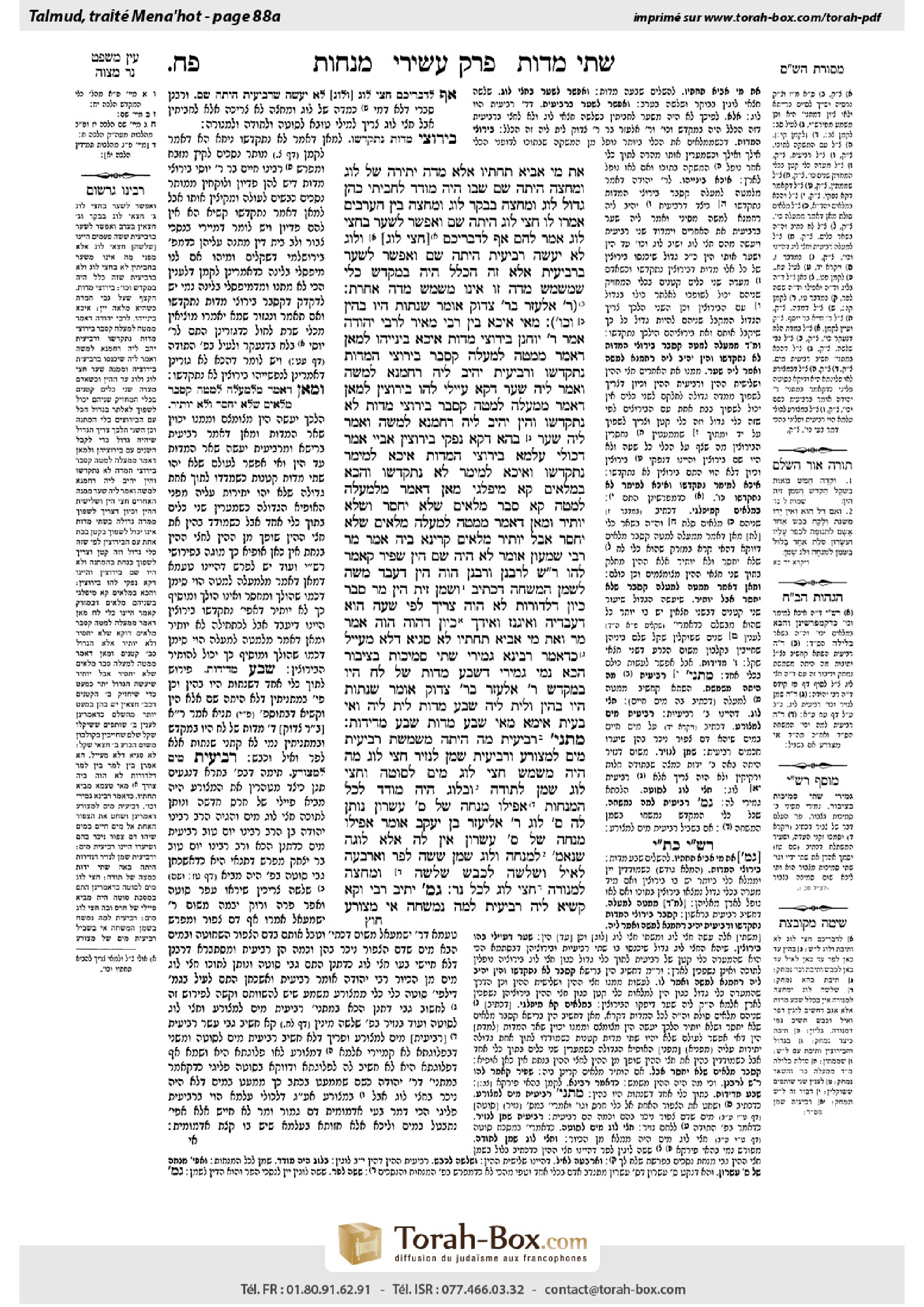
Menachot 88a: Talmud study for Daf Yomi
Daf Yomi is the daily study of one Talmud folio. Explore 37 tractates with scans, Hebrew text, Sefaria English and AI-generated French translations where annotated.
Passage selection and English or AI-generated French translation are available where the scan has annotations. Daf Study is independent of Torah-Box and Sefaria.
Browse Menachot · מנחות · All tractatesMenachot 88a text and translations
This page of Menachot includes the Aramaic text, an English translation and an AI-generated French translation, alongside the scan above.
מנחות פ״ח א · Aramaic and Hebrew text
אֶת מִי אָבִיא תַּחְתָּיו? אֶלָּא מִדָּה יְתֵירָה שֶׁל לוֹג וּמֶחֱצָה הָיְתָה שָׁם, שֶׁבּוֹ הָיָה מוֹדֵד לַחֲבִיתֵּי כֹּהֵן גָּדוֹל – לוֹג וּמֶחֱצָה בַּבֹּקֶר, לוֹג וּמֶחֱצָה בֵּין הָעַרְבַּיִם.
אָמְרוּ לוֹ: חֲצִי לוֹג הָיְתָה שָׁם, וְאֶפְשָׁר לְשַׁעֵר בַּחֲצִי לוֹג.
אָמַר לָהֶם: אַף לְדִבְרֵיכֶם, חֲצִי לוֹג וְלוֹג לֹא יַעֲשֶׂה, רְבִיעִית הָיְתָה שָׁם, וְאֶפְשָׁר לְשַׁעֵר בִּרְבִיעִית! אֶלָּא זֶה הַכְּלָל הָיָה בַּמִּקְדָּשׁ: כְּלִי שֶׁמְּשַׁמֵּשׁ מִדָּה זוֹ אֵינוֹ מְשַׁמֵּשׁ מִדָּה אַחֶרֶת.
רַבִּי אֶלְעָזָר בְּרַבִּי צָדוֹק אוֹמֵר: שְׁנָתוֹת הָיוּ בַּהִין וְכוּ׳.
מַאי אִיכָּא בֵּין רַבִּי מֵאִיר לְרַבִּי יְהוּדָה? אָמַר רַבִּי יוֹחָנָן: בֵּירוּצֵי מִדּוֹת אִיכָּא בֵּינַיְיהוּ.
לְמַאן דְּאָמַר מִמַּטָּה לְמַעְלָה, קָסָבַר בֵּירוּצֵי הַמִּדּוֹת נִתְקַדְּשׁוּ, וּרְבִיעִית יָהֵיב לֵיהּ רַחֲמָנָא לְמֹשֶׁה, וְאָמַר לֵיהּ: שַׁעַר דְּקָא עָיְילִי לְהוּ בֵּירוּצִין.
לְמַאן דְּאָמַר מִמַּעְלָה לְמַטָּה, קָסָבַר בֵּירוּצֵי מִדּוֹת לֹא נִתְקַדְּשׁוּ, וְהִין יָהֵיב לֵיהּ רַחֲמָנָא לְמֹשֶׁה, וְאָמַר לֵיהּ: שַׁעַר בְּהָא, דְּקָא נָפְקִי בֵּירוּצִין.
אַבָּיֵי אָמַר: דְּכוּלֵּי עָלְמָא בֵּירוּצֵי הַמִּדּוֹת אִיכָּא לְמֵימַר נִתְקַדְּשׁוּ, וְאִיכָּא לְמֵימַר לֹא נִתְקַדְּשׁוּ, וְהָכָא בִּמְלֵאִים קָא מִיפַּלְגִי.
מַאן דְּאָמַר מִלְּמַעְלָה לְמַטָּה, קָא סָבַר מְלֵאִים, שֶׁלֹּא יְחַסֵּר וְשֶׁלֹּא יוֹתִיר.
וּמַאן דְּאָמַר מִמַּטָּה לְמַעְלָה, מְלֵאִים – שֶׁלֹּא יְחַסֵּר, אֲבָל יוֹתִיר, ״מְלֵאִים״ קָרֵינָא בֵּיהּ.
אָמַר מָר: רַבִּי שִׁמְעוֹן אוֹמֵר לֹא הָיָה שָׁם הִין, שַׁפִּיר קָאָמַר לְהוּ רַבִּי שִׁמְעוֹן לְרַבָּנַן! וְרַבָּנַן – הֲוָה הִין דַּעֲבַד מֹשֶׁה לְשֶׁמֶן הַמִּשְׁחָה, דִּכְתִיב ״וְשֶׁמֶן זַיִת הִין״.
מָר סָבַר: כֵּיוָן דִּלְדוֹרוֹת לָא הֲוָה צְרִיךְ, לְפִי שָׁעָה הוּא דְּעַבְדֵיהּ וְאִיגְּנֵז, וְאִידַּךְ: כֵּיוָן דַּהֲוָה – הֲוָה.
אָמַר מָר: וְאֶת מִי אָבִיא תַּחְתָּיו. לָא סַגִּיא דְּלָא מְעַיֵּיל? כִּדְאָמַר רָבִינָא: גְּמִירִי שְׁתֵּי סְמִיכוֹת בְּצִיבּוּר, הָכָא נָמֵי גְּמִירִי דְּשֶׁבַע מִדּוֹת שֶׁל לַח הָיוּ בְּמִקְדָּשׁ.
רַבִּי אֶלְעָזָר בְּרַבִּי צָדוֹק אוֹמֵר: שְׁנָתוֹת הָיוּ בַּהִין. וְלֵית לֵיהּ שֶׁבַע מִדּוֹת? לֵית לֵיהּ. וְאִי בָּעֵית אֵימָא: מַאי ״שֶׁבַע מִדּוֹת״? שֶׁבַע מְדִידוֹת.
מַתְנִי׳ רְבִיעִית מָה הָיְתָה מְשַׁמֶּשֶׁת? רְבִיעִית מַיִם לִמְצוֹרָע, וּרְבִיעִית שֶׁמֶן לְנָזִיר.
חֲצִי לוֹג מָה הָיָה מְשַׁמֵּשׁ? חֲצִי לוֹג מַיִם לְסוֹטָה, וַחֲצִי לוֹג שֶׁמֶן לְתוֹדָה.
וּבַלּוֹג הָיָה מוֹדֵד לְכׇל הַמְּנָחוֹת.
אֲפִילּוּ מִנְחָה שֶׁל שִׁשִּׁים עִשָּׂרוֹן, נוֹתֵן לָהּ שִׁשִּׁים לוֹג. רַבִּי אֱלִיעֶזֶר בֶּן יַעֲקֹב אוֹמֵר: אֲפִילּוּ מִנְחָה שֶׁל שִׁשִּׁים עִשָּׂרוֹן אֵין לָהּ אֶלָּא לוּגָּהּ, שֶׁנֶּאֱמַר ״לְמִנְחָה וְלֹג שָׁמֶן״.
שִׁשָּׁה לַפָּר, וְאַרְבָּעָה לָאַיִל, וּשְׁלֹשָׁה לַכֶּבֶשׂ.
שְׁלֹשָׁה וּמֶחֱצָה לַמְּנוֹרָה, חֲצִי לוֹג לְכׇל נֵר.
גְּמָ׳ יְתֵיב רַבִּי וְקָא קַשְׁיָא לֵיהּ: רְבִיעִית לָמָּה נִמְשְׁחָה? אִי מְצוֹרָע –
Menachot 88a · English translation
If so, which size vessel shall I bring in its stead to complete the tally of seven vessels? Rather, there was an additional measuring vessel of one and a half log there in the Temple, with which one would measure the oil used for the griddle-cake offering of the High Priest; one and a half log were used in the morning and one and a half log in the afternoon.
The Rabbis said to Rabbi Shimon: There is no need for a dedicated vessel for the one and a half log for the High Priest’s offering, as there was a vessel of one-half of a log there, in the Temple, and it is possible to calculate the required one and a half log by using the vessel of one-half of a log three times.
Rabbi Shimon said to them: But according to your statement as well, one should not fashion a vessel of one-half of a log or of one log, as there was a vessel of one-quarter of a log there, and it is possible to calculate whatever quantity is required by repeatedly using the vessel of one-quarter of a log. Rather, this was the principle with regard to measuring vessels in the Temple: A measuring vessel that was used for measuring this quantity was not used to measure a different quantity.
The baraita concludes with an opinion that is also stated in the mishna: Rabbi Elazar, son of Rabbi Tzadok, says: There were graduations on the vessel that held one hin, indicating the respective quantities needed for the bull, the ram, and the lamb.
The Gemara analyzes the baraita. What difference is there between the opinions of Rabbi Meir and Rabbi Yehuda? They both list the same seven vessels, but in a different order. Rabbi Yoḥanan said: The practical difference between them concerns whether the vessels consecrate the overflow [beirutzei] of the measuring vessels, i.e., the liquid that flows down over the outer walls of the vessel when it is filled beyond capacity.
According to the one who said that the vessels should be listed in ascending order of size, i.e., Rabbi Yehuda, he holds that the overflow of measuring vessels is consecrated. His reasoning is as follows: When Moses was commanded to fashion these vessels, the Merciful One initially gave Moses a measuring vessel of one-quarter of a hin and said to him: With this vessel calculate the various quantities needed and fashion vessels accordingly. So, for example, to calculate one-half of a hin, Moses would twice fill up the vessel of one-quarter of a hin, each time pouring it into a larger vessel. When pouring from a small vessel into a larger one, the overflow also enters the larger one and so it is included in the calculation. Evidently, the overflow is also consecrated.
According to the one who said that the vessels should be listed in descending order of size, i.e., Rabbi Meir, he holds that the overflow of measuring vessels is not consecrated. His reasoning is as follows: When Moses was commanded to fashion these vessels for the Temple, the Merciful One initially gave Moses a measuring vessel of one hin and said to him: With this vessel calculate the various quantities needed and fashion vessels accordingly. So, for example, to calculate one-half of a hin, Moses filled the vessel of one hin and divided it equally into two vessels. Then, to calculate one-quarter of a hin, he would equally divide the liquid in one of those vessels into another two vessels. When pouring from a large vessel into a smaller one, the overflow on the outer walls of the larger vessel does not enter the smaller vessel but instead falls to the ground. Therefore, the overflow is excluded from the calculation. Accordingly, there is no basis to say that the overflow is consecrated.
Abaye said: Everyone, both Rabbi Yehuda and Rabbi Meir, agrees that with regard to the overflow of measuring vessels, one could say that they are consecrated and one could say that they are not consecrated, i.e., their dispute is unrelated to this issue. But here they disagree with regard to the meaning of the term “full” in the verse: “And his offering was one silver dish, its weight was one hundred and thirty shekels, one silver basin of seventy shekels, after the shekel of the Sanctuary; both of them full of fine flour mixed with oil for a meal offering” (Numbers 7:13).
The one who said that the vessels should be listed in descending order of size, i.e., Rabbi Meir, holds that the term “full” indicates that the size of each vessel should be exact, i.e., that it should hold neither less nor more than the prescribed amount. If one calculates the various sizes by first filling a vessel of the largest size, one hin, and then dividing its contents carefully between two smaller vessels and so on, one will arrive at accurate measurements. By contrast, if one starts with the smallest size and uses it multiple times to calculate larger quantities, then each time one pours he includes the overflow of the smaller vessel, and so the quantities calculated are slightly larger than prescribed.
And the one who said that the vessels should be listed in ascending order of size, i.e., Rabbi Yehuda, holds that the intention of the term “full” is that the size of each vessel should not hold less than the prescribed amount, but if it holds more, that is still called full. Accordingly, the various quantities can be calculated by starting with the smallest vessel.
In the mishna and the baraita cited above the Master said that in contrast to the opinion of the Rabbis, Rabbi Shimon says: There was no vessel there in the Temple that held one hin, as what purpose could a one-hin vessel serve? That volume of liquid was never used in an offering. The Gemara comments: Rabbi Shimon is saying well to the Rabbis, i.e., this is a reasonable objection. And what would the Rabbis say? Why is there a measuring vessel of one hin? The Gemara answers: It was the vessel of one hin that Moses fashioned in the wilderness for measuring the anointing oil with which the Tabernacle, its vessels, and the priests were anointed, as it is written: “And of olive oil a hin. And you shall make it a holy anointing oil” (Exodus 30:24–25).
The Gemara explains the dispute between Rabbi Shimon and the Rabbis. One Sage, Rabbi Shimon, holds that since there was no further need for the vessel of one hin in future generations, Moses fashioned it only for the sake of that time, and then afterward it was sequestered. And the other Sage, the Rabbis, holds that since it was fashioned and used in the time of Moses, it was kept in the Temple despite the fact there was no longer a need for it.
The Master said in the baraita that after claiming that there was no vessel of one hin, Rabbi Shimon asked: If so, which size vessel shall I bring in its stead to complete the tally of seven vessels? The Gemara asks: Is it not possible to simply not include a seventh vessel? What compels him to list a seventh? The Gemara explains: It is just as Ravina said with regard to a different matter: It is learned as a tradition that there are two instances in which placing hands on the head of the offering is required for communal offerings. Here too, one must say that it is learned as a tradition that there were seven measuring vessels for liquids in the Temple.
The mishna teaches: Rabbi Elazar, son of Rabbi Tzadok, says: It was not necessary to have separate vessels for the meal offerings and libations of each type of animal. Rather, there were graduations on the vessel that held one hin indicating the measures for the various offerings. The Gemara asks: But doesn’t Rabbi Eliezer, son of Rabbi Tzadok, have the tradition that there were seven measuring vessels? The Gemara concedes: He does not have that tradition. And if you wish, say instead that he has that tradition, but he understands that what is meant by seven measuring vessels? It means that seven fixed ways of measuring should exist, but not that there must be seven different vessels.
MISHNA: What purpose did the quarter-log measuring vessel serve? It was used to measure a quarter-log of water for the purification of the leper, and a quarter-log of oil for the wafers and loaves that the nazirite brings on the day that his term of naziriteship ends.
What purpose did the half-log measuring vessel serve? It was used to measure a half-log of water for the rite of the sota and a half-log of oil for the three types of loaves of matza accompanying the thanks offering.
And with the vessel of one log, one would measure the oil for all the standard meal offerings.
Each tenth of an ephah of flour requires one log of oil. Accordingly, even if one brings a meal offering of sixty tenths of an ephah of flour, one adds to it sixty log of oil. Rabbi Eliezer ben Ya’akov says: Each meal offering, irrespective of its volume, even a meal offering of sixty tenths of an ephah of flour, requires only its single log of oil, as it is stated with regard to the offering brought by a poor leper on the day of his purification: “And a tenth of an ephah of fine flour mixed with oil for a meal offering, and a log of oil” (Leviticus 14:21). The juxtaposition of “a meal offering” with “a log of oil” teaches a principle for all meal offerings: Each offering requires only one log of oil.
The mishna lists the quantities of oil and wine that were required for the meal offerings and libations that accompanied the sacrifice of an animal. Six log, i.e., one-half of a hin, for those of a bull; and four log, i.e., one-third of a hin, for those of a ram; and three log, i.e., one-quarter of a hin, for those of a lamb.
In addition, three and a half log of oil were required for the Candelabrum, as there were seven lamps and a half-log was required for each lamp.
GEMARA: Rabbi Yehuda HaNasi was sitting in study and posed a difficulty: For what purpose was the quarter-log measuring vessel anointed with the anointing oil, thereby consecrating it a service vessel? If you suggest it was necessary in order to measure the water used in the purification of a leper,
Menachot 88a · Traduction française (IA)
Dans ce cas, quel récipient de quelle capacité faut-il apporter à sa place pour compléter le compte de sept récipients ? Il y avait plutôt dans le Temple un récipient gradué supplémentaire d’un log et demi, avec lequel on mesurait l’huile destinée à l’offrande de galettes à la poêle du Grand Prêtre : un log et demi le matin et un log et demi l’après-midi.
Les Sages dirent à Rabbi Shimon : Il n’est pas nécessaire d’avoir un récipient réservé au log et demi destiné à l’offrande du Grand Prêtre, puisqu’il y avait dans le Temple un récipient d’un demi-log ; on pouvait mesurer le log et demi requis en utilisant trois fois le récipient d’un demi-log.
Rabbi Shimon leur dit : Mais, selon votre raisonnement également, il ne faudrait fabriquer ni récipient d’un demi-log ni récipient d’un log, puisqu’il y avait là un récipient d’un quart de log et qu’on pouvait mesurer toute quantité requise en utilisant à plusieurs reprises le récipient d’un quart de log. Voici plutôt le principe qui régissait les récipients gradués du Temple : un récipient gradué utilisé pour mesurer une quantité donnée n’était pas utilisé pour en mesurer une autre.
La baraïta conclut par un avis également rapporté dans la Michna : Rabbi Elazar, fils de Rabbi Tsadok, dit : Le récipient d’un hin portait des graduations indiquant les quantités respectivement nécessaires pour le taureau, le bélier et l’agneau.
La Guemara examine la baraïta. Quelle différence y a-t-il entre les avis de Rabbi Meïr et de Rabbi Yehouda ? Tous deux énumèrent les mêmes sept récipients, mais dans un ordre différent. Rabbi Yo’hanan dit : La différence pratique entre eux porte sur la question de savoir si les récipients consacrent le débordement [beirutzei] des récipients gradués, c’est-à-dire le liquide qui s’écoule le long de leurs parois extérieures lorsqu’on les remplit au-delà de leur capacité.
Celui qui affirme que les récipients doivent être énumérés par ordre croissant de capacité, à savoir Rabbi Yehouda, considère que le débordement des récipients gradués est consacré. Voici son raisonnement : Lorsque Moïse reçut l’ordre de fabriquer ces récipients, le Miséricordieux lui donna d’abord un récipient gradué d’un quart de hin et lui dit : « Avec ce récipient, mesure les différentes quantités nécessaires et fabrique les récipients en conséquence. » Ainsi, pour mesurer un demi-hin, par exemple, Moïse remplissait deux fois le récipient d’un quart de hin, en versant chaque fois son contenu dans un récipient plus grand. Lorsqu’on verse le contenu d’un petit récipient dans un plus grand, le débordement y entre également et est donc inclus dans le calcul. Il en ressort que le débordement est lui aussi consacré.
Celui qui affirme que les récipients doivent être énumérés par ordre décroissant de capacité, à savoir Rabbi Meïr, considère que le débordement des récipients gradués n’est pas consacré. Voici son raisonnement : Lorsque Moïse reçut l’ordre de fabriquer ces récipients pour le Temple, le Miséricordieux lui donna d’abord un récipient gradué d’un hin et lui dit : « Avec ce récipient, mesure les différentes quantités nécessaires et fabrique les récipients en conséquence. » Ainsi, pour mesurer un demi-hin, par exemple, Moïse remplissait le récipient d’un hin et répartissait son contenu à parts égales entre deux récipients. Puis, pour mesurer un quart de hin, il répartissait à parts égales le liquide contenu dans l’un de ces récipients entre deux autres récipients. Lorsqu’on verse le contenu d’un grand récipient dans un plus petit, le débordement qui s’écoule le long des parois extérieures du grand récipient ne tombe pas dans le petit, mais par terre. Le débordement est donc exclu du calcul. Par conséquent, rien ne permet d’affirmer que le débordement est consacré.
Abayé dit : Rabbi Yehouda comme Rabbi Meïr admettent tous deux qu’en ce qui concerne le débordement des récipients gradués, on peut dire qu’il est consacré aussi bien que l’on peut dire qu’il ne l’est pas ; autrement dit, leur désaccord ne porte pas sur cette question. Ils divergent plutôt quant au sens du terme « pleins » dans le verset : « Son offrande était un plat d’argent pesant cent trente sicles, un bassin d’argent de soixante-dix sicles, au poids du sicle du Sanctuaire ; tous deux pleins de fleur de farine mélangée à de l’huile pour une oblation » (Nombres 7,13).
Celui qui affirme que les récipients doivent être énumérés par ordre décroissant de capacité, à savoir Rabbi Meïr, estime que le terme « pleins » indique que la capacité de chaque récipient doit être exacte, c’est-à-dire qu’il ne doit contenir ni moins ni plus que la quantité prescrite. Si l’on calcule les différentes capacités en commençant par remplir le plus grand récipient, d’un hin, puis en répartissant soigneusement son contenu entre deux récipients plus petits, et ainsi de suite, on obtient des mesures exactes. En revanche, si l’on commence par la plus petite capacité et qu’on utilise plusieurs fois le petit récipient pour mesurer de plus grandes quantités, chaque versement inclut le débordement du petit récipient, de sorte que les quantités mesurées sont légèrement supérieures à celles qui sont prescrites.
Celui qui affirme que les récipients doivent être énumérés par ordre croissant de capacité, à savoir Rabbi Yehouda, estime que le terme « pleins » signifie que la capacité de chaque récipient ne doit pas être inférieure à la quantité prescrite ; s’il en contient davantage, on le considère tout de même comme plein. Par conséquent, on peut mesurer les différentes quantités en commençant par le plus petit récipient.
Dans la Michna et la baraïta citées plus haut, le Maître a dit que, contrairement à l’avis des Sages, Rabbi Shimon déclare : « Il n’y avait pas dans le Temple de récipient d’un hin, car à quoi aurait servi un récipient d’un hin ? Ce volume de liquide n’était jamais utilisé dans une offrande. » La Guemara commente : Rabbi Shimon répond à juste titre aux Sages, car son objection est raisonnable. Et que répondraient les Sages ? Pourquoi y avait-il un récipient d’un hin ? La Guemara répond : C’était le récipient d’un hin que Moïse avait fabriqué dans le désert pour mesurer l’huile d’onction avec laquelle le Tabernacle, ses récipients et les prêtres furent oints, comme il est écrit : « Et un hin d’huile d’olive. Tu en feras une huile d’onction sainte » (Exode 30,24-25).
La Guemara explique le désaccord entre Rabbi Shimon et les Sages. Rabbi Shimon estime que, puisqu’on n’avait plus besoin du récipient d’un hin dans les générations suivantes, Moïse ne l’avait fabriqué que pour cette époque, après quoi il fut mis à l’écart. Les Sages, quant à eux, estiment que, puisqu’il avait été fabriqué et utilisé à l’époque de Moïse, il fut conservé dans le Temple, bien qu’on n’en eût plus besoin.
Le Maître a dit dans la baraïta qu’après avoir affirmé qu’il n’y avait pas de récipient d’un hin, Rabbi Shimon demanda : « Dans ce cas, quel récipient de quelle capacité faut-il apporter à sa place pour compléter le compte de sept récipients ? » La Guemara demande : Ne pouvait-on pas simplement ne pas inclure de septième récipient ? Qu’est-ce qui l’oblige à en énumérer un septième ? La Guemara explique : C’est comme ce que Ravina a dit à propos d’une autre question : on a appris par tradition que, dans deux cas, il est requis de poser les mains sur la tête d’une offrande communautaire. Ici aussi, il faut dire que l’on a appris par tradition qu’il y avait sept récipients gradués pour les liquides dans le Temple.
La Michna enseigne : Rabbi Elazar, fils de Rabbi Tsadok, dit : Il n’était pas nécessaire d’avoir des récipients distincts pour les oblations et les libations de chaque type d’animal. Le récipient d’un hin portait plutôt des graduations indiquant les mesures nécessaires pour les différentes offrandes. La Guemara demande : Mais Rabbi Elazar, fils de Rabbi Tsadok, ne détient-il pas la tradition selon laquelle il y avait sept récipients gradués ? La Guemara reconnaît : Il ne détient pas cette tradition. Ou, si tu préfères, dis qu’il la détient, mais qu’il comprend l’expression « sept récipients gradués » ainsi : il devait exister sept façons fixes de mesurer, et non nécessairement sept récipients différents.
MICHNA : À quoi servait le récipient gradué d’un quart de log ? Il servait à mesurer un quart de log d’eau pour la purification du lépreux, ainsi qu’un quart de log d’huile pour les galettes et les pains que le nazir apporte le jour où prend fin sa période de naziréat.
À quoi servait le récipient gradué d’un demi-log ? Il servait à mesurer un demi-log d’eau pour le rite de la sota et un demi-log d’huile pour les trois sortes de pains azymes accompagnant le sacrifice de remerciement.
Avec le récipient d’un log, on mesurait l’huile destinée à toutes les oblations ordinaires.
Chaque dixième d’épha de farine requiert un log d’huile. Par conséquent, même si quelqu’un apporte une oblation composée de soixante dixièmes d’épha de farine, il y ajoute soixante log d’huile. Rabbi Eliezer ben Yaakov dit : Chaque oblation, quelle que soit sa quantité, même une oblation composée de soixante dixièmes d’épha de farine, ne requiert qu’un seul log d’huile, comme il est dit au sujet de l’offrande apportée par un lépreux pauvre le jour de sa purification : « Un dixième d’épha de fleur de farine mélangée à de l’huile pour une oblation, et un log d’huile » (Lévitique 14,21). Le rapprochement des termes « une oblation » et « un log d’huile » enseigne un principe valable pour toutes les oblations : chacune ne requiert qu’un log d’huile.
La Michna énumère les quantités d’huile et de vin requises pour les oblations et les libations accompagnant le sacrifice d’un animal : six log, soit un demi-hin, pour celles du taureau ; quatre log, soit un tiers de hin, pour celles du bélier ; et trois log, soit un quart de hin, pour celles de l’agneau.
En outre, trois log et demi d’huile étaient nécessaires pour le Candélabre, car celui-ci comptait sept lampes et chacune nécessitait un demi-log.
GUEMARA : Rabbi Yehouda HaNassi était assis en train d’étudier et souleva une difficulté : À quoi servait le récipient gradué d’un quart de log qui avait été oint avec l’huile d’onction, ce qui en faisait un ustensile de service consacré ? Si tu suggères qu’il servait à mesurer l’eau utilisée pour la purification d’un lépreux,
Traduction française générée par IA à partir de l’édition anglaise de Sefaria. Vérifie toujours un passage avec le texte source.
Text from Sefaria: William Davidson Edition - Vocalized Aramaic (unknown); William Davidson Edition - English (CC BY NC).