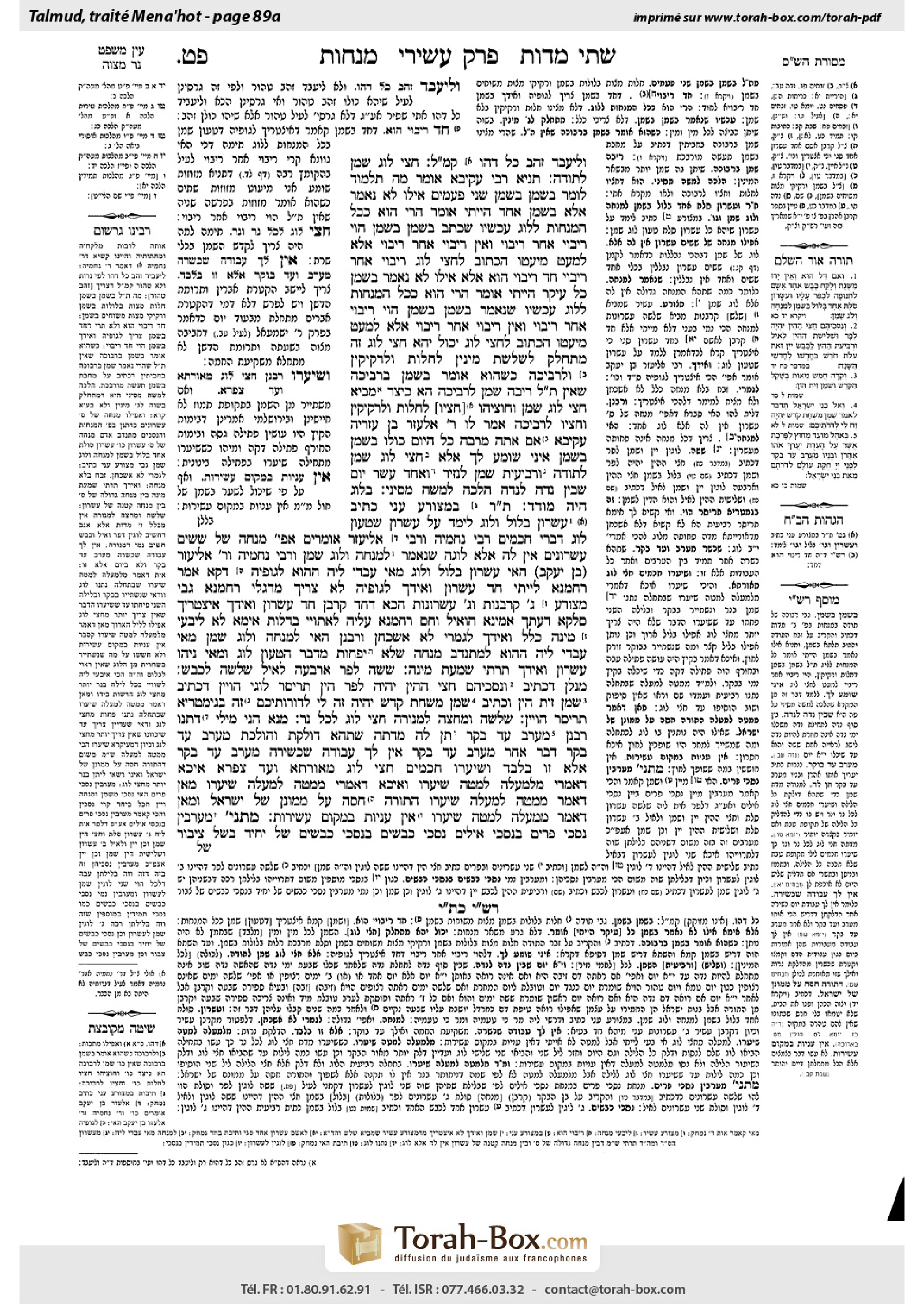
Menachot 89a: Talmud study for Daf Yomi
Daf Yomi is the daily study of one Talmud folio. Explore 37 tractates with scans, Hebrew text, Sefaria English and AI-generated French translations where annotated.
Passage selection and English or AI-generated French translation are available where the scan has annotations. Daf Study is independent of Torah-Box and Sefaria.
Browse Menachot · מנחות · All tractatesMenachot 89a text and translations
This page of Menachot includes the Aramaic text, an English translation and an AI-generated French translation, alongside the scan above.
מנחות פ״ט א · Aramaic and Hebrew text
וְלֶיעְבֵּד זָהָב כֹּל דְּהוּ, קָא מַשְׁמַע לַן.
חֲצִי לוֹג שֶׁמֶן לְתוֹדָה.
תַּנְיָא: רַבִּי עֲקִיבָא אוֹמֵר: מָה תַּלְמוּד לוֹמַר ״בַּשֶּׁמֶן״ ״בַּשֶּׁמֶן״ שְׁנֵי פְּעָמִים? אִילּוּ לֹא נֶאֱמַר אֶלָּא ״בַּשֶּׁמֶן״ אֶחָד, הָיִיתִי אוֹמֵר: הֲרֵי הוּא כְּכׇל הַמְּנָחוֹת לְלוֹג. עַכְשָׁיו שֶׁכָּתַב ״בַּשֶּׁמֶן״ ״בַּשֶּׁמֶן״, הָוֵי רִיבּוּי אַחַר רִיבּוּי, וְאֵין רִיבּוּי אַחַר רִיבּוּי אֶלָּא לְמַעֵט – מִיעֲטוֹ הַכָּתוּב לַחֲצִי לוֹג.
רִיבּוּי אַחַר רִיבּוּי?! חַד רִיבּוּי הוּא.
אֶלָּא, אִילּוּ לֹא נֶאֱמַר ״בַּשֶּׁמֶן״ כׇּל עִיקָּר, הָיִיתִי אוֹמֵר הֲרֵי הוּא כְּכׇל הַמְּנָחוֹת לְלוֹג. עַכְשָׁיו שֶׁנֶּאֱמַר ״בַּשֶּׁמֶן״ ״בַּשֶּׁמֶן״, הָוֵי רִיבּוּי אַחַר רִיבּוּי, וְאֵין רִיבּוּי אַחַר רִיבּוּי אֶלָּא לְמַעֵט, מִיעֲטוֹ הַכָּתוּב לַחֲצִי לוֹג.
יָכוֹל יְהֵא חֲצִי לוֹג זֶה מִתְחַלֵּק לִשְׁלֹשֶׁת מִינִין, לַחַלּוֹת וְלָרְקִיקִין וְלָרְבִיכָה? כְּשֶׁהוּא אוֹמֵר ״בַּשֶּׁמֶן״ בָּרְבִיכָה, שֶׁאֵין תַּלְמוּד לוֹמַר, רִיבָּה שֶׁמֶן לָרְבִיכָה. הָא כֵּיצַד? מֵבִיא חֲצִי לוֹג שֶׁמֶן וְחוֹצֵיהוּ [חֶצְיוֹ] לַחַלּוֹת וְלָרְקִיקִין, וְחֶצְיוֹ לָרְבִיכָה.
אָמַר לוֹ רַבִּי אֶלְעָזָר בֶּן עֲזַרְיָה: עֲקִיבָא, אִם אַתָּה מְרַבֶּה כׇּל הַיּוֹם כּוּלּוֹ ״בַּשֶּׁמֶן״ ״בַּשֶּׁמֶן״ – אֵינִי שׁוֹמֵעַ לָךְ, אֶלָּא חֲצִי לוֹג שֶׁמֶן לְתוֹדָה, וּרְבִיעִית שֶׁמֶן לְנָזִיר, וְאַחַד עָשָׂר יוֹם שֶׁבֵּין נִדָּה לְנִדָּה – הֲלָכָה לְמֹשֶׁה מִסִּינַי.
בְּלוֹג הָיָה מוֹדֵד.
תָּנוּ רַבָּנַן: בִּמְצוֹרָע עָנִי כְּתִיב ״עִשָּׂרוֹן ... בָּלוּל ... וְלֹג״, לִימֵּד עַל עִשָּׂרוֹן שֶׁטָּעוּן לוֹג, דִּבְרֵי חֲכָמִים.
רַבִּי נְחֶמְיָה וְרַבִּי אֱלִיעֶזֶר אוֹמְרִים: אֲפִילּוּ מִנְחָה שֶׁל שִׁשִּׁים עֶשְׂרוֹנִים אֵין לָהּ אֶלָּא לוּגָּהּ, שֶׁנֶּאֱמַר: ״לְמִנְחָה וְלֹג שֶׁמֶן״.
וְרַבִּי נְחֶמְיָה וְרַבִּי אֱלִיעֶזֶר בֶּן יַעֲקֹב, הַאי ״עִשָּׂרוֹן בָּלוּל וְלֹג״ מַאי עָבְדִי לֵיהּ? הָהוּא לְגוּפֵיהּ, דְּקָא אָמַר רַחֲמָנָא: לַיְיתֵי חַד עִשָּׂרוֹן.
וְאִידָּךְ, לְגוּפֵיהּ לָא צְרִיךְ, מִדְּגַלִּי רַחֲמָנָא גַּבֵּי מְצוֹרָע שְׁלֹשָׁה קׇרְבָּנוֹת וּשְׁלֹשָׁה עֶשְׂרוֹנוֹת, הָכָא דְּחַד קׇרְבָּן – חַד עִשָּׂרוֹן.
וְאִידַּךְ – אִיצְטְרִיךְ, סָלְקָא דַּעְתָּךְ אָמֵינָא: הוֹאִיל וְחָס רַחֲמָנָא עֲלֵיהּ לְאֵתוֹיֵי בְּדַלּוּת, אֵימָא לָא לִיבְעֵי (מנה) [מִנְחָה] כְּלָל. וְאִידַּךְ – לִגְמָרֵי לָא אַשְׁכְּחַן.
וְרַבָּנַן, הַאי ״לְמִנְחָה וְלֹג שֶׁמֶן״ מַאי עָבְדִי לֵיהּ? הָהוּא לַמִּתְנַדֵּב מִנְחָה, שֶׁלֹּא יִפְחוֹת מִדָּבָר הַטָּעוּן לוֹג, וּמַאי נִיהוּ? עִשָּׂרוֹן. וְאִידַּךְ, תַּרְתֵּי שָׁמְעַתְּ מִינַּהּ.
שִׁשָּׁה לַפָּר, אַרְבָּעָה לָאַיִל, שְׁלֹשָׁה לַכֶּבֶשׂ. מְנָלַן? דִּכְתִיב: ״וְנִסְכֵּיהֶם חֲצִי הַהִין יִהְיֶה לַפָּר״.
הִין – תְּרֵיסַר לוּגֵּי הָוַיִין, דִּכְתִיב: ״שֶׁמֶן זַיִת הִין״, וּכְתִיב: ״שֶׁמֶן מִשְׁחַת קֹדֶשׁ יִהְיֶה זֶה לִי לְדֹרֹתֵיכֶם״, זֶה בְּגִימַטְרִיָּא תְּרֵיסַר הָוַיִין.
שְׁלֹשָׁה וּמֶחֱצָה לַמְּנוֹרָה, חֲצִי לוֹג לְכׇל נֵר. מְנָא הָנֵי מִילֵּי? דְּתָנוּ רַבָּנַן: ״מֵעֶרֶב עַד בֹּקֶר״ – תֵּן לָהּ מִדָּתָהּ שֶׁתְּהֵא דּוֹלֶקֶת וְהוֹלֶכֶת מֵעֶרֶב עַד בֹּקֶר. דָּבָר אַחֵר: ״מֵעֶרֶב עַד בֹּקֶר״ – אֵין לְךָ עֲבוֹדָה שֶׁכְּשֵׁירָה מֵעֶרֶב עַד בֹּקֶר אֶלָּא זוֹ בִּלְבַד. וְשִׁיעֲרוּ חֲכָמִים חֲצִי לוֹג מֵאוּרְתָּא וְעַד צַפְרָא.
אִיכָּא דְּאָמְרִי: מִלְּמַעְלָה לְמַטָּה שִׁיעֲרוּ, וְאִיכָּא דְּאָמְרִי: מִמַּטָּה לְמַעְלָה שִׁיעֲרוּ.
מַאן דְּאָמַר מִמַּטָּה לְמַעְלָה שִׁיעֲרוּ – הַתּוֹרָה חָסָה עַל מָמוֹנָן שֶׁל יִשְׂרָאֵל, וּמַאן דְּאָמַר מִמַּעְלָה לְמַטָּה שִׁיעֲרוּ – אֵין עֲנִיּוּת בִּמְקוֹם עֲשִׁירוּת.
מַתְנִי׳ מְעָרְבִין נִסְכֵי פָרִים בְּנִסְכֵי אֵילִים, נִסְכֵי כְבָשִׂים בְּנִסְכֵי כְבָשִׂים, שֶׁל יָחִיד בְּשֶׁל צִיבּוּר,
Menachot 89a · English translation
and consequently, let the mouth of the lamps be fashioned from gold of any quality, not necessarily from pure gold. Therefore, the baraita teaches us that even the mouth of the lamps must be fashioned from pure gold.
§ The mishna teaches: A half-log of oil was used to measure oil for the thanks offering. The thanks offering was accompanied by four different types of loaves; three types were unleavened and one was leavened, as the verse states: “If he offers it for a thanks offering, then he shall offer with the sacrifice of thanks offering: Unleavened loaves mixed with oil; and unleavened wafers spread with oil; and poached fine flour, loaves mixed with oil. With loaves of leavened bread he shall present his offering, with the sacrifice of his peace offerings for a thanks offering” (Leviticus 7:12–13).
It is taught in a baraita: Rabbi Akiva says: Why must the verse state: “With oil,” “with oil,” writing it twice; why was the first time not sufficient? Because were the term “with oil” stated only once, I would have said that, with regard to the amount of oil required, the meal offerings that accompany the thanks offerings are like all other meal offerings to the extent that they require one log of oil. Now that the verse wrote “with oil,” “with oil,” it constitutes one amplification following another amplification, and the principle is that one amplification following another amplification serves only to restrict the extent of the halakha. Accordingly, in this case the verse restricted the amount of oil used in the three types of unleavened meal offerings to a half-log for all of them together.
The Gemara interjects the citation of the baraita to ask: Is this a case of one amplification following another amplification? It would appear that there is only one amplification, as according to the baraita the first mention of the term “with oil” is necessary to teach the basic requirement that the meal offerings of the thanks offering require oil, like other meal offerings. How then can it be considered an amplification?
Rather, Rabbi Akiva’s statement should be emended, as follows: Were the term “with oil,” not written at all, I would still have said that the thanks offering meal offerings are like all other meal offerings to the extent that they require one log of oil. Now that the verse wrote “with oil,” “with oil,” it constitutes one amplification following another amplification, and the principle is that one amplification following another amplification serves only to restrict the extent of the halakha. Accordingly, in this case the verse restricted the amount of oil used in the three types of unleavened meal offerings to a half-log for all three together.
The Gemara resumes its citation of the baraita: Once it has been established that the meal offerings require only a half-log of oil, one might have thought that this half-log should be equally divided between the three types of unleavened meal offerings, i.e., one-sixth of a log for the loaves, one-sixth for the wafers, and one-sixth for the poached loaves. When the verse states: “With oil,” with regard to the poached loaves, that is seemingly superfluous, as there is no need for the verse to state the requirement to use part of the half-log of oil, being that this requirement has already been established. It must therefore serve to amplify the amount of oil used for a poached loaf as opposed to the other two types. How so? One brings a half-log of oil and divides it equally into two. Half of it is further divided and used both for the ten regular loaves and for the ten wafers, and the other half of it is used entirely for the ten poached loaves.
Rabbi Elazar ben Azarya said to Rabbi Akiva: Akiva, even if you were to amplify halakhot the entire day from the terms “with oil,” “with oil,” I would not listen to you and accept your claims. Rather, the halakha that a half-log of oil is required for the thanks offering, and similarly, the halakha that a quarter-log of oil is required for the loaves of a nazirite, and the halakha that a woman who experiences an emission of blood during the eleven days that are between one seven-day period of menstruation and the next period of menstruation is a zava, each of these is a halakha transmitted to Moses from Sinai; they are not derived from verses.
§ The mishna states that with the vessel of one log one would measure the oil for all the standard meal offerings. It then cites a dispute between the Rabbis, who hold that one log of oil is required for each tenth of an ephah of flour used, and Rabbi Eliezer ben Ya’akov, who holds that each meal offering, irrespective of its size, requires only one log of oil.
The Sages taught in a baraita: With regard to a poor leper, who cannot afford the standard offerings that are required as part of the purification process and is instead required to bring one lamb as a guilt offering and a tenth of an ephah of flour as a meal offering, it is written: “And a tenth-part of an ephah of fine flour mixed with oil for a meal offering, and a log of oil” (Leviticus 14:21). The verse juxtaposes the need for a log of oil with the fact the offering is made of a tenth of an ephah of flour. Accordingly, it teaches about each tenth of an ephah of flour that it requires one log of oil; this is the statement of the Rabbis.
Rabbi Neḥemya and Rabbi Eliezer say: Each meal offering, irrespective of its size, and even a meal offering of sixty tenths of an ephah of flour, requires only its single log of oil, as it is stated with regard to offering of a leper: “And a tenth of an ephah of fine flour mixed with oil for a meal offering, and a log of oil.” The juxtaposition of “a meal offering” with “a log of oil” teaches a principle for all meal offerings: Each offering requires only one log of oil.
The Gemara asks: And as for Rabbi Neḥemya and Rabbi Eliezer ben Ya’akov, what do they do with this verse: “And a tenth-part of an ephah of fine flour mixed with oil for a meal offering and a log of oil,” which links the need for a log of oil with the fact the offering is made of a tenth of an ephah of flour? The Gemara explains: That verse is required to teach the matter itself, as the Merciful One states: Let a poor leper bring an offering of just a tenth of an ephah of flour. Accordingly, it cannot be used to teach a principle about meal offerings.
The Gemara asks: And as for the other, i.e., the Rabbis, how do they respond to this claim? They maintain that it is not necessary to teach the matter itself, as from the fact that the Merciful One revealed with regard to a leper who is not poor that he must bring three animal offerings and a meal offering of three-tenths of an ephah as part of his purification process, it may be inferred that here, with regard to a poor leper, who brings only one offering, that he similarly brings a meal offering of only a tenth of an ephah. Accordingly, the fact that the verse mentions that his offering is only a tenth of an ephah is superfluous and can teach a principle for all meal offerings.
The Gemara continues to ask: And as for the other, Rabbi Neḥemya and Rabbi Eliezer, how would they respond to this claim? They maintain that it was necessary for the verse to state the size of his meal offering, as otherwise it might enter your mind to say that since the Merciful One spared the money of the poor leper by allowing him to bring an offering affordable in poverty, one might say that the Merciful One does not require from him to bring any meal offering at all. The Gemara asks: And as for the other, the Rabbis, how would they respond to this? They claim that we do not find that the Torah entirely exempts a poor person from the offerings of the purification process, only that it provides a less expensive way to complete that process.
The Gemara asks: And as for the Rabbis, what do they do with the juxtaposition in the end of this verse: “For a meal offering and a log of oil,” from which Rabbi Neḥemya and Rabbi Eliezer derive the principle that each meal offering requires only one log of oil? The Gemara explains: The Rabbis maintain that the juxtaposition teaches about one who donates a meal offering, without specifying its size, that he should not bring less than an amount of flour that requires one log. And what is this amount? A tenth of an ephah. The Gemara asks: And as for the other, Rabbi Neḥemya and Rabbi Eliezer, from where do they derive that halakha, as they maintain the verse teaches the principle for all meal offerings? The Gemara explains: They maintain that two halakhot can be derived from this verse.
§ The mishna lists the quantities of oil and wine that were required for the meal offerings and libations that accompanied the sacrifice of an animal. Six log, i.e., one-half of a hin, for those of a bull; and four log, i.e., one-third of a hin, for those of a ram; and three log, i.e., one-quarter of a hin, for those of a lamb. The Gemara asks: From where do we derive these quantities? We derive them from a verse, as it is written: “And their libations shall be one-half of a hin of wine for a bull, and one-third of a hin for the ram, and one-quarter of a hin for a lamb” (Numbers 28:14).
The Gemara elaborates: Now, one hin is twelve log, as it is written: “And of olive oil a hin” (Exodus 30:24), and it is written afterward in the same verse: “Sacred anointing oil, this [zeh] shall be for Me, throughout your generations.” The numerical value [gimatriyya] of zeh is twelve. Once it is established that one hin is twelve log, it is possible to calculate how may log are in one-half, one-third, and one-quarter of a hin.
§ The mishna teaches: Three and a half log of oil were required for the Candelabrum, as there were seven lamps and a half-log was required for each lamp. The Gemara asks: From where are these matters derived? They are derived from a verse, as the Sages taught in a baraita: The verse states with regard to the Candelabrum: “Aaron and his sons shall arrange it from evening to morning, before the Lord” (Exodus 27:21). This indicates that you shall put into each lamp its required quantity of oil so that it will continue burning from evening until morning. Alternatively, the phrase “from evening to morning” indicates that the mitzva is fulfilled throughout the night, and you have no other rite that is valid from evening until morning except for this one alone. And the Sages calculated that a half-log of oil for each lamp is necessary to ensure that they continue burning from evening until morning.
How did the Sages reach the conclusion that a half-log of oil is needed? There are those who say that the Sages calculated it by initially using a large quantity of oil, more than necessary to burn throughout the night, and then decreasing the quantity by a small amount each night until they saw that at the end of the night there was no oil remaining. And there are those who say that they calculated it by initially using a small quantity of oil and then increasing the quantity each night until they saw that the quantity was sufficient to allow the lamps to burn throughout the night.
The Gemara elaborates: The one who said that they calculated it by increasing the quantity each night holds that they did so in accordance with the principle that the Torah spared the money of the Jewish people, so the Sages wished to minimize the financial cost of their experimentation. And the one who said that they calculated it by decreasing the quantity each night holds that in the Temple one’s actions should not be motivated by a concern for the financial cost, as in a place of wealth there is no poverty.
MISHNA: Many animal offerings are brought together with a meal offering and a wine libation. These additions are collectively referred to as libations. One may mix together the libations of bulls with the libations of rams; the meal offerings may be mixed as they both share the same ratio of flour to oil, i.e., two log of oil for each tenth of an ephah of flour. Likewise, one may mix together the libations of lambs with the libations of other lambs, as the meal offerings both share the same ratio of three log of oil for each tenth of an ephah of flour. And one may mix together the libations of the offering of an individual with those of a communal offering.
Menachot 89a · Traduction française (IA)
Par conséquent, on pourrait dire que l’orifice des lampes peut être façonné avec de l’or de n’importe quelle qualité, et pas nécessairement avec de l’or pur. La baraïta nous enseigne donc que même l’orifice des lampes doit être façonné en or pur.
§ La Michna enseigne qu’un demi-log d’huile était utilisé pour mesurer l’huile de l’offrande de reconnaissance. Celle-ci était accompagnée de quatre sortes de pains : trois sortes sans levain et une sorte avec levain, comme le dit le verset : « S’il la présente en offrande de reconnaissance, il présentera avec le sacrifice de reconnaissance des galettes sans levain pétries à l’huile, des galettes minces sans levain enduites d’huile et de la fleur de farine préparée en pâte, en galettes pétries à l’huile. Avec des galettes de pain levé, il présentera son offrande, avec le sacrifice de ses offrandes de paix en offrande de reconnaissance » (Lévitique 7, 12-13).
Une baraïta enseigne : Rabbi Akiva dit : Pourquoi le verset mentionne-t-il deux fois « à l’huile » ? Pourquoi la première occurrence ne suffit-elle pas ? Si le terme « à l’huile » n’apparaissait qu’une seule fois, j’aurais dit que, pour ce qui est de la quantité d’huile requise, les oblations accompagnant les offrandes de reconnaissance sont comme toutes les autres oblations, qui requièrent un log d’huile. Mais puisque le verset mentionne deux fois « à l’huile », il s’agit d’une amplification qui suit une autre amplification, et le principe veut qu’une amplification suivant une autre amplification ne serve qu’à restreindre la portée de la halakha. En l’occurrence, le verset a donc limité la quantité d’huile utilisée pour les trois sortes d’oblations sans levain à un demi-log au total.
La Guemara interrompt la citation de la baraïta pour demander : S’agit-il ici d’une amplification qui suit une autre amplification ? Il semblerait qu’il n’y ait qu’une seule amplification, car, selon la baraïta, la première mention du terme « à l’huile » est nécessaire pour enseigner l’exigence fondamentale selon laquelle les oblations de l’offrande de reconnaissance requièrent de l’huile, comme les autres oblations. Comment peut-on donc la considérer comme une amplification ?
Il faut plutôt corriger la déclaration de Rabbi Akiva comme suit : Même si le terme « à l’huile » n’avait pas du tout été écrit, j’aurais dit que les oblations de l’offrande de reconnaissance sont comme toutes les autres oblations, en ce qu’elles requièrent un log d’huile. Mais puisque le verset mentionne deux fois « à l’huile », il s’agit d’une amplification qui suit une autre amplification, et le principe veut qu’une amplification suivant une autre amplification ne serve qu’à restreindre la portée de la halakha. En l’occurrence, le verset a donc limité la quantité d’huile utilisée pour les trois sortes d’oblations sans levain à un demi-log au total.
La Guemara reprend la citation de la baraïta : Une fois établi que les oblations ne requièrent qu’un demi-log d’huile, on aurait pu penser que ce demi-log devait être réparti également entre les trois sortes d’oblations sans levain, soit un sixième de log pour les galettes, un sixième pour les galettes minces et un sixième pour les galettes préparées en pâte. Lorsque le verset dit « à l’huile » à propos des galettes préparées en pâte, cela semble superflu, puisqu’il n’est pas nécessaire que le verset précise qu’une partie du demi-log d’huile doit être utilisée, cette exigence ayant déjà été établie. Ce terme doit donc servir à amplifier la quantité d’huile utilisée pour les galettes préparées en pâte par rapport aux deux autres sortes. Comment ? On prend un demi-log d’huile et on le divise en deux parts égales. On divise encore l’une de ces parts et on l’utilise à la fois pour les dix galettes ordinaires et pour les dix galettes minces ; l’autre moitié est entièrement utilisée pour les dix galettes préparées en pâte.
Rabbi Elazar ben Azarya dit à Rabbi Akiva : Akiva, même si tu devais tirer des halakhot toute la journée des termes « à l’huile », « à l’huile », je ne t’écouterais pas et n’accepterais pas tes arguments. La halakha selon laquelle un demi-log d’huile est requis pour l’offrande de reconnaissance, de même que celle selon laquelle un quart de log d’huile est requis pour les galettes d’un nazir, et celle selon laquelle une femme qui présente un écoulement de sang pendant les onze jours séparant une période de sept jours de menstruation de la suivante est une zava, sont toutes des halakhot transmises à Moïse au Sinaï ; elles ne sont pas déduites des versets.
§ La Michna indique qu’on mesurait l’huile de toutes les oblations ordinaires avec le récipient d’un log. Elle rapporte ensuite un désaccord entre les Sages, qui estiment qu’un log d’huile est requis pour chaque dixième d’épha de farine utilisé, et Rabbi Eliezer ben Ya’akov, qui estime que chaque oblation, quelle que soit sa taille, ne requiert qu’un log d’huile.
Les Sages enseignent dans une baraïta : À propos d’un lépreux pauvre, qui ne peut se permettre les offrandes ordinaires requises dans le cadre de son processus de purification et doit à la place apporter un agneau comme sacrifice de culpabilité et un dixième d’épha de farine comme oblation, il est écrit : « Un dixième d’épha de fleur de farine pétrie à l’huile, pour une oblation, et un log d’huile » (Lévitique 14, 21). Le verset met en parallèle l’obligation d’un log d’huile et le fait que l’offrande soit constituée d’un dixième d’épha de farine. Il enseigne donc que chaque dixième d’épha de farine requiert un log d’huile. Telle est la déclaration des Sages.
Rabbi Neḥemya et Rabbi Eliezer disent : Chaque oblation, quelle que soit sa taille, même une oblation constituée de soixante dixièmes d’épha de farine, ne requiert qu’un seul log d’huile, comme il est dit au sujet de l’offrande d’un lépreux : « Un dixième d’épha de fleur de farine pétrie à l’huile, pour une oblation, et un log d’huile. » Le rapprochement entre « une oblation » et « un log d’huile » enseigne un principe concernant toutes les oblations : chacune ne requiert qu’un seul log d’huile.
La Guemara demande : Et Rabbi Neḥemya et Rabbi Eliezer ben Ya’akov, que font-ils de ce verset : « Un dixième d’épha de fleur de farine pétrie à l’huile, pour une oblation, et un log d’huile », qui associe l’obligation d’un log d’huile au fait que l’offrande soit constituée d’un dixième d’épha de farine ? La Guemara explique : Ce verset est nécessaire pour enseigner la disposition elle-même, car le Miséricordieux dit qu’un lépreux pauvre doit apporter une offrande constituée d’un seul dixième d’épha de farine. Il ne peut donc pas servir à enseigner un principe concernant les oblations.
La Guemara demande : Et les autres, c’est-à-dire les Sages, que répondent-ils à cet argument ? Ils estiment qu’il n’est pas nécessaire d’enseigner la disposition elle-même, car du fait que le Miséricordieux a révélé qu’un lépreux qui n’est pas pauvre doit apporter trois offrandes animales et une oblation de trois dixièmes d’épha dans le cadre de son processus de purification, on peut déduire qu’ici, dans le cas d’un lépreux pauvre, qui n’apporte qu’une seule offrande, il apporte de même une oblation d’un seul dixième d’épha. Par conséquent, le fait que le verset précise que son offrande ne comporte qu’un dixième d’épha est superflu et peut servir à enseigner un principe concernant toutes les oblations.
La Guemara poursuit : Et les autres, Rabbi Neḥemya et Rabbi Eliezer, que répondraient-ils à cet argument ? Ils estiment qu’il était nécessaire que le verset précise la quantité de son oblation, car sinon, on aurait pu penser que, puisque le Miséricordieux a épargné l’argent du lépreux pauvre en lui permettant d’apporter une offrande à sa portée, le Miséricordieux ne lui impose même aucune oblation. La Guemara demande : Et les autres, les Sages, que répondraient-ils à cela ? Ils soutiennent que nous ne trouvons pas que la Torah dispense entièrement une personne pauvre des offrandes requises pour le processus de purification ; elle lui offre seulement un moyen moins coûteux d’accomplir ce processus.
La Guemara demande : Et les Sages, que font-ils du rapprochement, à la fin de ce verset, entre « pour une oblation » et « un log d’huile », dont Rabbi Neḥemya et Rabbi Eliezer déduisent le principe selon lequel chaque oblation ne requiert qu’un seul log d’huile ? La Guemara explique : Les Sages estiment que ce rapprochement enseigne que celui qui fait don d’une oblation sans en préciser la taille ne doit pas apporter moins de farine que la quantité qui requiert un log d’huile. Et quelle est cette quantité ? Un dixième d’épha. La Guemara demande : Et les autres, Rabbi Neḥemya et Rabbi Eliezer, d’où déduisent-ils cette halakha, puisqu’ils estiment que le verset enseigne le principe applicable à toutes les oblations ? La Guemara explique : Ils estiment que l’on peut déduire deux halakhot de ce verset.
§ La Michna énumère les quantités d’huile et de vin requises pour les oblations et les libations accompagnant le sacrifice d’un animal : six log, soit un demi-hin, pour celles d’un taureau ; quatre log, soit un tiers de hin, pour celles d’un bélier ; et trois log, soit un quart de hin, pour celles d’un agneau. La Guemara demande : D’où déduisons-nous ces quantités ? Nous les déduisons d’un verset, comme il est écrit : « Leurs libations seront d’un demi-hin de vin pour un taureau, d’un tiers de hin pour le bélier et d’un quart de hin pour un agneau » (Nombres 28, 14).
La Guemara développe : Un hin équivaut à douze log, comme il est écrit : « Et d’huile d’olive, un hin » (Exode 30, 24), puis, dans le même verset, il est écrit : « Huile d’onction sainte, ceci [zeh] sera pour Moi, à travers vos générations. » La valeur numérique [gimatriyya] de zeh est douze. Une fois établi qu’un hin équivaut à douze log, on peut calculer combien de log représentent un demi-hin, un tiers de hin et un quart de hin.
§ La Michna enseigne qu’il fallait trois log et demi d’huile pour la Menora, qui comptait sept lampes et nécessitait un demi-log pour chacune. La Guemara demande : D’où déduit-on ces règles ? Elles sont déduites d’un verset, comme les Sages l’enseignent dans une baraïta : À propos de la Menora, le verset dit : « Aaron et ses fils la disposeront du soir au matin, devant le Seigneur » (Exode 27, 21). Cela indique qu’il faut mettre dans chaque lampe la quantité d’huile requise pour qu’elle brûle du soir au matin. Autre explication : l’expression « du soir au matin » indique que la mitsva s’accomplit pendant toute la nuit, et il n’existe aucun autre rite valable du soir au matin, à part celui-ci. Les Sages ont calculé qu’un demi-log d’huile par lampe est nécessaire pour que les lampes continuent de brûler du soir au matin.
Comment les Sages sont-ils parvenus à la conclusion qu’un demi-log d’huile était nécessaire ? Selon certains, ils l’ont calculé en utilisant d’abord une grande quantité d’huile, supérieure à celle qui était nécessaire pour brûler toute la nuit, puis en la réduisant chaque nuit d’une petite quantité jusqu’à constater qu’il ne restait plus d’huile à la fin de la nuit. Selon d’autres, ils l’ont calculé en utilisant d’abord une petite quantité d’huile, puis en l’augmentant chaque nuit jusqu’à constater qu’elle suffisait pour que les lampes brûlent toute la nuit.
La Guemara développe : Celui qui dit qu’ils ont calculé la quantité en l’augmentant chaque nuit estime qu’ils ont agi conformément au principe selon lequel la Torah épargne l’argent du peuple juif ; les Sages souhaitaient donc réduire au minimum le coût de leur expérimentation. Celui qui dit qu’ils ont calculé la quantité en la réduisant chaque nuit estime que, dans le Temple, les actes ne doivent pas être motivés par le souci du coût, car là où règne l’abondance, il n’y a pas de pauvreté.
MICHNA : De nombreuses offrandes animales sont accompagnées d’une oblation et d’une libation de vin. Ces éléments supplémentaires sont désignés collectivement comme des libations. On peut mélanger les libations des taureaux avec celles des béliers ; on peut mélanger les oblations, car elles ont le même rapport entre la farine et l’huile, à savoir deux log d’huile pour chaque dixième d’épha de farine. De même, on peut mélanger les libations des agneaux avec celles d’autres agneaux, car leurs oblations ont le même rapport, soit trois log d’huile pour chaque dixième d’épha de farine. On peut également mélanger les libations d’une offrande individuelle avec celles d’une offrande communautaire.
Traduction française générée par IA à partir de l’édition anglaise de Sefaria. Vérifie toujours un passage avec le texte source.
Text from Sefaria: William Davidson Edition - Vocalized Aramaic (unknown); William Davidson Edition - English (CC BY NC).