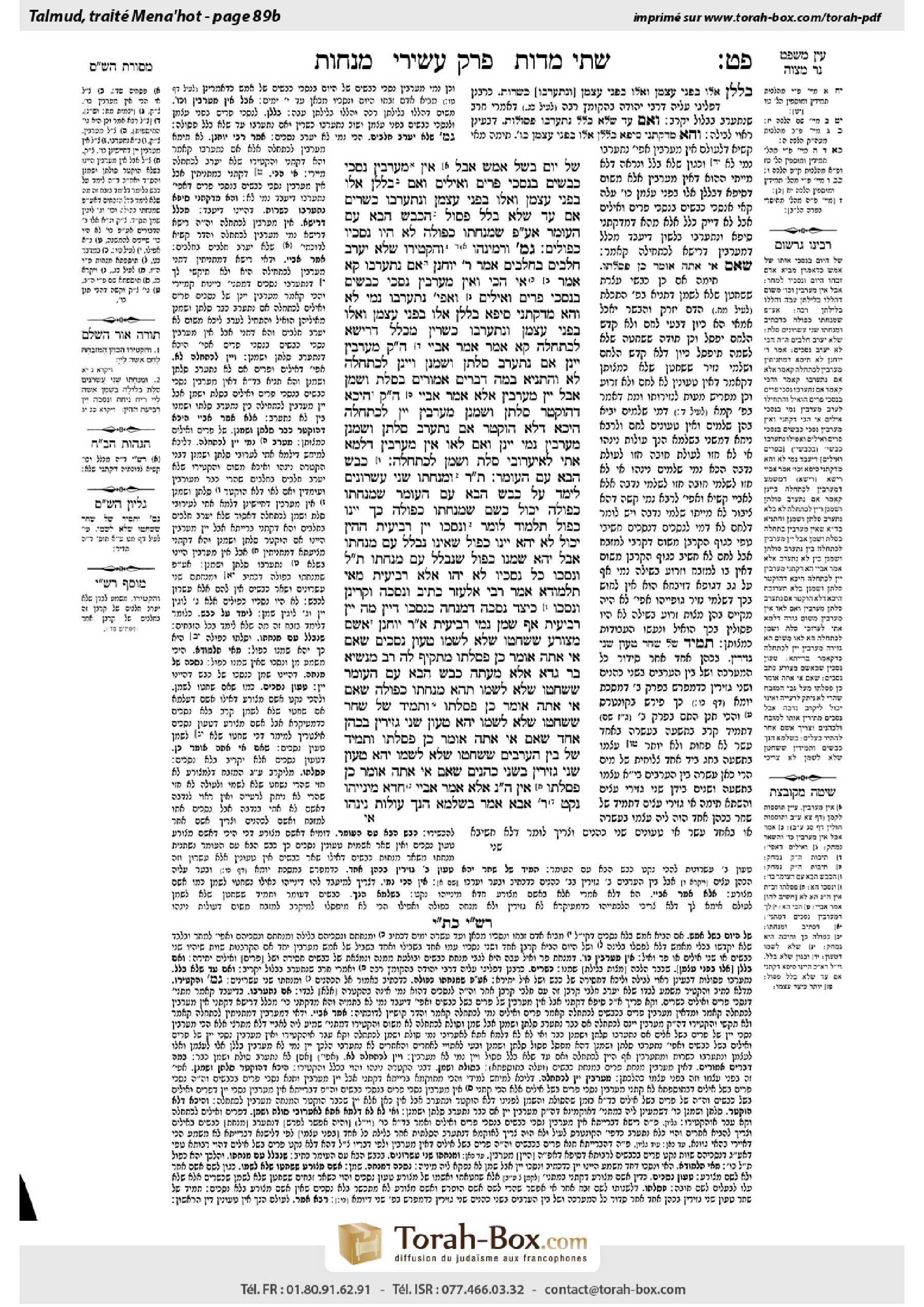
Menachot 89b: Talmud study for Daf Yomi
Daf Yomi is the daily study of one Talmud folio. Explore 37 tractates with scans, Hebrew text, Sefaria English and AI-generated French translations where annotated.
Passage selection and English or AI-generated French translation are available where the scan has annotations. Daf Study is independent of Torah-Box and Sefaria.
Browse Menachot · מנחות · All tractatesMenachot 89b text and translations
This page of Menachot includes the Aramaic text, an English translation and an AI-generated French translation, alongside the scan above.
מנחות פ״ט ב · Aramaic and Hebrew text
שֶׁל יוֹם בְּשֶׁל אֶמֶשׁ.
אֲבָל אֵין מְעָרְבִין נִסְכֵי כְבָשִׂים בְּנִסְכֵי פָרִים וְאֵילִים, וְאִם בְּלָלָן אֵלּוּ בִּפְנֵי עַצְמָן וְאֵלּוּ בִּפְנֵי עַצְמָן וְנִתְעָרְבוּ – כְּשֵׁרִים, אִם עַד שֶׁלֹּא בָּלַל – פָּסוּל.
הַכֶּבֶשׂ הַבָּא עִם הָעוֹמֶר, אַף עַל פִּי שֶׁמִּנְחָתוֹ כְּפוּלָה – לֹא הָיוּ נְסָכָיו כְּפוּלִים.
גְּמָ׳ וּרְמִינְהוּ:
״וְהִקְטִירוֹ״, שֶׁלֹּא יְעָרֵב חֲלָבִים בַּחֲלָבִים.
אָמַר רַבִּי יוֹחָנָן: ״אִם נִתְעָרְבוּ״ קָא אָמַר.
אִי הָכִי, וְאֵין מְעָרְבִין נִסְכֵי כְבָשִׂים בְּנִסְכֵי פָרִים וְאֵילִים, וַאֲפִילּוּ נִתְעָרְבוּ נָמֵי לָא? וְהָא מִדְּקָתָנֵי סֵיפָא: בְּלָלָן אֵלּוּ בִּפְנֵי עַצְמָן וְאֵלּוּ בִּפְנֵי עַצְמָן וְנִתְעָרְבוּ כְּשֵׁרִין, מִכְּלָל דְּרֵישָׁא לְכַתְּחִלָּה קָא אָמַר!
אָמַר אַבָּיֵי: הָכִי קָאָמַר, מְעָרְבִין יֵינָן, אִם נִתְעָרֵב סׇלְתָּן וְשַׁמְנָן.
וְיֵינָן לְכִתְחִלָּה לָא? וְהָתַנְיָא: בַּמֶּה דְּבָרִים אֲמוּרִים – בְּסֹלֶת וָשֶׁמֶן, אֲבָל יַיִן מְעָרְבִין.
אֶלָּא אָמַר אַבָּיֵי: הָכִי קָאָמַר – הֵיכָא דְּהוּקְטַר סׇלְתָּן וְשַׁמְנָן, מְעָרְבִין יַיִן לְכַתְּחִלָּה. הֵיכָא דְּלָא הוּקְטַר – אִם נִתְעָרֵב סׇלְתָּן וְשַׁמְנָן, מְעָרְבִין נָמֵי יֵינָן, וְאִם לָאו – אֵין מְעָרְבִין, דִּלְמָא אָתֵי לְאִיעָרוֹבֵי סֹלֶת וְשֶׁמֶן לְכַתְּחִלָּה.
כֶּבֶשׂ הַבָּא עִם הָעוֹמֶר, תָּנוּ רַבָּנַן: ״וּמִנְחָתוֹ שְׁנֵי עֶשְׂרוֹנִים״, לִימֵּד עַל כֶּבֶשׂ הַבָּא עִם הָעוֹמֶר שֶׁמִּנְחָתוֹ כְּפוּלָה.
יָכוֹל כְּשֵׁם שֶׁמִּנְחָתוֹ כְּפוּלָה, כָּךְ יֵינוֹ כָּפוּל? תַּלְמוּד לוֹמַר ״וְנִסְכּוֹ יַיִן רְבִיעִית הַהִין״. יָכוֹל לֹא יְהֵא יֵינוֹ כָּפוּל שֶׁאֵינוֹ נִבְלָל עִם מִנְחָתוֹ, אֲבָל יְהֵא שַׁמְנוֹ כָּפוּל שֶׁנִּבְלָל עִם מִנְחָתוֹ? תַּלְמוּד לוֹמַר ״וְנִסְכּוֹ״ – כׇּל נְסָכָיו לֹא יְהוּ אֶלָּא רְבִיעִית.
מַאי תַּלְמוּדָא? אָמַר רַבִּי אֶלְעָזָר: כְּתִיב ״וְנִסְכָּהּ״, וְקָרֵינַן ״וְנִסְכּוֹ״.
כֵּיצַד? ״נִסְכָּהּ״ דְּמִנְחָה כְּ״נִסְכּוֹ״ דְּיַיִן – מָה יַיִן רְבִיעִית, אַף שֶׁמֶן נָמֵי רְבִיעִית.
אָמַר רַבִּי יוֹחָנָן: אֲשַׁם מְצוֹרָע שֶׁשְּׁחָטוֹ שֶׁלֹּא לִשְׁמוֹ, טָעוּן נְסָכִים, שֶׁאִם אִי אַתָּה אוֹמֵר כֵּן – פְּסַלְתּוֹ.
מַתְקֵיף לַהּ רַב מְנַשְּׁיָא בַּר גַּדָּא: אֶלָּא מֵעַתָּה, כֶּבֶשׂ הַבָּא עִם הָעוֹמֶר שֶׁשְּׁחָטוֹ שֶׁלֹּא לִשְׁמוֹ, תְּהֵא מִנְחָתוֹ כְּפוּלָה, שֶׁאִם אִי אַתָּה אוֹמֵר כֵּן – פְּסַלְתּוֹ.
וְתָמִיד שֶׁל שַׁחַר שֶׁשְּׁחָטוֹ שֶׁלֹּא לִשְׁמוֹ, יְהֵא טָעוּן שְׁנֵי גְזִירִין בְּכֹהֵן אֶחָד, שֶׁאִם אִי אַתָּה אוֹמֵר כֵּן – פְּסַלְתּוֹ. וְתָמִיד שֶׁל בֵּין הָעַרְבַּיִם שֶׁשְּׁחָטוֹ שֶׁלֹּא לִשְׁמוֹ, יְהֵא טָעוּן שְׁנֵי גְזִירִין בִּשְׁנֵי כֹהֲנִים, שֶׁאִם אִי אַתָּה אוֹמֵר כֵּן – פְּסַלְתּוֹ.
אִין הָכִי נָמֵי, אֶלָּא אָמַר אַבָּיֵי: חֲדָא מִינַּיְיהוּ נְקַט.
רַבִּי אַבָּא אָמַר: בִּשְׁלָמָא הָנָךְ, עוֹלוֹת נִינְהוּ,
Menachot 89b · English translation
And one may mix together the libations of an offering brought on one day with those of the day before, if the meal offerings have the same ratio of oil to flour.
But one may not mix together the libations of lambs with the libations of bulls or the libations of rams, as the meal offerings have different ratios of oil to flour. And nevertheless, if one intermingled the flour and oil of these lamb offerings by themselves and the flour and oil of these bull or ram offerings by themselves, and only then were they mixed together, then they remain fit to be sacrificed. If they were mixed together before the oil and flour of each offering were independently intermingled to form the meal offering, then they are disqualified.
With regard to the lamb offering that comes with the omer meal offering, which is accompanied by another meal offering and a wine libation, even though the quantity of flour used in its meal offering is doubled, i.e., one uses twice the amount that is generally used for meal offerings that accompany the sacrifice of a lamb, its oil and wine libations were not doubled; rather, three log of oil and three log of wine were used, per the standard quantities used for a lamb.
GEMARA: The mishna states that different types of libations may be mixed together provided that the meal offerings have the same flour to oil ratio. And the Gemara raises a contradiction to this from a baraita discussing the verse: “And he shall sacrifice, from the peace offerings, a fire to the Lord: The fat covering the innards, and all the fat that is on the innards, and the two kidneys with the fat that is on them, which is over the loins; and the diaphragm with the liver, with the kidneys, he shall take away. And Aaron’s sons shall burn it on the altar, apart from the burnt offering, which is on the wood that is on the fire; it is a fire of a pleasing aroma to the Lord” (Leviticus 3:3–5).
The direct object of the term: “And they shall burn,” i.e., the pronoun “it,” is singular, despite referring to the many types of fats listed in the verse. This indicates that one may not mix fats of one offering with the fats of a different offering, but should burn the parts from each offering separately. Similarly, it follows that the libations accompanying different animal offerings should not be mixed together.
Rabbi Yoḥanan says: The mishna stated only that if libations of different offerings were mixed together one may still sacrifice them, but not that this is permitted ab initio. Accordingly, there is no contradiction between the mishna and baraita.
The Gemara infers: If that is so, then when the mishna states in its first clause: And one may not mix together the libations of lambs with the libations of bulls or the libations of rams, the intention is that even after the fact, if they were mixed together, they are also not valid. The Gemara challenges: But from the fact that the latter clause teaches: If one intermingled the flour and oil of these lamb offerings by themselves and the flour and oil of these bull or ram offerings by themselves and only then were they mixed together then they remain fit to be sacrificed, which is explicitly referring to the halakha after the fact, it may be inferred that the first clause stated the halakha ab initio.
Abaye said that this is what the mishna is saying: When different animal offerings are sacrificed, their wine libations may be mixed together ab initio, but only if their fine flour and their oil from their respective meal offerings were already mixed together, albeit improperly.
The Gemara asks: And is it correct that one may not mix together the wine libations of different offerings ab initio unless their flour and oil were already mixed? But isn’t it taught in the continuation of the baraita just cited: In what case is this statement, that one may not mix together parts from different offerings, said? It is said only with regard to flour and oil. But one may mix together the wine libations of different offerings. The implication is that this is the halakha even if their meal offerings had not been mixed together.
Rather, Abaye said that this is what the mishna is saying: With regard to offerings of similar types of animals, where their fine flour and their oil from their respective meal offerings have been burned on the altar, one may mix together the wine libations ab initio. And even where their fine flour and their oil have not been burned, if their fine flour and their oil have at least been mixed together, one may mix together their wine libations ab initio. But if the fine flour and oil have not been mixed together, then one may not mix the libations together. The reason is that if one does mix the libations, perhaps one will come to mix together their flour and oil ab initio, which is prohibited.
§ The mishna teaches: With regard to the lamb offering that comes with the omer meal offering, the quantity of flour used in its meal offering is doubled, i.e., one uses twice the amount that is generally used for meal offerings that accompany the sacrifice of a lamb, but the quantities of oil and wine are not doubled. The Sages taught in a baraita: The verse states with regard to the omer meal offering: “And its meal offering shall be two tenths” (Leviticus 23:13). This verse teaches about the lamb that comes with the omer that the size of its meal offering is doubled.
One might have thought that just as its meal offering is doubled, so too its wine libation should be doubled, i.e., instead of using a quarter-hin, as is generally done for lambs, one should use a half-hin. To counter this, the verse states, in its continuation: “And its libation shall be of wine, a quarter-hin” (Leviticus 23:13). One might have thought that it is only its wine libation that should not be doubled, as it is not intermingled with the flour of its meal offering, but its oil should be doubled, as it is intermingled with the flour of its meal offering. To counter this, the verse states: “And its libation shall be of wine, a quarter-hin,” which teaches that all of its libations shall be only a quarter-hin, but no more.
The Gemara elaborates on the final proof in the baraita: What is the biblical derivation here? Rabbi Elazar says: There is an ambiguity as to whether the possessive pronoun in the term “and its libation” is referring to the lamb offering or the meal offering, both of which are mentioned previously in the verse. This is due to a disparity between the way the Hebrew word for the term is written and the way it is vocalized. It is written as veniskah, with the possessive pronoun in the feminine form. This would be referring to the meal offering [minḥa], which is a feminine noun. Accordingly, this means: The libation of the meal offering, and it is referring to the oil that is intermingled in the meal offering. And we read it as venisko, with the possessive pronoun in the masculine form. This would be referring to the lamb offering itself [keves], which is a masculine noun. Accordingly, this means: The libation of the lamb offering, which is a reference to the wine libation that accompanies the lamb offering.
How can this be explained? It teaches that the libation of the meal offering, i.e., its oil, is like the libation of the lamb of wine: Just as the quantity of wine used is a quarter-hin, so too, the quantity of oil used is a quarter-hin and no more.
§ The Gemara cites a related discussion: A guilt offering brought by a leper as part of his purification process is distinct from other guilt offerings in that there is an additional requirement that it must be brought together with a meal offering and a wine libation. Rabbi Yoḥanan says: In the case of a guilt offering of a leper that one slaughtered not for its own sake, although the leper can therefore no longer fulfill his obligation with it, the offering continues to be regarded as a guilt offering of a leper and still requires libations, i.e., a meal offering and a wine libation; as if you do not say this, you have disqualified it. To bring it without libations one would have to regard it as a standard guilt offering, but the halakha is that an offering may not be sacrificed for a different purpose than the one for which it was originally consecrated.
Rav Menashya bar Gadda objects to this: If that is so, that whenever an offering is consecrated for a specific purpose that requires various additional conditions to be fulfilled beyond those normally required for that type of offering, then even if it is then slaughtered not for its own sake those conditions must still be fulfilled in order for the offering to be valid; then with regard to the lamb offering that comes with the omer meal offering the halakha should likewise be that if one slaughtered it not for its own sake, the flour in its meal offering should still be doubled in quantity, as normally required for the omer meal offering, because it continues to be regarded as an omer meal offering, as if you do not say this, you have disqualified it.
And similarly, with regard to the daily morning offering, if one slaughtered it not for its own sake, it should still require the arrangement of two logs of wood on the fire on the altar by one priest, because it continues to be regarded as a daily morning offering; as if you do not say this, you have disqualified it. And similarly, with regard to the daily afternoon offering, if one slaughtered it not for its own sake, it should still require the arrangement of two logs of wood on the fire on the altar by two priests, because it continues to be regarded as a daily afternoon offering; as if you do not say this, you have disqualified it. The fact that Rabbi Yoḥanan did not mention these halakhot suggests that he holds they are not correct, but then his opinion is logically inconsistent.
The Gemara deflects the objection: Yes, it is indeed so that Rabbi Yoḥanan’s ruling should be extended to other cases, as Rav Menashya bar Gadda claimed. Rather, Abaye said: Rabbi Yoḥanan mentioned just one of them as an example, even though they are all correct.
Rabbi Abba said that there is a different resolution: Actually, Rabbi Yoḥanan’s ruling is limited to a guilt offering of a leper. The other offerings that Rav Menashya bar Gadda mentioned would be valid even if the additional conditions that originally applied to them were not fulfilled. The reason for this is as follows: Granted, these other offerings that Rav Menashya bar Gadda mentioned would be valid, as they are burnt offerings;
Menachot 89b · Traduction française (IA)
On peut aussi mêler les libations d’un sacrifice offert un jour avec celles du jour précédent, si les oblations ont la même proportion d’huile et de farine.
Mais on ne peut pas mêler les libations d’agneaux à celles de taureaux ou de béliers, car les oblations ont des proportions différentes d’huile et de farine. Toutefois, si l’on a d’abord mêlé séparément la farine et l’huile des oblations de ces agneaux, et séparément la farine et l’huile des oblations de ces taureaux ou de ces béliers, puis qu’on les a seulement ensuite réunies, elles restent aptes à être offertes. Si on les a réunies avant d’avoir mêlé séparément l’huile et la farine de chaque sacrifice pour former l’oblation, elles sont invalidées.
Quant au sacrifice d’agneau qui accompagne l’oblation de l’omer, elle-même accompagnée d’une autre oblation et d’une libation de vin, bien que la quantité de farine utilisée pour son oblation soit doublée — c’est-à-dire qu’on en utilise deux fois la quantité habituelle pour les oblations accompagnant le sacrifice d’un agneau —, les quantités d’huile et de vin de ses libations ne sont pas doublées : on utilise trois log d’huile et trois log de vin, conformément aux quantités habituelles pour un agneau.
GUEMARA : La Michna enseigne que l’on peut mêler différents types de libations, à condition que les oblations aient la même proportion de farine et d’huile. La Guemara soulève une contradiction à partir d’une baraïta commentant le verset : « Il offrira, parmi les sacrifices de paix, un sacrifice consumé par le feu pour le Seigneur : la graisse qui recouvre les entrailles, toute la graisse qui est sur les entrailles, les deux rognons avec la graisse qui les recouvre, celle qui est sur les flancs, ainsi que le diaphragme avec le foie ; il les séparera des rognons. Les fils d’Aaron les feront brûler sur l’autel, à part l’holocauste qui est sur le bois placé sur le feu ; c’est un sacrifice consumé par le feu, d’odeur agréable pour le Seigneur » (Lévitique 3, 3-5).
Le complément du terme « ils feront brûler », c’est-à-dire le pronom « le », est au singulier, bien qu’il renvoie aux différentes sortes de graisses énumérées dans le verset. Cela indique qu’on ne peut pas mêler les graisses d’un sacrifice à celles d’un autre, mais qu’il faut brûler séparément les parties provenant de chaque sacrifice. De même, il s’ensuit qu’on ne doit pas mêler les libations accompagnant différents sacrifices d’animaux.
Rabbi Yoḥanan dit : La Michna enseigne seulement que si les libations de différents sacrifices ont été mêlées, on peut néanmoins les offrir, mais pas que cela soit permis a priori. Il n’y a donc pas de contradiction entre la Michna et la baraïta.
La Guemara déduit : Si tel est le cas, lorsque la première partie de la Michna enseigne : « On ne peut pas mêler les libations d’agneaux à celles de taureaux ou de béliers », cela signifie que même a posteriori, si elles ont été mêlées, elles ne sont pas valides. La Guemara objecte : Mais puisque la dernière partie enseigne que si l’on a mêlé séparément la farine et l’huile des oblations de ces agneaux, et séparément la farine et l’huile des oblations de ces taureaux ou de ces béliers, puis qu’on les a seulement ensuite réunies, elles restent aptes à être offertes — ce qui concerne explicitement la halakha a posteriori —, on peut en déduire que la première partie énonçait la halakha a priori.
Abaye dit que voici ce qu’enseigne la Michna : lorsque différents sacrifices d’animaux sont offerts, on peut mêler a priori leurs libations de vin, mais seulement si la fleur de farine et l’huile de leurs oblations respectives ont déjà été mêlées, quoique de manière irrégulière.
La Guemara demande : Est-il exact qu’on ne peut pas mêler a priori les libations de vin de différents sacrifices, à moins que leur farine et leur huile aient déjà été mêlées ? Or, n’est-il pas enseigné dans la suite de la baraïta citée précédemment : « Dans quel cas cette règle, selon laquelle on ne peut pas mêler les parties de différents sacrifices, a-t-elle été énoncée ? Elle ne concerne que la farine et l’huile. Mais on peut mêler les libations de vin de différents sacrifices. » Il en ressort que cette halakha s’applique même si leurs oblations n’ont pas été mêlées.
Abaye dit plutôt que voici ce qu’enseigne la Michna : pour des sacrifices d’animaux de même type, lorsque leur fleur de farine et leur huile, provenant de leurs oblations respectives, ont été brûlées sur l’autel, on peut mêler a priori les libations de vin. Même si leur fleur de farine et leur huile n’ont pas été brûlées, dès lors qu’elles ont au moins été mêlées, on peut mêler a priori leurs libations de vin. En revanche, si la fleur de farine et l’huile n’ont pas été mêlées, on ne peut pas mêler les libations. En effet, si on le faisait, on pourrait en venir à mêler a priori leur farine et leur huile, ce qui est interdit.
§ La Michna enseigne qu’en ce qui concerne le sacrifice d’agneau qui accompagne l’oblation de l’omer, la quantité de farine utilisée pour son oblation est doublée — c’est-à-dire qu’on en utilise deux fois la quantité habituelle pour les oblations accompagnant le sacrifice d’un agneau —, mais les quantités d’huile et de vin ne sont pas doublées. Les Sages enseignent dans une baraïta : Au sujet de l’oblation de l’omer, le verset dit : « Son oblation sera de deux dixièmes » (Lévitique 23, 13). Ce verset enseigne que la quantité de l’oblation de l’agneau qui accompagne l’omer est doublée.
On aurait pu penser que, de même que son oblation est doublée, sa libation de vin doit elle aussi être doublée : au lieu d’utiliser un quart de hin, comme c’est généralement le cas pour les agneaux, on devrait utiliser un demi-hin. Pour l’exclure, le verset poursuit : « Sa libation sera de vin, un quart de hin » (Lévitique 23, 13). On aurait pu penser que seule sa libation de vin ne doit pas être doublée, puisqu’elle n’est pas mêlée à la farine de son oblation, mais que son huile doit être doublée, puisqu’elle est mêlée à la farine de son oblation. Pour l’exclure, le verset dit : « Sa libation sera de vin, un quart de hin », ce qui enseigne que toutes ses libations ne doivent être que d’un quart de hin, pas davantage.
La Guemara développe le dernier raisonnement de la baraïta : Quelle est ici la déduction tirée du texte biblique ? Rabbi Elazar dit : Le pronom possessif dans l’expression « et sa libation » est ambigu : renvoie-t-il au sacrifice d’agneau ou à l’oblation, tous deux mentionnés précédemment dans le verset ? Cette ambiguïté vient du décalage entre l’orthographe du mot hébreu et sa vocalisation. Il s’écrit veniskah, avec un pronom possessif au féminin. Il renverrait alors à l’oblation [minḥa], qui est un nom féminin. Cela signifie donc : la libation de l’oblation, c’est-à-dire l’huile qui y est mêlée. Mais on le lit venisko, avec un pronom possessif au masculin. Il renverrait alors au sacrifice d’agneau lui-même [keves], qui est un nom masculin. Cela signifie donc : la libation de l’agneau, c’est-à-dire la libation de vin qui accompagne le sacrifice d’agneau.
Comment faut-il comprendre cela ? Le texte enseigne que la libation de l’oblation, c’est-à-dire son huile, est comparable à la libation de vin de l’agneau : de même que la quantité de vin utilisée est d’un quart de hin, la quantité d’huile utilisée est elle aussi d’un quart de hin, pas davantage.
§ La Guemara cite une discussion connexe : le sacrifice de culpabilité qu’un lépreux apporte dans le cadre de son processus de purification se distingue des autres sacrifices de culpabilité en ce qu’il doit en outre être apporté avec une oblation et une libation de vin. Rabbi Yoḥanan dit : Dans le cas d’un sacrifice de culpabilité de lépreux que l’on a égorgé sans l’intention requise, bien que le lépreux ne puisse dès lors plus s’acquitter de son obligation par ce sacrifice, celui-ci conserve son statut de sacrifice de culpabilité de lépreux et exige toujours des libations, c’est-à-dire une oblation et une libation de vin ; car si l’on ne dit pas cela, on l’invalide. Pour l’apporter sans libations, il faudrait le considérer comme un sacrifice de culpabilité ordinaire ; or, la halakha veut qu’un sacrifice ne puisse pas être offert dans une intention différente de celle pour laquelle il a été consacré initialement.
Rav Menashya bar Gadda objecte : Si tel est le cas, si chaque fois qu’un sacrifice est consacré dans un but précis qui exige que soient remplies diverses conditions supplémentaires par rapport à celles normalement requises pour ce type de sacrifice, ces conditions doivent encore être remplies pour que le sacrifice soit valide, même si on l’égorge ensuite sans l’intention requise, alors, pour le sacrifice d’agneau qui accompagne l’oblation de l’omer, la halakha devrait également être que, si on l’égorge sans l’intention requise, la quantité de farine de son oblation doit néanmoins rester doublée, comme l’exige normalement l’oblation de l’omer, puisqu’il conserve son statut d’agneau accompagnant l’oblation de l’omer. Car si l’on ne dit pas cela, on l’invalide.
De même, pour le sacrifice quotidien du matin, si on l’égorge sans l’intention requise, il devrait encore falloir qu’un prêtre dispose deux bûches sur le feu de l’autel, puisqu’il conserve son statut de sacrifice quotidien du matin ; si l’on ne dit pas cela, on l’invalide. De même, pour le sacrifice quotidien de l’après-midi, si on l’égorge sans l’intention requise, il devrait encore falloir que deux prêtres disposent deux bûches sur le feu de l’autel, puisqu’il conserve son statut de sacrifice quotidien de l’après-midi ; si l’on ne dit pas cela, on l’invalide. Le fait que Rabbi Yoḥanan n’ait pas mentionné ces halakhot laisse entendre qu’il estime qu’elles ne sont pas exactes ; son opinion serait alors logiquement incohérente.
La Guemara écarte l’objection : Oui, la décision de Rabbi Yoḥanan doit effectivement être étendue à d’autres cas, comme l’a affirmé Rav Menashya bar Gadda. Abaye dit plutôt : Rabbi Yoḥanan n’en a mentionné qu’un seul à titre d’exemple, bien qu’ils soient tous exacts.
Rabbi Abba propose une autre solution : En réalité, la décision de Rabbi Yoḥanan se limite au sacrifice de culpabilité d’un lépreux. Les autres sacrifices mentionnés par Rav Menashya bar Gadda seraient valides même si les conditions supplémentaires qui leur étaient initialement applicables n’étaient pas remplies. En effet, ces autres sacrifices mentionnés par Rav Menashya bar Gadda seraient valides, puisqu’il s’agit d’holocaustes ;
Traduction française générée par IA à partir de l’édition anglaise de Sefaria. Vérifie toujours un passage avec le texte source.
Text from Sefaria: William Davidson Edition - Vocalized Aramaic (unknown); William Davidson Edition - English (CC BY NC).