Menachot 90a: Talmud study for Daf Yomi
Daf Yomi is the daily study of one Talmud folio. Explore 37 tractates with scans, Hebrew text, Sefaria English and AI-generated French translations where annotated.
Passage selection and English or AI-generated French translation are available where the scan has annotations. Daf Study is independent of Torah-Box and Sefaria.
Browse Menachot · מנחות · All tractatesMenachot 90a text and translations
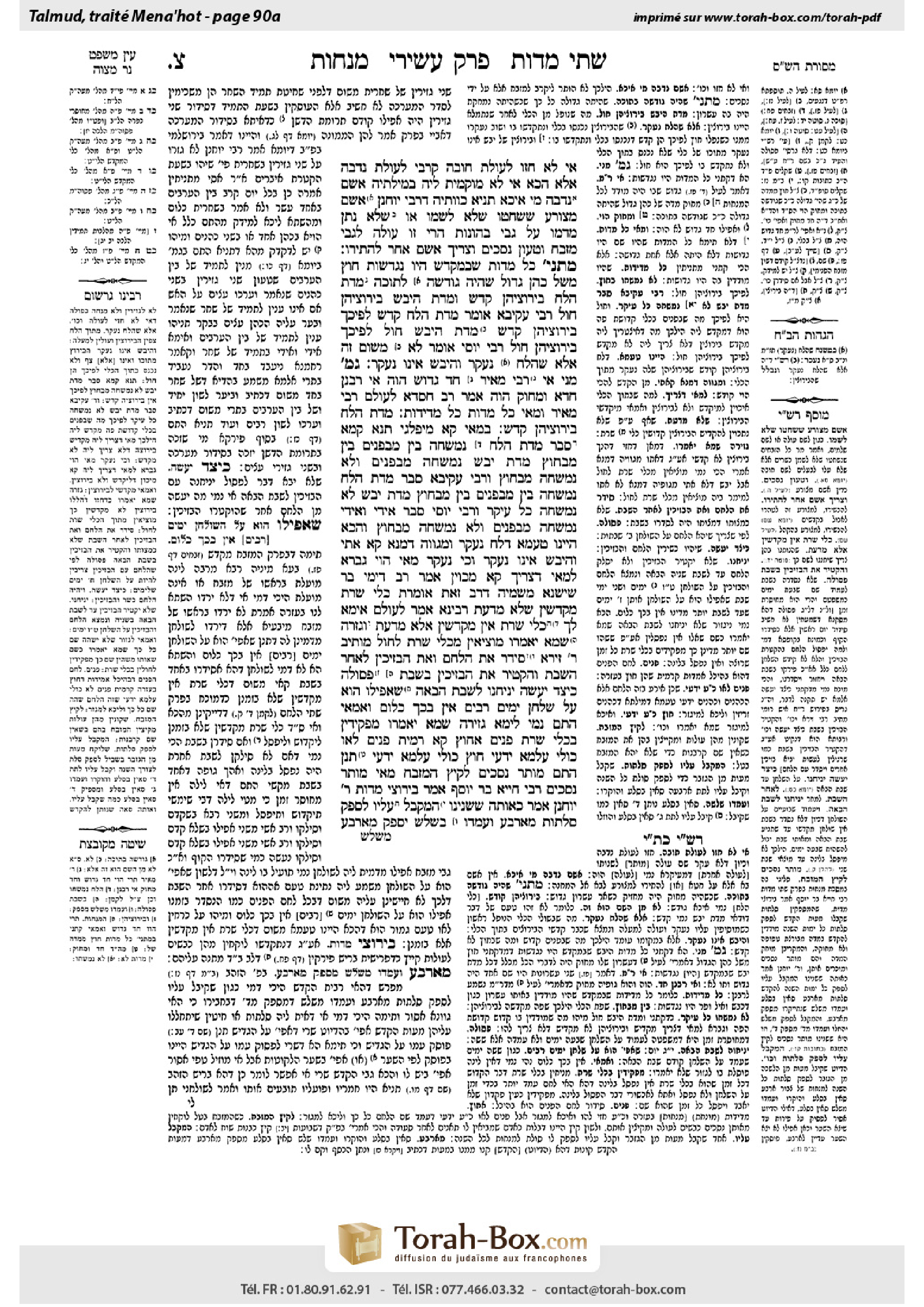
This page of Menachot includes the Aramaic text, an English translation and an AI-generated French translation, alongside the scan above.
מנחות צ׳ א · Aramaic and Hebrew text
אִי לָא חֲזוּ לְעוֹלַת חוֹבָה קׇרְבִי לְעוֹלַת נְדָבָה, אֶלָּא הָכָא, אִי לָא מוֹקְמֵית לֵיהּ בְּמִילְּתֵיהּ – אֲשַׁם נְדָבָה מִי אִיכָּא?
תַּנְיָא כְּוָותֵיהּ דְּרַבִּי יוֹחָנָן: אֲשַׁם מְצוֹרָע שֶׁשְּׁחָטוֹ שֶׁלֹּא לִשְׁמוֹ, אוֹ שֶׁלֹּא נָתַן מִדָּמוֹ עַל גַּבֵּי בְּהוֹנוֹת – הֲרֵי זוֹ עוֹלָה לְגַבֵּי מִזְבֵּחַ, וְטָעוּן נְסָכִים, וְצָרִיךְ אָשָׁם אַחֵר לְהַתִּירוֹ.
מַתְנִי׳ כׇּל מִדּוֹת שֶׁבַּמִּקְדָּשׁ הָיוּ נִגְדָּשׁוֹת, חוּץ מִשֶּׁל כֹּהֵן גָּדוֹל, שֶׁהָיָה גּוֹדְשָׁהּ לְתוֹכָהּ.
מִדֹּת הַלַּח, בֵּירוּצֵיהֶן קֹדֶשׁ; וּמִדֹּת הַיָּבֵשׁ, בֵּירוּצֵיהֶן חוֹל.
רַבִּי עֲקִיבָא אוֹמֵר: מִדֹּת הַלַּח קֹדֶשׁ, לְפִיכָךְ בֵּירוּצֵיהֶן קֹדֶשׁ. מִדֹּת הַיָּבֵשׁ חוֹל, לְפִיכָךְ בֵּירוּצֵיהֶן חוֹל. רַבִּי יוֹסֵי אוֹמֵר: לֹא מִשּׁוּם זֶה, אֶלָּא שֶׁהַלַּח נֶעֱקָר וְהַיָּבֵשׁ אֵינוֹ נֶעֱקָר.
גְּמָ׳ מַנִּי? אִי רַבִּי מֵאִיר – חַד גָּדוּשׁ הֲוָה, אִי רַבָּנַן – חַד מָחוּק הֲוָה.
אָמַר רַב חִסְדָּא: לְעוֹלָם רַבִּי מֵאִיר, וּמַאי ״כׇּל מִדּוֹת״? כָּל מְדִידוֹת.
מִדֹּת הַלַּח בֵּירוּצֵיהֶן קֹדֶשׁ, בְּמַאי קָא מִיפַּלְגִי?
תַּנָּא קַמָּא סָבַר: מִדַּת הַלַּח נִמְשְׁחָה, בֵּין מִבִּפְנִים בֵּין מִבַּחוּץ; מִדַּת יָבֵשׁ נִמְשְׁחָה מִבִּפְנִים, וְלֹא נִמְשְׁחָה מִבַּחוּץ.
וְרַבִּי עֲקִיבָא סָבַר: מִדַּת הַלַּח נִמְשְׁחָה בֵּין מִבִּפְנִים בֵּין מִבַּחוּץ, מִדַּת יָבֵשׁ לֹא נִמְשְׁחָה כׇּל עִיקָּר.
וְרַבִּי יוֹסֵי סָבַר: אִידֵּי וְאִידֵּי נִמְשְׁחָה מִבִּפְנִים וְלֹא נִמְשְׁחָה מִבַּחוּץ, וְהָכָא הַיְינוּ טַעְמָא – דְּלַח נֶעֱקָר וּמִגַּוֵּוהּ דְּמָנָא קָא אָתֵי, וְהַיָּבֵשׁ אֵינוֹ נֶעֱקָר.
וְכִי נֶעֱקָר מַאי הָוֵי? גַּבְרָא לְמַאי דִּצְרִיךְ קָא מְכַוֵּין.
אָמַר רַב דִּימִי בַּר שִׁישְׁנָא מִשְּׁמֵיהּ דְּרַב, זֹאת אוֹמֶרֶת, כְּלֵי שָׁרֵת מְקַדְּשִׁין שֶׁלֹּא מִדַּעַת. רָבִינָא אָמַר: לְעוֹלָם אֵימָא לָךְ, כְּלֵי שָׁרֵת אֵין מְקַדְּשִׁין אֶלָּא מִדַּעַת, וּגְזֵרָה שֶׁמָּא יֹאמְרוּ מוֹצִיאִין מִכְּלֵי שָׁרֵת לְחוֹל.
מוֹתֵיב רַבִּי זֵירָא: סִידֵּר אֶת הַלֶּחֶם וְאֶת הַבָּזִיכִין לְאַחַר הַשַּׁבָּת, וְהִקְטִיר אֶת הַבָּזִיכִין בַּשַּׁבָּת – פְּסוּלָה. כֵּיצַד יַעֲשֶׂה? יַנִּיחֶנּוּ לַשַּׁבָּת הַבָּאָה, שֶׁאֲפִילּוּ הוּא עַל שֻׁלְחָן יָמִים רַבִּים – אֵין בְּכָךְ כְּלוּם.
וְאַמַּאי? הָתָם נָמֵי לֵימָא: גְּזֵירָה, שֶׁמָּא יֹאמְרוּ: מַפְקִידִין בִּכְלֵי שָׁרֵת!
פְּנִים אַחוּץ קָא רָמֵית?! פְּנִים – לָאו כּוּלֵּי עָלְמָא יָדְעִי, חוּץ – כּוּלֵּי עָלְמָא יָדְעִי.
תְּנַן הָתָם: מוֹתַר נְסָכִים לְקֵיץ הַמִּזְבֵּחַ.
מַאי ״מוֹתַר נְסָכִים״?
רַבִּי חִיָּיא בַּר יוֹסֵף אָמַר: בֵּירוּצֵי מִדּוֹת. רַבִּי יוֹחָנָן אָמַר: כְּאוֹתָהּ שֶׁשָּׁנִינוּ: הַמְקַבֵּל עָלָיו לְסַפֵּק סְלָתוֹת מֵאַרְבַּע וְעָמְדוּ בְּשָׁלֹשׁ – יְסַפֵּק מֵאַרְבַּע,
Menachot 90a · English translation
therefore, even if they are no longer fit to be sacrificed as obligatory burnt offerings, for which they were originally consecrated, having now been slaughtered not for their own sake they can still be sacrificed as voluntary burnt offerings, without the need to fulfill the additional conditions that originally applied to them. But here, with regard to the guilt offering of a leper, if you do not maintain it in accordance with its original status and require it to be brought together with its libations, it can no longer be considered a guilt offering at all, as is there a voluntary guilt offering?
The Gemara notes that it is taught in a baraita in accordance with the opinion of Rabbi Yoḥanan: In the case of a guilt offering of a leper that one slaughtered not for its own sake, or in a case where one did not place some of its blood upon the leper’s right thumb and big toe, this guilt offering is still brought up upon the altar and requires libations, i.e., a meal offering and wine-libation; but since it was sacrificed incorrectly, the leper needs to bring another guilt offering to permit him to partake of offerings.
MISHNA: All measuring vessels that were in the Temple were such that they held the volume that they measured when their contents were heaped above the rim, except for the measuring vessel used to measure the flour for the griddle-cake offering of the High Priest, as its heaped measure, i.e., the quantity of flour held by a tenth of an ephah measuring vessel when heaped, was contained within its walls when the flour was leveled with the rim. This was due to the fact that the measuring vessel for the griddle-cake offering was slightly larger than the tenth of an ephah measuring vessel.
With regard to measuring vessels for liquids, their overflows, i.e., that which flows onto the outside of vessel’s walls, are sacred, but with regard to measuring vessels for dry substances, their overflows are non-sacred.
Rabbi Akiva says that the reason for this difference is that since the measuring vessels for liquids are themselves sacred, therefore their overflows are sacred, and since the measuring vessels for dry substances are non-sacred, therefore their overflows are non-sacred. Rabbi Yosei says: The difference is not due to that factor. Rather, it is because the overflow of liquid was originally inside the vessel, where it became consecrated, and was then displaced, whereas the overflow of a dry substance was not displaced from inside the vessel, so it had not become consecrated.
GEMARA: The mishna and Gemara on 87a cite a dispute between the Rabbis and Rabbi Meir concerning the number and nature of the measuring vessels used for dry substances. In light of that dispute, the Gemara asks: In accordance with whose opinion is the mishna here? If you suggest it is in accordance with the opinion of Rabbi Meir, that is difficult: He holds that there were two measuring vessels that held a tenth of an ephah, but only one of them was such that it held its measure when heaped; the other one held its measure when leveled. And if you suggest it is in accordance with the opinion of the Rabbis, that is difficult: They hold there was only one measuring vessel that held a tenth of an ephah, and it held its measure when leveled. How can the mishna state that all measuring vessels in the Temple were heaped?
Rav Ḥisda said: Actually, the mishna is in accordance with the opinion of Rabbi Meir that only one of two measuring vessels that held a tenth of an ephah was such that it held its measure when heaped. And what does the mishna mean when it states: All measuring vessels [kol middot] in the Temple were heaped? It means that that all measurements [kol medidot] performed with that measuring vessel were done when its contents were heaped above its rim.
§ The mishna discusses the status of overflows: The first tanna states simply that with regard to measuring vessels for liquids, their overflows are sacred, but with regard to measuring vessels for dry substances, their overflows are non-sacred. Rabbi Akiva explains that this distinction is a function of whether the measuring vessel is itself sacred. Rabbi Yosei explains it is function of whether the overflow had initially been inside the vessel. The Gemara asks: With regard to what matter do these three tanna’im disagree?
The Gemara explains: The first tanna holds that the measuring vessels for liquid items, e.g., wine for libations and oil, were anointed and thereby consecrated both on the inside and on the outside. Therefore, the overflow is consecrated as it comes in contact with the outside of the vessel’s walls. The measuring vessels for dry items, such as the flour for meal offerings, were anointed and consecrated only on the inside, but were not anointed on the outside. Therefore, the overflow is not consecrated when it comes into contact with the outside of the vessel’s walls.
And Rabbi Akiva, who states the difference is due to whether the vessel is sacred or non-sacred, holds that the measuring vessels for liquid items were anointed on the inside and were not anointed on the outside, whereas the measuring vessels for dry items were not anointed at all, and they remained non-sacred and so could not consecrate the overflow.
And Rabbi Yosei holds that this and that, i.e., both types of measuring vessels, were anointed only on the inside but were not anointed on the outside, and so here, this is the reason behind whether the overflow was sacred: As the overflow of liquid was originally inside the vessel and was then displaced, and it comes from the inside of the vessel, it is therefore consecrated. But the overflow of a dry substance was not originally inside the vessel and then displaced, and so it is never consecrated.
The Gemara questions this explanation of Rabbi Yosei’s opinion: But even if the overflow was previously inside the vessel and then displaced, what of it? A person intends to consecrate only that which he requires, and so even if the overflow had been inside the vessel it would not have been consecrated.
Rav Dimi bar Shishna said in the name of Rav: That is to say that service vessels consecrate their contents even without the intent of the person using them. Ravina said: Actually, I will say to you that service vessels consecrate their contents only with the intent of the person using them, and by Torah law the overflows are not sacred. But the Sages issued a decree to regard them as sacred, lest people say that one may transfer a substance that has been consecrated in a service vessel to non-sacred status.
Rabbi Zeira raised an objection to this explanation from a mishna (100a): Each Shabbat, new shewbread and bowls of frankincense were arranged on the Table in the Sanctuary. They remained there until the following Shabbat, at which point the frankincense was burned, thereby permitting the shewbread to be eaten. If the priest arranged the bread and the bowls of frankincense on the Table after Shabbat, during the week, and then he burned the frankincense in the bowls on the Shabbat at the end of that week, the bread is disqualified, as it had not been on the Table for a full seven days from one Shabbat to the next. How then should one proceed to prevent the disqualification? He should leave the bread on the Table until the following Shabbat, as even if it remained on the Table for many days, there is nothing wrong with that, provided that it is there for at least seven days. The frankincense may then be burned and it will permit the bread to be eaten.
Rabbi Zeira explains his objection: But why is it permitted to leave the bread on the Table for more than seven days? There too, let us say that the Sages issued a decree disqualifying the bread lest people say that one can store sacred items in a service vessel overnight and that will prevent them becoming disqualified. Evidently, the Sages did not issue such decrees, and it follows that also with regard to using the measuring vessels they did not issue a decree.
The Gemara rejects this claim: Are you raising a contradiction between a rite performed inside the Sanctuary, i.e., the arrangement of the shewbread, and a rite performed outside the Sanctuary, i.e., using the measuring vessels? Since in the case of a rite performed inside the Sanctuary not everyone is aware of what is happening, there is no concern that people will misinterpret what is going on and so there is no need to issue a decree concerning it. In the case of a rite performed outside the Sanctuary everyone is aware of what is happening, and there is a need to issue a decree to prevent people from drawing mistaken conclusions.
§ The Gemara continues to discuss the overflow of measures. We learned in a mishna there (Shekalim 10b): The surplus libations were sold and the proceeds used to purchase supplementary offerings of the altar [keitz hamizbe’aḥ].
The Gemara asks: What is the meaning of: Surplus libations?
Rabbi Ḥiyya bar Yosef says: It means the overflows of measuring vessels. Rabbi Yoḥanan says: Surplus libations are like that which we learned in another mishna (Shekalim 13a): In the case of one who accepts upon himself to supply fine flour at four se’a for a sela, and its market price stood at three se’a for a sela, he is required to fulfill his commitment and supply fine flour at four se’a for a sela.
Menachot 90a · Traduction française (IA)
Par conséquent, même s’ils ne sont plus aptes à être offerts comme holocaustes obligatoires, pour lesquels ils avaient été consacrés à l’origine, puisqu’ils ont maintenant été égorgés sans être destinés à leur usage propre, ils peuvent encore être offerts comme holocaustes volontaires, sans qu’il soit nécessaire de remplir les conditions supplémentaires qui s’appliquaient initialement à eux. Mais ici, concernant le sacrifice de culpabilité d’un lépreux, si tu ne le maintiens pas dans son statut d’origine et n’exiges pas qu’il soit apporté avec ses libations, il ne peut plus du tout être considéré comme un sacrifice de culpabilité. Existe-t-il donc un sacrifice de culpabilité volontaire ?
La Guemara relève qu’une baraïta enseigne conformément à l’opinion de Rabbi Yoḥanan : dans le cas du sacrifice de culpabilité d’un lépreux que l’on a égorgé sans le destiner à son usage propre, ou dans celui où l’on n’a pas appliqué une partie de son sang sur le pouce droit et le gros orteil droit du lépreux, ce sacrifice de culpabilité est néanmoins offert sur l’autel et requiert des libations, c’est-à-dire une offrande de farine et une libation de vin ; mais, puisqu’il a été offert de manière incorrecte, le lépreux doit apporter un autre sacrifice de culpabilité pour être autorisé à consommer des sacrifices.
Michna : Tous les récipients de mesure qui se trouvaient dans le Temple contenaient la quantité mesurée lorsque leur contenu formait un dôme au-dessus du bord, à l’exception du récipient servant à mesurer la farine destinée à l’offrande de galettes du Grand Prêtre : la quantité comble, c’est-à-dire la quantité de farine contenue dans un récipient d’un dixième d’épha lorsqu’il est rempli à ras bord, tenait dans ses parois lorsque la farine était arasée au niveau du bord. Cela s’expliquait par le fait que le récipient de mesure destiné à l’offrande de galettes était légèrement plus grand que le récipient d’un dixième d’épha.
Pour les récipients de mesure destinés aux liquides, les débordements, c’est-à-dire ce qui coule à l’extérieur des parois du récipient, sont sacrés ; en revanche, pour les récipients de mesure destinés aux matières sèches, les débordements ne sont pas sacrés.
Rabbi Akiva dit que cette différence s’explique par le fait que les récipients de mesure destinés aux liquides sont eux-mêmes sacrés et que leurs débordements sont donc sacrés, tandis que les récipients de mesure destinés aux matières sèches ne sont pas sacrés et que leurs débordements ne le sont donc pas. Rabbi Yosei dit : la différence ne tient pas à ce facteur. Elle s’explique plutôt par le fait que le liquide qui déborde se trouvait d’abord à l’intérieur du récipient, où il a été consacré, avant d’en être déplacé, tandis que le débordement d’une matière sèche n’a pas été déplacé de l’intérieur du récipient et n’avait donc pas été consacré.
Guemara : La Michna et la Guemara en 87a citent une controverse entre les Sages et Rabbi Meïr concernant le nombre et la nature des récipients de mesure utilisés pour les matières sèches. À la lumière de cette controverse, la Guemara demande : selon l’opinion de qui la Michna enseigne-t-elle ici ? Si tu suggères qu’elle est conforme à l’opinion de Rabbi Meïr, cela pose problème : il soutient qu’il y avait deux récipients d’un dixième d’épha, mais qu’un seul contenait sa mesure lorsqu’il était rempli à ras bord ; l’autre contenait sa mesure lorsqu’il était arasé. Et si tu suggères qu’elle est conforme à l’opinion des Sages, cela pose également problème : ils soutiennent qu’il n’y avait qu’un seul récipient d’un dixième d’épha, et qu’il contenait sa mesure lorsqu’il était arasé. Comment la Michna peut-elle donc affirmer que tous les récipients de mesure du Temple étaient remplis à ras bord ?
Rav Ḥisda dit : En réalité, la Michna est conforme à l’opinion de Rabbi Meïr, selon laquelle un seul des deux récipients d’un dixième d’épha contenait sa mesure lorsqu’il était rempli à ras bord. Et que signifie l’énoncé de la Michna : « Tous les récipients de mesure [kol middot] du Temple étaient remplis à ras bord » ? Il signifie que toutes les mesures [kol medidot] effectuées à l’aide de ce récipient de mesure étaient prises lorsque son contenu formait un dôme au-dessus du bord.
§ La Michna traite du statut des débordements : le premier tanna affirme simplement que les débordements des récipients de mesure destinés aux liquides sont sacrés, tandis que ceux des récipients destinés aux matières sèches ne le sont pas. Rabbi Akiva explique que cette distinction dépend du fait que le récipient de mesure lui-même soit ou non sacré. Rabbi Yosei explique qu’elle dépend du fait que le débordement se soit ou non trouvé initialement à l’intérieur du récipient. La Guemara demande : sur quel point ces trois tannaïm sont-ils en désaccord ?
La Guemara explique : le premier tanna soutient que les récipients de mesure destinés aux liquides, par exemple le vin des libations et l’huile, étaient oints et consacrés à la fois à l’intérieur et à l’extérieur. Le débordement était donc consacré lorsqu’il entrait en contact avec l’extérieur des parois du récipient. Les récipients de mesure destinés aux matières sèches, comme la farine des offrandes de farine, étaient oints et consacrés uniquement à l’intérieur, mais n’étaient pas oints à l’extérieur. Le débordement n’était donc pas consacré lorsqu’il entrait en contact avec l’extérieur des parois du récipient.
Rabbi Akiva, qui affirme que la différence tient au fait que le récipient soit sacré ou non, soutient que les récipients de mesure destinés aux liquides étaient oints à l’intérieur, mais pas à l’extérieur, tandis que ceux destinés aux matières sèches n’étaient pas oints du tout. Ils restaient profanes et ne pouvaient donc pas consacrer le débordement.
Rabbi Yosei soutient que les deux types de récipients de mesure étaient oints uniquement à l’intérieur, et pas à l’extérieur. Voici donc pourquoi le débordement est ou non sacré : le débordement d’un liquide se trouvait initialement à l’intérieur du récipient, puis en a été déplacé ; puisqu’il provient de l’intérieur du récipient, il est consacré. En revanche, le débordement d’une matière sèche ne se trouvait pas initialement à l’intérieur du récipient avant d’en être déplacé ; il n’est donc jamais consacré.
La Guemara conteste cette explication de l’opinion de Rabbi Yosei : mais même si le débordement s’est trouvé auparavant à l’intérieur du récipient avant d’en être déplacé, qu’importe ? Une personne n’a l’intention de consacrer que ce dont elle a besoin ; par conséquent, même si le débordement s’était trouvé à l’intérieur du récipient, il n’aurait pas été consacré.
Rav Dimi bar Shishna dit au nom de Rav : cela enseigne que les ustensiles de service consacrent leur contenu même sans que la personne qui les utilise en ait l’intention. Ravina dit : En réalité, je vais te dire que les ustensiles de service ne consacrent leur contenu qu’avec l’intention de la personne qui les utilise, et que, selon la Torah, les débordements ne sont pas sacrés. Mais les Sages ont décrété qu’on devait les considérer comme sacrés, de peur que les gens ne disent qu’on peut rendre profane une substance consacrée dans un ustensile de service.
Rabbi Zeira soulève une objection à cette explication à partir d’une Michna (100a) : chaque Chabbat, on disposait le nouveau pain de proposition et les bols d’encens sur la Table du Sanctuaire. Ils y demeuraient jusqu’au Chabbat suivant ; alors, l’encens était brûlé, ce qui permettait de consommer le pain de proposition. Si le prêtre disposait le pain et les bols d’encens sur la Table après le Chabbat, en semaine, puis brûlait l’encens dans les bols le Chabbat à la fin de cette semaine, le pain était invalidé, puisqu’il n’était pas resté sur la Table pendant sept jours entiers, d’un Chabbat à l’autre. Comment fallait-il donc procéder pour éviter cette invalidation ? Il fallait laisser le pain sur la Table jusqu’au Chabbat suivant ; même s’il y restait de nombreux jours, cela ne posait aucun problème, pourvu qu’il y demeure au moins sept jours. L’encens pouvait alors être brûlé et permettait de consommer le pain.
Rabbi Zeira explique son objection : mais pourquoi est-il permis de laisser le pain sur la Table plus de sept jours ? Là aussi, disons que les Sages ont décrété que le pain était invalide, de peur que les gens ne disent qu’on peut conserver des objets sacrés dans un ustensile de service pendant la nuit et ainsi éviter qu’ils soient invalidés. Il ressort de là que les Sages n’ont pas émis de tels décrets ; il s’ensuit que, pour l’utilisation des récipients de mesure également, ils n’ont pas émis de décret.
La Guemara rejette cette affirmation : établis-tu une contradiction entre un rite accompli à l’intérieur du Sanctuaire, c’est-à-dire la disposition du pain de proposition, et un rite accompli à l’extérieur du Sanctuaire, c’est-à-dire l’utilisation des récipients de mesure ? Dans le cas d’un rite accompli à l’intérieur du Sanctuaire, puisque tout le monde ne sait pas ce qui s’y passe, on ne craint pas que les gens interprètent mal la situation ; il n’est donc pas nécessaire d’émettre un décret à ce sujet. En revanche, dans le cas d’un rite accompli à l’extérieur du Sanctuaire, tout le monde sait ce qui se passe ; il est donc nécessaire d’émettre un décret pour empêcher les gens d’en tirer des conclusions erronées.
§ La Guemara poursuit sa discussion sur les débordements des mesures. Nous avons appris dans une Michna là-bas (Shekalim 10b) : les libations excédentaires étaient vendues, et le produit de la vente servait à acheter des offrandes supplémentaires pour l’autel [keitz hamizbe’aḥ].
La Guemara demande : que signifie l’expression « libations excédentaires » ?
Rabbi Ḥiyya bar Yosef dit : cela désigne les débordements des récipients de mesure. Rabbi Yoḥanan dit : les libations excédentaires désignent ce que nous avons appris dans une autre Michna (Shekalim 13a) : celui qui s’engage à fournir de la farine fine à raison de quatre séas pour un sela, alors que le prix du marché est de trois séas pour un sela, est tenu de respecter son engagement et de fournir la farine fine à raison de quatre séas pour un sela.
Traduction française générée par IA à partir de l’édition anglaise de Sefaria. Vérifie toujours un passage avec le texte source.
Text from Sefaria: William Davidson Edition - Vocalized Aramaic (unknown); William Davidson Edition - English (CC BY NC).