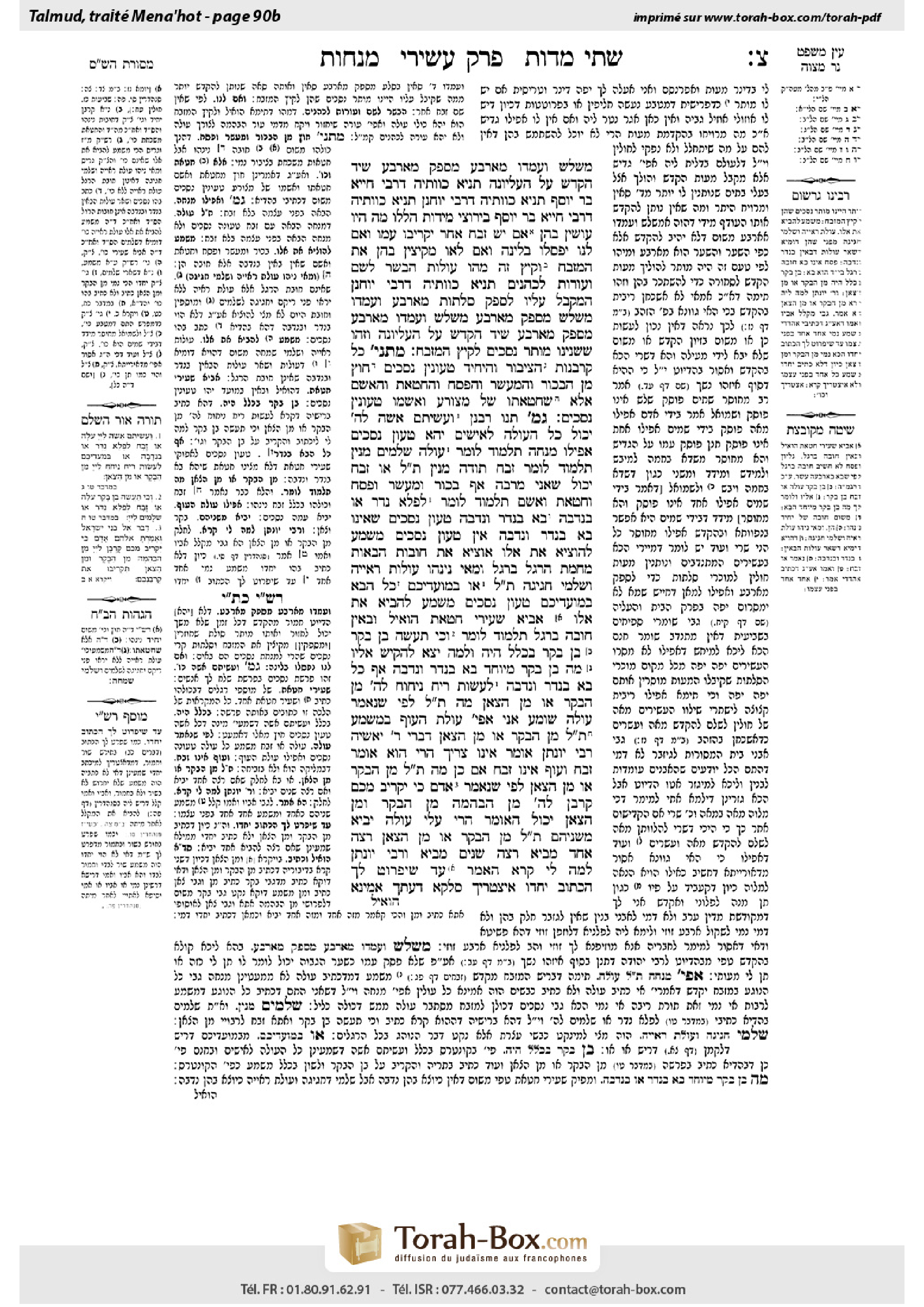
Menachot 90b: Talmud study for Daf Yomi
Daf Yomi is the daily study of one Talmud folio. Explore 37 tractates with scans, Hebrew text, Sefaria English and AI-generated French translations where annotated.
Passage selection and English or AI-generated French translation are available where the scan has annotations. Daf Study is independent of Torah-Box and Sefaria.
Browse Menachot · מנחות · All tractatesMenachot 90b text and translations
This page of Menachot includes the Aramaic text, an English translation and an AI-generated French translation, alongside the scan above.
מנחות צ׳ ב · Aramaic and Hebrew text
מִשָּׁלֹשׁ וְעָמְדוּ מֵאַרְבַּע – מְסַפֵּק מֵאַרְבַּע, שֶׁיַּד הֶקְדֵּשׁ עַל הָעֶלְיוֹנָה.
תַּנְיָא כְּוָותֵיהּ דְּרַבִּי חִיָּיא בַּר יוֹסֵף, תַּנְיָא כְּוָותֵיהּ דְּרַבִּי יוֹחָנָן.
תַּנְיָא כְּוָותֵיהּ דְּרַבִּי חִיָּיא בַּר יוֹסֵף: בֵּירוּצֵי מִידּוֹת הַלָּלוּ מָה הָיוּ עוֹשִׂין בָּהֶן? אִם יֵשׁ זֶבַח אַחֵר – יַקְרִיבוּ עִמּוֹ, וְאִם לָנוּ – יִפָּסְלוּ בְּלִינָה, וְאִם לָאו – מְקַיְּצִין בָּהֶן אֶת הַמִּזְבֵּחַ, וְקַיִץ זֶה מַהוּ? עוֹלוֹת – הַבָּשָׂר לַשֵּׁם, וְעוֹרוֹת לַכֹּהֲנִים.
תַּנְיָא כְּוָותֵיהּ דְּרַבִּי יוֹחָנָן: הַמְקַבֵּל עָלָיו לְסַפֵּק סְלָתוֹת מֵאַרְבַּע, וְעָמְדוּ מִשָּׁלֹשׁ – מְסַפֵּק מֵאַרְבַּע. מִשָּׁלֹשׁ וְעָמְדוּ מֵאַרְבַּע – מְסַפֵּק מֵאַרְבַּע, שֶׁיַּד הֶקְדֵּשׁ עַל הָעֶלְיוֹנָה. וְזֶהוּ שֶׁשָּׁנִינוּ: מוֹתַר נְסָכִים לְקֵיץ הַמִּזְבֵּחַ.
מַתְנִי׳ כׇּל קׇרְבְּנוֹת הַצִּיבּוּר וְהַיָּחִיד טְעוּנִין נְסָכִים, חוּץ מִן הַבְּכוֹר, וְהַמַּעֲשֵׂר, וְהַפֶּסַח, וְהַחַטָּאת, וְהָאָשָׁם. אֶלָּא שֶׁחַטָּאתוֹ שֶׁל מְצוֹרָע וַאֲשָׁמוֹ טְעוּנִין נְסָכִים.
גְּמָ׳ תָּנוּ רַבָּנַן:
״וַעֲשִׂיתֶם אִשֶּׁה לַה׳״ – יָכוֹל כׇּל הָעוֹלֶה לָאִישִּׁים יְהֵא טָעוּן נְסָכִים, אֲפִילּוּ מִנְחָה? תַּלְמוּד לוֹמַר ״עֹלָה״. שְׁלָמִים מִנַּיִן? תַּלְמוּד לוֹמַר ״זֶבַח״. תּוֹדָה מִנַּיִן? תַּלְמוּד לוֹמַר ״אוֹ זֶבַח״.
יָכוֹל שֶׁאֲנִי מְרַבֶּה אַף בְּכוֹר, וּמַעֲשֵׂר, וָפֶסַח, וְחַטָּאת, וְאָשָׁם? תַּלְמוּד לוֹמַר ״לְפַלֵּא נֶדֶר אוֹ בִנְדָבָה״ – בָּא בְּנֶדֶר וּנְדָבָה טָעוּן נְסָכִים, שֶׁאֵינוֹ בָּא בְּנֶדֶר וּנְדָבָה אֵין טָעוּן נְסָכִים.
מַשְׁמַע לְהוֹצִיא אֶת אֵלּוּ, אוֹצִיא אֶת חוֹבוֹת הַבָּאוֹת מֵחֲמַת הָרֶגֶל בָּרֶגֶל, וּמַאי נִינְהוּ? עוֹלוֹת רְאִיָּיה וְשַׁלְמֵי חֲגִיגָה. תַּלְמוּד לוֹמַר ״אוֹ בְּמוֹעֲדֵיכֶם״ – כׇּל הַבָּא בְּמוֹעֲדֵיכֶם טָעוּן נְסָכִים.
מַשְׁמַע לְהָבִיא אֶת אֵלּוּ, אָבִיא שְׂעִירֵי חַטָּאת, הוֹאִיל וּבָאִין חוֹבָה בָּרֶגֶל? תַּלְמוּד לוֹמַר ״וְכִי תַעֲשֶׂה בֶן בָּקָר״.
בֶּן בָּקָר בַּכְּלָל הָיָה, וְלָמָּה יָצָא? לְהַקִּישׁ אֵלָיו: מָה בֶּן בָּקָר מְיוּחָד בָּא בְּנֶדֶר וּנְדָבָה, אַף כֹּל בָּא בְּנֶדֶר וּנְדָבָה.
״לַעֲשׂוֹת רֵיחַ נִיחֹחַ לַה׳ מִן הַבָּקָר אוֹ מִן הַצֹּאן״, מָה תַּלְמוּד לוֹמַר? לְפִי שֶׁנֶּאֱמַר ״עֹלָה״, שׁוֹמֵעַ אֲנִי אֲפִילּוּ עוֹלַת הָעוֹף בְּמַשְׁמַע, תַּלְמוּד לוֹמַר ״מִן הַבָּקָר אוֹ מִן הַצֹּאן״, דִּבְרֵי רַבִּי יֹאשִׁיָּה.
רַבִּי יוֹנָתָן אוֹמֵר: אֵינוֹ צָרִיךְ, הֲרֵי הוּא אוֹמֵר ״זֶבַח״, וְעוֹף אֵינוֹ זֶבַח. אִם כֵּן, מָה תַּלְמוּד לוֹמַר ״מִן הַבָּקָר אוֹ מִן הַצֹּאן״? לְפִי שֶׁנֶּאֱמַר ״אָדָם כִּי יַקְרִיב מִכֶּם קׇרְבָּן לַה׳ מִן הַבְּהֵמָה מִן הַבָּקָר וּמִן הַצֹּאן״, יָכוֹל הָאוֹמֵר ״הֲרֵי עָלַי עוֹלָה״ יָבִיא מִשְּׁנֵיהֶם? תַּלְמוּד לוֹמַר ״מִן הַבָּקָר אוֹ מִן הַצֹּאן״ – רָצָה אֶחָד מֵבִיא, רָצָה שְׁנַיִם מֵבִיא.
וְרַבִּי יוֹנָתָן, לְמָה לִי קְרָא? הָאָמַר: עַד שֶׁיִּפְרוֹט לְךָ הַכָּתוּב ״יַחְדָּו״!
אִיצְטְרִיךְ, סָלְקָא דַּעְתָּךְ אָמֵינָא:
Menachot 90b · English translation
If one committed to supply fine flour at three se’a for a sela, and its market price decreased until it stood at four se’a for a sela, he must supply fine flour at four se’a for a sela. The reason for this halakha is that the Temple treasury is at an advantage. In the latter case, the merchant ends up providing the Temple with a greater quantity of flour than had initially been intended. Consequently, the Temple has more flour than it requires. The extra amount is referred to as surplus libations, and it is sold in order to purchase supplementary offerings.
The Gemara comments: It is taught in a baraita in accordance with the opinion of Rabbi Ḥiyya bar Yosef, and it is taught in another baraita in accordance with the opinion of Rabbi Yoḥanan.
The Gemara elaborates: It is taught in a baraita in accordance with the opinion of Rabbi Ḥiyya bar Yosef: These overflows of measuring vessels, what would be done with them? They are gathered, and if there is another offering to be sacrificed that day, the priests sacrifice this liquid with it as part of its libations. And if there is no other offering that day, and instead the overflows were left overnight without being sacrificed, they are disqualified by being left overnight. And if the overflows were not sacrificed with another offering and were not disqualified by being left overnight, they are sold, and the proceeds from their sale are used to purchase animals to supplement the offerings of the altar. And these supplementary offerings, what form do they take? They are burnt offerings; their flesh is entirely burned on the altar to God, and the hides are given to the priests.
It is taught in a baraita in accordance with the opinion of Rabbi Yoḥanan: In the case of one who accepts upon himself to supply fine flour at four se’a for a sela, and its market price stood at three se’a for a sela, he is required to fulfill his commitment and supply fine flour at four se’a for a sela. If one committed to supply fine flour at three se’a for a sela, and its market price decreased until it stood at four se’a for a sela, he must supply fine flour at four se’a for a sela. The reason for this halakha is that the Temple treasury is at an advantage. And it is to this later case that we referred when we learned in the mishna: The surplus libations were sold and the proceeds used to purchase supplementary offerings of the altar.
MISHNA: All offerings, whether communal or individual, require libations, i.e., a meal offering and a wine libation, except for the firstborn offering, the animal tithe offering, the Paschal offering, the sin offering, and the guilt offering, with which libations are not brought. But the exception to this exception is that the sin offering of a leper and his guilt offering do require libations.
GEMARA: The Sages taught a baraita that derives each of the rulings of the mishna from the verses that state the requirement to accompany animal offerings with the sacrifice of libations. The Torah states: “And you will make a fire offering to the Lord, a burnt offering, or a sacrifice, in fulfillment of a vow clearly uttered, or as a gift, or on your Festivals, to make a pleasing aroma to the Lord, of the herd or of the flock. And he who brings his offering to the Lord shall sacrifice a meal offering of a tenth of an ephah of fine flour mixed with a quarter-hin of oil; and wine for a libation, a quarter-hin, you shall make it with the burnt offering or for the sacrifice, for the one lamb” (Numbers 15:2–5). The Torah then proceeds to detail the quantities of flour, oil, and wine for a ram and a bull.
The verse states: “And you will make a fire offering to the Lord.” Accordingly, one might have thought that any offering that is raised up on the altar as a fire offering shall require that libations be brought with it, even a meal offering. The verse then states: “A burnt offering,” which teaches that the requirement of libations applies only to animal burnt offerings, but not to meal offerings. If so, from where is it derived that a peace offering requires libations? The verse states: “A sacrifice.” From where is it derived that a thanks offering requires libations? The verse states: “Or a sacrifice.” The superfluous word “or” serves to include thanks offerings.
One might have thought that I should include even the firstborn offering, the animal tithe offering, the Paschal offering, the sin offering, and the guilt offering. To counter this, the verse states: “In fulfillment of a vow clearly uttered, or as a gift.” This teaches that an offering that comes in fulfillment of a vow or as a gift offering requires libations, whereas each of these offerings, which do not come in fulfillment of a vow or as a gift offering but only as obligatory offerings, do not require libations.
The baraita continues: It has been derived, then, that one should exclude these offerings from the requirement of libations, as they are obligatory. Perhaps then I will likewise exclude the obligatory offerings that come on account of the pilgrimage Festival, which are sacrificed on the pilgrimage Festival, and what are these? Burnt offerings of appearance in the Temple and Festival peace offerings, both of which are brought on the three pilgrimage Festivals. To counter this, the verse states: “Or on your Festivals,” which indicates that any offering that comes on your Festivals, even if it is obligatory, requires libations.
It has been derived, then, that one should include even these Festival offerings, despite the fact that they are obligatory. Perhaps then I will likewise include the goat sin offerings brought as part of the additional offerings on the Festivals, since they come as obligatory offerings on the pilgrimage Festival. To counter this, the verse states in the continuation of that passage: “And when you make a young bull as a burnt offering” (Numbers 15:8), and proceeds to state the requirement to bring libations with it.
Now, the requirement to bring libations with a young bull was already included in the general requirement to bring libations with any fire offering, as stated in the beginning of that passage; and why, then, was it singled out and mentioned explicitly? This is in order to equate all other offerings to it, teaching that the requirement of libations applies only to offerings similar to a young bull: Just as a young bull is distinct in that it can come in fulfillment of a vow or as a gift offering, so too, any offering that comes in fulfillment of a vow or as a gift offering requires libations.
The baraita continues: The verses at the beginning of the passage state: “To make a pleasing aroma to the Lord, of the herd or of the flock.” What is the meaning when the verse states this? Since in the previous verse it is stated: “A burnt offering,” I would derive that all types of burnt offerings require libations, and even a bird sacrificed as a burnt offering is indicated. Therefore, the verse states: “Of the herd or of the flock,” which limits the requirement to offerings of animals such as sheep or cattle, but not to bird offerings; this is the statement of Rabbi Yoshiya.
Rabbi Yonatan says: This verse is unnecessary, as the verse states: “A sacrifice,” and a bird offering is not referred to as a sacrifice. If so, what is the meaning when the verse states: “Of the herd or of the flock”? Since it is stated with regard to a burnt offering: “A person, when he sacrifices from you an offering to the Lord, of the animals: Of the herd and of the flock, you shall sacrifice your offering” (Leviticus 1:2), one might have thought that one who takes a vow by saying: It is incumbent upon me to bring a burnt offering, without specifying which type of animal he will bring, that he must bring animals of both of these two types, i.e., from the herd and the flock. To counter this, the verse states: “Of the herd or of the flock,” separating the two types with the word “or,” thereby indicating that if he wanted to bring one of them, he may bring just one, and if he wanted to bring two, he may bring two. This concludes the baraita.
The Gemara asks: And according to the opinion of Rabbi Yonatan, why do I need an independent verse to teach that one who takes a vow to bring a burnt offering does not have to bring both types? Didn’t Rabbi Yonatan himself say an exegetical principle that whenever the Torah mentions two details together with regard to a halakha, it is presumed that the halakha is fulfilled even when only one of the details is realized, unless the verse specifies that both details are required by writing the word: Together, in the verse? Accordingly, when the verse states: “Of the herd or of the flock,” the intention is that either one is sufficient, and there should be no need for an independent verse to teach this.
The Gemara answers: Despite his principle, an independent verse was necessary to teach this, as it might enter your mind to say:
Menachot 90b · Traduction française (IA)
Si quelqu’un s’est engagé à fournir de la farine fine à raison de trois séa pour un sela, et que le prix du marché baisse jusqu’à quatre séa pour un sela, il doit fournir de la farine fine à raison de quatre séa pour un sela. Cette halakha s’explique par le fait que le Trésor du Temple est avantagé. Dans ce cas, le marchand finit par fournir au Temple une quantité de farine supérieure à celle qui avait été prévue au départ. Le Temple dispose donc de plus de farine qu’il n’en a besoin. Ce surplus est appelé « surplus des libations » ; il est vendu afin d’acheter des offrandes supplémentaires.
La Guemara fait remarquer : une baraïta enseigne conformément à l’opinion de Rabbi Ḥiyya bar Yosef, et une autre baraïta enseigne conformément à l’opinion de Rabbi Yoḥanan.
La Guemara développe : une baraïta enseigne conformément à l’opinion de Rabbi Ḥiyya bar Yosef : que faisait-on des débordements des récipients de mesure ? On les recueillait et, s’il y avait un autre sacrifice à offrir ce jour-là, les prêtres offraient ce liquide avec lui, au titre de ses libations. S’il n’y avait pas d’autre sacrifice ce jour-là et que les débordements restaient toute la nuit sans être offerts, ils étaient disqualifiés pour avoir passé la nuit. Si les débordements n’étaient ni offerts avec un autre sacrifice ni disqualifiés pour avoir passé la nuit, on les vendait, et le produit de la vente servait à acheter des animaux afin de compléter les offrandes de l’autel. Et sous quelle forme se présentaient ces offrandes supplémentaires ? C’étaient des holocaustes : leur chair était entièrement brûlée sur l’autel pour Dieu, et leurs peaux étaient données aux prêtres.
Une baraïta enseigne conformément à l’opinion de Rabbi Yoḥanan : celui qui s’engage à fournir de la farine fine à raison de quatre séa pour un sela, alors que le prix du marché est de trois séa pour un sela, doit s’acquitter de son engagement et fournir de la farine fine à raison de quatre séa pour un sela. Si quelqu’un s’est engagé à fournir de la farine fine à raison de trois séa pour un sela, et que le prix du marché baisse jusqu’à quatre séa pour un sela, il doit fournir de la farine fine à raison de quatre séa pour un sela. Cette halakha s’explique par le fait que le Trésor du Temple est avantagé. C’est à ce dernier cas que nous faisions référence en apprenant dans la Michna que le surplus des libations était vendu et que le produit de la vente servait à acheter des offrandes supplémentaires pour l’autel.
MICHNA : Toutes les offrandes, qu’elles soient communautaires ou individuelles, requièrent des libations, c’est-à-dire une offrande de farine et une libation de vin, à l’exception de l’offrande du premier-né, de l’offrande de la dîme animale, de l’offrande pascale, du sacrifice expiatoire et du sacrifice de culpabilité, qui ne sont pas accompagnés de libations. Toutefois, l’exception à cette règle est le sacrifice expiatoire du lépreux et son sacrifice de culpabilité, qui requièrent des libations.
GUEMARA : Les Sages enseignèrent une baraïta qui déduit des versets chacune des règles de la Michna concernant l’obligation d’accompagner les offrandes animales de libations. La Torah dit : « Vous présenterez au Seigneur une offrande consumée par le feu, un holocauste ou un sacrifice, pour accomplir un vœu clairement formulé, ou comme offrande volontaire, ou lors de vos fêtes, afin d’être d’une agréable odeur pour le Seigneur, du gros ou du petit bétail. Celui qui apporte son offrande au Seigneur présentera une offrande de farine d’un dixième d’épha de fleur de farine mélangée à un quart de hin d’huile ; et pour la libation, un quart de hin de vin, vous l’offrirez avec l’holocauste ou le sacrifice, pour l’agneau » (Nombres 15, 2-5). La Torah détaille ensuite les quantités de farine, d’huile et de vin pour un bélier et un taureau.
Le verset dit : « Vous présenterez au Seigneur une offrande consumée par le feu. » On aurait donc pu penser que toute offrande portée sur l’autel comme offrande consumée par le feu devait être accompagnée de libations, même une offrande de farine. Le verset dit ensuite : « Un holocauste », ce qui enseigne que l’obligation d’apporter des libations ne concerne que les holocaustes d’animaux, et non les offrandes de farine. Si tel est le cas, d’où apprend-on qu’un sacrifice de paix requiert des libations ? Le verset dit : « Un sacrifice. » D’où apprend-on qu’un sacrifice d’action de grâce requiert des libations ? Le verset dit : « Ou un sacrifice. » Le mot superflu « ou » inclut les sacrifices d’action de grâce.
On aurait pu penser qu’il fallait également inclure l’offrande du premier-né, l’offrande de la dîme animale, l’offrande pascale, le sacrifice expiatoire et le sacrifice de culpabilité. Pour l’exclure, le verset dit : « Pour accomplir un vœu clairement formulé, ou comme offrande volontaire. » Cela enseigne qu’une offrande apportée pour accomplir un vœu ou comme offrande volontaire requiert des libations, tandis que chacune de ces offrandes, qui n’est apportée ni pour accomplir un vœu ni comme offrande volontaire, mais uniquement à titre obligatoire, ne requiert pas de libations.
La baraïta poursuit : il a donc été établi qu’il faut exclure ces offrandes de l’obligation d’apporter des libations, puisqu’elles sont obligatoires. Peut-être faudrait-il également exclure les offrandes obligatoires apportées à l’occasion de la fête de pèlerinage, qui sont offertes pendant cette fête. De quelles offrandes s’agit-il ? Des holocaustes de présentation au Temple et des sacrifices de paix de la fête, apportés tous deux lors des trois fêtes de pèlerinage. Pour l’écarter, le verset dit : « Ou lors de vos fêtes », ce qui indique que toute offrande apportée lors de vos fêtes, même si elle est obligatoire, requiert des libations.
Il a donc été établi qu’il faut inclure ces offrandes de fête, bien qu’elles soient obligatoires. Peut-être faudrait-il également inclure les sacrifices expiatoires de boucs apportés dans le cadre des offrandes supplémentaires des fêtes, puisqu’ils sont des offrandes obligatoires présentées lors de la fête de pèlerinage. Pour l’écarter, le verset dit plus loin dans ce passage : « Et lorsque tu offriras un jeune taureau en holocauste » (Nombres 15, 8), puis énonce l’obligation de l’accompagner de libations.
Or, l’obligation d’apporter des libations avec un jeune taureau était déjà incluse dans l’obligation générale d’apporter des libations avec toute offrande consumée par le feu, énoncée au début de ce passage. Pourquoi, dès lors, le jeune taureau a-t-il été mentionné à part ? C’est afin d’assimiler toutes les autres offrandes à son cas et d’enseigner que l’obligation d’apporter des libations ne concerne que les offrandes semblables à un jeune taureau : de même qu’un jeune taureau se distingue en ce qu’il peut être apporté pour accomplir un vœu ou comme offrande volontaire, de même toute offrande apportée pour accomplir un vœu ou comme offrande volontaire requiert des libations.
La baraïta poursuit : les versets au début du passage disent : « Afin d’être d’une agréable odeur pour le Seigneur, du gros ou du petit bétail. » Pourquoi le verset précise-t-il cela ? Puisque le verset précédent dit : « Un holocauste », j’aurais déduit que toutes les sortes d’holocaustes requièrent des libations, y compris un oiseau offert en holocauste. Le verset dit donc : « Du gros ou du petit bétail », ce qui limite l’obligation aux offrandes d’animaux tels que les ovins ou les bovins, mais non aux offrandes d’oiseaux. Telle est l’opinion de Rabbi Yoshiya.
Rabbi Yonatan dit : ce verset est inutile, puisque le verset dit : « Un sacrifice », et qu’une offrande d’oiseau n’est pas appelée un sacrifice. Que signifie donc la précision : « Du gros ou du petit bétail » ? Puisqu’il est dit au sujet d’un holocauste : « Si quelqu’un parmi vous apporte une offrande au Seigneur, vous apporterez votre offrande de parmi les animaux : du gros bétail ou du petit bétail » (Lévitique 1, 2), on aurait pu penser que celui qui fait le vœu d’apporter un holocauste en disant : « Je suis tenu d’apporter un holocauste », sans préciser quel type d’animal il apportera, doit apporter des animaux de ces deux types, c’est-à-dire du gros et du petit bétail. Pour l’exclure, le verset dit : « Du gros ou du petit bétail », séparant les deux types par le mot « ou » et indiquant ainsi que s’il veut en apporter un seul, il peut n’en apporter qu’un ; et s’il veut en apporter deux, il peut en apporter deux. La baraïta s’achève ici.
La Guemara demande : selon l’opinion de Rabbi Yonatan, pourquoi faut-il un verset distinct pour enseigner que celui qui fait le vœu d’apporter un holocauste n’est pas tenu d’apporter les deux types ? Rabbi Yonatan n’a-t-il pas lui-même énoncé un principe d’exégèse selon lequel, chaque fois que la Torah mentionne ensemble deux éléments au sujet d’une halakha, on considère que celle-ci est accomplie dès lors qu’un seul des éléments est réalisé, à moins que le verset ne précise que les deux sont requis en employant le mot « ensemble » ? Ainsi, lorsque le verset dit : « Du gros ou du petit bétail », il signifie que l’un ou l’autre suffit ; aucun verset distinct ne devrait donc être nécessaire pour l’enseigner.
La Guemara répond : malgré son principe, un verset distinct était nécessaire pour enseigner cela, car on aurait pu être tenté de dire :
Traduction française générée par IA à partir de l’édition anglaise de Sefaria. Vérifie toujours un passage avec le texte source.
Text from Sefaria: William Davidson Edition - Vocalized Aramaic (unknown); William Davidson Edition - English (CC BY NC).