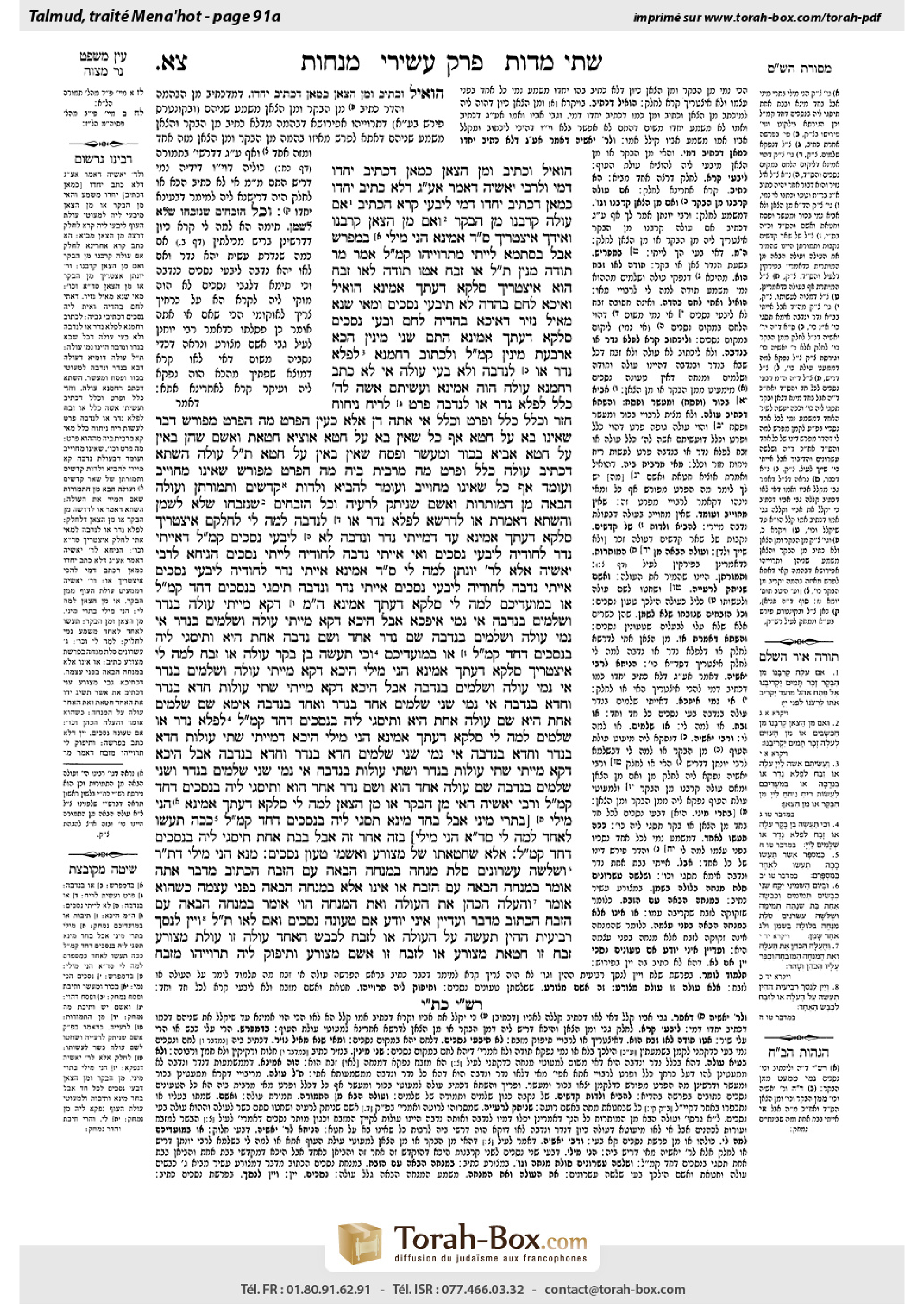
Menachot 91a: Talmud study for Daf Yomi
Daf Yomi is the daily study of one Talmud folio. Explore 37 tractates with scans, Hebrew text, Sefaria English and AI-generated French translations where annotated.
Passage selection and English or AI-generated French translation are available where the scan has annotations. Daf Study is independent of Torah-Box and Sefaria.
Browse Menachot · מנחות · All tractatesMenachot 91a text and translations
This page of Menachot includes the Aramaic text, an English translation and an AI-generated French translation, alongside the scan above.
מנחות צ״א א · Aramaic and Hebrew text
הוֹאִיל וּכְתִיב ״וּמִן הַצֹּאן״, כְּמַאן דִּכְתִיב ״יַחְדָּו״ דָּמֵי.
וּלְרַבִּי יֹאשִׁיָּה, דְּאָמַר: אַף עַל גַּב דְּלָא כְּתִיב ״יַחְדָּו״ כְּמַאן דִּכְתִיב ״יַחְדָּו״ דָּמֵי, לִיבְעֵי קְרָא!
הָכְתִיב: ״אִם עֹלָה קׇרְבָּנוֹ מִן הַבָּקָר״, ״וְאִם מִן הַצֹּאן קׇרְבָּנוֹ״.
וְאִידָּךְ, אִיצְטְרִיךְ – סָלְקָא דַּעְתָּךְ אָמֵינָא: הָנֵי מִילֵּי בִּמְפָרֵשׁ, אֲבָל בִּסְתָמָא – לַיְיתֵי מִתַּרְוַיְיהוּ! קָא מַשְׁמַע לַן.
אָמַר מָר: תּוֹדָה מִנַּיִן? תַּלְמוּד לוֹמַר ״אוֹ זֶבַח״. אַטּוּ תּוֹדָה לָאו זֶבַח הוּא? אִיצְטְרִיךְ, סָלְקָא דַּעְתָּךְ אָמֵינָא: הוֹאִיל וְאִיכָּא לֶחֶם בַּהֲדַהּ – לָא תִּיבְעֵי נְסָכִים.
וּמַאי שְׁנָא מֵאֵיל נָזִיר, דְּאִיכָּא בַּהֲדֵיהּ לֶחֶם, וּבָעֵי נְסָכִים?
סָלְקָא דַּעְתָּךְ אָמֵינָא: הָתָם שְׁנֵי מִינִין, הָכָא אַרְבַּעַת מִינִין – קָא מַשְׁמַע לַן.
וְלִכְתּוֹב רַחֲמָנָא ״לְפַלֵּא נֶדֶר אוֹ לִנְדָבָה״, וְלָא בָּעֵי ״עֹלָה״?
אִי לָא כְּתַב רַחֲמָנָא ״עֹלָה״, הֲוָה אָמֵינָא: ״וַעֲשִׂיתֶם אִשֶּׁה לַה׳״ – כְּלָל, ״לְפַלֵּא נֶדֶר אוֹ לִנְדָבָה״ – פְּרָט, ״לְרֵיחַ נִיחֹחַ״ – חָזַר וְכָלַל, כְּלָל וּפְרָט וּכְלָל, אִי אַתָּה דָן אֶלָּא כְּעֵין הַפְּרָט: מָה הַפְּרָט מְפוֹרָשׁ דָּבָר שֶׁאֵינוֹ בָּא עַל חֵטְא, אַף כֹּל שֶׁאֵין בָּא עַל חֵטְא.
אוֹצִיא חַטָּאת וְאָשָׁם, שֶׁהֵן בָּאִין עַל חֵטְא, אָבִיא בְּכוֹר וּמַעֲשֵׂר וָפֶסַח, שֶׁאֵין בָּאִין עַל חֵטְא – תַּלְמוּד לוֹמַר ״עֹלָה״.
הַשְׁתָּא דִּכְתִיב ״עֹלָה״, כְּלָל וּפְרָט, מָה מְרַבֵּית בֵּיהּ? מָה הַפְּרָט מְפוֹרָשׁ שֶׁאֵינוֹ מְחוּיָּיב וְעוֹמֵד, אַף כֹּל שֶׁאֵינוֹ מְחוּיָּיב וְעוֹמֵד.
לְהָבִיא וַלְדוֹת קֳדָשִׁים, וּתְמוּרָתָן, וְעוֹלָה הַבָּאָה מִן הַמּוֹתָרוֹת.
וְאָשָׁם שֶׁנִּיתַּק לִרְעִיָּה, וְכׇל הַזְּבָחִים שֶׁנִּזְבְּחוּ שֶׁלֹּא לִשְׁמָן.
וְהַשְׁתָּא דְּאָמְרַתְּ ״אוֹ״ לִדְרָשָׁא, לְפַלֵּא נֶדֶר אוֹ לִנְדָבָה, לְמָה לִי? לְחֶלְקָם. אִיצְטְרִיךְ, סָלְקָא דַּעְתָּךְ אָמֵינָא: עַד דְּמַיְיתֵי נֶדֶר וּנְדָבָה לָא לִיבְעֵי נְסָכִים, קָא מַשְׁמַע לַן דְּאַיְיתִי נֶדֶר לְחוֹדֵיהּ לִיבְעֵי נְסָכִים, וְאִי אַיְיתִי נְדָבָה לְחוֹדֵיהּ לַיְיתֵי נְסָכִים.
הָנִיחָא לְרַבִּי יֹאשִׁיָּה, אֶלָּא לְרַבִּי יוֹנָתָן לְמָה לִי? סָלְקָא דַּעְתָּךְ אָמֵינָא: אַיְיתִי נֶדֶר לְחוֹדֵיהּ – לִיבְעֵי נְסָכִים, אַיְיתִי נְדָבָה לְחוֹדֵיהּ – לִיבְעֵי נְסָכִים, אַיְיתִי נֶדֶר וּנְדָבָה – תִּיסְגֵּי בִּנְסָכִים דְּחַד, קָא מַשְׁמַע לַן.
״אוֹ בְּמוֹעֲדֵיכֶם״ לְמָה לִי? סָלְקָא דַּעְתָּךְ אָמֵינָא: הָנֵי מִילֵּי דְּקָא מַיְיתֵי עוֹלָה בְּנֶדֶר וּשְׁלָמִים בִּנְדָבָה, אִי נָמֵי אִיפְּכָא.
אֲבָל הֵיכָא דְּקָא מַיְיתֵי עוֹלָה וּשְׁלָמִים בְּנֶדֶר, אִי נָמֵי עוֹלָה וּשְׁלָמִים בִּנְדָבָה, שֵׁם נֶדֶר אֶחָד וְשֵׁם נְדָבָה אַחַת הִיא, וְתִיסְגֵּי לֵיהּ בִּנְסָכִים דְּחַד, קָא מַשְׁמַע לַן ״אוֹ בְּמוֹעֲדֵיכֶם״.
״וְכִי תַעֲשֶׂה בֶן בָּקָר עֹלָה אוֹ זָבַח״, לְמָה לִי? אִיצְטְרִיךְ, סָלְקָא דַּעְתָּךְ אָמֵינָא: הָנֵי מִילֵּי הֵיכָא דְּקָא מַיְיתֵי עוֹלָה וּשְׁלָמִים בְּנֶדֶר, אִי נָמֵי עוֹלָה וּשְׁלָמִים בִּנְדָבָה.
אֲבָל הֵיכָא דְּקָא מַיְיתֵי שְׁתֵּי עוֹלוֹת, חֲדָא בְּנֶדֶר וַחֲדָא בִּנְדָבָה, אִי נָמֵי שְׁנֵי שְׁלָמִים, אֶחָד בְּנֶדֶר וְאֶחָד בִּנְדָבָה, אֵימָא שֵׁם שְׁלָמִים אַחַת הִיא, שֵׁם עוֹלָה אַחַת הִיא, וְתִיסְגֵּי לֵיהּ בִּנְסָכִים דְּחַד, קָא מַשְׁמַע לַן.
״לְפַלֵּא נֶדֶר אוֹ שְׁלָמִים״, לְמָה לִי? סָלְקָא דַּעְתָּךְ אָמֵינָא: הָנֵי מִילֵּי הֵיכָא דְּמַיְיתֵי שְׁתֵּי עוֹלוֹת, חֲדָא בְּנֶדֶר וַחֲדָא בִּנְדָבָה, אִי נָמֵי שְׁנֵי שְׁלָמִים, חֲדָא בְּנֶדֶר וַחֲדָא בִּנְדָבָה.
אֲבָל הֵיכָא דְּקָא מַיְיתֵי שְׁתֵּי עוֹלוֹת בְּנֶדֶר, וּשְׁתֵּי עוֹלוֹת בִּנְדָבָה, אִי נָמֵי שָׁנֵי שְׁלָמִים בְּנֶדֶר וּשְׁנֵי שְׁלָמִים בִּנְדָבָה, שֵׁם עוֹלָה אֶחָד הוּא וְשֵׁם נֶדֶר אֶחָד הוּא, וְתִיסְגֵּי לֵיהּ בִּנְסָכִים דְּחַד, קָא מַשְׁמַע לַן.
וְרַבִּי יֹאשִׁיָּה, הַאי ״מִן הַבָּקָר אוֹ מִן הַצֹּאן״ לְמָה לִּי?
סָלְקָא דַּעְתָּךְ אָמֵינָא: הָנֵי מִילֵּי [בִּתְרֵי מִינֵי, אֲבָל בְּחַד מִינָא – תִּסְגֵּי לֵיהּ בִּנְסָכִים דְּחַד, קָא מַשְׁמַע לַן.
״כָּכָה תַּעֲשׂוּ לָאֶחָד״, לְמָה לִי? סָלְקָא דַּעְתָּךְ אָמֵינָא: הָנֵי מִילֵּי] בְּזֶה אַחַר זֶה, אֲבָל בְּבַת אַחַת – תִּיסְגֵּי לֵיהּ בִּנְסָכִים דְּחַד; קָא מַשְׁמַע לַן.
אֶלָּא שֶׁחַטָּאתוֹ שֶׁל מְצוֹרָע וַאֲשָׁמוֹ טָעוּן נְסָכִים, מְנָא הָנֵי מִילֵּי? דְּתָנוּ רַבָּנַן: ״וּשְׁלֹשָׁה עֶשְׂרוֹנִים סֹלֶת מִנְחָה״ – בְּמִנְחָה הַבָּאָה עִם הַזֶּבַח הַכָּתוּב מְדַבֵּר.
אַתָּה אוֹמֵר בְּמִנְחָה הַבָּאָה עִם הַזֶּבַח, אוֹ אֵינוֹ אֶלָּא בְּמִנְחָה הַבָּאָה בִּפְנֵי עַצְמָהּ? כְּשֶׁהוּא אוֹמֵר ״וְהֶעֱלָה הַכֹּהֵן אֶת הָעֹלָה וְאֶת הַמִּנְחָה״, הֱוֵי אוֹמֵר בְּמִנְחָה הַבָּאָה עִם הַזֶּבַח הַכָּתוּב מְדַבֵּר.
וַעֲדַיִין אֵינִי יוֹדֵעַ אִם טְעוּנָה נְסָכִים וְאִם לָאו, תַּלְמוּד לוֹמַר ״וְיַיִן לַנֶּסֶךְ רְבִיעִית הַהִין תַּעֲשֶׂה עַל הָעֹלָה אוֹ לַזָּבַח לַכֶּבֶשׂ הָאֶחָד״, ״עֹלָה״ – זוֹ עוֹלַת מְצוֹרָע, ״זָבַח״ – זוֹ חַטַּאת מְצוֹרָע, ״אוֹ לַזָּבַח״ – זוֹ אֲשַׁם מְצוֹרָע.
וְתִיפּוֹק לֵיהּ תַּרְוַיְיהוּ מִ״זָּבַח״,
Menachot 91a · English translation
Since in Leviticus 1:2 it is written: “And of the flock,” and not merely: Of the flock, it is as though the word: Together, was written in the verse. Therefore, the verse in Numbers 15, which does state: “Or of the flock,” is necessary to teach that this is not the case.
The Gemara asks: And according to the opinion of Rabbi Yoshiya, who said that even though it is not explicitly written in the verse: Together, it is as though it is written: Together, i.e., it is presumed that the halakha is fulfilled only when both details are realized, a verse should be required. Yet, in the baraita, Rabbi Yoshiya expounds the phrase “of the herd or of the flock” to teach a different halakha. From where, then, does he derive that one who takes a vow to bring a burnt offering does not need to bring both types of animals?
The Gemara explains: Isn’t it written: “If his offering is a burnt offering of the herd” (Leviticus 1:3), and then in a separate verse it states: “And if his offering is of the flock” (Leviticus 1:9)? The fact that these possibilities are presented in two disjointed verses is an explicit indication that the burnt offering can be brought from even just one of these animals. Therefore, even Rabbi Yoshiya concedes that there is no reason to presume a burnt offering must be brought from both types there.
The Gemara asks: And as for the other tanna, Rabbi Yonatan, why does he require a verse at all? The Gemara explains: It was necessary to have a verse to teach this, because otherwise it might enter your mind to say: These statements, i.e., the verses that indicate it is sufficient to bring just one type of animal, concern a case where one specifies in his vow that he intends to bring just one animal, and the verses indicate that it is valid to bring just one. But if one vowed without specification, one might say: Let him bring burnt offerings from both of them. Therefore the phrase “of the herd or of the flock” teaches us that even in that case, it is sufficient to bring just one type of animal.
§ The Gemara continues to analyze the baraita. The Master said in the baraita: From where is it derived that a peace offering requires libations? The verse states: “A sacrifice.” From where is it derived that a thanks offering requires libations? The verse states: “Or a sacrifice.” The superfluous word “or” includes thanks offerings. The Gemara asks: Is that to say that a thanks offering is not referred to as a sacrifice? It certainly is. Why, then, is it only included through the word “or”? The Gemara answers: An independent inclusion was necessary, as it might enter your mind to say: Since in any event there is bread brought together with the thanks offering, it should not require libations.
The Gemara raises a question concerning this explanation: But in what way is a thanks offering different from a nazirite’s ram, as there is bread brought together with it also, and yet it requires libations? The verse states with regard to the ram of a nazirite: “And one unblemished ram for a peace offering, and a basket of unleavened bread, cakes of fine flour mixed with oil, and unleavened wafers spread with oil, and their meal offering, and their libations” (Numbers 6:13–15).
The Gemara answers: It might enter your mind to say that one should differentiate between the thanks offering and a nazirite’s ram as there, together with the nazirite’s ram, he brings only two types of bread, i.e., loaves and wafers, whereas, here, together with the thanks offering, one brings four types of bread. Therefore, one might have concluded that since there are many types of loaves it does not require libations. For that reason it is necessary to have an independent derivation that teaches us that it does require libations.
The Gemara analyzes another one of the derivations of the baraita. The verse states: And you will make a fire offering to the Lord, a burnt offering, or a sacrifice, in fulfillment of a vow clearly uttered, or as a gift.” This teaches that an offering that comes in fulfillment of a vow or as a gift offering requires libations. The Gemara challenges: But if that is the halakha, then let the Merciful One write only: “In fulfillment of a vow clearly uttered, or as a gift,” and it would be unnecessary to write: “A burnt offering,” as a burnt offering is a type of offering that can be brought as a vow or gift offering.
The Gemara explains: Had the Merciful One not written “a burnt offering,” I would say that the verse should be expounded as follows: “And you will make a fire offering to the Lord” is a generalization, indicating that all offerings require libations. But then it states: “In fulfillment of a vow clearly uttered, or as a gift,” which is a detail, indicating that the requirement applies only to offerings brought in fulfillment of a vow or as a gift. But with “to make a pleasing aroma to the Lord” it then generalized. If so, this is a generalization, and a detail, and a generalization, and according to the principles of exegesis you may deduce that the verse is referring only to items similar to the detail: Just as the detail is explicit in referring to an offering that does not come to atone for a sin, but comes to fulfill a vow or as a gift, so too any offering that does not come to atone for a sin requires libations.
Accordingly, I would exclude a sin offering and a guilt offering from the requirement to have libations, as they come to atone for a sin, and I would include the firstborn offering, the animal tithe offering, and the Paschal offering, as they do not come to atone for a sin. In order to preclude the possibility of expounding the verses in this way, the verse states: “Burnt offering,” as an additional detail, which serves to further exclude offerings that are brought only in fulfillment of an obligation.
The Gemara asks: Now that it is written: “Burnt offering,” what do you include through the generalization and detail and generalization in this verse? The Gemara explains: Just as the detail of a burnt offering is explicit in referring to an offering that one had not always been obligated to bring, as it is referring to a burnt offering brought in fulfillment of a vow, which one became obligated to bring only once the vow was taken, so too, any offering that one had not always been obligated to bring requires libations.
This serves to include in the requirement for libations the offspring of consecrated animals, e.g., of a female peace offering; and substitutes of consecrated animals, i.e., a non-sacred animal with regard to which one stated that it should be a substitute for a consecrated animal, in which case the result is that both animals are consecrated and must be sacrificed; and a burnt offering that comes from the proceeds of having sold surpluses of items donated to the Temple that were not needed.
And this also serves to include a guilt offering whose owner either died or achieved atonement through sacrificing another animal and which was therefore consigned to grazing until it developed a blemish, at which point it should be sold and the proceeds used to purchase supplementary offerings for the altar. If instead, the guilt offering itself was sacrificed as a burnt offering, it is valid. In such a case, the offering requires libations. And this also serves to include all offerings that were slaughtered not for their own sake. Such offerings were brought to fulfill the owner’s obligation. Since they were not sacrificed for the sake of that purpose, the owner does not fulfill his obligation, but nevertheless the offerings are valid. In such a case, these offerings also require libations.
The Gemara asks: And now that you have said that the word “or” in the phrase “or a sacrifice” is necessary for the derivation that teaches that the thanks offering requires libations, I can similarly ask why do I need the word “or” in the phrase “in fulfillment of a vow clearly uttered or as a gift,” to separate between them? The Gemara explains: It was necessary to write “or” in that phrase, as it might enter your mind to say that until one brings both a vow offering and a gift offering together they do not require libations. The word “or” teaches us otherwise, that even if one brings a vow offering by itself it requires libations, and if one brings a gift offering by itself he must bring libations.
The Gemara challenges: This works out well according to the opinion of Rabbi Yoshiya, as he holds that whenever the Torah does not explicitly separate between two details stated with regard to a halakha, it is presumed that the halakha is fulfilled only when both details are realized. But according to the opinion of Rabbi Yonatan, who holds that in general it is presumed that either detail is sufficient, why do I need the word “or”? The Gemara explains: Were it not for this word, it might enter your mind to say that although the halakha is that if one brings a vow offering by itself it requires libations, and if one brings a gift offering by itself it requires libations, nevertheless, if one brings both a vow offering and a gift offering together, it would be sufficient to bring libations for just one of them. Therefore, the word “or” teaches us that libations are required for each offering.
The Gemara asks: Why do I need the word “or” in the phrase “or on your Festivals”? The Gemara answers: It was necessary, as it might enter your mind to say that this matter, that even when two offerings are brought together libations are required for each of them, applies only when they are distinct both in the type of offering and in the nature of the obligation to bring them, such as where one brings a burnt offering in fulfillment of a vow and a peace offering as a gift offering, or vice versa.
But where one brings a burnt offering and a peace offering both in fulfillment of a vow, or alternatively, a burnt offering and a peace offering both as gift offerings, one might have said that since in the former case both offerings are of a single type of commitment, i.e., a vow, and in the latter case both are of a single type of commitment, i.e., a gift offering, therefore it would be sufficient to bring libations for just one of them. Consequently, the word “or” in the phrase “or on your Festivals” teaches us that even if they are distinct only in the type of offering, libations are required for each offering.
The Gemara continues its analysis: Why do I need the word “or” in the verse: “And when you prepare a young bull for a burnt offering or for a sacrifice” (Numbers 15:9)? The Gemara explains: It was necessary, as it might enter your mind to say that this matter, that when two offerings are brought together libations are required for each of them, applies only when the two offerings are distinct in the type of offering, such as where one brings a burnt offering and a peace offering both in fulfillment of a vow, or alternatively, a burnt offering and a peace offering both as a gift offering.
But where one brings two burnt offerings, one in fulfillment of a vow and one as a gift offering, or alternatively, two peace offerings, one in fulfillment of a vow and one as a gift offering, I would say that since in the former case both offerings are of a single type of offering, i.e., a peace offering, and in the latter case both offerings are of a single type of offering, i.e., a burnt offering, therefore it would be sufficient to bring libations for just one of them. Consequently, the word “or” teaches us that even if they are distinct only in the nature of the commitment to bring them, libations are required for each offering.
The Gemara continues: Why do I need the word “or” in the verse: “In fulfillment of a vow clearly uttered or for peace offerings” (Numbers 15:8)? The Gemara answers: It was necessary, as it might enter your mind to say that this matter, that when two offerings are brought together libations are required for each of them, applies only where two offerings are distinct from each other either in the nature of the commitment to bring them or in the type of offering, such as where one brings two burnt offerings, one in fulfillment of a vow and one as a gift offering, or alternatively, two peace offerings, one in fulfillment of a vow and one as a gift offering.
But where one brings two burnt offerings, both in fulfillment of a vow, or two burnt offerings, both as a gift offering, or alternatively, two peace offerings, both in fulfillment of a vow, or two peace offerings, both as a gift offering, I might have said with regard to the first of these cases that since both offerings are of a single type of offering, i.e., a burnt offering, and of a single type of commitment, i.e., a vow, and likewise with regard to the other cases, therefore, it would be sufficient to bring libations for just one of them. Consequently, the word “or” teaches us that even if the offerings are not distinct from each other at all, libations are nevertheless required for each one.
The baraita teaches that according to Rabbi Yonatan, the word “or” in the phrase “of the herd or of the flock” teaches that one who takes a vow to bring a burnt offering fulfills his obligation even if he brings only one animal, either from the herd or from the flock. The Gemara asks: And as for Rabbi Yoshiya, why do I need the word “or” in this phrase “of the herd or of the flock”? Although the baraita explains that he expounds the phrase to teach that one does not bring libations with a bird offering, it does not explain what he derives from the word “or.”
The Gemara explains: The word “or” is necessary, as otherwise it might enter your mind to say that this matter, that when two offerings are brought together libations are required for each of them, applies only where one brings two kinds of animals, i.e., one from the flock and one from the herd; but where both animals are of a single kind, it would be sufficient for him to bring libations for just one of them. Therefore, the word “or” teaches us that even if the offerings are of the same kind of animal, libations are nevertheless required for each one.
Later in the passage concerning libations it states: “So shall be done for each young bull, or for each ram, or for each of the lambs, or of the goats. According to the number that you may prepare, so you shall do for each one according to their number” (Numbers 15:11–12). The Gemara asks: Why do I need this verse? The Gemara explains: It is necessary, as it might enter your mind to say that this matter, that when two offerings are brought together libations are required for each of them, applies only where the offerings were consecrated one after the other. But if they were consecrated at the same time, it would be sufficient for him to bring libations for just one of them. Therefore, the verse teaches us that in all cases, one must bring separate libations for each animal.
§ The mishna teaches that in general sin offerings and guilt offerings do not require libations. But the exception is that the sin offering of a leper and his guilt offering require libations. The Gemara asks: From where are these matters derived? They are derived from a verse, as the Sages taught in a baraita concerning the following verse, which details the offerings a leper is required to bring as part of his purification process: “And on the eighth day he shall take two unblemished male lambs, and one unblemished female lamb in its year, and three-tenths of fine flour for a meal offering, mixed with oil, and one log of oil” (Leviticus 14:10). The baraita explains: It is with regard to a meal offering that comes with an animal offering that the verse speaks, and so it is stating that each of the three offerings mentioned requires libations.
The baraita continues: Do you say that it is with regard to a meal offering that comes with an animal offering that the verse speaks? Or perhaps it is only with regard to a meal offering that comes by itself. When the verse states, in the continuation of that passage: “And the priest shall sacrifice the burnt offering and the meal offering” (Leviticus 14:20), which demonstrates that the meal offering accompanies the burnt offering, you must say that in the earlier verse as well it is with regard to a meal offering that comes with an animal offering that the verse speaks.
But still, I do not know whether this meal offering requires wine libations or whether it does not. Therefore, the verse states: “And wine for pouring a libation, a quarter-hin, you shall prepare with the burnt offering or for the sacrifice, for the one lamb” (Numbers 15:5). The verse is expounded as referring to each of the leper’s offerings: “The burnt offering”; this is referring to the burnt offering of a leper. “The sacrifice”; this is referring to the sin offering of a leper. And as for the word “or” in the phrase “or for the sacrifice,” this is referring to the guilt offering of a leper.
The Gemara suggests: And let the tanna derive both the sin offering and the guilt offering from the word “sacrifice” alone, without relating to the word “or.”
Menachot 91a · Traduction française (IA)
Puisqu’il est écrit dans Lévitique 1:2 : « Et du petit bétail », et non simplement « du petit bétail », c’est comme si le mot « ensemble » figurait dans le verset. Le verset de Nombres 15, qui dit bien « ou du petit bétail », est donc nécessaire pour enseigner qu’il n’en va pas ainsi.
La Guemara demande : Et selon l’opinion de Rabbi Yoshiya, qui soutient que même si le mot « ensemble » n’est pas explicitement écrit dans le verset, c’est comme s’il y figurait — c’est-à-dire qu’on présume que la halakha n’est satisfaite que si les deux conditions sont remplies —, un verset devrait être nécessaire. Pourtant, dans la baraïta, Rabbi Yoshiya interprète l’expression « du gros ou du petit bétail » pour enseigner une autre halakha. D’où déduit-il alors que celui qui fait vœu d’apporter un holocauste n’a pas besoin d’apporter les deux types d’animaux ?
La Guemara explique : N’est-il pas écrit : « Si son offrande est un holocauste du gros bétail » (Lévitique 1:3), puis, dans un verset distinct : « Et si son offrande est du petit bétail » (Lévitique 1:9) ? Le fait que ces possibilités soient présentées dans deux versets distincts indique explicitement qu’un holocauste peut être apporté avec un seul de ces types d’animaux. Par conséquent, même Rabbi Yoshiya reconnaît qu’il n’y a pas lieu de présumer qu’un holocauste doit provenir des deux types d’animaux.
La Guemara demande : Et pour l’autre tanna, Rabbi Yonatan, pourquoi faut-il un verset ? La Guemara explique : Un verset était nécessaire pour l’enseigner, car autrement on aurait pu penser que ces affirmations — c’est-à-dire les versets indiquant qu’il suffit d’apporter un seul type d’animal — concernent le cas où quelqu’un précise dans son vœu qu’il a l’intention de n’apporter qu’un seul animal, et que les versets indiquent que cela est valable. Mais si quelqu’un a fait un vœu sans précision, on aurait pu dire : qu’il apporte des holocaustes des deux types. L’expression « du gros ou du petit bétail » nous enseigne donc que même dans ce cas, il suffit d’apporter un seul type d’animal.
§ La Guemara poursuit l’analyse de la baraïta. Le Maître a dit dans la baraïta : D’où déduit-on qu’un sacrifice de paix exige des libations ? Le verset dit : « Un sacrifice ». D’où déduit-on qu’un sacrifice de reconnaissance exige des libations ? Le verset dit : « Ou un sacrifice ». Le mot « ou », superflu, inclut les sacrifices de reconnaissance. La Guemara demande : Cela signifie-t-il qu’un sacrifice de reconnaissance n’est pas appelé un sacrifice ? Il l’est assurément. Pourquoi, alors, ne l’inclut-on qu’au moyen du mot « ou » ? La Guemara répond : Une inclusion distincte était nécessaire, car on aurait pu penser : puisque, de toute façon, du pain est apporté avec le sacrifice de reconnaissance, celui-ci ne devrait pas exiger de libations.
La Guemara soulève une question au sujet de cette explication : En quoi un sacrifice de reconnaissance diffère-t-il du bélier du nazir, puisqu’on apporte également du pain avec celui-ci, et pourtant il exige des libations ? À propos du bélier du nazir, le verset dit : « Et un bélier sans défaut pour un sacrifice de paix, ainsi qu’une corbeille de pains sans levain, des gâteaux de fleur de farine pétris à l’huile et des galettes sans levain enduites d’huile, avec leur offrande de farine et leurs libations » (Nombres 6:13–15).
La Guemara répond : On aurait pu penser qu’il fallait distinguer le sacrifice de reconnaissance du bélier du nazir : avec le bélier du nazir, on n’apporte que deux sortes de pains, c’est-à-dire des miches et des galettes, tandis qu’avec le sacrifice de reconnaissance, on apporte quatre sortes de pains. On aurait donc pu conclure que, puisqu’il y a de nombreuses sortes de pains, celui-ci n’exige pas de libations. C’est pourquoi une déduction distincte est nécessaire pour nous enseigner qu’il exige bien des libations.
La Guemara analyse une autre déduction de la baraïta. Le verset dit : « Et vous ferez un sacrifice consumé par le feu pour l’Éternel, un holocauste ou un sacrifice, en accomplissement d’un vœu clairement formulé, ou comme offrande volontaire. » Cela enseigne qu’une offrande apportée en accomplissement d’un vœu ou comme offrande volontaire exige des libations. La Guemara objecte : Mais si telle est la halakha, que le Miséricordieux écrive seulement : « En accomplissement d’un vœu clairement formulé, ou comme offrande volontaire », et il serait inutile d’écrire « un holocauste », puisque l’holocauste est un type d’offrande qui peut être apporté en accomplissement d’un vœu ou comme offrande volontaire.
La Guemara explique : Si le Miséricordieux n’avait pas écrit « un holocauste », j’aurais dit qu’il faut interpréter le verset ainsi : « Et vous ferez un sacrifice consumé par le feu pour l’Éternel » est une généralité, indiquant que toutes les offrandes exigent des libations. Mais il est ensuite écrit : « En accomplissement d’un vœu clairement formulé, ou comme offrande volontaire », qui est un détail indiquant que l’exigence ne s’applique qu’aux offrandes apportées en accomplissement d’un vœu ou comme offrande volontaire. Puis, avec « pour produire une agréable odeur à l’Éternel », le texte revient à une généralité. Il s’agit donc d’une généralité, d’un détail, puis d’une généralité ; selon les règles d’exégèse, on peut en déduire que le verset ne concerne que les éléments semblables au détail : de même que le détail désigne explicitement une offrande qui n’est pas apportée pour expier une faute, mais pour accomplir un vœu ou comme offrande volontaire, de même toute offrande qui n’est pas apportée pour expier une faute exige des libations.
Par conséquent, j’exclurais de l’obligation d’apporter des libations le sacrifice expiatoire et le sacrifice de culpabilité, car ils sont apportés pour expier une faute, et j’inclurais l’offrande du premier-né, l’offrande de la dîme animale et l’offrande pascale, car elles ne sont pas apportées pour expier une faute. Afin d’écarter cette interprétation des versets, le texte dit : « Holocauste », comme un détail supplémentaire qui sert à exclure encore les offrandes apportées uniquement pour s’acquitter d’une obligation.
À présent que le texte dit « holocauste », qu’inclus-tu au moyen de la généralité, du détail et de la généralité dans ce verset ? La Guemara explique : De même que le détail d’un holocauste désigne explicitement une offrande que l’on n’a pas toujours été tenu d’apporter, puisqu’il s’agit d’un holocauste apporté en accomplissement d’un vœu, que l’on n’a été tenu d’apporter qu’une fois ce vœu formulé, de même toute offrande que l’on n’a pas toujours été tenu d’apporter exige des libations.
Cela sert à inclure dans l’obligation d’apporter des libations les petits des animaux consacrés, par exemple ceux d’une femelle vouée à un sacrifice de paix ; les substituts d’animaux consacrés, c’est-à-dire un animal non consacré dont on a déclaré qu’il remplacerait un animal consacré, auquel cas les deux animaux sont consacrés et doivent être sacrifiés ; ainsi qu’un holocauste acheté avec le produit de la vente des surplus d’objets donnés au Temple dont celui-ci n’avait pas besoin.
Cela sert également à inclure un sacrifice de culpabilité dont le propriétaire est mort ou a obtenu l’expiation en sacrifiant un autre animal, et qui a donc été laissé au pâturage jusqu’à ce qu’il présente un défaut ; il doit alors être vendu, et le produit de la vente utilisé pour acheter des offrandes supplémentaires pour l’autel. Si, au contraire, le sacrifice de culpabilité lui-même a été sacrifié comme holocauste, il est valide. Dans ce cas, l’offrande exige des libations. Cela sert aussi à inclure toutes les offrandes qui ont été abattues sans l’intention requise pour elles. Ces offrandes ont été apportées pour acquitter leur propriétaire de son obligation. Puisqu’elles n’ont pas été sacrifiées dans cette intention, leur propriétaire ne s’acquitte pas de son obligation ; elles sont néanmoins valides. Dans ce cas, ces offrandes exigent également des libations.
La Guemara demande : Et maintenant que tu as dit que le mot « ou » dans l’expression « ou un sacrifice » est nécessaire pour déduire que le sacrifice de reconnaissance exige des libations, je peux pareillement demander : Pourquoi ai-je besoin du mot « ou » dans l’expression « en accomplissement d’un vœu clairement formulé ou comme offrande volontaire », pour les distinguer ? La Guemara explique : Il était nécessaire d’écrire « ou » dans cette expression, car on aurait pu penser que tant qu’on n’apporte pas ensemble une offrande votive et une offrande volontaire, elles n’exigent pas de libations. Le mot « ou » nous enseigne le contraire : même si l’on apporte une offrande votive seule, elle exige des libations, et si l’on apporte une offrande volontaire seule, il faut apporter des libations.
La Guemara objecte : Cela s’explique bien selon l’opinion de Rabbi Yoshiya, qui soutient que chaque fois que la Torah ne distingue pas explicitement deux détails mentionnés à propos d’une halakha, on présume que celle-ci n’est satisfaite que si les deux conditions sont remplies. Mais selon l’opinion de Rabbi Yonatan, qui soutient qu’en général l’un ou l’autre détail suffit, pourquoi ai-je besoin du mot « ou » ? La Guemara explique : Sans ce mot, on aurait pu penser que, même si une offrande votive apportée seule exige des libations et qu’une offrande volontaire apportée seule exige des libations, si l’on apporte ensemble une offrande votive et une offrande volontaire, il suffirait néanmoins d’apporter des libations pour une seule d’entre elles. Le mot « ou » nous enseigne donc que chaque offrande exige des libations.
La Guemara demande : Pourquoi ai-je besoin du mot « ou » dans l’expression « ou lors de vos fêtes » ? La Guemara répond : Il était nécessaire, car on aurait pu penser que cette règle — à savoir que lorsque deux offrandes sont apportées ensemble, des libations sont exigées pour chacune — ne s’applique que lorsqu’elles diffèrent à la fois par leur type et par la nature de l’obligation de les apporter, par exemple si l’on apporte un holocauste en accomplissement d’un vœu et un sacrifice de paix comme offrande volontaire, ou inversement.
Mais si l’on apporte un holocauste et un sacrifice de paix, tous deux en accomplissement d’un vœu, ou bien un holocauste et un sacrifice de paix, tous deux comme offrandes volontaires, on aurait pu dire que, dans le premier cas, les deux offrandes relèvent d’un seul type d’engagement, à savoir un vœu, et que, dans le second, elles relèvent d’un seul type d’engagement, à savoir une offrande volontaire ; il suffirait donc d’apporter des libations pour une seule d’entre elles. Par conséquent, le mot « ou » dans l’expression « ou lors de vos fêtes » nous enseigne que même si elles ne diffèrent que par leur type, des libations sont exigées pour chaque offrande.
La Guemara poursuit son analyse : Pourquoi ai-je besoin du mot « ou » dans le verset : « Et quand tu prépareras un jeune taureau pour un holocauste ou pour un sacrifice » (Nombres 15:9) ? La Guemara explique : Il était nécessaire, car on aurait pu penser que cette règle — à savoir que lorsque deux offrandes sont apportées ensemble, des libations sont exigées pour chacune — ne s’applique que lorsque les deux offrandes diffèrent par leur type, par exemple si l’on apporte un holocauste et un sacrifice de paix, tous deux en accomplissement d’un vœu, ou bien un holocauste et un sacrifice de paix, tous deux comme offrandes volontaires.
Mais si l’on apporte deux holocaustes, l’un en accomplissement d’un vœu et l’autre comme offrande volontaire, ou bien deux sacrifices de paix, l’un en accomplissement d’un vœu et l’autre comme offrande volontaire, j’aurais dit que, dans le premier cas, les deux offrandes relèvent d’un seul type d’offrande, à savoir l’holocauste, et que, dans le second, elles relèvent d’un seul type d’offrande, à savoir le sacrifice de paix ; il suffirait donc d’apporter des libations pour une seule d’entre elles. Par conséquent, le mot « ou » nous enseigne que même si elles ne diffèrent que par la nature de l’engagement de les apporter, des libations sont exigées pour chaque offrande.
La Guemara poursuit : Pourquoi ai-je besoin du mot « ou » dans le verset : « En accomplissement d’un vœu clairement formulé ou pour des sacrifices de paix » (Nombres 15:8) ? La Guemara répond : Il était nécessaire, car on aurait pu penser que cette règle — à savoir que lorsque deux offrandes sont apportées ensemble, des libations sont exigées pour chacune — ne s’applique que si les deux offrandes diffèrent l’une de l’autre soit par la nature de l’engagement de les apporter, soit par leur type, par exemple si l’on apporte deux holocaustes, l’un en accomplissement d’un vœu et l’autre comme offrande volontaire, ou bien deux sacrifices de paix, l’un en accomplissement d’un vœu et l’autre comme offrande volontaire.
Mais si l’on apporte deux holocaustes, tous deux en accomplissement d’un vœu, ou deux holocaustes, tous deux comme offrandes volontaires, ou bien deux sacrifices de paix, tous deux en accomplissement d’un vœu, ou deux sacrifices de paix, tous deux comme offrandes volontaires, j’aurais pu dire, dans le premier de ces cas, que puisque les deux offrandes sont du même type, à savoir un holocauste, et relèvent du même type d’engagement, à savoir un vœu, et de même pour les autres cas, il suffirait d’apporter des libations pour une seule d’entre elles. Par conséquent, le mot « ou » nous enseigne que même si les offrandes ne diffèrent aucunement l’une de l’autre, des libations sont néanmoins exigées pour chacune.
La baraïta enseigne que, selon Rabbi Yonatan, le mot « ou » dans l’expression « du gros ou du petit bétail » enseigne que celui qui fait vœu d’apporter un holocauste s’acquitte de son obligation même s’il n’apporte qu’un seul animal, soit du gros, soit du petit bétail. La Guemara demande : Et pour Rabbi Yoshiya, pourquoi ai-je besoin du mot « ou » dans cette expression, « du gros ou du petit bétail » ? Bien que la baraïta explique qu’il interprète l’expression pour enseigner qu’on n’apporte pas de libations avec l’offrande d’un oiseau, elle n’explique pas ce qu’il déduit du mot « ou ».
La Guemara explique : Le mot « ou » est nécessaire, car autrement on aurait pu penser que cette règle — à savoir que lorsque deux offrandes sont apportées ensemble, des libations sont exigées pour chacune — ne s’applique que si l’on apporte deux types d’animaux, c’est-à-dire un du petit bétail et un du gros bétail ; mais si les deux animaux sont du même type, il suffirait d’apporter des libations pour un seul d’entre eux. Le mot « ou » nous enseigne donc que même si les offrandes sont du même type d’animal, des libations sont néanmoins exigées pour chacune.
Plus loin, dans le passage relatif aux libations, il est écrit : « Ainsi sera-t-il fait pour chaque jeune taureau, ou pour chaque bélier, ou pour chacun des agneaux, ou des boucs. Selon le nombre que vous préparerez, vous ferez ainsi pour chacun, selon leur nombre » (Nombres 15:11–12). La Guemara demande : Pourquoi ai-je besoin de ce verset ? La Guemara explique : Il est nécessaire, car on aurait pu penser que cette règle — à savoir que lorsque deux offrandes sont apportées ensemble, des libations sont exigées pour chacune — ne s’applique que si les offrandes ont été consacrées l’une après l’autre. Mais si elles avaient été consacrées au même moment, il suffirait d’apporter des libations pour une seule d’entre elles. Le verset nous enseigne donc que, dans tous les cas, il faut apporter des libations distinctes pour chaque animal.
§ La Michna enseigne qu’en général, les sacrifices expiatoires et les sacrifices de culpabilité n’exigent pas de libations. L’exception est le sacrifice expiatoire du lépreux et son sacrifice de culpabilité, qui exigent des libations. La Guemara demande : D’où déduit-on ces règles ? Elles se déduisent d’un verset, comme les Sages l’ont enseigné dans une baraïta à propos du verset suivant, qui détaille les offrandes que le lépreux doit apporter dans le cadre de sa purification : « Et le huitième jour, il prendra deux agneaux mâles sans défaut, une agnelle d’un an sans défaut, trois dixièmes de fleur de farine pour une offrande de farine, pétrie à l’huile, et un log d’huile » (Lévitique 14:10). La baraïta explique : Le verset parle d’une offrande de farine qui accompagne une offrande animale ; il enseigne donc que chacune des trois offrandes mentionnées exige des libations.
La baraïta poursuit : Dis-tu que le verset parle d’une offrande de farine qui accompagne une offrande animale ? Ou peut-être parle-t-il uniquement d’une offrande de farine apportée seule ? Lorsque le verset dit, dans la suite du passage : « Et le prêtre offrira l’holocauste et l’offrande de farine » (Lévitique 14:20), ce qui montre que l’offrande de farine accompagne l’holocauste, tu dois conclure que le verset précédent parle lui aussi d’une offrande de farine qui accompagne une offrande animale.
Mais je ne sais toujours pas si cette offrande de farine exige des libations de vin ou non. Le verset dit donc : « Et tu prépareras, avec l’holocauste ou avec le sacrifice, un quart de hin de vin pour la libation, pour l’agneau » (Nombres 15:5). Le verset est interprété comme se rapportant à chacune des offrandes du lépreux : « L’holocauste » désigne l’holocauste du lépreux. « Le sacrifice » désigne le sacrifice expiatoire du lépreux. Quant au mot « ou » dans l’expression « ou avec le sacrifice », il désigne le sacrifice de culpabilité du lépreux.
La Guemara suggère : Que le tanna déduise donc à la fois le sacrifice expiatoire et le sacrifice de culpabilité du seul mot « sacrifice », sans tenir compte du mot « ou ».
Traduction française générée par IA à partir de l’édition anglaise de Sefaria. Vérifie toujours un passage avec le texte source.
Text from Sefaria: William Davidson Edition - Vocalized Aramaic (unknown); William Davidson Edition - English (CC BY NC).