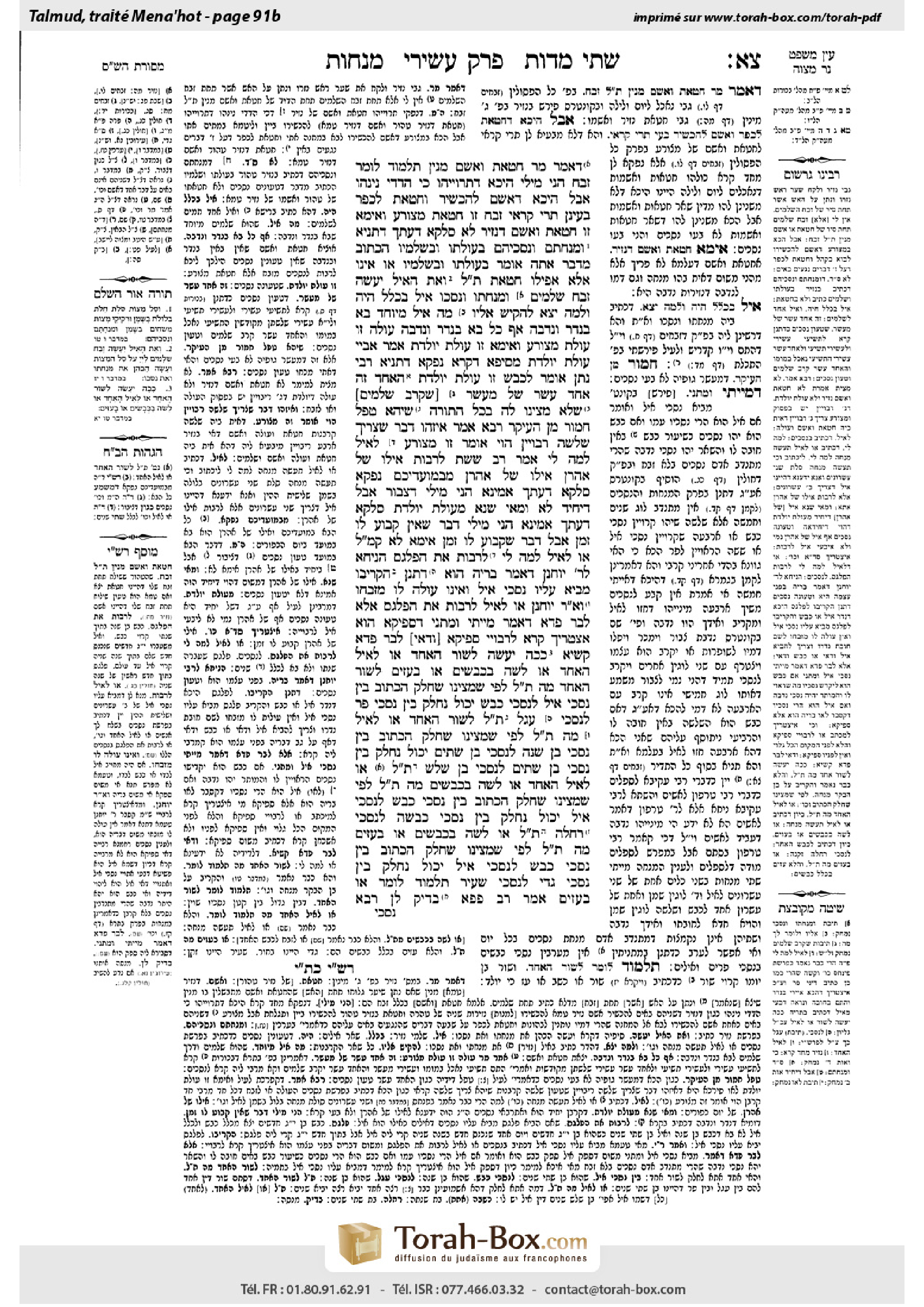
Menachot 91b: Talmud study for Daf Yomi
Daf Yomi is the daily study of one Talmud folio. Explore 37 tractates with scans, Hebrew text, Sefaria English and AI-generated French translations where annotated.
Passage selection and English or AI-generated French translation are available where the scan has annotations. Daf Study is independent of Torah-Box and Sefaria.
Browse Menachot · מנחות · All tractatesMenachot 91b text and translations
This page of Menachot includes the Aramaic text, an English translation and an AI-generated French translation, alongside the scan above.
מנחות צ״א ב · Aramaic and Hebrew text
דְּאָמַר מָר: חַטָּאת וְאָשָׁם מִנַּיִן? תַּלְמוּד לוֹמַר ״זָּבַח״.
הָנֵי מִילֵּי הֵיכָא דְּתַרְוַיְיהוּ כִּי הֲדָדֵי נִינְהוּ, אֲבָל הֵיכָא דְּאָשָׁם לְהַכְשִׁיר וְחַטָּאת לְכַפֵּר – בָּעֵינַן תְּרֵי קְרָאֵי.
״זָבַח״ – זוֹ חַטַּאת מְצוֹרָע, וְאֵימָא זוֹ חַטָּאת וְאָשָׁם דְּנָזִיר.
לָא סָלְקָא דַּעְתָּךְ, דְּתַנְיָא: ״וּמִנְחָתָם וְנִסְכֵּיהֶם״ – בְּעוֹלָתוֹ וּבִשְׁלָמָיו הַכָּתוּב מְדַבֵּר.
אַתָּה אוֹמֵר בְּעוֹלָתוֹ וּבִשְׁלָמָיו, אוֹ אֵינוֹ אֶלָּא אֲפִילּוּ חַטָּאת? תַּלְמוּד לוֹמַר: ״וְאֶת הָאַיִל יַעֲשֶׂה זֶבַח שְׁלָמִים וּמִנְחָתוֹ וְנִסְכּוֹ״.
אַיִל בַּכְּלָל הָיָה, וְלָמָּה יָצָא? לְהַקִּישׁ אֵלָיו. מָה אַיִל מְיוּחָד בָּא בְּנֶדֶר וּנְדָבָה, אַף כֹּל בָּא בְּנֶדֶר וּנְדָבָה.
״עֹלָה״ – זוֹ עוֹלַת מְצוֹרָע, וְאֵימָא זוֹ עוֹלַת יוֹלֶדֶת?
אָמַר אַבָּיֵי: עוֹלַת יוֹלֶדֶת מִסֵּיפָא דִּקְרָא נָפְקָא.
דְּתַנְיָא, רַבִּי נָתָן אוֹמֵר: ״לַכֶּבֶשׂ״ – זוֹ עוֹלַת יוֹלֶדֶת, ״הָאֶחָד״ – זֶה אַחַד עָשָׂר שֶׁל מַעֲשֵׂר [שֶׁקָּרֵב שְׁלָמִים].
שֶׁלֹּא מָצִינוּ לָהּ בְּכׇל הַתּוֹרָה, שֶׁיְּהֵא טָפֵל חָמוּר מִן הָעִיקָּר.
רָבָא אָמַר: אֵיזֶהוּ דָּבָר שֶׁצָּרִיךְ שְׁלֹשָׁה רִבּוּיִין? הֱוֵי אוֹמֵר: זוֹ מְצוֹרָע.
״לָאַיִל״, לְמָה לִי? אָמַר רַב שֵׁשֶׁת: לְרַבּוֹת אֵילוֹ שֶׁל אַהֲרֹן.
אֵילוֹ שֶׁל אַהֲרֹן, מִ״בְּמוֹעֲדֵיכֶם״ נָפְקָא! סָלְקָא דַּעְתָּךְ אָמֵינָא: הָנֵי מִילֵּי דְּצִבּוּר, אֲבָל דְּיָחִיד – לָא.
וּמַאי שְׁנָא מֵעוֹלַת יוֹלֶדֶת?
סָלְקָא דַּעְתָּךְ אָמֵינָא: הָנֵי מִילֵּי – דָּבָר שֶׁאֵין קָבוּעַ לוֹ זְמַן, אֲבָל דָּבָר שֶׁקָּבוּעַ לוֹ זְמַן – אֵימָא לָא. קָא מַשְׁמַע לַן.
״אוֹ לָאַיִל״, לְמָה לִי? לְרַבּוֹת אֶת הַפַּלְגָּס.
הָנִיחָא לְרַבִּי יוֹחָנָן, דְּאָמַר בִּרְיָה הוּא, דִּתְנַן: הִקְרִיבוּ – מֵבִיא עָלָיו נִסְכֵי אַיִל, וְאֵינוֹ עוֹלֶה לוֹ מִזִּבְחוֹ, וְאָמַר רַבִּי יוֹחָנָן: ״אוֹ לָאַיִל״ – לְרַבּוֹת אֶת הַפַּלְגָּס.
אֶלָּא לְבַר פְּדָא, דְּאָמַר: מַיְיתֵי וּמַתְנֵי, דִּסְפֵיקָא הוּא, אִצְטְרִיךְ קְרָא לְרַבּוֹיֵי סְפֵיקָא?
וַדַּאי לְבַר פְּדָא קַשְׁיָא.
״כָּכָה יֵעָשֶׂה לַשּׁוֹר הָאֶחָד אוֹ לָאַיִל הָאֶחָד אוֹ לַשֶּׂה בַכְּבָשִׂים אוֹ בָעִזִּים״. ״לְשׁוֹר הָאֶחָד״ – מָה תַּלְמוּד לוֹמַר? לְפִי שֶׁמָּצִינוּ שֶׁחִלֵּק הַכָּתוּב בֵּין נִסְכֵי אַיִל לְנִסְכֵי כֶבֶשׂ, יָכוֹל נְחַלֵּק בֵּין נִסְכֵי פַר לְנִסְכֵי עֵגֶל – תַּלְמוּד לוֹמַר ״לַשּׁוֹר הָאֶחָד״.
״אוֹ לָאַיִל״ – מָה תַּלְמוּד לוֹמַר? לְפִי שֶׁמָּצִינוּ שֶׁחִלֵּק הַכָּתוּב בֵּין נִסְכֵי בֶּן שָׁנָה לְנִסְכֵי בֶּן שְׁתַּיִם, יָכוֹל נְחַלֵּק בֵּין נִסְכֵי בֶּן שְׁתַּיִם לְנִסְכֵי בֶּן שָׁלֹשׁ? תַּלְמוּד לוֹמַר ״אוֹ לָאַיִל הָאֶחָד״.
״אוֹ לַשֶּׂה בַּכְּבָשִׂים״ – מָה תַּלְמוּד לוֹמַר? לְפִי שֶׁמָּצִינוּ שֶׁחִלֵּק הַכָּתוּב בֵּין נִסְכֵי כֶבֶשׂ לְנִסְכֵי אַיִל, יָכוֹל נְחַלֵּק בֵּין נִסְכֵי כִבְשָׂה לְנִסְכֵי רְחֵלָה? תַּלְמוּד לוֹמַר ״אוֹ לַשֶּׂה בַּכְּבָשִׂים״.
״אוֹ בָעִזִּים״ – מָה תַּלְמוּד לוֹמַר? לְפִי שֶׁמָּצִינוּ שֶׁחִלֵּק הַכָּתוּב בֵּין נִסְכֵי כֶבֶשׂ לְנִסְכֵי אַיִל, יָכוֹל נְחַלֵּק בֵּין נִסְכֵי גְדִי לְנִסְכֵי שָׂעִיר – תַּלְמוּד לוֹמַר ״אוֹ בָעִזִּים״.
אָמַר רַב פָּפָּא: בָּדֵיק לַן רָבָא,
Menachot 91b · English translation
This would be just as the Master said in a baraita concerning a nazirite: A nazirite who completes his term of naziriteship is required to shave his hair and bring various offerings. With regard to the shaved hair, the verse states: “And he shall take the hair of his nazirite head, and put it on the fire which is under the sacrifice of peace offerings” (Numbers 6:18). The baraita asks: From where is it derived that if, instead of putting his hair on the fire under the peace offering, he puts it on the fire under his sin offering or under his guilt offering, he still fulfills the obligation? The verse states: “The sacrifice,” which serves to include these two offerings. Evidently, the term “sacrifice” refers both to a sin offering and to a guilt offering. Why does the baraita concerning a leper derive a guilt offering only from the word “or”?
The Gemara explains: This matter, that both a sin offering and a guilt offering can be derived from the same term, applies only where they are both brought together, for the same purpose, as in the case of a nazirite. Both offerings serve to render him fit, in the case of a pure nazirite to partake of wine and cut his hair, and in the case of an impure nazirite to begin counting his term of naziriteship again. But in the case of a leper, where his guilt offering serves to render him fit to return to the camp and his sin offering serves to atone for the sin that was the cause of his leprosy, since they come for different purposes, we need two verses, i.e., sources, to teach about the two of them.
The Gemara once again questions the derivations in the baraita: “The sacrifice”; this is referring to the sin offering of a leper. The Gemara asks: And how does the baraita know this? I could say instead that this is referring to the sin offering and guilt offering of a nazirite. The sin offering is brought by a nazirite who completes his term of naziriteship, and the guilt offering is brought by a nazirite who became ritually impure. Accordingly, only those offerings of a nazirite would require libations, but not the burnt offering of a leper.
The Gemara rejects this possibility. This should not enter your mind, as it is taught in a baraita: In describing the offerings a nazirite brings upon the completion of his term of naziriteship, the verse states: “And he shall sacrifice his offering to the Lord, one unblemished male lamb in its year as a burnt offering, and one unblemished female lamb in its year as a sin offering, and one unblemished ram as peace offerings…and their meal offering, and their libations” (Numbers 6:14–15). The baraita explains that it is with regard to his burnt offering and his peace offering, mentioned earlier in that passage, that the verse speaks, and so it is only those nazirite offerings that require libations.
Do you say that the verse speaks with regard to his burnt offering and his peace offering? Or perhaps the verse speaks even with regard to the sin offering that a nazirite brings if he becomes ritually impure? To preclude the possibility of explaining the verse in that way, the verse states in the subsequent verses: “And he shall make the ram a sacrifice of a peace offering to the Lord, with the basket of unleavened bread; and the priest shall offer its meal offering and its libations” (Numbers 6:16–17).
Now, this ram offering was already included with all other peace offerings, which all require libations. Why, then, was it singled out in this verse with an independent statement teaching that it requires libations? It was in order to equate all other offerings to it, teaching that the requirement of libations applies only to offerings similar to it. Just as a ram is distinct in that it can come in fulfillment of a vow or as a gift offering, so too, any offering that can come in fulfillment of a vow or as a gift offering requires libations. This excludes the sin offering and guilt offering of a nazirite, as they cannot be brought as vow offerings or gift offerings.
The Gemara questions another of the derivations in the baraita: “The burnt offering”; this is referring to the burnt offering of a leper. The Gemara asks: And how does the baraita know this? I could say instead that this is referring to the burnt offering of a woman who gave birth (see Leviticus 12:6), and if so, there would be no source to require libations for the burnt offering of a leper.
Abaye said: The requirement to bring libations with the burnt offering of a woman who gave birth is derived from the end of that verse, so the term “the burnt offering,” mentioned just before it, remains available to include the burnt offering of a leper in the requirement for libations.
This is as it is taught in a baraita: The verse states: “And wine for pouring libations, a quarter-hin, you shall prepare with the burnt offering or for the sacrifice, for the one lamb” (Numbers 15:5). Rabbi Natan says: “For the one lamb”; this is referring to the burnt offering of a woman who gave birth and includes that offering in the requirement for libations. “The one”; this is referring to the eleventh animal of the animal tithe, which is sacrificed as a peace offering. In order to tithe his animals, the owner counts them one by one, and every tenth animal is consecrated as an animal tithe offering. If, when counting, he accidently counts the tenth animal as the ninth and the eleventh as the tenth, both are consecrated, the former as the animal tithe and the latter as a peace offering.
The baraita comments: It is necessary to have an independent derivation to teach that the eleventh animal requires libations, because we do not find another halakha like this in the entire Torah, in which the ancillary case is more stringent than the principal case. In this case, the animal tithe offering itself does not require libations.
The Gemara presents another answer. Rava says: The verse is expounded to be referring to three different offerings and includes them in the requirement to bring libations. It is reasonable that these three offerings all share an association with each other. What is the only matter in which three offerings are brought that would necessitate three inclusions to teach that each of them require libations? You must say that this is the offerings of a leper, who brings three different offerings.
§ It is further stated in the passage concerning libations: “Or for a ram, you shall prepare a meal offering of two-tenths of an ephah of fine flour, mixed with one-third of a hin of oil” (Numbers 15:6–7). The details of the meal offering brought with a ram are also mentioned elsewhere: “And two-tenths of fine flour for a meal offering, mixed with oil, for the one ram” (Numbers 28:12); therefore, the Gemara asks: Why do I need the verse here to state this? Rav Sheshet says: This verse serves to include in the requirement for libations the ram of Aaron, i.e., the ram of the High Priest that he sacrifices as a burnt offering on Yom Kippur.
The Gemara challenges: But the requirement to bring libations with the ram of Aaron should be derived from the term: “On your Festivals” (Numbers 15:3), as the baraita derived from that term that all obligatory offerings of Festivals require libations. The Gemara resolves this challenge: It is necessary to have an independent derivation for the ram of Aaron, as it might enter your mind to say that this matter, that obligatory offerings of Festivals require libations, applies only to communal offerings, but not to offerings of an individual, such as the ram of Aaron.
The Gemara questions this: But why would one think that because the ram of Aaron is an offering of an individual it would not require libations? In what way is it different from the burnt offering of a woman who gave birth, which is also brought by an individual and yet it requires libations?
The Gemara explains: It might enter your mind to say that this matter, i.e., the conclusion drawn from the halakha of the burnt offering of a woman who gave birth that even offerings of an individual require libations, applies only to an offering that does not have a fixed time when it must be sacrificed; but with regard to an offering that has a fixed time when it must be sacrificed, I might say that it does not require libations. Accordingly, it is necessary to have an independent derivation that teaches us that the ram of Aaron requires libations.
The Gemara continues to expound the verse cited: Why do I need the word “or” in the phrase “or for a ram”? The Gemara explains: It serves to include the sacrifice of a palges in the requirement to bring libations. When referring to sheep, the Torah speaks only of lambs and rams. A sheep during its first twelve months is called a lamb, and one older than thirteen months is called a ram. A palges is a sheep in its thirteenth month and is never explicitly mentioned by the Torah. It is therefore necessary to have an independent derivation to teach that if one is sacrificed, libations must be brought with it.
The Gemara raises a difficulty: This works out well according to the opinion of Rabbi Yoḥanan, who said that a palges is considered an independent entity, i.e., it is not regarded as a lamb or a ram, as we learned in a mishna (Para 1:3): One who is obligated to sacrifice a lamb or a ram and sacrificed a palges should bring with it the libations that are required when bringing a ram, but nevertheless its sacrifice is not considered a fulfillment of his obligation to bring an offering of a ram or a lamb. And, commenting on this mishna, Rabbi Yoḥanan says that the requirement to bring libations in this case is derived from the phrase “or for a ram,” which serves to include the sacrifice of a palges.
But the need for an independent derivation is difficult according to the opinion of bar Padda; as he said that in the mishna’s case, the individual brings the libations of a ram but stipulates concerning them that if a palges is a ram, then all of the libations should be regarded as its libations, and if a palges is a lamb, then the quantity of those libations required for a lamb should be regarded as its libations and the rest should be regarded as a gift offering, because he holds that a palges is either a lamb or a ram but that it is uncertain to us which it is. According to bar Padda, one can ask: Is it necessary to have a verse to include an uncertain case? Although it is not known how to categorize a palges, it is included either in the category of a sheep or a ram, and its libations are therefore detailed in the verse.
The Gemara concludes: Certainly, according to the opinion of bar Padda, this matter is difficult.
§ The Gemara discusses another verse in the passage about libations: “So it shall be done for the one bull, or for the one ram, or for the kid of the lambs or of the goats” (Numbers 15:11). Ostensibly, this verse states nothing beyond that which has already been explained in the beginning of that passage, which delineates the requirement of libations for each type of animal offering. The Gemara asks: Why must the verse state: “For the one bull”? The Gemara answers: Since we have found the verse differentiates between the libations of a ram and the libations of a lamb, even though they are both sheep, one might have thought that we should likewise differentiate between the libations of a bull, which is in its second year, and the libations of a calf, which is still in its first year. Therefore, the verse states: “For the one bull,” teaching that there is one halakha for all bulls, including calves, i.e., the same requirement applies to them.
The Gemara asks: Why must the verse state: “For the one ram”? The Gemara answers: Since we have found the verse differentiates with regard to sheep between the libations of a lamb in its first year and the libations of a ram in its second year, one might have thought that we should further differentiate with regard to rams themselves between the libations of a ram in its second year and the libations of a ram in its third year. Therefore, the verse states: “For the one ram,” teaching that there is one halakha for all rams.
The Gemara asks: Why must the verse state: “For the kid of the lambs”? The Gemara answers: Since we have found that the verse differentiates with regard to male sheep between the libations of a male lamb and the libations of a ram, one might have thought that we should further differentiate between the libations of a female lamb and the libations of a ewe. Therefore, the verse states: “For the kid of the lambs.”
The Gemara asks: Why must the verse state: “Or of the goats”? The Gemara answers: Since we have found that the verse differentiates with regard to sheep between the libations of a male lamb and the libations of a ram, one might have thought that we should further differentiate between the libations of a kid and the libations of an older goat. Therefore, the verse states: “Or of the goats.”
§ Having mentioned the libations of a ewe, the Gemara relates that Rav Pappa said: Rava tested us by asking the following question:
Menachot 91b · Traduction française (IA)
Cela correspond à ce que le Maître a enseigné dans une baraïta au sujet d’un nazir : lorsqu’un nazir achève sa période de naziréat, il doit se raser les cheveux et apporter diverses offrandes. Au sujet des cheveux rasés, le verset dit : « Il prendra les cheveux de sa tête de nazir et les mettra dans le feu qui se trouve sous le sacrifice de paix » (Nombres 6:18). La baraïta demande : D’où sait-on que, s’il met ses cheveux dans le feu sous son sacrifice expiatoire ou son sacrifice de culpabilité au lieu de les mettre dans le feu sous le sacrifice de paix, il s’acquitte néanmoins de son obligation ? Le verset dit : « Le sacrifice », terme qui inclut ces deux offrandes. Il apparaît donc que le terme « sacrifice » désigne à la fois un sacrifice expiatoire et un sacrifice de culpabilité. Pourquoi la baraïta concernant un lépreux ne déduit-elle le sacrifice de culpabilité que du mot « ou » ?
La Guemara explique : cette règle, selon laquelle on peut déduire à la fois un sacrifice expiatoire et un sacrifice de culpabilité d’un même terme, ne s’applique que lorsqu’ils sont apportés ensemble et dans le même but, comme dans le cas du nazir. Les deux offrandes le rendent apte : dans le cas d’un nazir pur, à boire du vin et à se couper les cheveux, et dans le cas d’un nazir impur, à recommencer à compter sa période de naziréat. Mais dans le cas d’un lépreux, son sacrifice de culpabilité le rend apte à réintégrer le camp, tandis que son sacrifice expiatoire expie le péché à l’origine de sa lèpre. Puisqu’ils sont apportés dans des buts différents, deux versets, c’est-à-dire deux sources, sont nécessaires pour enseigner le statut de chacun.
La Guemara remet de nouveau en question les déductions de la baraïta : « Le sacrifice » désigne le sacrifice expiatoire d’un lépreux. La Guemara demande : Comment la baraïta le sait-elle ? Je pourrais plutôt dire que cela désigne le sacrifice expiatoire et le sacrifice de culpabilité d’un nazir. Le sacrifice expiatoire est apporté par un nazir qui achève sa période de naziréat, et le sacrifice de culpabilité par un nazir devenu rituellement impur. Par conséquent, seuls ces sacrifices d’un nazir exigeraient des libations, mais pas l’holocauste d’un lépreux.
La Guemara rejette cette possibilité. Il ne faut pas envisager cette interprétation, car il est enseigné dans une baraïta : décrivant les offrandes qu’un nazir apporte à la fin de sa période de naziréat, le verset dit : « Il apportera son offrande à l’Éternel : un agneau mâle d’un an, sans défaut, comme holocauste, une agnelle d’un an, sans défaut, comme sacrifice expiatoire, et un bélier sans défaut comme sacrifice de paix… avec leur offrande végétale et leurs libations » (Nombres 6:14–15). La baraïta explique que le verset parle de son holocauste et de son sacrifice de paix, mentionnés plus tôt dans ce passage ; seuls ces sacrifices du nazir exigent donc des libations.
Dis-tu que le verset parle de son holocauste et de son sacrifice de paix ? Ou peut-être parle-t-il aussi du sacrifice expiatoire qu’un nazir apporte s’il devient rituellement impur ? Pour exclure cette interprétation, les versets suivants disent : « Il fera du bélier un sacrifice de paix pour l’Éternel, avec la corbeille de pains sans levain ; le prêtre apportera son offrande végétale et ses libations » (Nombres 6:16–17).
Or, ce sacrifice de bélier était déjà inclus parmi tous les autres sacrifices de paix, qui exigent tous des libations. Pourquoi donc a-t-il été distingué dans ce verset par une mention spécifique enseignant qu’il exige des libations ? C’était afin d’assimiler à lui toutes les autres offrandes, et d’enseigner que l’obligation d’apporter des libations ne s’applique qu’aux offrandes qui lui ressemblent. De même que le bélier se distingue en ce qu’il peut être apporté pour s’acquitter d’un vœu ou comme offrande volontaire, toute offrande qui peut être apportée pour s’acquitter d’un vœu ou comme offrande volontaire exige elle aussi des libations. Cela exclut le sacrifice expiatoire et le sacrifice de culpabilité d’un nazir, qui ne peuvent pas être apportés comme offrandes de vœu ou offrandes volontaires.
La Guemara met en question une autre déduction de la baraïta : « L’holocauste » désigne l’holocauste d’un lépreux. La Guemara demande : Comment la baraïta le sait-elle ? Je pourrais plutôt dire que cela désigne l’holocauste d’une femme qui a accouché (voir Lévitique 12:6) ; dans ce cas, aucune source n’exigerait des libations pour l’holocauste d’un lépreux.
Abayé dit : l’obligation d’apporter des libations avec l’holocauste d’une femme qui a accouché se déduit de la fin de ce verset ; le terme « l’holocauste », qui le précède, reste donc disponible pour inclure l’holocauste d’un lépreux dans l’obligation d’apporter des libations.
C’est ce qui est enseigné dans une baraïta : le verset dit : « Tu prépareras un quart de hin de vin pour les libations avec l’holocauste ou pour le sacrifice, pour l’agneau unique » (Nombres 15:5). Rabbi Natan dit : « Pour l’agneau unique » désigne l’holocauste d’une femme qui a accouché et inclut cette offrande dans l’obligation d’apporter des libations. « L’unique » désigne le onzième animal du troupeau soumis à la dîme animale, qui est sacrifié comme sacrifice de paix. Pour prélever la dîme sur ses animaux, le propriétaire les compte un par un, et chaque dixième animal est consacré comme offrande de dîme animale. Si, en comptant, il compte par erreur le dixième animal comme le neuvième et le onzième comme le dixième, les deux sont consacrés : le premier comme dîme animale et le second comme sacrifice de paix.
La baraïta commente : une déduction spécifique est nécessaire pour enseigner que le onzième animal exige des libations, car on ne trouve nulle part ailleurs dans toute la Torah une halakha de ce genre, où le cas secondaire est plus strict que le cas principal. En l’occurrence, l’offrande de dîme animale elle-même n’exige pas de libations.
La Guemara présente une autre réponse. Rava dit : le verset est interprété comme désignant trois offrandes différentes et les incluant dans l’obligation d’apporter des libations. Il est logique que ces trois offrandes aient toutes un lien entre elles. Dans quel seul cas apporte-t-on trois offrandes qui nécessiteraient trois inclusions pour enseigner que chacune exige des libations ? Il faut répondre qu’il s’agit des offrandes d’un lépreux, qui apporte trois offrandes différentes.
§ Le passage relatif aux libations précise également : « Pour un bélier, tu prépareras une offrande végétale de deux dixièmes d’épha de farine fine, mêlée à un tiers de hin d’huile » (Nombres 15:6–7). Les détails de l’offrande végétale apportée avec un bélier sont également mentionnés ailleurs : « Et deux dixièmes de farine fine pour une offrande végétale, mêlée d’huile, pour le bélier unique » (Nombres 28:12). La Guemara demande donc : Pourquoi le verset doit-il le préciser ici ? Rav Chéchet dit : ce verset sert à inclure dans l’obligation d’apporter des libations le bélier d’Aaron, c’est-à-dire le bélier que le grand prêtre sacrifie comme holocauste le jour de Yom Kippour.
La Guemara objecte : Mais l’obligation d’apporter des libations avec le bélier d’Aaron devrait se déduire des mots « lors de vos fêtes » (Nombres 15:3), puisque la baraïta a déduit de ces mots que toutes les offrandes obligatoires des fêtes exigent des libations. La Guemara résout cette objection : une déduction spécifique est nécessaire pour le bélier d’Aaron, car on pourrait envisager que cette règle, selon laquelle les offrandes obligatoires des fêtes exigent des libations, ne s’applique qu’aux offrandes communautaires, mais pas aux offrandes d’un particulier, comme le bélier d’Aaron.
La Guemara met cela en question : Mais pourquoi penserait-on que le bélier d’Aaron n’exige pas de libations parce qu’il s’agit d’une offrande d’un particulier ? En quoi diffère-t-il de l’holocauste d’une femme qui a accouché, qui est également apporté par un particulier et qui exige pourtant des libations ?
La Guemara explique : on pourrait envisager que cette règle, c’est-à-dire la conclusion tirée de la halakha concernant l’holocauste d’une femme qui a accouché, selon laquelle même les offrandes d’un particulier exigent des libations, ne s’applique qu’à une offrande dont le moment du sacrifice n’est pas fixé. Mais, pour une offrande dont le moment du sacrifice est fixé, je pourrais dire qu’elle n’exige pas de libations. Une déduction spécifique est donc nécessaire pour nous enseigner que le bélier d’Aaron exige des libations.
La Guemara poursuit l’interprétation du verset cité : Pourquoi le mot « ou » est-il nécessaire dans l’expression « ou pour un bélier » ? La Guemara explique qu’il sert à inclure le sacrifice d’un palgues dans l’obligation d’apporter des libations. Lorsqu’elle parle des ovins, la Torah ne mentionne que les agneaux et les béliers. Un ovin âgé de moins de douze mois est appelé agneau, et un ovin âgé de plus de treize mois est appelé bélier. Un palgues est un ovin dans son treizième mois et n’est jamais explicitement mentionné dans la Torah. Une déduction spécifique est donc nécessaire pour enseigner que, si on le sacrifie, des libations doivent l’accompagner.
La Guemara soulève une difficulté : cela s’explique bien selon l’opinion de Rabbi Yoḥanan, qui dit qu’un palgues est considéré comme une catégorie distincte, c’est-à-dire qu’il n’est considéré ni comme un agneau ni comme un bélier, comme nous l’avons appris dans une Michna (Para 1:3) : celui qui est tenu de sacrifier un agneau ou un bélier et qui sacrifie un palgues doit apporter avec lui les libations requises pour un bélier ; toutefois, son sacrifice n’est pas considéré comme l’accomplissement de son obligation d’apporter un bélier ou un agneau. Commentant cette Michna, Rabbi Yoḥanan dit que l’obligation d’apporter des libations dans ce cas se déduit de l’expression « ou pour un bélier », qui sert à inclure le sacrifice d’un palgues.
Mais la nécessité d’une déduction spécifique pose difficulté selon l’opinion de bar Padda. Selon lui, dans le cas de la Michna, le particulier apporte les libations d’un bélier, en précisant à leur sujet que, si un palgues est un bélier, toutes les libations doivent être considérées comme ses libations ; et que, si un palgues est un agneau, la quantité de libations requise pour un agneau doit être considérée comme ses libations, le reste étant considéré comme une offrande volontaire. En effet, il considère qu’un palgues est soit un agneau, soit un bélier, mais que nous ne savons pas lequel. Selon bar Padda, on peut demander : faut-il un verset pour inclure un cas incertain ? Bien qu’on ne sache pas dans quelle catégorie classer un palgues, il relève nécessairement soit de la catégorie de l’agneau, soit de celle du bélier ; ses libations sont donc précisées dans le verset.
La Guemara conclut : assurément, selon l’opinion de bar Padda, cette question pose difficulté.
§ La Guemara examine un autre verset du passage sur les libations : « Il en sera ainsi pour le taureau unique, ou pour le bélier unique, ou pour le chevreau des agneaux ou des chèvres » (Nombres 15:11). À première vue, ce verset ne dit rien de plus que ce qui a déjà été expliqué au début du passage, qui définit l’obligation de libations pour chaque type d’offrande animale. La Guemara demande : Pourquoi le verset doit-il dire « pour le taureau unique » ? La Guemara répond : puisque nous avons vu que le verset distingue les libations d’un bélier de celles d’un agneau, alors qu’ils sont tous deux des ovins, on aurait pu penser qu’il fallait également distinguer les libations d’un taureau, qui est dans sa deuxième année, de celles d’un veau, qui est encore dans sa première année. Le verset dit donc : « Pour le taureau unique », enseignant qu’une seule halakha s’applique à tous les taureaux, y compris les veaux : la même obligation s’applique à eux.
La Guemara demande : Pourquoi le verset doit-il dire « pour le bélier unique » ? La Guemara répond : puisque nous avons vu que le verset distingue, pour les ovins, les libations d’un agneau dans sa première année de celles d’un bélier dans sa deuxième année, on aurait pu penser qu’il fallait encore distinguer, pour les béliers eux-mêmes, les libations d’un bélier dans sa deuxième année de celles d’un bélier dans sa troisième année. Le verset dit donc : « Pour le bélier unique », enseignant qu’une seule halakha s’applique à tous les béliers.
La Guemara demande : Pourquoi le verset doit-il dire « pour le chevreau des agneaux » ? La Guemara répond : puisque nous avons vu que le verset distingue, pour les ovins mâles, les libations d’un agneau mâle de celles d’un bélier, on aurait pu penser qu’il fallait encore distinguer les libations d’une agnelle de celles d’une brebis. Le verset dit donc : « Pour le chevreau des agneaux ».
La Guemara demande : Pourquoi le verset doit-il dire « ou des chèvres » ? La Guemara répond : puisque nous avons vu que le verset distingue, pour les ovins, les libations d’un agneau mâle de celles d’un bélier, on aurait pu penser qu’il fallait encore distinguer les libations d’un chevreau de celles d’un bouc adulte. Le verset dit donc : « Ou des chèvres ».
§ Ayant mentionné les libations d’une brebis, la Guemara rapporte que Rav Pappa dit : Rava nous mit à l’épreuve en posant la question suivante :
Traduction française générée par IA à partir de l’édition anglaise de Sefaria. Vérifie toujours un passage avec le texte source.
Text from Sefaria: William Davidson Edition - Vocalized Aramaic (unknown); William Davidson Edition - English (CC BY NC).