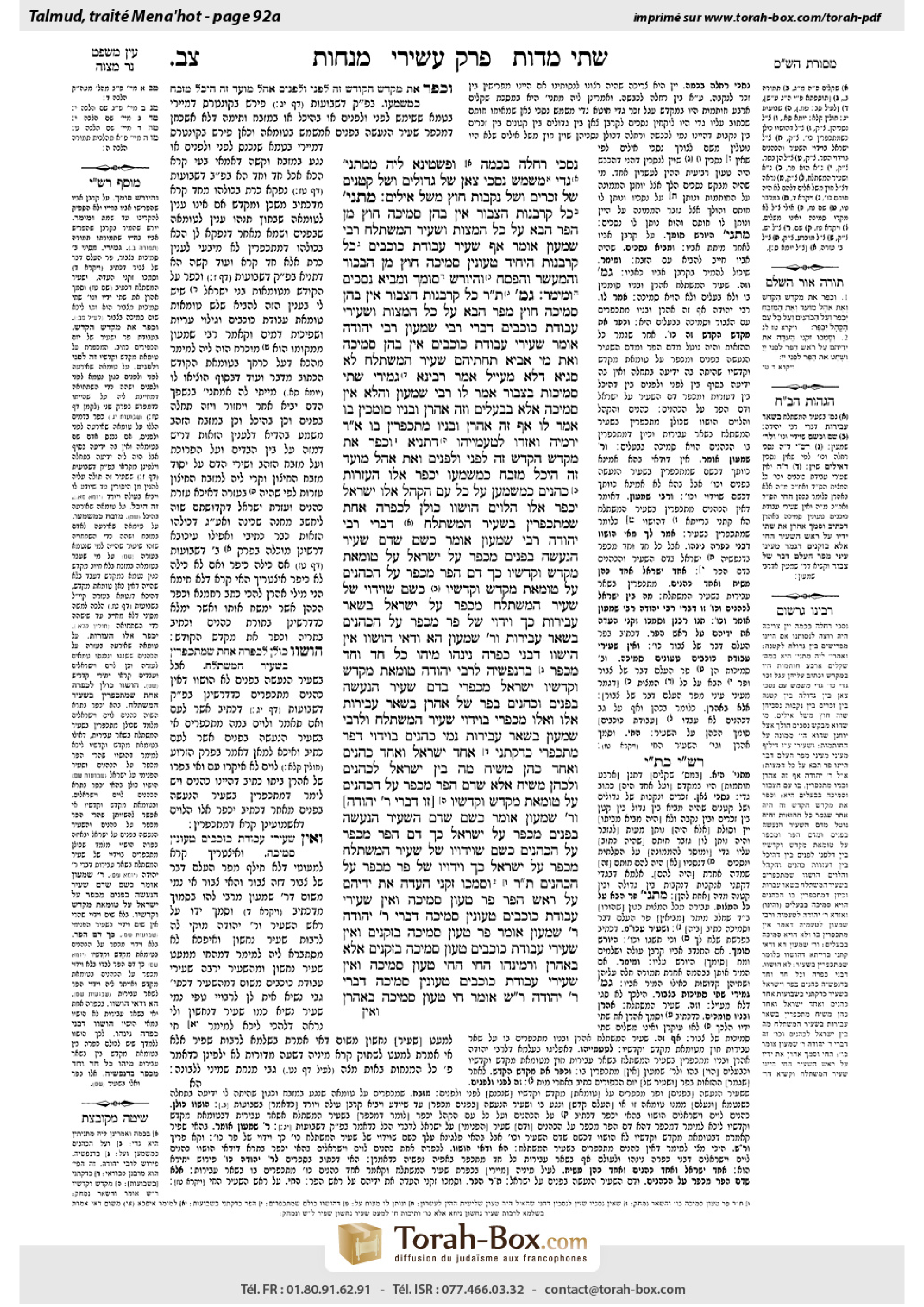
Menachot 92a: Talmud study for Daf Yomi
Daf Yomi is the daily study of one Talmud folio. Explore 37 tractates with scans, Hebrew text, Sefaria English and AI-generated French translations where annotated.
Passage selection and English or AI-generated French translation are available where the scan has annotations. Daf Study is independent of Torah-Box and Sefaria.
Browse Menachot · מנחות · All tractatesMenachot 92a text and translations
This page of Menachot includes the Aramaic text, an English translation and an AI-generated French translation, alongside the scan above.
מנחות צ״ב א · Aramaic and Hebrew text
נִסְכֵי רְחֵלָה בְּכַמָּה? וּפָשְׁטִינָא לֵיהּ מִמַּתְנִיתִין: גְּדִי מְשַׁמֵּשׁ נִסְכֵי צֹאן שֶׁל גְּדוֹלִים וְשֶׁל קְטַנִּים, שֶׁל זְכָרִים וְשֶׁל נְקֵבוֹת, חוּץ מִשֶּׁל אֵילִים.
מַתְנִי׳ כׇּל קׇרְבְּנוֹת הַצִּבּוּר אֵין בָּהֶן סְמִיכָה, חוּץ מִן הַפָּר הַבָּא עַל כׇּל הַמִּצְוֹת, וְשָׂעִיר הַמִּשְׁתַּלֵּחַ. רַבִּי שִׁמְעוֹן אוֹמֵר: אַף שָׂעִיר עֲבוֹדָה זָרָה.
כׇּל קׇרְבְּנוֹת הַיָּחִיד טְעוּנִין סְמִיכָה, חוּץ מִן הַבְּכוֹר וְהַמַּעֲשֵׂר וְהַפֶּסַח.
וְהַיּוֹרֵשׁ סוֹמֵךְ, וּמֵבִיא נְסָכִים, וּמֵימֵר.
גְּמָ׳ תָּנוּ רַבָּנַן: כׇּל קׇרְבְּנוֹת הַצִּבּוּר אֵין בָּהֶן סְמִיכָה, חוּץ מִפַּר הַבָּא עַל כׇּל הַמִּצְוֹת וּשְׂעִירֵי עֲבוֹדָה זָרָה, דִּבְרֵי רַבִּי שִׁמְעוֹן. רַבִּי יְהוּדָה אוֹמֵר: שְׂעִירֵי עֲבוֹדָה זָרָה אֵין בָּהֶן סְמִיכָה, וְאֶת מִי אָבִיא תַּחְתֵּיהֶם – שָׂעִיר הַמִּשְׁתַּלֵּחַ.
לָא סַגִּיא דְּלָא מְעַיֵּיל? אָמַר רָבִינָא: גְּמִירִי שְׁתֵּי סְמִיכוֹת בְּצִבּוּר.
אָמַר לוֹ רַבִּי שִׁמְעוֹן: וַהֲלֹא אֵין סְמִיכָה אֶלָּא בִּבְעָלִים, וְזֶה – אַהֲרֹן וּבָנָיו סוֹמְכִין בּוֹ! אָמַר לוֹ: אַף זֶה – אַהֲרֹן וּבָנָיו מִתְכַּפְּרִין בּוֹ.
אָמַר רַבִּי יִרְמְיָה: וְאָזְדוּ לְטַעְמַיְיהוּ.
דְּתַנְיָא: ״וְכִפֶּר אֶת מִקְדַּשׁ הַקֹּדֶשׁ״ – זֶה לִפְנַי וְלִפְנִים, ״וְאֶת אֹהֶל מוֹעֵד״ – זֶה הֵיכָל, ״מִזְבֵּחַ״ – כְּמַשְׁמָעוֹ, ״יְכַפֵּר״ – אֵלּוּ הָעֲזָרוֹת, ״כֹּהֲנִים״ – כְּמַשְׁמָעָן, ״עַל כׇּל עַם הַקָּהָל״ – אֵלּוּ יִשְׂרָאֵל, ״יְכַפֵּר״ – אֵלּוּ הַלְוִיִּם.
הוּשְׁווּ כּוּלָּן לְכַפָּרָה אַחַת, שֶׁמִּתְכַּפְּרִין בְּשָׂעִיר הַמִּשְׁתַּלֵּחַ, דִּבְרֵי רַבִּי יְהוּדָה.
רַבִּי שִׁמְעוֹן אוֹמֵר: כְּשֵׁם שֶׁדַּם שָׂעִיר הַנַּעֲשֶׂה בִּפְנִים מְכַפֵּר עַל יִשְׂרָאֵל עַל טוּמְאַת מִקְדָּשׁ וְקָדָשָׁיו – כָּךְ דַּם הַפָּר מְכַפֵּר עַל הַכֹּהֲנִים עַל טוּמְאַת מִקְדָּשׁ וְקָדָשָׁיו. כְּשֵׁם שֶׁוִּידּוּי שֶׁל שָׂעִיר הַמִּשְׁתַּלֵּחַ מְכַפֵּר עַל יִשְׂרָאֵל בִּשְׁאָר עֲבֵירוֹת – כָּךְ וִידּוּי שֶׁל פָּר מְכַפֵּר עַל הַכֹּהֲנִים בִּשְׁאָר עֲבֵירוֹת.
וְרַבִּי שִׁמְעוֹן, הָא וַדַּאי הוּשְׁווּ? אִין, הוּשְׁווּ דִּבְנֵי כַּפָּרָה נִינְהוּ, מִיהוּ כֹּל חַד וְחַד מְכַפֵּר בִּדְנַפְשֵׁיהּ.
לְרַבִּי יְהוּדָה – טוּמְאַת מִקְדָּשׁ וְקָדָשָׁיו, יִשְׂרָאֵל מְכַפְּרִי בְּדַם שָׂעִיר הַנַּעֲשֶׂה בִּפְנִים, וְכֹהֲנִים בְּפַר שֶׁל אַהֲרֹן. בִּשְׁאָר עֲבֵירוֹת, אֵלּוּ וָאֵלּוּ מְכַפְּרִי בְּוִידּוּי שָׂעִיר הַמִּשְׁתַּלֵּחַ. וּלְרַבִּי שִׁמְעוֹן – בִּשְׁאָר עֲבֵירוֹת נָמֵי, כֹּהֲנִים בְּוִידּוּי דְּפַר מִתְכַּפְּרִי.
כִּדְקָתָנֵי: אֶחָד יִשְׂרָאֵל וְאֶחָד כֹּהֲנִים וְאֶחָד כֹּהֵן מָשִׁיחַ, מָה בֵּין יִשְׂרָאֵל לְכֹהֲנִים וּלְכֹהֵן מָשִׁיחַ? אֶלָּא שֶׁדַּם הַפָּר מְכַפֵּר עַל הַכֹּהֲנִים עַל טוּמְאַת מִקְדָּשׁ וְקָדָשָׁיו, זוֹ דִּבְרֵי רַבִּי יְהוּדָה.
וְרַבִּי שִׁמְעוֹן אוֹמֵר: כְּשֵׁם שֶׁדַּם הַשָּׂעִיר הַנַּעֲשֶׂה בִּפְנִים מְכַפֵּר עַל יִשְׂרָאֵל – כָּךְ דַּם הַפָּר מְכַפֵּר עַל הַכֹּהֲנִים. כְּשֵׁם שֶׁוִּידּוּיוֹ שֶׁל שָׂעִיר הַמִּשְׁתַּלֵּחַ מְכַפֵּר עַל יִשְׂרָאֵל – כָּךְ וִידּוּיוֹ שֶׁל פָּר מְכַפֵּר עַל הַכֹּהֲנִים.
תָּנוּ רַבָּנַן: ״וְסָמְכוּ זִקְנֵי הָעֵדָה אֶת יְדֵיהֶם עַל רֹאשׁ הַפָּר״ – פַּר טָעוּן סְמִיכָה, וְאֵין שְׂעִירֵי עֲבוֹדָה זָרָה טְעוּנִין סְמִיכָה, דִּבְרֵי רַבִּי יְהוּדָה.
רַבִּי שִׁמְעוֹן אוֹמֵר: פַּר טָעוּן סְמִיכָה בִּזְקֵנִים, וְאֵין שְׂעִירֵי עֲבוֹדָה זָרָה טָעוּן סְמִיכָה בִּזְקֵנִים, אֶלָּא בְּאַהֲרֹן.
וּרְמִינְהוּ: ״הַחַי״ – הַחַי טָעוּן סְמִיכָה, וְאֵין שְׂעִירֵי עֲבוֹדָה זָרָה טְעוּנִין סְמִיכָה, דִּבְרֵי רַבִּי יְהוּדָה. רַבִּי שִׁמְעוֹן אוֹמֵר: חַי״ טָעוּן סְמִיכָה בְּאַהֲרֹן,
Menachot 92a · English translation
How much wine is used for the libations of a ewe? And I resolved this question from that which is stated in a mishna (Shekalim 14b): Generally, the wine for libations would be procured from the supplies of the Temple. One bringing an offering would pay the Temple treasurer for the quantity of wine required, and then the treasurer would give him a token as a receipt indicating what had been paid for. The individual would then proceed to the official appointed over the Temple’s supplies to collect the wine he had paid for. If the token had the word: Kid, it could be used to collect wine for libations for sheep, whether large or small, male or female, except for those of rams. Evidently, the same quantity is required for the libations of ewes as for lambs.
MISHNA: For all communal offerings there is no mitzva of placing hands on the head of the offering, except for the bull that comes to atone for a community-wide violation of any one of the mitzvot that was perpetrated due to an erroneous ruling of the Sanhedrin, where the judges of the Sanhedrin are required to place their hands upon its head (see Leviticus 4:13–21); and the scapegoat brought on Yom Kippur, upon which the High Priest places his hands (see Leviticus, chapter 16). Rabbi Shimon says: Also in the case of the goat that comes to atone for a community-wide perpetration of idol worship that occurred due to an erroneous ruling of the Sanhedrin, the judges of the Sanhedrin are required to place their hands upon its head (see Numbers 15:22–26).
All offerings of an individual require placing hands, except for the firstborn offering, the animal tithe offering, and the Paschal offering.
The mitzva of placing hands is performed by the owner of the offering. The mishna adds: And if the owner died, then the heir is regarded as the offering’s owner and so he places his hands on the offering and brings the accompanying libations. And furthermore, he can substitute a non-sacred animal for it. Although it is prohibited to perform an act of substitution, if the owner of an offering does this, his attempt is successful to the extent that the non-sacred animal is thereby consecrated, even though the original offering also remains sacred.
GEMARA: The Sages taught in a baraita: For all communal offerings there is no mitzva of placing hands, except for the bull that comes to atone for a community-wide violation of any one of the mitzvot, and the goats that come to atone for a community-wide violation of the prohibition of idol worship; this is the statement of Rabbi Shimon. Rabbi Yehuda says: There is no mitzva of placing hands with regard to the goats that come to atone for idol worship. But if this is the halakha, which offering shall I bring in their place? The scapegoat.
The Gemara interrupts the citation of the baraita with a question: Why does Rabbi Yehuda search for an additional case? Is it not possible not to insert an additional case? Ravina said: It is learned as a tradition that there are two instances in which placing hands is required for communal offerings.
The baraita continues: Rabbi Shimon said to Rabbi Yehuda: How can you include the scapegoat as one of the two cases requiring the placing of hands? Isn’t it the halakha that placing hands can be performed only by the offering’s owner, i.e., the one who will achieve atonement through the sacrifice of the offering? And with regard to this offering, the scapegoat, it is Aaron the High Priest or whichever of his sons serves as High Priest who places his hands on it, and yet it is not he who achieves atonement through it. Rabbi Yehuda said to him: With regard to this offering as well, that halakha is fulfilled because Aaron and his sons are considered owners, as they also achieve atonement through it together with the rest of the community.
The Gemara elaborates on the dispute. Rabbi Yirmeya said: And Rabbi Shimon and Rabbi Yehuda, who disagree as to whether the High Priest achieves atonement through the scapegoat, each follow their standard line of reasoning.
This is as it is taught in a baraita: At the end of the passage delineating the Yom Kippur Temple service, the verse states: “He shall bring atonement upon the sanctum of the sacred, and upon the Tent of Meeting and the altar he shall effect atonement; and upon the priests and upon all the people, shall he bring atonement” (Leviticus 16:33). “He shall bring atonement upon the sanctum of the sacred”; this is referring to the innermost sanctum, i.e., the Holy of Holies. “And upon the Tent of Meeting”; this is referring to the Sanctuary. “And the altar”; this is understood in accordance with its plain meaning. “He shall effect atonement”; this is referring to the Temple courtyards. “And upon the priests”; this is understood in accordance with its plain meaning. “And upon all the people”; these are the Israelites. “Shall he bring atonement”; this is referring to the Levites.
All of them are equated with regard to the fact that they are all atoned for through one atonement, i.e., that they are atoned for by the scapegoat for all transgressions other than the defiling of the Temple or its sacrificial foods. This is the statement of Rabbi Yehuda.
The baraita continues: Rabbi Shimon says: Just as the blood of the goat whose blood presentation is performed inside the Sanctuary atones for Israelites for their defiling of the Temple or its sacrificial foods, so too, the blood of the bull of the High Priest, whose blood presentation is also performed inside the Sanctuary, atones for the priests for their defiling of the Temple or its sacrificial foods. And just as the confession made over the scapegoat atones for Israelites for other transgressions, so too, the confession made over the bull atones for the priests for other transgressions. It is apparent from the baraita that it is only according to the opinion of Rabbi Yehuda that the scapegoat atones for both Israelites and priests, and consequently the High Priest may be considered an owner with regard to the mitzva of placing hands.
The Gemara analyzes Rabbi Shimon’s opinion: And according to Rabbi Shimon, one can ask: Weren’t both Israelites and priests certainly equated in the verse in Leviticus? In what way are they equated in the verse? The Gemara explains: Yes, according to his opinion they are equated in that they are all subject to atonement on Yom Kippur, but each one of the groups achieves atonement in its own way. The priests achieve atonement through the bull brought by the High Priest and his confession, while the Israelites and Levites achieve atonement through the confession over the scapegoat.
The Gemara summarizes: According to the opinion of Rabbi Yehuda, for the defiling of the Temple or its sacrificial foods, Israelites achieve atonement through the presentation of the blood of the goat whose blood presentation is performed inside the Sanctuary, and the priests achieve atonement through the presentation of the blood of the bull of Aaron, i.e., of the High Priest. And for other transgressions, both these Israelites and those priests achieve atonement through the confession made over the scapegoat. But according to Rabbi Shimon, for other transgressions as well, the priests achieve atonement through the confession made over the bull of the High Priest.
This understanding of their dispute is just like that which is taught in a mishna (Shevuot 2b): Israelites and priests and the anointed priest, i.e., the High Priest, achieve atonement from the scapegoat equally. What is the difference between Israelites, priests, and the anointed priest? It is only that the bull of the High Priest that he offers on Yom Kippur atones for the priests for their defiling of the Temple or its sacrificial foods, whereas the Israelites achieve atonement for defiling caused by them through the goats that are sacrificed on Yom Kippur; this is the statement of Rabbi Yehuda.
And Rabbi Shimon says: With regard to the defiling of the Temple or its sacrificial foods, just as the blood of the goat, whose blood presentation is performed inside the Sanctuary, atones for Israelites, so too, the blood of the bull of the High Priest, whose blood presentation is also performed inside the Sanctuary, atones for the priests. And for all other transgressions, just as the confession made over the scapegoat atones for Israelites, so too, the confession made over the bull atones for the priests.
§ The mishna teaches that Rabbi Yehuda and Rabbi Shimon disagree as to whether or not the goats that come for a community-wide violation of the prohibition against idol worship require the rite of placing hands. With regard to this, the Sages taught in a baraita: The verse states with regard to the bull that comes to atone for a community-wide violation of one of the mitzvot: “And the elders of the congregation shall place their hands upon the head of the bull before the Lord” (Leviticus 4:15). The verse specifies that this requirement applies to the bull to indicate that, with regard to offerings brought for community-wide transgressions, only the bull requires placing hands, but the goats brought for idol worship do not require placing hands; this is the statement of Rabbi Yehuda.
Rabbi Shimon says: Both offerings require placing hands. The verse specifies the requirement with regard to the bull because only it requires that placing hands be performed by Elders of the Sanhedrin, but the goats brought for idol worship do not require that placing hands be performed by the Elders, but rather by Aaron, i.e., the High Priest.
And the Gemara raises a contradiction from another baraita: With regard to the Yom Kippur scapegoat, the verse states: “And Aaron shall place both his hands upon the head of the live goat, and confess over him all the iniquities of the children of Israel, and all their transgressions, even all their sins” (Leviticus 16:21). The emphasis of “the live goat” indicates that with regard to communal offerings of goats, only the live goat, i.e., the scapegoat, requires placing hands, but the goats brought for idol worship do not require placing hands; this is the statement of Rabbi Yehuda. Rabbi Shimon says: Both offerings require placing hands. The verse specifies the requirement with regard to the live goat to teach that it requires that placing hands be performed by Aaron, i.e., the High Priest,
Menachot 92a · Traduction française (IA)
Quelle quantité de vin faut-il pour les libations d’une brebis ? J’ai résolu cette question à partir de ce qui est enseigné dans une Michna (Shekalim 14b) : en règle générale, le vin destiné aux libations était fourni par les réserves du Temple. Celui qui apportait une offrande payait au trésorier du Temple la quantité de vin nécessaire, puis le trésorier lui remettait un jeton en guise de reçu attestant le paiement. L’intéressé se rendait ensuite auprès du préposé aux réserves du Temple pour retirer le vin qu’il avait payé. Si le jeton portait le mot « chevreau », il permettait de retirer du vin pour les libations des ovins, qu’ils soient grands ou petits, mâles ou femelles, à l’exception des béliers. Il ressort de là que les libations d’une brebis nécessitent la même quantité que celles d’un agneau.
MICHNA : Pour toutes les offrandes communautaires, il n’y a pas de mitsva d’imposer les mains sur la tête de l’offrande, à l’exception du taureau apporté pour expier la transgression communautaire de l’un des commandements, commise à la suite d’une décision erronée du Sanhédrin, auquel cas les juges du Sanhédrin doivent imposer les mains sur sa tête (voir Lévitique 4:13–21), et du bouc émissaire apporté à Yom Kippour, sur lequel le Grand Prêtre impose les mains (voir Lévitique, chapitre 16). Rabbi Shimon dit : il en va de même du bouc apporté pour expier la transgression communautaire de l’interdiction de l’idolâtrie, commise à la suite d’une décision erronée du Sanhédrin ; les juges du Sanhédrin doivent imposer les mains sur sa tête (voir Nombres 15:22–26).
Toutes les offrandes individuelles nécessitent l’imposition des mains, à l’exception de l’offrande du premier-né, de l’offrande de la dîme animale et de l’offrande pascale.
La mitsva d’imposer les mains est accomplie par le propriétaire de l’offrande. La Michna ajoute : si le propriétaire est mort, l’héritier est considéré comme le propriétaire de l’offrande ; il lui impose donc les mains et apporte les libations qui l’accompagnent. En outre, il peut lui substituer un animal non consacré. Bien que la substitution soit interdite, si le propriétaire d’une offrande procède ainsi, sa tentative a cet effet : l’animal non consacré est consacré, même si l’offrande initiale reste elle aussi consacrée.
GUEMARA : Les Sages ont enseigné dans une baraïta : pour toutes les offrandes communautaires, il n’y a pas de mitsva d’imposer les mains, à l’exception du taureau apporté pour expier la transgression communautaire de l’un des commandements et des boucs apportés pour expier la transgression communautaire de l’interdiction de l’idolâtrie ; telle est l’opinion de Rabbi Shimon. Rabbi Yehouda dit : il n’y a pas de mitsva d’imposer les mains sur les boucs apportés pour expier l’idolâtrie. Mais si telle est la halakha, quelle offrande apporterai-je à leur place ? Le bouc émissaire.
La Guemara interrompt la citation de la baraïta par une question : pourquoi Rabbi Yehouda recherche-t-il un cas supplémentaire ? Ne peut-on pas ne pas ajouter de cas ? Ravina dit : la tradition enseigne qu’il existe deux cas où l’imposition des mains est requise pour des offrandes communautaires.
La baraïta poursuit : Rabbi Shimon dit à Rabbi Yehouda : comment peux-tu compter le bouc émissaire parmi les deux cas nécessitant l’imposition des mains ? N’est-il pas établi que seul le propriétaire de l’offrande peut imposer les mains, c’est-à-dire celui qui obtiendra l’expiation grâce au sacrifice de l’offrande ? Or, pour cette offrande, le bouc émissaire, c’est Aaron le Grand Prêtre, ou l’un de ses fils qui exerce la fonction de Grand Prêtre, qui lui impose les mains ; pourtant, ce n’est pas lui qui obtient l’expiation par son intermédiaire. Rabbi Yehouda lui répondit : cette règle est également respectée dans le cas de cette offrande, car Aaron et ses fils sont considérés comme propriétaires, puisqu’ils obtiennent eux aussi l’expiation par son intermédiaire, avec le reste de la communauté.
La Guemara développe le désaccord. Rabbi Yirmeya dit : Rabbi Shimon et Rabbi Yehouda, qui divergent sur la question de savoir si le Grand Prêtre obtient l’expiation grâce au bouc émissaire, suivent chacun leur raisonnement habituel.
C’est ce qu’enseigne une baraïta : à la fin du passage qui décrit le service du Temple à Yom Kippour, le verset dit : « Il apportera l’expiation pour le sanctuaire sacré, et pour la Tente de la Rencontre et l’autel il accomplira l’expiation ; et pour les prêtres et pour tout le peuple, il apportera l’expiation » (Lévitique 16:33). « Il apportera l’expiation pour le sanctuaire sacré » : cela désigne le sanctuaire le plus intérieur, c’est-à-dire le Saint des Saints. « Et pour la Tente de la Rencontre » : cela désigne le Sanctuaire. « Et l’autel » : il faut comprendre ces mots selon leur sens littéral. « Il accomplira l’expiation » : cela désigne les parvis du Temple. « Et pour les prêtres » : il faut comprendre ces mots selon leur sens littéral. « Et pour tout le peuple » : il s’agit des Israélites. « Il apportera l’expiation » : cela désigne les Lévites.
Tous sont assimilés en ce qu’ils obtiennent tous l’expiation par une seule expiation, c’est-à-dire que le bouc émissaire expie pour eux toutes les transgressions, hormis la profanation du Temple ou de ses offrandes. Telle est l’opinion de Rabbi Yehouda.
La baraïta poursuit : Rabbi Shimon dit : de même que le sang du bouc, dont l’aspersion est effectuée à l’intérieur du Sanctuaire, expie pour les Israélites la profanation du Temple ou de ses offrandes, de même le sang du taureau du Grand Prêtre, dont l’aspersion est également effectuée à l’intérieur du Sanctuaire, expie pour les prêtres la profanation du Temple ou de ses offrandes. Et de même que la confession prononcée sur le bouc émissaire expie pour les Israélites leurs autres transgressions, de même la confession prononcée sur le taureau expie pour les prêtres leurs autres transgressions. Il ressort de la baraïta que, selon Rabbi Yehouda seulement, le bouc émissaire expie à la fois pour les Israélites et pour les prêtres ; le Grand Prêtre peut donc être considéré comme propriétaire pour ce qui est de la mitsva d’imposer les mains.
La Guemara analyse l’opinion de Rabbi Shimon : selon Rabbi Shimon, on peut demander : les Israélites et les prêtres n’ont-ils pas certainement été assimilés dans le verset du Lévitique ? En quoi le verset les assimile-t-il ? La Guemara explique : oui, selon son opinion, ils sont assimilés en ce qu’ils sont tous concernés par l’expiation de Yom Kippour, mais chaque groupe obtient l’expiation à sa manière. Les prêtres obtiennent l’expiation grâce au taureau apporté par le Grand Prêtre et à sa confession, tandis que les Israélites et les Lévites l’obtiennent grâce à la confession prononcée sur le bouc émissaire.
La Guemara résume : selon Rabbi Yehouda, pour la profanation du Temple ou de ses offrandes, les Israélites obtiennent l’expiation par l’aspersion du sang du bouc, dont l’aspersion est effectuée à l’intérieur du Sanctuaire, et les prêtres l’obtiennent par l’aspersion du sang du taureau d’Aaron, c’est-à-dire du Grand Prêtre. Pour les autres transgressions, les Israélites comme les prêtres obtiennent l’expiation grâce à la confession prononcée sur le bouc émissaire. Mais selon Rabbi Shimon, même pour les autres transgressions, les prêtres obtiennent l’expiation grâce à la confession prononcée sur le taureau du Grand Prêtre.
Cette interprétation de leur désaccord correspond à ce qui est enseigné dans une Michna (Shevuot 2b) : les Israélites, les prêtres et le prêtre oint, c’est-à-dire le Grand Prêtre, obtiennent à égalité l’expiation grâce au bouc émissaire. Quelle différence y a-t-il entre les Israélites, les prêtres et le prêtre oint ? Seulement ceci : le taureau du Grand Prêtre, qu’il offre à Yom Kippour, expie pour les prêtres la profanation du Temple ou de ses offrandes, tandis que les Israélites obtiennent l’expiation pour la profanation qu’ils ont commise grâce aux boucs sacrifiés à Yom Kippour. Telle est l’opinion de Rabbi Yehouda.
Et Rabbi Shimon dit : pour la profanation du Temple ou de ses offrandes, de même que le sang du bouc, dont l’aspersion est effectuée à l’intérieur du Sanctuaire, expie pour les Israélites, de même le sang du taureau du Grand Prêtre, dont l’aspersion est également effectuée à l’intérieur du Sanctuaire, expie pour les prêtres. Et pour toutes les autres transgressions, de même que la confession prononcée sur le bouc émissaire expie pour les Israélites, de même la confession prononcée sur le taureau expie pour les prêtres.
§ La Michna enseigne que Rabbi Yehouda et Rabbi Shimon divergent sur la question de savoir si les boucs apportés pour une transgression communautaire de l’interdiction de l’idolâtrie nécessitent ou non le rite de l’imposition des mains. À ce sujet, les Sages ont enseigné dans une baraïta : au sujet du taureau apporté pour expier une transgression communautaire de l’un des commandements, le verset dit : « Les anciens de l’assemblée imposeront leurs mains sur la tête du taureau devant le Seigneur » (Lévitique 4:15). Le verset précise que cette exigence concerne le taureau pour enseigner que, parmi les offrandes apportées pour les transgressions communautaires, seul le taureau nécessite l’imposition des mains, tandis que les boucs apportés pour l’idolâtrie ne la nécessitent pas ; telle est l’opinion de Rabbi Yehouda.
Rabbi Shimon dit : les deux offrandes nécessitent l’imposition des mains. Le verset précise cette exigence au sujet du taureau, car lui seul nécessite que l’imposition des mains soit accomplie par les anciens du Sanhédrin ; les boucs apportés pour l’idolâtrie, quant à eux, ne nécessitent pas que l’imposition des mains soit accomplie par les anciens, mais par Aaron, c’est-à-dire le Grand Prêtre.
Et la Guemara soulève une contradiction à partir d’une autre baraïta : au sujet du bouc émissaire de Yom Kippour, le verset dit : « Aaron posera ses deux mains sur la tête du bouc vivant et confessera sur lui toutes les fautes des enfants d’Israël, toutes leurs transgressions, tous leurs péchés » (Lévitique 16:21). L’expression « le bouc vivant » indique que, parmi les offrandes communautaires constituées de boucs, seul le bouc vivant, c’est-à-dire le bouc émissaire, nécessite l’imposition des mains, tandis que les boucs apportés pour l’idolâtrie ne la nécessitent pas ; telle est l’opinion de Rabbi Yehouda. Rabbi Shimon dit : les deux offrandes nécessitent l’imposition des mains. Le verset précise cette exigence au sujet du bouc vivant pour enseigner que l’imposition des mains doit être accomplie par Aaron, c’est-à-dire le Grand Prêtre.
Traduction française générée par IA à partir de l’édition anglaise de Sefaria. Vérifie toujours un passage avec le texte source.
Text from Sefaria: William Davidson Edition - Vocalized Aramaic (unknown); William Davidson Edition - English (CC BY NC).