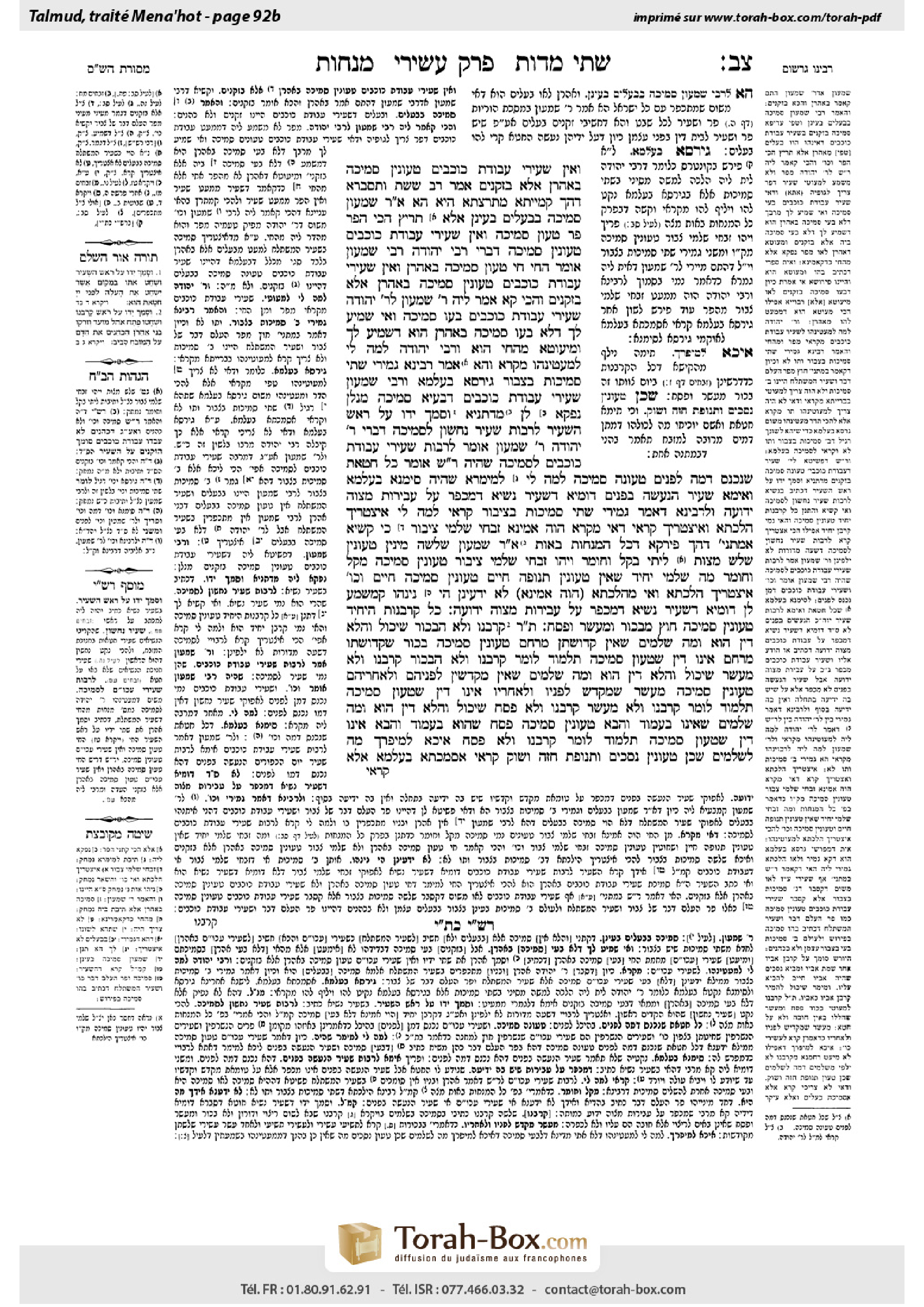
Menachot 92b: Talmud study for Daf Yomi
Daf Yomi is the daily study of one Talmud folio. Explore 37 tractates with scans, Hebrew text, Sefaria English and AI-generated French translations where annotated.
Passage selection and English or AI-generated French translation are available where the scan has annotations. Daf Study is independent of Torah-Box and Sefaria.
Browse Menachot · מנחות · All tractatesMenachot 92b text and translations
This page of Menachot includes the Aramaic text, an English translation and an AI-generated French translation, alongside the scan above.
מנחות צ״ב ב · Aramaic and Hebrew text
וְאֵין שְׂעִירֵי עֲבוֹדָה זָרָה טְעוּנִין סְמִיכָה בְּאַהֲרֹן, אֶלָּא בִּזְקֵנִים.
אָמַר רַב שֵׁשֶׁת: וְתִסְבְּרָא דְּהָךְ קַמַּיְיתָא מְתָרַצְתָּא הִיא? הָא אָמַר רַבִּי שִׁמְעוֹן: סְמִיכָה בִּבְעָלִים בָּעֵינַן!
אֶלָּא תָּרֵיץ הָכִי: ״הַפָּר״ – פַּר טָעוּן סְמִיכָה, וְאֵין שְׂעִירֵי עֲבוֹדָה זָרָה טְעוּנִין סְמִיכָה, דִּבְרֵי רַבִּי יְהוּדָה. רַבִּי שִׁמְעוֹן אוֹמֵר: ״הַחַי״ – חַי טָעוּן סְמִיכָה בְּאַהֲרֹן, וְאֵין שְׂעִירֵי עֲבוֹדָה זָרָה טְעוּנִין סְמִיכָה בְּאַהֲרֹן, אֶלָּא בִּזְקֵנִים.
וְהָכִי קָא אָמַר לֵיהּ רַבִּי שִׁמְעוֹן לְרַבִּי יְהוּדָה: שְׂעִירֵי עֲבוֹדָה זָרָה בָּעוּ סְמִיכָה, וְאִי שְׁמִיעַ לָךְ דְּלָא בָּעוּ סְמִיכָה – בְּאַהֲרֹן הוּא דִּשְׁמִיעַ לָךְ, וּמִיעוּטָא מֵ״הַחַי״ הוּא.
וְרַבִּי יְהוּדָה, לְמָה לִי לְמַעֹטִינְהוּ מִקְּרָא? וְהָא אָמַר רָבִינָא: גְּמִירִי שְׁתֵּי סְמִיכוֹת בְּצִבּוּר, גִּירְסָא בְּעָלְמָא.
וְרַבִּי שִׁמְעוֹן, שְׂעִירֵי עֲבוֹדָה זָרָה דְּבָעֲיָא סְמִיכָה – מְנָלַן?
נָפְקָא לַן מִדְּתַנְיָא: ״וְסָמַךְ יָדוֹ עַל רֹאשׁ הַשָּׂעִיר״ – לְרַבּוֹת שְׂעִיר נַחְשׁוֹן לִסְמִיכָה, דִּבְרֵי רַבִּי יְהוּדָה. רַבִּי שִׁמְעוֹן אוֹמֵר: לְרַבּוֹת שְׂעִירֵי עֲבוֹדָה זָרָה לִסְמִיכָה, שֶׁהָיָה רַבִּי שִׁמְעוֹן אוֹמֵר: כׇּל חַטָּאת שֶׁנִּכְנַס דָּמָהּ לִפְנִים טְעוּנָה סְמִיכָה.
לְמָה לִי לְמֵימְרָא ״שֶׁהָיָה״? סִימָנָא בְּעָלְמָא.
וְאֵימָא: שָׂעִיר הַנַּעֲשֶׂה בִּפְנִים! דּוּמְיָא דִּשְׂעִיר נָשִׂיא, דִּמְכַפֵּר עַל עֲבֵירוֹת מִצְוָה יְדוּעָה.
וּלְרָבִינָא דְּאָמַר: גְּמִירִי שְׁתֵּי סְמִיכוֹת בְּצִיבּוּר, קְרָאֵי לְמָה לִי?
אִיצְטְרִיךְ הִלְכְתָא, וְאִיצְטְרִיךְ קְרָאי.
דְּאִי מִקְּרָא, הֲוָה אָמֵינָא: זִבְחֵי שַׁלְמֵי צִיבּוּר.
כִּי קֻשְׁיָא אַמַּתְנִיתִין דְּהָךְ פִּירְקָא, דְּ״כׇל הַמְּנָחוֹת בָּאוֹת״, אָמַר רַבִּי שִׁמְעוֹן: שְׁלֹשָׁה מִינִין טְעוּנִין שָׁלֹשׁ מִצְוֹת.
לֵיתֵי בְּקַל וָחוֹמֶר, וִיהוּ זִבְחֵי שַׁלְמֵי צִיבּוּר טְעוּנִין סְמִיכָה מִקַּל וְחוֹמֶר: מָה שַׁלְמֵי יָחִיד, שֶׁאֵין טְעוּנִין תְּנוּפָה חַיִּים, טְעוּנִין סְמִיכָה חַיִּים וְכוּ׳. אִיצְטְרִיךְ הִלְכְתָא.
וְאִי מֵהִלְכְתָא, הֲוָה אָמֵינָא לָא יָדְעִינַן הֵי נִינְהוּ, קָמַשְׁמַע לַן דּוּמְיָא דִּשְׂעִיר נָשִׂיא, דִּמְכַפֵּר עַל עֲבֵירוֹת מִצְוָה יְדוּעָה.
כׇּל קׇרְבְּנוֹת הַיָּחִיד טְעוּנִין סְמִיכָה, חוּץ מִבְּכוֹר וּמַעֲשֵׂר וּפֶסַח.
תָּנוּ רַבָּנַן: ״קׇרְבָּנוֹ״ – וְלֹא הַבְּכוֹר, שֶׁיָּכוֹל וַהֲלֹא דִּין הוּא: וּמָה שְׁלָמִים שֶׁאֵין קְדוּשָּׁתָן מֵרֶחֶם טְעוּנִין סְמִיכָה, בְּכוֹר שֶׁקְּדוּשָּׁתוֹ מֵרֶחֶם אֵינוֹ דִּין שֶׁטָּעוּן סְמִיכָה! תַּלְמוּד לוֹמַר: ״קׇרְבָּנוֹ״ – וְלֹא הַבְּכוֹר.
״קׇרְבָּנוֹ״ – וְלֹא מַעֲשֵׂר, שֶׁיָּכוֹל וַהֲלֹא דִּין הוּא: וּמָה שְׁלָמִים שֶׁאֵין מְקַדְּשִׁין לִפְנֵיהֶם וּלְאַחֲרֵיהֶם טְעוּנִין סְמִיכָה, מַעֲשֵׂר שֶׁמְּקַדֵּשׁ לְפָנָיו וּלְאַחֲרָיו – אֵינוֹ דִּין שֶׁטָּעוּן סְמִיכָה! תַּלְמוּד לוֹמַר: ״קׇרְבָּנוֹ״ – וְלֹא מַעֲשֵׂר.
״קׇרְבָּנוֹ״ – וְלֹא פֶּסַח, שֶׁיָּכוֹל וַהֲלֹא דִּין הוּא: וּמָה שְׁלָמִים שֶׁאֵינוֹ בַּ״עֲמוֹד וְהָבֵא״ טְעוּנִין סְמִיכָה, פֶּסַח שֶׁהוּא בַּ״עֲמוֹד וְהָבֵא״ אֵינוֹ דִּין שֶׁטָּעוּן סְמִיכָה! תַּלְמוּד לוֹמַר: ״קׇרְבָּנוֹ״ – וְלֹא פֶּסַח.
אִיכָּא לְמִיפְרַךְ: מָה לִשְׁלָמִים שֶׁכֵּן טְעוּנִין נְסָכִים וּתְנוּפַת חָזֶה וָשׁוֹק? קְרָאֵי אַסְמַכְתָּא בְּעָלְמָא.
אֶלָּא
Menachot 92b · English translation
but the goats brought for idol worship do not require that placing hands be performed by Aaron. Rather, they require that it be performed by the Elders of the Sanhedrin. This contradicts the baraita that states that Rabbi Shimon holds that placing hands on the goats brought for idol worship is performed by the High Priest.
Rav Sheshet said: And how can you understand that this first baraita is accurate, in order to use it as the basis for a contradiction? But didn’t Rabbi Shimon say that we require that placing hands be performed by the owners, i.e., those who will achieve atonement through the offering? The goat brought for idol worship is brought to atone for the Sanhedrin and the people, not for the High Priest.
Rather, answer that the earlier baraita teaches as follows: The verse specifies the requirement of placing hands with regard to the bull brought for a community-wide transgression to indicate that only that bull requires placing hands, but the goats brought for idol worship do not require placing hands; this is the statement of Rabbi Yehuda. Rabbi Shimon says: The verse specifies the requirement of placing hands with regard to the live goat, i.e., the scapegoat, to indicate that only that live goat requires that placing hands be performed by Aaron, i.e., the High Priest, but the goats brought for a community-wide perpetration of idol worship do not require that placing hands be performed by Aaron. Rather, they require that it be performed by the Elders of the Sanhedrin.
The Gemara adds: And this is what Rabbi Shimon was saying to Rabbi Yehuda: Goats brought for idol worship require placing hands. And if you heard a tradition that they do not require placing hands, it is only with regard to the fact that it is not to be performed by Aaron, i.e., the High Priest, that you heard that tradition, and the exclusion of the High Priest from having to place hands is derived from the term “the live goat.”
The Gemara questions Rabbi Yehuda’s statement: And according to Rabbi Yehuda, why do I need to exclude the goats brought for idol worship from the requirement of placing hands by deriving this exclusion from a verse? Didn’t Ravina say that it is learned as a tradition that there are two instances in which placing hands is required for communal offerings? Accordingly, once it has been established that placing hands is required for the bull brought for a community-wide transgression and for the scapegoat, it follows that it is not required in any other case. The Gemara explains: Rabbi Yehuda holds that the tradition Ravina cited is merely a well-known statement. It is not a tradition that was transmitted to Moses; rather, the Sages formulated it to remember the halakha that they derived from the verses.
The Gemara questions Rabbi Shimon’s statement: And according to Rabbi Shimon, from where do we derive that the goats brought for idol worship require placing hands?
The Gemara answers that we derive it from that which is taught in a baraita: The verse states: “When a king sins…he shall bring for his offering an unblemished male goat. And he shall place his hand upon the head of the goat” (Leviticus 4:22–24). The verse could have stated: Upon its head. The reason it adds “of the goat” is to include the goat brought as a sin offering by Nahshon (see Numbers 7:12–17) in the requirement of placing hands on the head of an offering. This is the statement of Rabbi Yehuda. Rabbi Shimon says: The term “of the goat” serves to include the goats brought as sin offerings for communal idol worship in the requirement of placing hands on the head of an offering, as Rabbi Shimon would say: Any sin offering whose blood enters inside the Sanctuary requires placing hands.
The Gemara questions the concluding statement of the baraita: Why do I need the baraita to state: As Rabbi Shimon would say? The statement would appear to explain that Rabbi Shimon’s ruling is merely an expression of a principle that he held, while the baraita itself explains that Rabbi Shimon derived the matter from the repetition of the word “goat.” The Gemara explains: The statement is not presenting the basis of his ruling but is merely a mnemonic to aid in remembering it.
The Gemara questions why Rabbi Shimon expounds the word “goat” as referring to goats brought for idol worship: But why not say that the word “goat” includes the goat whose blood presentation is performed inside the Sanctuary on Yom Kippur? The Gemara answers: It is more reasonable to include a goat offering that is similar to the offering mentioned in that verse, i.e., the goat of a king, which atones for known transgressions of a mitzva. A goat brought for idol worship is similar in this regard, whereas the goat brought on Yom Kippur atones specifically for transgressions of which the transgressor is unaware.
The Gemara questions why Rabbi Shimon needs a verse at all: And according to the opinion of Ravina, who said: It is learned as a tradition that there are two instances in which placing hands is required for communal offerings, why do I need any verses, i.e., why do I need the word “goat,” to include goats brought for idol worship in the requirement of placing hands? Since he holds that the priests do not achieve atonement through the scapegoat, perforce the goat brought to atone for idol worship must require placing hands, as otherwise there would not be two instances.
The Gemara explains: The halakha learned by tradition was necessary, and the exposition of the verses was necessary as well.
The Gemara elaborates: As, if the halakha were to be derived only from the verse, I would say through an a fortiori inference that even communal peace offerings, i.e., the two lambs brought with the two loaves on the festival of Shavuot, require placing of the hands.
The Gemara explains: This is like the difficulty raised against the mishna of that chapter, i.e., Chapter Five, which begins: All the meal offerings come to be offered as matza. The mishna there states (61a): Rabbi Shimon says: There are three types of offerings that require performance of three mitzvot; in each case, two of the mitzvot apply, but not the third. The mishna continues: Peace offerings brought by individuals require placing hands on the head of the animal while the animal is still alive, and waving after it is slaughtered, but there is no obligation to wave it while it is alive. Communal peace offerings require waving both while they are alive and after they are slaughtered, but there is no obligation to place hands on them. And the guilt offering of the leper requires placing hands and waving while alive, but there is no obligation to wave it after it is slaughtered.
The Gemara there (62b) raises the following difficulty: Let us bring an a fortiori inference to the contrary, i.e., conclude that communal peace offerings should require placing hands through an a fortiori inference: If peace offerings brought by an individual, whose halakha is more lenient than that of communal peace offerings in that they do not require waving while alive, nevertheless require placing hands, then with regard to communal peace offerings, which do require waving when alive, is it not logical to conclude that they require placing hands? To counter this inference it was necessary to have the halakha learned by tradition to limit the requirement of placing hands to only two instances.
And conversely, if it were derived only from the halakha learned by tradition, without the exposition of the verse, I would say that we do not know exactly which offering other than the bull brought for a community-wide transgression requires placing hands. Therefore, the word “goat” teaches us that the second instance is a goat offering similar to the offering mentioned in that verse, specifically the goat of a king, which atones for known transgressions of a mitzva, i.e., a goat brought for idol worship.
§ The mishna teaches: All offerings of an individual require placing hands except for the firstborn offering, the animal tithe offering, and the Paschal offering.
Leviticus, chapter 3, discusses peace offerings and details the obligation of placing hands. The term “his offering” is mentioned a number of times. Each time serves to emphasize that peace offerings require placing hands and to exclude another type of offering from that requirement. The Sages taught a baraita detailing which offerings are excluded and why one might have thought otherwise. “His offering” (Leviticus 3:1) requires placing hands, but not the firstborn offering. As one might have thought: Could this not be derived through an a fortiori inference, as follows: If a peace offering, whose consecration does not originate from being in its mother’s womb, nevertheless requires placing hands, then with regard to a firstborn offering, whose consecration originates from the womb, is it not logical that it requires placing hands? To counter this inference, the verse states: “His offering,” teaching that a peace offering requires placing hands but the firstborn offering does not.
“His offering” (Leviticus 3:2) requires placing hands, but not the animal tithe offering. As one might have thought: Could this not be derived through an a fortiori inference, as follows: If peace offerings, which are unlike the animal tithe in that their designation does not consecrate the animals before and after them, i.e., this unique stringency of animal tithe does not apply to them, nevertheless require placing hands, then with regard to an animal tithe offering, which can consecrate the animals before and after it, as in the case where the ninth or eleventh animal to be counted was mistakenly designated as the tenth animal, is it not logical that it requires placing hands? To counter this inference, the verse states: “His offering,” teaching that a peace offering requires placing hands, but the animal tithe offering does not.
The baraita concludes: “His offering” (Leviticus 3:6) requires placing hands, but not the Paschal offering. As one might have thought: Could this not be derived through an a fortiori inference, as follows: If peace offerings, which are not subject to a positive mitzva to arise and bring them, nevertheless require placing hands, then with regard to a Paschal offering, which is subject to a positive mitzva to arise and bring it, is it not logical that it requires placing hands? To counter this inference, the verse states: “His offering,” teaching that a peace offering requires placing hands, but the Paschal offering does not.
The Gemara rejects the inferences of the baraita: Each of these a fortiori inferences can be refuted. What is notable about peace offerings? They are notable in that they require libations and the waving of the breast and thigh. Therefore, a halakha that applies to peace offerings cannot necessarily be applied to the firstborn offering, animal tithe offering, or Paschal offering, which do not share those requirements. Accordingly, the verses that the baraita cites must be understood as a mere support, but are not actually necessary to counter the a fortiori inferences.
The Gemara asks: But
Menachot 92b · Traduction française (IA)
mais les boucs apportés pour l’idolâtrie n’exigent pas que l’imposition des mains soit effectuée par Aaron. Elle doit plutôt être effectuée par les Anciens du Sanhédrin. Cela contredit la baraïta selon laquelle Rabbi Shimon considère que l’imposition des mains sur les boucs apportés pour l’idolâtrie est effectuée par le Grand Prêtre.
Rav Sheshet dit : Et comment peux-tu considérer que cette première baraïta est exacte, au point de t’en servir pour établir une contradiction ? Rabbi Shimon n’a-t-il pas dit que l’imposition des mains doit être effectuée par les propriétaires, c’est-à-dire ceux qui obtiendront l’expiation grâce à l’offrande ? Le bouc apporté pour l’idolâtrie est offert pour expier les fautes du Sanhédrin et du peuple, et non celles du Grand Prêtre.
Réponds plutôt que la baraïta précédente enseigne ce qui suit : le verset précise l’obligation d’imposer les mains à propos du taureau apporté pour une transgression de toute la communauté afin d’indiquer que seul ce taureau exige l’imposition des mains, tandis que les boucs apportés pour l’idolâtrie ne l’exigent pas ; telle est l’opinion de Rabbi Yehouda. Rabbi Shimon dit : le verset précise l’obligation d’imposer les mains à propos du bouc vivant, c’est-à-dire le bouc émissaire, afin d’indiquer que seul ce bouc vivant exige qu’Aaron, c’est-à-dire le Grand Prêtre, impose les mains, tandis que les boucs apportés pour une transgression collective d’idolâtrie n’exigent pas qu’Aaron leur impose les mains. L’imposition des mains doit plutôt être effectuée par les Anciens du Sanhédrin.
La Guemara ajoute : voici ce que Rabbi Shimon disait à Rabbi Yehouda : les boucs apportés pour l’idolâtrie exigent l’imposition des mains. Et si tu as reçu une tradition selon laquelle ils ne l’exigent pas, cette tradition concerne uniquement le fait que l’imposition des mains ne doit pas être effectuée par Aaron, c’est-à-dire le Grand Prêtre ; l’exclusion du Grand Prêtre de l’obligation d’imposer les mains est déduite de l’expression « le bouc vivant ».
La Guemara conteste la déclaration de Rabbi Yehouda : selon Rabbi Yehouda, pourquoi faut-il exclure les boucs apportés pour l’idolâtrie de l’obligation d’imposer les mains en déduisant cette exclusion d’un verset ? Ravina n’a-t-il pas dit qu’une tradition enseigne que, pour les offrandes communautaires, l’imposition des mains est requise dans deux cas ? Par conséquent, dès lors qu’il a été établi qu’elle est requise pour le taureau apporté pour une transgression de toute la communauté et pour le bouc émissaire, il s’ensuit qu’elle n’est requise dans aucun autre cas. La Guemara explique : Rabbi Yehouda considère que la tradition citée par Ravina n’est qu’une formule bien connue. Ce n’est pas une tradition transmise à Moïse ; les Sages l’ont plutôt formulée pour se rappeler la halakha qu’ils ont déduite des versets.
La Guemara conteste la déclaration de Rabbi Shimon : selon Rabbi Shimon, d’où déduisons-nous que les boucs apportés pour l’idolâtrie exigent l’imposition des mains ?
La Guemara répond que nous le déduisons de ce qui est enseigné dans une baraïta : le verset dit : « Lorsqu’un chef pèche… il apportera comme offrande un bouc mâle sans défaut. Il posera sa main sur la tête du bouc » (Lévitique 4, 22-24). Le verset aurait pu dire : « sur sa tête ». S’il ajoute « du bouc », c’est pour inclure le bouc apporté par Nahshon comme sacrifice expiatoire (voir Nombres 7, 12-17) dans l’obligation d’imposer les mains sur la tête d’une offrande. Telle est l’opinion de Rabbi Yehouda. Rabbi Shimon dit : l’expression « du bouc » sert à inclure les boucs apportés comme sacrifices expiatoires pour l’idolâtrie commise par la communauté, dans l’obligation d’imposer les mains sur la tête d’une offrande, car Rabbi Shimon disait : tout sacrifice expiatoire dont le sang est introduit à l’intérieur du Sanctuaire exige l’imposition des mains.
La Guemara conteste la conclusion de la baraïta : pourquoi la baraïta doit-elle dire « comme Rabbi Shimon le disait » ? Cette formule semble indiquer que la décision de Rabbi Shimon n’est que l’expression d’un principe qu’il soutenait, alors que la baraïta elle-même explique qu’il a déduit la règle de la répétition du mot « bouc ». La Guemara explique : cette formule ne présente pas le fondement de sa décision ; elle sert seulement de moyen mnémotechnique pour s’en souvenir.
La Guemara demande pourquoi Rabbi Shimon interprète le mot « bouc » comme désignant les boucs apportés pour l’idolâtrie : pourquoi ne pas dire que le mot « bouc » inclut le bouc dont le sang est présenté à l’intérieur du Sanctuaire à Yom Kippour ? La Guemara répond : il est plus logique d’inclure une offrande de bouc semblable à celle mentionnée dans ce verset, c’est-à-dire le bouc d’un roi, qui expie des transgressions connues d’une mitsva. À cet égard, le bouc apporté pour l’idolâtrie lui est semblable, tandis que le bouc apporté à Yom Kippour expie spécifiquement des transgressions dont l’auteur n’a pas connaissance.
La Guemara demande pourquoi Rabbi Shimon a besoin d’un verset : selon l’opinion de Ravina, qui a dit qu’une tradition enseigne que, pour les offrandes communautaires, l’imposition des mains est requise dans deux cas, pourquoi avons-nous besoin de versets, c’est-à-dire pourquoi avons-nous besoin du mot « bouc », pour inclure les boucs apportés pour l’idolâtrie dans l’obligation d’imposer les mains ? Puisqu’il considère que les prêtres n’obtiennent pas l’expiation par le bouc émissaire, le bouc apporté pour expier l’idolâtrie doit nécessairement exiger l’imposition des mains ; autrement, il n’y aurait pas deux cas.
La Guemara explique : la halakha reçue par tradition était nécessaire, et l’interprétation des versets l’était également.
La Guemara développe : en effet, si la halakha était déduite uniquement du verset, je dirais, par une déduction a fortiori, que même les sacrifices de paix communautaires, c’est-à-dire les deux agneaux offerts avec les deux pains lors de la fête de Chavouot, exigent l’imposition des mains.
La Guemara explique : la difficulté est semblable à celle soulevée à propos de la Michna de ce chapitre, c’est-à-dire le chapitre cinq, qui commence ainsi : toutes les offrandes de farine sont offertes sous forme de matsa. La Michna y enseigne (61a) : Rabbi Shimon dit : trois sortes d’offrandes exigent l’accomplissement de trois mitsvot ; dans chaque cas, deux des mitsvot s’appliquent, mais pas la troisième. La Michna poursuit : les sacrifices de paix offerts par des particuliers exigent qu’on impose les mains sur la tête de l’animal tant qu’il est encore vivant, ainsi que le balancement après son abattage, mais il n’est pas obligatoire de le balancer tant qu’il est vivant. Les sacrifices de paix communautaires doivent être balancés tant qu’ils sont vivants et après leur abattage, mais il n’est pas obligatoire de leur imposer les mains. Le sacrifice de culpabilité du lépreux exige l’imposition des mains et le balancement tant que l’animal est vivant, mais il n’est pas obligatoire de le balancer après son abattage.
La Guemara soulève là-bas (62b) la difficulté suivante : tirons la conclusion inverse par une déduction a fortiori, c’est-à-dire concluons que les sacrifices de paix communautaires exigent l’imposition des mains. Si les sacrifices de paix offerts par un particulier, dont la halakha est plus indulgente que celle des sacrifices de paix communautaires en ce qu’ils n’exigent pas d’être balancés tant qu’ils sont vivants, exigent néanmoins l’imposition des mains, alors, s’agissant des sacrifices de paix communautaires, qui doivent être balancés tant qu’ils sont vivants, n’est-il pas logique de conclure qu’ils exigent l’imposition des mains ? Pour réfuter cette déduction, la halakha reçue par tradition était nécessaire afin de limiter l’obligation d’imposer les mains à deux cas seulement.
Inversement, si l’on se fondait uniquement sur la halakha reçue par tradition, sans interpréter le verset, je dirais que nous ne savons pas exactement quelle offrande, autre que le taureau apporté pour une transgression de toute la communauté, exige l’imposition des mains. C’est pourquoi le mot « bouc » nous enseigne que le second cas est une offrande de bouc semblable à celle mentionnée dans ce verset, en particulier le bouc d’un roi, qui expie des transgressions connues d’une mitsva, c’est-à-dire un bouc apporté pour l’idolâtrie.
§ La Michna enseigne : toutes les offrandes d’un particulier exigent l’imposition des mains, à l’exception de l’offrande du premier-né, de l’offrande de la dîme du bétail et de l’offrande pascale.
Le chapitre 3 du Lévitique traite des sacrifices de paix et détaille l’obligation d’imposer les mains. L’expression « son offrande » y est mentionnée plusieurs fois. Chaque occurrence souligne que les sacrifices de paix exigent l’imposition des mains et exclut un autre type d’offrande de cette obligation. Les Sages ont enseigné une baraïta qui détaille les offrandes exclues et explique pourquoi on aurait pu penser le contraire. L’expression « son offrande » (Lévitique 3, 1) exige l’imposition des mains, mais pas l’offrande du premier-né. On aurait pu penser : ne pourrait-on pas le déduire par une déduction a fortiori, comme suit ? Si un sacrifice de paix, dont la consécration ne provient pas de son statut dans le ventre de sa mère, exige néanmoins l’imposition des mains, alors, s’agissant de l’offrande d’un premier-né, dont la consécration trouve son origine dans le ventre de sa mère, n’est-il pas logique qu’elle exige l’imposition des mains ? Pour réfuter cette déduction, le verset dit : « son offrande », enseignant qu’un sacrifice de paix exige l’imposition des mains, mais pas l’offrande du premier-né.
L’expression « son offrande » (Lévitique 3, 2) exige l’imposition des mains, mais pas l’offrande de la dîme du bétail. On aurait pu penser : ne pourrait-on pas le déduire par une déduction a fortiori, comme suit ? Si les sacrifices de paix, qui ne partagent pas avec la dîme du bétail la propriété de consacrer les animaux qui la précèdent et la suivent — cette rigueur particulière de la dîme du bétail ne s’applique donc pas à eux — exigent néanmoins l’imposition des mains, alors, s’agissant de l’offrande de la dîme du bétail, qui peut consacrer les animaux qui la précèdent et la suivent, comme dans le cas où le neuvième ou le onzième animal compté est désigné par erreur comme le dixième, n’est-il pas logique qu’elle exige l’imposition des mains ? Pour réfuter cette déduction, le verset dit : « son offrande », enseignant qu’un sacrifice de paix exige l’imposition des mains, mais pas l’offrande de la dîme du bétail.
La baraïta conclut : l’expression « son offrande » (Lévitique 3, 6) exige l’imposition des mains, mais pas l’offrande pascale. On aurait pu penser : ne pourrait-on pas le déduire par une déduction a fortiori, comme suit ? Si les sacrifices de paix, pour lesquels il n’existe pas de mitsva positive de se mettre en route et de les apporter, exigent néanmoins l’imposition des mains, alors, s’agissant de l’offrande pascale, pour laquelle il existe une mitsva positive de se mettre en route et de l’apporter, n’est-il pas logique qu’elle exige l’imposition des mains ? Pour réfuter cette déduction, le verset dit : « son offrande », enseignant qu’un sacrifice de paix exige l’imposition des mains, mais pas l’offrande pascale.
La Guemara rejette les déductions de la baraïta : chacune de ces déductions a fortiori peut être réfutée. Qu’y a-t-il de particulier dans les sacrifices de paix ? Ils se distinguent en ce qu’ils exigent des libations ainsi que le balancement de la poitrine et de la cuisse. Par conséquent, une halakha qui s’applique aux sacrifices de paix ne s’applique pas nécessairement à l’offrande du premier-né, à l’offrande de la dîme du bétail ou à l’offrande pascale, qui ne sont pas soumises à ces obligations. Il faut donc comprendre les versets cités par la baraïta comme un simple appui, et non comme étant véritablement nécessaires pour réfuter les déductions a fortiori.
La Guemara demande : Mais
Traduction française générée par IA à partir de l’édition anglaise de Sefaria. Vérifie toujours un passage avec le texte source.
Text from Sefaria: William Davidson Edition - Vocalized Aramaic (unknown); William Davidson Edition - English (CC BY NC).