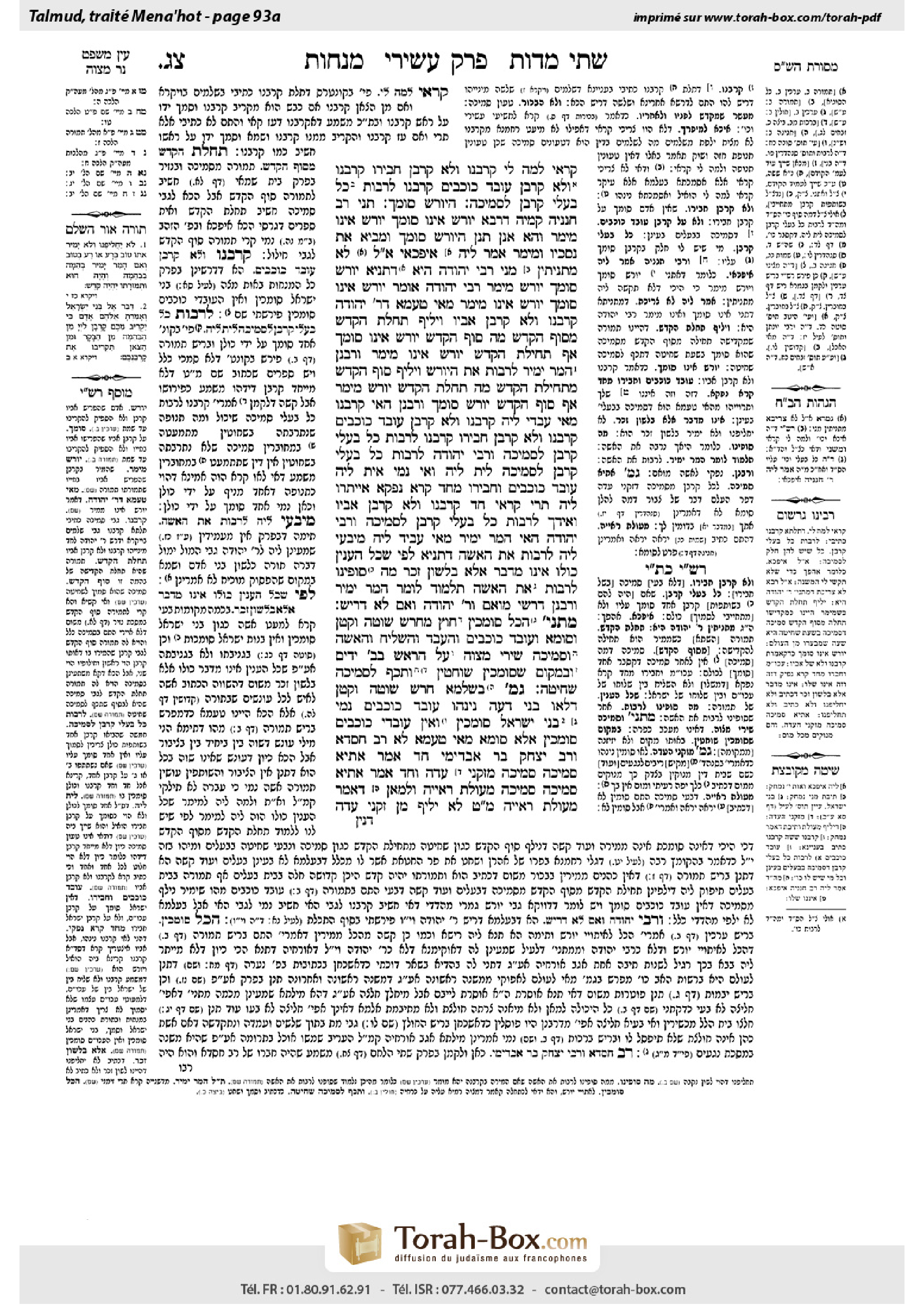
Menachot 93a: Talmud study for Daf Yomi
Daf Yomi is the daily study of one Talmud folio. Explore 37 tractates with scans, Hebrew text, Sefaria English and AI-generated French translations where annotated.
Passage selection and English or AI-generated French translation are available where the scan has annotations. Daf Study is independent of Torah-Box and Sefaria.
Browse Menachot · מנחות · All tractatesMenachot 93a text and translations
This page of Menachot includes the Aramaic text, an English translation and an AI-generated French translation, alongside the scan above.
מנחות צ״ג א · Aramaic and Hebrew text
קְרָאֵי לְמָה לִי? ״קׇרְבָּנוֹ״ – וְלֹא קׇרְבַּן חֲבֵירוֹ, ״קׇרְבָּנוֹ״ – וְלֹא קׇרְבַּן גּוֹי, ״קׇרְבָּנוֹ״ – לְרַבּוֹת כׇּל בַּעֲלֵי קׇרְבָּן לִסְמִיכָה.
הַיּוֹרֵשׁ סוֹמֵךְ.
תָּנֵי רַב חֲנַנְיָה קַמֵּיהּ דְּרָבָא: יוֹרֵשׁ אֵינוֹ סוֹמֵךְ, יוֹרֵשׁ אֵינוֹ מֵימֵר. וְהָא אֲנַן תְּנַן: הַיּוֹרֵשׁ סוֹמֵךְ, וּמֵבִיא אֶת נְסָכָיו, וּמֵימֵר.
אֲמַר לֵיהּ אֶיפְכַאּי? אֲמַר לֵיהּ: לָא, מַתְנִיתִין מַנִּי? רַבִּי יְהוּדָה הִיא, דְּתַנְיָא: יוֹרֵשׁ סוֹמֵךְ, יוֹרֵשׁ מֵימֵר. רַבִּי יְהוּדָה אוֹמֵר: יוֹרֵשׁ אֵינוֹ סוֹמֵךְ, יוֹרֵשׁ אֵינוֹ מֵימֵר.
מַאי טַעְמָא דְּרַבִּי יְהוּדָה? ״קׇרְבָּנוֹ״ – וְלֹא קׇרְבַּן אָבִיו, וְיָלֵיף תְּחִלַּת הֶקְדֵּשׁ מִסּוֹף הֶקְדֵּשׁ: מָה סוֹף הֶקְדֵּשׁ – יוֹרֵשׁ אֵינוֹ סוֹמֵךְ, אַף תְּחִילַּת הֶקְדֵּשׁ – יוֹרֵשׁ אֵינוֹ מֵימֵר.
וְרַבָּנַן: ״הָמֵר יָמִיר״ – לְרַבּוֹת אֶת הַיּוֹרֵשׁ, וְיָלֵיף סוֹף הֶקְדֵּשׁ מִתְּחִילַּת הֶקְדֵּשׁ: מָה תְּחִלַּת הֶקְדֵּשׁ – יוֹרֵשׁ מֵימֵר, אַף סוֹף הֶקְדֵּשׁ – יוֹרֵשׁ סוֹמֵךְ.
וְרַבָּנַן, הַאי ״קׇרְבָּנוֹ״ מַאי עָבְדִי לֵיהּ? ״קׇרְבָּנוֹ״ – וְלֹא קׇרְבַּן גּוֹי, ״קׇרְבָּנוֹ״ – וְלֹא קׇרְבַּן חֲבֵירוֹ, ״קׇרְבָּנוֹ״ – לְרַבּוֹת כׇּל בַּעֲלֵי קׇרְבָּן לִסְמִיכָה.
וְרַבִּי יְהוּדָה, לְרַבּוֹת כׇּל בַּעֲלֵי קׇרְבָּן לִסְמִיכָה – לֵית לֵיהּ, וְאִי נָמֵי אִית לֵיהּ – גּוֹי וַחֲבֵירוֹ מֵחַד קְרָא נָפְקָא. אִיַּיתַּרוּ לֵיהּ תְּרֵי קְרָאֵי: חַד – ״קׇרְבָּנוֹ״ וְלֹא קׇרְבַּן אָבִיו, וְאִידַּךְ – לְרַבּוֹת כׇּל בַּעֲלֵי קׇרְבָּן לִסְמִיכָה.
וְרַבִּי יְהוּדָה, הַאי ״הָמֵר יָמִיר״ מַאי עָבֵיד לֵיהּ? מִיבְּעֵי לֵיהּ לְרַבּוֹת אֶת הָאִשָּׁה, דְּתַנְיָא: לְפִי שֶׁכׇּל הָעִנְיָן כּוּלּוֹ אֵינוֹ מְדַבֵּר אֶלָּא בִּלְשׁוֹן זָכָר, מָה סוֹפֵינוּ לְרַבּוֹת אֶת הָאִשָּׁה? תַּלְמוּד לוֹמַר ״הָמֵר יָמִיר״.
וְרַבָּנַן דָּרְשִׁי מִ״וְּאִם״, וְרַבִּי יְהוּדָה ״וְאִם״ לָא דָּרֵישׁ.
מַתְנִי׳ הַכֹּל סוֹמְכִין, חוּץ מֵחֵרֵשׁ, שׁוֹטֶה, וְקָטָן, וְסוֹמֵא, וְגוֹי, וְהָעֶבֶד, וְהַשָּׁלִיחַ, וְהָאִשָּׁה.
וּסְמִיכָה – שְׁיָרֵי מִצְוָה.
עַל הָרֹאשׁ בִּשְׁתֵּי יָדַיִם, וּבִמְקוֹם שֶׁסּוֹמְכִין שׁוֹחֲטִין, וְתֵכֶף לִסְמִיכָה שְׁחִיטָה.
גְּמָ׳ בִּשְׁלָמָא חֵרֵשׁ שׁוֹטֶה וְקָטָן, דְּלָאו בְּנֵי דֵעָה נִינְהוּ. גּוֹי נָמֵי – ״בְּנֵי יִשְׂרָאֵל״ סוֹמְכִין וְאֵין גּוֹיִם סוֹמְכִין. אֶלָּא סוֹמֵא מַאי טַעְמָא לָא?
רַב חִסְדָּא וְרַב יִצְחָק בַּר אַבְדִּימִי, חַד אָמַר: אָתְיָא סְמִיכָה סְמִיכָה מִ״זִּקְנֵי עֵדָה״.
וְחַד אָמַר: אָתְיָא סְמִיכָה סְמִיכָה מֵעוֹלַת רְאִיָּיה.
וּלְמַאן דְּאָמַר מֵעוֹלַת רְאִיָּיה, מַאי טַעְמָא לָא יָלֵיף מִן זִקְנֵי עֵדָה?
Menachot 93a · English translation
if the repeated term “his offering” is not needed to counter the a fortiori inferences, why do I need these three verses? The Gemara explains: One instance of “his offering” teaches that one places hands only on one’s own offering, but not on an offering of another person. Another instance of “his offering” teaches that one places hands only on one’s own offering, but not on an offering of a gentile. The third instance of “his offering” serves to include all the owners of a jointly owned offering in the requirement of placing hands, i.e., they are all required to place their hands on the offering.
§ The mishna states: If the owner of an offering died, then the heir is regarded as the offering’s owner. Therefore, he places his hands on the offering and brings the accompanying libations, and he can substitute a non-sacred animal for it. Although it is prohibited to perform an act of substitution, if the owner of an offering does this, his attempt is successful to the extent that the non-sacred animal is thereby consecrated, even though the original offering also remains sacred.
Rav Ḥananya taught a baraita in the presence of Rava: An heir does not place hands on an offering he inherited, and an heir cannot substitute a non-sacred animal for an offering he inherited. Rava asked: But didn’t we learn in the mishna: The heir places his hands on the offering, and brings the accompanying libations, and he can substitute a non-sacred animal for it and thereby consecrate the non-sacred animal?
Rav Ḥananya said to Rava: Should I reverse the current version of the baraita to have it be in accordance with the mishna? Rava said to him: No, as whose opinion is expressed in the mishna? It is the opinion of Rabbi Yehuda, as it is taught in a baraita: An heir places hands, and an heir can effect substitution. Rabbi Yehuda says: An heir does not place hands, and an heir cannot effect substitution.
The Gemara clarifies: What is the reasoning of Rabbi Yehuda? He expounds the term “his offering” as teaching that one places hands only on one’s own offering, but not on one’s father’s offering that one inherited. And furthermore, Rabbi Yehuda derives the halakha concerning who can substitute a non-sacred animal for an offering, which is the initial stage of consecration, from the halakha concerning who performs the rite of placing hands on the offering, which is the final stage of consecration: Just as with regard to the final stage of consecration, an heir does not place his hands, so too, with regard to the initial stage of consecration, an heir cannot effect substitution.
And as for the Rabbis, from where do they derive their opinion? The verse states: “If he shall substitute [hamer yamir] animal for animal” (Leviticus 27:10), with the doubled form of hamer yamir serving to include the heir as one capable of effecting substitution. And furthermore, they derive the halakha concerning who performs the rite of placing hands, which is the final stage of consecration, from the halakha concerning who can effect substitution, which is an initial stage of consecration: Just as with regard to the initial stage of consecration, an heir can effect substitution, so too, with regard to the final stage of consecration, an heir places his hands.
The Gemara asks: And as for the Rabbis, what do they do with this term: “His offering”? The Gemara explains how the Rabbis expound each mention of the term. One instance of “his offering” teaches that one places hands only on one’s own offering, but not on an offering of a gentile. Another instance of “his offering” teaches that one places hands only on one’s own offering, but not on an offering of another person. The third instance of “his offering” serves to include all the owners of a jointly owned offering in the requirement of placing hands, i.e., they are all required to place their hands on the offering.
The Gemara clarifies: And Rabbi Yehuda does not hold that one of the mentions serves to include all the owners of a jointly owned offering in the requirement of placing hands, so he is able to expound it to exclude an heir from the requirement. Alternatively, if he holds that one of the mentions serves to include owners of a jointly owned offering, then he must derive that one does not place hands on the offering of a gentile or of another person from the same one mention in the verse, which leaves him two more mentions in the verses. One he expounds to teach that on “his offering” he places hands, but not on his father’s offering that he inherited, and the other mention remains to include all the owners of a jointly owned offering in the requirement of placing hands.
The Gemara asks: And as for Rabbi Yehuda, what does he do with the use of the doubled form in this verse: “If he shall substitute [hamer yamir]”? The Gemara answers: He requires it to include a woman among those who can effect substitution. As it is taught in a baraita: Since the entire matter of substitution is stated in the Torah only in the masculine form, what is the reason that we ultimately come to include a woman? The verse states: “If he shall substitute [hamer yamir],” using a doubled form.
And as for the Rabbis, they derive that a woman can effect substitution from the term: “And if” (Leviticus 27:10), in the phrase “and if he shall substitute.” And Rabbi Yehuda does not expound the term “and if” at all.
MISHNA: Everyone who brings an animal offering places hands upon its head, except for a deaf-mute, an imbecile, a minor, a blind person, a gentile, a Canaanite slave, the agent of the owner of the offering who brings the offering on the owner’s behalf, and a woman.
And the requirement of placing hands is a non-essential mitzva; therefore, failure to place hands does not prevent the owner from achieving atonement.
The rite of placing hands is performed by leaning on the head of the offering with two hands. And in the same location in the Temple that one places hands, one slaughters the animal. And immediately following the rite of placing hands, the slaughter is performed.
GEMARA: The Gemara explains why certain types of people do not place hands on an offering: Granted, a deaf-mute, an imbecile, and a minor do not place their hands on the offering, as they are not mentally competent. The exclusion of a gentile is also understandable, as the verses concerning placing hands are introduced with: “Speak to the children of Israel and say to them” (Leviticus 1:2), which indicates that the children of Israel place hands upon their offerings, but gentiles do not place their hands upon their offerings. But with regard to a blind person, what is the reason that he does not place his hands on his offering?
Rav Ḥisda and Rav Yitzḥak bar Avdimi disagree as to the source of the exclusion of a blind person. One said that it is derived from a verbal analogy between the mention of placing hands in the passage detailing the general requirement to do so, and the mention of placing hands stated with regard to the bull offering brought for a community-wide violation perpetrated due to an erroneous ruling of the Sanhedrin, which is performed by the Elders of the congregation, i.e., the judges of the Sanhedrin: Just as the judges may not be blind (see Sanhedrin 34b), so too the rite of placing hands is not performed by a blind person.
And the other one said that it is derived from a verbal analogy between the mention of placing hands in the passage detailing the general requirement to do so, and the mention of placing hands stated with regard to the burnt offering of appearance brought by an individual on the pilgrimage Festivals: Just as a blind person is exempt from making the pilgrimage to Jerusalem and bringing the offering (see Ḥagiga 2a), so too he is excluded from the requirement of placing hands.
The Gemara asks: And according to the one who said that the exclusion of a blind person is derived from the burnt offering of appearance, what is the reason that he does not derive this from the placing of hands performed by the Elders of the congregation?
Menachot 93a · Traduction française (IA)
Si l’expression répétée « son offrande » n’est pas nécessaire pour répondre aux raisonnements a fortiori, pourquoi ai-je besoin de ces trois versets ? La Guemara explique : Une occurrence de « son offrande » enseigne que l’on ne pose les mains que sur sa propre offrande, et non sur celle d’autrui. Une autre occurrence enseigne que l’on ne pose les mains que sur sa propre offrande, et non sur celle d’un non-Juif. La troisième occurrence sert à inclure tous les propriétaires d’une offrande détenue en commun dans l’obligation de poser les mains : ils doivent donc tous poser les mains sur l’offrande.
§ La Michna enseigne : Si le propriétaire d’une offrande est mort, l’héritier est considéré comme le propriétaire de l’offrande. Il pose donc les mains sur l’offrande, apporte les libations qui l’accompagnent et peut lui substituer un animal non consacré. Bien que la substitution soit interdite, si le propriétaire d’une offrande procède à cette substitution, celle-ci est effective en ce sens que l’animal non consacré est alors consacré, même si l’offrande initiale reste elle aussi sacrée.
Rav Ḥananya enseigna une baraïta en présence de Rava : Un héritier ne pose pas les mains sur une offrande dont il a hérité, et ne peut pas non plus lui substituer un animal non consacré. Rava demanda : Mais n’avons-nous pas appris dans la Michna : L’héritier pose les mains sur l’offrande, apporte les libations qui l’accompagnent et peut lui substituer un animal non consacré, consacrant ainsi cet animal ?
Rav Ḥananya dit à Rava : Dois-je modifier la version actuelle de la baraïta pour la mettre en accord avec la Michna ? Rava lui répondit : Non. De qui la Michna exprime-t-elle l’opinion ? De Rabbi Yehouda, comme il est enseigné dans une baraïta : Un héritier pose les mains, et un héritier peut procéder à une substitution. Rabbi Yehouda dit : Un héritier ne pose pas les mains, et un héritier ne peut pas procéder à une substitution.
La Guemara précise : Quel est le raisonnement de Rabbi Yehouda ? Il interprète l’expression « son offrande » comme enseignant que l’on ne pose les mains que sur sa propre offrande, et non sur l’offrande de son père dont on a hérité. De plus, Rabbi Yehouda déduit la halakha concernant la personne qui peut substituer un animal non consacré à une offrande — étape initiale de la consécration — de la halakha concernant la personne qui accomplit le rite de la pose des mains sur l’offrande — étape finale de la consécration : de même qu’à l’étape finale de la consécration, un héritier ne pose pas les mains, de même, à l’étape initiale de la consécration, un héritier ne peut pas procéder à une substitution.
Et les Rabbins, de quelle source tirent-ils leur opinion ? Le verset dit : « S’il substitue [hamer yamir] un animal à un animal » (Lévitique 27:10) ; la forme redoublée de hamer yamir sert à inclure l’héritier parmi ceux qui peuvent procéder à une substitution. De plus, ils déduisent la halakha concernant la personne qui accomplit le rite de la pose des mains — étape finale de la consécration — de la halakha concernant la personne qui peut procéder à une substitution — étape initiale de la consécration : de même qu’à l’étape initiale de la consécration, un héritier peut procéder à une substitution, de même, à l’étape finale de la consécration, un héritier pose les mains.
La Guemara demande : Et que font les Rabbins de l’expression « son offrande » ? La Guemara explique comment ils interprètent chacune de ses occurrences. Une occurrence enseigne que l’on ne pose les mains que sur sa propre offrande, et non sur celle d’un non-Juif. Une autre enseigne que l’on ne pose les mains que sur sa propre offrande, et non sur celle d’autrui. La troisième sert à inclure tous les propriétaires d’une offrande détenue en commun dans l’obligation de poser les mains : ils doivent donc tous poser les mains sur l’offrande.
La Guemara précise : Rabbi Yehouda ne considère pas que l’une des occurrences sert à inclure tous les propriétaires d’une offrande détenue en commun dans l’obligation de poser les mains ; il peut donc l’interpréter comme excluant l’héritier de cette obligation. Autre possibilité : s’il considère que l’une des occurrences sert à inclure les propriétaires d’une offrande détenue en commun, il doit alors déduire de cette même occurrence que l’on ne pose pas les mains sur l’offrande d’un non-Juif ou sur celle d’autrui. Il lui reste donc deux autres occurrences dans les versets. Il interprète l’une comme enseignant que l’on pose les mains sur « son offrande », mais non sur l’offrande de son père dont on a hérité ; l’autre reste disponible pour inclure tous les propriétaires d’une offrande détenue en commun dans l’obligation de poser les mains.
La Guemara demande : Et que fait Rabbi Yehouda de la forme redoublée dans ce verset : « S’il substitue [hamer yamir] » ? La Guemara répond : Il en a besoin pour inclure les femmes parmi ceux qui peuvent procéder à une substitution. En effet, il est enseigné dans une baraïta : Puisque toute la loi de la substitution est formulée dans la Torah au masculin, pourquoi finit-on par inclure les femmes ? Le verset dit : « S’il substitue [hamer yamir] », en employant une forme redoublée.
Quant aux Rabbins, ils déduisent qu’une femme peut procéder à une substitution de l’expression « et si » (Lévitique 27:10), dans la formule « et s’il substitue ». Rabbi Yehouda, lui, n’interprète pas du tout l’expression « et si ».
MICHNA : Toute personne qui apporte une offrande animale pose les mains sur la tête de l’animal, à l’exception d’un sourd-muet, d’un déficient mental, d’un mineur, d’un aveugle, d’un non-Juif, d’un esclave cananéen, du mandataire du propriétaire de l’offrande qui l’apporte en son nom, et d’une femme.
L’obligation de poser les mains est une mitsva dont l’omission n’invalide pas l’offrande ; par conséquent, ne pas poser les mains n’empêche pas le propriétaire d’obtenir l’expiation.
Le rite de la pose des mains consiste à s’appuyer des deux mains sur la tête de l’offrande. L’animal est abattu au même endroit du Temple où l’on pose les mains. L’abattage a lieu immédiatement après le rite de la pose des mains.
GUEMARA : La Guemara explique pourquoi certaines catégories de personnes ne posent pas les mains sur une offrande : Il est compréhensible qu’un sourd-muet, un déficient mental et un mineur ne posent pas les mains sur l’offrande, car ils ne disposent pas de la capacité mentale requise. L’exclusion d’un non-Juif est également compréhensible, puisque les versets relatifs à la pose des mains commencent par : « Parle aux enfants d’Israël et dis-leur » (Lévitique 1:2), ce qui indique que les enfants d’Israël posent les mains sur leurs offrandes, mais que les non-Juifs ne posent pas les mains sur les leurs. Mais, dans le cas d’un aveugle, pour quelle raison ne pose-t-il pas les mains sur son offrande ?
Rav Ḥisda et Rav Yitzḥak bar Avdimi sont en désaccord sur la source de l’exclusion de l’aveugle. Selon l’un, elle est déduite d’une analogie verbale entre la mention de la pose des mains dans le passage qui expose l’obligation générale de l’accomplir et la mention de la pose des mains à propos du taureau offert pour une transgression commise par la communauté à la suite d’une décision erronée du Sanhédrin. Ce rite est accompli par les Anciens de l’assemblée, c’est-à-dire les juges du Sanhédrin : de même que les juges ne peuvent pas être aveugles (voir Sanhédrin 34b), de même, un aveugle n’accomplit pas le rite de la pose des mains.
Selon l’autre, elle est déduite d’une analogie verbale entre la mention de la pose des mains dans le passage qui expose l’obligation générale de l’accomplir et la mention de la pose des mains à propos de l’holocauste de pèlerinage qu’un particulier apporte lors des fêtes de pèlerinage : de même qu’un aveugle est dispensé de monter en pèlerinage à Jérusalem et d’apporter l’offrande (voir Ḥagiga 2a), de même, il est exclu de l’obligation de poser les mains.
La Guemara demande : Et selon celui qui dit que l’exclusion de l’aveugle est déduite de l’holocauste de pèlerinage, pour quelle raison ne la déduit-il pas de la pose des mains accomplie par les Anciens de l’assemblée ?
Traduction française générée par IA à partir de l’édition anglaise de Sefaria. Vérifie toujours un passage avec le texte source.
Text from Sefaria: William Davidson Edition - Vocalized Aramaic (unknown); William Davidson Edition - English (CC BY NC).