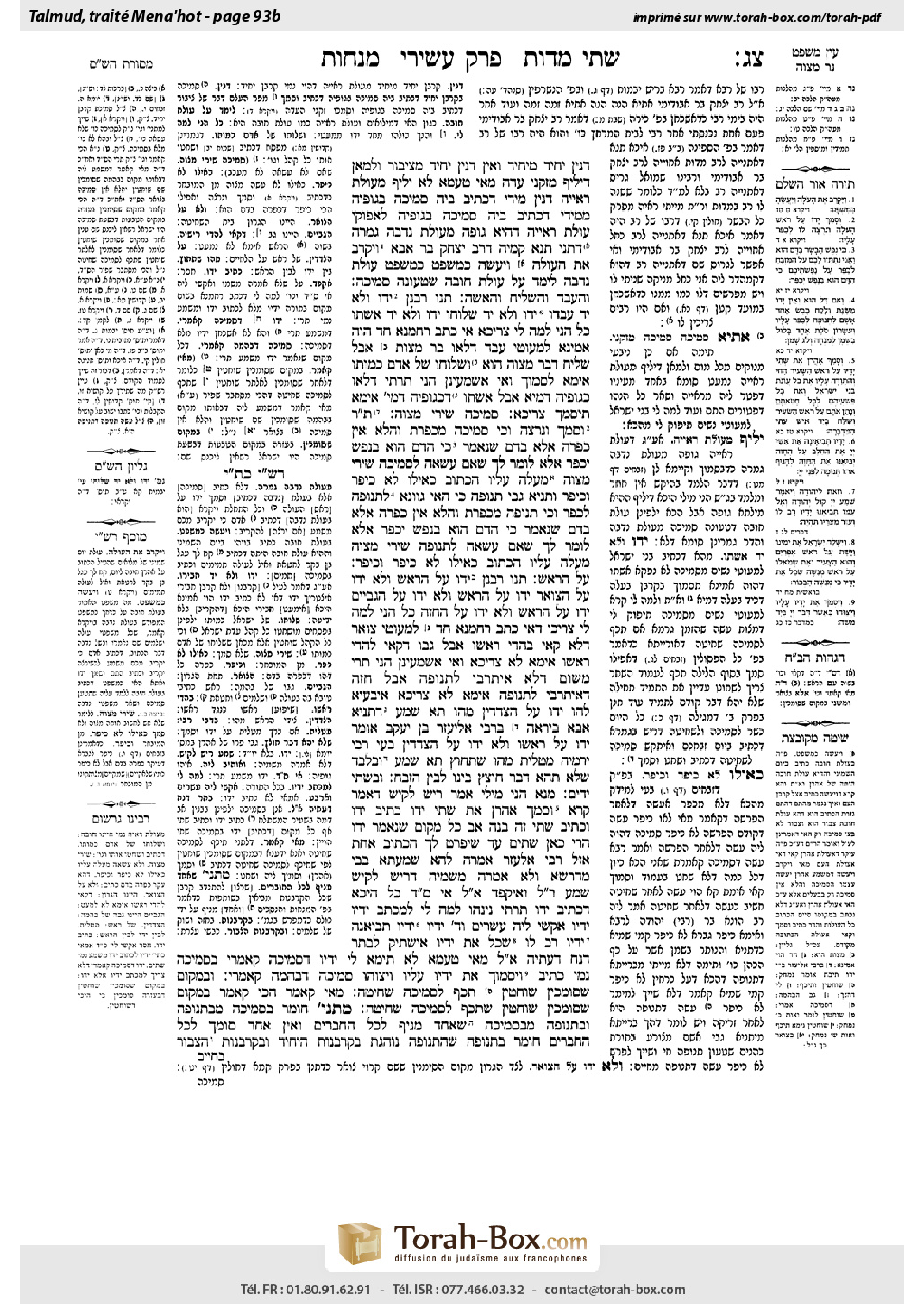
Menachot 93b: Talmud study for Daf Yomi
Daf Yomi is the daily study of one Talmud folio. Explore 37 tractates with scans, Hebrew text, Sefaria English and AI-generated French translations where annotated.
Passage selection and English or AI-generated French translation are available where the scan has annotations. Daf Study is independent of Torah-Box and Sefaria.
Browse Menachot · מנחות · All tractatesMenachot 93b text and translations
This page of Menachot includes the Aramaic text, an English translation and an AI-generated French translation, alongside the scan above.
מנחות צ״ג ב · Aramaic and Hebrew text
דָּנִין יָחִיד מִיָּחִיד, וְאֵין דָּנִין יָחִיד מִצִּיבּוּר.
וּלְמַאן דְּיָלֵיף מִזִּקְנֵי עֵדָה, מַאי טַעְמָא לָא יָלֵיף מֵעוֹלַת רְאִיָּיה? דָּנִין מִידֵּי דִּכְתִיב בֵּיהּ סְמִיכָה בְּגוּפֵיהּ, מִמִּידֵּי דִּכְתִיב בֵּיהּ סְמִיכָה בְּגוּפֵיהּ, לְאַפּוֹקֵי עוֹלַת רְאִיָּיה, דְּהִיא גּוּפַהּ מֵעוֹלַת נְדָבָה גָּמְרָה.
דְּתָנֵי תַּנָּא קַמֵּיהּ דְּרַב יִצְחָק בַּר אַבָּא: ״וַיַּקְרֵב אֶת הָעֹלָה וַיַּעֲשֶׂהָ כַּמִּשְׁפָּט״ – כְּמִשְׁפַּט עוֹלַת נְדָבָה, לִימֵּד עַל עוֹלַת חוֹבָה שֶׁטְּעוּנָה סְמִיכָה.
וְהָעֶבֶד וְהַשָּׁלִיחַ וְהָאִשָּׁה. תָּנוּ רַבָּנַן: ״יָדוֹ״ – וְלֹא יַד עַבְדּוֹ, ״יָדוֹ״ – וְלֹא יַד שְׁלוּחוֹ, ״יָדוֹ״ – וְלֹא יַד אִשְׁתּוֹ.
כֹּל הָנֵי לְמָה לִי? צְרִיכָא, אִי כְּתַב רַחֲמָנָא חַד, הֲוָה אָמֵינָא לְמַעוֹטֵי עֶבֶד, דְּלָאו בַּר מִצְוֹת, אֲבָל שָׁלִיחַ דְּבַר מִצְוָה הוּא, וּשְׁלוּחוֹ שֶׁל אָדָם כְּמוֹתוֹ, אֵימָא לִסְמוֹךְ.
וְאִי אַשְׁמְעִינַן הָנֵי תַּרְתֵּי, דְּלָאו כְּגוּפֵיהּ דָּמְיָא, אֲבָל אִשְׁתּוֹ דִּכְגוּפֵיהּ דָּמְיָא, אֵימָא תִּיסְמֹךְ – צְרִיכָא.
סְמִיכָה שְׁיָרֵי מִצְוָה. תָּנוּ רַבָּנַן: ״וְסָמַךְ״ ״וְנִרְצָה״, וְכִי סְמִיכָה מְכַפֶּרֶת? וַהֲלֹא אֵין כַּפָּרָה אֶלָּא בַּדָּם, שֶׁנֶּאֱמַר: ״כִּי הַדָּם הוּא בַּנֶּפֶשׁ יְכַפֵּר״! אֶלָּא לוֹמַר לָךְ, שֶׁאִם עֲשָׂאָהּ לִסְמִיכָה שְׁיָרֵי מִצְוָה, מַעֲלֶה עָלָיו הַכָּתוּב כְּאִילּוּ לֹא כִּיפֵּר, וְכִיפֵּר.
וְתַנְיָא גַּבֵּי תְנוּפָה כִּי הַאי גַוְונָא: ״לִתְנוּפָה לְכַפֵּר״, וְכִי תְּנוּפָה מְכַפֶּרֶת? וַהֲלֹא אֵין כַּפָּרָה אֶלָּא בַּדָּם, שֶׁנֶּאֱמַר: ״כִּי הַדָּם הוּא בַּנֶּפֶשׁ יְכַפֵּר״! אֶלָּא לוֹמַר לָךְ, שֶׁאִם עֲשָׂאָהּ לִתְנוּפָה שְׁיָרֵי מִצְוָה, מַעֲלֶה עָלָיו הַכָּתוּב כְּאִילּוּ לֹא כִּיפֵּר, וְכִיפֵּר.
עַל הָרֹאשׁ, תָּנוּ רַבָּנַן: ״יָדוֹ עַל הָרֹאשׁ״ – וְלֹא יָדוֹ עַל הַצַּוָּאר, ״יָדוֹ עַל הָרֹאשׁ״ – וְלֹא יָדוֹ עַל הַגַּבַּיִים, ״יָדוֹ עַל הָרֹאשׁ״ – וְלֹא יָדוֹ עַל הֶחָזֶה.
כֹּל הָנֵי לְמָה לִי? צְרִיכִי, דְּאִי כְּתַב רַחֲמָנָא חַד לְמַעוֹטֵי צַוָּאר, דְּלָא קָאֵי בַּהֲדֵי רֹאשׁוֹ, אֲבָל גַּבּוֹ דְּקָאֵי לַהֲדֵי רֹאשׁוֹ אֵימָא לָא, צְרִיכָא.
וְאִי אַשְׁמְעִינַן הָנֵי תְּרֵי, מִשּׁוּם דְּלָא אִיתְרַבִּי לִתְנוּפָה, אֲבָל חָזֶה דְּאִיתְרַבִּי לִתְנוּפָה, אֵימָא לָא, צְרִיכָא.
אִיבַּעְיָא לְהוּ: יָדוֹ עַל הַצְּדָדִין, מַהוּ? תָּא שְׁמַע, דְּתַנְיָא: אַבָּא בִּירָאָה בְּרַבִּי אֱלִיעֶזֶר בֶּן יַעֲקֹב אוֹמֵר: ״יָדוֹ עַל רֹאשׁוֹ״, וְלָא יָדוֹ עַל הַצְּדָדִין.
בָּעֵי רַבִּי יִרְמְיָה: מַטְלֵית מַהוּ שֶׁתָּחוֹץ? תָּא שְׁמַע: וּבִלְבַד שֶׁלֹּא יְהֵא דָּבָר חוֹצֵץ בֵּינוֹ לְבֵין הַזֶּבַח.
וּבִשְׁתֵּי יָדַיִם, מְנָא הָנֵי מִילֵּי? אָמַר רֵישׁ לָקִישׁ, דְּאָמַר קְרָא ״וְסָמַךְ אַהֲרֹן אֶת שְׁתֵּי יָדָו״, כְּתִיב ״יָדוֹ״ וּכְתִיב ״שְׁתֵּי״, זֶה בָּנָה אָב: כׇּל מָקוֹם שֶׁנֶּאֱמַר ״יָדוֹ״ – הֲרֵי כָּאן שְׁתַּיִם, עַד שֶׁיִּפְרֹט לְךָ הַכָּתוּב ״אַחַת״.
אֲזַל רַבִּי אֶלְעָזָר, אַמְרַהּ לְהָא שְׁמַעְתָּא בְּבֵי מִדְרְשָׁא, וְלָא אַמְרַהּ מִשְּׁמֵיהּ דְּרֵישׁ לָקִישׁ. שְׁמַע רֵישׁ לָקִישׁ וְאִיקְּפַד, אֲמַר לֵיהּ: אִי סָלְקָא דַּעְתָּךְ כֹּל הֵיכָא דִּכְתִיב ״יָדוֹ״ תַּרְתֵּי נִינְהוּ, לְמָה לִי לְמִכְתַּב ״יָדָיו״ ״יָדָיו״?
אַקְשִׁי לֵיהּ עֶשְׂרִים וְאַרְבַּע ״יָדָיו״, ״יָדָיו תְּבִיאֶינָה״, ״יָדָיו רָב לוֹ״, ״שִׂכֵּל אֶת יָדָיו״ – אִישְׁתִּיק.
לְבָתַר דְּנָח דַּעְתֵּיהּ, אֲמַר לֵיהּ: מַאי טַעְמָא לָא תֵּימָא לִי, ״יָדָיו״ דִּסְמִיכָה קָאָמְרִי?
בִּסְמִיכָה נָמֵי כְּתִיב: ״וַיִּסְמֹךְ אֶת יָדָיו עָלָיו וַיְצַוֵּהוּ״, סְמִיכָה דִּבְהֵמָה קָאָמְרִי.
וּבִמְקוֹם שֶׁסּוֹמְכִין שׁוֹחֲטִין, תֵּכֶף לִסְמִיכָה שְׁחִיטָה. מַאי קָאָמַר? הָכִי קָאָמַר: בִּמְקוֹם שֶׁסּוֹמְכִין שׁוֹחֲטִין, שֶׁתֵּכֶף לִסְמִיכָה שְׁחִיטָה.
מַתְנִי׳ חוֹמֶר בַּסְּמִיכָה מִבַּתְּנוּפָה, וּבַתְּנוּפָה מִבַּסְּמִיכָה – שֶׁאֶחָד מֵנִיף לְכׇל הַחֲבֵרִים, וְאֵין אֶחָד סוֹמֵךְ לְכׇל הַחֲבֵרִים. חוֹמֶר בַּתְּנוּפָה – שֶׁהַתְּנוּפָה נוֹהֶגֶת בְּקׇרְבְּנוֹת הַיָּחִיד וּבְקׇרְבְּנוֹת הַצִּבּוּר,
Menachot 93b · English translation
The Gemara answers: He holds that one derives the halakhot of the offering of an individual from the halakhot of another offering of an individual, such as the burnt offering of appearance, and one does not derive the halakhot of the offering of an individual from the halakhot of a communal offering, e.g., the bull brought for a community-wide violation.
The Gemara asks: And according to the one who said that the exclusion of a blind person is derived from the placing of hands performed by the Elders of the congregation, what is the reason that he does not derive this from the burnt offering of appearance? The Gemara answers: He holds that one derives the halakhot of a matter concerning which the requirement of placing hands is explicitly written with regard to that case itself, as is the case in the passage detailing the general requirement of placing hands, from another matter concerning which placing hands is also explicitly written with regard to that case itself, as is the case in the passage describing the bull brought for a community-wide violation of a sin. This serves to exclude the possibility of deriving the halakhot from those of the burnt offering of appearance, as the requirement to place hands upon it is not explicitly written in the Torah with regard to it, but rather it itself is derived from the requirement stated with regard to a voluntary burnt offering.
This is as a tanna taught in a baraita in the presence of Rav Yitzḥak bar Abba: With regard to the obligatory offering brought by Aaron the High Priest on the eighth day of the inauguration of the Tabernacle, it is written: “And the burnt offering was presented, and he sacrificed in accordance with the ordinance” (Leviticus 9:16). This last phrase means: In accordance with the ordinance of a voluntary burnt offering. Accordingly, this verse teaches about every obligatory burnt offering, including the burnt offering of appearance, that it requires placing hands, just as a voluntary burnt offering does.
§ The mishna states: A Canaanite slave, the agent of the owner of the offering who brings the offering on his behalf, and a woman do not place hands on their offerings. Concerning these halakhot, the Sages taught in a baraita: The term “his hand” is mentioned three times in Leviticus, chapter 3, which details the requirement of placing hands. Each mention is expounded to exclude a different case. “His hand” (Leviticus 3:2), but not the hand of his Canaanite slave; “his hand” (Leviticus 3:8), but not the hand of his agent; “his hand” (Leviticus 3:13), but not the hand of his wife.
The Gemara asks: Why do I need all these three exclusions? The Gemara explains that all three mentions are necessary, as had the Merciful One written only one exclusion, I would say that it serves to exclude only a Canaanite slave, as since he is not commanded in mitzvot it is reasonable that he cannot perform the rite of placing hands. But with regard to an agent, since he is commanded in mitzvot, and there is a principle that the halakhic status of a person’s agent is like that of himself, one might say that he could place his hands on the offering of the owner on the owner’s behalf, and thereby fulfill the requirement. Therefore, it is necessary to have an independent source to exclude an agent.
And had the Merciful One taught us only these two halakhot, one would have excluded only a Canaanite slave and an agent, as they are not considered like his own flesh. But with regard to his wife, who is considered like his own flesh, one might say that she places her hands on her husband’s offering. Therefore, the third mention is necessary to teach that even a wife cannot fulfill the requirement on behalf of her husband.
§ The mishna states: The requirement of placing hands is a non-essential mitzva. The Sages taught in a baraita: “And he shall place his hand upon the head of the burnt offering, and it shall be accepted for him to effect atonement for him” (Leviticus 1:4). The baraita asks: But does the rite of placing hands effect atonement? Isn’t atonement effected only through the presentation of the blood? As it is stated with regard to blood: “For the soul of the flesh is in the blood, and I have given it to you upon the altar to effect atonement for your souls, for it is the blood of the soul that effects atonement” (Leviticus 17:11). Rather, the verse serves to say to you that if one treated placing hands as though it were a non-essential mitzva and therefore neglected to perform it, then the verse ascribes him blame as though he did not effect atonement; but nevertheless, in actuality, the offering atones for his sin and he does not need to bring another offering.
And it is taught in a baraita with regard to waving in this way: “He shall take one male lamb as a guilt offering to be waved to effect atonement for him” (Leviticus 14:21). The baraita asks: Does waving the offering effect atonement? Isn’t atonement effected only through the presentation of the blood? As it is stated: “For it is the blood of the soul that effects atonement” (Leviticus 17:11). Rather, the verse serves to say to you that if one treated waving as though it were a non-essential mitzva and therefore neglected to perform it, then the verse ascribes him blame as though he did not effect atonement; but nevertheless, in actuality, the offering effects atonement for his sin and he does not need to bring another offering.
§ The mishna further states that placing hands is performed by leaning on the head of the offering. The Sages taught in a baraita: The phrase “his hand upon the head” is mentioned three times in Leviticus, chapter 3. Each mention is expounded to exclude the possibility of performing the rite on a different part of the animal’s body. Placing hands is performed with “his hand upon the head” (Leviticus 3:2), but not with his hand on the neck of the animal; with “his hand upon the head” (Leviticus 3:8), but not with his hand on the back of the animal; with “his hand upon the head” (Leviticus 3:13), but not with his hand on the breast of the animal.
The Gemara asks: Why do I need all these three exclusions? The Gemara explains that all three mentions are necessary, as had the Merciful One written only one exclusion, I would say that it serves to exclude only the animal’s neck, as it is not level with the head of the animal. But with regard to its back, which is level with its head, one might say that it is not precluded and that one can fulfill the requirement by placing one’s hands there. Therefore, it is necessary to have an independent source to exclude the animal’s back.
And had the Torah taught us only these two halakhot, one would have excluded only the neck and the back, as those parts are not included in the waving of the offering, i.e., they are not waved. But with regard to the animal’s breast, which is included in the waving of the offering, one might say that it is not precluded and that one can fulfill the requirement by placing one’s hands there. Therefore, the third mention is necessary to teach that placing hands cannot be performed even on the animal’s breast.
A dilemma was raised before the Sages: If one placed his hand on the sides of the animal’s head, what is the halakha; does one fulfill the requirement of placing hands by doing so? The Gemara answers: Come and hear, as it is taught in a baraita: Abba Bira’a, son of Rabbi Eliezer ben Ya’akov, says that the verse: “And he shall place his hand upon the head of the burnt offering” (Leviticus 1:4), indicates that it must be done with his hand on the top of its head and not with his hand on the sides of its head.
Rabbi Yirmeya raises a dilemma: If one’s hands were wrapped in a cloth, what is the halakha as to whether the cloth is regarded as an interposition between his hands and the animal such that it invalidates the rite? The Gemara answers: Come and hear a resolution from a baraita, which states: The rite is valid provided that there is no item that interposes between him and the offering.
§ The mishna adds that the placing of hands is performed with two hands. The Gemara asks: From where are these matters derived? Reish Lakish said: As the verse states with regard to the Yom Kippur service: “And Aaron shall place both his hands [yadav] upon the head of the live goat” (Leviticus 16:21). The word yadav, meaning: His hands, is written without a second yod, and so if read without vowels it reads as: His hand. But it is also written “both,” which makes clear that the intention is that he must use both of his hands. This established a paradigm that in any place where it is stated in the Torah: His hand, there are here two hands, unless the verse explicitly specifies that there is only one.
The Gemara relates: Rabbi Elazar went and stated this halakha in the study hall, but he did not say it in the name of Reish Lakish. Reish Lakish heard about this and became angry. He said to Rabbi Elazar: If it enters your mind that wherever it is written: His hand, the meaning is that there are actually two hands, then why do I ever need the Torah to write: His hands, his hands, i.e., yadav in the plural, which it does on numerous occasions?
Reish Lakish raised objections against him from twenty-four occasions where the Torah writes: His hands, for example: “His own hands [yadav] shall bring the offerings of the Lord” (Leviticus 7:30); “his hands [yadav] shall contend for him, and You shall be a help against his adversaries” (Deuteronomy 33:7); “Guiding his hands [yadav] wittingly, for Manasseh was the firstborn” (Genesis 48:14). Rabbi Elazar was silent, as he had no response.
After Reish Lakish had calmed down, he said to Rabbi Elazar: What is the reason that you did not say to me the following: When I established that paradigm, I was speaking only about the term: His hands [yadav], with regard to placing hands. But with regard to other halakhot, when the Torah says “his hand” the reference is to just one hand, and so when referring to two hands it must say “his hands.”
The Gemara asks: But also with regard to placing hands it is written, concerning Moses’ ordination of Joshua: “And he placed his hands [yadav] upon him and gave him a charge” (Numbers 27:23), using the plural “his hands” [yadav] instead of: His hand [yado]. The Gemara clarifies that Reish Lakish meant that one could say: When I established that paradigm, I was speaking only about the term: His hands [yadav], with regard to placing hands on an animal offering. But in all other cases, if the intention is that there were two hands, the plural must be used.
§ The mishna teaches: And in the same location in the Temple that one places hands, one slaughters the animal. And immediately following the rite of placing hands, the slaughter is performed. The Gemara asks: What is the mishna saying? The mishna appears to state two distinct rulings. But if so, the first statement is superfluous, because if the slaughter immediately follows the placing of hands, then it is obvious that the animal is slaughtered without changing its location. The Gemara explains that this is what the mishna is saying: In the same location in the Temple that one places hands one slaughters the animal, because immediately following the rite of placing hands, the slaughter is performed. There are not two distinct rulings; rather, the second statement is the explanation of the first.
MISHNA: There is an aspect of greater stringency with regard to placing hands than there is with regard to waving, and there is an aspect of greater stringency with regard to waving than there is with regard to placing hands. The stringency with regard to placing hands is that if several people are partners in bringing an offering, one of them waves the offering on behalf of all the other partners, but one cannot fulfill the requirement of placing hands if he alone places hands on behalf of all the other partners; rather, each member must place hands himself. The stringency with regard to waving is that waving is practiced in the cases of both offerings of an individual, e.g., peace offerings, where the breast and thigh and sacrificial portions are waved, and in the cases of communal offerings, e.g., the two lambs sacrificed on Shavuot, which are waved together with the two loaves;
Menachot 93b · Traduction française (IA)
La Guemara répond : Il considère qu’on déduit les halakhot d’une offrande individuelle de celles d’une autre offrande individuelle, comme l’holocauste de pèlerinage, mais qu’on ne déduit pas les halakhot d’une offrande individuelle de celles d’une offrande communautaire, par exemple du taureau apporté pour une faute commise par toute la communauté.
La Guemara demande : Et selon celui qui dit que l’exclusion de l’aveugle est déduite de l’imposition des mains effectuée par les Anciens de la communauté, pourquoi ne déduit-il pas cette halakha de l’holocauste de pèlerinage ? La Guemara répond : Il considère qu’on déduit les halakhot d’un cas pour lequel l’obligation d’imposer les mains est explicitement mentionnée à propos de ce cas même, comme dans le passage détaillant l’obligation générale d’imposer les mains, de celles d’un autre cas pour lequel l’imposition des mains est également explicitement mentionnée à propos de ce cas même, comme dans le passage décrivant le taureau apporté pour une faute commise par toute la communauté. Cela exclut la possibilité de déduire les halakhot de celles de l’holocauste de pèlerinage, puisque l’obligation d’imposer les mains sur celui-ci n’est pas explicitement mentionnée dans la Torah à son sujet : elle est elle-même déduite de l’obligation énoncée à propos d’un holocauste volontaire.
C’est ce qu’un tanna enseigna dans une baraïta en présence de Rav Yitzḥak bar Abba : au sujet de l’offrande obligatoire apportée par Aaron le grand prêtre le huitième jour de l’inauguration du Tabernacle, il est écrit : « On présenta l’holocauste, et il l’offrit selon la règle » (Lévitique 9:16). Cette dernière expression signifie : selon la règle d’un holocauste volontaire. Ce verset enseigne donc que tout holocauste obligatoire, y compris l’holocauste de pèlerinage, requiert l’imposition des mains, tout comme un holocauste volontaire.
§ La Michna énonce : Un esclave cananéen, l’agent du propriétaire de l’offrande qui l’apporte en son nom et une femme n’imposent pas les mains sur leurs offrandes. À propos de ces halakhot, les Sages enseignèrent dans une baraïta : l’expression « sa main » apparaît trois fois dans le chapitre 3 du Lévitique, qui détaille l’obligation d’imposer les mains. Chaque occurrence est interprétée comme excluant un cas différent. « Sa main » (Lévitique 3:2), mais pas la main de son esclave cananéen ; « sa main » (Lévitique 3:8), mais pas la main de son agent ; « sa main » (Lévitique 3:13), mais pas la main de sa femme.
La Guemara demande : Pourquoi faut-il ces trois exclusions ? La Guemara explique que les trois occurrences sont nécessaires. En effet, si le Miséricordieux n’avait écrit qu’une seule exclusion, j’aurais dit qu’elle sert uniquement à exclure un esclave cananéen, puisque, n’étant pas astreint aux mitsvot, il est logique qu’il ne puisse accomplir le rite de l’imposition des mains. Mais pour ce qui est d’un agent, puisqu’il est astreint aux mitsvot et qu’un principe veut que le statut halakhique de l’agent d’une personne soit celui de cette personne elle-même, on aurait pu dire qu’il peut imposer les mains sur l’offrande du propriétaire en son nom et ainsi s’acquitter de l’obligation. Il faut donc une source distincte pour exclure un agent.
Et si le Miséricordieux nous avait enseigné uniquement ces deux halakhot, on n’aurait exclu qu’un esclave cananéen et un agent, puisqu’ils ne sont pas considérés comme sa propre chair. Mais pour ce qui est de sa femme, qui est considérée comme sa propre chair, on aurait pu dire qu’elle impose les mains sur l’offrande de son mari. La troisième occurrence est donc nécessaire pour enseigner que même une femme ne peut s’acquitter de l’obligation au nom de son mari.
§ La Michna énonce : L’imposition des mains est une mitsva non indispensable. Les Sages enseignèrent dans une baraïta : « Il posera sa main sur la tête de l’holocauste, et celui-ci sera agréé pour lui afin de faire expiation pour lui » (Lévitique 1:4). La baraïta demande : Mais l’imposition des mains fait-elle expiation ? L’expiation n’est-elle pas obtenue uniquement par la présentation du sang ? Car il est dit à propos du sang : « Car l’âme de la chair est dans le sang, et Je vous l’ai donné sur l’autel pour faire expiation pour vos âmes, car c’est le sang de l’âme qui fait expiation » (Lévitique 17:11). Le verset vient plutôt t’enseigner que si quelqu’un a considéré l’imposition des mains comme une mitsva non indispensable et a donc omis de l’accomplir, le verset lui impute la faute comme s’il n’avait pas fait expiation ; néanmoins, en réalité, l’offrande expie son péché et il n’a pas besoin d’en apporter une autre.
Et une baraïta enseigne de la même manière au sujet de l’agitation : « Il prendra un agneau mâle comme sacrifice de culpabilité, afin de l’agiter pour faire expiation pour lui » (Lévitique 14:21). La baraïta demande : L’agitation de l’offrande fait-elle expiation ? L’expiation n’est-elle pas obtenue uniquement par la présentation du sang ? Car il est dit : « C’est le sang de l’âme qui fait expiation » (Lévitique 17:11). Le verset vient plutôt t’enseigner que si quelqu’un a considéré l’agitation comme une mitsva non indispensable et a donc omis de l’accomplir, le verset lui impute la faute comme s’il n’avait pas fait expiation ; néanmoins, en réalité, l’offrande expie son péché et il n’a pas besoin d’en apporter une autre.
§ La Michna énonce en outre que l’imposition des mains s’accomplit en s’appuyant sur la tête de l’offrande. Les Sages enseignèrent dans une baraïta : l’expression « sa main sur la tête » apparaît trois fois dans le chapitre 3 du Lévitique. Chaque occurrence est interprétée comme excluant la possibilité d’accomplir le rite sur une autre partie du corps de l’animal. L’imposition des mains se fait avec « sa main sur la tête » (Lévitique 3:2), mais pas avec la main sur la nuque de l’animal ; avec « sa main sur la tête » (Lévitique 3:8), mais pas avec la main sur le dos de l’animal ; avec « sa main sur la tête » (Lévitique 3:13), mais pas avec la main sur la poitrine de l’animal.
La Guemara demande : Pourquoi faut-il ces trois exclusions ? La Guemara explique que les trois occurrences sont nécessaires. En effet, si le Miséricordieux n’avait écrit qu’une seule exclusion, j’aurais dit qu’elle sert uniquement à exclure la nuque de l’animal, puisqu’elle n’est pas au même niveau que sa tête. Mais pour ce qui est de son dos, qui est au même niveau que sa tête, on aurait pu dire qu’il n’est pas exclu et qu’on peut s’acquitter de l’obligation en y posant les mains. Il faut donc une source distincte pour exclure le dos de l’animal.
Et si la Torah nous avait enseigné uniquement ces deux halakhot, on n’aurait exclu que la nuque et le dos, car ces parties ne sont pas comprises dans l’agitation de l’offrande, c’est-à-dire qu’elles ne sont pas agitées. Mais pour ce qui est de la poitrine de l’animal, qui est comprise dans l’agitation de l’offrande, on aurait pu dire qu’elle n’est pas exclue et qu’on peut s’acquitter de l’obligation en y posant les mains. La troisième occurrence est donc nécessaire pour enseigner que l’imposition des mains ne peut pas non plus s’accomplir sur la poitrine de l’animal.
Une question fut posée aux Sages : si quelqu’un pose sa main sur les côtés de la tête de l’animal, quelle est la halakha ? S’acquitte-t-il ainsi de l’obligation d’imposer les mains ? La Guemara répond : Viens et entends, car une baraïta enseigne : Abba Bira’a, fils de Rabbi Eliezer ben Ya’akov, dit que le verset « Il posera sa main sur la tête de l’holocauste » (Lévitique 1:4) indique qu’il faut poser la main sur le sommet de sa tête, et non sur les côtés de sa tête.
Rabbi Yirmeya soulève une question : si les mains de quelqu’un sont enveloppées dans un tissu, quelle est la halakha ? Le tissu est-il considéré comme un écran entre ses mains et l’animal, de sorte qu’il invalide le rite ? La Guemara répond : Viens et entends une réponse tirée d’une baraïta, qui énonce : le rite est valide à condition qu’aucun objet ne fasse écran entre lui et l’offrande.
§ La Michna ajoute que l’imposition des mains se fait avec les deux mains. La Guemara demande : D’où tire-t-on ces règles ? Reish Lakish dit : le verset relatif au service de Yom Kippour indique : « Aaron posera ses deux mains [yadav] sur la tête du bouc vivant » (Lévitique 16:21). Le mot yadav, qui signifie « ses mains », est écrit sans le deuxième yod ; sans voyelles, il se lit donc « sa main ». Mais le texte dit également « les deux », ce qui montre clairement qu’il doit utiliser ses deux mains. Cela établit le principe que partout où la Torah dit « sa main », il s’agit de deux mains, sauf si le verset précise explicitement qu’il n’y en a qu’une.
La Guemara rapporte : Rabbi Elazar alla enseigner cette halakha à la maison d’étude, mais ne la cita pas au nom de Reish Lakish. Reish Lakish l’apprit et se mit en colère. Il dit à Rabbi Elazar : Si tu penses que partout où il est écrit « sa main », le sens est qu’il s’agit en réalité de deux mains, alors pourquoi la Torah a-t-elle parfois besoin d’écrire « ses mains », c’est-à-dire yadav au pluriel, comme elle le fait à de nombreuses reprises ?
Reish Lakish souleva contre lui des objections tirées de vingt-quatre passages où la Torah écrit « ses mains », par exemple : « De ses propres mains [yadav], il apportera les offrandes de l’Éternel » (Lévitique 7:30) ; « Ses mains [yadav] le défendront, et Tu seras un secours contre ses adversaires » (Deutéronome 33:7) ; « Il guida ses mains [yadav] avec discernement, car Manassé était le premier-né » (Genèse 48:14). Rabbi Elazar garda le silence, car il n’avait pas de réponse.
Après que Reish Lakish se fut calmé, il dit à Rabbi Elazar : Pourquoi ne m’as-tu pas répondu ceci ? Lorsque j’ai établi ce principe, je ne parlais que de l’expression « ses mains » [yadav] à propos de l’imposition des mains. Mais pour les autres halakhot, lorsque la Torah dit « sa main », il s’agit d’une seule main ; par conséquent, pour désigner deux mains, elle doit dire « ses mains ».
La Guemara demande : Mais à propos de l’imposition des mains aussi, il est écrit, au sujet de l’investiture de Josué par Moïse : « Il posa ses mains [yadav] sur lui et lui donna ses instructions » (Nombres 27:23), avec le pluriel « ses mains » [yadav] plutôt que « sa main » [yado]. La Guemara précise que Reish Lakish voulait dire qu’on aurait pu répondre : lorsque j’ai établi ce principe, je ne parlais que de l’expression « ses mains » [yadav] à propos de l’imposition des mains sur une offrande animale. Mais dans tous les autres cas, si l’on veut indiquer qu’il s’agissait de deux mains, il faut employer le pluriel.
§ La Michna enseigne : Au même endroit du Temple où l’on impose les mains, on égorge l’animal. Et l’égorgement a lieu immédiatement après le rite de l’imposition des mains. La Guemara demande : Que dit la Michna ? Elle semble énoncer deux règles distinctes. Mais dans ce cas, la première affirmation est superflue, car si l’égorgement a lieu immédiatement après l’imposition des mains, il est évident que l’animal est égorgé sans être déplacé. La Guemara explique que la Michna veut dire ceci : au même endroit du Temple où l’on impose les mains, on égorge l’animal, car l’égorgement a lieu immédiatement après le rite de l’imposition des mains. Il ne s’agit pas de deux règles distinctes ; la seconde affirmation explique plutôt la première.
MICHNA : L’imposition des mains présente un aspect plus rigoureux que l’agitation, et l’agitation présente un aspect plus rigoureux que l’imposition des mains. La rigueur propre à l’imposition des mains est la suivante : lorsque plusieurs personnes sont associées pour apporter une offrande, l’une d’elles agite l’offrande au nom de tous les autres associés, mais nul ne peut s’acquitter de l’obligation d’imposer les mains au nom de tous les autres associés en étant le seul à imposer les mains ; chacun doit plutôt le faire lui-même. La rigueur propre à l’agitation est qu’elle s’applique aussi bien aux offrandes individuelles, par exemple les sacrifices de paix, dont la poitrine, la cuisse et les parties destinées au sacrifice sont agitées, qu’aux offrandes communautaires, par exemple les deux agneaux sacrifiés à Chavouot, qui sont agités avec les deux pains ;
Traduction française générée par IA à partir de l’édition anglaise de Sefaria. Vérifie toujours un passage avec le texte source.
Text from Sefaria: William Davidson Edition - Vocalized Aramaic (unknown); William Davidson Edition - English (CC BY NC).