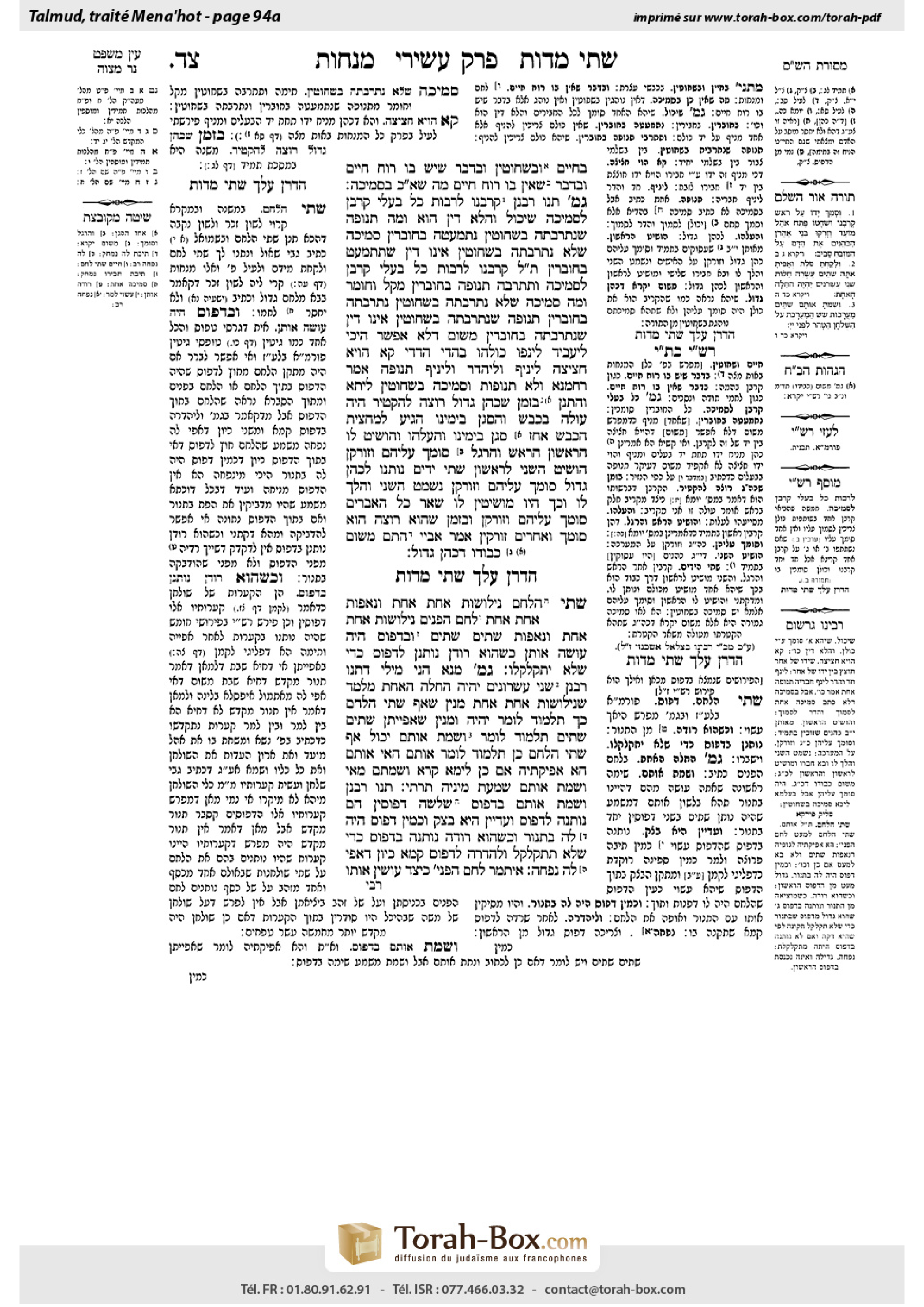
Menachot 94a: Talmud study for Daf Yomi
Daf Yomi is the daily study of one Talmud folio. Explore 37 tractates with scans, Hebrew text, Sefaria English and AI-generated French translations where annotated.
Passage selection and English or AI-generated French translation are available where the scan has annotations. Daf Study is independent of Torah-Box and Sefaria.
Browse Menachot · מנחות · All tractatesMenachot 94a text and translations
This page of Menachot includes the Aramaic text, an English translation and an AI-generated French translation, alongside the scan above.
מנחות צ״ד א · Aramaic and Hebrew text
בְּחַיִּים וּבִשְׁחוּטִין, וּבְדָבָר שֶׁיֵּשׁ בּוֹ רוּחַ חַיִּים וּבְדָבָר שֶׁאֵין בּוֹ רוּחַ חַיִּים, מַה שֶּׁאֵין כֵּן בַּסְּמִיכָה.
גְּמָ׳ תָּנוּ רַבָּנַן: קׇרְבָּנוֹ – לְרַבּוֹת כׇּל בַּעֲלֵי קׇרְבָּן לִסְמִיכָה.
שֶׁיָּכוֹל, וַהֲלֹא דִּין הוּא: וּמָה תְּנוּפָה שֶׁנִּתְרַבְּתָה בִּשְׁחוּטִין נִתְמַעֲטָה בְּחוֹבְרִין, סְמִיכָה שֶׁלֹּא נִתְרַבְּתָה בִּשְׁחוּטִין – אֵינוֹ דִּין שֶׁתִּתְמַעֵט בְּחוֹבְרִין? תַּלְמוּד לוֹמַר ״קׇרְבָּנוֹ״, לְרַבּוֹת כׇּל בַּעֲלֵי קׇרְבָּן לִסְמִיכָה.
וְתִתְרַבֶּה תְּנוּפָה בְּחוֹבְרִין מִקַּל וָחוֹמֶר: וּמָה סְמִיכָה שֶׁלֹּא נִתְרַבְּתָה בִּשְׁחוּטִין, נִתְרַבְּתָה בְּחוֹבְרִין, תְּנוּפָה שֶׁנִּתְרַבְּתָה בִּשְׁחוּטִין – אֵינוֹ דִּין שֶׁנִּתְרַבְּתָה בְּחוֹבְרִין!
מִשּׁוּם דְּלָא אֶפְשָׁר, הֵיכִי לֶיעְבֵּיד? לַינְפּוּ כּוּלְּהוּ בַּהֲדֵי הֲדָדֵי – קָא הָוְיָא חֲצִיצָה, לָינֵיף וְלֶיהְדַּר וְלָינֵיף – ״תְּנוּפָה״ אָמַר רַחֲמָנָא, וְלֹא תְּנוּפוֹת.
וּסְמִיכָה בִּשְׁחוּטִין לֵיתַהּ? וְהָתְנַן: בִּזְמַן שֶׁכֹּהֵן גָּדוֹל רוֹצֶה לְהַקְטִיר, הָיָה עוֹלֶה בַּכֶּבֶשׁ, וְהַסְּגָן בִּימִינוֹ. הִגִּיעַ לְמַחֲצִית הַכֶּבֶשׁ – אָחַז סְגָן בִּימִינוֹ וְהֶעֱלָהוּ, וְהוֹשִׁיט לוֹ הָרִאשׁוֹן הָרֹאשׁ וְהָרֶגֶל, סוֹמֵךְ עֲלֵיהֶם וְזוֹרְקָן.
הוֹשִׁיט הַשֵּׁנִי לָרִאשׁוֹן שְׁתֵּי יָדַיִם, נוֹתְנוֹ לְכֹהֵן גָּדוֹל, סוֹמֵךְ עֲלֵיהֶם וְזוֹרְקָן. נִשְׁמַט הַשֵּׁנִי וְהָלַךְ לוֹ, וְכָךְ הָיוּ מוֹשִׁיטִין לוֹ שְׁאָר כׇּל הָאֵבָרִים, סוֹמֵךְ עֲלֵיהֶם וְזוֹרְקָן.
וּבִזְמַן שֶׁהוּא רוֹצֶה – הוּא סוֹמֵךְ, וַאֲחֵרִים זוֹרְקִין.
אָמַר אַבָּיֵי: הָתָם מִשּׁוּם כְּבוֹדוֹ דְּכֹהֵן גָּדוֹל.
הֲדַרַן עֲלָךְ שְׁתֵּי מִדּוֹת.
מַתְנִי׳ שְׁתֵּי הַלֶּחֶם נִילּוֹשׁוֹת אַחַת אַחַת, וְנֶאֱפוֹת אַחַת אַחַת. לֶחֶם הַפָּנִים נִילּוֹשׁוֹת אַחַת אַחַת, וְנֶאֱפוֹת שְׁתַּיִם שְׁתַּיִם. וּבִדְפוּס הָיָה עוֹשֶׂה אוֹתָן; כְּשֶׁהוּא רוֹדָן, נוֹתְנָן לִדְפוּס כְּדֵי שֶׁלֹּא יִתְקַלְקְלוּ.
גְּמָ׳ מְנָא הָנֵי מִילֵּי? דְּתָנוּ רַבָּנַן: ״שְׁנֵי עֶשְׂרֹנִים יִהְיֶה הַחַלָּה הָאֶחָת״ – מְלַמֵּד שֶׁנִּילּוֹשׁוֹת אַחַת אַחַת.
מִנַּיִן שֶׁאַף שְׁתֵּי הַלֶּחֶם כָּךְ? תַּלְמוּד לוֹמַר ״יִהְיֶה״. וּמִנַּיִן שֶׁאֲפִיָּיתָן שְׁתַּיִם שְׁתַּיִם? תַּלְמוּד לוֹמַר ״וְשַׂמְתָּ אוֹתָם״. יָכוֹל אַף שְׁתֵּי הַלֶּחֶם כֵּן? תַּלְמוּד לוֹמַר ״אוֹתָם״.
הַאי ״אוֹתָם״, הָא אַפֵּיקְתֵּיהּ? אִם כֵּן, לֵימָא קְרָא ״וְשַׂמְתָּם״! מַאי ״וְשַׂמְתָּ אוֹתָם״? שָׁמְעַתְּ מִינַּהּ תַּרְתֵּי.
תָּנוּ רַבָּנַן: ״וְשַׂמְתָּ אוֹתָם״ – בִּדְפוּס. שְׁלֹשָׁה דְּפוּסִין הֵם: נוֹתְנָהּ לִדְפוּס וַעֲדַיִין הִיא בָּצֵק, וּכְמִין דְּפוּס הָיָה לָהּ בַּתַּנּוּר, וּכְשֶׁהוּא רוֹדָהּ נוֹתְנָהּ בַּדְּפוּס כְּדֵי שֶׁלֹּא תִּתְקַלְקֵל. וְלַהְדְּרַהּ לִדְפוּס קַמָּא? כֵּיוָן דְּאָפֵי לַהּ, נָפְחָה.
אִיתְּמַר: לֶחֶם הַפָּנִים, כֵּיצַד עוֹשִׂין אוֹתוֹ?
Menachot 94a · English translation
and it is practiced both in the cases of offerings when they are alive, e.g., the guilt offering of a leper and the lambs of Shavuot, and in the cases of offerings after they are slaughtered, e.g., the breast and thigh. By contrast, placing hands is practiced with a live animal. A further stringency is that waving is practiced both in the case of an item in which there is a living spirit, i.e., an animal offering, and in the case of an item in which there is not a living spirit, e.g., the omer offering, the sota meal offering, and the loaves accompanying a thanks offering and the ram of the nazirite, whereas placing hands is only ever performed upon living beings.
GEMARA: The Sages taught in a baraita: The verse states with regard to placing hands: “And he shall place his hand on the head of his offering” (Leviticus 3:2). The term “his offering” serves to include all of the owners of an offering in the requirement of placing hands, i.e., each one must perform it.
It is necessary for the verse to teach this, as one might have thought: Could it not be derived through an a fortiori inference that only one partner needs to place his hands on the offering? The inference is as follows: If the requirement of waving, which was amplified to apply also to slaughtered animals, nevertheless was limited with regard to an offering jointly owned by a number of partners, as only one of them waves on behalf of all of them, then with regard to the requirement of placing hands, which was not amplified to apply also to slaughtered animals, is it not logical that it was also limited with regard to an offering jointly owned by partners, and it is sufficient for one partner to place his hands on behalf of the others? To counter this inference, the verse states: “His offering,” to include each of the owners of an offering in the requirement of placing hands.
The Gemara asks: But one could suggest the opposite inference and conclude that the requirement of waving should be amplified with regard to partners, through the following a fortiori inference: If the requirement of placing hands, which was not amplified to apply also to slaughtered animals, was amplified with regard to an offering jointly owned by partners, requiring each partner to perform it himself, then with regard to the requirement of waving, which was amplified to apply also to slaughtered animals, is it not logical that it was also amplified with regard to an offering jointly owned by partners, requiring each partner to perform it himself?
The Gemara rejects this: This inference cannot be correct, because it is obvious that only one of the partners needs to perform the waving. It is not possible to have all of them perform it, as how would it be done? If one says: Let all of the partners wave together, with each one placing his hands under those of another, that is difficult: There would be an invalidating interposition between the offering and hands of the partners who are not directly holding onto the offering. And if one says: Let one partner wave, and then the next one will wave, and so on, that would also be invalid, as the Merciful One states in the Torah that one must perform a waving, using a singular noun, which indicates that one waving, but not multiple wavings, should be performed.
§ The mishna states that placing hands is not performed upon a slaughtered offering. The Gemara questions this: And is there no instance of placing hands performed on slaughtered animals? But didn’t we learn in a mishna (Tamid 33b): When the High Priest would want to sacrifice the daily offering, as it is his right to be the one to sacrifice it whenever he wishes to, he would ascend the ramp to the top of the altar, and the deputy [segan] High Priest would also ascend to the right of the High Priest. If it occurred that the High Priest reached halfway up the ramp and grew tired, the deputy would hold him by his right hand to assist him and would bring him up to the top of the altar. And the first of the group of priests who had been selected to bring the limbs of the daily offering to the altar would hold out the head and the right hind leg of the offering to the High Priest, who would place his hands upon them, and then he would throw the limbs onto the fire of the altar.
Then the second priest would hold out the two forelegs to the first priest, and the first priest would give them to the High Priest, who would place his hands upon them and then throw them onto the fire. At this stage the second priest would slip away and leave, as he was no longer needed. The first priest remained where he was, as he was still needed to present the other limbs of the offering to the High Priest. And in this manner the other priests who had been selected would hold out the rest of all the limbs to the first priest, who would present them to the High Priest, who would then place his hands upon them and throw them onto the fire.
The mishna concludes: And when the High Priest wants, he may merely place his hands upon the limbs, and then the other priests throw the limbs onto the fire of the altar.
This mishna apparently demonstrates an instance of placing hands performed upon a slaughtered animal. In resolution of this difficulty, Abaye said: In the mishna there, the placing of hands is not in fulfillment of the requirement to do so to an offering; rather, it is done merely due to the eminence of the High Priest, so that his sacrifice of the limbs of an offering is more distinguished than when performed by ordinary priests.
MISHNA: The two loaves that are brought on the festival of Shavuot from the new wheat are each made from a tenth of an ephah of fine flour. They are kneaded one by one and they are baked one by one, i.e., each loaf is placed separately in the oven. The loaves of the shewbread are kneaded one by one and baked two by two, i.e., two loaves are placed in the oven at the same time. And the baker would prepare the shewbread in a mold [defus] when he made the dough. When he removes the shewbread from the oven he again places the loaves in a mold so that their shape will not be ruined.
GEMARA: The mishna teaches that the two loaves are kneaded one by one and baked one by one. The loaves of the shewbread are also kneaded one by one but are baked two at a time. The Gemara asks: From where are these matters derived? They are derived from a verse, as the Sages taught in a baraita: The verse states: “And you shall take fine flour, and bake twelve cakes from it; two-tenths of an ephah shall be in one cake. And you shall set them in two arrangements, six in an arrangement, upon the pure Table before the Lord” (Leviticus 24:5–6). The phrase “Two-tenths of an ephah shall be in one cake” teaches that the loaves of the shewbread are kneaded one by one.
The baraita continues: From where is it derived that this is also the halakha with regard to the two loaves, i.e., that they are kneaded one at a time? The verse states: “Shall be,” to include the two loaves. And from where is it derived that the baking of the loaves of the shewbread is performed two by two? The verse states: “And you shall set them [vesamta otam],” the plural form indicating that two loaves should be baked together. One might have thought that the two loaves brought on Shavuot should also be baked in this manner. The verse states: “Them [otam],” which is a term of exclusion, indicating that only the loaves of the shewbread are baked two at a time, but not the two loaves brought on Shavuot.
The Gemara asks: Didn’t you already derive from this term: “Them,” that the shewbread must be baked two loaves at a time? The Gemara answers: If so, i.e., if the term “them” teaches only that the shewbread is baked two loaves at a time, let the verse say: And you shall set them [vesamtam], using the shortened form. What is the verse teaching by using the longer form “vesamta otam”? You may learn from the verse two matters, both that the loaves of the shewbread should be baked two at a time and that this requirement does not apply to the two loaves brought on Shavuot.
§ The mishna teaches that the shewbread was placed in a mold, and with regard to this the Sages taught in a baraita: The verse states: “And you shall set them” (Leviticus 24:6), which means to set them in a mold. There are three molds that are used in the Temple in the preparation of the loaves. First, the baker places the shewbread in a mold while it is still dough. And second, there was a type of mold for the shewbread in the oven, in which the loaves were baked. And when he removes [rodah] the shewbread from the oven, he places it in a third mold so that its shape will not be ruined. The Gemara asks: But why is a third mold necessary? Let him return the shewbread to the first mold, in which the dough was kneaded. The Gemara answers: Once the dough is baked, it rises, and no longer fits into the first mold.
§ It was stated: How is the shewbread prepared, i.e., in what shape?
Menachot 94a · Traduction française (IA)
et elle s’applique aussi bien aux offrandes encore vivantes, par exemple au sacrifice de culpabilité du lépreux et aux agneaux de Chavouot, qu’aux offrandes après leur abattage, par exemple à la poitrine et à la cuisse. En revanche, l’imposition des mains ne s’applique qu’à un animal vivant. Une autre rigueur est que le balancement s’applique aussi bien à un élément animé, c’est-à-dire une offrande animale, qu’à un élément inanimé, par exemple l’offrande de l’omer, l’offrande de farine de la sota, les pains qui accompagnent une offrande de remerciement et le bélier du nazir, tandis que l’imposition des mains ne s’effectue que sur des êtres vivants.
GUEMARA : Les Sages ont enseigné dans une baraïta : À propos de l’imposition des mains, le verset dit : « Il posera sa main sur la tête de son offrande » (Lévitique 3:2). Le terme « son offrande » inclut tous les propriétaires d’une offrande dans l’obligation d’imposer les mains, c’est-à-dire que chacun doit le faire.
Le verset doit l’enseigner, car on aurait pu penser : Ne peut-on pas déduire par raisonnement a fortiori qu’un seul associé doit imposer les mains sur l’offrande ? Le raisonnement est le suivant : si l’obligation de balancer, dont le champ d’application a été étendu aux animaux abattus, a néanmoins été restreinte dans le cas d’une offrande appartenant conjointement à plusieurs associés, puisqu’un seul d’entre eux balance au nom de tous, alors, concernant l’obligation d’imposer les mains, dont le champ d’application n’a pas été étendu aux animaux abattus, n’est-il pas logique qu’elle ait également été restreinte dans le cas d’une offrande appartenant conjointement à plusieurs associés, de sorte qu’il suffise qu’un seul associé impose les mains au nom des autres ? Pour contrer ce raisonnement, le verset dit : « Son offrande », afin d’inclure chacun des propriétaires d’une offrande dans l’obligation d’imposer les mains.
La Guemara demande : Mais ne pourrait-on pas proposer le raisonnement inverse et conclure que l’obligation de balancer a été étendue dans le cas des associés, par le raisonnement a fortiori suivant : si l’obligation d’imposer les mains, dont le champ d’application n’a pas été étendu aux animaux abattus, a été étendue au cas d’une offrande appartenant conjointement à plusieurs associés, exigeant que chacun l’accomplisse lui-même, alors, concernant l’obligation de balancer, dont le champ d’application a été étendu aux animaux abattus, n’est-il pas logique qu’elle ait également été étendue au cas d’une offrande appartenant conjointement à plusieurs associés, exigeant que chacun l’accomplisse lui-même ?
La Guemara rejette ce raisonnement : il ne peut pas être juste, car il est évident qu’un seul des associés doit effectuer le balancement. Il est impossible qu’ils le fassent tous ; en effet, comment cela se ferait-il ? Si l’on dit : que tous les associés balancent ensemble, chacun plaçant ses mains sous celles d’un autre, cela pose difficulté : il y aurait un interstice invalidant entre l’offrande et les mains des associés qui ne la tiennent pas directement. Et si l’on dit : qu’un associé balance, puis le suivant, et ainsi de suite, cela serait également invalide, car le Miséricordieux dit dans la Torah qu’il faut effectuer un balancement, au singulier, ce qui indique qu’un seul balancement, et non plusieurs, doit être effectué.
§ La Michna enseigne que l’imposition des mains ne s’effectue pas sur une offrande abattue. La Guemara objecte : N’existe-t-il donc aucun cas où l’imposition des mains s’effectue sur des animaux abattus ? N’avons-nous pas appris dans une Michna (Tamid 33b) : Lorsque le grand prêtre voulait offrir l’offrande quotidienne — car il avait le droit de l’offrir chaque fois qu’il le souhaitait —, il montait la rampe jusqu’au sommet de l’autel, et le grand prêtre adjoint [segan] montait lui aussi, à la droite du grand prêtre. S’il arrivait que le grand prêtre, parvenu à mi-hauteur de la rampe, se fatigue, le grand prêtre adjoint le soutenait de la main droite pour l’aider et le faisait monter jusqu’au sommet de l’autel. Le premier des prêtres désignés pour apporter les membres de l’offrande quotidienne à l’autel tendait alors au grand prêtre la tête et la patte arrière droite de l’offrande ; celui-ci posait ses mains dessus, puis jetait les membres dans le feu de l’autel.
Puis le deuxième prêtre tendait les deux pattes avant au premier prêtre, qui les remettait au grand prêtre ; celui-ci posait ses mains dessus, puis les jetait dans le feu. À ce stade, le deuxième prêtre se retirait et s’en allait, puisqu’on n’avait plus besoin de lui. Le premier prêtre restait à sa place, car il devait encore présenter au grand prêtre les autres membres de l’offrande. De cette manière, les autres prêtres désignés lui tendaient tous les autres membres de l’offrande ; le premier les présentait au grand prêtre, qui posait alors ses mains dessus et les jetait dans le feu.
La Michna conclut : Et lorsque le grand prêtre le souhaite, il peut se contenter de poser ses mains sur les membres ; les autres prêtres jettent alors les membres dans le feu de l’autel.
Cette Michna semble donc présenter un cas d’imposition des mains sur un animal abattu. Pour résoudre cette difficulté, Abayé a dit : Dans cette Michna, l’imposition des mains n’accomplit pas l’obligation de le faire sur une offrande ; elle est effectuée uniquement en raison de la dignité du grand prêtre, afin que son offrande des membres d’une offrande se distingue de celle accomplie par de simples prêtres.
MICHNA : Les deux pains apportés lors de la fête de Chavouot à partir du blé nouveau sont chacun faits d’un dixième d’épha de farine fine. Ils sont pétris un par un et cuits un par un, c’est-à-dire que chaque pain est placé séparément dans le four. Les pains de proposition sont pétris un par un et cuits deux par deux, c’est-à-dire que deux pains sont placés en même temps dans le four. Le boulanger préparait les pains de proposition dans un moule [defus] lorsqu’il faisait la pâte. Lorsqu’il sortait les pains de proposition du four, il les plaçait de nouveau dans un moule afin que leur forme ne soit pas abîmée.
GUEMARA : La Michna enseigne que les deux pains sont pétris un par un et cuits un par un. Les pains de proposition sont eux aussi pétris un par un, mais cuits deux à la fois. La Guemara demande : D’où ces règles sont-elles déduites ? Elles sont déduites d’un verset, comme les Sages l’ont enseigné dans une baraïta : le verset dit : « Tu prendras de la fleur de farine et tu en feras cuire douze gâteaux ; il y aura deux dixièmes d’épha dans un gâteau. Tu les disposeras en deux rangées, six par rangée, sur la Table pure devant l’Éternel » (Lévitique 24:5–6). L’expression « il y aura deux dixièmes d’épha dans un gâteau » enseigne que les pains de proposition sont pétris un par un.
La baraïta poursuit : D’où déduit-on que cette halakha s’applique aussi aux deux pains, c’est-à-dire qu’ils sont pétris un à la fois ? Le verset dit : « Il y aura », pour inclure les deux pains. Et d’où déduit-on que les pains de proposition sont cuits deux par deux ? Le verset dit : « Tu les disposeras [vesamta otam] », la forme plurielle indiquant que deux pains doivent être cuits ensemble. On aurait pu penser que les deux pains apportés à Chavouot devaient eux aussi être cuits de cette manière. Le verset dit : « Les [otam] », terme d’exclusion qui indique que seuls les pains de proposition sont cuits deux à la fois, mais pas les deux pains apportés à Chavouot.
La Guemara demande : N’as-tu pas déjà déduit de ce terme, « les », que les pains de proposition doivent être cuits deux à la fois ? La Guemara répond : Dans ce cas, c’est-à-dire si le terme « les » enseigne seulement que les pains de proposition sont cuits deux à la fois, que le verset dise : « Tu les disposeras [vesamtam] », sous sa forme abrégée. Que nous enseigne le verset en employant la forme plus longue « vesamta otam » ? On peut en déduire deux choses : les pains de proposition doivent être cuits deux à la fois, et cette exigence ne s’applique pas aux deux pains apportés à Chavouot.
§ La Michna enseigne que les pains de proposition étaient placés dans un moule. À ce sujet, les Sages ont enseigné dans une baraïta : le verset dit : « Tu les disposeras » (Lévitique 24:6), ce qui signifie qu’il faut les disposer dans un moule. Trois moules sont utilisés dans le Temple pour préparer les pains. Premièrement, le boulanger place les pains de proposition dans un moule alors qu’ils sont encore de la pâte. Deuxièmement, il existait un type de moule pour les pains de proposition dans le four, dans lequel les pains cuisaient. Enfin, lorsqu’il sortait [rodah] les pains de proposition du four, il les plaçait dans un troisième moule afin que leur forme ne soit pas abîmée. La Guemara demande : Mais pourquoi faut-il un troisième moule ? Qu’il remette les pains de proposition dans le premier moule, dans lequel la pâte a été pétrie. La Guemara répond : Une fois cuite, la pâte gonfle et ne rentre plus dans le premier moule.
§ Il a été enseigné : Comment les pains de proposition étaient-ils préparés, c’est-à-dire quelle était leur forme ?
Traduction française générée par IA à partir de l’édition anglaise de Sefaria. Vérifie toujours un passage avec le texte source.
Text from Sefaria: William Davidson Edition - Vocalized Aramaic (unknown); William Davidson Edition - English (CC BY NC).