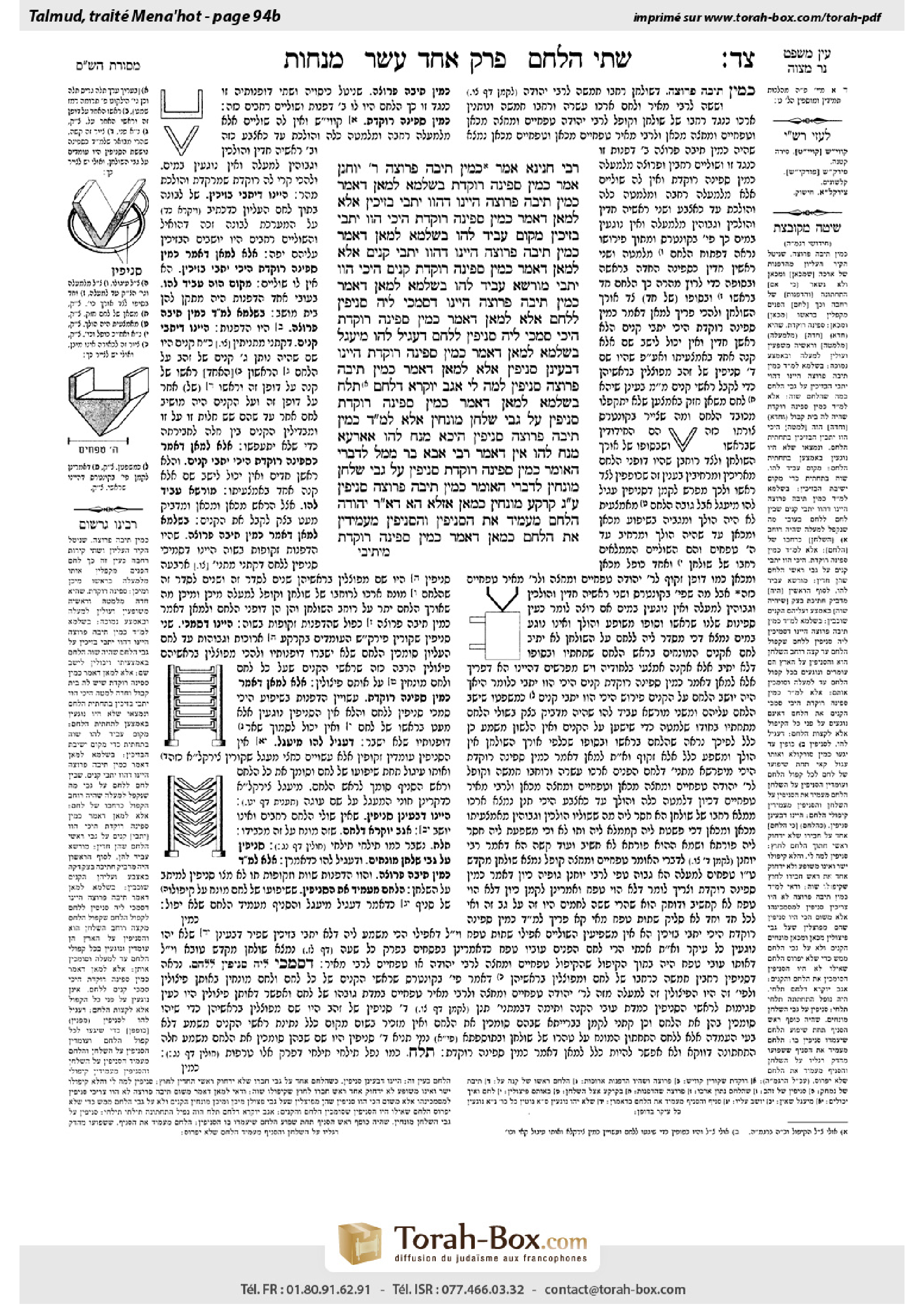
Menachot 94b: Talmud study for Daf Yomi
Daf Yomi is the daily study of one Talmud folio. Explore 37 tractates with scans, Hebrew text, Sefaria English and AI-generated French translations where annotated.
Passage selection and English or AI-generated French translation are available where the scan has annotations. Daf Study is independent of Torah-Box and Sefaria.
Browse Menachot · מנחות · All tractatesMenachot 94b text and translations
This page of Menachot includes the Aramaic text, an English translation and an AI-generated French translation, alongside the scan above.
מנחות צ״ד ב · Aramaic and Hebrew text
רַבִּי חֲנִינָא אָמַר: כְּמִין תֵּיבָה פְּרוּצָה. רַבִּי יוֹחָנָן אָמַר: כְּמִין סְפִינָה רוֹקֶדֶת.
בִּשְׁלָמָא לְמַאן דְּאָמַר כְּמִין תֵּיבָה פְּרוּצָה – הַיְינוּ דַּהֲווֹ יָתְבִי בָּזִיכִין, אֶלָּא לְמַאן דְּאָמַר כְּמִין סְפִינָה רוֹקֶדֶת – הֵיכִי הֲווֹ יָתְבִי בָּזִיכִין? מָקוֹם עָבֵיד לְהוּ.
בִּשְׁלָמָא לְמַאן דְּאָמַר כְּמִין תֵּיבָה פְּרוּצָה – הַיְינוּ דַּהֲווֹ יָתְבִי קָנִים, אֶלָּא לְמַאן דְּאָמַר כְּמִין סְפִינָה רוֹקֶדֶת – קָנִים הֵיכִי הֲווֹ יָתְבִי? מוּרְשָׁא עָבֵיד לְהוּ.
בִּשְׁלָמָא לְמַאן דְּאָמַר כְּמִין תֵּיבָה פְּרוּצָה – הַיְינוּ דְּסָמְכִי לֵיהּ סְנִיפִין לְלֶחֶם, אֶלָּא לְמַאן דְּאָמַר כְּמִין סְפִינָה רוֹקֶדֶת – הֵיכִי סְמַכִי לֵיהּ סְנִיפִין לְלֶחֶם? דְּעָגִיל לְהוּ מִיעְגָּל.
בִּשְׁלָמָא לְמַאן דְּאָמַר כְּמִין סְפִינָה רוֹקֶדֶת – הַיְינוּ דְּבָעֵינַן סְנִיפִין, אֶלָּא לְמַאן דְּאָמַר כְּמִין תֵּיבָה פְּרוּצָה – סְנִיפִין לְמָה לִי? אַגַּב יוּקְרָא דְּלֶחֶם תָּלַח.
בִּשְׁלָמָא לְמַאן דְּאָמַר כְּמִין סְפִינָה רוֹקֶדֶת – סְנִיפִין עַל גַּבֵּי שֻׁלְחָן מוּנָּחִין. אֶלָּא לְמַאן דְּאָמַר כְּמִין תֵּיבָה פְּרוּצָה – סְנִיפִין הֵיכָא מַנַּח לְהוּ? אַאַרְעָא מַנַּח לְהוּ? אִין, דְּאָמַר רַבִּי אַבָּא בַּר מֶמֶל: לְדִבְרֵי הָאוֹמֵר כְּמִין סְפִינָה רוֹקֶדֶת – סְנִיפִין עַל גַּבֵּי שֻׁלְחָן מוּנָּחִין, לְדִבְרֵי הָאוֹמֵר כְּמִין תֵּיבָה פְּרוּצָה – סְנִיפִין עַל גַּבֵּי קַרְקַע מוּנָּחִין.
כְּמַאן אָזְלָא הָא דְאָמַר רַבִּי יְהוּדָה: הַלֶּחֶם מַעֲמִיד אֶת הַסְּנִיפִין, וְהַסְּנִיפִין מַעֲמִידִין אֶת הַלֶּחֶם? כְּמַאן דְּאָמַר כְּמִין סְפִינָה רוֹקֶדֶת.
Menachot 94b · English translation
Rabbi Ḥanina says: It was rectangular, with a wide base and two parallel walls with an open space between them, like a box that is open on two sides. Rabbi Yoḥanan says that the shewbread was like a rocking boat, i.e., a triangular-shaped boat with a narrow base from which two walls rise at angles. Since the boat does not have a wide base it rocks from side to side.
The Gemara comments: Granted, according to the one who said the shewbread was like a box that is open on two sides, this is the reason that the bowls of frankincense could rest upon it. The Gemara asks: But according to the one who said the shewbread was like a rocking boat, how would the bowls rest upon it? The Gemara answers: The baker prepared a flat place for the bowls to rest, on the side of the shewbread.
The Gemara comments: Granted, according to the one who said the shewbread was like a box that is open on two sides, this is the reason that the rods could rest upon the it. The shewbread was placed on the Table in two arrangements. In each arrangement the lowest loaf was placed on the Table and the remaining loaves were set one above the other, with rods separating the loaves. There were fourteen rods for each arrangement, each loaf being placed upon three rods, except for the uppermost loaf, which was placed on only two rods. The Gemara asks: But according to the one who said the shewbread was like a rocking boat, how were the rods resting upon the shewbread? Since the loaves had a narrow base, they would rest on only one rod. The Gemara answers: The baker would make a protrusion in the base of the loaves, which would slightly widen their pointed base, enabling them to rest with stability upon the rods.
The Gemara comments: Granted, according to the one who said the shewbread was like a box that is open on two sides, this is the reason that the panels would support the loaves. There were four gold panels that stood at the two sides of the Table and rose up above the height of the Table, and the rods rested on these panels. The loaves were placed lengthwise along the entire width of the Table, and the panels supported the two sides of the loaves, preventing them from falling to the ground. The Gemara asks: But according to the one who said the shewbread was like a rocking boat, how would the panels support the loaves? Since the sides of the shewbread rose at an angle, the panels would touch only the upper edges of the shewbread. The Gemara answers that the panels would be made to curve inward at an angle corresponding to the angle of the shewbread, so that the panels supported the loaves along their entire length.
The Gemara comments: Granted, according to the one who said the shewbread was like a rocking boat, this is the reason that we require panels. Since the loaves do not have a wide base they cannot stand on their own without the support of the rods and panels. The Gemara asks: But according to the one who said the shewbread was like a box that is open on two sides, why do I need panels? The loaves could stand without the assistance of rods and panels. The Gemara answers: If there were no panels supporting the loaves from the sides and the loaves were placed on top of each other, due to the weight of the upper loaves the lower loaves would break [telaḥ].
The Gemara comments: Granted, according to the one who said the shewbread was like a rocking boat, it is evident that the panels are placed on the Table, in order to prevent the slanted loaves from falling to the ground. The Gemara asks: But according to the one who said the shewbread was like a box that is open on two sides, where would the priest place the panels? Since the wide base of the loaves reached the edge of the Table, there was no room for the panels there. Would the priest place them on the ground? The Gemara answers: Yes, the panels were placed on the ground, as Rabbi Abba bar Memel said: According to the statement of the one who says the shewbread was like a rocking boat, the panels are placed on the Table, whereas according to the statement of the one who says the shewbread was like a box that is open on two sides, the panels are placed on the ground.
The Gemara asks: In accordance with whose opinion is that which Rabbi Yehuda said: The loaves support the panels and the panels support the loaves, i.e., they lean against one another? It is in accordance with the opinion of the one who said the shewbread was like a rocking boat, i.e., Rabbi Yoḥanan. According to the opinion of Rabbi Ḥanina, the panels stood on the ground and did not require the support of the loaves.
Menachot 94b · Traduction française (IA)
Rabbi Ḥanina dit : Elle était rectangulaire, avec une base large et deux parois parallèles séparées par un espace ouvert, comme une boîte ouverte sur deux côtés. Rabbi Yoḥanan dit que les pains de proposition avaient la forme d’une barque qui tangue, c’est-à-dire d’une embarcation triangulaire à base étroite, dont deux parois s’élevaient en biais. Comme cette barque n’avait pas de base large, elle tanguait d’un côté à l’autre.
La Guemara commente : Il est compréhensible que, selon celui qui dit que les pains de proposition avaient la forme d’une boîte ouverte sur deux côtés, les coupes d’encens puissent reposer dessus. La Guemara demande : Mais selon celui qui dit que les pains de proposition avaient la forme d’une barque qui tangue, comment les coupes pouvaient-elles reposer dessus ? La Guemara répond : Le boulanger aménageait un emplacement plat sur le côté des pains de proposition, où les coupes pouvaient reposer.
La Guemara commente : Il est compréhensible que, selon celui qui dit que les pains de proposition avaient la forme d’une boîte ouverte sur deux côtés, les tiges puissent reposer dessus. Les pains de proposition étaient disposés sur la Table en deux rangées. Dans chaque rangée, le pain du bas était posé sur la Table, et les pains restants étaient placés les uns au-dessus des autres, des tiges séparant les pains. Chaque rangée comptait quatorze tiges ; chaque pain reposait sur trois tiges, à l’exception du pain du haut, qui n’en avait que deux. La Guemara demande : Mais selon celui qui dit que les pains de proposition avaient la forme d’une barque qui tangue, comment les tiges pouvaient-elles reposer sur les pains ? Puisque ceux-ci avaient une base étroite, ils n’auraient reposé que sur une seule tige. La Guemara répond : Le boulanger faisait une saillie à la base des pains, élargissant légèrement leur base pointue et leur permettant ainsi de reposer de façon stable sur les tiges.
La Guemara commente : Il est compréhensible que, selon celui qui dit que les pains de proposition avaient la forme d’une boîte ouverte sur deux côtés, les panneaux puissent soutenir les pains. Quatre panneaux d’or se dressaient de part et d’autre de la Table et dépassaient sa hauteur ; les tiges reposaient sur ces panneaux. Les pains étaient disposés dans le sens de la longueur sur toute la largeur de la Table, et les panneaux soutenaient leurs deux côtés, les empêchant de tomber à terre. La Guemara demande : Mais selon celui qui dit que les pains de proposition avaient la forme d’une barque qui tangue, comment les panneaux pouvaient-ils soutenir les pains ? Puisque les côtés des pains s’élevaient en biais, les panneaux ne touchaient que leurs bords supérieurs. La Guemara répond que les panneaux étaient courbés vers l’intérieur selon un angle correspondant à celui des pains, de sorte qu’ils les soutenaient sur toute leur longueur.
La Guemara commente : Il est compréhensible que, selon celui qui dit que les pains de proposition avaient la forme d’une barque qui tangue, des panneaux soient nécessaires. Comme les pains n’avaient pas de base large, ils ne pouvaient tenir seuls sans le soutien des tiges et des panneaux. La Guemara demande : Mais selon celui qui dit que les pains de proposition avaient la forme d’une boîte ouverte sur deux côtés, pourquoi faut-il des panneaux ? Les pains pouvaient tenir sans l’aide des tiges et des panneaux. La Guemara répond : Sans panneaux soutenant les pains sur les côtés, si ceux-ci étaient placés les uns sur les autres, le poids des pains du dessus ferait s’effondrer les pains du dessous [telaḥ].
La Guemara commente : Il est compréhensible que, selon celui qui dit que les pains de proposition avaient la forme d’une barque qui tangue, les panneaux soient placés sur la Table, afin d’empêcher les pains inclinés de tomber à terre. La Guemara demande : Mais selon celui qui dit que les pains de proposition avaient la forme d’une boîte ouverte sur deux côtés, où le prêtre placerait-il les panneaux ? Puisque la large base des pains atteignait le bord de la Table, il n’y avait pas de place pour les panneaux à cet endroit. Le prêtre les placerait-il à terre ? La Guemara répond : Oui, les panneaux étaient placés à terre, comme l’a dit Rabbi Abba bar Memel : Selon celui qui affirme que les pains de proposition avaient la forme d’une barque qui tangue, les panneaux sont placés sur la Table, tandis que selon celui qui affirme qu’ils avaient la forme d’une boîte ouverte sur deux côtés, les panneaux sont placés à terre.
La Guemara demande : De l’avis de qui est l’affirmation de Rabbi Yehuda selon laquelle les pains soutiennent les panneaux et les panneaux soutiennent les pains, c’est-à-dire qu’ils s’appuient les uns contre les autres ? Elle correspond à l’avis de celui qui dit que les pains de proposition avaient la forme d’une barque qui tangue, à savoir Rabbi Yoḥanan. Selon l’avis de Rabbi Ḥanina, les panneaux reposaient à terre et n’avaient pas besoin du soutien des pains.
Traduction française générée par IA à partir de l’édition anglaise de Sefaria. Vérifie toujours un passage avec le texte source.
Text from Sefaria: William Davidson Edition - Vocalized Aramaic (unknown); William Davidson Edition - English (CC BY NC).