Menachot 95a: Talmud study for Daf Yomi
Daf Yomi is the daily study of one Talmud folio. Explore 37 tractates with scans, Hebrew text, Sefaria English and AI-generated French translations where annotated.
Passage selection and English or AI-generated French translation are available where the scan has annotations. Daf Study is independent of Torah-Box and Sefaria.
Browse Menachot · מנחות · All tractatesMenachot 95a text and translations
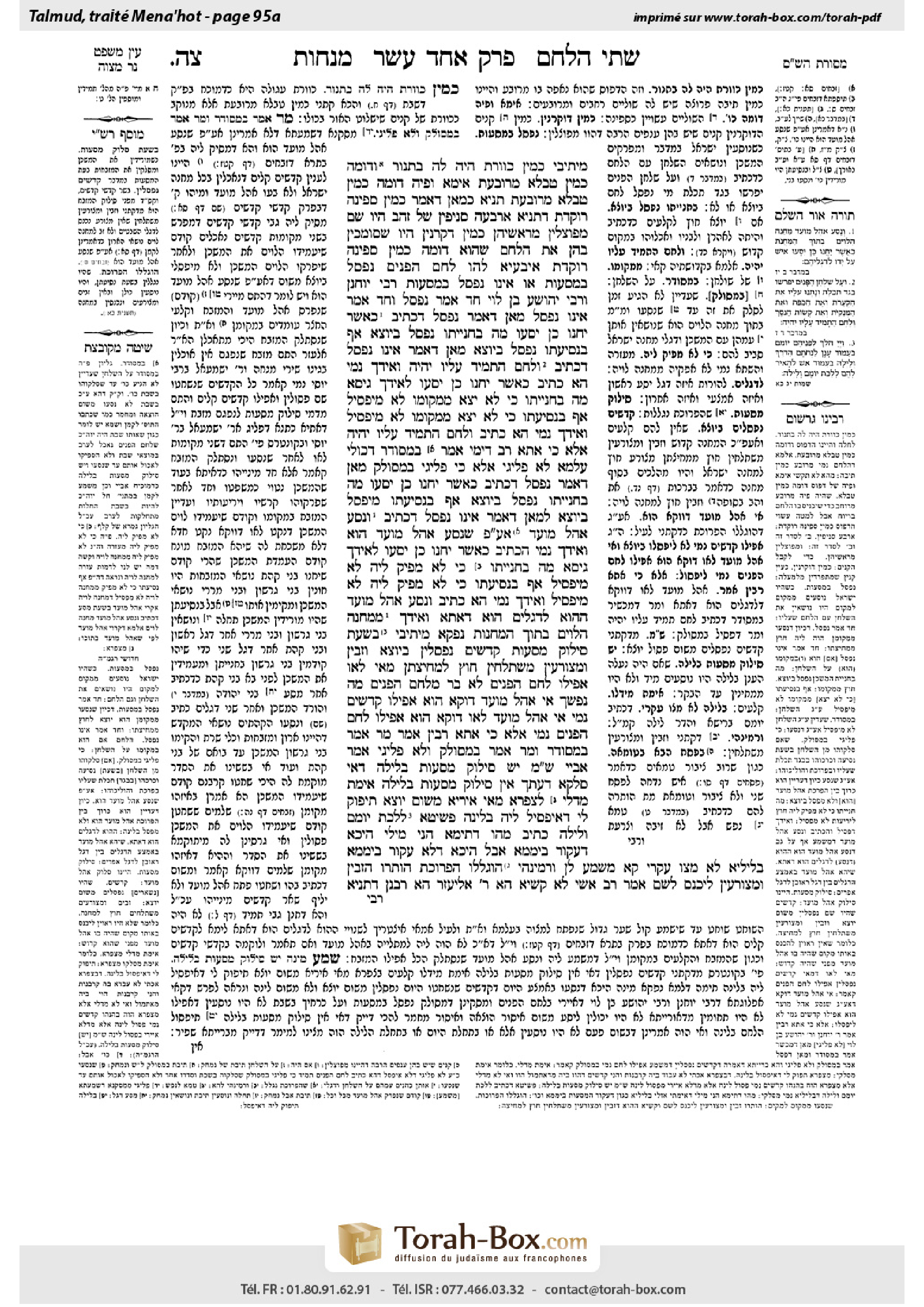
This page of Menachot includes the Aramaic text, an English translation and an AI-generated French translation, alongside the scan above.
מנחות צ״ה א · Aramaic and Hebrew text
מֵיתִיבִי: כְּמִין כַּוֶּורֶת הָיָה לָהּ בַּתַּנּוּר, וְדוֹמָה כְּמִין טַבְלָא מְרוּבַּעַת! אֵימָא: וּפִיהָ דּוֹמֶה כְּמִין טַבְלָא מְרוּבַּעַת.
תַּנְיָא כְּמַאן דְּאָמַר כְּמִין סְפִינָה רוֹקֶדֶת, דְּתַנְיָא: אַרְבָּעָה סְנִיפִין שֶׁל זָהָב הָיוּ שָׁם, מְפוּצָּלִין מֵרָאשֵׁיהֶן כְּמִין דֻּקְרָנִין הָיוּ, שֶׁסּוֹמְכִין בָּהֶן אֶת הַלֶּחֶם, שֶׁהוּא דּוֹמֶה כְּמִין סְפִינָה רוֹקֶדֶת.
אִיבַּעְיָא לְהוּ: לֶחֶם הַפָּנִים נִפְסָל בַּמַּסָּעוֹת, אוֹ אֵינוֹ נִפְסָל בַּמַּסָּעוֹת? רַבִּי יוֹחָנָן וְרַבִּי יְהוֹשֻׁעַ בֶּן לֵוִי – חַד אָמַר: נִפְסָל, וְחַד אָמַר: אֵינוֹ נִפְסָל.
מַאן דְּאָמַר נִפְסָל, דִּכְתִיב: ״כַּאֲשֶׁר יַחֲנוּ כֵּן יִסָּעוּ״. מָה בַּחֲנִיָּיתוֹ – נִפְסָל בְּיוֹצֵא, אַף בִּנְסִיעָתוֹ – נִפְסָל בְּיוֹצֵא.
מַאן דְּאָמַר אֵינוֹ נִפְסָל, דִּכְתִיב: ״וְלֶחֶם הַתָּמִיד עָלָיו יִהְיֶה״.
וְאִידַּךְ נָמֵי, הָא כְּתִיב ״כַּאֲשֶׁר יַחֲנוּ כֵּן יִסָּעוּ״, לְאִידַּךְ גִּיסָא: מָה בַּחֲנִיָּיתוֹ, כִּי לֹא יָצָא מִמְּקוֹמוֹ – לָא מִיפְּסֵיל, אַף בִּנְסִיעָתוֹ, כִּי לֹא יָצָא מִמְּקוֹמוֹ – לָא מִיפְּסֵיל.
וְאִידַּךְ נָמֵי, הָא כְּתִיב ״וְלֶחֶם הַתָּמִיד עָלָיו יִהְיֶה״? אֶלָּא, כִּי אֲתָא רַב דִּימִי אָמַר: בִּמְסוּדָּר – דְּכוּלֵּי עָלְמָא לָא פְּלִיגִי, אֶלָּא כִּי פְּלִיגִי – בִּמְסוּלָּק.
מַאן דְּאָמַר נִפְסָל, דִּכְתִיב: ״כַּאֲשֶׁר יַחֲנוּ כֵּן יִסָּעוּ״, מָה בַּחֲנִיָּיתוֹ נִפְסָל בְּיוֹצֵא, אַף בִּנְסִיעָתוֹ מִיפְּסֵל בְּיוֹצֵא.
לְמַאן דְּאָמַר אֵינוֹ נִפְסָל, דִּכְתִיב: ״וְנָסַע אֹהֶל מוֹעֵד״, אַף עַל פִּי שֶׁנָּסַע, אֹהֶל מוֹעֵד הוּא.
וְאִידַּךְ נָמֵי, הָכְתִיב ״כַּאֲשֶׁר יַחֲנוּ כֵּן יִסָּעוּ״, לְאִידַּךְ גִּיסָא: מָה בַּחֲנִיָּיתוֹ – כִּי לָא מַפֵּיק לֵיהּ לָא מִיפְּסֵיל, אַף בִּנְסִיעָתוֹ – כִּי לָא מַפֵּיק לֵיהּ לָא מִיפְּסֵיל.
וְאִידַּךְ נָמֵי, הָא כְּתִיב ״וְנָסַע אֹהֶל מוֹעֵד״? הַהוּא לִדְגָלִים הוּא דַּאֲתָא.
וְאִידָּךְ, מִ״מַּחֲנֵה הַלְוִיִּם בְּתוֹךְ הַמַּחֲנוֹת״ נָפְקָא.
מֵיתִיבִי: בִּשְׁעַת סִילּוּק מַסָּעוֹת, קָדָשִׁים נִפְסָלִין בְּיוֹצֵא, וְזָבִין וּמְצוֹרָעִין מִשְׁתַּלְּחִין חוּץ לִמְחִיצָתָן. מַאי לָאו אֲפִילּוּ לֶחֶם הַפָּנִים? לָא, בַּר מִלֶּחֶם הַפָּנִים.
מָה נַפְשָׁךְ, אִי ״אֹהֶל מוֹעֵד״ דַּוְקָא הוּא – אֲפִילּוּ קֳדָשִׁים נָמֵי, אִי ״אֹהֶל מוֹעֵד״ לָאו דַּוְקָא הוּא – אֲפִילּוּ לֶחֶם הַפָּנִים נָמֵי.
אֶלָּא, כִּי אֲתָא רָבִין אָמַר: מָר אָמַר בִּמְסוּדָּר, וּמָר אֲמַר בִּמְסוּלָּק, וְלָא פְּלִיגִי.
אָמַר אַבָּיֵי: שְׁמַע מִינַּהּ יֵשׁ סִילּוּק מַסָּעוֹת בַּלַּיְלָה, דְּאִי סָלְקָא דַעְתָּךְ אֵין סִילּוּק מַסָּעוֹת בַּלַּיְלָה – אֵימַת מִדְּלֵי? לְצַפְרָא? מַאי אִירְיָא מִשּׁוּם יוֹצֵא? תִּיפּוֹק לִי דְּאִיפְּסִיל לֵיהּ בְּלִינָה!
פְּשִׁיטָא, ״לָלֶכֶת יוֹמָם וָלָיְלָה״ כְּתִיב! מַהוּ דְּתֵימָא: הָנֵי מִילֵּי הֵיכָא דַּעֲקוּר בִּימָמָא, אֲבָל הֵיכָא דְּלָא עֲקוּר בִּימָמָא – בְּלֵילְיָא לָא מָצוּ עָקְרִי; קָא מַשְׁמַע לַן.
וּרְמִינְהִי: הוּגְלְלוּ הַפָּרֹכוֹת, הוּתְּרוּ (הזבין) [זָבִין] וּמְצוֹרָעִין לִיכָּנֵס לְשָׁם. אָמַר רַב אָשֵׁי: לָא קַשְׁיָא, הָא – רַבִּי אֱלִיעֶזֶר, הָא – רַבָּנַן. דְּתַנְיָא:
Menachot 95a · English translation
The Gemara raises an objection to the opinion of Rabbi Yoḥanan from another baraita: There was a mold in the oven for the shewbread that was similar to a barrel made of reeds, as it was perforated to enable the bread to bake well, and in its shape it resembled a type of rectangular tablet [tavla]. This indicates that the shewbread was rectangular. The Gemara answers: Say that the opening, i.e., the upper section of the mold, resembled a type of rectangular tablet, and that the mold tapered down to a point.
It is taught in a baraita in accordance with the one who said the shewbread was like a rocking boat, as it is taught in a baraita: There were four gold panels there, on the Table, which split up at their upper ends so that they were like forked reed branches. The panels were forked because the bread, which resembled a type of rocking boat, was supported by them.
§ A dilemma was raised before the Sages: During the era of the Tabernacle, was the shewbread disqualified during the journeys of the Jewish people in the wilderness, or was it not disqualified during the journeys? When the Jewish people would travel from one place to another in the wilderness, the Tabernacle would be dismantled and the Table would be carried with the loaves upon it. The dilemma is about whether or not the loaves were disqualified, since they left the boundaries of the Sanctuary. This matter is the subject of a dispute between Rabbi Yoḥanan and Rabbi Yehoshua ben Levi. One says the loaves were thereby disqualified, and one says they were not disqualified.
The Gemara explains their respective reasons: The one who says the shewbread was disqualified derives his opinion from a verse, as it is written with regard to the journeys: “Then the Tent of Meeting shall journey with the camp of the Levites in the midst of the camps; as they encamp, so shall they journey, every man in his place, by their banners” (Numbers 2:17). The verse juxtaposes the encampments with the journeys, indicating that just as when the Tabernacle is encamped the shewbread is disqualified when it leaves the Tabernacle courtyard, so too, when the Tabernacle journeys the shewbread is disqualified when it leaves the courtyard.
The one who says the shewbread was not disqualified during the journeys derives his opinion from a verse, as it is written with regard to the journeys: “And upon the Table of shewbread they shall spread a cloth of blue…and the continual bread shall remain upon it” (Numbers 4:7). The verse refers to the shewbread as “the continual bread” even during the journeys, indicating that as long as the loaves are on the Table they retain their sacred status.
The Gemara asks: But also according to the other amora, who maintains the shewbread was not disqualified during the journeys, isn’t it written: “As they encamp, so shall they journey,” indicating that the shewbread is disqualified when it leaves the Tabernacle during the journeys? The Gemara replies that according to this opinion, the juxtaposition of the encampments with the journeys is interpreted in the other direction: Just as when the Tabernacle is encamped, if the shewbread does not leave its place and remains on the Table it is not disqualified, so too, when the Tabernacle journeys, if it does not leave its place on the Table it is not disqualified.
The Gemara asks: But also according to the other amora, who maintains the shewbread was disqualified during the journeys, isn’t it written: “And the continual bread shall remain upon it,” indicating that the shewbread retains its sanctity as long as it is on the Table? Rather, when Rav Dimi came from Eretz Yisrael to Babylonia he said that the explanation of the dispute between Rabbi Yoḥanan and Rabbi Yehoshua ben Levi is different. With regard to a case where the shewbread is arranged on the Table, everyone agrees the shewbread is not disqualified during the journey. Rather, when they disagree it is in a case where the shewbread is removed from the Table before the journey.
The Gemara explains their respective reasons: The one who says the shewbread is disqualified derives his opinion from a verse, as it is written: “Then the Tent of Meeting shall journey with the camp of the Levites in the midst of the camps; as they encamp, so shall they journey, every man in his place, by their banners” (Numbers 2:17). The verse juxtaposes the encampments with the journeys, indicating that just as when the Tabernacle is encamped the shewbread is disqualified when it leaves the Tabernacle courtyard, so too, when the Tabernacle journeys the shewbread is disqualified when it leaves the courtyard.
According to the one who says the shewbread is not disqualified during the journeys, this is derived from a verse, as it is written: “Then the Tent of Meeting shall journey,” indicating that even though it has journeyed it is still considered the Tent of Meeting, and therefore the shewbread is not disqualified.
The Gemara asks: But also according to the other amora, who maintains the shewbread was not disqualified during the journeys, isn’t it written: “As they encamp, so shall they journey,” indicating that the shewbread is disqualified when it leaves the Tabernacle during the journeys? The Gemara replies that according to this opinion, the juxtaposition of the encampments with the journeys is interpreted in the other direction: Just as when the Tabernacle is encamped, if one does not take the shewbread out of the courtyard it is not disqualified, so too, when the Tabernacle journeys, if one does not take the shewbread out of the courtyard it is not disqualified.
The Gemara asks: But also according to the other amora, who maintains the shewbread was disqualified during the journeys, isn’t it written: “Then the Tent of Meeting shall journey,” indicating that the Tent of Meeting retains its sanctity during the journeys and therefore the shewbread should not be disqualified? The Gemara answers: That verse is not referring to the sanctity of the Tent of Meeting during the journeys. Rather, it comes to teach the position of the Tent of Meeting between the banners of the different tribes during the journeys.
The Gemara asks: And according to the other amora, from where does he derive the position of the Tent of Meeting during the journeys? The Gemara replies: He derives this from the continuation of the verse: “With the camp of the Levites in the midst of the camps” (Numbers 2:17).
The Gemara raises an objection from a baraita to the opinion that the shewbread was not disqualified during the journeys: At the time of the dismantling of the Tabernacle in order to commence the journeys, when the curtains surrounding the Tabernacle courtyard are removed, the sacrificial food is disqualified from being consumed, as it is considered to have left the Tabernacle courtyard. And zavim and lepers are sent out of the partitions of their camps; the zavim are sent out of the Levite camp, while lepers are sent out of the Israelite camp. What, is it not referring even to the shewbread, indicating that it is disqualified during the journeys? The Gemara answers: No, the baraita means that most sacrificial food is disqualified, except for the shewbread.
The Gemara challenges: Whichever way you look at it, this explanation is difficult. If the phrase: “Then the Tent of Meeting shall journey,” is meant exactly, i.e., literally, and it still has the status of the Tent of Meeting even during the journeys, then even other sacrificial food should not be disqualified during the journeys. If “then the Tent of Meeting shall journey,” is not meant exactly, and it does not have the status of the Tent of Meeting during the journeys, then even the shewbread should be disqualified.
Rather, when Ravin came from Eretz Yisrael to Babylonia he said that there is actually no dispute between Rabbi Yoḥanan and Rabbi Yehoshua ben Levi. This Master, who stated that the shewbread is not disqualified during the journeys, stated his ruling with regard to loaves that are arranged on the Table; and that Master, who stated that the shewbread is disqualified during the journeys, stated his ruling with regard to loaves that were removed from the Table. And the two amora’im do not disagree, as each was referring to a different case.
§ The aforementioned baraita states that when the Tabernacle was dismantled the sacrificial food was disqualified, as it was considered to have left the Tabernacle courtyard. Abaye said: One may conclude from the baraita that there could be a case where the dismantling of the Tabernacle in order to commence the journeys would take place at night. This is a necessary conclusion, as if it should enter your mind to say that there could not be a case where the dismantling of the Tabernacle in order to commence the journeys would take place at night, when would the curtains surrounding the Tabernacle be removed? If they were removed right away in the morning, why was the sacrificial food disqualified specifically due to the fact that it left the Tabernacle courtyard? I may derive that it was disqualified because of the fact that it was left overnight.
The Gemara challenges: It is obvious that the Tabernacle could be dismantled at night, as it is written: “And the Lord went before them by day in a pillar of cloud, to lead them the way; and by night in a pillar of fire, to give them light; that they might go by day and by night” (Exodus 13:21). The Gemara answers that Abaye’s observation is necessary lest you say that this statement, that they would travel at night, applies only in a case where the Jewish people dismantled their camp and began to journey by day, in which case they would continue to travel at night. But in a case where they did not dismantle their camp by day they could not dismantle the camp and leave at night. Abaye therefore teaches us that they could set out even at night.
§ The aforementioned baraita teaches that even when the Tabernacle was dismantled, zavim and lepers were sent outside the camp, as the sanctity of both the Levite camp and the Israelite camp remained intact even while the Tabernacle was dismantled. And the Gemara raises a contradiction from another baraita: Once the curtain surrounding the Tabernacle courtyard was rolled up, the zavim and the lepers were permitted to enter into that area where the Tabernacle had stood. This indicates that the camps did not retain their sacred status once the Tabernacle was dismantled. Rav Ashi said: This is not difficult; this baraita is in accordance with the opinion of Rabbi Eliezer and that baraita is in accordance with the opinion of the Rabbis. As it is taught in a baraita:
Menachot 95a · Traduction française (IA)
La Guemara soulève une objection à l’opinion de Rabbi Yoḥanan à partir d’une autre baraïta : il y avait dans le four du pain de proposition un moule semblable à un panier cylindrique en roseaux, percé pour permettre au pain de bien cuire, et dont la forme ressemblait à une sorte de tablette rectangulaire [tavla]. Cela indique que le pain de proposition était rectangulaire. La Guemara répond : dis plutôt que l’ouverture, c’est-à-dire la partie supérieure du moule, ressemblait à une sorte de tablette rectangulaire, et que le moule s’effilait jusqu’à une pointe.
Une baraïta enseigne conformément à l’opinion de celui qui affirme que le pain de proposition avait la forme d’une barque à balancier, comme l’enseigne une baraïta : il y avait là, sur la Table, quatre panneaux d’or dont les extrémités supérieures se divisaient de manière à ressembler à des branches de roseau fourchues. Les panneaux étaient fourchus parce que le pain, qui ressemblait à une sorte de barque à balancier, était soutenu par eux.
§ Une question fut posée aux Sages : à l’époque du Tabernacle, le pain de proposition était-il invalidé pendant les déplacements du peuple juif dans le désert, ou ne l’était-il pas ? Lorsque le peuple juif se déplaçait d’un endroit à un autre dans le désert, le Tabernacle était démonté et la Table était transportée avec les pains dessus. La question est de savoir si les pains étaient invalidés ou non, puisqu’ils sortaient des limites du Sanctuaire. Rabbi Yoḥanan et Rabbi Yehoshua ben Levi font l’objet d’une controverse à ce sujet : l’un dit que les pains étaient alors invalidés, et l’autre qu’ils ne l’étaient pas.
La Guemara explique les raisons de chacun : celui qui dit que le pain de proposition était invalidé tire son opinion d’un verset, comme il est écrit au sujet des déplacements : « Alors la Tente d’assignation se mettra en marche avec le camp des Lévites, au milieu des camps ; comme ils campent, ainsi ils se mettront en marche, chacun à sa place, selon leurs bannières » (Nombres 2:17). Le verset met en parallèle les campements et les déplacements, indiquant que, de même que lorsque le Tabernacle est installé, le pain de proposition est invalidé lorsqu’il quitte le parvis du Tabernacle, de même, lorsque le Tabernacle se déplace, le pain de proposition est invalidé lorsqu’il quitte le parvis.
Celui qui dit que le pain de proposition n’était pas invalidé pendant les déplacements tire son opinion d’un verset, comme il est écrit au sujet des déplacements : « Sur la Table du pain de proposition, ils étendront un tissu bleu… et le pain perpétuel restera dessus » (Nombres 4:7). Le verset désigne le pain de proposition comme « le pain perpétuel » même pendant les déplacements, ce qui indique que, tant que les pains se trouvent sur la Table, ils conservent leur statut sacré.
La Guemara demande : mais, selon l’autre amora, qui soutient que le pain de proposition n’était pas invalidé pendant les déplacements, n’est-il pas écrit : « Comme ils campent, ainsi ils se mettront en marche », ce qui indique que le pain de proposition est invalidé lorsqu’il quitte le Tabernacle pendant les déplacements ? La Guemara répond que, selon cette opinion, le parallèle entre les campements et les déplacements s’interprète en sens inverse : de même que, lorsque le Tabernacle est installé, si le pain de proposition ne quitte pas sa place et reste sur la Table, il n’est pas invalidé, de même, lorsque le Tabernacle se déplace, s’il ne quitte pas sa place sur la Table, il n’est pas invalidé.
La Guemara demande : mais, selon l’autre amora, qui soutient que le pain de proposition était invalidé pendant les déplacements, n’est-il pas écrit : « Et le pain perpétuel restera dessus », ce qui indique que le pain de proposition conserve sa sainteté tant qu’il se trouve sur la Table ? Rav Dimi répondit, à son arrivée d’Eretz Israël en Babylonie, que l’explication de la controverse entre Rabbi Yoḥanan et Rabbi Yehoshua ben Levi était différente. Dans le cas où le pain de proposition est disposé sur la Table, tous sont d’accord qu’il n’est pas invalidé pendant le déplacement. Leur désaccord porte plutôt sur le cas où le pain de proposition est retiré de la Table avant le déplacement.
La Guemara explique les raisons de chacun : celui qui dit que le pain de proposition est invalidé tire son opinion d’un verset, comme il est écrit : « Alors la Tente d’assignation se mettra en marche avec le camp des Lévites, au milieu des camps ; comme ils campent, ainsi ils se mettront en marche, chacun à sa place, selon leurs bannières » (Nombres 2:17). Le verset met en parallèle les campements et les déplacements, indiquant que, de même que lorsque le Tabernacle est installé, le pain de proposition est invalidé lorsqu’il quitte le parvis du Tabernacle, de même, lorsque le Tabernacle se déplace, le pain de proposition est invalidé lorsqu’il quitte le parvis.
Selon celui qui dit que le pain de proposition n’est pas invalidé pendant les déplacements, cela se déduit d’un verset, comme il est écrit : « Alors la Tente d’assignation se mettra en marche », ce qui indique que, même si elle s’est mise en marche, elle est toujours considérée comme la Tente d’assignation ; le pain de proposition n’est donc pas invalidé.
La Guemara demande : mais, selon l’autre amora, qui soutient que le pain de proposition n’était pas invalidé pendant les déplacements, n’est-il pas écrit : « Comme ils campent, ainsi ils se mettront en marche », ce qui indique que le pain de proposition est invalidé lorsqu’il quitte le Tabernacle pendant les déplacements ? La Guemara répond que, selon cette opinion, le parallèle entre les campements et les déplacements s’interprète en sens inverse : de même que, lorsque le Tabernacle est installé, si l’on ne fait pas sortir le pain de proposition du parvis, il n’est pas invalidé, de même, lorsque le Tabernacle se déplace, s’il n’est pas sorti du parvis, il n’est pas invalidé.
La Guemara demande : mais, selon l’autre amora, qui soutient que le pain de proposition était invalidé pendant les déplacements, n’est-il pas écrit : « Alors la Tente d’assignation se mettra en marche », ce qui indique que la Tente d’assignation conserve sa sainteté pendant les déplacements et que, par conséquent, le pain de proposition ne devrait pas être invalidé ? La Guemara répond : ce verset ne traite pas de la sainteté de la Tente d’assignation pendant les déplacements. Il vient plutôt enseigner la position de la Tente d’assignation entre les bannières des différentes tribus pendant les déplacements.
La Guemara demande : et selon l’autre amora, d’où déduit-il la position de la Tente d’assignation pendant les déplacements ? La Guemara répond : il la déduit de la suite du verset : « Avec le camp des Lévites, au milieu des camps » (Nombres 2:17).
La Guemara soulève, à partir d’une baraïta, une objection à l’opinion selon laquelle le pain de proposition n’était pas invalidé pendant les déplacements : au moment du démontage du Tabernacle en vue du départ, lorsque les tentures entourant le parvis du Tabernacle sont retirées, les aliments sacrificiels sont invalidés pour la consommation, car ils sont considérés comme ayant quitté le parvis du Tabernacle. Les zavim et les lépreux sont alors envoyés hors des limites de leurs camps : les zavim hors du camp des Lévites, tandis que les lépreux sont envoyés hors du camp d’Israël. N’est-il pas question ici même du pain de proposition, ce qui indiquerait qu’il est invalidé pendant les déplacements ? La Guemara répond : non, la baraïta signifie que la plupart des aliments sacrificiels sont invalidés, à l’exception du pain de proposition.
La Guemara objecte : quelle que soit la manière dont on considère les choses, cette explication est difficile. Si l’expression « Alors la Tente d’assignation se mettra en marche » doit être prise au sens propre, c’est-à-dire littéralement, et si la Tente conserve son statut même pendant les déplacements, alors les autres aliments sacrificiels ne devraient pas non plus être invalidés pendant les déplacements. Si l’expression « Alors la Tente d’assignation se mettra en marche » ne doit pas être prise au sens propre et si la Tente ne conserve pas son statut pendant les déplacements, alors le pain de proposition devrait lui aussi être invalidé.
Ravin répondit, à son arrivée d’Eretz Israël en Babylonie, qu’en réalité, il n’y a aucun désaccord entre Rabbi Yoḥanan et Rabbi Yehoshua ben Levi. Ce maître, qui a déclaré que le pain de proposition n’était pas invalidé pendant les déplacements, parlait des pains disposés sur la Table ; cet autre maître, qui a déclaré que le pain de proposition était invalidé pendant les déplacements, parlait des pains retirés de la Table. Les deux amoraïm ne sont donc pas en désaccord, car chacun parlait d’un cas différent.
§ La baraïta susmentionnée affirme que, lorsque le Tabernacle était démonté, les aliments sacrificiels étaient invalidés, car ils étaient considérés comme ayant quitté le parvis du Tabernacle. Abaye dit : on peut conclure de la baraïta qu’il est possible que le démontage du Tabernacle en vue du départ ait eu lieu la nuit. Cette conclusion est nécessaire, car si l’on devait penser qu’il était impossible que le démontage du Tabernacle en vue du départ ait lieu la nuit, à quel moment les tentures entourant le Tabernacle auraient-elles été retirées ? Si elles avaient été retirées dès le matin, pourquoi les aliments sacrificiels auraient-ils été invalidés précisément parce qu’ils avaient quitté le parvis du Tabernacle ? On pourrait en déduire qu’ils avaient été invalidés parce qu’ils étaient restés toute la nuit.
La Guemara objecte : il est évident que le Tabernacle pouvait être démonté la nuit, comme il est écrit : « L’Éternel allait devant eux le jour dans une colonne de nuée, pour les guider sur le chemin, et la nuit dans une colonne de feu, pour les éclairer, afin qu’ils puissent marcher le jour et la nuit » (Exode 13:21). La Guemara répond que la remarque d’Abaye est nécessaire, de peur que l’on dise que l’affirmation selon laquelle ils voyageaient la nuit ne s’applique qu’au cas où le peuple juif avait démonté son camp et commencé à se déplacer le jour, auquel cas il continuait sa route pendant la nuit. Mais, dans le cas où il n’avait pas démonté son camp pendant le jour, il ne pouvait pas le démonter et partir la nuit. Abaye nous enseigne donc qu’ils pouvaient partir même la nuit.
§ La baraïta susmentionnée enseigne que, même lorsque le Tabernacle était démonté, les zavim et les lépreux étaient envoyés hors du camp, car la sainteté du camp des Lévites et celle du camp d’Israël demeuraient intactes même pendant le démontage du Tabernacle. La Guemara soulève une contradiction à partir d’une autre baraïta : une fois que la tenture entourant le parvis du Tabernacle était enroulée, les zavim et les lépreux étaient autorisés à entrer dans la zone où le Tabernacle s’était trouvé. Cela indique que les camps ne conservaient pas leur statut sacré après le démontage du Tabernacle. Rav Ashi dit : il n’y a pas de difficulté ; cette baraïta est conforme à l’opinion de Rabbi Eliezer, et l’autre baraïta à celle des Rabbins. En effet, une baraïta enseigne :
Traduction française générée par IA à partir de l’édition anglaise de Sefaria. Vérifie toujours un passage avec le texte source.
Text from Sefaria: William Davidson Edition - Vocalized Aramaic (unknown); William Davidson Edition - English (CC BY NC).