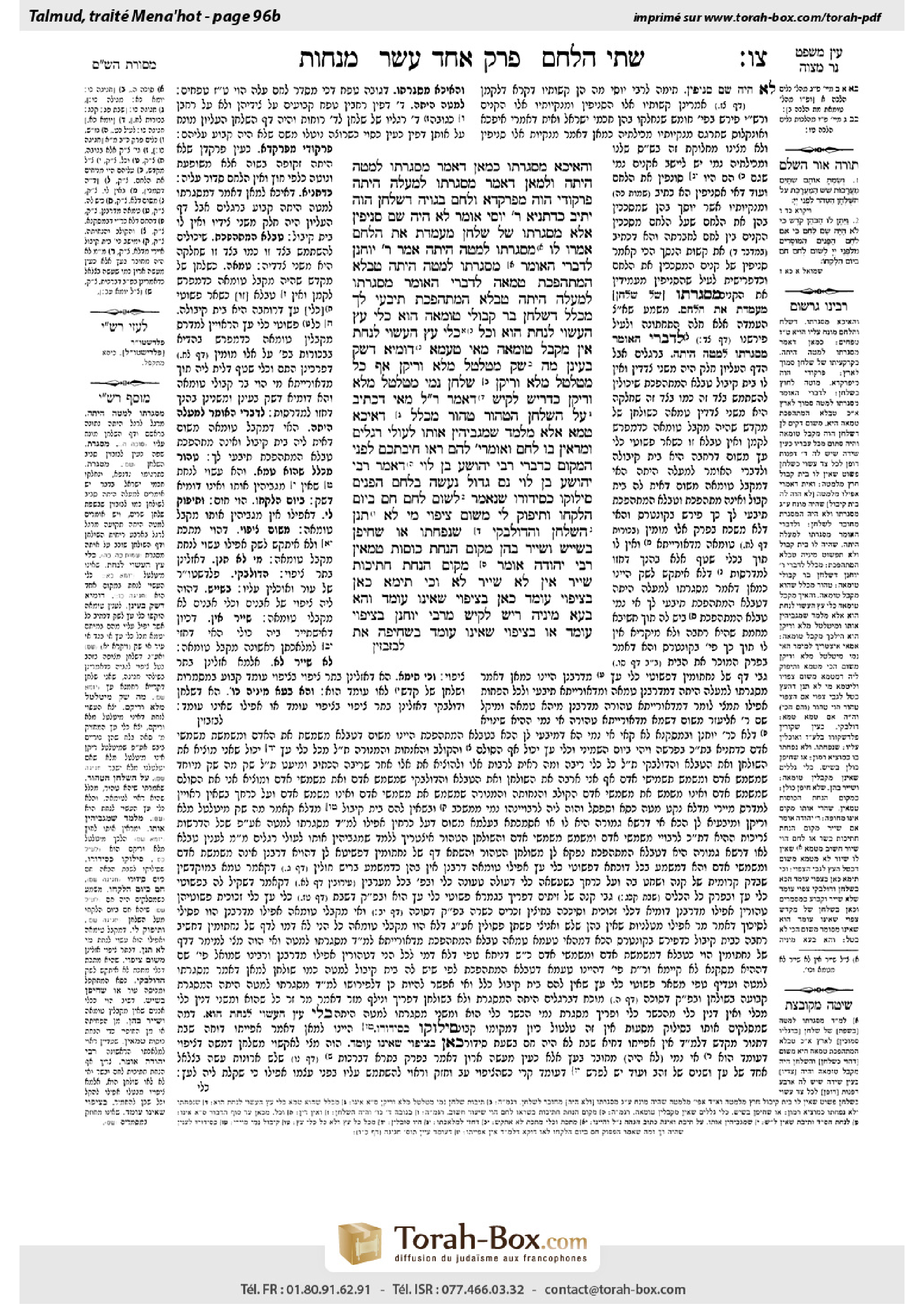
Menachot 96b: Talmud study for Daf Yomi
Daf Yomi is the daily study of one Talmud folio. Explore 37 tractates with scans, Hebrew text, Sefaria English and AI-generated French translations where annotated.
Passage selection and English or AI-generated French translation are available where the scan has annotations. Daf Study is independent of Torah-Box and Sefaria.
Browse Menachot · מנחות · All tractatesMenachot 96b text and translations
This page of Menachot includes the Aramaic text, an English translation and an AI-generated French translation, alongside the scan above.
מנחות צ״ו ב · Aramaic and Hebrew text
וְהָאִיכָּא מִסְגַּרְתּוֹ!
כְּמַאן דְּאָמַר מִסְגַּרְתּוֹ לְמַטָּה הָיְתָה, וּלְמַאן דְּאָמַר מִסְגַּרְתּוֹ לְמַעְלָה הָיְתָה – פַּרְקוֹדֵי הֲוָה מְפַרְקְדָא, וְלֶחֶם בְּגַוֵּיהּ דְּשֻׁלְחָן הֲוָה יָתֵיב.
כִּדְתַנְיָא, רַבִּי יוֹסֵי אוֹמֵר: לֹא הָיָה שָׁם סְנִיפִין, אֶלָּא מִסְגַּרְתּוֹ שֶׁל שֻׁלְחָן מַעֲמֶדֶת אֶת הַלֶּחֶם. אָמְרוּ לוֹ: מִסְגַּרְתּוֹ לְמַטָּה הָיְתָה.
אָמַר רַבִּי יוֹחָנָן: לְדִבְרֵי הָאוֹמֵר מִסְגַּרְתּוֹ לְמַטָּה הָיְתָה, טַבְלָא הַמִּתְהַפֶּכֶת טְמֵאָה.
לְדִבְרֵי הָאוֹמֵר מִסְגַּרְתּוֹ לְמַעְלָה הָיְתָה, טַבְלָא הַמִּתְהַפֶּכֶת תִּיבְּעֵי לָךְ.
מִכְּלָל דְּשֻׁלְחָן בַּר קַבּוֹלֵי טוּמְאָה הוּא? כְּלִי עֵץ הֶעָשׂוּי לְנַחַת הוּא, וְכׇל כְּלִי עֵץ הֶעָשׂוּי לְנַחַת – אֵין מְקַבֵּל טוּמְאָה.
מַאי טַעְמָא? דּוּמְיָא דְּשַׂק בָּעֵינַן – מָה שַׂק מִטַּלְטֵל מָלֵא וְרֵיקָן, אַף כֹּל מִטַּלְטֵל מָלֵא וְרֵיקָן.
שֻׁלְחָן נָמֵי מִטַּלְטֵל מָלֵא וְרֵיקָן, כִּדְרֵישׁ לָקִישׁ, דְּאָמַר רֵישׁ לָקִישׁ: מַאי דִּכְתִיב ״עַל הַשֻּׁלְחָן הַטָּהוֹר״? ״טָהוֹר״ – מִכְּלָל דְּאִיכָּא טָמֵא!
אֶלָּא, מְלַמֵּד שֶׁמַּגְבִּיהִין אוֹתוֹ לְעוֹלֵי רְגָלִים, וּמַרְאִין בּוֹ לֶחֶם, וְאוֹמְרִים לָהֶם: רְאוּ חִיבַּתְכֶם לִפְנֵי הַמָּקוֹם!
כְּדִבְרֵי רַבִּי יְהוֹשֻׁעַ בֶּן לֵוִי, דְּאָמַר רַבִּי יְהוֹשֻׁעַ בֶּן לֵוִי: נֵס גָּדוֹל נַעֲשָׂה בְּלֶחֶם הַפָּנִים, סִילּוּקוֹ כְּסִידּוּרוֹ, שֶׁנֶּאֱמַר: ״לָשׂוּם לֶחֶם חֹם בְּיוֹם הִלָּקְחוֹ״.
וְתִיפּוֹק לִי מִשּׁוּם צִיפּוּי? מִי לָא תְּנַן: הַשֻּׁלְחָן וְהַדּוּלְבָּקִי שֶׁנִּפְחֲתוּ, אוֹ שֶׁחִיפָּן בְּשַׁיִישׁ, וְשִׁיֵּיר בָּהֶן מְקוֹם הַנָּחַת כּוֹסוֹת – טְמֵאִין. רַבִּי יְהוּדָה אוֹמֵר: מְקוֹם הַנָּחַת חֲתִיכוֹת.
שִׁיֵּיר – אִין, לֹא שִׁיֵּיר – לָא.
וְכִי תֵּימָא, כָּאן בְּצִיפּוּי עוֹמֵד, כָּאן בְּצִיפּוּי שֶׁאֵינוֹ עוֹמֵד, וְהָא בְּעָא מִינֵּיהּ רֵישׁ לָקִישׁ מֵרַבִּי יוֹחָנָן: בְּצִיפּוּי עוֹמֵד, אוֹ בְּצִיפּוּי שֶׁאֵינוֹ עוֹמֵד? בְּשֶׁחִיפָּה אֶת
Menachot 96b · English translation
The Gemara asks: But isn’t there the Table’s decorated frame, which ran around its perimeter and was one handbreadth wide, as the verse states: “And you shall make for it a frame of a handbreadth” (Exodus 25:25)? Since the arrangements are placed on the Table’s frame, they rise one additional handbreadth above the Table.
The Gemara answers: Rabbi Yoḥanan’s statement is in accordance with the opinion of the one who said the Table’s frame was not above the Table’s surface but below it, and therefore it did not add any height to the arrangements on the Table. And furthermore, even according to the one who said the Table’s frame was above the Table’s surface, it did not add to the height of the arrangements. This is because the frame was tilted outward, but the bread was set within the area of the Table’s surface.
The Gemara cites the dispute with regard to the location of the frame: As it is taught in a baraita: Rabbi Yosei says: There were no panels there at all, as they were not required in order to support the loaves. Rather, the Table’s frame supported the bread, as the frame was above the Table’s surface. The Rabbis said to Rabbi Yosei: The Table’s frame was below the Table’s surface, and therefore the panels were required to support the loaves.
§ Rabbi Yoḥanan says: According to the statement of the one who says that the Table’s frame was below the Table’s surface, the surface was merely a flat board. It is a halakhic principle with regard to wooden utensils that only rounded utensils are susceptible to ritual impurity, but not flat utensils. It is known that the shewbread Table was susceptible to impurity. One may therefore infer from this that a flat board is susceptible to impurity, provided that it can be turned over and used on both sides. This is because the wide surface of the board renders it functionally similar to a concave receptacle.
Rabbi Yoḥanan continues: According to the statement of the one who says that the Table’s frame was above the Table’s surface, the Table served as a receptacle. One therefore cannot infer the halakha with regard to a flat board that can be turned over from the case of the Table, and you must still raise the dilemma as to whether it is susceptible to ritual impurity.
The Gemara asks: One can conclude by inference from Rabbi Yoḥanan’s statement that the Table is susceptible to ritual impurity. But it is a wooden vessel designated to rest in a fixed place, and any wooden vessel that is designated to rest in a fixed place is not susceptible to impurity.
The Gemara explains: What is the reason for this halakha? The verse states with regard to items that are rendered impure by the carcasses of creeping animals: “And anything upon which any of them fall when they are dead shall be impure, whether it is any vessel of wood, or cloth, or leather, or sack” (Leviticus 11:32). The verse juxtaposes wooden vessels with sacks, indicating that we require a wooden vessel to be similar to a sack in order to be susceptible to ritual impurity. Just as a sack is carried both when it is full and when it is empty, so too, any wooden vessel that is carried both full and empty is susceptible to impurity. Since the Table is designated to rest in a fixed place and not to be carried, it should not be susceptible to impurity.
The Gemara answers: The Table is also carried both full and empty, i.e., even when the shewbread is upon it, in accordance with the statement of Reish Lakish. This is as Reish Lakish said: What is the meaning of that which is written: “And you shall set them in two arrangements, six in an arrangement, upon the pure Table before the Lord” (Leviticus 24:6)? The term “the pure Table” teaches by inference that there is a case where the Table becomes impure, and therefore the Torah states that the Table must be pure when the shewbread is set upon it. This conclusion is difficult, as the principle that a wooden vessel designated to rest in a fixed place is not susceptible to impurity indicates that the Table should not be susceptible to impurity.
Rather, the verse teaches that the priests would lift the Table with its shewbread to display the shewbread to the pilgrims standing in the Temple courtyard, and a priest would say to them: See how beloved you are before, i.e., in the eyes of, the Omnipresent, Who constantly performs a miracle with regard to the shewbread. For this reason, the Table is susceptible to ritual impurity.
This is in accordance with the statement of Rabbi Yehoshua ben Levi, as Rabbi Yehoshua ben Levi said: A great miracle was performed with the shewbread: Its condition at the time of its removal from the Table, after having been left there for a week, was like its condition at the time of its arrangement on the Table; as it is stated: “To place hot bread on the day when it was taken away” (I Samuel 21:7), indicating that it was as hot on the day of its removal as it was on the day when it was placed on the Table.
The Gemara asks: But why is it necessary to derive that the Table is susceptible to impurity due to the fact that it is not designated to rest in a fixed place? I may derive that it is susceptible to impurity due to its gold covering. Didn’t we learn in a mishna (Kelim 22:1): Consider the case of the table and the dulbeki, a small table upon which the food and drink are placed before being served at the dining table, that were partially broken, or that one covered with marble stone, which is not susceptible to impurity. If an area of their surface large enough for placing cups there was left unbroken or uncovered with marble they remain susceptible to impurity. Rabbi Yehuda says: The remaining surface area must be large enough for placing pieces of meat and bread as well.
One can infer from the mishna that if one left part of the surface area of the table without covering it with marble, yes, it remains susceptible to impurity. But if he did not leave part of the table without covering it with marble it is not susceptible to impurity. Evidently, the status of a vessel is determined according to the material of its external covering and not according to its main material. Consequently, since the shewbread Table was covered with gold it should have the status of a metal vessel, which is susceptible to ritual impurity even if it is designated to rest in a fixed place.
And if you would say the case of the shewbread Table is different, as here, with regard to the marble-covered table, the mishna is referring to a permanent covering that is fixed to the table with nails, whereas there, in the case of the shewbread Table, the discussion is referring to a covering that is not permanent, as the gold was not attached to the shewbread Table with nails, this explanation is difficult. But didn’t Reish Lakish raise a dilemma to Rabbi Yoḥanan: Is the mishna that discusses the marble-covered table referring only to a permanent covering, or even to a covering that is not permanent? Is it referring only to a case where one covered
Menachot 96b · Traduction française (IA)
La Guemara demande : Mais n’y a-t-il pas le cadre orné de la Table, qui en faisait le tour et avait une largeur d’une palme, comme le dit le verset : « Tu lui feras un cadre d’une palme » (Exode 25,25) ? Puisque les rangées sont posées sur le cadre de la Table, elles s’élèvent d’une palme supplémentaire au-dessus de la Table.
La Guemara répond : La déclaration de Rabbi Yoḥanan suit l’opinion de celui qui dit que le cadre de la Table se trouvait sous la surface de celle-ci et ne la dépassait donc pas ; il n’ajoutait ainsi aucune hauteur aux rangées posées sur la Table. De plus, même selon celui qui dit que le cadre se trouvait au-dessus de la surface de la Table, il n’augmentait pas la hauteur des rangées. En effet, le cadre était incliné vers l’extérieur, tandis que le pain était posé à l’intérieur des limites de la surface de la Table.
La Guemara rapporte le désaccord concernant l’emplacement du cadre : comme il est enseigné dans une baraïta, Rabbi Yosei dit : « Il n’y avait là aucun panneau, car ils n’étaient pas nécessaires pour soutenir les pains. C’est plutôt le cadre de la Table qui soutenait le pain, puisqu’il se trouvait au-dessus de la surface de la Table. » Les Sages dirent à Rabbi Yosei : « Le cadre de la Table se trouvait sous la surface de celle-ci ; les panneaux étaient donc nécessaires pour soutenir les pains. »
§ Rabbi Yoḥanan dit : Selon celui qui affirme que le cadre de la Table se trouvait sous la surface de celle-ci, cette surface n’était qu’une planche plate. En matière d’ustensiles en bois, le principe halakhique est que seuls les ustensiles arrondis sont susceptibles de contracter l’impureté rituelle, et non les ustensiles plats. Or, on sait que la Table des pains de proposition était susceptible de contracter l’impureté. On peut donc en déduire qu’une planche plate est susceptible de contracter l’impureté, à condition qu’elle puisse être retournée et utilisée des deux côtés. En effet, la grande surface de la planche la rend fonctionnellement semblable à un récipient concave.
Rabbi Yoḥanan poursuit : Selon celui qui affirme que le cadre de la Table se trouvait au-dessus de sa surface, la Table faisait office de récipient. On ne peut donc pas déduire du cas de la Table la halakha concernant une planche plate que l’on peut retourner, et il faut encore poser la question de savoir si elle est susceptible de contracter l’impureté rituelle.
La Guemara demande : On peut déduire de la déclaration de Rabbi Yoḥanan que la Table est susceptible de contracter l’impureté rituelle. Mais il s’agit d’un ustensile en bois destiné à rester en place, et tout ustensile en bois destiné à rester en place n’est pas susceptible de contracter l’impureté.
La Guemara explique : Quelle est la raison de cette halakha ? Le verset dit, à propos des objets rendus impurs par les carcasses d’animaux rampants : « Tout objet sur lequel tombera l’un d’eux, une fois morts, sera impur : tout ustensile de bois, tout vêtement, toute peau ou tout sac » (Lévitique 11,32). Le verset rapproche les ustensiles en bois des sacs, ce qui indique qu’un ustensile en bois doit être semblable à un sac pour être susceptible de contracter l’impureté rituelle. De même qu’un sac est porté aussi bien lorsqu’il est plein que lorsqu’il est vide, de même tout ustensile en bois porté aussi bien plein que vide est susceptible de contracter l’impureté. Puisque la Table est destinée à rester en place et non à être portée, elle ne devrait pas être susceptible de contracter l’impureté.
La Guemara répond : La Table est elle aussi portée aussi bien pleine que vide, c’est-à-dire même lorsque les pains de proposition sont dessus, conformément à la déclaration de Reish Lakish. En effet, Reish Lakish a dit : Quel est le sens de ce qui est écrit : « Tu les disposeras en deux rangées, six par rangée, sur la Table pure devant l’Éternel » (Lévitique 24,6) ? L’expression « la Table pure » enseigne par déduction qu’il existe un cas où la Table devient impure ; c’est pourquoi la Torah exige que la Table soit pure lorsque les pains de proposition y sont disposés. Cette conclusion pose problème, puisque le principe selon lequel un ustensile en bois destiné à rester en place n’est pas susceptible de contracter l’impureté implique que la Table ne devrait pas y être susceptible.
Le verset enseigne plutôt que les prêtres soulevaient la Table avec les pains de proposition pour les montrer aux pèlerins qui se tenaient dans le parvis du Temple. Un prêtre leur disait : « Voyez combien vous êtes chers aux yeux du Tout-Puissant, qui accomplit constamment un miracle concernant les pains de proposition. » C’est pour cette raison que la Table est susceptible de contracter l’impureté rituelle.
Cela concorde avec la déclaration de Rabbi Yehoshua ben Levi, car Rabbi Yehoshua ben Levi a dit : Un grand miracle se produisait avec les pains de proposition : lorsqu’on les retirait de la Table, après qu’ils y avaient été laissés pendant une semaine, ils étaient dans le même état que lorsqu’on les y avait disposés. Comme il est dit : « Pour placer du pain chaud le jour où il fut retiré » (I Samuel 21,7), ce qui indique qu’il était aussi chaud le jour de son retrait que le jour où il avait été placé sur la Table.
La Guemara demande : Mais pourquoi faut-il déduire que la Table est susceptible de contracter l’impureté parce qu’elle n’est pas destinée à rester en place ? Ne peut-on pas déduire qu’elle est susceptible de contracter l’impureté en raison de son revêtement d’or ? N’avons-nous pas appris dans une Michna (Kelim 22,1) : « Considérons le cas d’une table et d’une dulbeki, petite table sur laquelle on pose les aliments et les boissons avant de les servir à la table de repas, qui ont été partiellement brisées, ou dont la surface a été recouverte de marbre, matériau qui n’est pas susceptible de contracter l’impureté. Si une partie de leur surface, suffisamment grande pour y poser des coupes, est restée intacte ou n’a pas été recouverte de marbre, elles restent susceptibles de contracter l’impureté. Rabbi Yehuda dit : La surface restante doit être assez grande pour qu’on puisse y poser des morceaux de viande et de pain. »
On peut déduire de la Michna que si l’on a laissé une partie de la surface de la table sans la recouvrir de marbre, alors elle reste susceptible de contracter l’impureté. Mais si l’on n’a laissé aucune partie de la table sans la recouvrir de marbre, elle n’est pas susceptible de contracter l’impureté. Il apparaît donc que le statut d’un ustensile est déterminé par le matériau de son revêtement extérieur, et non par son matériau principal. Par conséquent, puisque la Table des pains de proposition était recouverte d’or, elle devrait avoir le statut d’un ustensile en métal, susceptible de contracter l’impureté rituelle même si elle est destinée à rester en place.
Et si tu dis que le cas de la Table des pains de proposition est différent, car ici, à propos de la table recouverte de marbre, la Michna parle d’un revêtement permanent, fixé à la table avec des clous, tandis que là, dans le cas de la Table des pains de proposition, la discussion porte sur un revêtement non permanent, puisque l’or n’était pas fixé à la Table avec des clous, cette explication pose problème. En effet, Reish Lakish n’a-t-il pas soumis à Rabbi Yoḥanan la question suivante : La Michna qui traite de la table recouverte de marbre parle-t-elle uniquement d’un revêtement permanent, ou également d’un revêtement non permanent ? Parle-t-elle uniquement d’un cas où l’on a recouvert
Traduction française générée par IA à partir de l’édition anglaise de Sefaria. Vérifie toujours un passage avec le texte source.
Text from Sefaria: William Davidson Edition - Vocalized Aramaic (unknown); William Davidson Edition - English (CC BY NC).