Menachot 97b: Talmud study for Daf Yomi
Daf Yomi is the daily study of one Talmud folio. Explore 37 tractates with scans, Hebrew text, Sefaria English and AI-generated French translations where annotated.
Passage selection and English or AI-generated French translation are available where the scan has annotations. Daf Study is independent of Torah-Box and Sefaria.
Browse Menachot · מנחות · All tractatesMenachot 97b text and translations
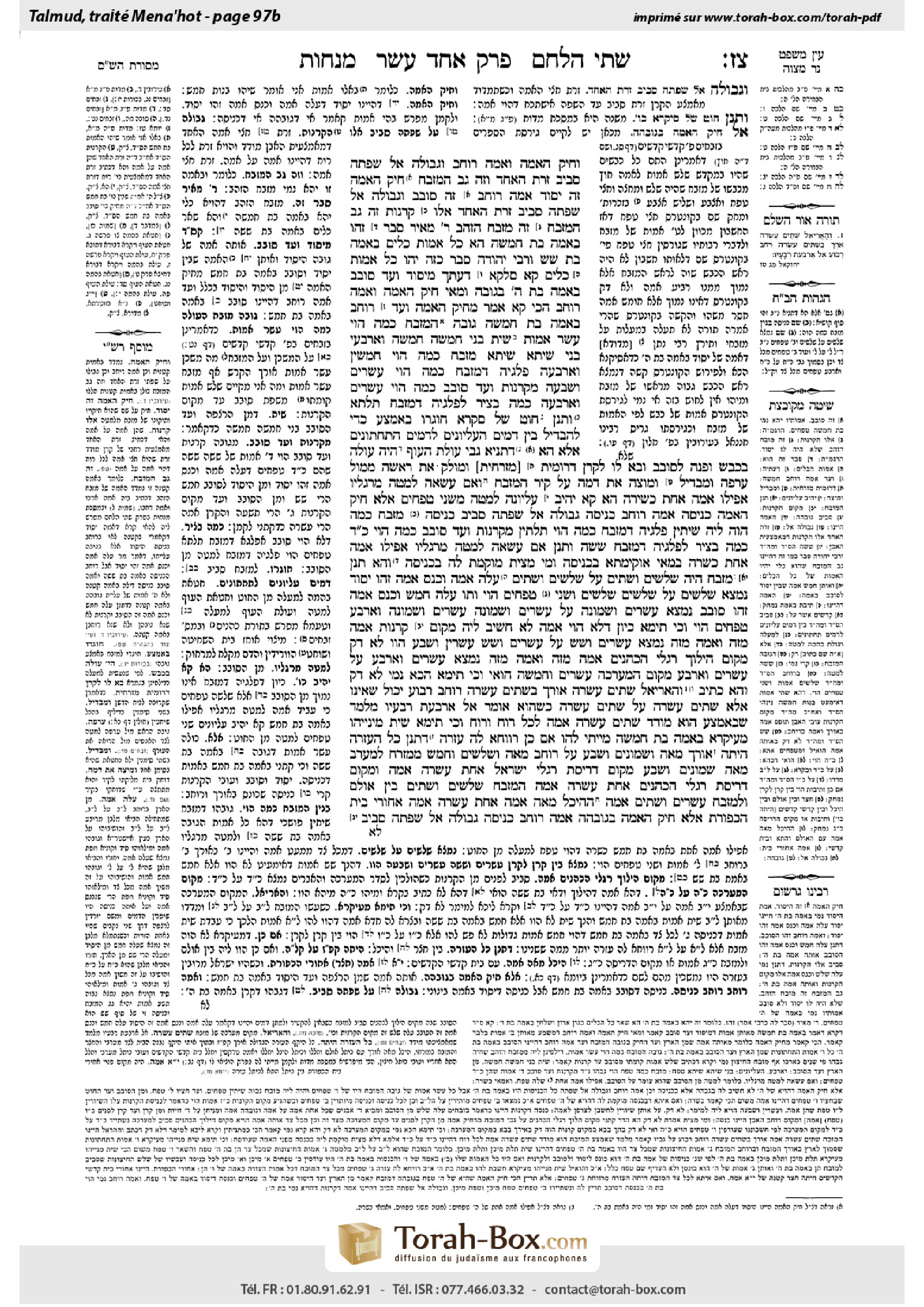
This page of Menachot includes the Aramaic text, an English translation and an AI-generated French translation, alongside the scan above.
מנחות צ״ז ב · Aramaic and Hebrew text
וְחֵיק הָאַמָּה וְאַמָּה רֹחַב וּגְבוּלָהּ אֶל שְׂפָתָהּ סָבִיב זֶרֶת הָאֶחָד וְזֶה גַּב הַמִּזְבֵּחַ״. ״חֵיק הָאַמָּה״ – זֶה יְסוֹד, ״אַמָּה רֹחַב״ – זֶה סוֹבֵב, ״וּגְבוּלָהּ אֶל שְׂפָתָהּ סָבִיב זֶרֶת הָאֶחָד״ – אֵלּוּ קְרָנוֹת, ״זֶה גַּב הַמִּזְבֵּחַ״ – זֶה מִזְבַּח הַזָּהָב.
רַבִּי מֵאִיר סָבַר: ״זֶהוּ״ – בְּאַמָּה בַּת חֲמִשָּׁה, הָא כׇּל אַמּוֹת כֵּלִים בְּאַמָּה בַּת שֵׁשׁ. וְרַבִּי יְהוּדָה סָבַר: כְּזֶה יְהוּ כׇּל אַמּוֹת כֵּלִים.
קָא סָלְקָא דַּעְתָּךְ מִיְּסוֹד וְעַד סוֹבֵב בְּאַמָּה בַּת חֲמִשָּׁה בְּגוֹבַהּ. וּמַאי ״חֵיק הָאַמָּה וְאַמָּה רֹחַב״? הָכִי קָא אָמַר: מֵחֵיק הָאַמָּה וְעַד רוֹחַב בְּאַמָּה בַּת חֲמִשָּׁה.
גּוֹבַהּ הַמִּזְבֵּחַ כַּמָּה הָוֵי? עֶשֶׂר אַמּוֹת: שֵׁית בְּנֵי חַמְשָׁה חַמְשָׁה, וְאַרְבְּעֵי בְּנֵי שִׁיתָּא שִׁיתָּא.
מִזְבֵּחַ כַּמָּה הָוֵי? חַמְשִׁין וְאַרְבְּעָה. פַּלְגֵיהּ דְּמִזְבֵּחַ כַּמָּה הָוֵי? עֶשְׂרִין וְשִׁבְעָה. מִקְּרָנוֹת וְעַד סוֹבֵב כַּמָּה הָוֵי? עֶשְׂרִין וְאַרְבְּעָה. כַּמָּה בְּצִיר לְפַלְגֵיהּ דְּמִזְבֵּחַ? תְּלָתָא. וּתְנַן: חוּט שֶׁל סִקְרָא חוֹגְרוֹ בָּאֶמְצַע, כְּדֵי לְהַבְדִּיל בֵּין דָּמִים הָעֶלְיוֹנִים לְדָמִים הַתַּחְתּוֹנִים.
אֶלָּא הָא דְּתַנְיָא גַּבֵּי עוֹלַת הָעוֹף: הָיָה עוֹלֶה בַּכֶּבֶשׁ, וּפָנָה לַסּוֹבֵב, וּבָא לוֹ לְקֶרֶן דְּרוֹמִית [מִזְרָחִית], וּמוֹלֵק אֶת רֹאשָׁהּ מִמּוּל עׇרְפָּה, וּמַבְדִּיל, וּמוֹצֶה אֶת דָּמָהּ עַל קִיר הַמִּזְבֵּחַ, וְאִם עֲשָׂאָהּ לְמַטָּה מֵרַגְלָיו אֲפִילּוּ אַמָּה אַחַת – כְּשֵׁירָה.
הָא קָא יָהֵיב עֶלְיוֹנָה לְמַטָּה מִשְּׁנֵי טְפָחִים!
אֶלָּא, ״חֵיק הָאַמָּה״ – כְּנִיסָה, ״אַמָּה רֹחַב״ – כְּנִיסָה, ״גְּבוּלָהּ אֶל שְׂפָתָהּ סָבִיב״ – כְּנִיסָה.
מִזְבֵּחַ כַּמָּה הָוֵה לֵיהּ? שִׁיתִּין. פַּלְגֵיהּ דְּמִזְבֵּחַ כַּמָּה הָוֵי? תְּלָתִין. מִקְּרָנוֹת וְעַד סוֹבֵב כַּמָּה הָוֵי? עֶשְׂרִים וְאַרְבְּעָה. כַּמָּה בְּצִיר לְפַלְגֵיהּ דְּמִזְבֵּחַ? שִׁשָּׁה. וּתְנַן: אִם עֲשָׂאָהּ לְמַטָּה מֵרַגְלָיו אֲפִילּוּ אַמָּה אַחַת – כְּשֵׁרָה.
בְּמַאי אוֹקֵימְתַּאּ? בִּכְנִיסָה. וּמִי מָצֵית מוֹקְמַתְּ לָהּ בִּכְנִיסָה? וְהָא תְּנַן: מִזְבֵּחַ הָיָה שְׁלֹשִׁים וּשְׁתַּיִם עַל שְׁלֹשִׁים וּשְׁתַּיִם, עָלָה אַמָּה וְכָנַס אַמָּה – זֶהוּ יְסוֹד, נִמְצָא שְׁלֹשִׁים עַל שְׁלֹשִׁים.
שְׁלֹשִׁים וּשְׁנֵי טְפָחִים הָוֵי.
וְתוּ: עָלָה חָמֵשׁ, וְכָנַס אַמָּה – זֶהוּ סוֹבֵב. נִמְצָא עֶשְׂרִים וּשְׁמוֹנֶה עַל עֶשְׂרִים וּשְׁמוֹנֶה. עֶשְׂרִים וּשְׁמוֹנֶה (וארבע) [וְאַרְבָּעָה] טְפָחִים הָוֵי!
וְכִי תֵּימָא, כֵּיוָן דְּלָא הָוֵי אַמָּה, לָא חָשֵׁיב לֵיהּ מְקוֹם קְרָנוֹת: אַמָּה מִזֶּה וְאַמָּה מִזֶּה – נִמְצָא עֶשְׂרִים וָשֵׁשׁ עַל עֶשְׂרִים וָשֵׁשׁ.
עֶשְׂרִין וּשְׁבַע הָווּ! לָא דָּק.
מְקוֹם הִילּוּךְ רַגְלֵי הַכֹּהֲנִים, אַמָּה מִזֶּה וְאַמָּה מִזֶּה. נִמְצָא עֶשְׂרִים וְאַרְבַּע עַל עֶשְׂרִים וְאַרְבַּע מְקוֹם הַמַּעֲרָכָה. עֶשְׂרִים וְחָמֵשׁה הֲוַאי!
וְכִי תֵּימָא הָכָא נָמֵי לָא דָּק, וְהָא כְּתִיב: ״וְהָאֲרִיאֵל שְׁתֵּים עֶשְׂרֵה אֹרֶךְ בִּשְׁתֵּים עֶשְׂרֵה רֹחַב רָבוּעַ״, יָכוֹל שֶׁאֵינוֹ אֶלָּא שְׁתֵּים עֶשְׂרֵה עַל שְׁתֵּים עֶשְׂרֵה, כְּשֶׁהוּא אוֹמֵר: ״אַל אַרְבַּעַת רְבָעָיו״, מְלַמֵּד שֶׁבָּאֶמְצַע הוּא מוֹדֵד שְׁתֵּים עֶשְׂרֵה אַמָּה לְכׇל רוּחַ וָרוּחַ.
וְכִי תֵּימָא: שֵׁית מִינַּיְיהוּ מֵעִיקָּרָא בְּאַמָּה בַּת חַמְשָׁה מַיְיתֵי לְהוּ, אִם כֵּן – רָוְוחָא לַהּ עֲזָרָה.
דִּתְנַן: כׇּל הָעֲזָרָה הָיְתָה אוֹרֶךְ מֵאָה וּשְׁמוֹנִים וָשֶׁבַע עַל רוֹחַב מֵאָה וּשְׁלֹשִׁים וְחָמֵשׁ, מִמִּזְרָח לַמַּעֲרָב מֵאָה שְׁמוֹנִים וָשֶׁבַע: מְקוֹם דְּרִיסַת רַגְלֵי יִשְׂרָאֵל – אַחַת עֶשְׂרֵה אַמָּה, וּמְקוֹם דְּרִיסַת רַגְלֵי הַכֹּהֲנִים – אַחַת עֶשְׂרֵה אַמָּה, הַמִּזְבֵּחַ – שְׁלֹשִׁים וּשְׁתַּיִם, בֵּין אוּלָם וְלַמִּזְבֵּחַ – עֶשְׂרִים וּשְׁתַּיִם אַמָּה, הַהֵיכָל – מֵאָה אַמָּה, אַחַת עֶשְׂרֵה אַמָּה אֲחוֹרֵי בֵּית הַכַּפּוֹרֶת.
אֶלָּא, ״חֵיק הָאַמָּה״ – בְּגוּבְהָה, ״אַמָּה רֹחַב״ – כְּנִיסָה, ״גְּבוּלָהּ אֶל שְׂפָתָהּ סָבִיב״ –
Menachot 97b · English translation
and the bottom shall be a cubit, and the breadth a cubit, and its border by its edge round about shall be the one span. And this shall be the higher part of the altar” (Ezekiel 43:13). The first section of this verse is referring to the outer altar: “The bottom shall be a cubit,” this is the base of the altar. “And the breadth a cubit,” this is the surrounding ledge of the altar. “And its border by its edge round about shall be the one span,” these are the protruding corners of the altar, which were one cubit wide and one cubit high. “And this shall be the higher part of the altar,” this is referring to the golden altar, which stood inside the Sanctuary and was also measured with small cubits.
Rabbi Yoḥanan explains that Rabbi Meir and Rabbi Yehuda disagree with regard to the inference from the phrase “And this shall be the higher part of the altar.” Rabbi Meir maintains that one can infer that it is this, the golden altar, which is measured with a cubit of five handbreadths, but all the cubits of the other vessels in the Temple are measured with a cubit of six handbreadths. And Rabbi Yehuda maintains that one can infer that like this small cubit shall be all the cubits of the other vessels in the Temple.
The Gemara discusses the interpretation of the verse: It might enter your mind to say that the verse is referring to the height of the sections of the altar, i.e., from the base of the altar until the surrounding ledge the height is measured with a cubit of five handbreadths. And what is the meaning of the phrase “The bottom shall be a cubit, and the breadth a cubit”? This is what the verse is saying: From the cubit at the bottom, i.e., the base of the altar, until the cubit of the breadth of the surrounding ledge shall be measured with a cubit of five handbreadths.
The Gemara explains the difficulty with this interpretation: According to this interpretation, how many cubits is the height of the altar? It is ten cubits. Six of these cubits, from the ground up to the surrounding ledge, are measured with a cubit of five handbreadths each, totaling thirty handbreadths. And the remaining four cubits, from the ledge up to the top of the corners of the altar, are measured with a cubit of six handbreadths each, totaling twenty-four handbreadths.
Accordingly, how many handbreadths is the height of the altar? It is fifty-four handbreadths. How many handbreadths is the height of half of the altar? It is twenty-seven handbreadths. How many handbreadths is the height from the top of the corners of the altar until the surrounding ledge? It is twenty-four handbreadths, four cubits of six handbreadths each. Therefore, how many handbreadths is the surrounding ledge short of half the height of the altar? It is three handbreadths above the halfway mark. And we learned in a mishna (Middot 3:1): A red line encircled the altar in the middle, in order to separate between the blood that must be presented on the upper part of the altar and the blood that must be presented on the lower part of the altar.
But this interpretation is contradicted by that which is taught in a baraita with regard to the bird burnt offering, the blood of which must be presented on the upper part of the altar: The priest would ascend the ramp and turn to the surrounding ledge and arrive at the southeast corner. He would pinch off the bird’s head across its nape, and separate it from its body. He would then squeeze out its blood on the wall of the altar beside him. And if the priest performed the squeezing below his feet, i.e., below the surrounding ledge, even one cubit beneath the ledge, it is valid.
The Gemara explains the difficulty: According to the previous calculation, the surrounding ledge was only three handbreadths above the halfway mark. Therefore, if one squeezes out the blood one cubit, of five handbreadths, below the ledge, isn’t he putting the blood of an offering that must be presented on the upper part of the altar, two handbreadths below the middle of the altar?
Rather, the verse must be interpreted differently. It is not referring to the height of the altar but to the width of each of its levels, as follows: “The bottom shall be a cubit”: From the top of the external side of the base of the altar, the wall of the altar is inset by one cubit of five handbreadths. “And the breadth a cubit,” this is referring to the width of the surrounding ledge of the altar, as at this point the wall is again inset by one cubit of five handbreadths. “Its border by its edge round about shall be the one span,” this is referring to the width of the corners of the altar, which is also a cubit of five handbreadths, causing the area of the top of the altar to be inset by an additional cubit.
The Gemara explains the halakha with regard to the bird burnt offering according to this interpretation: How many handbreadths is the height of the altar? It is sixty handbreadths, ten cubits of six handbreadths each. How many handbreadths is the height of half of the altar? It is thirty handbreadths. How many handbreadths is the height from the top of the corners of the altar until the surrounding ledge? It is twenty-four handbreadths, four cubits of six handbreadths each. Therefore, how many handbreadths is the surrounding ledge short of half the height of the altar? It is six handbreadths above the halfway mark. And we learned in the baraita: And if the priest performed the squeezing below his feet, even one cubit beneath the ledge, it is valid. According to this calculation, one cubit below the surrounding ledge is still part of the upper section of the altar.
The Gemara asks: To what part of the altar did you interpret the verse to be referring? It is referring to the width by which each section of the altar is inset. And can you interpret the verse as referring to the width by which each section is inset? But didn’t we learn in a mishna (Middot 3:1): The measurements of the base of the altar were thirty-two cubits by thirty-two cubits. Once the altar rose to the height of one cubit it was inset by one cubit on each side. This lower section was the base of the altar. One therefore finds that the second section of the altar measured thirty cubits by thirty cubits.
If the width of the base is measured with a cubit of five handbreadths, then the second section of the altar does not measure thirty cubits by thirty cubits. Since the rest of the altar is measured with a cubit of six handbreadths, the second section measures thirty cubits and two handbreadths.
And furthermore, the aforementioned mishna continues: Once the altar rose to the height of six cubits, i.e., five cubits above the base, it was inset by one cubit on each side, forming a ledge. This is the surrounding ledge. One therefore finds that the third section of the altar measured twenty-eight cubits by twenty-eight cubits. If the width of the base and the surrounding ledge are measured with a cubit of five handbreadths, the third section measures twenty-eight cubits and four handbreadths.
And if you would say that since the additional area is not a full cubit the mishna did not count it, this explanation is difficult, as the mishna continues: The area taken up by each of the four corners of the altar was one cubit on this side, along the length of the altar, and one cubit on that side, along the width of the altar. One therefore finds that the area of the top of the altar, within the corners, is twenty-six cubits by twenty-six cubits.
If the corners of the altar were also measured with a cubit of five handbreadths, then the top of the altar was a full cubit of six handbreadths wider, as the wall of the altar was inset three times on each side by a cubit of five handbreadths rather than six handbreadths. The area of the top of the altar was therefore twenty-seven cubits by twenty-seven cubits, which the mishna should not have referred to as twenty-six cubits. The Gemara answers that the tanna was not precise, as he should indeed have stated that the altar measured twenty-seven cubits by twenty-seven cubits.
The Gemara rejects this explanation, as the mishna continues: Within the corners of the altar there was an area where the priests set their feet as they circuited the altar. This area was one cubit on this side, along the length of the altar, and one cubit on that side, along the width of the altar. One therefore finds that an area of twenty-four cubits by twenty-four cubits remained as the area for the arrangement of wood on the altar. If the total area of the top of the altar was twenty-seven cubits by twenty-seven cubits, the remaining area would be twenty-five cubits by twenty-five cubits, not twenty-four by twenty-four.
And if you would say that here too, the tanna was not precise, that is difficult: But isn’t it written: “And the hearth shall be twelve cubits long by twelve wide, square on its four sides” (Ezekiel 43:16)? The hearth is the area for the arrangement of wood on the altar. One might have thought that the area for the arrangement of wood was only twelve cubits by twelve cubits. When the verse states: “On its four sides,” this teaches that one measures from the middle of the altar twelve cubits in each and every direction, i.e., the area for the arrangement of wood was twenty-four cubits by twenty-four cubits, not twenty-five by twenty-five.
The Gemara rejects an alternative explanation: And if you would say that when the mishna states that the base of the altar was thirty-two cubits by thirty-two cubits, with regard to six of those cubits the mishna initially counted them as cubits of five handbreadths, this explanation is difficult. If so, the base of the altar measures six handbreadths less, totaling only thirty-one cubits of six handbreadths, in which case the vacant area in the Temple courtyard would be one cubit wider than it actually was.
The Gemara elaborates: This is as we learned in a mishna (Middot 5:1): The dimensions of the entire Temple courtyard were a length of 187 cubits by a width of 135 cubits. The length of the courtyard from east to west was 187 cubits, divided as follows: The area of the Israelite courtyard, where it was permitted for Israelites to set their feet, was eleven cubits long, and the area where it was permitted only for the priests to set their feet was eleven cubits long. The altar was thirty-two cubits long. The area designated as: Between the Entrance Hall and the altar, was twenty-two cubits, and the Sanctuary was one hundred cubits long. There was an additional eleven cubits of space behind the Hall of the Ark Cover, i.e., behind the Holy of Holies, which was at the western end of the Sanctuary. If the altar was actually only thirty-one cubits long, the mishna accounts for the length of only 186 cubits.
Rather, the verse must be interpreted differently: “The bottom shall be a cubit,” this is referring to the height of the base. “The breadth a cubit,” this is referring to the width of the surrounding ledge, where the wall of the altar is inset by one cubit. “Its border by its edge round about shall be the one span,”
Menachot 97b · Traduction française (IA)
« La partie inférieure aura une coudée, sa largeur une coudée, et son rebord, tout autour de son bord, aura un empan. Tel sera le sommet de l’autel » (Ézéchiel 43,13). La première partie de ce verset se rapporte à l’autel extérieur : « La partie inférieure aura une coudée » désigne le socle de l’autel. « Et sa largeur une coudée » désigne la corniche qui entoure l’autel. « Et son rebord, tout autour de son bord, aura un empan » désigne les cornes en saillie de l’autel, qui avaient une coudée de largeur et une coudée de hauteur. « Tel sera le sommet de l’autel » se rapporte à l’autel d’or, qui se trouvait à l’intérieur du Sanctuaire et dont les mesures étaient également calculées en petites coudées.
Rabbi Yoḥanan explique que Rabbi Meïr et Rabbi Yehouda sont en désaccord sur la déduction à tirer de l’expression « Tel sera le sommet de l’autel ». Rabbi Meïr estime qu’on peut en déduire que seul celui-ci, l’autel d’or, est mesuré avec une coudée de cinq palmes, tandis que toutes les coudées des autres objets du Temple sont mesurées avec une coudée de six palmes. Rabbi Yehouda estime qu’on peut en déduire que toutes les coudées des autres objets du Temple sont, elles aussi, comme cette petite coudée.
La Guemara examine l’interprétation du verset : on pourrait penser que celui-ci se rapporte à la hauteur des niveaux de l’autel, c’est-à-dire que la hauteur entre le socle et la corniche est mesurée en coudées de cinq palmes. Que signifie alors l’expression « La partie inférieure aura une coudée, et sa largeur une coudée » ? Le verset veut dire ceci : du socle de l’autel jusqu’à la corniche, dont la largeur est d’une coudée, la mesure se fait en coudées de cinq palmes.
La Guemara explique la difficulté que pose cette interprétation : selon celle-ci, quelle est la hauteur de l’autel en coudées ? Elle est de dix coudées. Six de ces coudées, depuis le sol jusqu’à la corniche, sont mesurées chacune en coudées de cinq palmes, soit trente palmes au total. Les quatre coudées restantes, depuis la corniche jusqu’au sommet des cornes de l’autel, sont mesurées chacune en coudées de six palmes, soit vingt-quatre palmes au total.
Ainsi, quelle est la hauteur de l’autel en palmes ? Elle est de cinquante-quatre palmes. Quelle est la hauteur de la moitié de l’autel ? Elle est de vingt-sept palmes. Quelle est la hauteur entre le sommet des cornes de l’autel et la corniche ? Elle est de vingt-quatre palmes, soit quatre coudées de six palmes chacune. De combien la corniche dépasse-t-elle donc le milieu de la hauteur de l’autel ? De trois palmes. Or nous avons appris dans une Michna (Middot 3,1) : une ligne rouge entourait l’autel en son milieu, afin de distinguer le sang qui devait être appliqué sur la partie supérieure de l’autel de celui qui devait être appliqué sur sa partie inférieure.
Mais cette interprétation est contredite par ce qui est enseigné dans une baraïta au sujet de l’holocauste d’un oiseau, dont le sang doit être appliqué sur la partie supérieure de l’autel : le prêtre montait par la rampe, se tournait vers la corniche et arrivait à l’angle sud-est. Il pinçait la tête de l’oiseau au niveau de sa nuque et la séparait de son corps. Puis il pressait son sang contre le mur de l’autel qui se trouvait à côté de lui. Si le prêtre avait pressé le sang plus bas que ses pieds, c’est-à-dire sous la corniche, même à une coudée en dessous, le rite était valide.
La Guemara explique la difficulté : selon le calcul précédent, la corniche ne se trouvait que trois palmes au-dessus du milieu de l’autel. Par conséquent, si l’on pressait le sang à une coudée, soit cinq palmes, sous la corniche, ne plaçait-on pas le sang d’une offrande qui doit être appliqué sur la partie supérieure de l’autel deux palmes sous le milieu de l’autel ?
Il faut plutôt interpréter le verset autrement. Il ne se rapporte pas à la hauteur de l’autel, mais à la largeur de chacun de ses niveaux, comme suit : « La partie inférieure aura une coudée » : à partir du sommet de la face extérieure du socle de l’autel, le mur de l’autel est en retrait d’une coudée de cinq palmes. « Et sa largeur une coudée » se rapporte à la largeur de la corniche de l’autel, car à cet endroit le mur est de nouveau en retrait d’une coudée de cinq palmes. « Son rebord, tout autour de son bord, aura un empan » se rapporte à la largeur des cornes de l’autel, qui est également d’une coudée de cinq palmes ; la surface du sommet de l’autel se trouve ainsi en retrait d’une coudée supplémentaire.
La Guemara explique la halakha relative à l’holocauste d’un oiseau selon cette interprétation : quelle est la hauteur de l’autel en palmes ? Elle est de soixante palmes, soit dix coudées de six palmes chacune. Quelle est la hauteur de la moitié de l’autel ? Elle est de trente palmes. Quelle est la hauteur entre le sommet des cornes de l’autel et la corniche ? Elle est de vingt-quatre palmes, soit quatre coudées de six palmes chacune. De combien la corniche dépasse-t-elle donc le milieu de la hauteur de l’autel ? De six palmes. Or nous avons appris dans la baraïta : si le prêtre avait pressé le sang plus bas que ses pieds, même à une coudée sous la corniche, le rite était valide. Selon ce calcul, une coudée sous la corniche se trouve encore dans la partie supérieure de l’autel.
La Guemara demande : à quelle partie de l’autel as-tu rapporté le verset ? À la largeur du retrait de chaque niveau de l’autel. Mais peux-tu interpréter le verset comme se rapportant à la largeur de ce retrait ? N’avons-nous pas appris dans une Michna (Middot 3,1) que le socle de l’autel mesurait trente-deux coudées sur trente-deux ? Lorsque l’autel s’élevait d’une coudée, il était en retrait d’une coudée de chaque côté. Cette partie inférieure constituait le socle de l’autel. On constate donc que le deuxième niveau de l’autel mesurait trente coudées sur trente.
Si la largeur du socle est mesurée avec une coudée de cinq palmes, le deuxième niveau de l’autel ne mesure pas trente coudées sur trente. Puisque le reste de l’autel est mesuré avec des coudées de six palmes, le deuxième niveau mesure trente coudées et deux palmes.
De plus, la Michna susmentionnée poursuit : lorsque l’autel s’élevait à une hauteur de six coudées, c’est-à-dire cinq coudées au-dessus du socle, il était en retrait d’une coudée de chaque côté, formant une corniche. Il s’agit de la corniche qui entoure l’autel. On constate donc que le troisième niveau de l’autel mesurait vingt-huit coudées sur vingt-huit. Si la largeur du socle et celle de la corniche sont mesurées avec une coudée de cinq palmes, le troisième niveau mesure vingt-huit coudées et quatre palmes.
Et si tu disais que, puisque la surface supplémentaire n’atteint pas une coudée entière, la Michna ne l’a pas prise en compte, cette explication pose problème, car la Michna poursuit : la surface occupée par chacune des quatre cornes de l’autel était d’une coudée de ce côté, dans le sens de la longueur de l’autel, et d’une coudée de l’autre côté, dans le sens de sa largeur. On constate donc que le sommet de l’autel, à l’intérieur des cornes, mesure vingt-six coudées sur vingt-six.
Si les cornes de l’autel étaient elles aussi mesurées avec une coudée de cinq palmes, le sommet de l’autel serait plus large d’une coudée entière de six palmes, puisque le mur de l’autel aurait été en retrait trois fois de chaque côté d’une coudée de cinq palmes au lieu d’une coudée de six palmes. Le sommet de l’autel mesurerait donc vingt-sept coudées sur vingt-sept, et la Michna n’aurait pas dû indiquer vingt-six coudées. La Guemara répond que le tanna n’a pas été précis : il aurait effectivement dû dire que l’autel mesurait vingt-sept coudées sur vingt-sept.
La Guemara rejette cette explication, car la Michna poursuit : à l’intérieur des cornes de l’autel se trouvait une surface où les prêtres posaient les pieds lorsqu’ils faisaient le tour de l’autel. Cette surface mesurait une coudée de ce côté, dans le sens de la longueur de l’autel, et une coudée de l’autre côté, dans le sens de sa largeur. On constate donc qu’il restait une surface de vingt-quatre coudées sur vingt-quatre pour disposer le bois sur l’autel. Si le sommet de l’autel mesurait au total vingt-sept coudées sur vingt-sept, la surface restante mesurerait vingt-cinq coudées sur vingt-cinq, et non vingt-quatre sur vingt-quatre.
Et si tu disais qu’ici aussi le tanna n’a pas été précis, cela pose problème : n’est-il pas écrit : « Le foyer aura douze coudées de long sur douze de large, carré sur ses quatre côtés » (Ézéchiel 43,16) ? Le foyer désigne la surface réservée à la disposition du bois sur l’autel. On aurait pu penser que cette surface ne mesurait que douze coudées sur douze. Lorsque le verset dit : « Sur ses quatre côtés », il enseigne qu’on mesure douze coudées à partir du milieu de l’autel dans chacune des directions ; la surface réservée à la disposition du bois mesurait donc vingt-quatre coudées sur vingt-quatre, et non vingt-cinq sur vingt-cinq.
La Guemara rejette une autre explication : et si tu disais que, lorsque la Michna affirme que le socle de l’autel mesurait trente-deux coudées sur trente-deux, elle a d’abord compté six de ces coudées en coudées de cinq palmes, cette explication pose problème. Dans ce cas, le socle de l’autel serait plus petit de six palmes, soit de trente et une coudées de six palmes seulement, et l’espace libre dans la cour du Temple serait alors plus large d’une coudée qu’il ne l’était réellement.
La Guemara développe : c’est ce que nous avons appris dans une Michna (Middot 5,1) : la cour entière du Temple mesurait 187 coudées de long sur 135 coudées de large. La longueur de la cour, d’est en ouest, était de 187 coudées, réparties comme suit : la cour des Israélites, où les Israélites étaient autorisés à poser les pieds, mesurait onze coudées de long, et la zone où seuls les prêtres étaient autorisés à poser les pieds mesurait également onze coudées. L’autel mesurait trente-deux coudées de long. La zone appelée « entre le Vestibule et l’autel » mesurait vingt-deux coudées, et le Sanctuaire mesurait cent coudées de long. Il y avait encore onze coudées d’espace derrière la salle de l’Arche du Propitiatoire, c’est-à-dire derrière le Saint des Saints, qui se trouvait à l’extrémité occidentale du Sanctuaire. Si l’autel ne mesurait en réalité que trente et une coudées de long, la Michna ne rendrait compte que de 186 coudées.
Il faut plutôt interpréter le verset autrement : « La partie inférieure aura une coudée » se rapporte à la hauteur du socle. « Sa largeur, une coudée » se rapporte à la largeur de la corniche qui entoure l’autel, à l’endroit où le mur de l’autel est en retrait d’une coudée. « Son rebord, tout autour de son bord, aura un empan »
Traduction française générée par IA à partir de l’édition anglaise de Sefaria. Vérifie toujours un passage avec le texte source.
Text from Sefaria: William Davidson Edition - Vocalized Aramaic (unknown); William Davidson Edition - English (CC BY NC).