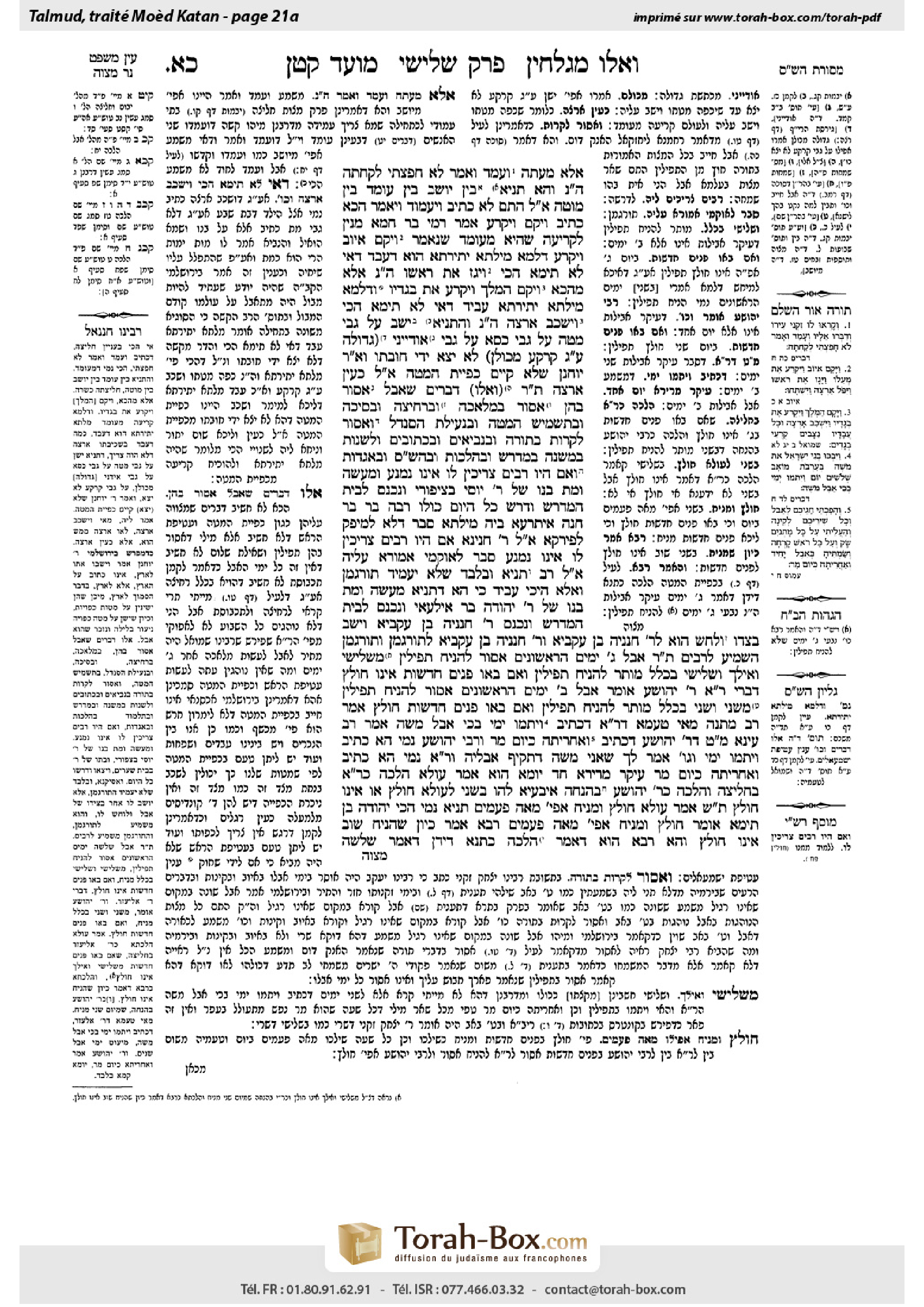
Moed Katan 21a: Talmud study for Daf Yomi
Daf Yomi is the daily study of one Talmud folio. Explore 37 tractates with scans, Hebrew text, Sefaria English and AI-generated French translations where annotated.
Passage selection and English or AI-generated French translation are available where the scan has annotations. Daf Study is independent of Torah-Box and Sefaria.
Browse Moed Katan · מועד קטן · All tractatesMoed Katan 21a text and translations
This page of Moed Katan includes the Aramaic text, an English translation and an AI-generated French translation, alongside the scan above.
מועד קטן כ״א א · Aramaic and Hebrew text
אֶלָּא מֵעַתָּה: ״וְעָמַד וְאָמַר לֹא חָפַצְתִּי לְקַחְתָּהּ״, הָכָא נָמֵי? וְהָא תַּנְיָא: בֵּין יוֹשֵׁב בֵּין עוֹמֵד בֵּין מוּטֶּה!
אֲמַר לֵיהּ: הָתָם לָא כְּתִיב ״וְיַעֲמֹד וְיֹאמַר״, הָכָא כְּתִיב ״וַיָּקׇם וַיִּקְרַע״.
אָמַר רָמֵי בַּר חָמָא: מִנַּיִן לִקְרִיעָה שֶׁהִיא מְעוּמָּד, שֶׁנֶּאֱמַר: ״וַיָּקׇם אִיּוֹב וַיִּקְרַע״. דִּלְמָא מִילְּתָא יַתִּירְתָּא הוּא דַּעֲבַד? דְּאִי לָא תֵּימָא הָכִי — ״וַיָּגׇז אֶת רֹאשׁוֹ״, הָכִי נָמֵי?
אֶלָּא מֵהָכָא: ״וַיָּקָם הַמֶּלֶךְ וַיִּקְרַע אֶת בְּגָדָיו״. וְדִלְמָא מִילְּתָא יַתִּירְתָּא עָבֵיד? דְּאִי לָא תֵּימָא הָכִי — ״וַיִּשְׁכַּב אָרְצָה״, הָכִי נָמֵי?
וְהָתַנְיָא: יָשַׁב עַל גַּבֵּי מִטָּה, עַל גַּבֵּי כִּסֵּא, עַל גַּבֵּי אוּדְיָינִי גְּדוֹלָה, עַל גַּבֵּי קַרְקַע — מִכּוּלָּן לֹא יָצָא יְדֵי חוֹבָתוֹ. וְאָמַר רַבִּי יוֹחָנָן: שֶׁלֹּא קִיֵּים כְּפִיַּית הַמִּטָּה!
אֲמַר לֵיהּ: כְּעֵין אַרְצָה.
תָּנוּ רַבָּנַן, וְאֵלּוּ דְּבָרִים שֶׁאָבֵל אָסוּר בָּהֶן: אָסוּר בִּמְלָאכָה וּבִרְחִיצָה וּבְסִיכָה וּבְתַשְׁמִישׁ הַמִּטָּה וּבִנְעִילַת הַסַּנְדָּל. וְאָסוּר לִקְרוֹת בְּתוֹרָה וּבַנְּבִיאִים וּבַכְּתוּבִים, וְלִשְׁנוֹת בַּמִּשְׁנָה, בַּמִּדְרָשׁ וּבָהֲלָכוֹת, וּבַתַּלְמוּד וּבָאַגָּדוֹת. וְאִם הָיוּ רַבִּים צְרִיכִין לוֹ — אֵינוֹ נִמְנָע. וּמַעֲשֶׂה וּמֵת בְּנוֹ שֶׁל רַבִּי יוֹסֵי בְּצִיפּוֹרִי, וְנִכְנַס לְבֵית הַמִּדְרָשׁ, וְדָרַשׁ כׇּל הַיּוֹם כּוּלּוֹ.
רַבָּה בַּר בַּר חָנָה אִיתְּרַעָא בֵּיהּ מִילְּתָא, סָבַר דְּלָא לְמִיפַּק לְפִירְקָא. אֲמַר לֵיהּ רַבִּי חֲנִינָא: אִם הָיוּ רַבִּים צְרִיכִין לוֹ — אֵינוֹ נִמְנָע. סְבַר לְאוֹקוֹמֵי אָמוֹרָא עֲלֵיהּ. אֲמַר לֵיהּ רַב: תַּנְיָא, וּבִלְבַד שֶׁלֹּא יַעֲמִיד תּוּרְגְּמָן.
וְאֶלָּא הֵיכִי עָבֵיד? כִּי הָא דְּתַנְיָא: מַעֲשֶׂה וּמֵת בְּנוֹ שֶׁל רַבִּי יְהוּדָה בַּר אִילְעַאי, וְנִכְנַס לְבֵית הַמִּדְרָשׁ. וְנִכְנַס רַבִּי חֲנַנְיָה בֶּן עֲקַבְיָא וְיָשַׁב בְּצִדּוֹ, וְלָחַשׁ הוּא לְרַבִּי חֲנַנְיָה בֶּן עֲקַבְיָא, וְרַבִּי חֲנַנְיָה בֶּן עֲקַבְיָא לְתוּרְגְּמָן, וְתוּרְגְּמָן הִשְׁמִיעַ לָרַבִּים.
תָּנוּ רַבָּנַן: אָבֵל, שְׁלֹשָׁה יָמִים הָרִאשׁוֹנִים — אָסוּר לְהַנִּיחַ תְּפִילִּין, מִשְּׁלִישִׁי וְאֵילָךְ, וּשְׁלִישִׁי בַּכְּלָל — מוּתָּר לְהַנִּיחַ תְּפִילִּין. וְאִם בָּאוּ פָּנִים חֲדָשׁוֹת — אֵינוֹ חוֹלֵץ, דִּבְרֵי רַבִּי אֱלִיעֶזֶר. רַבִּי יְהוֹשֻׁעַ אוֹמֵר: אָבֵל, שְׁנֵי יָמִים הָרִאשׁוֹנִים אָסוּר לְהַנִּיחַ תְּפִילִּין. מִשֵּׁנִי, וְשֵׁנִי בַּכְּלָל — מוּתָּר לְהַנִּיחַ תְּפִילִּין, וְאִם בָּאוּ פָּנִים חֲדָשׁוֹת — חוֹלֵץ.
אָמַר רַב מַתְנָה: מַאי טַעְמָא דְּרַבִּי אֱלִיעֶזֶר, דִּכְתִיב: ״וַיִּתְּמוּ יְמֵי בְכִי אֵבֶל מֹשֶׁה״. אָמַר רַב עֵינָא: מַאי טַעְמָא דְּרַבִּי יְהוֹשֻׁעַ, דִּכְתִיב: ״וְאַחֲרִיתָהּ כְּיוֹם מָר״.
וְרַבִּי יְהוֹשֻׁעַ נָמֵי, הָא כְּתִיב: ״וַיִּתְּמוּ יְמֵי וְגוֹ׳״! אָמַר לָךְ: שָׁאנֵי מֹשֶׁה, דְּתַקִּיף אֶבְלֵיהּ. וְרַבִּי אֱלִיעֶזֶר נָמֵי, הָא כְּתִיב: ״וְאַחֲרִיתָהּ כְּיוֹם מָר״! עִיקַּר מְרִירָא חַד יוֹמָא הוּא.
אָמַר עוּלָּא: הֲלָכָה כְּרַבִּי אֱלִיעֶזֶר בַּחֲלִיצָה, וַהֲלָכָה כְּרַבִּי יְהוֹשֻׁעַ בְּהַנָּחָה.
אִיבַּעְיָא לְהוּ: בַּשֵּׁנִי לְעוּלָּא, חוֹלֵץ אוֹ אֵינוֹ חוֹלֵץ?
תָּא שְׁמַע, אָמַר עוּלָּא: חוֹלֵץ וּמַנִּיחַ אֲפִילּוּ מֵאָה פְּעָמִים. תַּנְיָא נָמֵי הָכִי, יְהוּדָה בֶּן תֵּימָא אוֹמֵר: חוֹלֵץ וּמַנִּיחַ אֲפִילּוּ מֵאָה פְּעָמִים.
רָבָא אָמַר: כֵּיוָן שֶׁהִנִּיחַ שׁוּב אֵינוֹ חוֹלֵץ. וְהָא רָבָא הוּא דְּאָמַר: הֲלָכָה כְּתַנָּא דִּידַן דְּאָמַר שְׁלֹשָׁה!
Moed Katan 21a · English translation
Rav Ashi challenged him: However, if that is so, one should be required to stand while performing the ritual through which the brother-in-law frees the yevama of her levirate bonds [ḥalitza], as the verse states: “And if he stands and he says: I do not wish to take her” (Deuteronomy 25:8). Here must he also stand for the ceremony? But isn’t it taught in a baraita that ḥalitza may be performed whether the man is sitting, or standing, or reclining?
He said to him: There, in the case of ḥalitza, it is not written: And he will stand and he will say, which would imply an obligation to stand; whereas here, in the case of rending, it is written: “Then Job arose, and rent his coat” (Job 1:20).
Rami bar Ḥama said: From where is it derived that rending must be performed while standing? As it is stated: “Then Job arose, and rent his coat” (Job 1:20). The Gemara asks: Perhaps he did something extra beyond what is required, and actually there is no obligation to stand; as, if you do not say that he did more than what was required of him, then how do you explain the continuation of the verse: “And he shaved his head” (Job 1:20)? Is every mourner required to act in this manner also and shave his head?
The Gemara concludes: Rather, this source must be rejected, and instead the halakha is derived from here, the verse that describes David’s mourning over his son: “Then the king arose, and rent his garments” (II Samuel 13:31). The Gemara asks: But perhaps he too did something extra beyond what is required, and he was not actually obligated to stand; as, if you do not say that he did more than what was required of him, then how do you explain the continuation of the verse: “And he lay on the earth” (II Samuel 13:31)? Is every mourner required to act in this manner also?
But isn’t it taught in a baraita: If a mourner sat on a bed, on a chair, on a large mortar [udyanei], or on the ground, he does not fulfill his obligation through any of them. And Rabbi Yoḥanan said: This is because he did not fulfill his obligation to overturn his bed, even if he lay on the ground. This indicates that there is no requirement whatsoever to lie on the ground.
Ameimar said to Rav Ashi: The verse does not mean that David actually lay on the ground. Rather, it was as if he were on the ground, since he overturned his bed and brought it closer to the ground. If this is the case, then Ameimar acted correctly, and a mourner should rend his garments while standing.
§ The Sages taught: These are the activities that a mourner is prohibited from engaging in: He is prohibited from working, and from bathing, and from anointing himself with oil, and from engaging in sexual relations, and from wearing shoes. And he is prohibited from reading in the Torah, and in the Prophets, and in the Writings, and from studying in the Mishna, in the midrash, and in the halakhot, and in the Talmud, and in the aggadot. But if the public needs him to teach them these things, he need not refrain from doing so. There was an incident that the son of Rabbi Yosei died in Tzippori, and Rabbi Yosei entered the study hall and expounded there for the entire day.
It was related that a calamity, i.e., a death in the family, once befell Rabba bar bar Ḥana, and he thought not to go out to deliver his exposition. Rabbi Ḥanina said to him: Is it not taught that if the public needs him to teach them these things, one need not refrain from doing so? He then thought to place an interpreter alongside him, who would sound his words to the public, as was normally done for such an exposition. Rav said to him: It is taught in a baraita similarly: Provided that he does not place the disseminator alongside him.
The Gemara asks: But how, then, should he act so that he can be heard? The Gemara answers: It is like that which is taught in a baraita: There was an incident and the son of Rabbi Yehuda bar Ilai died, and Rabbi Yehuda entered the study hall. And Rabbi Ḥananya ben Akavya entered after him and sat by his side. Rabbi Yehuda bar Ilai then whispered his lecture to Rabbi Ḥananya ben Akavya, and Rabbi Ḥananya ben Akavya whispered it to the disseminator, and the disseminator sounded to the public what had been told to him. In this way, it became known that Rabbi Yehuda bar Ilai was in mourning.
§ The Sages taught the following baraita: For the first three days, a mourner is prohibited from donning phylacteries. From the third day and on, and including the third day, he is permitted to don phylacteries. And if new faces, i.e., people who had not yet come to console him, come, he need not remove them, although these people may falsely conclude that he had also donned phylacteries during the first two days of his mourning; this is the statement of Rabbi Eliezer. Rabbi Yehoshua says: For the first two days, a mourner is prohibited from donning phylacteries. From the second day, and including the second day, he is permitted to wear phylacteries. But if new faces come in to console him, he must remove his phylacteries.
Rav Mattana said: What is the reason of Rabbi Eliezer? As it is written: “And the days of weeping and mourning for Moses ended” (Deuteronomy 34:8). The plural term “days” implies a minimum of two, and it indicates that the main portion of the mourning period is the first two full days. Rav Eina said: What is the reason of Rabbi Yehoshua? As it is written: “And I will make it as the mourning for an only son, and its end as a bitter day” (Amos 8:10), i.e., a single “day.”
The Gemara asks: But also for Rabbi Yehoshua, isn’t it written in the Torah: “And the days of weeping and mourning for Moses ended,” thereby implying that this period lasts for two days? The Gemara answers: He could have said to you that Moses was different, because the mourning for him was more intense, and the people mourned for him longer than usual. The Gemara asks: But also for Rabbi Eliezer, isn’t it written in the Torah: “And its end as a bitter day”? The Gemara answers: He could have said to you that the main bitterness is only one day, but the severity of the mourning lasts for two days.
Ulla said: The halakha is in accordance with the opinion of Rabbi Eliezer with regard to the removal of phylacteries. A mourner need not remove them when new people come in to console him. And the halakha is in accordance with the opinion of Rabbi Yehoshua with regard to the donning of phylacteries, and so a mourner may already don phylacteries on the second day.
A dilemma was raised before the scholars: According to Ulla, who rules in accordance with Rabbi Yehoshua that a mourner may don phylacteries on his second day of mourning, is the mourner required to remove them if new people arrive on that day, or is he not required to remove them?
The Gemara answers: Come and hear what Ulla said explicitly: One removes his phylacteries when new people come to console him, and he dons them again when they leave, even if he must don and remove them a hundred times. This is also taught in a baraita: Yehuda ben Teima says: He removes his phylacteries and dons them again, even if he must do so a hundred times.
Rava said: Once he dons his phylacteries, he does not remove them again. The Gemara asks: But wasn’t it Rava himself who said: The halakha is in accordance with the opinion of the tanna of our mishna, who said that the most serious period of mourning is three days? How then does he rule in accordance with the baraita that a mourner may don phylacteries during these days?
Moed Katan 21a · Traduction française (IA)
Rav Ashi lui objecta : Pourtant, si tel est le cas, il devrait être obligatoire de se tenir debout pour accomplir le rituel par lequel le beau-frère libère la yevama de ses liens léviratiques [ḥalitza], comme le dit le verset : « Et s’il se tient debout et dit : “Je ne veux pas la prendre” » (Deutéronome 25:8). Doit-il donc également se tenir debout pour cette cérémonie ? Mais n’enseigne-t-on pas dans une baraïta que la ḥalitza peut être accomplie que l’homme soit assis, debout ou allongé ?
Il lui répondit : Dans le cas de la ḥalitza, il n’est pas écrit : « Et il se tiendra debout et dira », ce qui impliquerait l’obligation de se tenir debout ; tandis qu’ici, dans le cas de la déchirure des vêtements, il est écrit : « Alors Job se leva et déchira son manteau » (Job 1:20).
Rami bar Ḥama dit : D’où déduit-on que la déchirure des vêtements doit être accomplie debout ? Comme il est dit : « Alors Job se leva et déchira son manteau » (Job 1:20). La Guemara demande : Peut-être a-t-il fait davantage que ce qui était requis, et n’y a-t-il en réalité aucune obligation de se tenir debout ? Car, si tu ne dis pas qu’il a fait plus que ce qui était exigé de lui, comment expliquer la suite du verset : « Et il se rasa la tête » (Job 1:20) ? Tout endeuillé est-il également tenu d’agir ainsi et de se raser la tête ?
La Guemara conclut : Il faut donc rejeter cette source et déduire plutôt la halakha de ce verset, qui décrit le deuil de David après la mort de son fils : « Alors le roi se leva et déchira ses vêtements » (II Samuel 13:31). La Guemara demande : Mais peut-être a-t-il lui aussi fait davantage que ce qui était requis, sans être réellement tenu de se tenir debout ? Car, si tu ne dis pas qu’il a fait plus que ce qui était exigé de lui, comment expliquer la suite du verset : « Et il se coucha à terre » (II Samuel 13:31) ? Tout endeuillé est-il également tenu d’agir ainsi ?
Mais n’enseigne-t-on pas dans une baraïta : Si un endeuillé s’assied sur un lit, une chaise, un grand mortier [udyanei] ou à même le sol, il ne s’acquitte pas de son obligation par aucun de ces moyens. Rabbi Yoḥanan a dit : C’est parce qu’il ne s’est pas acquitté de l’obligation de retourner son lit, même s’il s’est couché à terre. Cela indique qu’il n’est absolument pas obligatoire de se coucher à terre.
Ameimar dit à Rav Ashi : Le verset ne signifie pas que David s’est réellement couché à terre. Il était plutôt comme s’il se trouvait à terre, puisqu’il avait retourné son lit et l’avait rapproché du sol. Si tel est le cas, Ameimar a agi correctement, et l’endeuillé doit déchirer ses vêtements debout.
§ Les Sages ont enseigné : Voici les activités auxquelles un endeuillé ne peut s’adonner : il lui est interdit de travailler, de se baigner, de s’enduire d’huile, d’avoir des relations sexuelles et de porter des chaussures. Il lui est également interdit de lire la Torah, les Prophètes et les Écrits, ainsi que d’étudier la Michna, le midrach, les halakhot, le Talmud et les aggadot. Toutefois, si le public a besoin qu’il lui enseigne ces matières, il n’est pas tenu de s’en abstenir. Un jour, le fils de Rabbi Yosei mourut à Tzippori, et Rabbi Yosei entra dans la maison d’étude et y enseigna toute la journée.
On rapporte qu’un malheur, c’est-à-dire un décès dans sa famille, frappa un jour Rabba bar bar Ḥana, et qu’il envisagea de ne pas sortir pour donner son enseignement. Rabbi Ḥanina lui dit : N’enseigne-t-on pas que si le public a besoin qu’il lui enseigne ces matières, il n’est pas tenu de s’en abstenir ? Il envisagea alors de placer à ses côtés un interprète qui transmettrait ses paroles au public, comme on le faisait habituellement pour un tel enseignement. Rav lui dit : Une baraïta enseigne de même : à condition qu’il ne place pas de transmetteur à ses côtés.
La Guemara demande : Mais que doit-il donc faire pour se faire entendre ? La Guemara répond : C’est comparable à ce qu’enseigne une baraïta : Un jour, le fils de Rabbi Yehuda bar Ilai mourut, et Rabbi Yehuda entra dans la maison d’étude. Rabbi Ḥananya ben Akavya entra après lui et s’assit à ses côtés. Rabbi Yehuda bar Ilai murmura alors son enseignement à Rabbi Ḥananya ben Akavya, qui le murmura à son tour au transmetteur ; celui-ci fit entendre au public ce qu’on lui avait rapporté. Ainsi, on sut que Rabbi Yehuda bar Ilai était en deuil.
§ Les Sages ont enseigné la baraïta suivante : Pendant les trois premiers jours, il est interdit à l’endeuillé de mettre les tefillin. À partir du troisième jour, troisième jour inclus, il est autorisé à les mettre. Si de nouveaux visages, c’est-à-dire des personnes qui n’étaient pas encore venues le consoler, arrivent, il n’est pas tenu de les retirer, bien que ces personnes puissent en conclure à tort qu’il avait également mis les tefillin pendant les deux premiers jours de son deuil. Telle est l’opinion de Rabbi Eliezer. Rabbi Yehoshua dit : Pendant les deux premiers jours, il est interdit à l’endeuillé de mettre les tefillin. À partir du deuxième jour, deuxième jour inclus, il est autorisé à les mettre. Mais si de nouveaux visages viennent le consoler, il doit retirer ses tefillin.
Rav Mattana dit : Quelle est la raison de Rabbi Eliezer ? Comme il est écrit : « Les jours de pleurs et de deuil pour Moïse prirent fin » (Deutéronome 34:8). Le pluriel « jours » implique un minimum de deux et indique que la période principale du deuil comprend les deux premiers jours complets. Rav Eina dit : Quelle est la raison de Rabbi Yehoshua ? Comme il est écrit : « Je le rendrai pareil au deuil pour un fils unique, et sa fin sera comme un jour amer » (Amos 8:10), c’est-à-dire un seul « jour ».
La Guemara demande : Mais pour Rabbi Yehoshua également, n’est-il pas écrit dans la Torah : « Les jours de pleurs et de deuil pour Moïse prirent fin », ce qui implique que cette période dure deux jours ? La Guemara répond : Il aurait pu te répondre que Moïse faisait exception, car le deuil pour lui fut plus intense et le peuple le pleura plus longtemps que d’habitude. La Guemara demande : Mais pour Rabbi Eliezer également, n’est-il pas écrit : « Et sa fin sera comme un jour amer » ? La Guemara répond : Il aurait pu te répondre que l’amertume principale ne dure qu’un jour, mais que la rigueur du deuil dure deux jours.
Ulla dit : La halakha suit l’opinion de Rabbi Eliezer concernant le retrait des tefillin. L’endeuillé n’est pas tenu de les retirer lorsque de nouvelles personnes viennent le consoler. La halakha suit aussi l’opinion de Rabbi Yehoshua concernant le moment où l’on peut mettre les tefillin : l’endeuillé peut donc les mettre dès le deuxième jour.
Une question fut soumise aux Sages : Selon Ulla, qui statue conformément à Rabbi Yehoshua, selon lequel l’endeuillé peut mettre les tefillin le deuxième jour de son deuil, doit-il les retirer si de nouvelles personnes arrivent ce jour-là, ou n’est-il pas tenu de les retirer ?
La Guemara répond : Écoute ce qu’Ulla a dit explicitement : Il retire ses tefillin lorsque de nouvelles personnes viennent le consoler, et les remet quand elles partent, même s’il doit les mettre et les retirer cent fois. Cela est également enseigné dans une baraïta : Yehuda ben Teima dit : Il retire ses tefillin et les remet, même s’il doit le faire cent fois.
Rava dit : Une fois qu’il a mis ses tefillin, il ne les retire plus. La Guemara demande : Mais n’est-ce pas Rava lui-même qui a dit que la halakha suit l’opinion du tanna de notre Michna, selon laquelle la période la plus rigoureuse du deuil dure trois jours ? Comment peut-il donc statuer conformément à la baraïta, selon laquelle un endeuillé peut mettre les tefillin pendant ces jours ?
Traduction française générée par IA à partir de l’édition anglaise de Sefaria. Vérifie toujours un passage avec le texte source.
Text from Sefaria: William Davidson Edition - Vocalized Aramaic (CC BY NC); William Davidson Edition - English (CC BY NC).