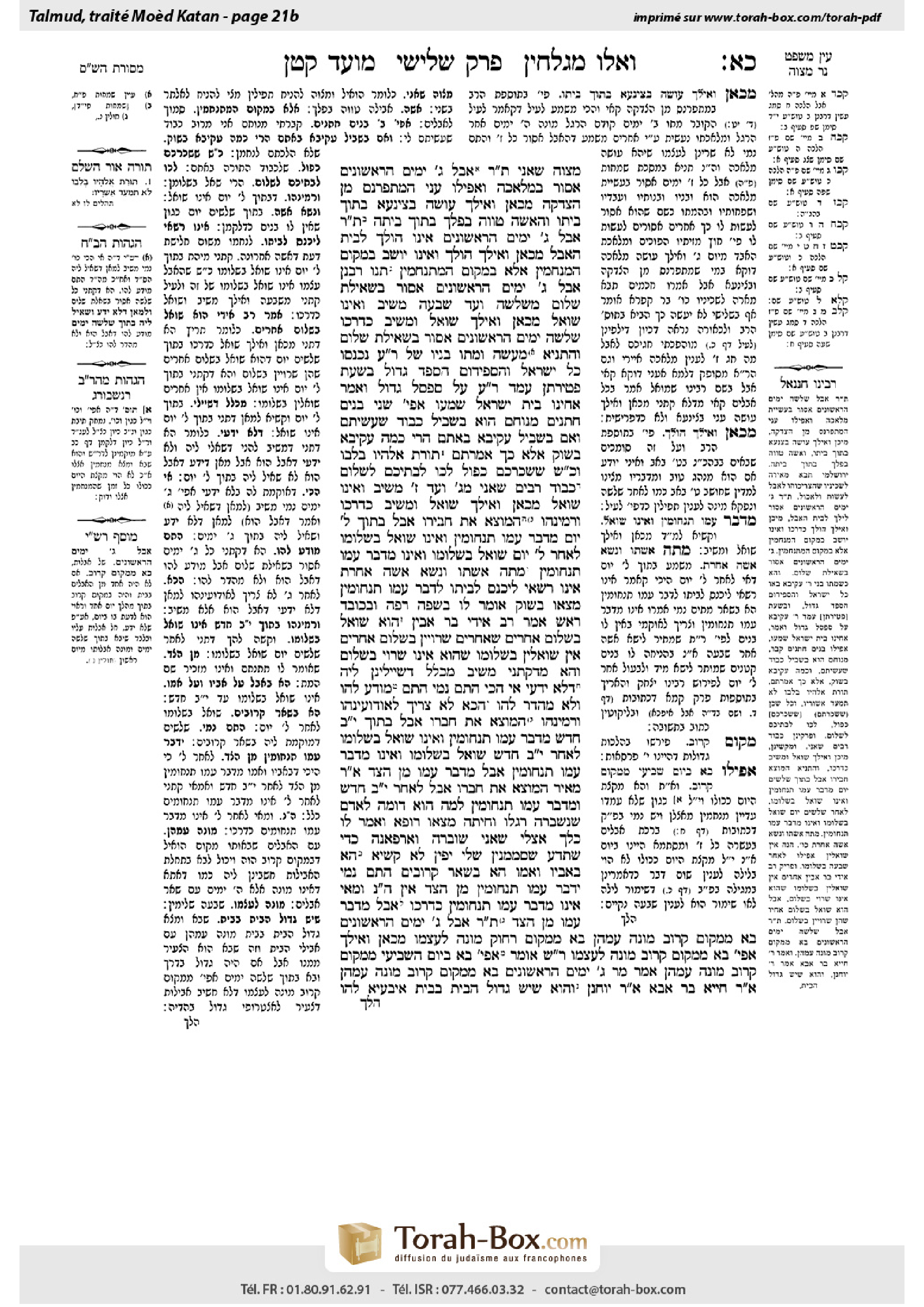
Moed Katan 21b: Talmud study for Daf Yomi
Daf Yomi is the daily study of one Talmud folio. Explore 37 tractates with scans, Hebrew text, Sefaria English and AI-generated French translations where annotated.
Passage selection and English or AI-generated French translation are available where the scan has annotations. Daf Study is independent of Torah-Box and Sefaria.
Browse Moed Katan · מועד קטן · All tractatesMoed Katan 21b text and translations
This page of Moed Katan includes the Aramaic text, an English translation and an AI-generated French translation, alongside the scan above.
מועד קטן כ״א ב · Aramaic and Hebrew text
מִצְוָה שָׁאנֵי.
תָּנוּ רַבָּנַן: אָבֵל, שְׁלֹשָׁה יָמִים הָרִאשׁוֹנִים אָסוּר בִּמְלָאכָה, וַאֲפִילּוּ עָנִי הַמִּתְפַּרְנֵס מִן הַצְּדָקָה. מִכָּאן וְאֵילָךְ — עוֹשֶׂה בְּצִינְעָא בְּתוֹךְ בֵּיתוֹ. וְהָאִשָּׁה טוֹוָה בַּפֶּלֶךְ בְּתוֹךְ בֵּיתָהּ.
תָּנוּ רַבָּנַן: אָבֵל, שְׁלֹשָׁה יָמִים הָרִאשׁוֹנִים אֵינוֹ הוֹלֵךְ לְבֵית הָאֵבֶל, מִכָּאן וְאֵילָךְ הוֹלֵךְ, וְאֵינוֹ יוֹשֵׁב בִּמְקוֹם הַמְנַחֲמִין, אֶלָּא בִּמְקוֹם הַמִּתְנַחֲמִין.
תָּנוּ רַבָּנַן: אָבֵל, שְׁלֹשָׁה יָמִים הָרִאשׁוֹנִים אָסוּר בִּשְׁאֵילַת שָׁלוֹם. מִשְּׁלֹשָׁה וְעַד שִׁבְעָה — מֵשִׁיב וְאֵינוֹ שׁוֹאֵל. מִכָּאן וְאֵילָךְ, שׁוֹאֵל וּמֵשִׁיב כְּדַרְכּוֹ.
שְׁלֹשָׁה יָמִים הָרִאשׁוֹנִים אָסוּר בִּשְׁאֵילַת שָׁלוֹם? וְהָתַנְיָא: מַעֲשֶׂה וּמֵתוּ בָּנָיו שֶׁל רַבִּי עֲקִיבָא, נִכְנְסוּ כׇּל יִשְׂרָאֵל וְהִסְפִּידוּם הֶסְפֵּד גָּדוֹל.
בִּשְׁעַת פְּטִירָתָן, עָמַד רַבִּי עֲקִיבָא עַל סַפְסָל גָּדוֹל וְאָמַר: אַחֵינוּ בֵּית יִשְׂרָאֵל שִׁמְעוּ! אֲפִילּוּ שְׁנֵי בָנִים חֲתָנִים — מְנוּחָם הוּא בִּשְׁבִיל כָּבוֹד שֶׁעֲשִׂיתֶם. וְאִם בִּשְׁבִיל עֲקִיבָא בָּאתֶם, הֲרֵי כַּמָּה עֲקִיבָא בַּשּׁוּק. אֶלָּא כָּךְ אֲמַרְתֶּם: תּוֹרַת אֱלֹהָיו בְּלִבּוֹ. וְכׇל שֶׁכֵּן שֶׁשְּׂכַרְכֶם כָּפוּל, לְכוּ לְבָתֵּיכֶם לְשָׁלוֹם!
כְּבוֹד רַבִּים שָׁאנֵי.
מִשְּׁלֹשָׁה וְעַד שִׁבְעָה — מֵשִׁיב וְאֵינוֹ שׁוֹאֵל, מִכָּאן וְאֵילָךְ, שׁוֹאֵל וּמֵשִׁיב כְּדַרְכּוֹ.
וּרְמִינְהוּ: הַמּוֹצֵא אֶת חֲבֵירוֹ אָבֵל, בְּתוֹךְ שְׁלֹשִׁים יוֹם — מְדַבֵּר עִמּוֹ תַּנְחוּמִין וְאֵינוֹ שׁוֹאֵל בִּשְׁלוֹמוֹ, לְאַחַר שְׁלֹשִׁים יוֹם — שׁוֹאֵל בִּשְׁלוֹמוֹ וְאֵינוֹ מְדַבֵּר עִמּוֹ תַּנְחוּמִין.
מֵתָה אִשְׁתּוֹ וְנָשָׂא אִשָּׁה אַחֶרֶת, אֵינוֹ רַשַּׁאי לִיכָּנֵס לְבֵיתוֹ לְדַבֵּר עִמּוֹ תַּנְחוּמִין. מְצָאוֹ בַּשּׁוּק — אוֹמֵר לוֹ בְּשָׂפָה רָפָה וּבְכוֹבֶד רֹאשׁ.
אָמַר רַב אִידִי בַּר אָבִין: הוּא שׁוֹאֵל בִּשְׁלוֹם אֲחֵרִים — שֶׁאֲחֵרִים שְׁרוּיִין בְּשָׁלוֹם, אֲחֵרִים אֵין שׁוֹאֲלִין בִּשְׁלוֹמוֹ, שֶׁהוּא אֵינוֹ שָׁרוּי בְּשָׁלוֹם.
וְהָא מִדְּקָתָנֵי מֵשִׁיב, מִכְּלָל דְּשָׁיְילִינַן לֵיהּ? דְּלָא יָדְעִי.
אִי הָכִי, הָתָם נָמֵי! הָתָם — מוֹדַע לְהוּ וְלָא מַהְדַּר לְהוּ, הָכָא — לָא צָרִיךְ לְאוֹדוֹעִינְהוּ.
וּרְמִינְהוּ: הַמּוֹצֵא אֶת חֲבֵרוֹ אָבֵל, בְּתוֹךְ שְׁנֵים עָשָׂר חֹדֶשׁ — מְדַבֵּר עִמּוֹ תַּנְחוּמִין, וְאֵינוֹ שׁוֹאֵל בִּשְׁלוֹמוֹ. לְאַחַר שְׁנֵים עָשָׂר חֹדֶשׁ — שׁוֹאֵל בִּשְׁלוֹמוֹ, וְאֵינוֹ מְדַבֵּר עִמּוֹ תַּנְחוּמִין, אֲבָל מְדַבֵּר עִמּוֹ מִן הַצַּד.
אָמַר רַבִּי מֵאִיר: הַמּוֹצֵא אֶת חֲבֵרוֹ אָבֵל לְאַחַר שְׁנֵים עָשָׂר חֹדֶשׁ, וּמְדַבֵּר עִמּוֹ תַּנְחוּמִין, לְמָה הוּא דּוֹמֶה? לְאָדָם שֶׁנִּשְׁבְּרָה רַגְלוֹ וְחָיְתָה, מְצָאוֹ רוֹפֵא וְאָמַר לוֹ: כְּלָךְ אֶצְלִי שֶׁאֲנִי שׁוֹבְרָהּ וַאֲרַפְּאֶנָּה, כְּדֵי שֶׁתֵּדַע שֶׁסַּמְמָנִין שֶׁלִּי יָפִין!
לָא קַשְׁיָא: הָא בְּאָבִיו וְאִמּוֹ, הָא בִּשְׁאָר קְרוֹבִים.
הָתָם נָמֵי, יְדַבֵּר עִמּוֹ תַּנְחוּמִין מִן הַצַּד? אִין הָכִי נָמֵי. וּמַאי אֵינוֹ מְדַבֵּר עִמּוֹ תַּנְחוּמִין — כְּדַרְכּוֹ, אֲבָל מְדַבֵּר עִמּוֹ מִן הַצַּד.
תָּנוּ רַבָּנַן: אָבֵל, שְׁלֹשָׁה יָמִים הָרִאשׁוֹנִים, בָּא מִמָּקוֹם קָרוֹב — מוֹנֶה עִמָּהֶן, בָּא מִמָּקוֹם רָחוֹק — מוֹנֶה לְעַצְמוֹ. מִכָּאן וְאֵילָךְ, אֲפִילּוּ בָּא מִמָּקוֹם קָרוֹב — מוֹנֶה לְעַצְמוֹ. רַבִּי שִׁמְעוֹן אוֹמֵר: אֲפִילּוּ בָּא בְּיוֹם הַשְּׁבִיעִי מִמָּקוֹם קָרוֹב — מוֹנֶה עִמָּהֶן.
אָמַר מָר: שְׁלֹשָׁה יָמִים הָרִאשׁוֹנִים, בָּא מִמָּקוֹם קָרוֹב — מוֹנֶה עִמָּהֶן. אָמַר רַבִּי חִיָּיא בַּר אַבָּא אָמַר רַבִּי יוֹחָנָן: וְהוּא שֶׁיֵּשׁ גְּדוֹל הַבַּיִת בַּבַּיִת.
אִיבַּעְיָא לְהוּ:
Moed Katan 21b · English translation
The Gemara answers: A mitzva is different, and since it is a mitzva to put on phylacteries, the mourner is required to do so, even during the first three days.
§ The Sages taught the following baraita: During the first three days after his bereavement, a mourner is prohibited from working, even if he is a poor person who is supported by charity. From this point forward, he may do work privately in his own home if he needs to do so. And similarly a woman may spin thread on a spindle in her own home when she is mourning.
The Sages taught in another baraita: A mourner during the first three days after his bereavement may not go to another mourner’s house to console him. From this point forward, he may go, but he may not sit among the consolers, but rather in the place of those being consoled, i.e., with the mourners in that house.
§ The Sages taught in yet another baraita: A mourner, during the first three days after his bereavement, is prohibited from extending greetings to others. From the third day to the seventh day, he may respond when other people address him, but he may not extend greetings to them. From this point forward, he may extend greetings and respond in his usual manner.
The Gemara asks: Is he really prohibited from extending greetings during the first three days of mourning? But isn’t it taught in a baraita: There was an incident and the sons of Rabbi Akiva died, and all the Jews entered to eulogize them with a great eulogy.
When they were about to take leave, Rabbi Akiva stood on a large bench and said: Our brothers, the house of Israel, listen! Even had my two sons been bridegrooms, I would have been consoled on account of the honor you have shown them. If you came to console for the sake of Akiva, there are many Akivas in the marketplace whom the Jews do all not come to console. Rather, certainly this is what you said to yourselves: “The Torah of his God is in his heart” (Psalms 37:31), and you wished to show your respect for the Torah. All the more so is your reward doubled, for you have consoled mourners and shown respect for the Torah. Return now to your homes in peace. This indicates that a mourner may greet other people even on the first day of his mourning.
The Gemara answers: Showing respect for the public is different. Rabbi Akiva was permitted to greet them to demonstrate courtesy and respect.
§ It was taught in the aforementioned baraita: From the third day to the seventh day, he may respond when other people address him, but he may not extend greetings to them. From this point forward, he may extend greetings and respond in his usual manner.
And the Gemara raises a contradiction from another baraita that states: One who finds another in mourning during the first thirty days of that person’s bereavement may still speak words of consolation to him, but he should not extend greetings toward him. If he finds him after thirty days, he may extend greetings toward him, but he should not speak words of consolation to him, so as not to remind him of his pain.
If it was the mourner’s wife who died and he married another woman within thirty days of his first wife’s death, one may not enter his house to speak words of consolation with him, so as not to offend his new wife. If, however, he finds him alone in the marketplace, he may speak to him with gentle words and in a serious manner. This indicates that the prohibition against extending greetings lasts for thirty days and not just seven.
Rav Idi bar Avin said: The two baraitot refer to different situations: The first baraita is referring to the mourner himself, who may extend greetings [shalom] to others after the completion of his seven days of mourning, as the others are at peace [shalom]. The second baraita, which speaks of a prohibition that lasts thirty days, is referring to other people, who may not extend greetings to him, as he, the mourner, is not at peace.
The Gemara challenges: But from the fact that it teaches in a baraita that after the third day of his bereavement, the mourner may respond when other people address him, by inference others may extend greetings to him. The Gemara answers: This is referring to a case where people did not know that he was in mourning and unknowingly extended greetings to him.
The Gemara asks: If so, if the baraita speaks of a case where the people who greeted him were unaware that he was in mourning, then there also, during the first three days of his bereavement, he should be permitted to respond when other people address him. The Gemara answers: There, during the first three days, he must inform them that he is in mourning and not respond to their greetings. Here, after the first three days, he need not inform them about his bereavement, but rather he may respond to their greetings.
And the Gemara raises a contradiction from another baraita that states: One who finds another in mourning during his twelve months of bereavement may still speak words of consolation to him, but he should not extend greetings toward him. If he finds him after twelve months, he may extend greetings toward him, and he should not speak words of consolation to him. He may, however, speak to him indirectly, i.e., he may say to him: May you be consoled, without mentioning the name of the deceased.
Rabbi Meir said: One who finds another in mourning after twelve months and speaks to him words of consolation, to what may this situation be likened? To a person who broke his leg and it healed, and afterward a physician found him and said to him: Come to me, for I will break it a second time and then I will heal it, so that you may know how good my medicines are and how well they work. One who consoles his friend after so much time has passed acts in a similar fashion, stirring up an old wound and then trying to heal it. In any event, it appears that one must not extend greetings to a mourner during the entire twelve-month mourning period.
The Gemara answers: This is not difficult. This baraita, which says that one must not extend greetings to a mourner for twelve months, is referring to one who lost his father or mother. That baraita, which teaches that a mourner may be greeted after seven days, is referring to one who is in mourning over other relatives.
The Gemara asks: There too, in the case of other relatives after thirty days, let him speak words of consolation to him indirectly. Why does the baraita say that after thirty days he should not speak words of consolation to him at all? The Gemara answers: Yes, it is indeed so. And what is meant by the words: He should not speak words of consolation to him? This means that he may not console him in his usual manner, but he may speak to him indirectly.
§ The Sages taught the following baraita: If a mourner comes to the house of mourning from a nearby place during the first three days of mourning, he counts his days of mourning with the other mourners from the time of the burial and completes his mourning with them. This is the case even if he may end up observing mourning for only five or six days. But if he came from a distant place, he counts on his own seven complete days from the time that he was informed of his relative’s death. From this point forward, i.e., after the first three days of mourning, even if he came from a nearby place, he counts seven days on his own. Rabbi Shimon says: Even if he came on the seventh day from a nearby place, he counts and completes the seven-day period of mourning with the other mourners.
The Master said, citing the baraita: If a mourner comes to the house of mourning from a nearby place during the first three days of mourning, he counts his days of mourning with the other mourners and completes his mourning with them. Rabbi Ḥiyya bar Abba said that Rabbi Yoḥanan said: This is in a case where the principal member of the household is in the house, and therefore all the other family members follow his mourning. If, however, it is the principal member of the family who comes home, he certainly does not follow the other members, but rather he counts seven days on his own.
A dilemma was raised before the scholars:
Moed Katan 21b · Traduction française (IA)
La Guemara répond : Le cas d’une mitsva est différent. Puisqu’il s’agit d’une mitsva de mettre les téfilines, l’endeuillé doit le faire, même pendant les trois premiers jours.
§ Les Sages ont enseigné la baraïta suivante : Pendant les trois premiers jours suivant son deuil, l’endeuillé n’a pas le droit de travailler, même s’il est pauvre et vit de la charité. Ensuite, s’il en a besoin, il peut travailler discrètement chez lui. De même, une femme en deuil peut filer au fuseau chez elle.
Les Sages ont enseigné dans une autre baraïta : Pendant les trois premiers jours suivant son deuil, l’endeuillé ne peut pas se rendre chez un autre endeuillé pour le consoler. Ensuite, il peut s’y rendre, mais ne doit pas s’asseoir parmi ceux qui consolent ; il doit plutôt prendre place parmi ceux qui sont consolés, c’est-à-dire avec les endeuillés de cette maison.
§ Les Sages ont enseigné dans une autre baraïta encore : Pendant les trois premiers jours suivant son deuil, l’endeuillé n’a pas le droit de saluer les autres. Du troisième au septième jour, il peut répondre lorsque d’autres personnes s’adressent à lui, mais ne peut pas les saluer. Ensuite, il peut saluer les autres et leur répondre comme à son habitude.
La Guemara demande : Lui est-il vraiment interdit de saluer les autres pendant les trois premiers jours de deuil ? N’est-il pas enseigné dans une baraïta : Un jour, les fils de Rabbi Akiva moururent, et tous les Juifs vinrent leur rendre hommage en leur faisant de grandes oraisons funèbres.
Au moment de prendre congé, Rabbi Akiva se leva sur un grand banc et dit : « Nos frères, maison d’Israël, écoutez ! Même si mes deux fils avaient été des mariés, j’aurais été consolé par l’honneur que vous leur avez témoigné. Si vous êtes venus consoler Akiva, il y a beaucoup d’Akiva sur la place du marché que les Juifs ne viennent pas tous consoler. En réalité, vous vous êtes certainement dit : “La Torah de son Dieu est dans son cœur” (Psaumes 37,31), et vous avez voulu témoigner votre respect à la Torah. À plus forte raison, votre récompense est double, puisque vous avez consolé des endeuillés et témoigné du respect à la Torah. Retournez maintenant chez vous en paix. » Cela indique qu’un endeuillé peut saluer les autres, même le premier jour de son deuil.
La Guemara répond : Le respect dû au public constitue un cas différent. Rabbi Akiva avait le droit de les saluer pour leur témoigner courtoisie et respect.
§ Il a été enseigné dans la baraïta citée plus haut : Du troisième au septième jour, l’endeuillé peut répondre lorsque d’autres personnes s’adressent à lui, mais ne peut pas les saluer. Ensuite, il peut saluer les autres et leur répondre comme à son habitude.
La Guemara soulève une contradiction à partir d’une autre baraïta, qui enseigne : Celui qui rencontre une personne en deuil pendant les trente premiers jours suivant son deuil peut lui adresser des paroles de consolation, mais ne doit pas la saluer. S’il la rencontre après trente jours, il peut la saluer, mais ne doit pas lui adresser de paroles de consolation, afin de ne pas lui rappeler sa douleur.
Si c’est la femme de l’endeuillé qui est morte et qu’il s’est remarié dans les trente jours suivant la mort de sa première épouse, on ne doit pas entrer chez lui pour lui adresser des paroles de consolation, afin de ne pas offenser sa nouvelle épouse. S’il le rencontre toutefois seul sur la place du marché, il peut lui parler avec douceur et gravité. Cela indique que l’interdiction de saluer dure trente jours, et non pas seulement sept.
Rav Idi bar Avin dit : Les deux baraïtot portent sur des situations différentes. La première baraïta concerne l’endeuillé lui-même, qui peut saluer [shalom] les autres à l’issue de ses sept jours de deuil, puisqu’ils sont en paix [shalom]. La seconde baraïta, qui évoque une interdiction durant trente jours, concerne les autres personnes, qui ne peuvent pas le saluer, car lui, l’endeuillé, n’est pas en paix.
La Guemara objecte : Mais puisqu’une baraïta enseigne qu’après le troisième jour de son deuil, l’endeuillé peut répondre lorsque d’autres personnes s’adressent à lui, on peut en déduire que les autres peuvent le saluer. La Guemara répond : Il s’agit d’un cas où les gens ignoraient qu’il était en deuil et l’ont salué sans le savoir.
La Guemara demande : Dans ce cas, si la baraïta parle d’une situation où ceux qui l’ont salué ignoraient qu’il était en deuil, alors, pendant les trois premiers jours suivant son deuil aussi, il devrait pouvoir répondre lorsque d’autres personnes s’adressent à lui. La Guemara répond : Pendant les trois premiers jours, il doit les informer qu’il est en deuil et ne pas répondre à leurs salutations. Après les trois premiers jours, en revanche, il n’a pas besoin de les informer de son deuil ; il peut répondre à leurs salutations.
La Guemara soulève une contradiction à partir d’une autre baraïta, qui enseigne : Celui qui rencontre une personne en deuil pendant les douze mois suivant son deuil peut lui adresser des paroles de consolation, mais ne doit pas la saluer. S’il la rencontre après douze mois, il peut la saluer, mais ne doit pas lui adresser de paroles de consolation. Il peut toutefois lui parler indirectement, c’est-à-dire lui dire : « Que tu sois consolé », sans mentionner le nom du défunt.
Rabbi Meïr dit : À quoi peut-on comparer celui qui rencontre une personne en deuil après douze mois et lui adresse des paroles de consolation ? À un homme qui s’est cassé la jambe et a guéri, puis qu’un médecin rencontre et à qui il dit : « Viens chez moi ; je te casserai la jambe une seconde fois, puis je la guérirai, afin que tu saches combien mes remèdes sont bons et efficaces. » Celui qui console son ami après qu’un tel laps de temps s’est écoulé agit de la même façon : il ravive une ancienne blessure, puis tente de la guérir. Quoi qu’il en soit, il semble qu’on ne doive pas saluer un endeuillé pendant toute la période de deuil de douze mois.
La Guemara répond : Il n’y a pas de difficulté. Cette baraïta, qui dit qu’on ne doit pas saluer un endeuillé pendant douze mois, concerne celui qui a perdu son père ou sa mère. L’autre baraïta, qui enseigne qu’on peut saluer un endeuillé après sept jours, concerne celui qui est en deuil pour d’autres proches.
La Guemara demande : Dans le cas d’autres proches aussi, après trente jours, qu’on lui adresse des paroles de consolation indirectement. Pourquoi la baraïta dit-elle qu’après trente jours on ne doit pas du tout lui adresser de paroles de consolation ? La Guemara répond : Oui, c’est effectivement le cas. Que signifie donc : « On ne doit pas lui adresser de paroles de consolation » ? Cela signifie qu’on ne peut pas le consoler de la manière habituelle, mais qu’on peut lui parler indirectement.
§ Les Sages ont enseigné la baraïta suivante : Si un endeuillé arrive à la maison de deuil depuis un endroit proche pendant les trois premiers jours de deuil, il compte ses jours de deuil avec les autres endeuillés à partir de l’inhumation et achève son deuil avec eux. C’est le cas même s’il ne devait observer que cinq ou six jours de deuil. Mais s’il vient d’un endroit éloigné, il compte seul sept jours complets à partir du moment où il a été informé de la mort de son proche. Ensuite, c’est-à-dire après les trois premiers jours de deuil, même s’il vient d’un endroit proche, il compte seul sept jours. Rabbi Chimon dit : Même s’il vient d’un endroit proche le septième jour, il compte et achève les sept jours de deuil avec les autres endeuillés.
Le maître a enseigné, en citant la baraïta : Si un endeuillé arrive à la maison de deuil depuis un endroit proche pendant les trois premiers jours de deuil, il compte ses jours de deuil avec les autres endeuillés et achève son deuil avec eux. Rabbi Ḥiyya bar Abba a dit au nom de Rabbi Yoḥanan : C’est le cas lorsque le principal membre du foyer se trouve dans la maison ; tous les autres membres de la famille suivent alors son deuil. En revanche, si c’est le principal membre de la famille qui rentre chez lui, il ne suit certainement pas les autres membres ; il compte plutôt seul sept jours.
Une question fut posée aux Sages :
Traduction française générée par IA à partir de l’édition anglaise de Sefaria. Vérifie toujours un passage avec le texte source.
Text from Sefaria: William Davidson Edition - Vocalized Aramaic (CC BY NC); William Davidson Edition - English (CC BY NC).