Moed Katan 22a: Talmud study for Daf Yomi
Daf Yomi is the daily study of one Talmud folio. Explore 37 tractates with scans, Hebrew text, Sefaria English and AI-generated French translations where annotated.
Passage selection and English or AI-generated French translation are available where the scan has annotations. Daf Study is independent of Torah-Box and Sefaria.
Browse Moed Katan · מועד קטן · All tractatesMoed Katan 22a text and translations
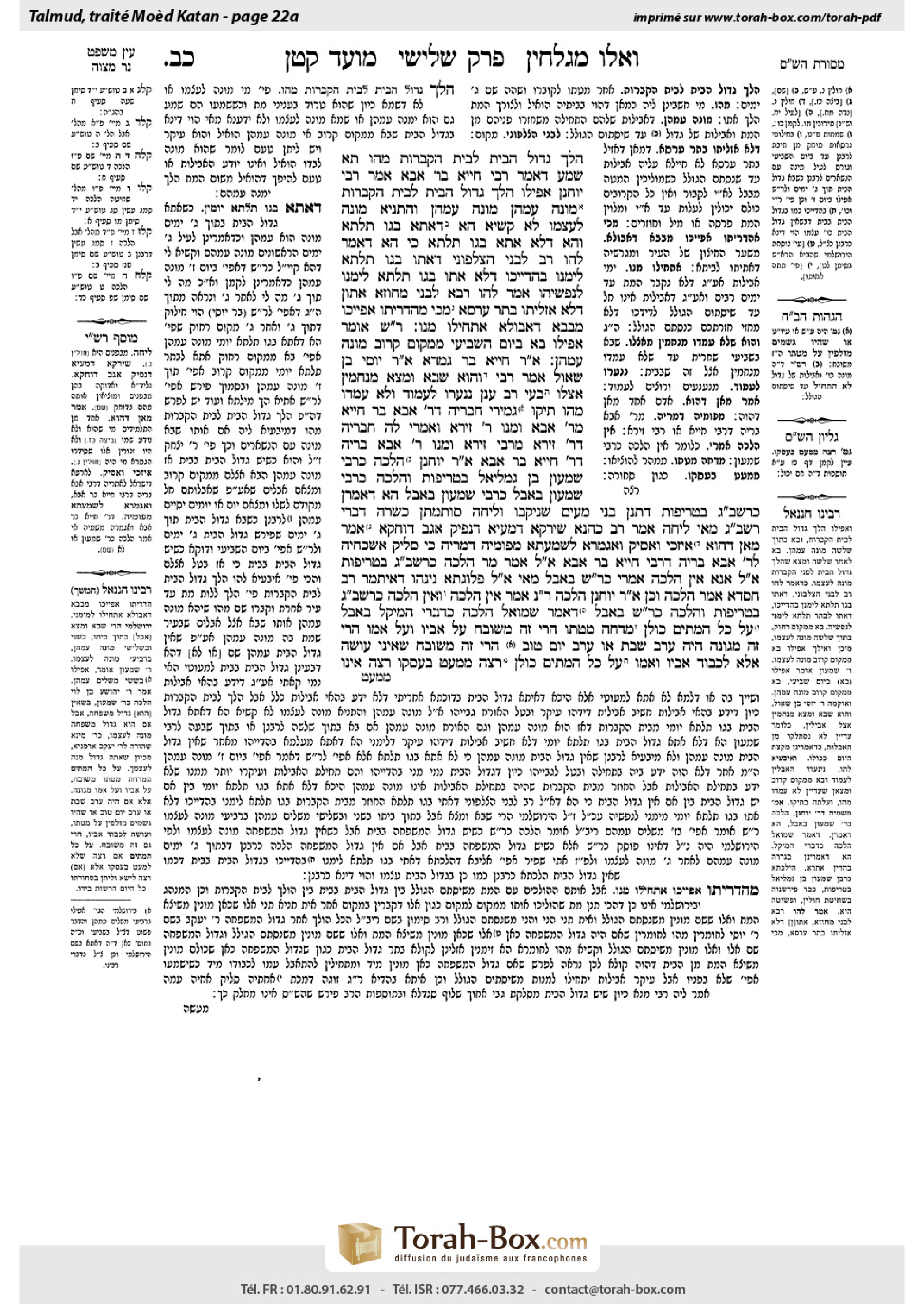
This page of Moed Katan includes the Aramaic text, an English translation and an AI-generated French translation, alongside the scan above.
מועד קטן כ״ב א · Aramaic and Hebrew text
הָלַךְ גְּדוֹל הַבַּיִת לְבֵית הַקְּבָרוֹת, מַהוּ?
תָּא שְׁמַע, דְּאָמַר רַבִּי חִיָּיא בַּר אַבָּא אָמַר רַבִּי יוֹחָנָן: אֲפִילּוּ הָלַךְ גְּדוֹל הַבַּיִת לְבֵית הַקְּבָרוֹת — מוֹנֶה עִמָּהֶן. מוֹנֶה עִמָּהֶן? וְהָתַנְיָא מוֹנֶה לְעַצְמוֹ!
לָא קַשְׁיָא: הָא דַּאֲתָא בְּגוֹ תְּלָתָא, וְהָא דְּלָא אֲתָא בְּגוֹ תְּלָתָא. כִּי הָא דַּאֲמַר לְהוּ רַב לִבְנֵי הַצַּלְבּוֹנִי: דְּאָתוּ בְּגוֹ תְּלָתָא — לִימְנוֹ בַּהֲדַיְיכוּ, דְּלָא אָתוּ בְּגוֹ תְּלָתָא — לִימְנוֹ לְנַפְשַׁיְהוּ.
אֲמַר לְהוּ רָבָא לִבְנֵי מָחוֹזָא: אַתּוּן דְּלָא אָזְלִיתוּ בָּתַר עַרְסָא, מִכִּי מְהַדְּרִיתוּ אַפַּיְיכוּ מִבָּבָא דַאֲבוּלָּא — אַתְחִילוּ מְנוֹ.
רַבִּי שִׁמְעוֹן אוֹמֵר: אֲפִילּוּ בָּא בַּיּוֹם הַשְּׁבִיעִי מִמָּקוֹם קָרוֹב — מוֹנֶה עִמָּהֶן. אָמַר רַבִּי חִיָּיא בַּר גַּמָּדָא אָמַר רַבִּי יוֹסֵי בֶּן שָׁאוּל אָמַר רַבִּי: וְהוּא שֶׁבָּא וּמָצָא מְנַחֲמִין אֶצְלוֹ.
בָּעֵי רַב עָנָן: נִנְעֲרוּ לַעֲמוֹד וְלֹא עָמְדוּ, מַהוּ? תֵּיקוּ.
גְּמִירִי חַבְרֵיהּ דְּרַבִּי אַבָּא בַּר חִיָּיא מֵרַבִּי אַבָּא, וּמַנּוּ — רַבִּי זֵירָא, וְאָמְרִי לַהּ: חַבְרֵיהּ דְּרַבִּי זֵירָא מֵרַבִּי זֵירָא, וּמַנּוּ — רַבִּי אַבָּא בְּרֵיהּ דְּרַבִּי חִיָּיא בַּר אַבָּא, אָמַר רַבִּי יוֹחָנָן: הֲלָכָה כְּרַבָּן שִׁמְעוֹן בֶּן גַּמְלִיאֵל בִּטְרֵיפוֹת, וַהֲלָכָה כְּרַבִּי שִׁמְעוֹן בְּאֵבֶל.
כְּרַבִּי שִׁמְעוֹן בְּאֵבֶל — הָא דַּאֲמַרַן. כְּרַבָּן שִׁמְעוֹן בֶּן גַּמְלִיאֵל בִּטְרֵיפוֹת — דִּתְנַן: בְּנֵי מֵעַיִם שֶׁנִּיקְּבוּ וְלֵיחָה סוֹתַמְתָּן — כְּשֵׁרָה, דִּבְרֵי רַבָּן שִׁמְעוֹן בֶּן גַּמְלִיאֵל.
מַאי לֵיחָה? אָמַר רַב כָּהֲנָא: שִׁירְקָא דִמְעַיָּא דְּנָפֵיק אַגַּב דּוּחְקָא. אָמַר מַאן דְּהוּא: אִיזְכֵּי וְאֶיסַּק וְאֶגְמְרַהּ לִשְׁמַעְתָּא מִפּוּמֵּיהּ דְּמָרַיהּ,
כִּי סְלֵיק, אַשְׁכְּחֵיהּ לְרַבִּי אַבָּא בְּרֵיהּ דְּרַבִּי חִיָּיא בַּר אַבָּא. אֲמַר לֵיהּ: אֲמַר מָר: הֲלָכָה כְּרַבָּן שִׁמְעוֹן בֶּן גַּמְלִיאֵל בִּטְרֵיפוֹת? אֲמַר לֵיהּ: אֲנָא ״אֵין הֲלָכָה״ אֲמַרִי.
כְּרַבִּי שִׁמְעוֹן בְּאֵבֶל, מַאי? אֲמַר לֵיהּ: פְּלוּגְתָּא נִינְהוּ, דְּאִיתְּמַר, רַב חִסְדָּא אָמַר: הֲלָכָה, וְכֵן אָמַר רַבִּי יוֹחָנָן: הֲלָכָה. רַב נַחְמָן אָמַר: אֵין הֲלָכָה.
וְאֵין הֲלָכָה כְּרַבָּן שִׁמְעוֹן בֶּן גַּמְלִיאֵל בִּטְרֵיפוֹת, וַהֲלָכָה כְּרַבִּי שִׁמְעוֹן בְּאֵבֶל. דְּאָמַר שְׁמוּאֵל: הֲלָכָה כְּדִבְרֵי הַמֵּיקֵל בְּאֵבֶל.
עַל כׇּל הַמֵּתִים כּוּלָּן מְדַחֶה מִטָּתוֹ — הֲרֵי זֶה מְשׁוּבָּח. עַל אָבִיו וְעַל אִמּוֹ — הֲרֵי זֶה מְגוּנֶּה, הָיָה עֶרֶב שַׁבָּת אוֹ עֶרֶב יוֹם טוֹב — הֲרֵי זֶה מְשׁוּבָּח, שֶׁאֵינוֹ עוֹשֶׂה אֶלָּא לִכְבוֹד אָבִיו וְאִמּוֹ.
עַל כׇּל הַמֵּתִים כּוּלָּן, רָצָה — מְמַעֵט בְּעִסְקוֹ, רָצָה — אֵינוֹ
Moed Katan 22a · English translation
If the principal member of the household went with the remains of the deceased to the cemetery and did not return for several days, what is the halakha? If another mourner came to the house of mourning during his absence, does he follow the principal member of the household and count from the time of the burial, or does he count from the time that the funeral procession departed, like the other members of the household?
The Gemara answers: Come and hear that which Rabbi Ḥiyya bar Abba said that Rabbi Yoḥanan said: Even if the principal member of the household went to the cemetery, the mourner who comes home during his absence counts with them, i.e., the other members of the household who did not go to the cemetery. The Gemara asks: Does he really count and complete his mourning with them? But isn’t it taught otherwise in a baraita, that he counts seven days on his own?
The Gemara answers: This is not difficult. This statement, that he counts with them, is referring to a case where the principal member of the household came home within three days. And the other ruling, that he counts on his own, is referring to a case where he did not come home within three days. This conclusion is similar to what Rav said to the sons of Hatzleponi when they were in mourning: Those who come home within three days should count with you; whereas those who do not come home within three days should count on their own.
Rava said to the people of Meḥoza: Those of you who do not follow the coffin all the way to the place of interment should begin counting your days of mourning from when you turn your faces from the city gates to return home. Since the dead were commonly transported long distances and buried far away, most of the mourners did not accompany their deceased relatives to the actual site of burial.
§ The Gemara cites the baraita taught above: Rabbi Shimon says: Even if one of the mourners came on the seventh day from a nearby place, he counts with the other mourners and completes the seven-day period of mourning with them. Rabbi Ḥiyya bar Gamda said that Rabbi Yosei ben Shaul said that Rabbi Yehuda HaNasi said: And this is the halakha, provided that he came and found consolers still present in the house.
§ Rav Anan asks: If the consolers had already stirred themselves to stand up and leave but did not yet actually stand up and leave, what is the halakha? Is it considered as if the consolers have already left or not? This question was not answered, and the dilemma stands unresolved.
The Gemara relates that a colleague of Rabbi Abba bar Ḥiyya learned the following principle as a tradition from Rabbi Abba. The Gemara asks: And who was this colleague? It was Rabbi Zeira. And some say a different version of this tradition: A colleague of Rabbi Zeira learned a tradition from Rabbi Zeira. The Gemara asks: And who is this colleague? It was Rabbi Abba, son of Rabbi Ḥiyya bar Abba: Rabbi Yoḥanan said: The halakha is in accordance with the opinion of Rabban Shimon ben Gamliel with regard to an animal that is unsuitable for human consumption because of severe organic disease or congenital defect, making it a tereifa, and the halakha is in accordance with the opinion of Rabbi Shimon with regard to the halakhot of mourning.
The Gemara explains: The halakha is in accordance with the opinion of Rabbi Shimon with regard to mourning, concerning that which we just said about a mourner who arrives on the seventh day. The halakha is in accordance with the opinion of Rabban Shimon ben Gamliel with regard to defects in animals that render them tereifa concerning that which we learned in a baraita: If the animal’s intestines became perforated, but the hole was stopped up by mucus, so that nothing comes out of this hole, the animal is fit. Unlike an ordinary hole in the intestines, this hole does not render the animal a tereifa and make it unfit for consumption. This is the statement of Rabban Shimon ben Gamliel.
The Gemara asks: What is this mucus? Rav Kahana said: The fat [shirka] of the intestines that comes out under pressure. Someone whose name was not given said: May I merit to go up to Eretz Yisrael and learn this halakha from the mouth of its author.
When he went up from Babylonia to Eretz Yisrael, he found Rabbi Abba, son of Rabbi Ḥiyya bar Abba, and said to him: Did the Master say that the halakha is in accordance with the opinion of Rabban Shimon ben Gamliel with regard to defects that render the animal a tereifa? He said to him: I said just the opposite, namely, that the halakha is not in accordance with Rabban Shimon ben Gamliel, and therefore such a hole in the animal’s intestine makes it unfit for eating.
He asked him again: What about the other ruling reported in your name, that the halakha is in accordance with the opinion of Rabbi Shimon with regard to mourning? Is this accurate? He said to him: This issue is subject to dispute, as it was stated: Rav Ḥisda said: The halakha is in accordance with the opinion of Rabbi Shimon, and similarly Rabbi Yoḥanan said: It is the halakha. But Rav Naḥman said: It is not the halakha.
The Gemara concludes: The halakha is not in accordance with the opinion of Rabban Shimon ben Gamliel with regard to the aforementioned issue of tereifa, and the halakha is in accordance with Rabbi Shimon with regard to mourning, as Shmuel stated a principle: The halakha follows the opinion of the more lenient authority in matters relating to mourning.
§ It was taught in a baraita: With regard to all other deceased relatives, it is praiseworthy for one to be quick in taking the bier out for burial. But in the case of one’s father or mother, acting in this manner is condemnable, as one should draw out the period of acute mourning for his parent. If, however, it was Friday or the eve of a Festival, then one is praiseworthy for expediting his parent’s burial because he does this only out of respect for his father or mother, as he does not want them to remain unburied for the duration of Shabbat or the Festival.
With regard to all other dead, if the mourner wishes he may reduce his business due to mourning. If, however, he wishes not to do so, he need not
Moed Katan 22a · Traduction française (IA)
Si le membre principal du foyer a accompagné la dépouille du défunt au cimetière et n’est pas revenu pendant plusieurs jours, quelle est la halakha ? Si un autre endeuillé arrive à la maison de deuil pendant son absence, suit-il le membre principal du foyer et compte-t-il à partir de l’inhumation, ou compte-t-il à partir du départ du cortège funèbre, comme les autres membres du foyer ?
La Guemara répond : Viens entendre ce que Rabbi Ḥiyya bar Abba a dit au nom de Rabbi Yoḥanan : même si le membre principal du foyer s’est rendu au cimetière, l’endeuillé qui rentre à la maison pendant son absence compte avec eux, c’est-à-dire avec les autres membres du foyer qui ne sont pas allés au cimetière. La Guemara demande : Compte-t-il vraiment avec eux et achève-t-il avec eux sa période de deuil ? Pourtant, n’est-il pas enseigné le contraire dans une baraïta : il compte sept jours de son côté ?
La Guemara répond : Il n’y a pas de contradiction. L’affirmation selon laquelle il compte avec eux concerne le cas où le membre principal du foyer est rentré dans les trois jours. L’autre décision, selon laquelle il compte de son côté, concerne le cas où il n’est pas rentré dans les trois jours. Cette conclusion est semblable à ce que Rav a dit aux fils de Hatzleponi alors qu’ils étaient en deuil : ceux qui rentrent dans les trois jours doivent compter avec vous, tandis que ceux qui ne rentrent pas dans les trois jours doivent compter de leur côté.
Rava dit aux habitants de Meḥoza : Ceux d’entre vous qui n’accompagnent pas le cercueil jusqu’au lieu d’inhumation doivent commencer à compter leurs jours de deuil à partir du moment où ils tournent le dos aux portes de la ville pour rentrer chez eux. Comme les morts étaient couramment transportés sur de longues distances et enterrés loin de là, la plupart des endeuillés n’accompagnaient pas leurs proches défunts jusqu’au lieu même de l’inhumation.
§ La Guemara cite la baraïta enseignée plus haut : Rabbi Shimon dit : même si l’un des endeuillés arrive le septième jour depuis un lieu proche, il compte avec les autres endeuillés et achève avec eux les sept jours de deuil. Rabbi Ḥiyya bar Gamda a dit au nom de Rabbi Yosei ben Shaul, qui l’a dit au nom de Rabbi Yehuda HaNasi : telle est la halakha, à condition qu’il arrive et trouve encore des consolateurs dans la maison.
§ Rav Anan demande : Si les consolateurs s’étaient déjà préparés à se lever pour partir, sans être encore effectivement partis, quelle est la halakha ? Considère-t-on que les consolateurs sont déjà partis ou non ? Cette question n’a pas reçu de réponse et reste sans solution.
La Guemara rapporte qu’un collègue de Rabbi Abba bar Ḥiyya avait appris de Rabbi Abba la règle suivante par tradition. La Guemara demande : Et qui était ce collègue ? C’était Rabbi Zeira. Certains transmettent une autre version de cette tradition : un collègue de Rabbi Zeira avait appris une tradition de Rabbi Zeira. La Guemara demande : Et qui était ce collègue ? C’était Rabbi Abba, fils de Rabbi Ḥiyya bar Abba. Rabbi Yoḥanan a dit : La halakha suit l’avis de Rabban Shimon ben Gamliel concernant un animal impropre à la consommation humaine en raison d’une maladie organique grave ou d’une malformation congénitale qui en fait une tereifa, et elle suit l’avis de Rabbi Shimon concernant les lois du deuil.
La Guemara explique : La halakha suit l’avis de Rabbi Shimon en matière de deuil, à propos de ce que nous venons de dire au sujet de l’endeuillé qui arrive le septième jour. La halakha suit l’avis de Rabban Shimon ben Gamliel concernant les défauts qui rendent un animal tereifa, à propos de ce que nous avons appris dans une baraïta : si les intestins de l’animal sont perforés, mais que le trou est bouché par du mucus, de sorte que rien ne s’en écoule, l’animal est propre à la consommation. Contrairement à une perforation ordinaire des intestins, ce trou ne rend pas l’animal tereifa et ne le rend pas impropre à la consommation. Telle est la déclaration de Rabban Shimon ben Gamliel.
La Guemara demande : Qu’est-ce que ce mucus ? Rav Kahana a dit : la graisse [shirka] des intestins qui sort sous l’effet d’une pression. Un homme dont le nom n’est pas précisé dit : Puissé-je avoir le mérite de monter en Eretz Israël et d’apprendre cette halakha de la bouche de son auteur.
Lorsqu’il monta de Babylonie en Eretz Israël, il trouva Rabbi Abba, fils de Rabbi Ḥiyya bar Abba, et lui demanda : Le Maître a-t-il dit que la halakha suit l’avis de Rabban Shimon ben Gamliel concernant les défauts qui rendent l’animal tereifa ? Celui-ci lui répondit : J’ai dit exactement le contraire, à savoir que la halakha ne suit pas l’avis de Rabban Shimon ben Gamliel ; par conséquent, une telle perforation des intestins de l’animal le rend impropre à la consommation.
Il lui demanda encore : Et qu’en est-il de l’autre décision rapportée en ton nom, selon laquelle la halakha suit l’avis de Rabbi Shimon concernant le deuil ? Est-ce exact ? Il lui répondit : Cette question fait l’objet d’un désaccord, comme il a été dit : Rav Ḥisda a dit que la halakha suit l’avis de Rabbi Shimon, et Rabbi Yoḥanan a également dit que telle est la halakha. Mais Rav Naḥman a dit que ce n’est pas la halakha.
La Guemara conclut : La halakha ne suit pas l’avis de Rabban Shimon ben Gamliel sur la question de la tereifa mentionnée plus haut, et elle suit l’avis de Rabbi Shimon concernant le deuil, car Shmuel a énoncé un principe : la halakha suit l’avis de l’autorité la plus indulgente en matière de deuil.
§ Il a été enseigné dans une baraïta : Pour tous les autres proches décédés, il est louable de se hâter de sortir le cercueil pour l’inhumation. Mais, dans le cas de son père ou de sa mère, agir ainsi est condamnable, car il convient de prolonger la période de deuil aigu pour son parent. Toutefois, si c’est vendredi ou la veille d’une fête, il est alors louable de hâter l’inhumation de son parent, car il ne le fait que par respect pour son père ou sa mère : il ne veut pas qu’ils restent sans sépulture pendant tout le Chabbat ou la fête.
Pour tous les autres défunts, si l’endeuillé le souhaite, il peut réduire ses activités commerciales en raison du deuil. Mais s’il ne le souhaite pas, il n’y est pas tenu.
Traduction française générée par IA à partir de l’édition anglaise de Sefaria. Vérifie toujours un passage avec le texte source.
Text from Sefaria: William Davidson Edition - Vocalized Aramaic (CC BY NC); William Davidson Edition - English (CC BY NC).