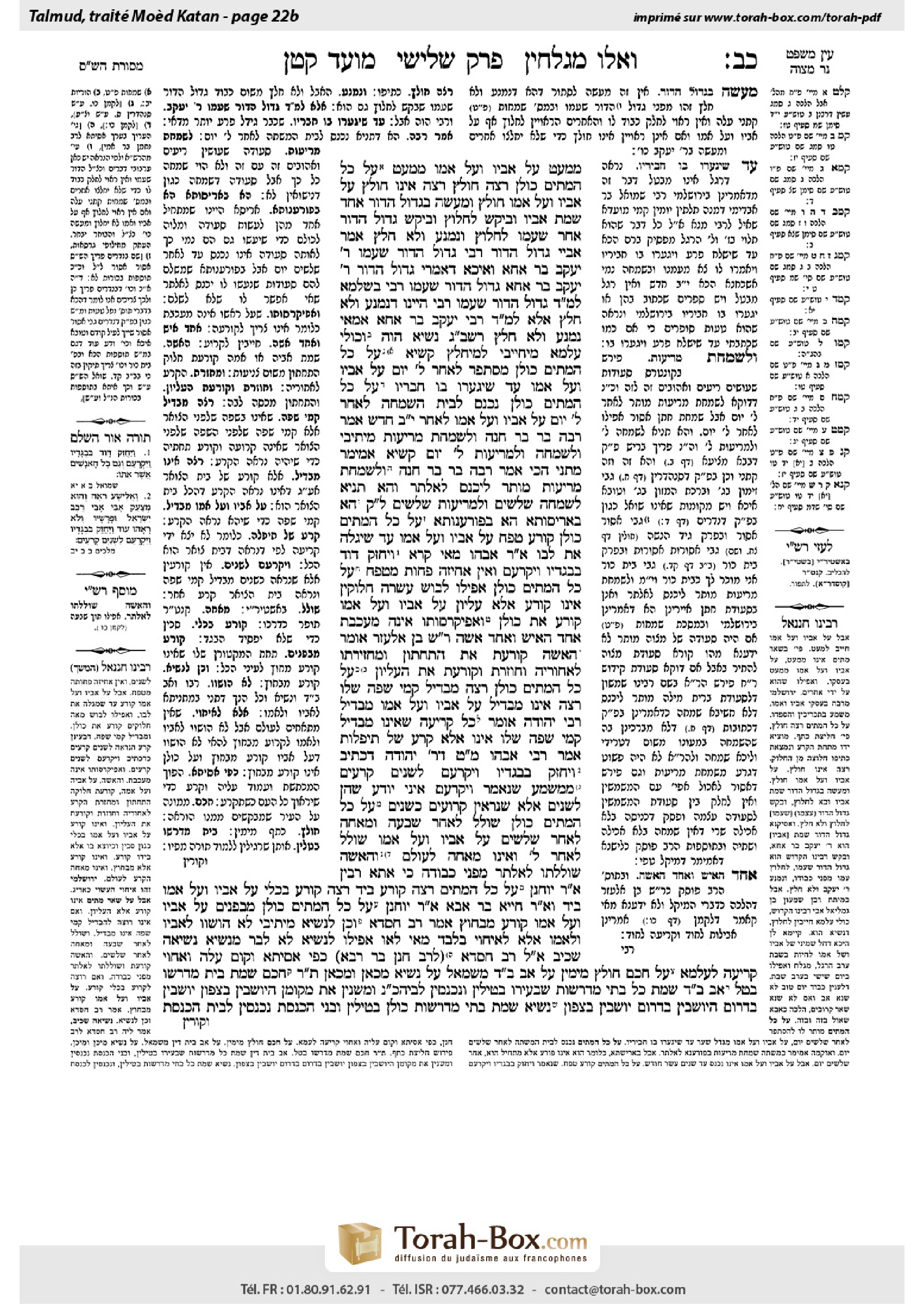
Moed Katan 22b: Talmud study for Daf Yomi
Daf Yomi is the daily study of one Talmud folio. Explore 37 tractates with scans, Hebrew text, Sefaria English and AI-generated French translations where annotated.
Passage selection and English or AI-generated French translation are available where the scan has annotations. Daf Study is independent of Torah-Box and Sefaria.
Browse Moed Katan · מועד קטן · All tractatesMoed Katan 22b text and translations
This page of Moed Katan includes the Aramaic text, an English translation and an AI-generated French translation, alongside the scan above.
מועד קטן כ״ב ב · Aramaic and Hebrew text
מְמַעֵט, עַל אָבִיו וְעַל אִמּוֹ — מְמַעֵט.
עַל כׇּל הַמֵּתִים כּוּלָּן, רָצָה — חוֹלֵץ, רָצָה — אֵינוֹ חוֹלֵץ. עַל אָבִיו וְעַל אִמּוֹ — חוֹלֵץ.
וּמַעֲשֶׂה בִּגְדוֹל הַדּוֹר אֶחָד שֶׁמֵּת אָבִיו וּבִיקֵּשׁ לַחְלוֹץ, וּבִיקֵּשׁ גְּדוֹל הַדּוֹר אַחֵר שֶׁעִמּוֹ לַחְלוֹץ, וְנִמְנַע וְלֹא חָלַץ.
אָמַר אַבָּיֵי: גְּדוֹל הַדּוֹר — רַבִּי, גְּדוֹל הַדּוֹר שֶׁעִמּוֹ — רַבִּי יַעֲקֹב בַּר אַחָא. וְאִיכָּא דְּאָמְרִי: גְּדוֹל הַדּוֹר — רַבִּי יַעֲקֹב בַּר אַחָא, גְּדוֹל הַדּוֹר שֶׁעִמּוֹ — רַבִּי.
בִּשְׁלָמָא לְמַאן דְּאָמַר גְּדוֹל הַדּוֹר שֶׁעִמּוֹ — רַבִּי, הַיְינוּ דְּנִמְנַע וְלֹא חָלַץ,
אֶלָּא לְמַאן דְּאָמַר רַבִּי יַעֲקֹב בַּר אַחָא, אַמַּאי נִמְנַע וְלֹא חָלַץ? רַבָּן שִׁמְעוֹן בֶּן גַּמְלִיאֵל נָשִׂיא הֲוָה, וְכוּלֵּי עָלְמָא מִיחַיְּיבִי לְמִיחְלַץ! קַשְׁיָא.
עַל כׇּל הַמֵּתִים כּוּלָּן מִסְתַּפֵּר לְאַחַר שְׁלֹשִׁים יוֹם, עַל אָבִיו וְעַל אִמּוֹ — עַד שֶׁיִּגְעֲרוּ בּוֹ חֲבֵרָיו. עַל כׇּל הַמֵּתִים כּוּלָּן נִכְנָס לְבֵית הַשִּׂמְחָה לְאַחַר שְׁלֹשִׁים יוֹם, עַל אָבִיו וְעַל אִמּוֹ — לְאַחַר שְׁנֵים עָשָׂר חֹדֶשׁ.
אָמַר רַבָּה בַּר בַּר חָנָה: וּלְשִׂמְחַת מְרֵיעוּת. מֵיתִיבִי: וּלְשִׂמְחָה וְלִמְרֵיעוּת שְׁלֹשִׁים יוֹם. קַשְׁיָא.
אַמֵּימָר מַתְנֵי הָכִי, אָמַר רַבָּה בַּר בַּר חָנָה: וּלְשִׂמְחַת מְרֵיעוּת מוּתָּר לִיכָּנֵס לְאַלְתַּר. וְהָא תַּנְיָא: לְשִׂמְחָה שְׁלֹשִׁים, וְלִמְרֵיעוּת שְׁלֹשִׁים!
לָא קַשְׁיָא: הָא בַּאֲרִיסוּתָא, הָא בְּפוּרְעֲנוּתָא.
עַל כׇּל הַמֵּתִים כּוּלָּן קוֹרֵעַ טֶפַח, עַל אָבִיו וְעַל אִמּוֹ עַד שֶׁיְּגַלֶּה אֶת לִבּוֹ. אָמַר רַבִּי אֲבָהוּ, מַאי קְרָא: ״וַיַּחֲזֵק דָּוִד בִּבְגָדָיו וַיִּקְרָעֵם״, וְאֵין אֲחִיזָה פָּחוֹת מִטֶּפַח.
עַל כׇּל הַמֵּתִים כּוּלָּן אֲפִילּוּ לָבוּשׁ עֲשָׂרָה חֲלוּקִין — אֵינוֹ קוֹרֵעַ אֶלָּא עֶלְיוֹן, עַל אָבִיו וְעַל אִמּוֹ — קוֹרֵעַ אֶת כּוּלָּן. וְאַפִּיקָרְסוּתוֹ אֵינָהּ מְעַכֶּבֶת.
אֶחָד הָאִישׁ וְאֶחָד אִשָּׁה. רַבִּי שִׁמְעוֹן בֶּן אֶלְעָזָר אוֹמֵר: הָאִשָּׁה קוֹרַעַת אֶת הַתַּחְתּוֹן וּמַחְזִירָתוֹ לַאֲחוֹרֶיהָ, וְחוֹזֶרֶת וְקוֹרַעַת אֶת הָעֶלְיוֹן.
עַל כׇּל הַמֵּתִים כּוּלָּן, רָצָה — מַבְדִּיל קַמֵּי שָׂפָה שֶׁלּוֹ, רָצָה — אֵינוֹ מַבְדִּיל. עַל אָבִיו וְעַל אִמּוֹ — מַבְדִּיל.
רַבִּי יְהוּדָה אוֹמֵר: כׇּל קְרִיעָה שֶׁאֵינוֹ מַבְדִּיל קַמֵּי שָׂפָה שֶׁלּוֹ — אֵינוֹ אֶלָּא קֶרַע שֶׁל תִּיפְלוּת. אָמַר רַבִּי אֲבָהוּ: מַאי טַעְמָא דְּרַבִּי יְהוּדָה, דִּכְתִיב: ״וַיַּחֲזֵק בִּבְגָדָיו וַיִּקְרָעֵם לִשְׁנַיִם קְרָעִים״, מִמַּשְׁמַע שֶׁנֶּאֱמַר ״וַיִּקְרָעֵם״ אֵינִי יוֹדֵעַ שֶׁהֵן לִשְׁנַיִם? אֶלָּא שֶׁנִּרְאִין קְרוּעִים כִּשְׁנַיִם.
עַל כׇּל הַמֵּתִים כּוּלָּן שׁוֹלֵל לְאַחַר שִׁבְעָה, וּמְאַחֶה לְאַחַר שְׁלֹשִׁים. עַל אָבִיו וְעַל אִמּוֹ — שׁוֹלֵל לְאַחַר שְׁלֹשִׁים וְאֵינוֹ מְאַחֶה לְעוֹלָם. וְהָאִשָּׁה שׁוֹלַלְתּוֹ לְאַלְתַּר מִפְּנֵי כְּבוֹדָהּ.
כִּי אֲתָא רָבִין אָמַר רַבִּי יוֹחָנָן: עַל כׇּל הַמֵּתִים, רָצָה — קוֹרֵעַ בַּיָּד, רָצָה — קוֹרֵעַ בִּכְלִי. עַל אָבִיו וְעַל אִמּוֹ — בַּיָּד.
וְאָמַר רַבִּי חִיָּיא בַּר אַבָּא אָמַר רַבִּי יוֹחָנָן: עַל כׇּל הַמֵּתִים כּוּלָּן — מִבִּפְנִים, עַל אָבִיו וְעַל אִמּוֹ — קוֹרֵעַ מִבַּחוּץ. אֲמַר רַב חִסְדָּא: וְכֵן לַנָּשִׂיא.
מֵיתִיבִי: לֹא הוּשְׁווּ לְאָבִיו וּלְאִמּוֹ אֶלָּא לְאִיחוּי בִּלְבַד.
מַאי לָאו, אֲפִילּוּ לְנָשִׂיא? לָא, לְבַר מִנָּשִׂיא.
נְשִׂיאָה שְׁכֵיב, אֲמַר לֵיהּ רַב חִסְדָּא לְרַב חָנָן בַּר רָבָא: כְּפִי אֲסִיתָא וְקוּם עֲלַהּ, וְאַחְוִי קְרִיעָה לְעָלְמָא.
עַל חָכָם חוֹלֵץ מִיָּמִין, עַל אָב בֵּית דִּין מִשְּׂמֹאל, עַל נָשִׂיא מִכָּאן וּמִכָּאן.
תָּנוּ רַבָּנַן: חָכָם שֶׁמֵּת — בֵּית מִדְרָשׁוֹ בָּטֵל, אַב בֵּית דִּין שֶׁמֵּת — כׇּל בָּתֵּי מִדְרָשׁוֹת שֶׁבְּעִירוֹ בְּטֵילִין. וְנִכְנָסִין לְבֵית הַכְּנֶסֶת וּמְשַׁנִּין אֶת מְקוֹמָן: הַיּוֹשְׁבִין בַּצָּפוֹן — יוֹשְׁבִין בַּדָּרוֹם, הַיּוֹשְׁבִין בַּדָּרוֹם — יוֹשְׁבִין בַּצָּפוֹן. נָשִׂיא שֶׁמֵּת — בָּתֵּי מִדְרָשׁוֹת כּוּלָּן בְּטֵילִין, וּבְנֵי הַכְּנֶסֶת נִכְנָסִין לְבֵית הַכְּנֶסֶת
Moed Katan 22b · English translation
reduce it. In the case of his father or mother, he must always reduce his business.
With regard to all other deceased relatives, if the mourner wishes, he may remove his garment from one of his shoulders, and if he wishes not to remove it, he need not remove it. However, in the case of his father or mother, he must always remove his garment from one of his shoulders.
There was an incident when the father of a leading authority of his generation died, and the authority wished to remove his garment from one shoulder. Another leading authority of the generation also wished to remove his own garment together with him, in order to join him in his mourning, but due to this the first person refrained and did not remove his garment, so that his colleague would not remove his garment as well.
Abaye said: The leading authority of the generation mentioned here is Rabbi Yehuda HaNasi, and the leading authority of the generation who was with him was Rabbi Ya’akov bar Aḥa. And some say: The leading authority of the generation was Rabbi Ya’akov bar Aḥa, and the leading authority of the generation who was with him was Rabbi Yehuda HaNasi.
The Gemara examines this issue: Granted, according to the one who said that the leading authority of the generation who was with him was Rabbi Yehuda HaNasi, this is the reason that he refrained and did not remove his garment from his shoulder. That is to say, Rabbi Ya’akov bar Aḥa refrained from doing so because he did not wish to cause the Nasi to remove his own garment.
But according to the one who said that it is Rabbi Ya’akov bar Aḥa who was the leader of the generation with him, why did Rabbi Yehuda HaNasi refrain and not remove his garment from his shoulder? Rabban Shimon ben Gamliel, the father of Rabbi Yehuda HaNasi, was also the Nasi, and everyone is required to remove his garment from his shoulder for him, as was the accepted practice. Therefore, Rabbi Ya’akov bar Aḥa would also have been required to bare his shoulder. Why, then, did Rabbi Yehuda HaNasi prevent him from doing so? The Gemara concludes: Indeed this is difficult.
§ The Gemara returns to the continuation of the baraita: With regard to all deceased relatives except for parents, one may cut his hair after thirty days. In the case of one’s father or mother, one may not cut his hair until his colleagues have rebuked him for his hair being too long. With regard to all other deceased relatives, he may enter a place where a joyous celebration is taking place after thirty days; in the case of his father or mother, he may enter such a place only after twelve months.
Rabba bar bar Ḥana said: The ruling that a mourner may enter a house of joy after thirty days applies specifically to a joyous social gathering, that is to say, to the joyous meals that a group of friends would eat together, each taking a turn hosting. But this ruling does not apply to a large joyous occasion, such as a wedding feast. The Gemara raises an objection from a baraita which adds: And also for joyous social gatherings, thirty days. This implies that when the baraita speaks of joyous celebrations without further specification, it is not referring to joyous social gatherings, but even to weddings and other joyous occasions. The Gemara concludes: Indeed, it is difficult.
Ameimar taught the previous discussion as follows: Rabba bar bar Ḥana said an alternative version of the discussion: For a joyous social gathering one is permitted to enter immediately. The Gemara poses a question: But isn’t it taught in a baraita: For joyous celebrations and for joyous social gatherings, one must wait thirty days?
The Gemara answers: This is not difficult. This ruling, of the baraita, is referring to an initial gathering, when the mourner is the first in the group of friends to host. The baraita teaches that in such a situation the mourner is required to wait thirty days before doing so. That ruling, of Rabba bar bar Ḥana, is referring to a reciprocal gathering. The mourner’s friends have already hosted these gatherings, and now it is his turn to host. Since he is required to host such a gathering for his colleagues, he need not postpone it. Rather, he may host the group immediately.
The baraita continues: With regard to all other deceased relatives, one rends his garment the length of a handbreadth, and that suffices. In the case of his father or mother, he must rend his garment until he reveals his heart. Rabbi Abbahu said: What is the verse that teaches that the rent must be a handbreadth? “And David took hold of his clothes and rent them” (II Samuel 1:11), and taking hold cannot be done for a garment less than a handbreadth.
The baraita teaches further: With regard to all other deceased relatives, even if he is wearing ten garments, one on top of the other, he rends only his outer garment. But in the case of his father or mother, he must rend them all. Failure to rend his undergarment, however, does not invalidate the fulfillment of the mitzva.
Both a man and a woman are required to rend their garments. Rabbi Shimon ben Elazar says: A woman first rends her inner garment and turns it around, so that the tear is on her back. And only afterward does she rend her outer garment, so that she does not expose her chest.
With regard to all other deceased relatives, if one wishes he may rip apart his garment on the hem, rather than merely expanding the neck hole, so that the tear stands out distinctly from the opening of the garment. If he wishes not to do this, he does not rip apart the hem in this manner. That is to say, one may simply enlarge the neck hole, although rending a garment in this way makes the tear less prominent. In the case of one’s father or mother, however, he must always rip apart the hem.
Rabbi Yehuda says: Any rending that does not rip apart his garment on the hem of the garment is nothing other than a frivolous rent of no significance, as it must be evident that one has rent his garment in mourning and that the rent is not merely an imperfection in the garment. Rabbi Abbahu said: What is the reason for Rabbi Yehuda’s opinion? As it is written: “And he took hold of his own clothes and he rent them in two pieces” (II Kings 2:12). From that which is stated: “And he rent,” do I not know that he rent them in two? Rather, these words teach that the rent clothes must appear as if they were torn into two pieces, i.e., the tear must be obvious and visible.
The baraita continues: With regard to all other deceased relatives, one may tack the tear with rough stitches after seven days, and one may join the edges more carefully after thirty days. But in the case of one’s father or mother, he may tack the tear only after thirty days, and he may never again join the edges more carefully. A woman, however, may tack the tear immediately, due to her honor, for it would be dishonorable for her to be seen with torn garments.
When Ravin came from Eretz Yisrael to Babylonia, he said that Rabbi Yoḥanan said: With regard to all other deceased relatives, if one wishes, he may rend his garment with his hand; and if he wishes, he may rend it with a utensil in a way that will preserve it. But in the case of his father or mother, he must rend his garment with his hand in a manner that will utterly ruin it.
And Rabbi Ḥiyya bar Abba said that Rabbi Yoḥanan said: With regard to all other deceased relatives, one rends his garment on the inside, meaning, he rends his inner garment and not necessarily his outermost garment. In the case of one’s father or mother, however, he must rend the garment on the outside, i.e., the outermost garment. Rav Ḥisda said: And likewise, over a Nasi, one is required to rend his garment as he does over his father.
The Gemara raises an objection from a baraita in which it was taught: The halakhot of rending for the death of other people referred to in the baraita, e.g., a Nasi, a president of the court, or one’s teacher, were likened to the halakhot of rending for one’s father or mother only with regard to the issue of carefully rejoining the edges of the rent, as in all of these cases it is prohibited to mend one’s garment with precise stitches.
What, is this baraita not also referring even to one who rends his garment for the Nasi? The Gemara rejects this: No, the baraita is referring to the other people, aside from one who rends his garment for the Nasi, as rending for the Nasi is the same as rending for one’s father with regard to all aspects of the rending.
It was related that the Nasi died, and Rav Ḥisda said to Rav Ḥanan bar Rava: Turn the mortar over and stand on it, and show the rent to everyone. Everyone will then rend his garment in this manner, as everyone is required to rend his garment over the death of the Nasi.
§ It was further taught: For mourning a Sage, one removes his garment from the right shoulder. For the president of the court he removes his garment from the left shoulder. For the Nasi he removes his garment from here and from here, from both shoulders.
The Sages taught the following baraita: When a Sage dies, his study hall ceases its regular study as a sign of mourning over him. When the president of the court dies, all of the study halls in his city cease their regular study, and everyone enters the synagogue and changes their places there as a sign of mourning over him. Those who ordinarily sit in the north should sit in the south, and those who ordinarily sit in the south should sit in the north. When a Nasi dies, all study halls cease their regular study. On Shabbat, the members of the synagogue enter the synagogue for public Torah reading, which requires a congregation of ten,
Moed Katan 22b · Traduction française (IA)
réduire son activité. Dans le cas de son père ou de sa mère, il doit toujours réduire son activité.
Pour tous les autres proches décédés, la personne en deuil peut, si elle le souhaite, dégager un de ses épaules en retirant son vêtement ; si elle ne le souhaite pas, elle n’est pas tenue de le faire. Toutefois, dans le cas de son père ou de sa mère, elle doit toujours dégager une de ses épaules en retirant son vêtement.
Un jour, le père d’une autorité éminente de sa génération mourut, et celle-ci voulut dégager une de ses épaules en retirant son vêtement. Une autre autorité éminente de la génération voulut également retirer son propre vêtement avec lui, afin de s’associer à son deuil. Mais, à cause de cela, le premier s’abstint et ne retira pas son vêtement, afin que son collègue ne le retire pas non plus.
Abayé dit : L’autorité éminente de la génération mentionnée ici est Rabbi Yehouda HaNassi, et celle qui était avec lui est Rabbi Ya’akov bar Aḥa. Certains disent : L’autorité éminente de la génération était Rabbi Ya’akov bar Aḥa, et celle qui était avec lui était Rabbi Yehouda HaNassi.
La Guemara examine cette question : il est compréhensible, selon celui qui dit que l’autorité éminente de la génération qui était avec lui était Rabbi Yehouda HaNassi, que ce soit là la raison pour laquelle il s’abstint et ne retira pas son vêtement de son épaule. Autrement dit, Rabbi Ya’akov bar Aḥa s’abstint parce qu’il ne voulait pas amener le Nassi à retirer lui aussi son vêtement.
Mais, selon celui qui dit que Rabbi Ya’akov bar Aḥa était l’autorité de la génération qui se trouvait avec lui, pourquoi Rabbi Yehouda HaNassi s’abstint-il et ne retira-t-il pas son vêtement de son épaule ? Rabban Shimon ben Gamliel, le père de Rabbi Yehouda HaNassi, était également le Nassi, et chacun devait retirer son vêtement de son épaule en son honneur, conformément à la pratique reçue. Rabbi Ya’akov bar Aḥa aurait donc lui aussi dû dégager son épaule. Pourquoi Rabbi Yehouda HaNassi l’en empêcha-t-il ? La Guemara conclut : En effet, la difficulté demeure.
§ La Guemara revient à la suite de la baraïta : pour tous les proches décédés, à l’exception des parents, on peut se couper les cheveux après trente jours. Dans le cas de son père ou de sa mère, on ne peut se couper les cheveux que lorsque ses collègues lui ont reproché leur longueur excessive. Pour tous les autres proches décédés, on peut se rendre dans un lieu où se déroule une réjouissance après trente jours ; dans le cas de son père ou de sa mère, on ne peut s’y rendre qu’après douze mois.
Rabba bar bar Ḥana dit : La règle selon laquelle une personne en deuil peut se rendre à une réjouissance après trente jours s’applique précisément à une réunion festive, c’est-à-dire aux repas de fête que des amis prennent ensemble, chacun recevant les autres à tour de rôle. Cette règle ne s’applique toutefois pas à une grande célébration, telle qu’un festin de mariage. La Guemara soulève une objection à partir d’une baraïta qui ajoute : « Et aussi pour les réunions festives, trente jours. » Cela implique que lorsque la baraïta parle de célébrations sans autre précision, elle ne désigne pas les réunions festives, mais même les mariages et autres réjouissances. La Guemara conclut : En effet, la difficulté demeure.
Ameimar enseigna la discussion précédente sous la forme suivante : Rabba bar bar Ḥana donna une autre version de la discussion : pour une réunion festive, il est permis d’y participer immédiatement. La Guemara demande : Mais n’est-il pas enseigné dans une baraïta : « Pour les célébrations et les réunions festives, il faut attendre trente jours » ?
La Guemara répond : Il n’y a pas de difficulté. La règle de la baraïta concerne une première réunion, lorsque la personne en deuil est la première du groupe d’amis à recevoir les autres. La baraïta enseigne que, dans une telle situation, elle doit attendre trente jours avant de le faire. La règle de Rabba bar bar Ḥana concerne une réunion réciproque. Les amis de la personne en deuil ont déjà organisé ces réunions, et c’est maintenant son tour de recevoir les autres. Puisqu’elle doit recevoir ses collègues à une telle réunion, elle n’a pas à la reporter ; elle peut au contraire accueillir le groupe immédiatement.
La baraïta poursuit : pour tous les autres proches décédés, on déchire son vêtement sur une longueur d’un téfaḥ, et cela suffit. Dans le cas de son père ou de sa mère, on doit déchirer son vêtement jusqu’à ce que son cœur soit découvert. Rabbi Abbahou dit : Quel verset enseigne que la déchirure doit mesurer un téfaḥ ? « David saisit ses vêtements et les déchira » (II Samuel 1, 11) ; or, on ne peut saisir un vêtement s’il mesure moins d’un téfaḥ.
La baraïta enseigne également : pour tous les autres proches décédés, même si l’on porte dix vêtements superposés, on ne déchire que le vêtement extérieur. Mais, dans le cas de son père ou de sa mère, on doit les déchirer tous. Toutefois, le fait de ne pas déchirer le vêtement de dessous n’invalide pas l’accomplissement de la mitsva.
Les hommes comme les femmes sont tenus de déchirer leurs vêtements. Rabbi Shimon ben Elazar dit : Une femme déchire d’abord son vêtement intérieur et le retourne, de sorte que la déchirure se trouve dans son dos. Ce n’est qu’ensuite qu’elle déchire son vêtement extérieur, afin de ne pas dévoiler sa poitrine.
Pour tous les autres proches décédés, on peut, si on le souhaite, déchirer l’ourlet de son vêtement plutôt que de simplement élargir l’encolure, afin que la déchirure se distingue nettement de l’ouverture du vêtement. Si on ne le souhaite pas, on n’est pas tenu de déchirer ainsi l’ourlet. Autrement dit, on peut simplement élargir l’encolure, bien que la déchirure soit alors moins visible. Dans le cas de son père ou de sa mère, toutefois, on doit toujours déchirer l’ourlet.
Rabbi Yehouda dit : Toute déchirure qui ne fend pas l’ourlet du vêtement n’est qu’une déchirure superficielle et sans importance, car il doit être évident que l’on a déchiré son vêtement en signe de deuil et que la déchirure n’est pas simplement un défaut du vêtement. Rabbi Abbahou dit : Quelle est la raison de l’opinion de Rabbi Yehouda ? Car il est écrit : « Il saisit ses propres vêtements et les déchira en deux morceaux » (II Rois 2, 12). Les mots « il les déchira » ne permettent-ils pas déjà de savoir qu’il les déchira en deux ? Ces mots enseignent plutôt que les vêtements déchirés doivent sembler avoir été déchirés en deux morceaux, c’est-à-dire que la déchirure doit être nette et visible.
La baraïta poursuit : pour tous les autres proches décédés, on peut faufiler grossièrement la déchirure après sept jours, puis en rapprocher soigneusement les bords après trente jours. Mais, dans le cas de son père ou de sa mère, on ne peut faufiler la déchirure qu’après trente jours, et l’on ne peut plus jamais en rapprocher soigneusement les bords. Une femme, toutefois, peut faufiler la déchirure immédiatement, par égard pour son honneur, car il serait déshonorant qu’on la voie avec des vêtements déchirés.
Lorsque Ravin vint d’Eretz Israël en Babylonie, il rapporta que Rabbi Yoḥanan avait dit : pour tous les autres proches décédés, on peut, si on le souhaite, déchirer son vêtement à la main ; si on le souhaite, on peut le déchirer à l’aide d’un instrument, de façon à le préserver. Mais, dans le cas de son père ou de sa mère, on doit déchirer son vêtement à la main, de manière à le ruiner complètement.
Rabbi Ḥiyya bar Abba dit au nom de Rabbi Yoḥanan : pour tous les autres proches décédés, on déchire son vêtement du côté intérieur, c’est-à-dire son vêtement intérieur, sans nécessairement déchirer celui qui se trouve le plus à l’extérieur. Dans le cas de son père ou de sa mère, en revanche, on doit déchirer le vêtement du côté extérieur, c’est-à-dire le vêtement le plus extérieur. Rav Ḥisda dit : De même, à la mort d’un Nassi, on doit déchirer son vêtement comme on le fait à la mort de son père.
La Guemara soulève une objection à partir d’une baraïta où il est enseigné que les règles de déchirure pour le décès d’autres personnes mentionnées dans la baraïta, par exemple un Nassi, le président du tribunal ou son maître, ne sont assimilées aux règles de déchirure pour son père ou sa mère que concernant le fait de rapprocher soigneusement les bords de la déchirure, car, dans tous ces cas, il est interdit de repriser son vêtement avec des points précis.
Quoi, cette baraïta ne parle-t-elle pas également de celui qui déchire son vêtement à la mort du Nassi ? La Guemara rejette cette interprétation : non, la baraïta parle des autres personnes, à l’exclusion de celui qui déchire son vêtement à la mort du Nassi, car, à tous égards, la déchirure pour le Nassi est identique à celle pour son père.
Il fut rapporté que le Nassi était mort, et Rav Ḥisda dit à Rav Ḥanan bar Rava : « Retourne le mortier, monte dessus et montre à tous la déchirure. » Tous déchireront alors leur vêtement de cette façon, car chacun est tenu de déchirer son vêtement à la mort du Nassi.
§ Il fut également enseigné : à la mort d’un Sage, on retire son vêtement de l’épaule droite. À la mort du président du tribunal, on le retire de l’épaule gauche. À la mort du Nassi, on le retire des deux côtés, c’est-à-dire des deux épaules.
Les Sages enseignèrent la baraïta suivante : lorsqu’un Sage meurt, sa maison d’étude interrompt ses études habituelles en signe de deuil. Lorsque le président du tribunal meurt, toutes les maisons d’étude de sa ville interrompent leurs études habituelles, et tous se rendent à la synagogue et y changent de place en signe de deuil. Ceux qui s’assoient habituellement au nord doivent s’asseoir au sud, et ceux qui s’assoient habituellement au sud doivent s’asseoir au nord. Lorsqu’un Nassi meurt, toutes les maisons d’étude interrompent leurs études habituelles. Le Chabbat, les membres de la synagogue se rendent à la synagogue pour la lecture publique de la Torah, qui requiert une assemblée de dix personnes,
Traduction française générée par IA à partir de l’édition anglaise de Sefaria. Vérifie toujours un passage avec le texte source.
Text from Sefaria: William Davidson Edition - Vocalized Aramaic (CC BY NC); William Davidson Edition - English (CC BY NC).