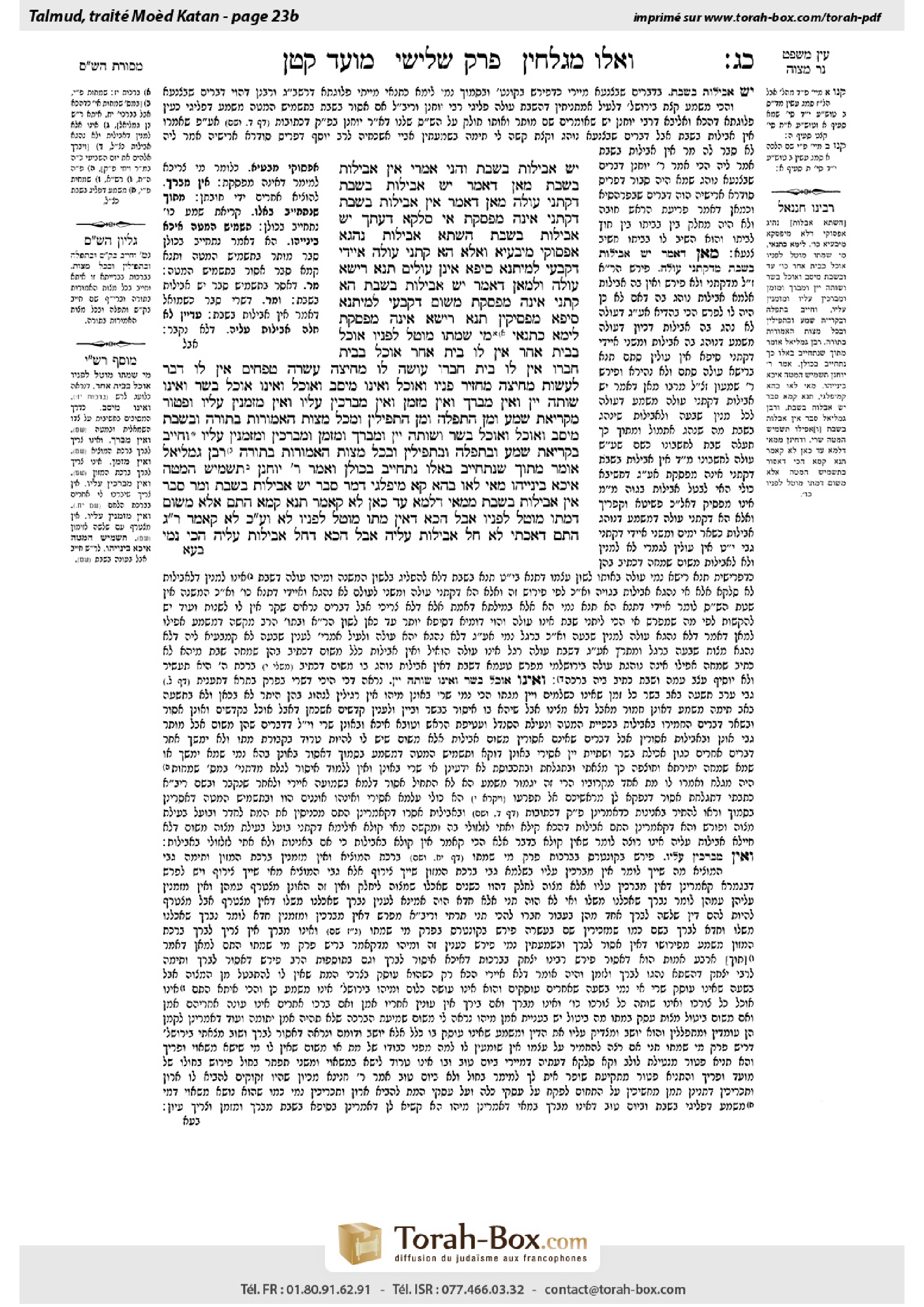
Moed Katan 23b: Talmud study for Daf Yomi
Daf Yomi is the daily study of one Talmud folio. Explore 37 tractates with scans, Hebrew text, Sefaria English and AI-generated French translations where annotated.
Passage selection and English or AI-generated French translation are available where the scan has annotations. Daf Study is independent of Torah-Box and Sefaria.
Browse Moed Katan · מועד קטן · All tractatesMoed Katan 23b text and translations
This page of Moed Katan includes the Aramaic text, an English translation and an AI-generated French translation, alongside the scan above.
מועד קטן כ״ג ב · Aramaic and Hebrew text
יֵשׁ אֲבֵילוּת בְּשַׁבָּת, וְהָנֵי אָמְרִי: אֵין אֲבֵילוּת בְּשַׁבָּת.
מַאן דְּאָמַר יֵשׁ אֲבֵילוּת בְּשַׁבָּת, דְּקָתָנֵי ״עוֹלָה״. מַאן דְּאָמַר אֵין אֲבֵילוּת בְּשַׁבָּת, דְּקָתָנֵי ״אֵינָהּ מַפְסֶקֶת״.
אִי סָלְקָא דַעְתָּךְ יֵשׁ אֲבֵילוּת בְּשַׁבָּת, הַשְׁתָּא אֲבֵילוּת נָהֲגָא, אַפְסוֹקֵי מִיבַּעְיָא?
וְאֶלָּא הָא קָתָנֵי ״עוֹלָה״! אַיְּידֵי דְּקָבָעֵי לְמִיתְנֵא סֵיפָא ״אֵינָן עוֹלִים״, תְּנָא רֵישָׁא ״עוֹלָה״.
וּלְמַאן דְּאָמַר יֵשׁ אֲבֵילוּת בְּשַׁבָּת, הָא קָתָנֵי אֵינָהּ מַפְסֶקֶת! מִשּׁוּם דְּקָבָעֵי לְמִיתְנֵא סֵיפָא ״מַפְסִיקִין״, תְּנָא רֵישָׁא ״אֵינָהּ מַפְסֶקֶת״.
לֵימָא כְּתַנָּאֵי: מִי שֶׁמֵּתוֹ מוּטָּל לְפָנָיו — אוֹכֵל בְּבַיִת אַחֵר. אֵין לוֹ בַּיִת אַחֵר — אוֹכֵל בְּבֵית חֲבֵרוֹ, אֵין לוֹ בַּיִת חֲבֵרוֹ — עוֹשֶׂה לוֹ מְחִיצָה עֲשָׂרָה טְפָחִים. אֵין לוֹ דָּבָר לַעֲשׂוֹת מְחִיצָה — מַחְזִיר פָּנָיו וְאוֹכֵל.
וְאֵינוֹ מֵיסֵב וְאוֹכֵל, וְאֵינוֹ אוֹכֵל בָּשָׂר וְאֵינוֹ שׁוֹתֶה יַיִן, וְאֵין מְבָרֵךְ וְאֵין מְזַמֵּן, וְאֵין מְבָרְכִין עָלָיו וְאֵין מְזַמְּנִין עָלָיו, וּפָטוּר מִקְּרִיאַת שְׁמַע וּמִן הַתְּפִלָּה וּמִן הַתְּפִילִּין, וּמִכׇּל מִצְוֹת הָאֲמוּרוֹת בַּתּוֹרָה.
וּבְשַׁבָּת — מֵיסֵב וְאוֹכֵל, וְאוֹכֵל בָּשָׂר וְשׁוֹתֶה יַיִן, וּמְבָרֵךְ וּמְזַמֵּן, וּמְבָרְכִין וּמְזַמְּנִין עָלָיו, וְחַיָּיב בִּקְרִיאַת שְׁמַע וּבִתְפִילָּה וּבִתְפִילִּין, וּבְכׇל מִצְוֹת הָאֲמוּרוֹת בַּתּוֹרָה. רַבָּן גַּמְלִיאֵל אוֹמֵר: מִתּוֹךְ שֶׁנִּתְחַיֵּיב בְּאֵלּוּ — נִתְחַיֵּיב בְּכוּלָּן.
וְאָמַר רַבִּי יוֹחָנָן: תַּשְׁמִישׁ הַמִּטָּה אִיכָּא בֵּינַיְיהוּ.
מַאי לָאו בְּהָא קָא מִיפַּלְגִי, דְּמָר סָבַר: יֵשׁ אֲבֵילוּת בְּשַׁבָּת, וּמַר סָבַר: אֵין אֲבֵילוּת בְּשַׁבָּת!
מִמַּאי? דִּלְמָא עַד כָּאן לָא קָאָמַר תַּנָּא קַמָּא הָתָם, אֶלָּא מִשּׁוּם דְּמֵתוֹ מוּטָּל לְפָנָיו. אֲבָל הָכָא, דְּאֵין מֵתוֹ מוּטָּל לְפָנָיו — לָא.
וְעַד כָּאן לָא קָאָמַר רַבָּן גַּמְלִיאֵל הָתָם, דְּאַכַּתִּי לָא חָל אֲבֵילוּת עֲלֵיהּ. אֲבָל הָכָא, דְּחָל אֲבֵילוּת עֲלֵיהּ — הָכִי נָמֵי.
Moed Katan 23b · English translation
There is some mourning on Shabbat, i.e., with regard to mourning rites that can be observed privately in the mourner’s home and will go unnoticed by other people; whereas those say: There is no mourning on Shabbat at all.
The Gemara explains: The ones who said that there is some mourning on Shabbat rely on that which is taught, that Shabbat counts as one of the days of mourning, implying that some degree of mourning applies on that day. The ones who said that there is no mourning on Shabbat at all base this on that which is taught that Shabbat does not interrupt the mourning period.
The latter argue as follows: If it should enter your mind to say that there is some mourning on Shabbat, there is a difficulty, for now that it has been stated that actual mourning applies on Shabbat, is it necessary to teach us that this day does not interrupt the mourning period? Rather, the conclusion must be that there is no mourning on Shabbat whatsoever.
The Gemara asks: But isn’t it taught in the mishna that Shabbat counts as one of the days of mourning, implying that it is just like the other days of mourning, and at least some mourning rites are practiced on it? The Gemara answers: Since the mishna wished to teach in the latter clause that the days of a Festival do not count toward the requisite days of mourning, it taught also in the first clause that Shabbat counts as one of the days of mourning, although no mourning rites are practiced on it.
The Gemara asks: And according to the ones who said that there is some mourning on Shabbat, isn’t it taught in the mishna that it does not interrupt the mourning period, which would have been unnecessary to say if the mourning rites are practiced on it? The Gemara answers: This was not necessary for itself, but due to the fact that the mishna wished to teach in the latter clause that the Festivals interrupt the mourning, it taught also in the first clause that Shabbat does not interrupt it.
The Gemara asks: Let us say that this is parallel to a dispute between tanna’im with regard to whether or not some mourning rites are observed even on Shabbat, for it was taught in a baraita: One whose deceased relative is laid out before him eats in another room. If he does not have another room, he eats in the house of a friend. If he does not have a friend’s house available, he makes a partition ten handbreadths high between him and the deceased, so that he may eat. If he does not have material with which to make a partition, he averts his face from the dead and eats.
And in any case, he does not recline while he eats, as reclining is characteristic of a festive meal; and he neither eats meat nor drinks wine; and he does not recite a blessing before eating to exempt others from their obligation; and he does not recite the formula to invite the participants in the meal to join together in the Grace after Meals, and they do not recite a blessing over him nor do others invite him to join in the Grace after Meals, as he cannot be a member of the three required to recite the formula. And he is exempt from the recitation of Shema, and from the Amida prayer, and from donning phylacteries, and from performing all of the mitzvot mentioned in the Torah.
But on Shabbat he reclines at the meal, as per his custom, and eats; and he eats meat and drinks wine; and he recites blessings to exempt others from their obligation; and he recites the formula to invite the participants in the meal to join together in the Grace after Meals, and others may recite blessings on his behalf and invite him to join in the Grace after Meals. And he is also obligated in the recitation of Shema, and in the Amida prayer, and in the mitzva of phylacteries, and in all the mitzvot mentioned in the Torah. Rabban Gamliel says: Since he is obligated to fulfill these mitzvot associated with Shabbat, he is obligated to fulfill all of the mitzvot on Shabbat.
Rabban Gamliel’s statement is vague. The following clarifies it: Rabbi Yoḥanan said: The practical difference between them, the opinion of the anonymous first tanna and Rabbi Yoḥanan’s opinion, is with regard to sexual relations. According to Rabban Gamliel, the acute mourner is obligated in the mitzva to engage in marital intercourse with his wife on Shabbat, just as he is obligated in all the other mitzvot.
The Gemara asks: What, is it not with regard to this issue that they disagree: Is it not that one Sage, the anonymous first tanna, holds that there is some mourning on Shabbat with regard to private issues, and therefore the mourner does not engage in sexual relations; and one Sage, Rabban Gamliel, holds that there is no mourning on Shabbat at all?
The Gemara rejects this argument: From where do you reach this conclusion? Perhaps the first tanna is saying that it is prohibited for the grieving relative to engage in sexual relations in the case dealt with only there, because his deceased relative is laid out before him and has not yet been buried. But here, with regard to the period of mourning, when his dead has been buried and is no longer laid out before him, sexual relations are not prohibited.
And alternatively, perhaps Rabban Gamliel is saying that the grieving relative is permitted to engage in sexual relations only there, where the halakhot of mourning have not yet taken effect, as mourning begins only after the burial. But here, where the halakhot of mourning have already taken effect, he may also prohibit sexual relations.
Moed Katan 23b · Traduction française (IA)
Il y a une certaine forme de deuil pendant Chabbat, c’est-à-dire en ce qui concerne les rites de deuil que l’endeuillé peut observer en privé chez lui, sans que les autres s’en aperçoivent ; d’autres disent au contraire qu’il n’y a aucun deuil pendant Chabbat.
La Guemara explique : ceux qui disent qu’il y a une certaine forme de deuil pendant Chabbat s’appuient sur l’enseignement selon lequel Chabbat compte comme l’un des jours de deuil, ce qui implique qu’un certain degré de deuil s’applique ce jour-là. Ceux qui disent qu’il n’y a aucun deuil pendant Chabbat s’appuient sur l’enseignement selon lequel Chabbat n’interrompt pas la période de deuil.
Ces derniers raisonnent ainsi : si l’on pouvait penser qu’il y a une certaine forme de deuil pendant Chabbat, une difficulté se poserait. Puisqu’il a été dit que le deuil proprement dit s’applique pendant Chabbat, était-il nécessaire de nous enseigner que ce jour n’interrompt pas la période de deuil ? Il faut donc conclure qu’il n’y a absolument aucun deuil pendant Chabbat.
La Guemara demande : Mais n’est-il pas enseigné dans la Michna que Chabbat compte comme l’un des jours de deuil, ce qui implique qu’il est semblable aux autres jours de deuil et que l’on y observe au moins certains rites de deuil ? La Guemara répond : Comme la Michna souhaitait enseigner dans sa dernière partie que les jours de fête ne comptent pas dans le nombre de jours de deuil requis, elle a également enseigné dans sa première partie que Chabbat compte comme l’un des jours de deuil, bien qu’on n’y observe aucun rite de deuil.
La Guemara demande : Et selon ceux qui disent qu’il y a une certaine forme de deuil pendant Chabbat, n’est-il pas enseigné dans la Michna que Chabbat n’interrompt pas la période de deuil ? Il aurait été inutile de le préciser si l’on y observait les rites de deuil. La Guemara répond : Cette précision n’était pas nécessaire en soi ; mais, comme la Michna souhaitait enseigner dans sa dernière partie que les fêtes interrompent le deuil, elle a également enseigné dans sa première partie que Chabbat ne l’interrompt pas.
La Guemara demande : Ne peut-on pas dire que cela correspond à une controverse entre des tannaïm sur la question de savoir si certains rites de deuil sont observés même pendant Chabbat ? En effet, il a été enseigné dans une baraïta : Celui dont le proche défunt est étendu devant lui mange dans une autre pièce. S’il n’a pas d’autre pièce, il mange chez un ami. S’il ne peut pas disposer de la maison d’un ami, il établit entre lui et le défunt une cloison de dix palmes de hauteur afin de pouvoir manger. S’il n’a pas de quoi construire une cloison, il détourne le visage du mort et mange.
Dans tous les cas, il ne s’accoude pas pour manger, car cette posture caractérise un repas de fête ; il ne mange ni viande ni ne boit de vin ; il ne récite pas de bénédiction avant de manger afin d’acquitter les autres de leur obligation ; il ne prononce pas la formule invitant les participants au repas à réciter ensemble le Birkat Hamazon, et l’on ne récite pas de bénédiction à son intention ni ne l’invite à se joindre au Birkat Hamazon, car il ne peut faire partie des trois personnes requises pour prononcer cette formule. Il est dispensé de la récitation du Chéma, de la prière de la Amida, du port des tefillin et de l’accomplissement de toutes les mitsvot mentionnées dans la Torah.
Mais pendant Chabbat, il s’accoude au repas, comme à son habitude, et mange ; il mange de la viande et boit du vin ; il récite des bénédictions afin d’acquitter les autres de leur obligation ; il prononce la formule invitant les participants au repas à réciter ensemble le Birkat Hamazon, et d’autres peuvent réciter des bénédictions à son intention et l’inviter à se joindre au Birkat Hamazon. Il est également tenu de réciter le Chéma et la prière de la Amida, d’accomplir la mitsva des tefillin et toutes les mitsvot mentionnées dans la Torah. Rabban Gamliel dit : puisqu’il est tenu d’accomplir ces mitsvot liées à Chabbat, il est tenu d’accomplir toutes les mitsvot pendant Chabbat.
La déclaration de Rabban Gamliel est imprécise. Rabbi Yoḥanan l’éclaire ainsi : la différence pratique entre eux, c’est-à-dire entre l’opinion du premier tanna anonyme et celle de Rabban Gamliel, concerne les relations conjugales. Selon Rabban Gamliel, l’endeuillé avant l’inhumation est tenu d’accomplir la mitsva des relations conjugales avec son épouse pendant Chabbat, tout comme il est tenu d’accomplir toutes les autres mitsvot.
La Guemara demande : Ne sont-ils pas en désaccord sur cette question ? Le premier Sage, le premier tanna anonyme, ne tient-il pas qu’il y a une certaine forme de deuil pendant Chabbat en ce qui concerne les questions privées et que l’endeuillé n’a donc pas de relations conjugales ? Et l’autre Sage, Rabban Gamliel, ne tient-il pas qu’il n’y a aucun deuil pendant Chabbat ?
La Guemara rejette cet argument : D’où tirez-vous cette conclusion ? Peut-être le premier tanna dit-il que les relations conjugales sont interdites au proche endeuillé uniquement dans le cas traité là-bas, parce que son proche défunt est étendu devant lui et n’a pas encore été enterré. Mais ici, pendant la période de deuil, son proche défunt ayant été enterré et n’étant plus étendu devant lui, les relations conjugales ne sont pas interdites.
Autre possibilité : peut-être Rabban Gamliel dit-il que le proche endeuillé est autorisé à avoir des relations conjugales uniquement dans le cas traité là-bas, où les règles du deuil ne sont pas encore entrées en vigueur, puisque le deuil ne commence qu’après l’inhumation. Mais ici, où les règles du deuil sont déjà entrées en vigueur, il peut également interdire les relations conjugales.
Traduction française générée par IA à partir de l’édition anglaise de Sefaria. Vérifie toujours un passage avec le texte source.
Text from Sefaria: William Davidson Edition - Vocalized Aramaic (CC BY NC); William Davidson Edition - English (CC BY NC).