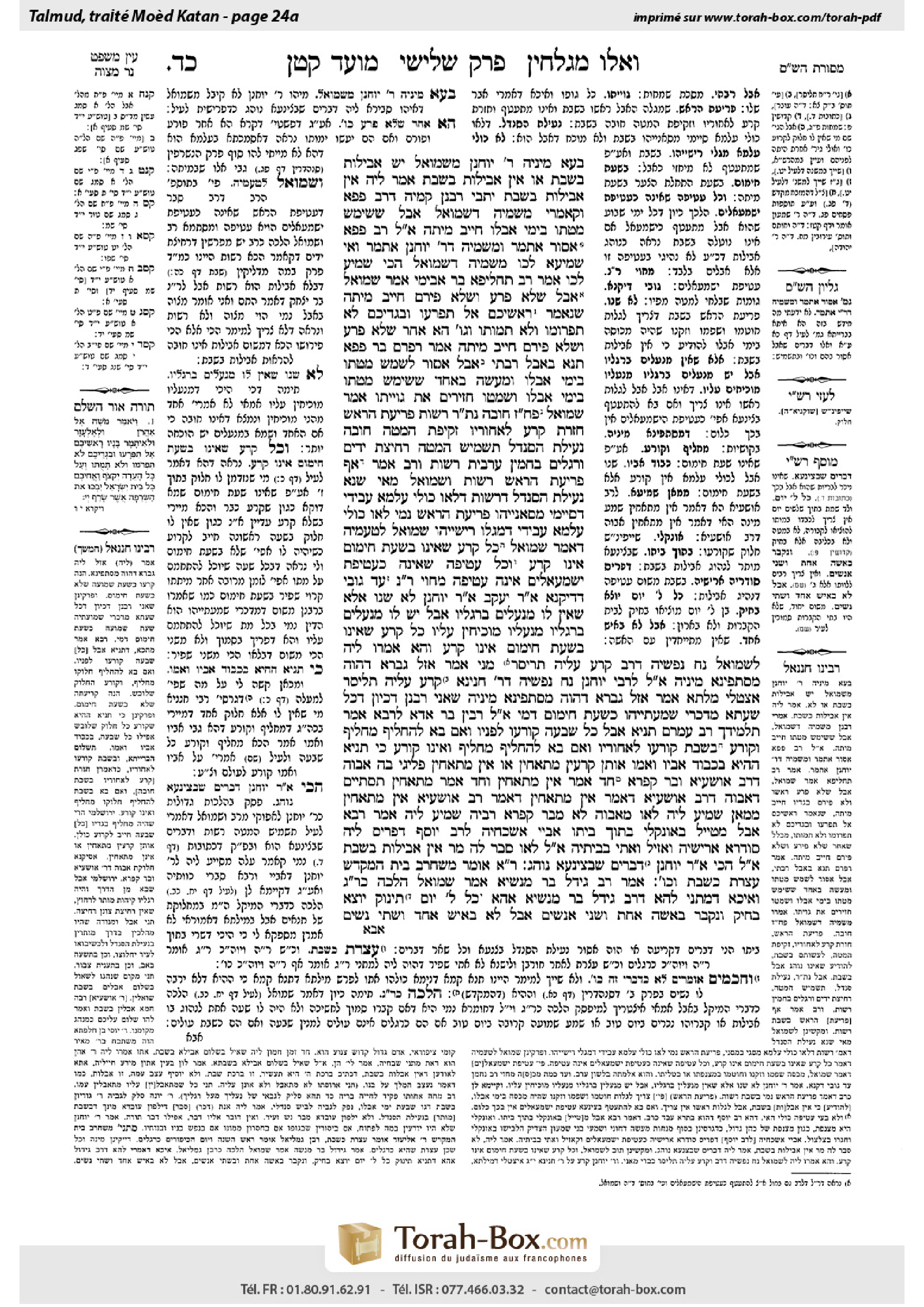
Moed Katan 24a: Talmud study for Daf Yomi
Daf Yomi is the daily study of one Talmud folio. Explore 37 tractates with scans, Hebrew text, Sefaria English and AI-generated French translations where annotated.
Passage selection and English or AI-generated French translation are available where the scan has annotations. Daf Study is independent of Torah-Box and Sefaria.
Browse Moed Katan · מועד קטן · All tractatesMoed Katan 24a text and translations
This page of Moed Katan includes the Aramaic text, an English translation and an AI-generated French translation, alongside the scan above.
מועד קטן כ״ד א · Aramaic and Hebrew text
בְּעָא מִינֵּיהּ רַבִּי יוֹחָנָן מִשְּׁמוּאֵל: יֵשׁ אֲבֵילוּת בְּשַׁבָּת אוֹ אֵין אֲבֵילוּת בְּשַׁבָּת? אֲמַר לֵיהּ: אֵין אֲבֵילוּת בְּשַׁבָּת.
יָתְבִי רַבָּנַן קַמֵּיהּ דְּרַב פָּפָּא וְקָאָמְרִי מִשְּׁמֵיהּ דִּשְׁמוּאֵל: אָבֵל שֶׁשִּׁימֵּשׁ מִטָּתוֹ בִּימֵי אֶבְלוֹ — חַיָּיב מִיתָה. אֲמַר לֵיהּ רַב פָּפָּא: אָסוּר אִתְּמַר, וּמִשְּׁמֵיהּ דְּרַבִּי יוֹחָנָן אִתְּמַר,
וְאִי שְׁמִיעָא לְכוּ מִשְּׁמֵיהּ דִּשְׁמוּאֵל, הָכִי שְׁמִיעַ לְכוּ: אָמַר רַב תַּחְלִיפָא בַּר אֲבִימִי אָמַר שְׁמוּאֵל: אָבֵל שֶׁלֹּא פֵּרַע וְשֶׁלֹּא פֵּירַם — חַיָּיב מִיתָה, שֶׁנֶּאֱמַר: ״רָאשֵׁיכֶם אַל תִּפְרָעוּ וּבִגְדֵיכֶם לֹא תִפְרוֹמוּ וְלֹא תָמוּתוּ וְגוֹ׳״, הָא אַחֵר שֶׁלֹּא פֵּרַע וְשֶׁלֹּא פֵּירַם — חַיָּיב מִיתָה.
אָמַר רַפְרָם בַּר פָּפָּא, תָּנָא בְּאֵבֶל רַבָּתִי: אָבֵל אָסוּר לְשַׁמֵּשׁ מִטָּתוֹ בִּימֵי אֶבְלוֹ, וּמַעֲשֶׂה בְּאֶחָד שֶׁשִּׁימֵּשׁ מִטָּתוֹ בִּימֵי אֶבְלוֹ, וְשָׁמְטוּ חֲזִירִים אֶת גְּוִיָּיתוֹ.
אָמַר שְׁמוּאֵל: פַּחַ״ז חוֹבָה, נֶתֶ״ר רְשׁוּת.
פְּרִיעַת הָרֹאשׁ, חֲזָרַת קֶרַע לַאֲחוֹרָיו, זְקִיפַת הַמִּטָּה — חוֹבָה. נְעִילַת הַסַּנְדָּל, תַּשְׁמִישׁ הַמִּטָּה, רְחִיצַת יָדַיִם וְרַגְלַיִם בְּחַמִּין עַרְבִית — רְשׁוּת. וְרַב אָמַר: אַף פְּרִיעַת הָרֹאשׁ רְשׁוּת.
וּשְׁמוּאֵל, מַאי שְׁנָא נְעִילַת הַסַּנְדָּל דִּרְשׁוּת — דְּלָאו כּוּלֵּי עָלְמָא עֲבִידִי דְּסָיְימִי מְסָאנַיְיהוּ. פְּרִיעַת הָרֹאשׁ נָמֵי, לָאו כּוּלֵּי עָלְמָא עֲבִידִי דִּמְגַלּוּ רֵישַׁיְיהוּ!
שְׁמוּאֵל לְטַעְמֵיהּ, דְּאָמַר שְׁמוּאֵל: כׇּל קֶרַע שֶׁאֵינוֹ בִּשְׁעַת חִימּוּם — אֵינוֹ קֶרַע. וְכׇל עֲטִיפָה שֶׁאֵינָהּ כַּעֲטִיפַת יִשְׁמְעֵאלִים — אֵינָהּ עֲטִיפָה. מַחְוֵי רַב נַחְמָן עַד גּוּבֵּי דְּדִיקְנָא.
אָמַר רַבִּי יַעֲקֹב אָמַר רַבִּי יוֹחָנָן: לֹא שָׁנוּ אֶלָּא שֶׁאֵין לוֹ מִנְעָלִים בְּרַגְלָיו, אֲבָל יֵשׁ לוֹ מִנְעָלִים בְּרַגְלָיו — מִנְעָלָיו מוֹכִיחִין עָלָיו.
כׇּל קֶרַע שֶׁאֵינוֹ בִּשְׁעַת חִימּוּם אֵינוֹ קֶרַע — וְהָא אֲמַרוּ לֵיהּ לִשְׁמוּאֵל: נָח נַפְשֵׁיהּ דְּרַב, קְרַע עֲלֵיהּ תְּרֵיסַר מָנֵי. אֲמַר: אֲזַל גַּבְרָא דַּהֲוָה מִסְתְּפֵינָא מִינֵּיהּ. אֲמַר לֵיהּ לְרַבִּי יוֹחָנָן: נָח נַפְשֵׁיהּ דְּרַבִּי חֲנִינָא. קְרַע עֲלֵיהּ תְּלֵיסַר אִצְטְלֵי מֵלָתָא. אֲמַר: אֲזַל גַּבְרָא דַּהֲוָה מִסְתְּפֵינָא מִינֵּיהּ!
שָׁאנֵי רַבָּנַן, דְּכֵיוָן דְּכֹל שַׁעְתָּא מַדְכְּרִי שְׁמַעְתַּיְיהוּ — כִּשְׁעַת חִימּוּם דָּמֵי.
אֲמַר לֵיהּ רָבִין בַּר אַדָּא לְרָבָא: אָמַר תַּלְמִידְךָ רַב עַמְרָם, תַּנְיָא: אָבֵל, כׇּל שִׁבְעָה קוֹרְעוֹ לְפָנָיו, וְאִם בָּא לְהַחֲלִיף — מַחְלִיף וְקוֹרֵעַ. בְּשַׁבָּת, קוֹרְעוֹ לַאֲחוֹרָיו, וְאִם בָּא לְהַחֲלִיף — מַחְלִיף וְאֵינוֹ קוֹרֵעַ!
כִּי תַּנְיָא הָהִיא, בִּכְבוֹד אָבִיו וְאִמּוֹ.
אוֹתָן קְרָעִין מִתְאַחִין, אוֹ אֵין מִתְאַחִין? פְּלִיגִי בַּהּ אֲבוּהּ דְּרַב אוֹשַׁעְיָא וּבַר קַפָּרָא. חַד אָמַר: אֵין מִתְאַחִין, וְחַד אָמַר: מִתְאַחִין.
תִּסְתַּיֵּים דַּאֲבוּהּ דְּרַב אוֹשַׁעְיָא דְּאָמַר אֵין מִתְאַחִין. דְּאָמַר רַב אוֹשַׁעְיָא: אֵין מִתְאַחִין, מִמַּאן שְׁמִיעַ לֵיהּ — לָאו מֵאֲבוּהּ? לָא, מִבַּר קַפָּרָא רַבֵּיהּ שְׁמִיעַ לֵיהּ.
אָמַר רָבָא: אָבֵל מְטַיֵּיל בְּאוּנְקְלִי בְּתוֹךְ בֵּיתוֹ. אַבָּיֵי אַשְׁכְּחֵיהּ לְרַב יוֹסֵף דִּפְרִיס לֵיהּ סוּדָרָא אַרֵישֵׁיהּ וְאָזֵיל וְאָתֵי בְּבֵיתֵיהּ. אֲמַר לֵיהּ: לָאו סָבַר לַהּ מָר אֵין אֲבֵילוּת בְּשַׁבָּת? אֲמַר לֵיהּ, הָכִי אָמַר רַבִּי יוֹחָנָן: דְּבָרִים שֶׁבְּצִינְעָא — נוֹהֵג.
רַבִּי אֱלִיעֶזֶר אוֹמֵר: מִשֶּׁחָרַב בֵּית הַמִּקְדָּשׁ עֲצֶרֶת כַּשַּׁבָּת וְכוּ׳. אָמַר רַב גִּידֵּל בַּר מְנַשְּׁיָא אָמַר שְׁמוּאֵל: הֲלָכָה כְּרַבָּן גַּמְלִיאֵל.
וְאִיכָּא דְּמַתְנֵי לְהָא דְּרַב גִּידֵּל בַּר מְנַשְּׁיָא אַהָא: כׇּל שְׁלֹשִׁים יוֹם, תִּינוֹק יוֹצֵא בַּחֵיק, וְנִקְבָּר בְּאִשָּׁה אַחַת וּשְׁנֵי אֲנָשִׁים. אֲבָל לֹא בְּאִישׁ אֶחָד וּשְׁתֵּי נָשִׁים.
Moed Katan 24a · English translation
Rabbi Yoḥanan asked of Shmuel: Is there some mourning on Shabbat or is there no mourning on Shabbat at all? He said to him: There is no mourning on Shabbat at all.
The Sages sat before Rav Pappa and said in the name of Shmuel: A mourner who engaged in sexual relations during his days of mourning is liable to receive the death penalty at the hand of Heaven. Rav Pappa said to them: It was said that sexual relations are prohibited, but not that the offender is guilty of a capital crime. And the ruling was said in the name of Rabbi Yoḥanan, and not in the name of Shmuel.
And if you heard a statement on this issue in the name of Shmuel, then you heard as follows: Rav Taḥlifa bar Avimi said that Shmuel said: A mourner who did not let his hair grow wild and did not rend his garments is liable to receive the death penalty at the hand of Heaven, as it is stated following the deaths of Nadab and Abihu concerning the surviving sons of Aaron: “Let not the hair of your heads go loose, neither rend your clothes, that you not die” (Leviticus 10:6). They were instructed not to mourn, so as not to interfere with the dedication of the Tabernacle. From here it may be deduced that any other mourner who did not let his hair grow wild or rend his clothes is liable to receive the death penalty.
Rafram bar Pappa said: A Sage taught in Evel Rabbati, a separate tractate devoted to the halakhot of mourning: A mourner is prohibited from engaging in sexual relations during his days of mourning. There was an incident with one who engaged in sexual relations during his days of mourning and he was punished, for after his death pigs dragged away his corpse.
Shmuel offered a mnemonic device with regard to the observance of mourning rites on Shabbat, and said: Peh, ḥet, zayin are obligatory. These letters combine to create a mnemonic standing for: Uncovering the head [periat rosh], reversing the torn garment [ḥazarat kera], and standing the bed upright [zekifat hamitta]. However, nun, tav, reish, which stand for: Wearing shoes [ne’ilat hasandal], marital relations [tashmish hamitta], and hand washing [reḥitzat yadayim], are optional.
This is explained: Uncovering the head, i.e., removing the head covering usually worn by a mourner; reversing the tear to the back, so that it will not be visible; and standing the bed upright in the usual position, so that it is not overturned, are all obligatory for the mourner to uphold in honor of Shabbat. However, wearing shoes, engaging in sexual relations, and washing one’s hands and feet in hot water in the evening are optional activities on Shabbat. If a mourner wishes to refrain from them he may do so. And Rav said: Uncovering the head is also an optional activity.
The Gemara asks: According to Shmuel, what is different about wearing shoes that it is optional? His reasoning presumably is that not everyone wears shoes at all times, and therefore not wearing shoes will not be perceived by others as a sign of mourning. If so, the same thing may be said about uncovering the head also, i.e., not everyone uncovers his head at all times, as some people always walk around with their heads wrapped. This, too, should not be seen as a clear display of mourning, and therefore uncovering one’s head should also be treated as optional.
The Gemara answers: Shmuel conforms to his standard line of reasoning, for Shmuel said: Any rending of garments that is not done at the time of the most intense grief, i.e., the time of death, is not considered proper rending of garments. And any wrapping of the head that is not done in the manner of the wrapping of the Ishmaelites, who wrap their heads on all sides, is not considered proper wrapping. Since Shmuel requires that a mourner wrap his head in this special manner, one who acts in this way on Shabbat openly displays his mourning, as people do not ordinarily wrap their heads in this manner. What is this wrapping? Rav Naḥman demonstrated the procedure by covering up his face to the sides of the beard, leaving only the center of his face exposed.
Rabbi Ya’akov said that Rabbi Yoḥanan said: They taught that a mourner is required to remove his head covering on Shabbat only when he has no shoes on his feet, so that he not appear too obviously to be in mourning. But if he has shoes on his feet, then his shoes prove that he is not observing the rites of mourning on Shabbat.
The Gemara returns to Shmuel’s statement that any rending of garments that is not done at the time of most intense grief and pain is not considered proper rending of garments. The Gemara poses a question: But when they said to Shmuel that Rav had passed away, he rent twelve garments on account of him, and said: The man of whom I was in fear, owing to his great learning, has gone and died. Similarly, when they told Rabbi Yoḥanan that Rabbi Ḥanina had passed away, he rent thirteen expensive wool [mileta] garments [itztelei] on account of him, and said: The man of whom I was in fear has gone. When each of these Sages received the news that their distinguished colleague had died, it was no longer the time of the most intense grief, i.e., the time of death, and yet they rent their garments.
The Gemara answers: The Sages are different. Since their teachings are mentioned all the time, every time they are mentioned is like the time of most intense grief, as the pain over their death is once again renewed.
Ravin bar Adda said to Rava: Your student, Rav Amram, said that it is taught in a baraita as follows: For all seven days of mourning, a mourner must keep the tear in his garment before him so that it will be seen. And if he comes to change clothing, he changes and rends the new garment. On Shabbat, he turns the tear to his back, and if he comes to change clothing, he changes but does not tear the second garment. From here it seems that there is an obligation to rend garments during the entire week of mourning, not only at the most intense moment of grief.
The Gemara answers: When that baraita is taught, it is referring to the specific case of rending one’s garment in honor of his father or mother. Owing to the special honor due to one’s parents, it is inappropriate for the child to wear a garment that is not torn. Consequently, if he changes clothing, he must tear the new garment, even if it is no longer the most intense time of grief.
The Gemara asks: Those additional tears that are made in honor of one’s father or mother, may they be properly mended at the end of the son’s period of mourning, or may they not be properly mended, like the tear made for one’s father or mother at the most intense moment of grief? The Gemara answers: They disagree about this issue, the father of Rav Oshaya and bar Kappara. One said: They may not be mended, and one said: They may be mended.
The Gemara comments: Conclude that it was Rav Oshaya’s father who said that such rents may not be properly mended, for Rav Oshaya said: Such rents may not be properly mended. From whom did he hear this halakha? Was it not from his father? The Gemara rejects this argument: No, this cannot be offered as a proof, as perhaps he heard it from bar Kappara, who was his teacher.
§ Rava said: A mourner may walk about his house in a torn robe [unkali] on Shabbat, since he is not doing so in public. It was related that Abaye found Rav Yosef walking back and forth in his house on Shabbat when he was in mourning with a scarf spread over his head in the manner of mourning. He said to him: Master, do you not maintain that there is no mourning on Shabbat? He said to him: This is what Rabbi Yoḥanan said: Matters that are in private apply, and so when one is in his house he must observe the rites of mourning even on Shabbat.
§ The mishna taught: Rabbi Eliezer says: Since the Temple was destroyed, Shavuot is like Shabbat with regard to mourning. Rabban Gamliel says: Even Rosh HaShana and Yom Kippur are considered like Festivals. The Gemara comments that Rav Giddel bar Menashya said that Shmuel said: The halakha is in accordance with the opinion of Rabban Gamliel.
And some teach this ruling of Rav Giddel bar Menashya as referring to the following case: It is taught in a baraita: Within the first thirty days after birth, an infant that dies is taken out for burial in one’s bosom, that is to say, he is carried to his grave in one’s arms, not in a coffin. And he is buried by one woman and two men, there being no need for a quorum of ten men. But he should not be taken out by one man and two women, because it is prohibited for one man to seclude himself with two women.
Moed Katan 24a · Traduction française (IA)
Rabbi Yoḥanan demanda à Shmuel : Y a-t-il une forme de deuil le Chabbat, ou n’y a-t-il absolument aucun deuil le Chabbat ? Il lui répondit : Il n’y a absolument aucun deuil le Chabbat.
Les Sages étaient assis devant Rav Pappa et rapportèrent au nom de Shmuel : Un endeuillé qui a des relations sexuelles pendant les jours de son deuil est passible de la peine de mort par la main du Ciel. Rav Pappa leur dit : Il a été dit que les relations sexuelles sont interdites, mais pas que celui qui enfreint cette interdiction est passible de la peine de mort. Et cette décision a été rapportée au nom de Rabbi Yoḥanan, et non au nom de Shmuel.
Et si vous avez entendu une déclaration à ce sujet au nom de Shmuel, voici ce que vous avez entendu : Rav Taḥlifa bar Avimi a dit au nom de Shmuel : Un endeuillé qui ne laisse pas pousser ses cheveux et ne déchire pas ses vêtements est passible de la peine de mort par la main du Ciel, comme il est dit, après la mort de Nadav et Avihou, au sujet des fils survivants d’Aaron : « Ne laissez pas vos cheveux se défaire et ne déchirez pas vos vêtements, afin que vous ne mouriez pas » (Lévitique 10, 6). Il leur fut ordonné de ne pas prendre le deuil afin de ne pas entraver l’inauguration du Tabernacle. On peut en déduire que tout autre endeuillé qui ne laisse pas pousser ses cheveux ou ne déchire pas ses vêtements est passible de la peine de mort.
Rafram bar Pappa dit : Un Sage enseigna dans Evel Rabbati, traité distinct consacré aux halakhot du deuil : Il est interdit à un endeuillé d’avoir des relations sexuelles pendant les jours de son deuil. Il arriva qu’un homme eut des relations sexuelles pendant les jours de son deuil et fut puni, car après sa mort, des porcs traînèrent son cadavre.
Shmuel proposa un moyen mnémotechnique concernant l’observance des rites de deuil le Chabbat et dit : Peh, ḥet, zayin sont obligatoires. Ces lettres forment un moyen mnémotechnique correspondant à : découvrir la tête [periat rosh], remettre la déchirure vers l’arrière [ḥazarat kera] et redresser le lit [zekifat hamitta]. En revanche, nun, tav, reish, qui correspondent à porter des chaussures [ne’ilat hasandal], avoir des relations conjugales [tashmish hamitta] et se laver les mains [reḥitzat yadayim], sont facultatifs.
Voici l’explication : découvrir la tête, c’est-à-dire retirer le couvre-chef que l’endeuillé porte habituellement ; remettre la déchirure vers l’arrière, afin qu’elle ne soit pas visible ; et remettre le lit dans sa position habituelle, au lieu de le laisser renversé, sont des obligations auxquelles l’endeuillé doit se conformer en l’honneur du Chabbat. En revanche, porter des chaussures, avoir des relations sexuelles et se laver les mains et les pieds à l’eau chaude le soir sont des actes facultatifs le Chabbat. Si l’endeuillé souhaite s’en abstenir, il le peut. Et Rav dit : Découvrir la tête est également facultatif.
La Guemara demande : Selon Shmuel, en quoi le port de chaussures est-il facultatif ? Son raisonnement est sans doute que tout le monde ne porte pas de chaussures en permanence ; ne pas en porter ne sera donc pas perçu par les autres comme un signe de deuil. Si c’est le cas, on peut en dire autant du fait de découvrir sa tête : tout le monde ne garde pas la tête découverte en permanence, puisque certains se promènent toujours la tête couverte. Cela non plus ne devrait pas être considéré comme une manifestation évidente de deuil ; découvrir sa tête devrait donc également être facultatif.
La Guemara répond : Shmuel suit son raisonnement habituel, car Shmuel a dit : Toute déchirure de vêtement qui n’est pas faite au moment du chagrin le plus intense, c’est-à-dire au moment de la mort, n’est pas considérée comme une véritable déchirure. Et toute manière de se couvrir la tête qui ne suit pas la manière des Ismaélites, lesquels s’enveloppent la tête de tous côtés, n’est pas considérée comme une véritable façon de se couvrir la tête. Puisque Shmuel exige que l’endeuillé s’enveloppe la tête de cette façon particulière, celui qui agit ainsi le Chabbat manifeste ouvertement son deuil, car les gens ne s’enveloppent pas habituellement la tête de cette manière. En quoi consiste cette manière de s’envelopper ? Rav Naḥman en fit la démonstration : il se couvrit le visage jusqu’aux côtés de la barbe, ne laissant découvert que le milieu du visage.
Rabbi Ya’akov a dit au nom de Rabbi Yoḥanan : Ils ont enseigné qu’un endeuillé doit retirer son couvre-chef le Chabbat uniquement s’il ne porte pas de chaussures, afin qu’il n’ait pas l’air trop manifestement en deuil. Mais s’il porte des chaussures, celles-ci prouvent qu’il n’observe pas les rites de deuil le Chabbat.
La Guemara revient à la déclaration de Shmuel selon laquelle toute déchirure de vêtement qui n’est pas faite au moment du chagrin et de la douleur les plus intenses n’est pas considérée comme une véritable déchirure. La Guemara soulève une difficulté : Pourtant, lorsqu’on annonça à Shmuel que Rav était mort, il déchira douze vêtements en son honneur et dit : « L’homme que je craignais en raison de son grand savoir est parti et mort. » De même, lorsqu’on annonça à Rabbi Yoḥanan que Rabbi Ḥanina était mort, il déchira en son honneur treize vêtements coûteux en laine [mileta] [itztelei] et dit : « L’homme que je craignais est parti. » Lorsque chacun de ces Sages apprit la mort de son collègue éminent, ce n’était plus le moment du chagrin le plus intense, c’est-à-dire le moment de la mort, et pourtant ils déchirèrent leurs vêtements.
La Guemara répond : Le cas des Sages est différent. Puisque leurs enseignements sont constamment mentionnés, chaque fois qu’on les mentionne équivaut au moment du chagrin le plus intense, car la douleur de leur mort se renouvelle alors.
Ravin bar Adda dit à Rava : Ton élève, Rav Amram, a dit qu’une baraïta enseigne ce qui suit : Pendant les sept jours de deuil, l’endeuillé doit garder la déchirure de son vêtement devant lui, de sorte qu’elle soit visible. Et s’il veut changer de vêtements, il se change et déchire le nouveau vêtement. Le Chabbat, il tourne la déchirure vers l’arrière et, s’il veut changer de vêtements, il se change sans déchirer le second vêtement. Il semble donc qu’il y ait l’obligation de déchirer ses vêtements durant toute la semaine de deuil, et pas seulement au moment du chagrin le plus intense.
La Guemara répond : Cette baraïta concerne le cas particulier où l’on déchire son vêtement en l’honneur de son père ou de sa mère. En raison de l’honneur particulier dû aux parents, il ne convient pas que l’enfant porte un vêtement qui ne soit pas déchiré. Par conséquent, s’il change de vêtements, il doit déchirer le nouveau vêtement, même si le moment du chagrin le plus intense est passé.
La Guemara demande : Peut-on raccommoder comme il convient ces déchirures supplémentaires faites en l’honneur de son père ou de sa mère à la fin de la période de deuil du fils, ou ne peut-on pas les raccommoder comme il convient, à l’instar de la déchirure faite pour son père ou sa mère au moment du chagrin le plus intense ? La Guemara répond : Le père de Rav Oshaya et bar Kappara sont en désaccord sur cette question. L’un dit qu’elles ne peuvent pas être raccommodées, et l’autre dit qu’elles peuvent l’être.
La Guemara remarque : Concluons que c’est le père de Rav Oshaya qui a dit que de telles déchirures ne peuvent pas être raccommodées comme il convient, car Rav Oshaya a dit qu’elles ne peuvent pas l’être. De qui a-t-il entendu cette halakha ? N’est-ce pas de son père ? La Guemara rejette cet argument : Non, cela ne peut pas servir de preuve, car il l’a peut-être entendue de bar Kappara, qui était son maître.
§ Rava dit : Un endeuillé peut se déplacer dans sa maison le Chabbat vêtu d’une robe déchirée [unkali], puisqu’il ne le fait pas en public. On rapporte qu’Abaye trouva Rav Yosef qui allait et venait dans sa maison le Chabbat, alors qu’il était en deuil, un foulard étendu sur la tête à la manière des endeuillés. Il lui dit : « Maître, ne considérez-vous pas qu’il n’y a pas de deuil le Chabbat ? » Il lui répondit : « Voici ce que Rabbi Yoḥanan a dit : Les pratiques qui relèvent de l’intimité s’appliquent ; ainsi, lorsqu’on est chez soi, on doit observer les rites de deuil même le Chabbat. »
§ La Michna enseignait : Rabbi Eliezer dit : Depuis la destruction du Temple, Chavouot est comme le Chabbat en ce qui concerne le deuil. Rabban Gamliel dit : Même Roch Hachana et Yom Kippour sont considérés comme des fêtes. La Guemara rapporte que Rav Giddel bar Menashya a dit au nom de Shmuel : La halakha est conforme à l’opinion de Rabban Gamliel.
Certains rapportent cette décision de Rav Giddel bar Menashya à propos du cas suivant. Une baraïta enseigne : Lorsqu’un nourrisson meurt dans les trente premiers jours suivant sa naissance, on le porte à l’enterrement dans ses bras, c’est-à-dire qu’on le conduit à sa tombe dans les bras de quelqu’un, et non dans un cercueil. Il est enterré par une femme et deux hommes, sans qu’il soit nécessaire de réunir un quorum de dix hommes. Mais il ne faut pas le porter au dehors avec un seul homme et deux femmes, car il est interdit à un homme de s’isoler avec deux femmes.
Traduction française générée par IA à partir de l’édition anglaise de Sefaria. Vérifie toujours un passage avec le texte source.
Text from Sefaria: William Davidson Edition - Vocalized Aramaic (CC BY NC); William Davidson Edition - English (CC BY NC).