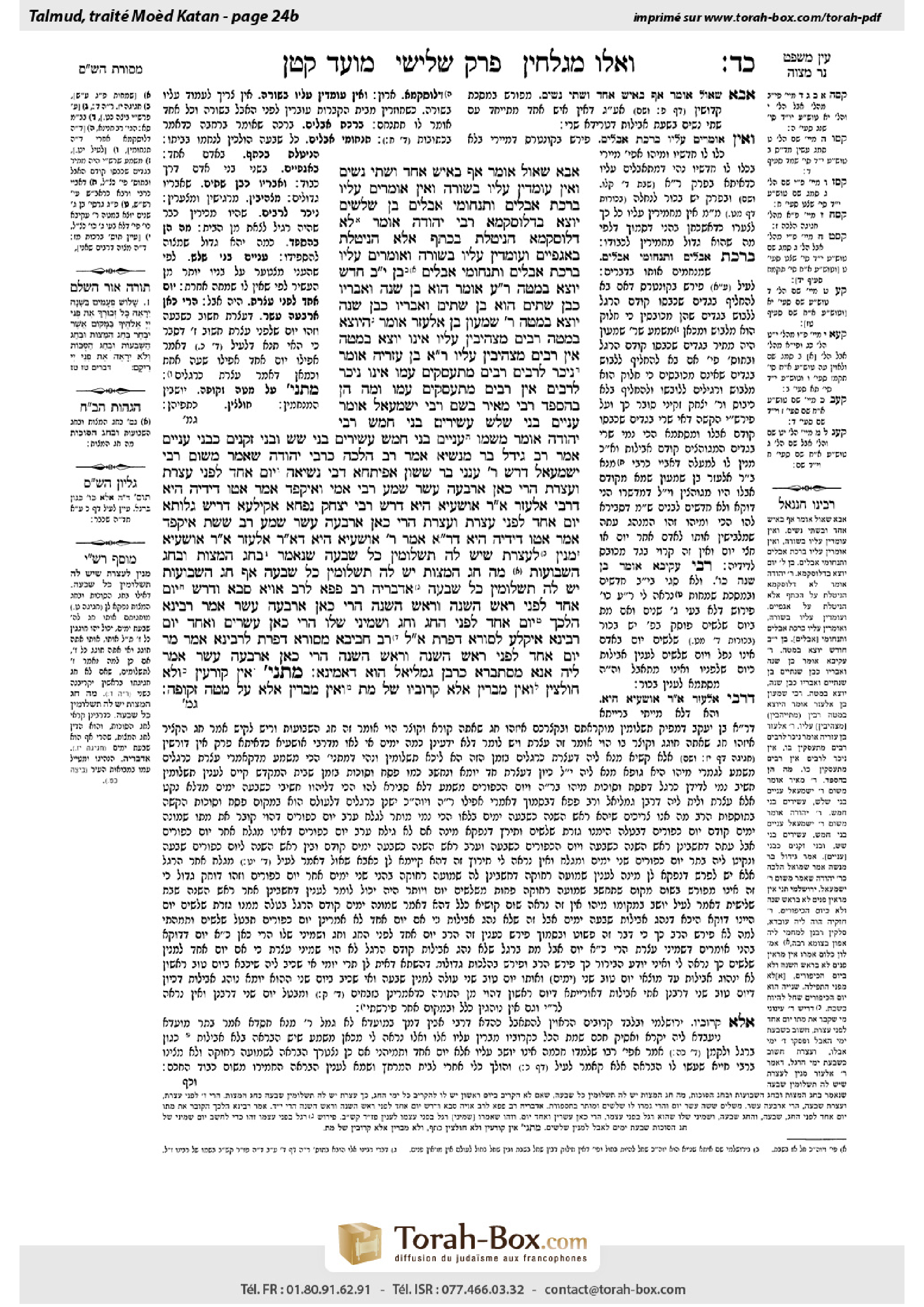
Moed Katan 24b: Talmud study for Daf Yomi
Daf Yomi is the daily study of one Talmud folio. Explore 37 tractates with scans, Hebrew text, Sefaria English and AI-generated French translations where annotated.
Passage selection and English or AI-generated French translation are available where the scan has annotations. Daf Study is independent of Torah-Box and Sefaria.
Browse Moed Katan · מועד קטן · All tractatesMoed Katan 24b text and translations
This page of Moed Katan includes the Aramaic text, an English translation and an AI-generated French translation, alongside the scan above.
מועד קטן כ״ד ב · Aramaic and Hebrew text
אַבָּא שָׁאוּל אוֹמֵר: אַף בְּאִישׁ אֶחָד וּשְׁתֵּי נָשִׁים. וְאֵין עוֹמְדִין עָלָיו בְּשׁוּרָה. וְאֵין אוֹמְרִים עָלָיו בִּרְכַּת אֲבֵלִים וְתַנְחוּמֵי אֲבֵלִים.
בֶּן שְׁלֹשִׁים יוֹצֵא בִּדְלוֹסְקָמָא. רַבִּי יְהוּדָה אוֹמֵר: לֹא דְּלוֹסְקָמָא הַנִּיטֶּלֶת בַּכָּתֵף, אֶלָּא הַנִּיטֶּלֶת בָּאֲגַפַּיִים. וְעוֹמְדִין עָלָיו בְּשׁוּרָה, וְאוֹמְרִים עָלָיו בִּרְכַּת אֲבֵלִים וְתַנְחוּמֵי אֲבֵלִים.
בֶּן שְׁנֵים עָשָׂר חֹדֶשׁ יוֹצֵא בְּמִטָּה. רַבִּי עֲקִיבָא אוֹמֵר: הוּא בֶּן שָׁנָה וְאֵבָרָיו כְּבֶן שְׁתַּיִם, הוּא בֶּן שְׁתַּיִם וְאֵבָרָיו כְּבֶן שָׁנָה — יוֹצֵא בְּמִטָּה.
רַבִּי שִׁמְעוֹן בֶּן אֶלְעָזָר אוֹמֵר: הַיּוֹצֵא בְּמִטָּה — רַבִּים מַצְהִיבִין עָלָיו. אֵינוֹ יוֹצֵא בְּמִטָּה — אֵין רַבִּים מַצְהִיבִין עָלָיו. רַבִּי אֶלְעָזָר בֶּן עֲזַרְיָה אוֹמֵר: נִיכָּר לָרַבִּים — רַבִּים מִתְעַסְּקִים עִמּוֹ, אֵינוֹ נִיכָּר לָרַבִּים — אֵין רַבִּים מִתְעַסְּקִים עִמּוֹ.
וּמָה הֵן בְּהֶסְפֵּד? רַבִּי מֵאִיר בְּשֵׁם רַבִּי יִשְׁמָעֵאל אוֹמֵר: עֲנִיִּים — בְּנֵי שָׁלֹשׁ, עֲשִׁירִים — בְּנֵי חָמֵשׁ. רַבִּי יְהוּדָה אוֹמֵר מִשְּׁמוֹ: עֲנִיִּים — בְּנֵי חָמֵשׁ, עֲשִׁירִים — בְּנֵי שֵׁשׁ, וּבְנֵי זְקֵנִים — כִּבְנֵי עֲנִיִּים.
אָמַר רַב גִּידֵּל בַּר מְנַשְּׁיָא אָמַר רַב: הֲלָכָה כְּרַבִּי יְהוּדָה שֶׁאָמַר מִשּׁוּם רַבִּי יִשְׁמָעֵאל.
דָּרֵשׁ רַבִּי עֲנָנִי בַּר שָׂשׂוֹן אַפִּיתְחָא דְּבֵי נְשִׂיאָה: יוֹם אֶחָד לִפְנֵי עֲצֶרֶת וַעֲצֶרֶת — הֲרֵי כָּאן אַרְבָּעָה עָשָׂר. שְׁמַע רַבִּי אַמֵּי וְאִיקְּפַד, אֲמַר: אַטּוּ דִּידֵיהּ הִיא? דְּרַבִּי אֶלְעָזָר אָמַר רַבִּי אוֹשַׁעְיָא הִיא!
דְּרַשׁ רַבִּי יִצְחָק נַפָּחָא אַקִּילְעָא דְּרֵישׁ גָּלוּתָא: יוֹם אֶחָד לִפְנֵי עֲצֶרֶת וַעֲצֶרֶת — הֲרֵי כָּאן אַרְבָּעָה עָשָׂר. שְׁמַע רַב שֵׁשֶׁת אִיקְּפַד, אָמַר: אַטּוּ דִּידֵיהּ הִיא? דְּרַבִּי אֶלְעָזָר אָמַר רַבִּי אוֹשַׁעְיָא הִיא!
דְּאָמַר רַבִּי אֶלְעָזָר אָמַר רַבִּי אוֹשַׁעְיָא: מִנַּיִן לָעֲצֶרֶת שֶׁיֵּשׁ לָהּ תַּשְׁלוּמִין כׇּל שִׁבְעָה — שֶׁנֶּאֱמַר: ״בְּחַג הַמַּצּוֹת וּבְחַג הַשָּׁבוּעוֹת״, מָה חַג הַמַּצּוֹת יֵשׁ לָהּ תַּשְׁלוּמִין כׇּל שִׁבְעָה — אַף חַג הַשָּׁבוּעוֹת יֵשׁ לָהּ תַּשְׁלוּמִין כׇּל שִׁבְעָה.
אַדְבְּרֵיהּ רַב פָּפָּא לְרַב אַוְיָא סָבָא וּדְרַשׁ: יוֹם אֶחָד לִפְנֵי רֹאשׁ הַשָּׁנָה וְרֹאשׁ הַשָּׁנָה — הֲרֵי כָּאן אַרְבָּעָה עָשָׂר. אָמַר רָבִינָא, הִלְכָּךְ: יוֹם אֶחָד לִפְנֵי הֶחָג, וְחַג, וּשְׁמִינִי שֶׁלּוֹ — הֲרֵי כָּאן עֶשְׂרִים וְאֶחָד יוֹם.
רָבִינָא אִיקְּלַע לְסוּרָא דִפְרָת, אֲמַר לֵיהּ רַב חֲבִיבָא מִסּוּרָא דִפְרָת לְרָבִינָא: אָמַר מָר, יוֹם אֶחָד לִפְנֵי רֹאשׁ הַשָּׁנָה וְרֹאשׁ הַשָּׁנָה — הֲרֵי כָּאן אַרְבָּעָה עָשָׂר? אֲמַר לֵיהּ: אֲנָא, מִסְתַּבְּרָא כְּרַבָּן גַּמְלִיאֵל הוּא דְּאָמֵינָא.
מַתְנִי׳ אֵין קוֹרְעִין וְלֹא חוֹלְצִין וְאֵין מַבְרִין אֶלָּא קְרוֹבָיו שֶׁל מֵת, וְאֵין מַבְרִין אֶלָּא עַל מִטָּה זְקוּפָה.
Moed Katan 24b · English translation
Abba Shaul says: The infant may be taken out even by one man and two women, for there is no concern with regard to seclusion in a time of mourning. And for such an infant, people do not stand in a line to offer their condolences to the mourners, as is ordinarily done after a burial; nor do others recite over him the mourners’ blessing, which is recited in the courtyard of the graveyard after the burial; nor is the usual formula for the consolation of mourners recited during the seven days of mourning.
A thirty-day-old infant that dies is taken out for burial in a coffin [deluskema]. Rabbi Yehuda says: Not in a small coffin that is carried on one’s shoulder, but rather in a coffin that is carried in the arms of two people. And for such an infant, people stand in a line to offer their condolences to the mourners. And others recite the mourners’ blessing at the cemetery. And people recite the consolation of mourners during the week of mourning.
A twelve-month-old infant is taken out for burial on a bier, just as an adult is. Rabbi Akiva says: This halakha applies if the infant that dies is one year old and his limbs are like those of a two year old, so that he looks older, or if he is two years old and his limbs are like those of a one-year-old. Only then he is taken out on a bier.
Rabbi Shimon ben Elazar says: For one that is taken out on a bier, the public should grieve [matzhivin]. For one that is not taken out on a bier, the public need not grieve. Rabbi Elazar ben Azarya says: The halakha is as follows: If the infant was known to the public, because he regularly left the house and many people knew him, the public must occupy themselves with him and participate in his burial. If he was not known to the public, the public need not occupy themselves with him.
And what is the status of deceased infants with regard to eulogy? Rabbi Meir said in the name of Rabbi Yishmael: The children of the poor are eulogized from the age of three, whereas the children of the wealthy are eulogized from the age of five. This is because a child is the sole source of joy for the poor, and so the pain and grief of the poor over the death of a child is greater than that of the wealthy. Rabbi Yehuda said in the name of Rabbi Yishmael: The children of the poor are eulogized from the age of five, whereas the children of the wealthy are eulogized from the age of six. And the children of the elderly are treated like the children of the poor, for the death of a child is particularly painful for an older person.
Rav Giddel bar Menashya said that Rav said: The halakha is in accordance with the opinion of Rabbi Yehuda, who stated it in the name of Rabbi Yishmael.
Rabbi Anani bar Sason taught at the entrance to the house of the Nasi: If one suffered the loss of a close relative shortly before the festival of Shavuot, his one day of mourning before Shavuot and Shavuot itself together count as fourteen days. The day before the Festival counts as seven full days of mourning because the Festival interrupts the seven-day period of mourning, and the Festival itself is counted as a seven-day Festival. Even though it is a one-day Festival, it is counted as seven days because it has the same halakha as the other Festivals. After Shavuot, then, only sixteen days are left to complete the thirty-day mourning period. Rabbi Ami heard this and became angry with him. He said: Is that to say that it is his own opinion? It is the opinion that Rabbi Elazar said that Rabbi Oshaya said.
Similarly Rabbi Yitzḥak Nappaḥa taught in the pavilion [kila] of the Exilarch: If one’s relative died shortly before the festival of Shavuot, his one day of mourning before Shavuot and Shavuot itself count as fourteen days. Rav Sheshet heard and became angry. He said: Is that to say that it is his own opinion? It is the opinion that Rabbi Elazar said that Rabbi Oshaya said.
In both of these cases, a Sage presented an opinion as their own, without attributing it to the original Sage who stated it, for Rabbi Elazar said that Rabbi Oshaya said: From where is it derived that the Shavuot offerings have redress all seven subsequent days? That is to say, if someone failed to bring the Festival offering on the Festival itself, he has six more days to bring it. As it is stated: “Three times a year shall all your males appear before the Lord your God in the place that He shall choose; on the festival of Passover, and on the festival of Shavuot, and on the festival of Sukkot” (Deuteronomy 16:16). Just as the offerings of the festival of Passover have redress all seven days, as Passover is seven days long, so too the offerings of the festival of Shavuot have redress all seven days, during the week following Shavuot. From this we learn that Shavuot is treated like a seven-day Festival for all halakhic purposes.
Rav Pappa granted permission to Rav Avya the Elder to speak and he taught the following in public: If one’s relative died shortly before Rosh HaShana, his one day of mourning before Rosh HaShana and Rosh HaShana itself together count as fourteen days, because Rosh HaShana is treated like a seven-day Festival. Ravina said: Therefore, if one’s relative died shortly before Sukkot, his one day of mourning before the Festival of Sukkot, and the Festival of Sukkot itself, which is seven days, and its Eighth day of Assembly, which is considered to be a separate Festival, count as twenty-one days, and he must observe only nine more days of mourning to complete the thirty-day period of mourning.
It was related that Ravina happened to come to the city of Sura on the Euphrates River. Rav Ḥaviva from Sura on the Euphrates said to Ravina: Did the Master say that one day of mourning before Rosh HaShana and Rosh HaShana itself count as fourteen days? He said to him: I said that it stands to reason that this is so according to Rabban Gamliel, who maintains that Rosh HaShana is treated like a pilgrim Festival. But I did not rule in accordance with this opinion.
MISHNA: Mourners do not rend their garments during the intermediate days of a Festival and do not remove their garments from their shoulders. And others do not provide them with a meal [mavrin] after the burial, except for close relatives of the deceased. And the consolers provide the first meal after the burial only while the mourner is sitting on an upright bed, and not on one that is overturned.
Moed Katan 24b · Traduction française (IA)
Abba Shaoul dit : On peut sortir le nourrisson même avec un homme et deux femmes, car il n’y a pas lieu de craindre un isolement pendant le deuil. Pour un tel nourrisson, les gens ne se tiennent pas en rang pour présenter leurs condoléances aux endeuillés, comme on le fait habituellement après une inhumation ; les autres ne récitent pas non plus sur lui la bénédiction des endeuillés, qui est récitée dans la cour du cimetière après l’inhumation ; et on ne récite pas la formule habituelle de consolation des endeuillés pendant les sept jours de deuil.
Un nourrisson âgé de trente jours qui meurt est sorti pour être enterré dans un cercueil [deluskema]. Rabbi Yehouda dit : pas dans un petit cercueil porté sur l’épaule, mais dans un cercueil porté dans les bras de deux personnes. Pour un tel nourrisson, les gens se tiennent en rang pour présenter leurs condoléances aux endeuillés. Les autres récitent la bénédiction des endeuillés au cimetière. On récite aussi la formule de consolation des endeuillés pendant la semaine de deuil.
Un nourrisson âgé de douze mois est sorti pour être enterré sur une civière, comme un adulte. Rabbi Akiva dit : cette halakha s’applique si le nourrisson décédé a un an et que ses membres sont comme ceux d’un enfant de deux ans, de sorte qu’il paraît plus âgé, ou s’il a deux ans et que ses membres sont comme ceux d’un enfant d’un an. Ce n’est que dans ces cas qu’on le sort sur une civière.
Rabbi Shimon ben Elazar dit : pour celui qu’on sort sur une civière, le public doit prendre part au deuil [matzhivin]. Pour celui qu’on ne sort pas sur une civière, le public n’a pas à prendre part au deuil. Rabbi Elazar ben Azarya dit : voici la halakha : si le nourrisson était connu du public, parce qu’il sortait régulièrement de la maison et que beaucoup de gens le connaissaient, le public doit s’occuper de lui et participer à son inhumation. S’il n’était pas connu du public, celui-ci n’a pas à s’occuper de lui.
Quel est le statut des nourrissons décédés en ce qui concerne l’éloge funèbre ? Rabbi Meïr a dit au nom de Rabbi Yishmaël : on prononce l’éloge funèbre des enfants des pauvres à partir de l’âge de trois ans, tandis que celui des enfants des riches n’est prononcé qu’à partir de l’âge de cinq ans. En effet, un enfant est la seule source de joie des pauvres ; la douleur et le chagrin des pauvres à la mort d’un enfant sont donc plus grands que ceux des riches. Rabbi Yehouda a dit au nom de Rabbi Yishmaël : on prononce l’éloge funèbre des enfants des pauvres à partir de l’âge de cinq ans, tandis que celui des enfants des riches n’est prononcé qu’à partir de l’âge de six ans. Les enfants des personnes âgées sont considérés comme les enfants des pauvres, car la mort d’un enfant est particulièrement douloureuse pour une personne âgée.
Rav Giddel bar Menashya a dit que Rav a dit : la halakha est conforme à l’avis de Rabbi Yehouda, qui l’a énoncé au nom de Rabbi Yishmaël.
Rabbi Anani bar Sason enseignait à l’entrée de la maison du Nassi : si l’on perd un proche peu avant la fête de Chavouot, le jour de deuil précédant Chavouot et Chavouot lui-même comptent ensemble comme quatorze jours. La veille de la fête compte comme sept jours complets de deuil, car la fête interrompt la période de deuil de sept jours, et la fête elle-même est comptée comme une fête de sept jours. Bien qu’il s’agisse d’une fête d’un seul jour, elle compte comme sept jours, car elle a le même statut que les autres fêtes. Après Chavouot, il ne reste donc que seize jours pour compléter la période de deuil de trente jours. Rabbi Ami l’entendit et se mit en colère contre lui. Il dit : Prétend-il que c’est son propre avis ? C’est l’avis que Rabbi Elazar a rapporté de Rabbi Oshaya.
De même, Rabbi Yitzḥak Nappaḥa enseignait dans le pavillon [kila] de l’Exilarque : si l’on perd un proche peu avant la fête de Chavouot, le jour de deuil précédant Chavouot et Chavouot lui-même comptent comme quatorze jours. Rav Sheshet l’entendit et se mit en colère. Il dit : Prétend-il que c’est son propre avis ? C’est l’avis que Rabbi Elazar a rapporté de Rabbi Oshaya.
Dans ces deux cas, un Sage a présenté un avis comme étant le sien, sans l’attribuer au Sage qui l’avait énoncé à l’origine. En effet, Rabbi Elazar a dit que Rabbi Oshaya a dit : D’où déduit-on que les sacrifices de Chavouot peuvent être apportés pendant les sept jours qui suivent ? Autrement dit, si quelqu’un n’a pas apporté le sacrifice de la fête le jour même, il lui reste six jours pour le faire. Car il est dit : « Trois fois par an, tous tes mâles paraîtront devant l’Éternel, ton Dieu, au lieu qu’Il choisira : à la fête de Pessaḥ, à la fête de Chavouot et à la fête de Soukkot » (Deutéronome 16:16). De même que les sacrifices de la fête de Pessaḥ peuvent être apportés pendant les sept jours de cette fête, qui dure sept jours, de même les sacrifices de la fête de Chavouot peuvent être apportés pendant les sept jours qui suivent Chavouot. Nous apprenons de là que Chavouot est considéré comme une fête de sept jours à toutes fins halakhiques.
Rav Pappa donna à Rav Avya l’Ancien la permission de parler, et celui-ci enseigna publiquement ce qui suit : si l’on perd un proche peu avant Roch Hachana, le jour de deuil précédant Roch Hachana et Roch Hachana lui-même comptent ensemble comme quatorze jours, car Roch Hachana est considéré comme une fête de sept jours. Ravina dit : par conséquent, si l’on perd un proche peu avant Soukkot, le jour de deuil précédant la fête de Soukkot, la fête de Soukkot elle-même, qui dure sept jours, et le huitième jour de l’Assemblée, considéré comme une fête distincte, comptent comme vingt et un jours ; il ne reste alors que neuf jours de deuil à observer pour compléter la période de deuil de trente jours.
On rapporte que Ravina arriva par hasard dans la ville de Soura, sur l’Euphrate. Rav Ḥaviva, de Soura sur l’Euphrate, dit à Ravina : Le Maître a-t-il dit que le jour de deuil précédant Roch Hachana et Roch Hachana lui-même comptent comme quatorze jours ? Il lui répondit : J’ai dit qu’il est logique que ce soit ainsi selon Rabban Gamliel, qui considère Roch Hachana comme une fête de pèlerinage. Mais je n’ai pas statué conformément à cet avis.
MICHNA : Pendant les jours intermédiaires d’une fête, les endeuillés ne déchirent pas leurs vêtements et ne les retirent pas de leurs épaules. Les autres ne leur offrent pas non plus le repas [mavrin] après l’inhumation, sauf s’il s’agit de proches parents du défunt. Ceux qui viennent consoler les endeuillés ne leur offrent le premier repas après l’inhumation que lorsqu’ils sont assis sur un lit dressé, et non sur un lit renversé.
Traduction française générée par IA à partir de l’édition anglaise de Sefaria. Vérifie toujours un passage avec le texte source.
Text from Sefaria: William Davidson Edition - Vocalized Aramaic (CC BY NC); William Davidson Edition - English (CC BY NC).