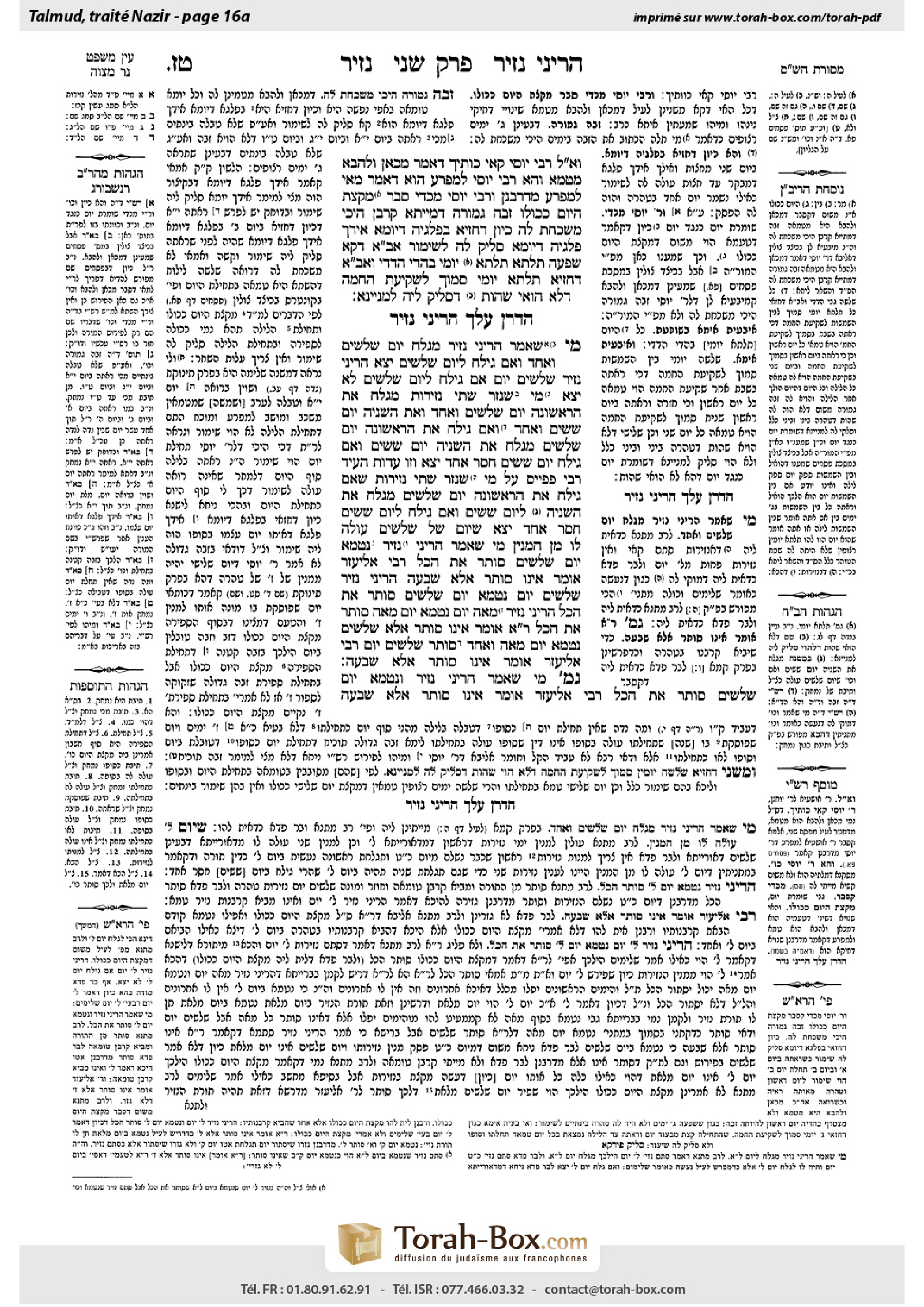
Nazir 16a: Talmud study for Daf Yomi
Daf Yomi is the daily study of one Talmud folio. Explore 37 tractates with scans, Hebrew text, Sefaria English and AI-generated French translations where annotated.
Passage selection and English or AI-generated French translation are available where the scan has annotations. Daf Study is independent of Torah-Box and Sefaria.
Browse Nazir · נזיר · All tractatesNazir 16a text and translations
This page of Nazir includes the Aramaic text, an English translation and an AI-generated French translation, alongside the scan above.
נזיר י״ו א · Aramaic and Hebrew text
וַאֲמַר לֵיהּ: רַבִּי יוֹסֵי קָאֵי כְּוָתָיךְ, דְּאָמַר מִכָּאן וּלְהַבָּא מְטַמֵּא. וְהָא רַבִּי יוֹסֵי לְמַפְרֵעַ הוּא דְּאָמַר! מַאי לְמַפְרֵעַ — מִדְּרַבָּנַן.
וְרַבִּי יוֹסֵי, מִכְּדִי סָבַר מִקְצָת הַיּוֹם כְּכוּלּוֹ, זָבָה גְּמוּרָה דְּמַיְיתָא קׇרְבָּן הֵיכִי מַשְׁכַּחַתְּ לָהּ? כֵּיוָן דְּחָזְיָא בְּפַלְגֵיהּ דְּיוֹמָא, אִידַּךְ פַּלְגֵיהּ דְּיוֹמָא סָלֵיק לַהּ לְשִׁימּוּר! אִיבָּעֵית אֵימָא דְּקָא שָׁפְעָה תְּלָתָא תְּלָתָא יוֹמֵי בַּהֲדֵי הֲדָדֵי. וְאִיבָּעֵית אֵימָא: דְּחָזְיָא תְּלָתָא יוֹמֵי סָמוּךְ לִשְׁקִיעַת הַחַמָּה, דְּלָא הֲוַאי שְׁהוּת דְּסָלֵיק לֵיהּ לְמִנְיָינָא.
הַדְרָן עֲלָךְ הֲרֵינִי נָזִיר
מִי שֶׁאָמַר ״הֲרֵינִי נָזִיר״ — מְגַלֵּחַ יוֹם שְׁלֹשִׁים וְאֶחָד, וְאִם גִּילַּח לְיוֹם שְׁלֹשִׁים — יָצָא. ״הֲרֵינִי נָזִיר שְׁלֹשִׁים יוֹם״ — אִם גִּילַּח לְיוֹם שְׁלֹשִׁים לֹא יָצָא.
מִי שֶׁנָּזַר שְׁתֵּי נְזִירוֹת — מְגַלֵּחַ אֶת הָרִאשׁוֹנָה יוֹם שְׁלֹשִׁים וְאֶחָד, וְאֶת הַשְּׁנִיָּה יוֹם שִׁשִּׁים וְאֶחָד. וְאִם גִּילַּח אֶת הָרִאשׁוֹנָה יוֹם שְׁלֹשִׁים — מְגַלֵּחַ אֶת הַשְּׁנִיָּה יוֹם שִׁשִּׁים, וְאִם גִּילַּח יוֹם שִׁשִּׁים חָסֵר אֶחָד — יָצָא.
וְזוֹ עֵדוּת הֵעִיד רַבִּי פַּפְּיָיס, עַל מִי שֶׁנָּזַר שְׁתֵּי נְזִירוֹת, שֶׁאִם גִּילַּח אֶת הָרִאשׁוֹנָה יוֹם שְׁלֹשִׁים — מְגַלֵּחַ אֶת הַשְּׁנִיָּה לְיוֹם שִׁשִּׁים, וְאִם גִּילַּח לְיוֹם שִׁשִּׁים חָסֵר אֶחָד — יָצָא, שֶׁיּוֹם שֶׁל שְׁלֹשִׁים עוֹלֶה לוֹ מִן הַמִּנְיָן.
מִי שֶׁאָמַר ״הֲרֵינִי נָזִיר״, נִטְמָא יוֹם שְׁלֹשִׁים — סוֹתֵר אֶת הַכֹּל. רַבִּי אֱלִיעֶזֶר אוֹמֵר: אֵינוֹ סוֹתֵר אֶלָּא שִׁבְעָה. ״הֲרֵינִי נָזִיר שְׁלֹשִׁים יוֹם״, נִטְמָא יוֹם שְׁלֹשִׁים — סוֹתֵר אֶת הַכֹּל. ״הֲרֵינִי נָזִיר מֵאָה יוֹם״, נִטְמָא יוֹם מֵאָה — סוֹתֵר אֶת הַכֹּל. רַבִּי אֱלִיעֶזֶר אוֹמֵר: אֵינוֹ סוֹתֵר אֶלָּא שְׁלֹשִׁים. נִטְמָא יוֹם מֵאָה וְאֶחָד — סוֹתֵר שְׁלֹשִׁים יוֹם. רַבִּי אֱלִיעֶזֶר אוֹמֵר: אֵינוֹ סוֹתֵר אֶלָּא שִׁבְעָה.
גְּמָ׳ מִי שֶׁאָמַר ״הֲרֵינִי נָזִיר״ וְנִטְמָא יוֹם שְׁלֹשִׁים — סוֹתֵר אֶת הַכֹּל, רַבִּי אֱלִיעֶזֶר אוֹמֵר: אֵינוֹ סוֹתֵר אֶלָּא שִׁבְעָה.
Nazir 16a · English translation
And Rabbi Oshaya said to Rabbi Yoḥanan: Rabbi Yosei holds in accordance with your opinion, as he too says that in this case one becomes impure from now and onward, and any impurity after the start of the seventh day does not cause him to forfeit the previous clean days. The Gemara analyzes Rabbi Oshaya’s statement: But didn’t Rabbi Yosei say that the impurity is retroactive, as stated above? Rather, Rabbi Oshaya must certainly hold as follows: What is the meaning of Rabbi Yosei’s ruling that he is impure retroactively? It means that he is rendered impure only by rabbinic law, but not by Torah law.
The Gemara poses a question with regard to Rabbi Yosei’s statement: And as to Rabbi Yosei, now, he holds that the status of part of the day is like that of an entire day. How can you find a full-fledged zava who brings an offering? Since she sees a discharge at the midpoint of the day, the other half of the day counts for her as a full day of observing, as part of the day is considered to be like all of a day. The Gemara answers: If you wish, say that she continuously discharges blood for three days consecutively. And if you wish, say that she saw a discharge on three consecutive days close to sunset. In that case she is impure on each occasion at the end of one day and the beginning of the next, so that there was not any time to become pure on the following day so as to be included for her counting of a clean day corresponding to an impure one.
MISHNA: One who said: I am hereby a nazirite, without specifying how long his term of naziriteship would last, shaves his hair on the thirty-first day after the start of his naziriteship, as an unspecified term of naziriteship lasts thirty days. And if he shaved on the thirtieth day, he has fulfilled his obligation. If he explicitly said: I am hereby a nazirite for thirty days, then, if he shaved on the thirtieth day, he has not fulfilled his obligation. Since the naziriteship would have been for thirty days even without him stating: For thirty days, this addition is understood to indicate that he will observe naziriteship for a full thirty days.
One who accepted two terms of naziriteship shaves at the close of the first naziriteship on the thirty-first day, and at the close of the second term on the sixty-first day. Since his second term of naziriteship begins after shaving on the thirty-first day, the sixty-first day of the first term is the thirty-first day of his second term. And if he shaved for the first term on the thirtieth day, he shaves for the second term on the sixtieth day, which is the thirty-first day after the start of his second term of naziriteship. And if he shaved for the second term on day sixty less one, he has fulfilled his obligation, as this is the thirtieth day of his second term.
And this testimony was attested to by Rabbi Pappeyas, who heard from his teachers with regard to one who vowed to observe two terms of naziriteship, that if he shaved for the first term on the thirtieth day, he shaves for the second term on the sixtieth day. And if he shaved for the second term on the day sixty less one, he has fulfilled his obligation, because the thirtieth day of the first term of naziriteship counts as part of his tally of the second term.
One who said: I am hereby a nazirite, without further specification, if he became ritually impure through contact with a corpse on the thirtieth day of his term of naziriteship, it negates the entire tally, and he must start his naziriteship afresh. Rabbi Eliezer says: It negates only seven days, which he must observe until his purification, after which he brings his offerings. If he said: I am hereby a nazirite for thirty days, and he became impure on the thirtieth day, everyone agrees that it negates the entire tally. If he said: I am hereby a nazirite for one hundred days, if he became impure on the one hundredth day, it negates the entire tally. Rabbi Eliezer says: It negates only thirty days, and he observes the final thirty days again. If he became impure on the one hundred and first day before bringing his offerings, it negates only thirty days, but does not negate all of the observed days. Rabbi Eliezer says: It negates only seven days.
GEMARA: The mishna taught: One who said: I am hereby a nazirite, and became ritually impure on the thirtieth day, it negates the entire tally; Rabbi Eliezer says: It negates only seven.
Nazir 16a · Traduction française (IA)
Et Rabbi Oshaya dit à Rabbi Yoḥanan : « Rabbi Yosei est du même avis que toi, car lui aussi dit que, dans ce cas, la personne devient impure à partir de maintenant, et que toute impureté survenant après le début du septième jour ne lui fait pas perdre les jours de pureté précédents. » La Guemara analyse les propos de Rabbi Oshaya : Mais Rabbi Yosei n’a-t-il pas dit que l’impureté est rétroactive, comme cela a été indiqué plus haut ? Rabbi Oshaya doit donc nécessairement soutenir la position suivante : que signifie la décision de Rabbi Yosei selon laquelle la personne est impure rétroactivement ? Cela signifie qu’elle est rendue impure uniquement par décret rabbinique, et non selon la Torah.
La Guemara pose une question au sujet des propos de Rabbi Yosei : Or, Rabbi Yosei considère maintenant qu’une partie de la journée équivaut à une journée entière. Comment peut-on alors trouver une zava accomplie qui apporte une offrande ? Puisqu’elle constate un écoulement au milieu de la journée, l’autre moitié de la journée compte pour elle comme une journée entière d’observation, car une partie de la journée est considérée comme une journée complète. La Guemara répond : Si tu veux, dis qu’elle perd du sang de façon continue pendant trois jours consécutifs. Et si tu veux, dis qu’elle a constaté un écoulement pendant trois jours consécutifs, à proximité du coucher du soleil. Dans ce cas, elle est impure chaque fois à la fin d’une journée et au début de la suivante, de sorte qu’elle n’a disposé d’aucun moment pour devenir pure le jour suivant et ainsi compter un jour de pureté correspondant à un jour d’impureté.
MICHNA : Celui qui a dit : « Je suis par les présentes nazir », sans préciser la durée de son naziréat, se rase le trente et unième jour après le début de son naziréat, car un naziréat dont la durée n’est pas précisée dure trente jours. S’il s’est rasé le trentième jour, il s’est acquitté de son obligation. S’il a explicitement dit : « Je suis par les présentes nazir pour trente jours », alors, s’il s’est rasé le trentième jour, il ne s’est pas acquitté de son obligation. Puisque son naziréat aurait duré trente jours même s’il n’avait pas précisé « pour trente jours », cet ajout signifie qu’il observera un naziréat pendant trente jours complets.
Celui qui a accepté deux périodes de naziréat se rase à la fin de la première, le trente et unième jour, et à la fin de la seconde, le soixante et unième jour. Puisque sa seconde période de naziréat commence après qu’il s’est rasé le trente et unième jour, le soixante et unième jour de la première période est le trente et unième jour de la seconde. S’il s’est rasé pour la première période le trentième jour, il se rase pour la seconde le soixantième jour, qui est le trente et unième jour après le début de cette seconde période de naziréat. Et s’il s’est rasé pour la seconde période le cinquante-neuvième jour, il s’est acquitté de son obligation, car il s’agit du trentième jour de cette seconde période.
Et Rabbi Pappeyas a attesté ce témoignage, qu’il avait entendu de ses maîtres au sujet de celui qui a fait le vœu d’observer deux périodes de naziréat : s’il s’est rasé pour la première le trentième jour, il se rase pour la seconde le soixantième jour. Et s’il s’est rasé pour la seconde le cinquante-neuvième jour, il s’est acquitté de son obligation, car le trentième jour de la première période de naziréat compte dans le décompte de la seconde.
Celui qui a dit : « Je suis par les présentes nazir », sans autre précision, et qui est devenu rituellement impur par contact avec un cadavre le trentième jour de son naziréat voit tout son décompte annulé et doit reprendre son naziréat depuis le début. Rabbi Eliezer dit : Cela n’annule que sept jours, qu’il doit observer jusqu’à sa purification, après quoi il apporte ses offrandes. S’il a dit : « Je suis par les présentes nazir pour trente jours » et qu’il est devenu impur le trentième jour, tous sont d’accord pour dire que tout le décompte est annulé. S’il a dit : « Je suis par les présentes nazir pour cent jours » et qu’il est devenu impur le centième jour, tout le décompte est annulé. Rabbi Eliezer dit : Cela n’annule que trente jours, et il doit observer de nouveau les trente derniers jours. S’il est devenu impur le cent unième jour, avant d’apporter ses offrandes, cela n’annule que trente jours et non l’ensemble des jours déjà observés. Rabbi Eliezer dit : Cela n’annule que sept jours.
GUEMARA : La Michna a enseigné : Celui qui a dit : « Je suis par les présentes nazir » et qui est devenu rituellement impur le trentième jour voit tout son décompte annulé ; Rabbi Eliezer dit : Cela n’annule que sept jours.
Traduction française générée par IA à partir de l’édition anglaise de Sefaria. Vérifie toujours un passage avec le texte source.
Text from Sefaria: William Davidson Edition - Vocalized Aramaic (CC BY NC); William Davidson Edition - English (CC BY NC).