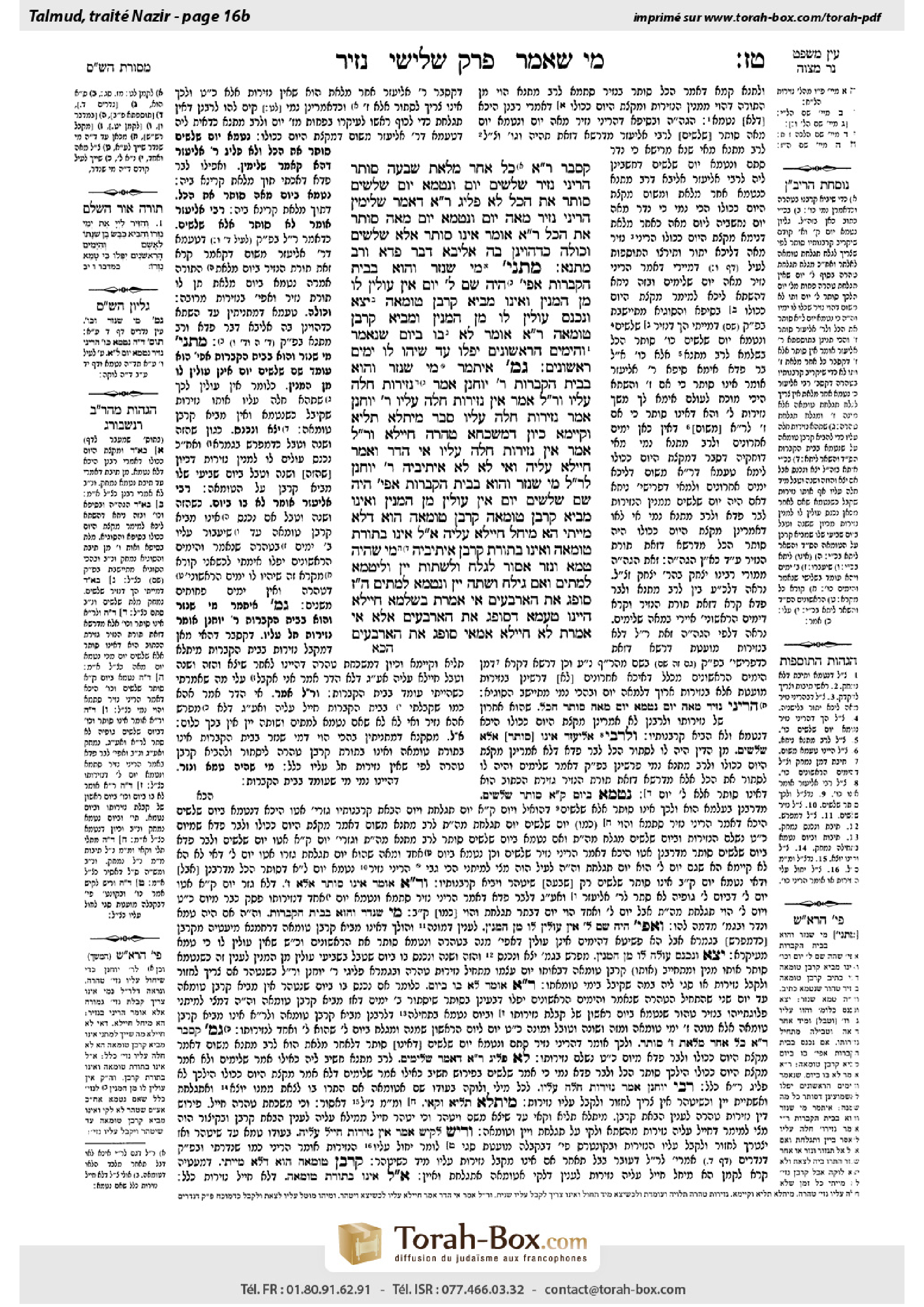
Nazir 16b: Talmud study for Daf Yomi
Daf Yomi is the daily study of one Talmud folio. Explore 37 tractates with scans, Hebrew text, Sefaria English and AI-generated French translations where annotated.
Passage selection and English or AI-generated French translation are available where the scan has annotations. Daf Study is independent of Torah-Box and Sefaria.
Browse Nazir · נזיר · All tractatesNazir 16b text and translations
This page of Nazir includes the Aramaic text, an English translation and an AI-generated French translation, alongside the scan above.
נזיר י״ו ב · Aramaic and Hebrew text
קָסָבַר רַבִּי אֱלִיעֶזֶר: כׇּל אַחַר מְלֹאת שִׁבְעָה — סוֹתֵר. ״הֲרֵינִי נָזִיר שְׁלֹשִׁים יוֹם״, וְנִטְמָא יוֹם שְׁלֹשִׁים — סוֹתֵר אֶת הַכֹּל, לָא פְּלִיג רַבִּי אֱלִיעֶזֶר דְּאָמַר שְׁלֵימִין.
״הֲרֵינִי נָזִיר מֵאָה יוֹם״, וְנִטְמָא יוֹם מֵאָה — סוֹתֵר אֶת הַכֹּל, רַבִּי אֱלִיעֶזֶר אוֹמֵר: אֵינוֹ סוֹתֵר אֶלָּא שְׁלֹשִׁים. וְכוּלָּהּ כְּדַהֲוֵינַן בָּהּ אַלִּיבָּא דְּבַר פַּדָּא וְרַב מַתְנָא.
מַתְנִי׳ מִי שֶׁנָּזַר וְהוּא בְּבֵית הַקְּבָרוֹת, אֲפִילּוּ הָיָה שָׁם שְׁלֹשִׁים יוֹם — אֵין עוֹלִין לוֹ מִן הַמִּנְיָן, וְאֵינוֹ מֵבִיא קׇרְבַּן טוּמְאָה. יָצָא וְנִכְנַס — עוֹלִין לוֹ מִן הַמִּנְיָן, וּמֵבִיא קׇרְבַּן טוּמְאָה.
רַבִּי אֱלִיעֶזֶר אוֹמֵר: לֹא בּוֹ בַיּוֹם, שֶׁנֶּאֱמַר: ״וְהַיָּמִים הָרִאשׁוֹנִים יִפְּלוּ״, עַד שֶׁיְּהוּ לוֹ יָמִים רִאשׁוֹנִים.
גְּמָ׳ אִיתְּמַר, מִי שֶׁנָּזַר וְהוּא בְּבֵית הַקְּבָרוֹת, רַבִּי יוֹחָנָן אָמַר: נְזִירוּת חָלָה עָלָיו, וְרֵישׁ לָקִישׁ אָמַר: אֵין נְזִירוּת חָלָה עָלָיו. רַבִּי יוֹחָנָן אָמַר נְזִירוּת חָלָה עָלָיו, סָבַר: מִיתְּלָא תַּלְיָא וְקָיְימָא, כֵּיוָן דְּמַשְׁכְּחָא טׇהֳרָה, חָיְילָא. וְרֵישׁ לָקִישׁ אָמַר: אֵין נְזִירוּת חָלָה עָלָיו. אִי הָדַר וְאָמַר — חָיְילָא עֲלֵיהּ, וְאִי לָא — לָא.
אֵיתִיבֵיהּ רַבִּי יוֹחָנָן לְרֵישׁ לָקִישׁ: מִי שֶׁנָּזַר וְהוּא בְּבֵית הַקְּבָרוֹת, אֲפִילּוּ הָיָה שָׁם שְׁלֹשִׁים יוֹם — אֵין עוֹלִין מִן הַמִּנְיָן, וְאֵינוֹ מֵבִיא קׇרְבַּן טוּמְאָה. קׇרְבַּן טוּמְאָה הוּא דְּלָא מַיְיתֵי, הָא מֵיחָל — חָיְילָא עֲלֵיהּ! אֲמַר לֵיהּ: אֵינוֹ בְּתוֹרַת טוּמְאָה, וְאֵינוֹ בְּתוֹרַת קׇרְבָּן.
אֵיתִיבֵיהּ: מִי שֶׁהָיָה טָמֵא וְנָזַר, אָסוּר לְגַלֵּחַ וְלִשְׁתּוֹת יַיִן וְלִיטָּמֵא לְמֵתִים. וְאִם גִּילַּח וְשָׁתָה יַיִן וְנִטְמָא לְמֵתִים — הֲרֵי זֶה סוֹפֵג אֶת הָאַרְבָּעִים. אִי אָמְרַתְּ בִּשְׁלָמָא חָיְילָא — הַיְינוּ טַעְמָא דְּסוֹפֵג אֶת הָאַרְבָּעִים, אֶלָּא אִי אָמְרַתְּ לָא חָיְילָא, אַמַּאי סוֹפֵג אֶת הָאַרְבָּעִים?
Nazir 16b · English translation
The Gemara explains: Rabbi Eliezer holds that when anyone becomes ritually impure after the completion of his term of naziriteship, but before he brought his offerings, only seven days are negated, and the thirtieth day is after the completion of his term. The mishna then teaches that one who said: I am hereby a nazirite for thirty days, and became impure on the thirtieth day, it negates the entire tally. Rabbi Eliezer does not disagree in this case, since it is an instance where he explicitly said that he accepts naziriteship on himself for a full thirty days, and his ritual impurity therefore occurs during his naziriteship period.
The mishna also taught that if one said: I am hereby a nazirite for one hundred days, and he became impure on the one hundredth day, it negates the entire tally. Rabbi Eliezer says it negates only thirty. And this entire mishna should be explained as we discussed it, in accordance with the opinions of bar Padda and Rav Mattana earlier (5a–6b).
MISHNA: One who took a vow of naziriteship while in a cemetery, even if he was there for a full thirty days without leaving, those days he spent in the cemetery do not count as part of his tally, since his naziriteship has not yet gone into effect. And he therefore does not bring the three offerings of impurity, brought by a nazirite when rendered ritually impure by contact with a corpse, despite having been in a cemetery. If he left the cemetery and entered it again, those days do count as part of his tally, meaning the naziriteship takes effect, and he does bring the offerings of impurity for reentering the cemetery.
Rabbi Eliezer says: This halakha does not apply to one who entered the cemetery on the very day that he left it, as it is stated with regard to the halakhot of a ritually impure nazirite: “But the first days shall be void” (Numbers 6:12), which indicates that he does not bring the offerings until he will have “first days” of purity, during which he observed his naziriteship.
GEMARA: It was stated that the amora’im disagree with regard to one who vowed to be a nazirite while in a cemetery. Rabbi Yoḥanan said: Naziriteship takes effect for him, and Reish Lakish said: Naziriteship does not take effect for him. The Gemara clarifies their respective opinions: Rabbi Yoḥanan, who said naziriteship takes effect for him, holds that from the moment he accepts naziriteship upon himself it is pending, so that when it is found that he is in a state of ritual purity it takes immediate effect. The vow registers from when he states it, but it cannot take effect in practice as long as he stands in a ritually impure location. And Reish Lakish said that naziriteship does not take effect for him at all. Consequently, if he again said after leaving the cemetery that he accepts a vow of naziriteship, it takes effect for him; but if he does not repeat his vow, he is not a nazirite.
Rabbi Yoḥanan raised an objection to the opinion of Reish Lakish from the mishna: One who took a vow of naziriteship while in a cemetery, even if he was there for a full thirty days without leaving, those days he spent in the cemetery do not count as part of the tally, since his naziriteship has not yet gone into effect. And he therefore does not bring the offerings of impurity despite having been in a cemetery. Rabbi Yoḥanan infers from this: It is the offerings of impurity that he does not bring, but as far as the issue of the naziriteship taking effect, it does take effect for him. Reish Lakish said to him: It means he is not included in the law of prohibited ritual impurity, and therefore he is not included in the law of the offerings. He is not a nazirite at all.
Rabbi Yoḥanan raised an objection to the opinion of Reish Lakish from what was taught in a baraita (Tosefta 2:14): One who was impure and took a vow of naziriteship must still observe the halakhot of a nazirite: He is prohibited from shaving, and from drinking wine, and from becoming impure from a corpse. And if he shaved, or if he drank wine, or if he became impure from a corpse, he incurs [sofeg] the forty lashes administered to one who actively transgresses a negative Torah prohibition. Rabbi Yoḥanan asks: Granted, if you say that naziriteship takes effect despite his ritual impurity, that is the reason that he incurs the forty lashes, similar to any nazirite who transgresses the prohibitions of naziriteship. But if you say the naziriteship does not take effect while he is ritually impure, why does he incur the forty lashes?
Nazir 16b · Traduction française (IA)
La Guemara explique : Rabbi Eliezer estime que lorsqu’une personne devient rituellement impure après l’achèvement de sa période de naziréat, mais avant d’avoir apporté ses sacrifices, seuls sept jours sont annulés, et le trentième jour se situe après l’achèvement de sa période. La Michna enseigne ensuite que celui qui a dit : « Me voici nazir pour trente jours », et qui est devenu impur le trentième jour, voit tout son décompte annulé. Rabbi Eliezer ne conteste pas cette règle dans ce cas, car il s’agit d’une situation où il a explicitement dit qu’il acceptait le naziréat pour une période complète de trente jours ; son impureté rituelle survient donc pendant sa période de naziréat.
La Michna a également enseigné que si quelqu’un a dit : « Me voici nazir pour cent jours », et qu’il est devenu impur le centième jour, tout son décompte est annulé. Rabbi Eliezer dit que seuls trente jours sont annulés. Toute cette Michna doit s’expliquer comme nous l’avons vu, conformément aux avis de bar Padda et de Rav Mattana exposés plus haut (5a–6b).
MICHNA : Celui qui a fait vœu de naziréat alors qu’il se trouvait dans un cimetière, même s’il y est resté trente jours complets sans en sortir, ne compte pas les jours passés dans le cimetière dans son décompte, car son naziréat n’est pas encore entré en vigueur. Il n’apporte donc pas les trois sacrifices d’impureté que le nazir apporte lorsqu’il devient rituellement impur par contact avec un cadavre, bien qu’il se soit trouvé dans un cimetière. S’il est sorti du cimetière puis y est entré de nouveau, ces jours comptent dans son décompte, ce qui signifie que le naziréat entre en vigueur ; il apporte alors les sacrifices d’impureté pour être entré de nouveau dans le cimetière.
Rabbi Eliezer dit : Cette halakha ne s’applique pas à celui qui est entré dans le cimetière le jour même où il en est sorti, comme il est dit au sujet des lois concernant un nazir rituellement impur : « Mais les premiers jours seront annulés » (Nombres 6:12). Cela indique qu’il n’apporte pas les sacrifices avant d’avoir connu des « premiers jours » de pureté, durant lesquels il a observé son naziréat.
GUEMARA : Il a été rapporté que les amoraïm sont en désaccord au sujet de celui qui a fait vœu de naziréat alors qu’il se trouvait dans un cimetière. Rabbi Yoḥanan dit : Le naziréat entre en vigueur pour lui ; Reish Lakish dit : Le naziréat n’entre pas en vigueur pour lui. La Guemara précise leurs avis respectifs : Rabbi Yoḥanan, qui dit que le naziréat entre en vigueur pour lui, estime qu’à partir du moment où il accepte le naziréat, celui-ci reste en suspens, de sorte que, lorsqu’il est établi qu’il se trouve en état de pureté rituelle, le vœu prend immédiatement effet. Le vœu prend effet dès qu’il le prononce, mais ne peut se réaliser tant qu’il se trouve dans un lieu d’impureté rituelle. Reish Lakish dit que le naziréat n’entre pas du tout en vigueur pour lui. Par conséquent, s’il déclare de nouveau, après avoir quitté le cimetière, qu’il accepte un vœu de naziréat, celui-ci entre en vigueur pour lui ; mais s’il ne répète pas son vœu, il n’est pas nazir.
Rabbi Yoḥanan soulève une objection à l’avis de Reish Lakish à partir de la Michna : Celui qui a fait vœu de naziréat alors qu’il se trouvait dans un cimetière, même s’il y est resté trente jours complets sans en sortir, ne compte pas les jours passés dans le cimetière dans son décompte, car son naziréat n’est pas encore entré en vigueur. Il n’apporte donc pas les sacrifices d’impureté, bien qu’il se soit trouvé dans un cimetière. Rabbi Yoḥanan en déduit : Il n’apporte pas les sacrifices d’impureté, mais, pour ce qui est de l’entrée en vigueur du naziréat, celui-ci entre bien en vigueur pour lui. Reish Lakish lui répond : Cela signifie qu’il ne relève pas de la loi interdisant l’impureté rituelle et qu’il ne relève donc pas non plus de la loi relative aux sacrifices. Il n’est pas du tout nazir.
Rabbi Yoḥanan soulève une objection à l’avis de Reish Lakish à partir de ce qui a été enseigné dans une baraïta (Tosefta 2:14) : Celui qui était impur et a fait vœu de naziréat doit néanmoins observer les halakhot du nazir : il lui est interdit de se raser, de boire du vin et de devenir impur au contact d’un cadavre. S’il s’est rasé, a bu du vin ou est devenu impur au contact d’un cadavre, il encourt [sofeg] les quarante coups de fouet administrés à celui qui transgresse activement un interdit négatif de la Torah. Rabbi Yoḥanan demande : Certes, si tu dis que le naziréat entre en vigueur malgré son impureté rituelle, c’est pour cette raison qu’il encourt les quarante coups de fouet, comme tout nazir qui transgresse les interdictions du naziréat. Mais si tu dis que le naziréat n’entre pas en vigueur tant qu’il est rituellement impur, pourquoi encourt-il les quarante coups de fouet ?
Traduction française générée par IA à partir de l’édition anglaise de Sefaria. Vérifie toujours un passage avec le texte source.
Text from Sefaria: William Davidson Edition - Vocalized Aramaic (CC BY NC); William Davidson Edition - English (CC BY NC).