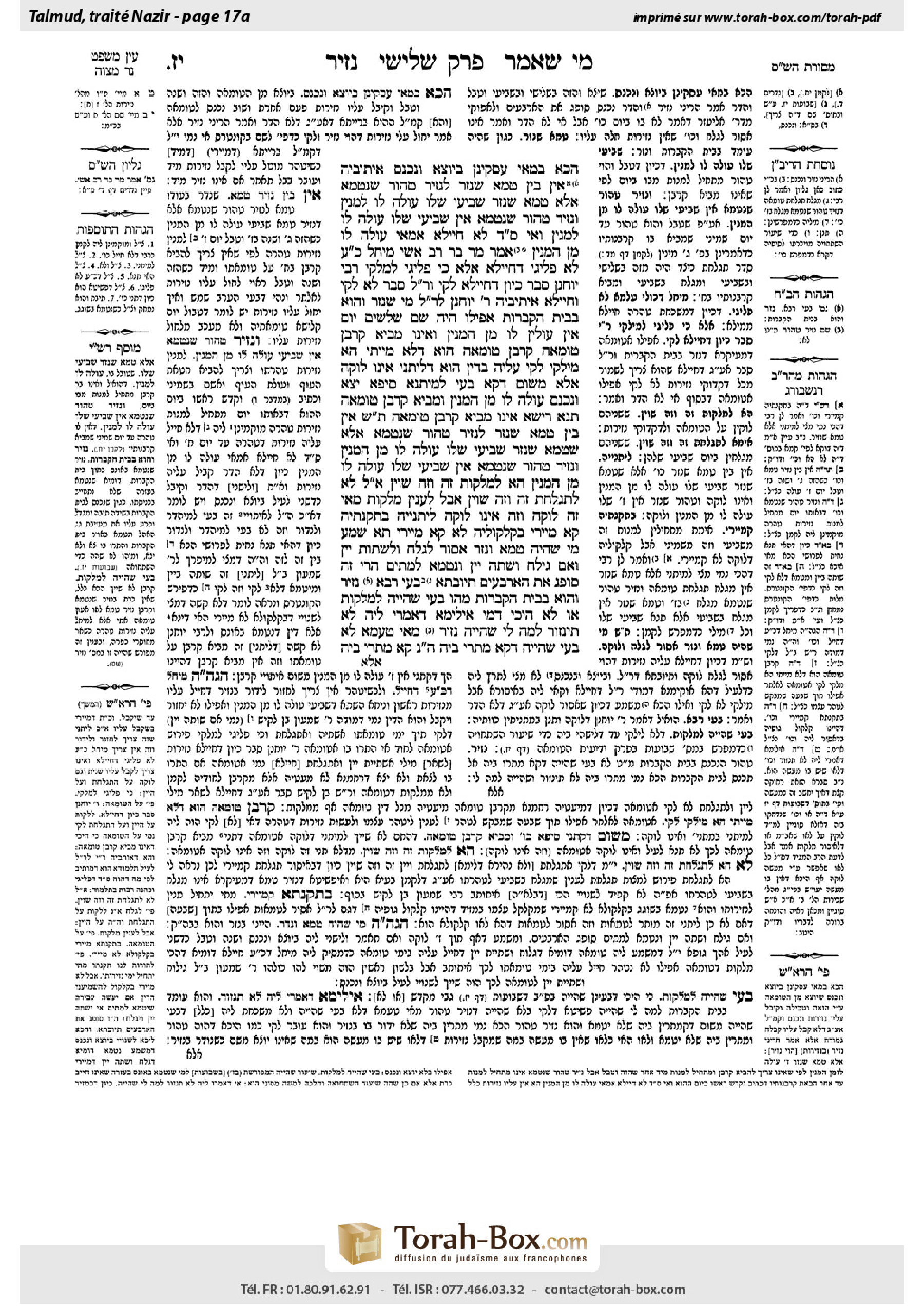
Nazir 17a: Talmud study for Daf Yomi
Daf Yomi is the daily study of one Talmud folio. Explore 37 tractates with scans, Hebrew text, Sefaria English and AI-generated French translations where annotated.
Passage selection and English or AI-generated French translation are available where the scan has annotations. Daf Study is independent of Torah-Box and Sefaria.
Browse Nazir · נזיר · All tractatesNazir 17a text and translations
This page of Nazir includes the Aramaic text, an English translation and an AI-generated French translation, alongside the scan above.
נזיר י״ז א · Aramaic and Hebrew text
הָכָא בְּמַאי עָסְקִינַן — בְּיוֹצֵא וְנִכְנָס.
אֵיתִיבֵיהּ: אֵין בֵּין טָמֵא שֶׁנָּזַר לְנָזִיר טָהוֹר שֶׁנִּטְמָא, אֶלָּא טָמֵא שֶׁנָּזַר — שְׁבִיעִי שֶׁלּוֹ עוֹלֶה לוֹ לַמִּנְיָן, וְנָזִיר טָהוֹר שֶׁנִּטְמָא — אֵין שְׁבִיעִי שֶׁלּוֹ עוֹלֶה לוֹ לַמִּנְיָן. וְאִי סָלְקָא דַעְתָּךְ לָא חָיְילָא, אַמַּאי עוֹלֶה לוֹ מִן הַמִּנְיָן?
אָמַר מָר בַּר רַב אָשֵׁי: מֵיחָל — כּוּלֵּי עָלְמָא לָא פְּלִיגִי דְּחָיְילָא, אֶלָּא כִּי פְּלִיגִי לְמִלְקֵי: רַבִּי יוֹחָנָן סָבַר: כֵּיוָן דְּחָיְילָא — לָקֵי. וְרֵישׁ לָקִישׁ סָבַר: לָא לָקֵי, וְחָיְילָא.
אֵיתִיבֵיהּ רַבִּי יוֹחָנָן לְרֵישׁ לָקִישׁ: מִי שֶׁנָּזַר וְהוּא בְּבֵית הַקְּבָרוֹת, אֲפִילּוּ הָיָה שָׁם שְׁלֹשִׁים יוֹם — אֵין עוֹלִין לוֹ מִן הַמִּנְיָן, וְאֵינוֹ מֵבִיא קׇרְבַּן טוּמְאָה. קׇרְבַּן טוּמְאָה הוּא דְּלָא מַיְיתֵי, הָא מִילְקֵי, לָקֵי עֲלֵיהּ!
בְּדִין הוּא דְּלִיתְנֵי ״אֵינוֹ לוֹקֶה״, אֶלָּא מִשּׁוּם דְּקָא בָּעֵי לְמִיתְנֵא סֵיפָא ״יָצָא וְנִכְנַס — עוֹלֶה לוֹ מִן הַמִּנְיָן, וּמֵבִיא קׇרְבַּן טוּמְאָה״, תְּנָא רֵישָׁא ״אֵינוֹ מֵבִיא קׇרְבַּן טוּמְאָה״.
תָּא שְׁמַע: אֵין בֵּין טָמֵא שֶׁנָּזַר לְנָזִיר טָהוֹר שֶׁנִּטְמָא, אֶלָּא שֶׁטָּמֵא שֶׁנָּזַר — שְׁבִיעִי שֶׁלּוֹ עוֹלֶה לוֹ מִן הַמִּנְיָן, וְנָזִיר טָהוֹר שֶׁנִּטְמָא — אֵין שְׁבִיעִי שֶׁלּוֹ עוֹלֶה לוֹ מִן הַמִּנְיָן. הָא לְמַלְקוּת — זֶה וָזֶה שָׁוִין! אֲמַר לֵיהּ: לָא, לְתִגְלַחַת זֶה וָזֶה שָׁוִין.
אֲבָל לְעִנְיַן מַלְקוֹת מַאי — זֶה לוֹקֶה וְזֶה אֵינוֹ לוֹקֶה? לִיתְנְיֵיהּ! בְּתַקַּנְתֵּיהּ קָא מַיְירֵי, בְּקִלְקוּלֵיהּ לָא קָא מַיְירֵי.
תָּא שְׁמַע: מִי שֶׁהָיָה טָמֵא וְנָזַר — אָסוּר לְגַלֵּחַ וְלִשְׁתּוֹת יַיִן, וְאִם גִּילַּח וְשָׁתָה יַיִן וְנִטְמָא לְמֵתִים — הֲרֵי זֶה סוֹפֵג אֶת הָאַרְבָּעִים! תְּיוּבְתָּא.
בָּעֵי רָבָא: נָזִיר וְהוּא בְּבֵית הַקְּבָרוֹת, מַהוּ? בָּעֵי שְׁהִיָּיה לְמַלְקוּת, אוֹ לָא?
הֵיכִי דָמֵי? אִילֵּימָא דְּאָמְרִי לֵיהּ ״לָא תִּינְזוֹר״, לְמָה לִי שְׁהִיָּיה? נָזִיר מַאי טַעְמָא לָא בָּעֵי שְׁהִיָּיה — דְּקָא מַתְרִי בֵּיהּ. הָכָא נָמֵי קָא מַתְרִי בֵּיהּ!
Nazir 17a · English translation
Reish Lakish responded: With what are we dealing here in this baraita? With one who left and entered, meaning that after having left the cemetery and purifying himself, he then vowed again to be a nazirite and subsequently reentered the cemetery.
Rabbi Yoḥanan raised another objection to Reish Lakish’s opinion from a different source: The difference between a ritually impure person who took a vow of naziriteship and a ritually pure nazirite who became impure is only the following halakha: If a ritually impure person took a vow of naziriteship, his seventh day of purification counts as part of his tally of his term of naziriteship, since he starts counting his term of naziriteship as soon as he becomes pure. But with regard to a ritually pure nazirite who became impure, his seventh day of purification does not count as part of his tally. Rather, he starts counting his days of naziriteship from the following day, which is the day on which he brings his offerings. And if it enters your mind that a vow of naziriteship stated while ritually impure does not take effect, why does the baraita state that the seventh day counts as part of his tally, indicating that the naziriteship takes effect without a need for him to restate his vow?
As a result of this question, the Gemara offers a different interpretation of their dispute. Mar bar Rav Ashi said: The dispute between Rabbi Yoḥanan and Reish Lakish is not as stated above. With regard to the question of the vow of naziriteship taking effect, everyone agrees that it takes effect from the moment of his acceptance of naziriteship, even if he was in the cemetery. Rather, when they disagree it is with regard to being flogged, as follows: Rabbi Yoḥanan holds that since the vow takes effect, he is therefore flogged for becoming impure, and Reish Lakish holds that he is not flogged for becoming impure, but the vow does take effect with regard to the prohibitions of naziriteship.
According to this version of the dispute as well, Rabbi Yoḥanan raised an objection to Reish Lakish from the mishna, which states: One who took a vow of naziriteship while in a cemetery, even if he was there for a full thirty days without leaving, those days he spent in the cemetery do not count as part of his tally, since his naziriteship has not yet gone into effect. And he therefore does not bring the offerings of impurity, despite having been in a cemetery. Rabbi Yoḥanan infers from this: It is the offerings of impurity that he does not bring, but he is flogged for contracting impurity, which is not in accordance with the opinion of Reish Lakish.
The Gemara answers: This inference is not correct, as by right the mishna should teach: He is not flogged, but due to the fact that the tanna wants to teach the latter clause of the mishna, which states: If he left the cemetery and entered it again, those days do count as part of his tally, meaning the naziriteship takes effect, and he does bring the offerings of impurity for reentering the cemetery, the tanna therefore taught a similar phrasing in the first clause of the mishna: He does not bring the offerings of impurity, so this should not be seen as an indication that he is not flogged.
The Gemara suggests another proof in support of Rabbi Yoḥanan’s opinion. Come and hear a proof from another baraita: The difference between an impure person who took a vow of naziriteship and a pure nazirite who became impure is only the following halakha: That in the case of an impure person who took a vow of naziriteship, his seventh day of purification counts as part of his tally of the term of naziriteship. But in the case of a pure nazirite who became impure, his seventh day of purification does not count as part of his tally. The Gemara infers: But with regard to flogging, this nazirite and that nazirite are equal. Reish Lakish said to Rabbi Yoḥanan: This is not a correct inference; rather, it is with regard to shaving on the seventh day of purification that this nazirite and that nazirite are equal, since even a ritually impure person who took a vow of naziriteship must shave on that day.
The Gemara asks: But in that case, according to Reish Lakish, what is the halakha with regard to flogging? This nazirite is flogged, and that nazirite, who was ritually impure when he vowed, is not flogged? If so, let him teach this difference as well; why does the baraita state that there is only one difference between them? The Gemara answers: This baraita is speaking of his remedy; it is not speaking of a matter that is detrimental to him. Consequently the baraita does not discuss a nazirite’s punishments and discusses only the means by which he can resume his observance of naziriteship.
The Gemara further suggests: Come and hear a proof from that which is taught in a baraita (Tosefta 2:14): One who was ritually impure and took a vow of naziriteship must still observe the halakhot of a nazirite. He is prohibited from shaving and from drinking wine. And if he shaved, or if he drank wine, or if he became ritually impure from a corpse, he incurs the forty lashes administered to one who actively transgresses a negative Torah prohibition. The Gemara concludes: This is a conclusive refutation of the opinion of Reish Lakish, as explained by Mar bar Rav Ashi.
§ After concluding that one who takes a vow of naziriteship while in a cemetery is liable to receive lashes, Rava asks: What is the halakha if one took a vow to be a nazirite while standing in a cemetery: Is it necessary that his exit from the cemetery be delayed for a specific period of time for him to become liable to receive lashes, just as one who becomes ritually impure while in the Temple receives lashes only if he remains there for a specific period of time, or is it not necessary?
The Gemara clarifies: What are the circumstances in which this question is relevant? If we say that they said to him in warning: Do not take a vow of naziriteship in the cemetery, and he ignored their warning and took a vow of naziriteship, why do I need him to delay his exit? What is the reason that one who was already a nazirite when he entered a cemetery does not need to delay his exit in order to be liable to receive lashes? Because they warn him not to enter, and if he enters he has transgressed a prohibition and is flogged. Here too, they warn him not to take the vow, and he should therefore be liable to receive lashes if he does take the vow.
Nazir 17a · Traduction française (IA)
Reish Lakish répondit : De quoi s’agit-il dans cette baraïta ? D’un homme qui est sorti puis est entré, c’est-à-dire qu’après avoir quitté le cimetière et s’être purifié, il a de nouveau fait vœu de naziréat, puis est retourné au cimetière.
Rabbi Yoḥanan souleva une autre objection contre l’opinion de Reish Lakish à partir d’une autre source : La seule différence entre une personne rituellement impure qui a fait vœu de naziréat et un naziréen rituellement pur devenu impur concerne la halakha suivante : si une personne rituellement impure a fait vœu de naziréat, son septième jour de purification compte dans le décompte de la durée de son naziréat, puisqu’elle commence à compter cette durée dès qu’elle devient pure. En revanche, pour un naziréen rituellement pur devenu impur, son septième jour de purification ne compte pas dans le décompte. Il commence plutôt à compter les jours de son naziréat le lendemain, jour où il apporte ses offrandes. Or, si l’on devait penser qu’un vœu de naziréat prononcé alors qu’on est rituellement impur ne prend pas effet, pourquoi la baraïta dit-elle que le septième jour compte dans le décompte, indiquant ainsi que le naziréat prend effet sans qu’il soit nécessaire de répéter le vœu ?
À la suite de cette question, la Guemara propose une autre interprétation de leur controverse. Mar bar Rav Ashi dit : Le désaccord entre Rabbi Yoḥanan et Reish Lakish ne se présente pas comme indiqué précédemment. Quant à savoir si le vœu de naziréat prend effet, tous s’accordent qu’il prend effet dès l’instant où l’homme accepte le naziréat, même s’il se trouvait au cimetière. Leur désaccord porte plutôt sur la question des flagellations : Rabbi Yoḥanan estime que, puisque le vœu prend effet, il est donc flagellé s’il devient impur ; Reish Lakish estime qu’il n’est pas flagellé pour être devenu impur, mais que le vœu prend effet en ce qui concerne les interdits du naziréat.
Selon cette version également, Rabbi Yoḥanan souleva une objection contre Reish Lakish à partir de la Michna, qui enseigne : Celui qui a fait vœu de naziréat alors qu’il se trouvait dans un cimetière, même s’il y est resté trente jours entiers sans en sortir, ne compte pas les jours passés au cimetière dans le décompte de la durée de son naziréat, puisque celui-ci n’a pas encore pris effet. Il n’apporte donc pas les offrandes d’impureté, bien qu’il se soit trouvé dans un cimetière. Rabbi Yoḥanan en déduit : Ce sont les offrandes d’impureté qu’il n’apporte pas, mais il est flagellé pour avoir contracté l’impureté, ce qui est contraire à l’opinion de Reish Lakish.
La Guemara répond : Cette déduction n’est pas correcte, car la Michna aurait dû enseigner à juste titre : « Il n’est pas flagellé ». Mais comme le tanna veut enseigner la dernière partie de la Michna, qui dit : « S’il a quitté le cimetière puis y est entré de nouveau, ces jours comptent dans son décompte », c’est-à-dire que le naziréat prend effet et qu’il apporte bien les offrandes d’impureté pour être retourné au cimetière, le tanna a donc employé une formulation similaire dans la première partie de la Michna : « Il n’apporte pas les offrandes d’impureté ». Il ne faut donc pas y voir l’indication qu’il n’est pas flagellé.
La Guemara propose une autre preuve à l’appui de l’opinion de Rabbi Yoḥanan. Viens et entends une preuve tirée d’une autre baraïta : La seule différence entre une personne impure qui a fait vœu de naziréat et un naziréen pur devenu impur concerne la halakha suivante : dans le cas d’une personne impure qui a fait vœu de naziréat, son septième jour de purification compte dans le décompte de la durée de son naziréat ; mais dans le cas d’un naziréen pur devenu impur, son septième jour de purification ne compte pas dans son décompte. La Guemara en déduit : Mais, en ce qui concerne les flagellations, les deux naziréens sont égaux. Reish Lakish dit à Rabbi Yoḥanan : Cette déduction n’est pas correcte ; c’est plutôt pour ce qui est de se raser le septième jour de purification que les deux naziréens sont égaux, puisque même une personne rituellement impure qui a fait vœu de naziréat doit se raser ce jour-là.
La Guemara demande : Mais alors, selon Reish Lakish, quelle est la halakha concernant les flagellations ? Ce naziréen est flagellé, tandis que cet autre naziréen, qui était rituellement impur au moment où il a fait vœu, ne l’est pas ? Si c’est le cas, que la baraïta enseigne aussi cette différence ; pourquoi dit-elle qu’il n’y a qu’une seule différence entre eux ? La Guemara répond : Cette baraïta parle de la manière de remédier à sa situation ; elle ne traite pas d’un élément qui lui porte préjudice. Par conséquent, la baraïta ne parle pas des sanctions encourues par un naziréen et ne traite que des moyens par lesquels il peut reprendre l’observance du naziréat.
La Guemara poursuit : Viens et entends une preuve de ce qui est enseigné dans une baraïta (Tosefta 2:14) : Celui qui était rituellement impur et a fait vœu de naziréat doit néanmoins observer les halakhot du naziréat. Il lui est interdit de se raser et de boire du vin. S’il s’est rasé, s’il a bu du vin ou s’il est devenu rituellement impur au contact d’un cadavre, il encourt les quarante coups de fouet infligés à celui qui transgresse activement un interdit de la Torah. La Guemara conclut : C’est une réfutation décisive de l’opinion de Reish Lakish, telle que Mar bar Rav Ashi l’a exposée.
§ Après avoir conclu que celui qui fait vœu de naziréat alors qu’il se trouve dans un cimetière est passible de flagellation, Rava demande : Quelle est la halakha si quelqu’un a fait vœu de devenir naziréen alors qu’il se tenait dans un cimetière ? Doit-il nécessairement retarder sa sortie du cimetière pendant un certain laps de temps pour être passible de flagellation, comme celui qui devient rituellement impur dans le Temple n’est flagellé que s’il y reste pendant un certain laps de temps, ou cela n’est-il pas nécessaire ?
La Guemara précise : Dans quelles circonstances cette question se pose-t-elle ? Si l’on suppose qu’on l’a averti en lui disant : « Ne fais pas vœu de naziréat dans le cimetière », et qu’il a ignoré l’avertissement et fait vœu de naziréat, pourquoi faudrait-il qu’il retarde sa sortie ? Pour quelle raison celui qui était déjà naziréen lorsqu’il est entré dans un cimetière n’a-t-il pas besoin de retarder sa sortie pour être passible de flagellation ? Parce qu’on l’avertit de ne pas entrer et que, s’il entre, il transgresse un interdit et est flagellé. Ici aussi, on l’avertit de ne pas faire le vœu ; il devrait donc être passible de flagellation s’il le fait.
Traduction française générée par IA à partir de l’édition anglaise de Sefaria. Vérifie toujours un passage avec le texte source.
Text from Sefaria: William Davidson Edition - Vocalized Aramaic (CC BY NC); William Davidson Edition - English (CC BY NC).