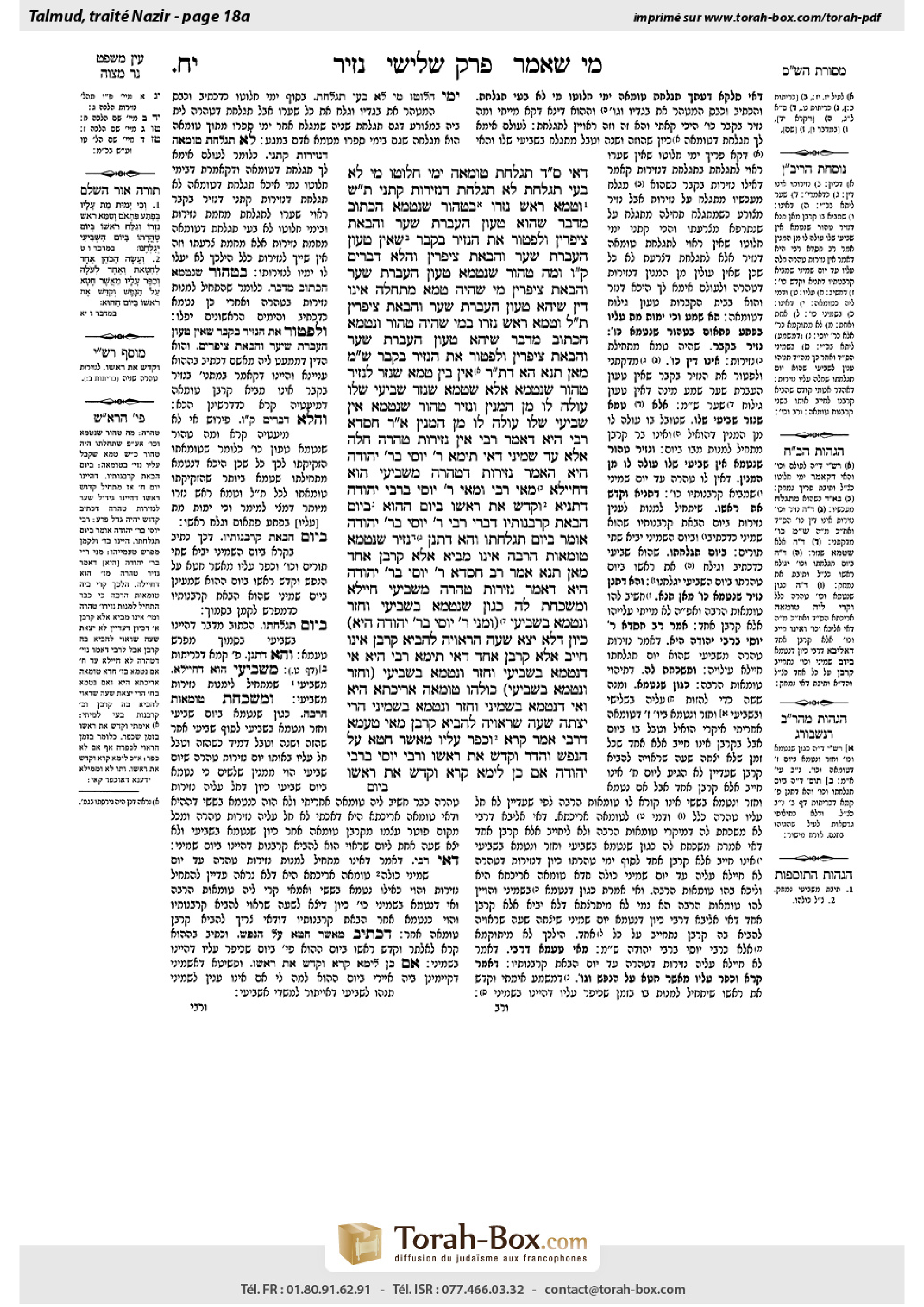
Nazir 18a: Talmud study for Daf Yomi
Daf Yomi is the daily study of one Talmud folio. Explore 37 tractates with scans, Hebrew text, Sefaria English and AI-generated French translations where annotated.
Passage selection and English or AI-generated French translation are available where the scan has annotations. Daf Study is independent of Torah-Box and Sefaria.
Browse Nazir · נזיר · All tractatesNazir 18a text and translations
This page of Nazir includes the Aramaic text, an English translation and an AI-generated French translation, alongside the scan above.
נזיר י״ח א · Aramaic and Hebrew text
דְּאִי סָלְקָא דַעְתָּךְ תִּגְלַחַת טוּמְאָה, יְמֵי חִלּוּטוֹ מִי לָא בָּעֵי תִּגְלַחַת? לָא, תִּגְלַחַת דִּנְזִירוּת קָתָנֵי.
תָּא שְׁמַע: ״וְטִמֵּא רֹאשׁ נִזְרוֹ״, בְּטָהוֹר שֶׁנִּטְמָא הַכָּתוּב מְדַבֵּר, שֶׁהוּא טָעוּן הַעֲבָרַת שֵׂעָר וַהֲבָאַת צִיפֳּרִין. וְלִפְטוֹר אֶת הַנָּזִיר בְּקֶבֶר — שֶׁאֵין טָעוּן הַעֲבָרַת שֵׂעָר וַהֲבָאַת צִיפֳּרִין.
וַהֲלֹא דְּבָרִים קַל וָחוֹמֶר: וּמָה טָהוֹר שֶׁנִּטְמָא — טָעוּן הַעֲבָרַת שֵׂעָר וַהֲבָאַת צִיפֳּרִין, מִי שֶׁהָיָה טָמֵא מִתְּחִלָּה — אֵינוֹ דִּין שֶׁיְּהֵא טָעוּן הַעֲבָרַת שֵׂעָר וַהֲבָאַת צִיפֳּרִין?
תַּלְמוּד לוֹמַר: ״וְטִמֵּא רֹאשׁ נִזְרוֹ״, בְּמִי שֶׁהָיָה טָהוֹר וְנִטְמָא הַכָּתוּב מְדַבֵּר, שֶׁיְּהֵא טָעוּן הַעֲבָרַת שֵׂעָר וַהֲבָאַת צִיפֳּרִין, וְלִפְטוֹר אֶת הַנָּזִיר בְּקֶבֶר. שְׁמַע מִינַּהּ.
מַאן תְּנָא הָא דְּתָנוּ רַבָּנַן: אֵין בֵּין טָמֵא שֶׁנָּזַר לְנָזִיר טָהוֹר שֶׁנִּטְמָא, אֶלָּא שֶׁטָּמֵא שֶׁנָּזַר — שְׁבִיעִי שֶׁלּוֹ עוֹלֶה לוֹ מִן הַמִּנְיָן, וְנָזִיר טָהוֹר שֶׁנִּטְמָא — אֵין שְׁבִיעִי שֶׁלּוֹ עוֹלֶה לוֹ מִן הַמִּנְיָן?
אָמַר רַב חִסְדָּא: רַבִּי הִיא, דְּאָמַר רַבִּי: אֵין נְזִירוּת טׇהֳרָה חָלָה אֶלָּא עַד שְׁמִינִי. דְּאִי תֵּימָא רַבִּי יוֹסֵי בְּרַבִּי יְהוּדָה הִיא, הָאָמַר נְזִירוּת דְּטׇהֳרָה מִשְּׁבִיעִי הוּא דְּחָיְילָא.
מַאי רַבִּי וּמַאי רַבִּי יוֹסֵי בְּרַבִּי יְהוּדָה — דְּתַנְיָא: ״וְקִדַּשׁ אֶת רֹאשׁוֹ בַּיּוֹם הַהוּא״ — בְּיוֹם הֲבָאַת קׇרְבְּנוֹתָיו, דִּבְרֵי רַבִּי. רַבִּי יוֹסֵי בְּרַבִּי יְהוּדָה אוֹמֵר: בְּיוֹם תִּגְלַחְתּוֹ.
וְהָא דִּתְנַן: נָזִיר שֶׁנִּטְמָא טוּמְאוֹת הַרְבֵּה — אֵינוֹ מֵבִיא אֶלָּא קׇרְבָּן אֶחָד, מַאן תַּנָּא? אָמַר רַב חִסְדָּא: רַבִּי יוֹסֵי בְּרַבִּי יְהוּדָה הִיא, דְּאָמַר: נְזִירוּת טׇהֳרָה מִשְּׁבִיעִי חָיְילָא. וּמַשְׁכַּחַתְּ לַהּ כְּגוֹן שֶׁנִּטְמָא בַּשְּׁבִיעִי, וְחָזַר וְנִטְמָא בַּשְּׁבִיעִי. (וּמַנִּי, רַבִּי יוֹסֵי בְּרַבִּי יְהוּדָה הִיא) כֵּיוָן דְּלֹא יָצָא שָׁעָה הָרְאוּיָה לְהָבִיא קׇרְבָּן — אֵינוֹ חַיָּיב אֶלָּא קׇרְבָּן אֶחָד.
דְּאִי תֵּימָא רַבִּי הִיא, אִי דְּנִטְמָא בַּשְּׁבִיעִי, וְחָזַר וְנִטְמָא בַּשְּׁבִיעִי (וְחָזַר וְנִטְמָא בַּשְּׁבִיעִי) — כּוּלְּהוּ טוּמְאָה אֲרִיכְתָּא הִיא. וְאִי דְּנִטְמָא בַּשְּׁמִינִי, וְחָזַר וְנִטְמָא בַּשְּׁמִינִי — הֲרֵי יָצְתָה שָׁעָה שֶׁרְאוּיָה לְהָבִיא קׇרְבָּן.
מַאי טַעְמָא דְּרַבִּי? אָמַר קְרָא ״וְכִפֶּר עָלָיו מֵאֲשֶׁר חָטָא עַל הַנָּפֶשׁ״, וַהֲדַר ״וְקִדַּשׁ אֶת רֹאשׁוֹ״. וְרַבִּי יוֹסֵי בְּרַבִּי יְהוּדָה: אִם כֵּן — לֵימָא קְרָא: ״וְקִדַּשׁ אֶת רֹאשׁוֹ״.
Nazir 18a · English translation
as if it enters your mind to say that the baraita is discussing the shaving done as a result of the nazirite’s impurity, and contrasts a nazirite with a leper, do the end of a leper’s days of confirmed leprosy not require shaving? A leper must shave when he is purified from his condition, so how can he be described as unfit for shaving? Rather, the baraita must be referring to the nazirite’s shaving of purity, as suggested above (17b). The Gemara rejects this: No, it could be that the baraita is discussing the shaving done as a result of the nazirite’s impurity, and when it states that a leper is unfit for shaving, the baraita is teaching about the shaving of naziriteship, and the baraita is stating that a leper is unfit for any shaving of a nazirite, since he must first shave for his leprosy.
The Gemara suggests another proof to answer the question of whether one who vows naziriteship while in a cemetery must shave upon undergoing purification. Come and hear a baraita: The verse states: “And he defiles his consecrated head, he shall shave his head on the day of his purification, on the seventh day shall he shave it” (Numbers 6:9). The baraita explains: The verse is speaking of a ritually pure nazirite who became impure, who requires hair removal and the bringing of birds as offerings. And this verse comes to exempt a nazirite who vowed while in the grave, i.e., a cemetery, that he does not require hair removal and the bringing of birds.
The baraita continues its analysis of this halakha. For one might have explained differently: And are these matters, the ruling that such a nazirite is exempt, not inferred with an a fortiori inference to reach the opposite conclusion: Just as a nazirite who was pure from the outset and who subsequently became impure requires hair removal and the bringing of birds, if one was impure from the outset, as he took a vow of naziriteship while in a cemetery, is it not logical that he should require hair removal and the bringing of birds?
Therefore the verse states: “And he defiles his consecrated head,” indicating that the verse speaks only of one who was a pure nazirite and later became impure, and that only he requires hair removal and the bringing of birds. And the verse serves to exempt the nazirite who vowed while in a place of a grave, who was ritually impure from the outset. The Gemara concludes: Learn from this that a nazirite who was ritually impure from the outset does not have to shave; this answers the question of Rav Ashi.
§ After resolving the question, the Gemara discusses additional halakhot involving a ritually impure person who took a vow of naziriteship. Who is the tanna who taught this baraita that the Sages taught in the previous discussion: The difference between an impure person who took a vow of naziriteship and a pure nazirite who became ritually impure is only the following halakha: That with regard to an impure person who took a vow of naziriteship, his seventh day of purification counts as part of his tally of the term of naziriteship. But with regard to a pure nazirite who became impure, his seventh day of purification does not count as part of his tally.
Rav Ḥisda said: It is the opinion of Rabbi Yehuda HaNasi, as Rabbi Yehuda HaNasi said: Naziriteship of purity takes effect only from the eighth day. When a nazirite becomes impure during his term, he begins to count his term of observing naziriteship in purity only on the day following his purification. For if you say it follows the opinion of Rabbi Yosei, son of Rabbi Yehuda, didn’t he say that the naziriteship of purity takes effect from the seventh day of his purification process?
The Gemara clarifies: What is the statement of Rabbi Yehuda HaNasi, and what is the statement of Rabbi Yosei, son of Rabbi Yehuda, that Rav Ḥisda referred to? As it is taught in a baraita: The verse states with regard to a ritually impure nazirite who underwent the purification rite: “And he shall sanctify his head on that day” (Numbers 6:11). This means that he renews the sanctity of his hair growth, i.e., begins observing his naziriteship in purity, on the day of the bringing of his offerings, the eighth day of his purification. This is the statement of Rabbi Yehuda HaNasi. Rabbi Yosei, son of Rabbi Yehuda, says: This means that he renews the sanctity of his hair growth on the day of his shaving, the seventh day of his purification.
§ The Gemara cites a related halakha: And that which we learned in a mishna (Karetot 9a): If a nazirite became impure by contracting many consecutive impurities, he brings only one set of offerings. Who taught that? Rav Ḥisda said: It is Rabbi Yosei, son of Rabbi Yehuda, who said the naziriteship of purity takes effect from the seventh day of his purification process. And you find this, that he contracts ritual impurity several times consecutively, in a case where he became ritually impure on the seventh day and, after undergoing the purification process, again became ritually impure on the seventh day. And whose opinion is it? It is that of Rabbi Yosei, son of Rabbi Yehuda. Since the appropriate time to bring an offering had not yet arrived, as all agree that his offerings are only brought on the eighth day, if he became ritually impure a second time he is obligated to bring only one set of offerings.
For if you say it follows the opinion of Rabbi Yehuda HaNasi, how can this mishna be explained? If it deals with a nazirite who became ritually impure on the seventh day, and, after undergoing the purification process, again became ritually impure on the seventh day, and, after undergoing the purification process, again became ritually impure on the seventh day, Rabbi Yehuda HaNasi would hold that all these impurities are in fact one long ritual impurity, because he never reached the eighth day, which would renew his observance of naziriteship in ritual purity, so the mishna would not refer to this as a case of multiple impurities. And if the mishna is referring to a nazirite who became ritually impure on the eighth day and, after undergoing the purification process, again became ritually impure on the eighth day, the appropriate time to bring an offering had already arrived, and if he becomes ritually impure at that stage, it is not viewed as a continuation of the previous ritual impurity, and he is obligated to bring another set of offerings.
The Gemara clarifies the dispute between Rabbi Yehuda HaNasi and Rabbi Yosei, son of Rabbi Yehuda: What is the reason for Rabbi Yehuda HaNasi’s ruling that he begins counting only from the eighth day? The Gemara answers: The verse states: “And the priest shall prepare one for a sin-offering, and the other for a burnt-offering, and make atonement for him, for he sinned by the soul” (Numbers 6:11), and the same verse again states immediately afterward: “And he shall sanctify his head.” This shows that the naziriteship of purity commences only after he has brought his offerings. And Rabbi Yosei, son of Rabbi Yehuda, says in response: If so, if the verse intended to teach us that his naziriteship starts only on the eighth day, let the verse merely state: “And he shall sanctify his head,” since that phrase addresses the bringing of his offerings, which is on the eighth.
Nazir 18a · Traduction française (IA)
Si tu envisages que la baraïta parle du rasage effectué à la suite de l’impureté du nazir et qu’elle oppose un nazir à un lépreux, la fin de la période pendant laquelle le lépreux est atteint de lèpre n’exige-t-elle pas un rasage ? Un lépreux doit se raser lorsqu’il est purifié de son état ; comment peut-on donc le décrire comme inapte au rasage ? La baraïta doit plutôt parler du rasage de purification du nazir, comme suggéré plus haut (17b). La Guemara rejette cette explication : non, il se peut que la baraïta parle du rasage effectué à la suite de l’impureté du nazir. Lorsqu’elle affirme qu’un lépreux est inapte au rasage, elle enseigne une règle concernant le rasage lié au naziréat : un lépreux ne peut effectuer aucun rasage lié au naziréat, puisqu’il doit d’abord se raser à cause de sa lèpre.
La Guemara propose une autre preuve pour répondre à la question de savoir si celui qui fait vœu de naziréat alors qu’il se trouve dans un cimetière doit se raser lorsqu’il est purifié. Viens et entends une baraïta : le verset dit : « Il profane sa tête consacrée ; il se rasera la tête le jour de sa purification, le septième jour il la rasera » (Nombres 6, 9). La baraïta explique que le verset parle d’un nazir rituellement pur devenu impur, qui doit se raser et apporter des oiseaux en sacrifice. Ce verset vient exclure le nazir qui a fait vœu alors qu’il se trouvait dans la tombe, c’est-à-dire dans un cimetière : il n’a pas à se raser ni à apporter des oiseaux.
La baraïta poursuit l’analyse de cette halakha. On aurait pu donner une autre explication : la règle selon laquelle un tel nazir est dispensé ne se déduit-elle pas, au contraire, par un raisonnement a fortiori ? De même qu’un nazir qui était pur au départ et qui est ensuite devenu impur doit se raser et apporter des oiseaux, n’est-il pas logique que celui qui était impur dès le départ, puisqu’il a fait vœu de naziréat dans un cimetière, doive lui aussi se raser et apporter des oiseaux ?
Le verset dit donc : « Il profane sa tête consacrée », ce qui indique qu’il ne parle que de celui qui était un nazir pur et qui est devenu impur par la suite : lui seul doit se raser et apporter des oiseaux. Le verset sert à exempter le nazir qui a fait vœu alors qu’il se trouvait en un lieu où il y avait une tombe et qui était donc rituellement impur dès le départ. La Guemara conclut : déduis-en qu’un nazir qui était rituellement impur dès le départ n’a pas à se raser. Cela répond à la question de Rav Ashi.
§ Après avoir résolu la question, la Guemara examine d’autres halakhot concernant une personne rituellement impure qui a fait vœu de naziréat. Qui est le tanna de cette baraïta, enseignée par les Sages dans la discussion précédente : « La seule différence entre une personne impure qui a fait vœu de naziréat et un nazir pur devenu rituellement impur concerne la halakha suivante : pour la personne impure qui a fait vœu de naziréat, le septième jour de sa purification compte dans le décompte de la durée de son naziréat ; en revanche, pour un nazir pur devenu impur, le septième jour de sa purification ne compte pas dans ce décompte » ?
Rav Ḥisda dit : c’est l’opinion de Rabbi Yehouda HaNassi, car Rabbi Yehouda HaNassi dit que le naziréat de pureté ne prend effet qu’à partir du huitième jour. Lorsqu’un nazir devient impur pendant la durée de son naziréat, il ne commence à compter la période d’observance du naziréat en pureté que le lendemain de sa purification. Car si tu dis que cela suit l’opinion de Rabbi Yossei, fils de Rabbi Yehouda, n’a-t-il pas dit que le naziréat de pureté prend effet dès le septième jour de son processus de purification ?
La Guemara précise : quelle est la déclaration de Rabbi Yehouda HaNassi, et quelle est celle de Rabbi Yossei, fils de Rabbi Yehouda, auxquelles Rav Ḥisda fait référence ? Comme il est enseigné dans une baraïta : à propos d’un nazir rituellement impur qui a accompli le rite de purification, le verset dit : « Il consacrera sa tête ce jour-là » (Nombres 6, 11). Cela signifie qu’il renouvelle la sainteté de sa pousse de cheveux, c’est-à-dire qu’il commence à observer son naziréat en pureté, le jour où il apporte ses offrandes, soit le huitième jour de sa purification. Telle est l’opinion de Rabbi Yehouda HaNassi. Rabbi Yossei, fils de Rabbi Yehouda, dit : cela signifie qu’il renouvelle la sainteté de sa pousse de cheveux le jour de son rasage, soit le septième jour de sa purification.
§ La Guemara cite une halakha apparentée : qui enseigne la règle apprise dans une Michna (Karetot 9a) : si un nazir devient impur à la suite de plusieurs épisodes d’impureté successifs, il n’apporte qu’un seul ensemble d’offrandes ? Rav Ḥisda dit : c’est Rabbi Yossei, fils de Rabbi Yehouda, qui a dit que le naziréat de pureté prend effet dès le septième jour du processus de purification. Ce cas d’épisodes d’impureté rituelle successifs se présente lorsqu’il est devenu rituellement impur le septième jour puis, après avoir accompli le processus de purification, est de nouveau devenu rituellement impur le septième jour. De quelle opinion s’agit-il ? De celle de Rabbi Yossei, fils de Rabbi Yehouda. Puisque le moment prévu pour apporter une offrande n’était pas encore arrivé — car tous conviennent que ses offrandes ne sont apportées que le huitième jour —, s’il est devenu rituellement impur une seconde fois, il n’est tenu d’apporter qu’un seul ensemble d’offrandes.
Car si tu dis que cela suit l’opinion de Rabbi Yehouda HaNassi, comment expliquer cette Michna ? Si elle parle d’un nazir devenu rituellement impur le septième jour, puis de nouveau devenu rituellement impur le septième jour après avoir accompli le processus de purification, puis encore devenu rituellement impur le septième jour après avoir accompli le processus de purification, Rabbi Yehouda HaNassi considérerait toutes ces impuretés comme une seule et longue période d’impureté rituelle, puisqu’il n’a jamais atteint le huitième jour, qui aurait renouvelé son observance du naziréat en pureté rituelle ; la Michna ne pourrait donc pas présenter ce cas comme celui d’impuretés multiples. Et si la Michna parle d’un nazir devenu rituellement impur le huitième jour, puis de nouveau devenu rituellement impur le huitième jour après avoir accompli le processus de purification, le moment prévu pour apporter une offrande était déjà arrivé ; s’il devient rituellement impur à ce stade, cela n’est pas considéré comme le prolongement de l’impureté rituelle précédente, et il est tenu d’apporter un nouvel ensemble d’offrandes.
La Guemara précise le désaccord entre Rabbi Yehouda HaNassi et Rabbi Yossei, fils de Rabbi Yehouda : quelle est la raison de la décision de Rabbi Yehouda HaNassi selon laquelle le nazir ne commence à compter qu’à partir du huitième jour ? La Guemara répond : le verset dit : « Le prêtre préparera l’un en sacrifice expiatoire et l’autre en holocauste, et fera l’expiation pour lui, car il a péché à cause du mort » (Nombres 6, 11), puis le même verset dit immédiatement après : « Il consacrera sa tête. » Cela montre que le naziréat de pureté ne commence qu’après l’apport de ses offrandes. Rabbi Yossei, fils de Rabbi Yehouda, répond : dans ce cas, si le verset voulait nous enseigner que son naziréat ne commence qu’au huitième jour, qu’il dise simplement : « Il consacrera sa tête », puisque cette expression concerne l’apport de ses offrandes, qui a lieu le huitième jour.
Traduction française générée par IA à partir de l’édition anglaise de Sefaria. Vérifie toujours un passage avec le texte source.
Text from Sefaria: William Davidson Edition - Vocalized Aramaic (CC BY NC); William Davidson Edition - English (CC BY NC).