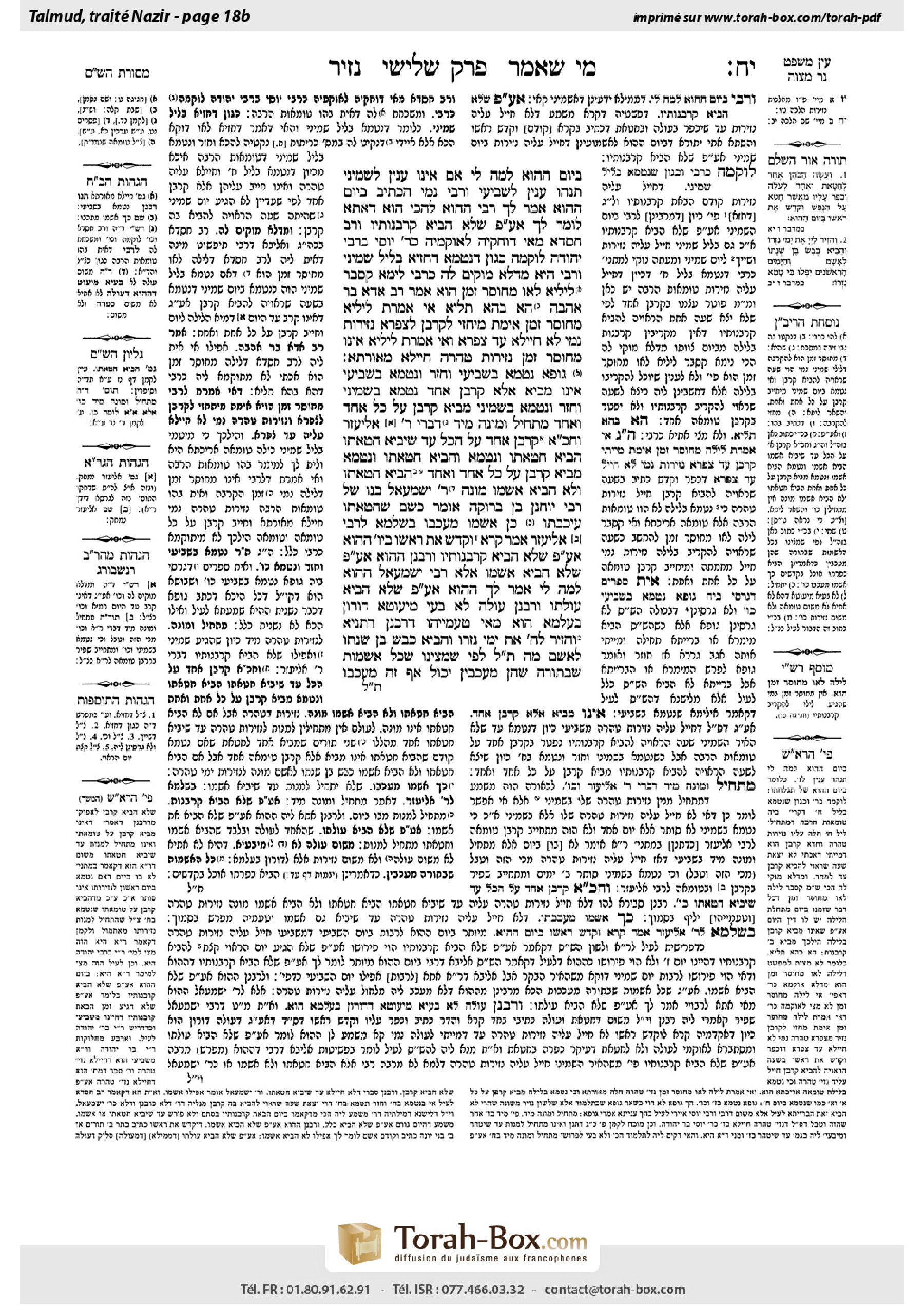
Nazir 18b: Talmud study for Daf Yomi
Daf Yomi is the daily study of one Talmud folio. Explore 37 tractates with scans, Hebrew text, Sefaria English and AI-generated French translations where annotated.
Passage selection and English or AI-generated French translation are available where the scan has annotations. Daf Study is independent of Torah-Box and Sefaria.
Browse Nazir · נזיר · All tractatesNazir 18b text and translations
This page of Nazir includes the Aramaic text, an English translation and an AI-generated French translation, alongside the scan above.
נזיר י״ח ב · Aramaic and Hebrew text
״בְּיוֹם הַהוּא״ לְמָה לִי? אִם אֵינוֹ עִנְיָן לִשְׁמִינִי, תְּנֵהוּ עִנְיָן לִשְׁבִיעִי. וְרַבִּי נָמֵי, הָכְתִיב ״בַּיּוֹם הַהוּא״? אָמַר לְךָ רַבִּי: הָהוּא לְהָכִי הוּא דַּאֲתָא — לוֹמַר לָךְ: אַף עַל פִּי שֶׁלֹּא הֵבִיא קׇרְבְּנוֹתָיו.
וְרַב חִסְדָּא, מַאי דּוּחְקֵיהּ לְאוֹקֹמַיהּ כְּרַבִּי יוֹסֵי בְּרַבִּי יְהוּדָה? לוֹקְמַהּ כְּגוֹן דְּנִטְמָא דְּחַזְיָא בְּלֵיל שְׁמִינִי, וְרַבִּי הִיא!
מִדְּלָא מוֹקֵים לַהּ כְּרַבִּי, לֵימָא קָסָבַר לֵילְיָא לָאו מְחוּסַּר זְמַן הוּא?
אָמַר רַב אַדָּא בַּר אַהֲבָה: הָא בְּהָא תַּלְיָא. אִי אָמְרַתְּ לֵילְיָא מְחוּסַּר זְמַן, אֵימַת מִיחְזֵי לְקׇרְבָּן — לְצַפְרָא, נְזִירוּת נָמֵי לָא חָיְילָא עַד צַפְרָא. וְאִי אָמְרַתְּ לֵילְיָא אֵינוֹ מְחוּסַּר זְמַן — נְזִירוּת טׇהֳרָה חָיְילָא מֵאוּרְתָּא.
גּוּפָא: נִטְמָא בַּשְּׁבִיעִי, וְחָזַר וְנִטְמָא בַּשְּׁבִיעִי — אֵינוֹ מֵבִיא אֶלָּא קׇרְבָּן אֶחָד. נִטְמָא בַּשְּׁמִינִי, וְחָזַר וְנִטְמָא בַּשְּׁמִינִי — מֵבִיא קׇרְבָּן עַל כׇּל אֶחָד וְאֶחָד. מַתְחִיל וּמוֹנֶה מִיָּד, דִּבְרֵי רַבִּי אֱלִיעֶזֶר.
וַחֲכָמִים אוֹמְרִים: קׇרְבָּן אֶחָד עַל הַכֹּל, עַד שֶׁיָּבִיא חַטָּאתוֹ. הֵבִיא חַטָּאתוֹ וְנִטְמָא, וְהֵבִיא חַטָּאתוֹ וְנִטְמָא — מֵבִיא קׇרְבָּן עַל כׇּל אֶחָד וְאֶחָד. הֵבִיא חַטָּאתוֹ וְלֹא הֵבִיא אֲשָׁמוֹ — מוֹנֶה.
רַבִּי יִשְׁמָעֵאל בְּנוֹ שֶׁל רַבִּי יוֹחָנָן בֶּן בְּרוֹקָה אוֹמֵר: כְּשֵׁם שֶׁחַטָּאתוֹ עִיכְּבַתּוּ, כֵּן אֲשָׁמוֹ מְעַכְּבוֹ.
בִּשְׁלָמָא לְרַבִּי אֱלִיעֶזֶר, אָמַר קְרָא ״וְקִדַּשׁ אֶת רֹאשׁוֹ בַּיּוֹם הַהוּא״ — אַף עַל פִּי שֶׁלֹּא הֵבִיא קׇרְבְּנוֹתָיו. וְרַבָּנַן: ״הַהוּא״ — אַף עַל פִּי שֶׁלֹּא הֵבִיא אֲשָׁמוֹ.
אֶלָּא רַבִּי יִשְׁמָעֵאל, ״הָהוּא״ לְמָה לִי? אָמַר לָךְ: ״הַהוּא״ — אַף עַל פִּי שֶׁלֹּא הֵבִיא עוֹלָתוֹ. וְרַבָּנַן: עוֹלָה לָא בָּעֵי מִיעוּטָא — דּוֹרוֹן בְּעָלְמָא הוּא.
מַאי טַעְמַיְיהוּ דְּרַבָּנַן? דְּתַנְיָא: ״וְהִזִּיר לַה׳ אֶת יְמֵי נִזְרוֹ וְהֵבִיא כֶּבֶשׂ בֶּן שְׁנָתוֹ לְאָשָׁם״, מָה תַּלְמוּד לוֹמַר? לְפִי שֶׁמָּצִינוּ שֶׁכׇּל אֲשָׁמוֹת שֶׁבַּתּוֹרָה שֶׁהֵן מְעַכְּבִין, יָכוֹל אַף זֶה מְעַכְּבוֹ —
Nazir 18b · English translation
Why do I need the extra phrase “on that day” (Numbers 6:11)? This teaches that if it does not apply to the matter of the eighth day, since the verse is speaking of that day anyway, apply it to the matter of the seventh day, so that “on that day” means the day when he becomes ritually purified, even before he brings his offerings. The Gemara asks: And according to Rabbi Yehuda HaNasi also, isn’t it written “on that day”? What halakha does he derive from these additional words? The Gemara answers: Rabbi Yehuda HaNasi could have said to you: That verse comes for this purpose, to tell you that even though he did not yet bring his offerings, he starts counting his naziriteship of purity from the eighth day. This is derived from the verse’s emphasis of: “And he shall sanctify his head on that day,” indicating that it depends on the day itself, rather than the bringing of the offerings.
The Gemara asks: And what forced Rav Ḥisda to establish this mishna in accordance with the opinion of Rabbi Yosei, son of Rabbi Yehuda? Let him establish it as referring to a case where one became impure by seeing, i.e., contracting, impurity on the night preceding the eighth day each time. Even according to Rabbi Yehuda HaNasi, the naziriteship of purity begins at the start of, presumably the night preceding, the eighth day. Therefore, this case will be one of a nazirite contracting ritual impurity many times. Nevertheless, the nazirite will be obligated to bring only one set of offerings for all of them, because each case of ritual impurity occurred at night, when he is unable to bring the offerings for his previous ritual impurity, as offerings can be brought only during the day. And therefore it is in accordance with the opinion of Rabbi Yehuda HaNasi.
The Gemara suggests: Since he did not establish it in accordance with the opinion of Rabbi Yehuda HaNasi in this way, shall we say that Rav Ḥisda holds that night is not considered premature? In other words, although he cannot in practice bring his offerings until the morning, as the Temple service was performed only in the daytime, the night is not considered a premature time, but rather it is viewed as part of the day in which it is appropriate to bring his offerings. Consequently, the halakha of one who becomes ritually impure on the night preceding the eighth day is the same as that of one who contracted ritual impurity on the eighth day itself, and they are both required to bring an additional set of offerings.
Rav Adda bar Ahava said: This conclusion is incorrect, as even if Rav Ḥisda holds that the night is considered to be premature, he could not establish the mishna in accordance with the opinion of Rabbi Yehuda HaNasi, as the offerings and his new term of naziriteship depend on each other: If you say night is considered premature, when is he fit to bring his offerings? Only in the morning. Accordingly, naziriteship also does not take effect until the morning. And if you say night is not considered premature, and he is already obligated in his offerings at night, in that case naziriteship of purity takes effect from the evening, which means that the ritual impurity he suffered at night renders him obligated to bring an additional set of offerings. Consequently, the mishna does not follow the opinion of Rabbi Yehuda HaNasi, whether night is considered premature or not, and nothing can be inferred from here with regard to Rav Ḥisda’s opinion in that matter.
§ The Gemara cites a baraita (Tosefta 4:8) concerning the matter of a nazirite who contracted ritual impurity many times itself: If a nazirite became impure, and then became impure on the seventh day of his purification process, and again became impure on the following seventh day of his purification process, he brings only one set of offerings. If he became impure on the eighth day, and again became impure on the following eighth day, he brings a set of offerings for each and every time he became impure. Nevertheless, he begins counting his ritually pure naziriteship immediately on the eighth day, even if he has not yet brought his offerings. This is the statement of Rabbi Eliezer.
And the Rabbis say: If he had not yet brought his offerings on the eighth day when he became impure, it is considered one long period of ritual impurity, and he brings one set of offerings for all the times he became impure, until he has brought his sin-offering at the end of his period of ritual impurity. It is only then that he can begin counting his next term of naziriteship. Therefore, if he brought his sin-offering and then became impure, and again brought his sin-offering and then again became impure, he brings a set of offerings for each and every one. If he brought his sin-offering and did not yet bring his guilt-offering, he begins to count his term of naziriteship in ritual purity.
Rabbi Yishmael, son of Rabbi Yoḥanan ben Beroka, says: Just as not bringing his sin-offering precludes him from starting his naziriteship in ritual purity, so too, not bringing his guilt-offering precludes him from starting his naziriteship in ritual purity, and if he became impure again before he brought his guilt-offering, he only brings one set of offerings for all his impurities.
After having quoted the baraita, the Gemara proceeds to analyze the three opinions: Granted, according to Rabbi Eliezer, his reason is that the verse states: “And he shall sanctify his head on that day” (Numbers 6:11), which indicates: Even though he has not brought his offerings, the eighth day determines the start of his ritually pure naziriteship. And the Rabbis agree that the phrase “on that day” is extra, and it teaches that he begins counting from that day even though he has not brought his guilt-offering, but he does not begin counting until after bringing his sin-offering.
But according to Rabbi Yishmael, why do I need the phrase “on that day”? According to his opinion the issue depends on the offerings, not the day. The Gemara answers: Rabbi Yishmael could have said to you: The phrase “on that day” teaches that he can begin counting even though he has not brought his burnt-offering, as he agrees that not bringing the burnt-offering does not preclude him from counting his naziriteship. And the Rabbis respond to this: A burnt-offering does not require a limitation in the text to teach that its omission does not preclude the start of his naziriteship in ritual purity, since it is merely a gift and not part of his atonement process.
The Gemara explains: What is the reason of the Rabbis for ruling that only refraining from bringing his sin-offering precludes the start of his new count of naziriteship? As it is taught in a baraita: The verse states with regard to a nazirite who became ritually impure: “And he shall consecrate to the Lord the days of his naziriteship, and he shall bring a lamb in its first year for a guilt-offering” (Numbers 6:12). What does this teach? Doesn’t he wait to begin the days of his naziriteship until after he has brought all of his offerings? Rather, since we have found that all guilt-offerings that are mentioned in the Torah are indispensable for atonement, and before he has brought his guilt-offering he is forbidden from partaking of any sacred offerings, one might have thought that not having brought this guilt-offering also precludes him from counting his ritually pure naziriteship,
Nazir 18b · Traduction française (IA)
Pourquoi l’expression supplémentaire « en ce jour » (Nombres 6,11) est-elle nécessaire ? Elle enseigne que, si elle ne s’applique pas au cas du huitième jour, puisque le verset parle de toute façon de ce jour, il faut l’appliquer au cas du septième jour : « en ce jour » désigne alors le jour où il devient rituellement pur, même avant d’apporter ses offrandes. La Guemara demande : Mais selon Rabbi Yehuda HaNasi aussi, n’est-il pas écrit « en ce jour » ? Quelle halakha déduit-il de ces mots supplémentaires ? La Guemara répond : Rabbi Yehuda HaNasi aurait pu te répondre que ce verset a pour fonction de t’enseigner que, même s’il n’a pas encore apporté ses offrandes, il commence à compter sa période de naziréat en état de pureté dès le huitième jour. Cela se déduit de l’insistance du verset : « Il consacrera sa tête en ce jour », ce qui indique que cela dépend du jour lui-même, et non de l’apport des offrandes.
La Guemara demande : Qu’est-ce qui a contraint Rav Ḥisda à interpréter cette Michna conformément à l’opinion de Rabbi Yosei, fils de Rabbi Yehuda ? Qu’il l’interprète comme portant sur le cas d’une personne qui a contracté l’impureté chaque fois pendant la nuit précédant le huitième jour. Même selon Rabbi Yehuda HaNasi, la période de naziréat en état de pureté commence au début du huitième jour, vraisemblablement pendant la nuit qui le précède. Il s’agirait donc d’un nazir qui contracte l’impureté rituelle à plusieurs reprises. Pourtant, il ne serait tenu d’apporter qu’un seul jeu d’offrandes pour tous ces cas, car chaque fois, l’impureté rituelle est survenue la nuit, alors qu’il ne peut pas apporter les offrandes dues pour l’impureté précédente, les offrandes ne pouvant être apportées que le jour. Cette interprétation serait donc conforme à l’opinion de Rabbi Yehuda HaNasi.
La Guemara suggère : Puisqu’il n’a pas interprété la Michna de cette manière, conformément à l’opinion de Rabbi Yehuda HaNasi, faut-il en conclure que Rav Ḥisda considère que la nuit n’est pas un moment prématuré ? Autrement dit, même s’il ne peut, en pratique, apporter ses offrandes qu’au matin, puisque le service du Temple n’était accompli que le jour, la nuit n’est pas considérée comme un moment prématuré ; elle est plutôt considérée comme faisant partie du jour où il convient d’apporter ses offrandes. Par conséquent, la halakha concernant celui qui contracte l’impureté rituelle pendant la nuit précédant le huitième jour est la même que celle concernant celui qui la contracte le huitième jour même, et tous deux sont tenus d’apporter un jeu supplémentaire d’offrandes.
Rav Adda bar Ahava dit : Cette conclusion est erronée. Même si Rav Ḥisda considère que la nuit est un moment prématuré, il ne pouvait pas interpréter la Michna conformément à l’opinion de Rabbi Yehuda HaNasi, car les offrandes et sa nouvelle période de naziréat dépendent l’une de l’autre. Si tu dis que la nuit est un moment prématuré, quand peut-il apporter ses offrandes ? Seulement le matin. Par conséquent, le naziréat ne prend lui aussi effet que le matin. Mais si tu dis que la nuit n’est pas un moment prématuré et qu’il est déjà tenu d’apporter ses offrandes la nuit, alors la période de naziréat en état de pureté prend effet dès le soir, ce qui signifie que l’impureté rituelle contractée cette nuit-là le rend tenu d’apporter un jeu supplémentaire d’offrandes. Par conséquent, que la nuit soit ou non considérée comme un moment prématuré, la Michna ne suit pas l’opinion de Rabbi Yehuda HaNasi, et l’on ne peut rien en déduire quant à l’opinion de Rav Ḥisda sur ce point.
§ La Guemara cite une baraïta (Tosefta 4:8) sur le cas même d’un nazir qui a contracté l’impureté rituelle à plusieurs reprises : si un nazir est devenu impur, puis l’est redevenu le septième jour de son processus de purification, et l’est encore redevenu le septième jour suivant de son processus de purification, il n’apporte qu’un seul jeu d’offrandes. S’il est devenu impur le huitième jour, puis l’est redevenu le huitième jour suivant, il apporte un jeu d’offrandes pour chaque fois qu’il est devenu impur. Néanmoins, il commence à compter sa période de naziréat en état de pureté dès le huitième jour, même s’il n’a pas encore apporté ses offrandes. Telle est la déclaration de Rabbi Eliezer.
Et les Sages disent : s’il n’avait pas encore apporté ses offrandes le huitième jour où il est devenu impur, cela est considéré comme une seule longue période d’impureté rituelle, et il apporte un seul jeu d’offrandes pour toutes les fois où il est devenu impur, jusqu’à ce qu’il ait apporté son sacrifice expiatoire à la fin de cette période d’impureté rituelle. C’est seulement alors qu’il peut commencer à compter sa période suivante de naziréat. Par conséquent, s’il a apporté son sacrifice expiatoire, puis est devenu impur, puis a de nouveau apporté son sacrifice expiatoire et est redevenu impur, il apporte un jeu d’offrandes pour chacune de ces fois. S’il a apporté son sacrifice expiatoire, mais pas encore son sacrifice de culpabilité, il commence à compter sa période de naziréat en état de pureté.
Rabbi Yishmael, fils de Rabbi Yoḥanan ben Beroka, dit : de même que le fait de ne pas apporter son sacrifice expiatoire l’empêche de commencer son naziréat en état de pureté, de même le fait de ne pas apporter son sacrifice de culpabilité l’empêche de commencer son naziréat en état de pureté. S’il est redevenu impur avant d’avoir apporté son sacrifice de culpabilité, il n’apporte qu’un seul jeu d’offrandes pour toutes ses impuretés.
Après avoir cité la baraïta, la Guemara examine les trois opinions : il est compréhensible que, selon Rabbi Eliezer, la raison soit que le verset dit : « Il consacrera sa tête en ce jour » (Nombres 6,11), ce qui indique que, même s’il n’a pas apporté ses offrandes, le huitième jour détermine le début de sa période de naziréat en état de pureté. Les Sages conviennent que l’expression « en ce jour » est superflue et enseigne qu’il commence à compter à partir de ce jour, même s’il n’a pas apporté son sacrifice de culpabilité ; toutefois, il ne commence à compter qu’après avoir apporté son sacrifice expiatoire.
Mais selon Rabbi Yishmael, pourquoi l’expression « en ce jour » est-elle nécessaire ? Selon son opinion, la question dépend des offrandes, et non du jour. La Guemara répond : Rabbi Yishmael aurait pu te répondre que l’expression « en ce jour » enseigne qu’il peut commencer à compter même s’il n’a pas apporté son holocauste, car il considère que le fait de ne pas apporter l’holocauste ne l’empêche pas de compter sa période de naziréat. Les Sages lui répondent : il n’est pas nécessaire de disposer d’une indication textuelle pour enseigner que l’absence d’holocauste n’empêche pas le début de son naziréat en état de pureté, car l’holocauste n’est qu’un don et ne fait pas partie du processus d’expiation.
La Guemara explique : quelle est la raison des Sages, selon lesquels seul le fait de ne pas apporter son sacrifice expiatoire empêche le début de sa nouvelle période de naziréat ? C’est ce qui est enseigné dans une baraïta : au sujet d’un nazir devenu rituellement impur, le verset dit : « Il consacrera au Seigneur les jours de son naziréat et apportera un agneau dans sa première année pour un sacrifice de culpabilité » (Nombres 6,12). Qu’est-ce que cela enseigne ? N’attend-il pas d’avoir apporté toutes ses offrandes avant de commencer les jours de son naziréat ? Mais puisque nous avons établi que tous les sacrifices de culpabilité mentionnés dans la Torah sont indispensables à l’expiation et qu’avant d’avoir apporté son sacrifice de culpabilité, il lui est interdit de consommer des offrandes sacrées, on aurait pu penser que le fait de ne pas avoir apporté ce sacrifice de culpabilité l’empêche également de compter sa période de naziréat en état de pureté,
Traduction française générée par IA à partir de l’édition anglaise de Sefaria. Vérifie toujours un passage avec le texte source.
Text from Sefaria: William Davidson Edition - Vocalized Aramaic (CC BY NC); William Davidson Edition - English (CC BY NC).