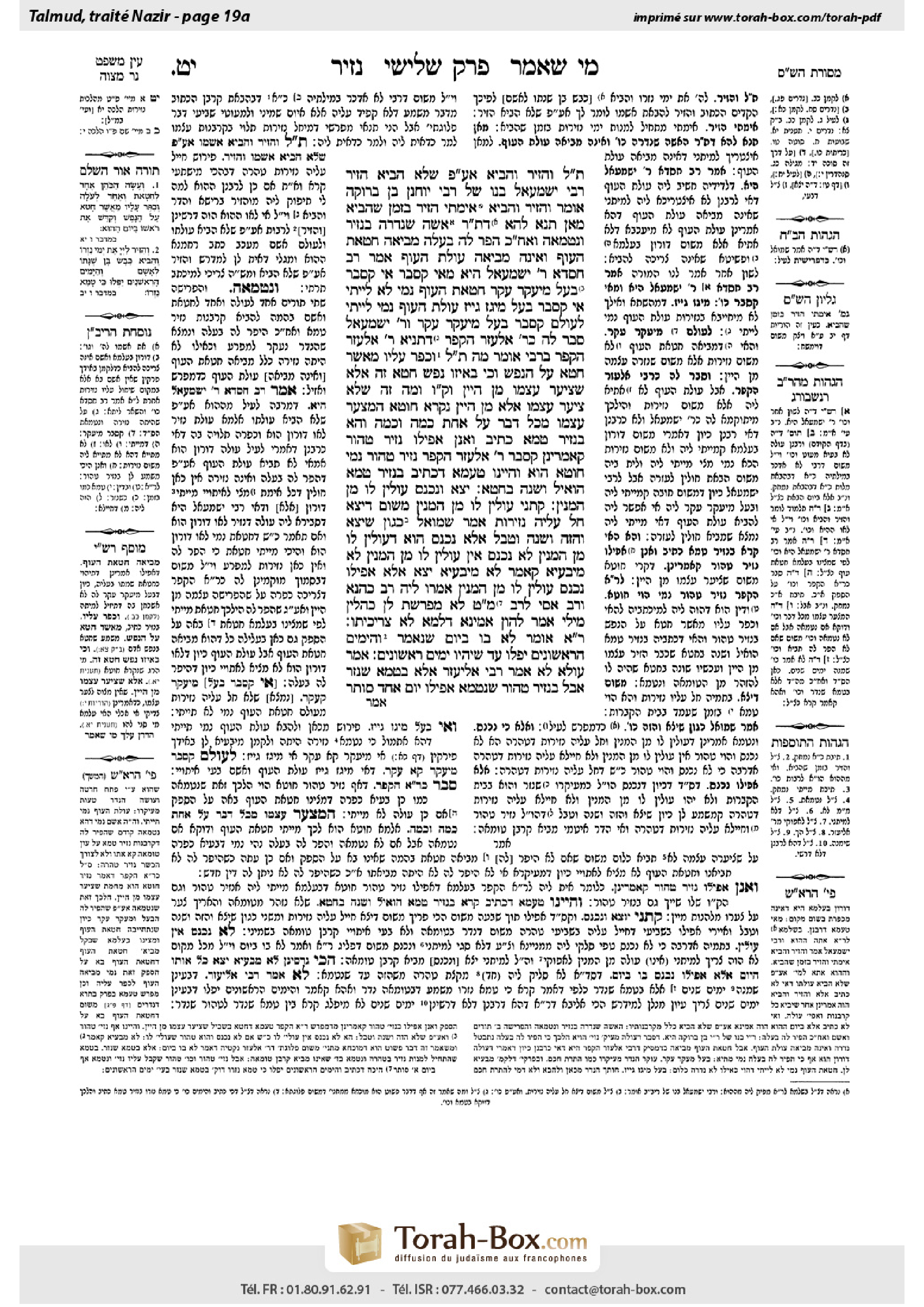
Nazir 19a: Talmud study for Daf Yomi
Daf Yomi is the daily study of one Talmud folio. Explore 37 tractates with scans, Hebrew text, Sefaria English and AI-generated French translations where annotated.
Passage selection and English or AI-generated French translation are available where the scan has annotations. Daf Study is independent of Torah-Box and Sefaria.
Browse Nazir · נזיר · All tractatesNazir 19a text and translations
This page of Nazir includes the Aramaic text, an English translation and an AI-generated French translation, alongside the scan above.
נזיר י״ט א · Aramaic and Hebrew text
תַּלְמוּד לוֹמַר: ״וְהִזִּיר ... וְהֵבִיא״, אַף עַל פִּי שֶׁלֹּא הֵבִיא — הִזִּיר. רַבִּי יִשְׁמָעֵאל בְּנוֹ שֶׁל רַבִּי יוֹחָנָן בֶּן בְּרוֹקָה אוֹמֵר: ״וְהִזִּיר ... וְהֵבִיא״, אֵימָתַי הִזִּיר — בִּזְמַן שֶׁהֵבִיא.
מַאן תְּנָא לְהָא דְּתָנוּ רַבָּנַן: אִשָּׁה שֶׁנָּדְרָה בְּנָזִיר וְנִטְמְאָה, וְאַחַר כָּךְ הֵפֵר לָהּ בַּעֲלָהּ — מְבִיאָה חַטַּאת הָעוֹף, וְאֵינָהּ מְבִיאָה עוֹלַת הָעוֹף.
אָמַר רַב חִסְדָּא: רַבִּי יִשְׁמָעֵאל הִיא.
מַאי קָסָבַר? אִי קָסָבַר בַּעַל מִיעְקָר עָקַר — חַטַּאת הָעוֹף נָמֵי לָא לַיְיתֵי. אִי קָסָבַר בַּעַל מִיגָּז גָּיֵיז, עוֹלַת הָעוֹף נָמֵי לַיְיתֵי! לְעוֹלָם קָסָבַר בַּעַל מִיעְקָר עָקַר, וְרַבִּי יִשְׁמָעֵאל סָבַר לַהּ כְּרַבִּי אֶלְעָזָר הַקַּפָּר.
דְּתַנְיָא, רַבִּי אֶלְעָזָר הַקַּפָּר בְּרַבִּי אוֹמֵר: מָה תַּלְמוּד לוֹמַר ״וְכִפֶּר עָלָיו מֵאֲשֶׁר חָטָא עַל הַנָּפֶשׁ״? וְכִי בְּאֵיזוֹ נֶפֶשׁ חָטָא זֶה? אֶלָּא שֶׁצִּיעֵר עַצְמוֹ מִן הַיַּיִן. וְקַל וָחוֹמֶר: וּמָה זֶה שֶׁלֹּא צִיעֵר עַצְמוֹ אֶלָּא מִן הַיַּיִן נִקְרָא חוֹטֵא, הַמְצַעֵר עַצְמוֹ מִכׇּל דָּבָר עַל אַחַת כַּמָּה וְכַמָּה.
וְהָא בְּנָזִיר טָמֵא כְּתִיב, וַאֲנַן אֲפִילּוּ נָזִיר טָהוֹר קָאָמְרִינַן! קָסָבַר רַבִּי אֶלְעָזָר הַקַּפָּר נָזִיר טָהוֹר נָמֵי חוֹטֵא הוּא, וְהַיְינוּ טַעְמָא דִּכְתִיב בְּנָזִיר טָמֵא — הוֹאִיל וְשָׁנָה בַּחֵטְא.
יָצָא וְנִכְנַס — עוֹלִין לוֹ מִן הַמִּנְיָן. קָתָנֵי עוֹלִין לוֹ מִן הַמִּנְיָן. מִשּׁוּם דְּיָצָא חָל עֲלֵיהּ נְזִירוּת? אָמַר שְׁמוּאֵל: כְּגוֹן שֶׁיָּצָא וְהִזָּה וְשָׁנָה וְטָבַל.
אֶלָּא נִכְנַס הוּא דְּעוֹלִין לוֹ מִן הַמִּנְיָן, לֹא נִכְנַס אֵין עוֹלִין לוֹ מִן הַמִּנְיָן?! לָא מִיבַּעְיָא קָאָמַר: לָא מִיבַּעְיָא יָצָא, אֶלָּא אֲפִילּוּ נִכְנַס — עוֹלִין לוֹ מִן הַמִּנְיָן.
אֲמַרוּ לֵיהּ רַב כָּהֲנָא וְרַב אַסִּי לְרַב: מַאי טַעְמָא לָא מְפָרְשַׁתְּ לַן כְּהָלֵין מִילֵּי? אָמַר לְהוֹן: אָמֵינָא דִּלְמָא לָא צְרִיכִיתוּ.
רַבִּי אֱלִיעֶזֶר אוֹמֵר: לֹא בּוֹ בְּיוֹם — שֶׁנֶּאֱמַר: ״וְהַיָּמִים הָרִאשׁוֹנִים יִפְּלוּ״ — עַד שֶׁיִּהְיוּ יָמִים רִאשׁוֹנִים. אָמַר עוּלָּא: לָא אָמַר רַבִּי אֱלִיעֶזֶר אֶלָּא בְּטָמֵא שֶׁנָּזַר, אֲבָל בַּנָּזִיר טָהוֹר שֶׁנִּטְמָא — אֲפִילּוּ יוֹם אֶחָד סוֹתֵר.
Nazir 19a · English translation
the verse therefore states: “And he shall consecrate to the Lord the days of his naziriteship, and he shall bring a lamb in its first year for a guilt-offering,” indicating: Even though he has not brought his guilt-offering he has nevertheless consecrated his days for the start of a new term of naziriteship. The opinion of Rabbi Yishmael, son of Rabbi Yoḥanan ben Beroka, is as follows: The verse states: “And he shall consecrate to the Lord the days of his naziriteship, and he shall bring,” which means: When has he consecrated his days of naziriteship, i.e., when does his new term of naziriteship begin? It begins when he has already brought his guilt-offering.
The Gemara poses a question: Who is the tanna who taught this that the Sages taught: With regard to a woman who vowed to be a nazirite and became ritually impure, leading her to designate a bird for a sin-offering, a bird for a burnt-offering, and a sheep for a guilt-offering, and afterward her husband nullified her vow of naziriteship for her, she brings the bird sin-offering and she does not bring the bird burnt-offering?
Rav Ḥisda said: It is the opinion of Rabbi Yishmael, son of Rabbi Yoḥanan ben Beroka. According to the opinion of the Rabbis, the burnt-offering is a gift, and she would bring it despite the fact that her naziriteship was nullified. According to Rabbi Yishmael, the burnt-offering is part of the atonement process, and since her naziriteship was nullified, there is no longer a need for atonement.
The Gemara asks: What does he hold? If he holds that the husband uproots a vow entirely when he nullifies it, and she is considered not to have vowed at all, she should not bring the bird sin-offering, as she was never a nazirite, and she does not need atonement. Conversely, if he holds that the husband severs the vow from that point onward, but it did take effect beforehand, she should also bring the bird burnt-offering, as she requires atonement for becoming impure while she was a nazirite. The Gemara answers: Actually, he holds that the husband uproots the vow, and why is she obliged to bring a sin-offering? Rabbi Yishmael holds in accordance with the opinion of Rabbi Elazar HaKappar.
As it is taught in a baraita: Rabbi Elazar HaKappar, the esteemed one, says: What is the meaning when the verse states with regard to a nazirite: “And make atonement for him, for he sinned by the soul” (Numbers 6:11)? And with which soul did this person sin by becoming a nazirite? Rather, in afflicting himself by abstaining from wine, he is considered to have sinned with his own soul, and he must bring a sin-offering for the naziriteship itself, for causing his body to suffer. And an a fortiori inference can be learned from this: Just as this person, in afflicting himself by abstaining only from wine, is nevertheless called a sinner, in the case of one who afflicts himself by abstaining from everything, through fasting or other acts of mortification, all the more so is he described as a sinner. According to this opinion, Rabbi Yishmael holds that since the woman afflicted herself by abstaining from wine she must bring a sin-offering, even though, due to her husband’s nullification, she did not actually become a nazirite.
The Gemara raises a difficulty with Rabbi Elazar HaKappar’s dictum: But this verse, labeling the nazirite a sinner, is written with regard to an impure nazirite, and we are saying that even a pure nazirite is a sinner. The Gemara answers: Rabbi Elazar HaKappar holds that a pure nazirite is also a sinner. And this is the reason that the statement that a nazirite is a sinner is written in reference to an impure nazirite rather than a pure one: Since he repeated his sin, as his impurity causes him to start his naziriteship again, he thereby deprives himself for a longer period. He should have taken extra care to prevent this from happening.
§ The mishna taught that if one took a vow of naziriteship while in a cemetery, left the cemetery, and then entered it again, the days he spent outside do count as part of his tally of his term of naziriteship, and he is obligated to bring the offerings of ritual impurity upon reentering the cemetery. The mishna teaches: They do count as part of his tally. The Gemara questions the meaning of this linkage: Does naziriteship take effect for him because he merely left the ritually impure place? He is still ritually impure, and he cannot begin counting his term of naziriteship until after he has undergone the purification process. Shmuel said: The mishna is referring to a case where he left and received the sprinkling of the ashes of the red heifer on the third day, and he again received the sprinkling on the seventh day and immersed, after which he entered the cemetery a second time. Since he is now ritually pure, his naziriteship takes effect.
The Gemara poses another question: According to the precise reading of the mishna, his term of naziriteship starts only if he reentered the cemetery; however, is it only if he returned and entered the cemetery that those days count as part of his tally, but if he did not enter, and remained outside the cemetery, those days do not count as part of his tally? Why should the start of the naziriteship be dependent upon his reentering the cemetery? The Gemara answers: The tanna is speaking utilizing the style of: It is not necessary, as follows: It is not necessary to state this halakha, that those days count as part of his tally, in the case of one who left the cemetery and began his naziriteship, but even if he entered the cemetery again immediately after his purification, those days count as part of his tally, and he will be obligated to bring the offerings of ritual impurity upon his reentry.
Rav Kahana and Rav Asi said to Rav: What is the reason you did not explain it to us with these words of Shmuel, as explained above? He said to them: I said to myself that perhaps you do not require that explanation, as I thought it was apparent that this is the proper explanation of the mishna.
§ The mishna also taught an additional halakha: Rabbi Eliezer says: This halakha does not apply to one who entered the cemetery on that very day that he left it, as it is stated with regard to the halakhot of an impure nazirite: “But the first days shall be void” (Numbers 6:12), which indicates that he does not bring the offerings unless he had his “first days” of ritual purity, during which he observed his naziriteship. Ulla said: Rabbi Eliezer said this halakha, that one day of naziriteship in purity is not sufficient to obligate him to bring offerings if he becomes impure, only with regard to an impure person who took a vow of naziriteship, but a pure nazirite who became impure, even if he was only pure for one day of naziriteship, it negates that day of his tally and he must bring the offerings of an impure nazirite.
Nazir 19a · Traduction française (IA)
Le verset énonce donc : « Il consacrera à l’Éternel les jours de son naziréat, et il apportera un agneau âgé d’un an en sacrifice de culpabilité », ce qui indique que, même s’il n’a pas apporté son sacrifice de culpabilité, il a néanmoins consacré ses jours pour commencer une nouvelle période de naziréat. Voici l’opinion de Rabbi Yishmael, fils de Rabbi Yoḥanan ben Beroka : le verset énonce : « Il consacrera à l’Éternel les jours de son naziréat, et il apportera », ce qui signifie : quand a-t-il consacré les jours de son naziréat, c’est-à-dire quand sa nouvelle période de naziréat commence-t-elle ? Elle commence lorsqu’il a déjà apporté son sacrifice de culpabilité.
La Guemara pose une question : quel est le tanna qui enseigne la baraïta suivante, rapportée par les Sages ? À propos d’une femme qui a fait vœu d’être naziréenne, puis est devenue rituellement impure, ce qui l’a amenée à désigner un oiseau en sacrifice expiatoire, un oiseau en holocauste et une brebis en sacrifice de culpabilité, et dont le mari a ensuite annulé le vœu de naziréat, elle apporte l’oiseau destiné au sacrifice expiatoire, mais n’apporte pas celui destiné à l’holocauste.
Rav Ḥisda dit : c’est l’opinion de Rabbi Yishmael, fils de Rabbi Yoḥanan ben Beroka. Selon les Sages, l’holocauste est un don, et elle l’apporterait même si son naziréat avait été annulé. Selon Rabbi Yishmael, l’holocauste fait partie du processus d’expiation et, puisque son naziréat a été annulé, elle n’a plus besoin d’expiation.
La Guemara demande : quelle est sa position ? S’il estime que le mari déracine entièrement le vœu lorsqu’il l’annule, si bien qu’elle est considérée comme n’ayant jamais fait de vœu, elle ne devrait pas apporter l’oiseau en sacrifice expiatoire, puisqu’elle n’a jamais été naziréenne et n’a pas besoin d’expiation. À l’inverse, s’il estime que le mari met fin au vœu à partir de ce moment, mais que celui-ci a pris effet auparavant, elle devrait aussi apporter l’oiseau en holocauste, puisqu’elle doit expier le fait d’être devenue impure alors qu’elle était naziréenne. La Guemara répond : en réalité, il estime que le mari déracine le vœu. Pourquoi est-elle alors tenue d’apporter un sacrifice expiatoire ? Rabbi Yishmael suit l’opinion de Rabbi Elazar HaKappar.
Comme il est enseigné dans une baraïta : Rabbi Elazar HaKappar, l’illustre, dit : que signifie le verset concernant un naziréen : « Il fera expiation pour lui, car il a péché à cause d’une personne morte » (Nombres 6:11) ? Et à l’égard de qui cet homme a-t-il péché en devenant naziréen ? C’est plutôt en s’imposant une souffrance par son abstinence de vin qu’il est considéré comme ayant péché contre lui-même ; il doit donc apporter un sacrifice expiatoire pour le naziréat lui-même, parce qu’il a fait souffrir son corps. On peut en tirer un raisonnement a fortiori : si cet homme, qui s’impose une souffrance en s’abstenant seulement de vin, est néanmoins qualifié de pécheur, à plus forte raison celui qui s’impose une souffrance en s’abstenant de tout, par le jeûne ou d’autres pratiques d’austérité, est-il qualifié de pécheur. Selon cette opinion, Rabbi Yishmael estime que, puisque la femme s’est imposé une souffrance en s’abstenant de vin, elle doit apporter un sacrifice expiatoire, bien que, du fait de l’annulation prononcée par son mari, elle ne soit pas réellement devenue naziréenne.
La Guemara soulève une difficulté à propos de la déclaration de Rabbi Elazar HaKappar : mais ce verset, qui qualifie le naziréen de pécheur, est écrit au sujet d’un naziréen impur, alors que nous disons qu’un naziréen pur est lui aussi pécheur. La Guemara répond : Rabbi Elazar HaKappar estime qu’un naziréen pur est également pécheur. Et voici pourquoi la déclaration qualifiant le naziréen de pécheur est écrite à propos d’un naziréen impur plutôt que d’un naziréen pur : puisqu’il a péché de nouveau, car son impureté l’oblige à recommencer son naziréat, il se prive ainsi pendant une période plus longue. Il aurait dû prendre davantage de précautions pour éviter que cela ne se produise.
§ La Michna enseigne que si quelqu’un a fait vœu de naziréat alors qu’il se trouvait dans un cimetière, en est sorti, puis y est entré de nouveau, les jours passés à l’extérieur comptent dans le décompte de sa période de naziréat, et il est tenu d’apporter les offrandes liées à l’impureté rituelle lorsqu’il entre de nouveau dans le cimetière. La Michna enseigne : ils comptent dans son décompte. La Guemara s’interroge sur le lien ainsi établi : le naziréat prend-il effet simplement parce qu’il a quitté le lieu rituellement impur ? Il est encore rituellement impur et ne peut commencer à compter sa période de naziréat qu’après avoir achevé le processus de purification. Shmuel dit : la Michna parle d’un cas où il est sorti et a reçu l’aspersion des cendres de la vache rousse le troisième jour, puis a reçu une nouvelle aspersion le septième jour et s’est immergé ; après cela, il est entré une seconde fois dans le cimetière. Puisqu’il est désormais rituellement pur, son naziréat prend effet.
La Guemara pose une autre question : selon une lecture précise de la Michna, sa période de naziréat ne commence que s’il entre de nouveau dans le cimetière. Mais est-ce uniquement s’il y retourne que ces jours comptent dans son décompte, tandis que, s’il n’y entre pas et reste à l’extérieur, ils ne comptent pas ? Pourquoi le début du naziréat dépendrait-il de son retour dans le cimetière ? La Guemara répond : le tanna s’exprime selon la tournure « il n’est pas nécessaire », comme suit : il n’est pas nécessaire d’énoncer cette halakha — à savoir que ces jours comptent dans son décompte — dans le cas de quelqu’un qui a quitté le cimetière et commencé son naziréat ; même s’il est entré de nouveau dans le cimetière immédiatement après sa purification, ces jours comptent dans son décompte et il sera tenu d’apporter les offrandes liées à l’impureté rituelle lorsqu’il y entrera de nouveau.
Rav Kahana et Rav Asi dirent à Rav : pourquoi ne nous as-tu pas expliqué cela en reprenant les termes de Shmuel, comme cela a été expliqué plus haut ? Il leur répondit : je me suis dit que vous n’aviez peut-être pas besoin de cette explication, car je pensais qu’il était évident que telle était la bonne explication de la Michna.
§ La Michna enseigne également une autre halakha : Rabbi Eliezer dit que cette halakha ne s’applique pas à quelqu’un qui est entré dans le cimetière le jour même où il en est sorti, comme il est dit au sujet des halakhot concernant un naziréen impur : « Mais les premiers jours seront annulés » (Nombres 6:12). Cela indique qu’il n’apporte pas les offrandes à moins d’avoir connu ses « premiers jours » de pureté rituelle, pendant lesquels il a observé son naziréat. Ulla dit : Rabbi Eliezer a énoncé cette halakha — selon laquelle un seul jour de naziréat dans la pureté ne suffit pas à le rendre redevable des offrandes s’il devient impur — uniquement à propos d’une personne impure qui a fait vœu de naziréat. En revanche, un naziréen pur devenu impur, même s’il n’a été pur qu’un seul jour de naziréat, voit ce jour retranché de son décompte et doit apporter les offrandes d’un naziréen impur.
Traduction française générée par IA à partir de l’édition anglaise de Sefaria. Vérifie toujours un passage avec le texte source.
Text from Sefaria: William Davidson Edition - Vocalized Aramaic (CC BY NC); William Davidson Edition - English (CC BY NC).