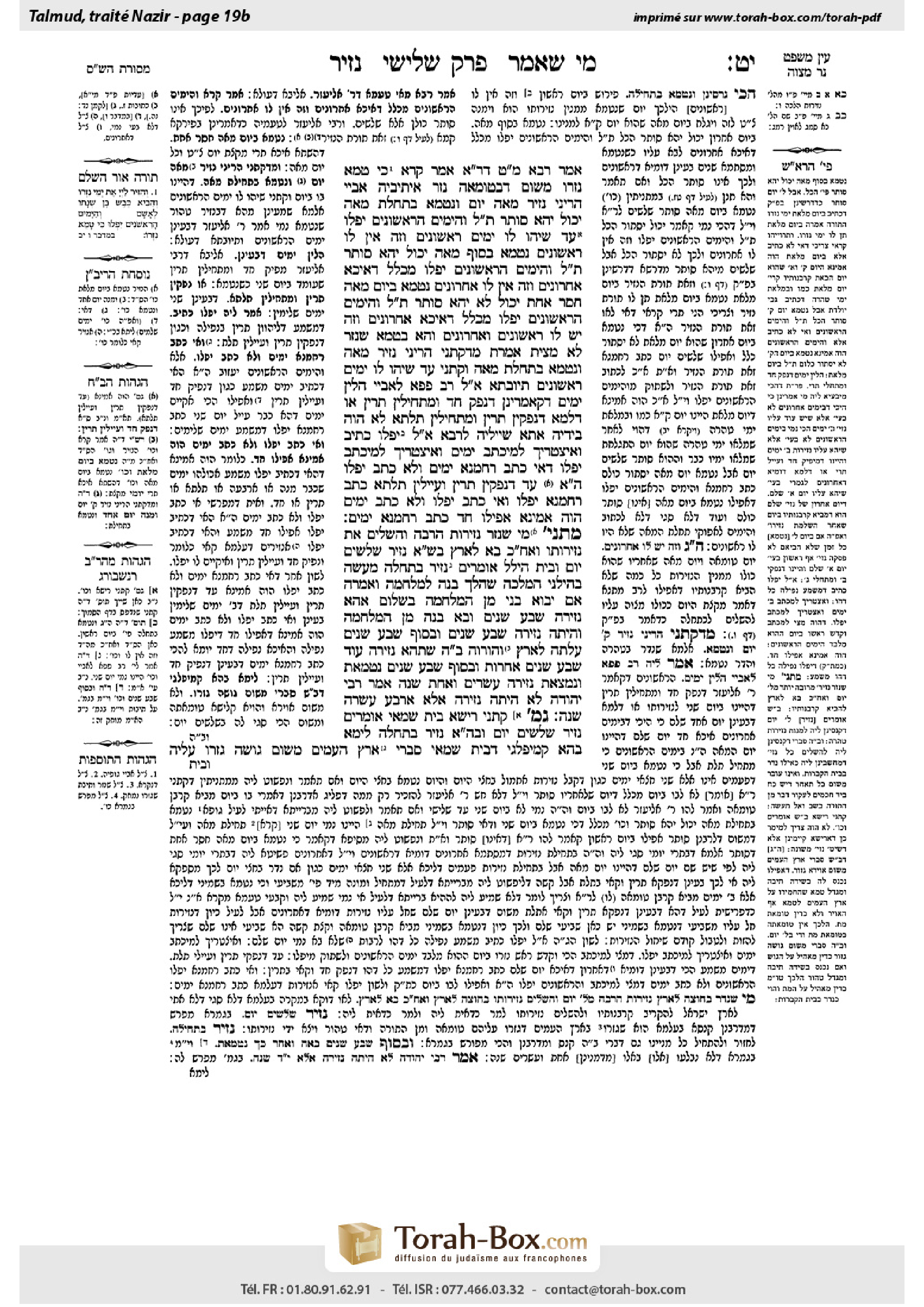
Nazir 19b: Talmud study for Daf Yomi
Daf Yomi is the daily study of one Talmud folio. Explore 37 tractates with scans, Hebrew text, Sefaria English and AI-generated French translations where annotated.
Passage selection and English or AI-generated French translation are available where the scan has annotations. Daf Study is independent of Torah-Box and Sefaria.
Browse Nazir · נזיר · All tractatesNazir 19b text and translations
This page of Nazir includes the Aramaic text, an English translation and an AI-generated French translation, alongside the scan above.
נזיר י״ט ב · Aramaic and Hebrew text
אָמַר רָבָא: מַאי טַעְמָא דְּרַבִּי אֱלִיעֶזֶר? אָמַר קְרָא: ״כִּי טָמֵא נִזְרוֹ״ — מִשּׁוּם דִּבְטוּמְאָה נְזַר.
אֵיתִיבֵיהּ אַבָּיֵי: ״הֲרֵינִי נָזִיר מֵאָה יוֹם״, וְנִטְמָא בִּתְחִלַּת מֵאָה, יָכוֹל יְהֵא סוֹתֵר, תַּלְמוּד לוֹמַר: ״וְהַיָּמִים הָרִאשׁוֹנִים יִפְּלוּ״ — עַד שֶׁיְּהוּ לוֹ יָמִים רִאשׁוֹנִים, וְזֶה אֵין לוֹ רִאשׁוֹנִים.
נִטְמָא בְּסוֹף מֵאָה, יָכוֹל יְהֵא סוֹתֵר, תַּלְמוּד לוֹמַר: ״וְהַיָּמִים הָרִאשׁוֹנִים יִפְּלוּ״ — מִכְּלָל דְּאִיכָּא אַחֲרוֹנִים, וְזֶה אֵין לוֹ אַחֲרוֹנִים. נִטְמָא בְּיוֹם מֵאָה חָסֵר אַחַת, יָכוֹל לֹא יְהֵא סוֹתֵר, תַּלְמוּד לוֹמַר: ״וְהַיָּמִים הָרִאשׁוֹנִים יִפְּלוּ״ — מִכְּלָל דְּאִיכָּא אַחֲרוֹנִים, וְזֶה יֵשׁ לוֹ רִאשׁוֹנִים וְאַחֲרוֹנִים.
וְהָא, בְּטָמֵא שֶׁנָּזַר לָא מָצֵית אָמְרַתְּ, מִדְּקָתָנֵי ״הֲרֵינִי נָזִיר מֵאָה״, וְנִטְמָא בִּתְחִלַּת מֵאָה, וְקָתָנֵי ״עַד שֶׁיְּהוּ לוֹ יָמִים רִאשׁוֹנִים״, תְּיוּבְתָּא.
אֲמַר לֵיהּ רַב פָּפָּא לְאַבָּיֵי: הָלֵין יָמִים דְּקָאָמְרִינַן, דְּנָפֵק חַד וּמַתְחִילִין תְּרֵין, אוֹ דִּלְמָא דְּנָפְקִין תְּרֵין וּמַתְחִילִין תְּלָתָא? לָא הֲוָה בִּידֵיהּ, אֲתָא שַׁיְילֵיהּ לְרָבָא. אֲמַר לֵיהּ: ״יִפְּלוּ״ כְּתִיב.
וְאִיצְטְרִיךְ לְמִיכְתַּב ״יָמִים״ וְאִיצְטְרִיךְ לְמִיכְתַּב ״יִפְּלוּ״, דְּאִי כְּתַב רַחֲמָנָא ״יָמִים״ וְלָא כְּתַב ״יִפְּלוּ״, הֲוָה אָמֵינָא: עַד דְּנָפְקִין תְּרֵין וְעָיְילִין תְּלָתָא, כְּתַב רַחֲמָנָא ״יִפְּלוּ״. וְאִי כְּתַב ״יִפְּלוּ״ וְלָא כְּתַב ״יָמִים״, הֲוָה אָמֵינָא אֲפִילּוּ חַד, כְּתַב רַחֲמָנָא ״יָמִים״.
מַתְנִי׳ מִי שֶׁנָּזַר נְזִירוּת הַרְבֵּה, וְהִשְׁלִים אֶת נְזִירוּתוֹ, וְאַחַר כָּךְ בָּא לָאָרֶץ, בֵּית שַׁמַּאי אוֹמְרִים: נָזִיר שְׁלֹשִׁים יוֹם, וּבֵית הִילֵּל אוֹמְרִים: נָזִיר בַּתְּחִלָּה.
מַעֲשֶׂה בְּהֵילֵנִי הַמַּלְכָּה שֶׁהָלַךְ בְּנָהּ לְמִלְחָמָה, וְאָמְרָה: אִם יָבוֹא בְּנִי מִן הַמִּלְחָמָה בְּשָׁלוֹם — אֱהֵא נְזִירָה שֶׁבַע שָׁנִים. וּבָא בְּנָהּ מִן הַמִּלְחָמָה, וְהָיְתָה נְזִירָה שֶׁבַע שָׁנִים, וּבְסוֹף שֶׁבַע שָׁנִים עָלְתָה לָאָרֶץ, וְהוֹרוּהָ בֵּית הִלֵּל שֶׁתְּהֵא נְזִירָה עוֹד שֶׁבַע שָׁנִים אֲחֵרוֹת. וּבְסוֹף שֶׁבַע שָׁנִים נִטְמֵאת. וְנִמְצֵאת נְזִירָה עֶשְׂרִים וְאַחַת שָׁנָה. אָמַר רַבִּי יְהוּדָה: לֹא הָיְתָה נְזִירָה אֶלָּא אַרְבַּע עֶשְׂרֵה שָׁנָה.
גְּמָ׳ קָתָנֵי רֵישָׁא: בֵּית שַׁמַּאי אוֹמְרִים: נָזִיר שְׁלֹשִׁים יוֹם, וּבֵית הִלֵּל אוֹמְרִים: נָזִיר בַּתְּחִלָּה. לֵימָא בְּהָא קָמִיפַּלְגִי, דְּבֵית שַׁמַּאי סָבְרִי: אֶרֶץ הָעַמִּים מִשּׁוּם גּוּשָׁהּ גָּזְרוּ עָלֶיהָ,
Nazir 19b · English translation
Rava said: What is the reason for the opinion of Rabbi Eliezer, according to Ulla’s explanation? The verse states: “But the first days shall be void because his consecration was ritually impure” (Numbers 6:12), which he explains as follows: Why are his first days rendered void? They are void because he took a vow of naziriteship, consecrating himself, when he was in a state of ritual impurity.
Abaye raised an objection to Rava from a baraita that is not in accordance with the opinion of Ulla: One who said: I am hereby a nazirite for one hundred days, and he became ritually impure immediately, at the beginning of the one hundred days, one might have thought it should negate the time he spent as a nazirite. The verse therefore states: “But the first days shall be void” (Numbers 6:12), which indicates that this halakha does not apply until he will have “first days” as a nazirite, and in this case the nazirite does not have his first days completed, as he became ritually impure right away.
The baraita continues: If one became ritually impure at the end of one hundred days, that is, on the hundredth day, one might have thought it should negate the days he had counted. The verse therefore states: “But the first days shall be void,” indicating by inference that there are other days that can be called the last ones, while this nazirite does not have last days, as he has already completed the tally of his naziriteship. If he became impure on the one hundredth day less one, one might have thought it should not negate the days he had counted. Therefore, the verse states: “But the first days shall be void,” indicating by inference that there are last ones, and this nazirite has first ones and last ones.
Abaye now concludes his objection to Rava: But with regard to this halakha of the baraita, you cannot say it is referring to an impure person who took a vow of naziriteship from the fact that it teaches: I am hereby a nazirite for one hundred days, and he became impure immediately at the beginning of the one hundred, indicating that it is discussing one who became impure after his term had already started. And it further teaches: Until he will have “first days,” which proves that Rabbi Eliezer states his halakha even with regard to a pure nazirite who later became impure. This is a conclusive refutation of Ulla, and his opinion is rejected.
Rav Pappa said to Abaye: Those first days that we said he must observe in ritual purity according to Rabbi Eliezer, does it mean that one day has finished and a second has started, so that if he became impure on the second day it negates his tally, or perhaps it means that two days have finished, and a third has started, which would mean it negates his tally only if he became impure after the beginning of the third day? An answer was not available to him, so Rav Pappa went to ask Rava, who said to him: It is written: “But the former days shall be void [yippelu]” (Numbers 6:12) in the plural, which means at least two days need to have passed.
The Gemara comments: And it was necessary for the verse to write “days” and it was also necessary for it to write “shall be void” in the plural. For if the Merciful One wrote in the Torah only “days” and had not also written “shall be void” in the plural, I would say that the halakha applies only if two days have finished and a third has started. The Merciful One therefore wrote in the Torah the plural form of “shall be void.” And if the Merciful One wrote in the Torah “shall be void” and had not also written “days,” I would say even one day, that is, the halakha applies even if he became ritually impure on the first day. The Merciful One therefore wrote in the Torah “days,” indicating that he must have observed at least part of the second day.
MISHNA: One who vowed many days of naziriteship while outside Eretz Yisrael, and completed his naziriteship, and afterward came to Eretz Yisrael, in order to bring the offerings at the end of his naziriteship, Beit Shammai say: He must be a nazirite for thirty days, so that he has observed a term of naziriteship in ritual purity in Eretz Yisrael, and Beit Hillel say: He is a nazirite from the beginning, that is, he must observe his entire naziriteship again.
The mishna cites a related story: An incident occurred with regard to Queen Helene, whose son had gone to war, and she said: If my son will return from war safely, I will be a nazirite for seven years. And her son returned safely from the war, and she was a nazirite for seven years. And at the end of seven years, she ascended to Eretz Yisrael, and Beit Hillel instructed her, in accordance with their opinion, that she should be a nazirite for an additional seven years. And at the end of those seven years she became ritually impure, and was therefore required to observe yet another seven years of naziriteship, as ritual impurity negates the tally of a nazirite. And she was found to be a nazirite for twenty-one years. Rabbi Yehuda said: She was a nazirite for only fourteen years and not twenty-one.
GEMARA: The first clause of the mishna teaches that Beit Shammai say: He must be a nazirite for thirty days, and Beit Hillel say: He is a nazirite from the beginning. The Gemara suggests a possible explanation of their dispute: Let us say that they disagree about this, that Beit Shammai hold that when the Sages declared that the land of the nations outside of Eretz Yisrael is impure, they decreed so with regard to its earth. In other words, they decreed that only the earth of the land of the nations is impure, but its airspace remains pure. If so, it is not a severe level of ritual impurity, and one who observed a vow of naziriteship outside of Eretz Yisrael is not considered to be impure to the extent that he would be required to start his naziriteship afresh once entering Eretz Yisrael,
Nazir 19b · Traduction française (IA)
Rava dit : Quelle est la raison de l’opinion de Rabbi Eliezer selon l’explication d’Ulla ? Le verset dit : « Mais les premiers jours seront annulés, car sa consécration était rituellement impure » (Nombres 6:12). Il l’explique ainsi : Pourquoi ses premiers jours sont-ils annulés ? Parce qu’il a fait vœu de naziréat et s’est consacré alors qu’il était en état d’impureté rituelle.
Abaye soulève une objection contre Rava à partir d’une baraïta qui ne va pas dans le sens de l’explication d’Ulla : Celui qui dit : « Me voici naziréen pour cent jours », puis devient impur rituellement immédiatement, au début des cent jours, on aurait pu penser que cela annule les jours qu’il a comptés comme naziréen. Le verset dit donc : « Mais les premiers jours seront annulés » (Nombres 6:12), ce qui indique que cette halakha ne s’applique que lorsqu’il a eu des « premiers jours » comme naziréen. Or, dans ce cas, le naziréen n’a pas achevé ses premiers jours, puisqu’il est devenu impur rituellement aussitôt.
La baraïta poursuit : Si quelqu’un devient impur rituellement à la fin des cent jours, c’est-à-dire le centième jour, on aurait pu penser que cela annule les jours qu’il avait comptés. Le verset dit donc : « Mais les premiers jours seront annulés », ce qui implique qu’il existe d’autres jours que l’on peut appeler les derniers jours ; or ce naziréen n’a pas de derniers jours, puisqu’il a déjà achevé le compte de son naziréat. S’il devient impur le jour précédant le centième, on aurait pu penser que cela n’annule pas les jours qu’il avait comptés. Le verset dit donc : « Mais les premiers jours seront annulés », ce qui implique qu’il y a des derniers jours, et que ce naziréen a des premiers jours et des derniers jours.
Abaye conclut maintenant son objection à Rava : Pour cette halakha de la baraïta, on ne peut pas dire qu’elle se rapporte à une personne qui était impure lorsqu’elle a fait vœu de naziréat, puisque la baraïta enseigne : « Me voici naziréen pour cent jours », puis il devient impur immédiatement, au début des cent jours ; cela montre qu’elle parle de quelqu’un qui est devenu impur après le début de son terme. Elle enseigne en outre : « Jusqu’à ce qu’il ait des premiers jours », ce qui prouve que Rabbi Eliezer énonce sa halakha même à propos d’un naziréen qui était pur et qui est devenu impur par la suite. C’est une réfutation décisive d’Ulla, et son opinion est rejetée.
Rav Pappa dit à Abaye : Ces premiers jours que, selon Rabbi Eliezer, il doit observer en état de pureté rituelle, cela signifie-t-il qu’un jour s’est achevé et qu’un deuxième a commencé, de sorte que, s’il devient impur le deuxième jour, son compte est annulé ? Ou bien cela signifie-t-il que deux jours se sont achevés et qu’un troisième a commencé, auquel cas son compte n’est annulé que s’il devient impur après le début du troisième jour ? Abaye ne put lui répondre ; Rav Pappa alla donc interroger Rava, qui lui dit : Il est écrit : « Mais les jours précédents tomberont [yippelu] » (Nombres 6:12), au pluriel, ce qui signifie qu’au moins deux jours doivent s’être écoulés.
La Guemara fait remarquer : Il fallait que le verset emploie le mot « jours », et il fallait également qu’il emploie au pluriel l’expression « seront annulés ». En effet, si le Miséricordieux avait écrit dans la Torah seulement « jours », sans employer aussi au pluriel l’expression « seront annulés », j’aurais dit que la halakha ne s’applique que si deux jours se sont achevés et qu’un troisième a commencé. Le Miséricordieux a donc écrit dans la Torah l’expression « seront annulés » au pluriel. Et si le Miséricordieux avait écrit dans la Torah « seront annulés » sans écrire aussi « jours », j’aurais dit qu’un seul jour suffit, c’est-à-dire que la halakha s’applique même s’il est devenu impur rituellement le premier jour. Le Miséricordieux a donc écrit dans la Torah « jours », ce qui indique qu’il doit avoir observé au moins une partie du deuxième jour.
MICHNA : Celui qui a fait vœu de nombreux jours de naziréat alors qu’il se trouvait hors d’Eretz Israël, a achevé son naziréat, puis est venu en Eretz Israël pour apporter les sacrifices à la fin de son naziréat : Beit Chammaï disent qu’il doit être naziréen pendant trente jours, afin d’avoir observé un terme de naziréat en état de pureté rituelle en Eretz Israël ; Beit Hillel disent qu’il est naziréen depuis le début, c’est-à-dire qu’il doit observer à nouveau l’intégralité de son naziréat.
La Michna rapporte un récit lié à ce sujet : Un événement eut lieu concernant la reine Hélène, dont le fils était parti à la guerre. Elle dit : « Si mon fils revient sain et sauf de la guerre, je serai naziréenne pendant sept ans. » Son fils revint sain et sauf de la guerre, et elle fut naziréenne pendant sept ans. Au terme de ces sept années, elle monta en Eretz Israël, et Beit Hillel lui enseignèrent, conformément à leur opinion, qu’elle devait être naziréenne pendant sept années supplémentaires. Au terme de ces sept années, elle devint impure rituellement et dut donc observer encore sept années de naziréat, car l’impureté rituelle annule le compte d’un naziréen. On constata qu’elle avait été naziréenne pendant vingt et un ans. Rabbi Yehouda dit : Elle fut naziréenne pendant quatorze ans seulement, et non vingt et un.
GUEMARA : La première partie de la Michna enseigne que Beit Chammaï disent : « Il doit être naziréen pendant trente jours », et Beit Hillel disent : « Il est naziréen depuis le début. » La Guemara propose une explication possible de leur désaccord : Peut-on dire qu’ils divergent sur ce point : Beit Chammaï tiennent que, lorsque les Sages ont déclaré impure la terre des nations, ils ont décrété l’impureté de son sol ? Autrement dit, ils ont décrété que seul le sol de la terre des nations est impur, tandis que son espace aérien demeure pur. Dans ce cas, il ne s’agit pas d’un degré grave d’impureté rituelle, et celui qui a observé son vœu de naziréat hors d’Eretz Israël n’est pas considéré comme impur au point de devoir recommencer son naziréat en entrant en Eretz Israël,
Traduction française générée par IA à partir de l’édition anglaise de Sefaria. Vérifie toujours un passage avec le texte source.
Text from Sefaria: William Davidson Edition - Vocalized Aramaic (CC BY NC); William Davidson Edition - English (CC BY NC).