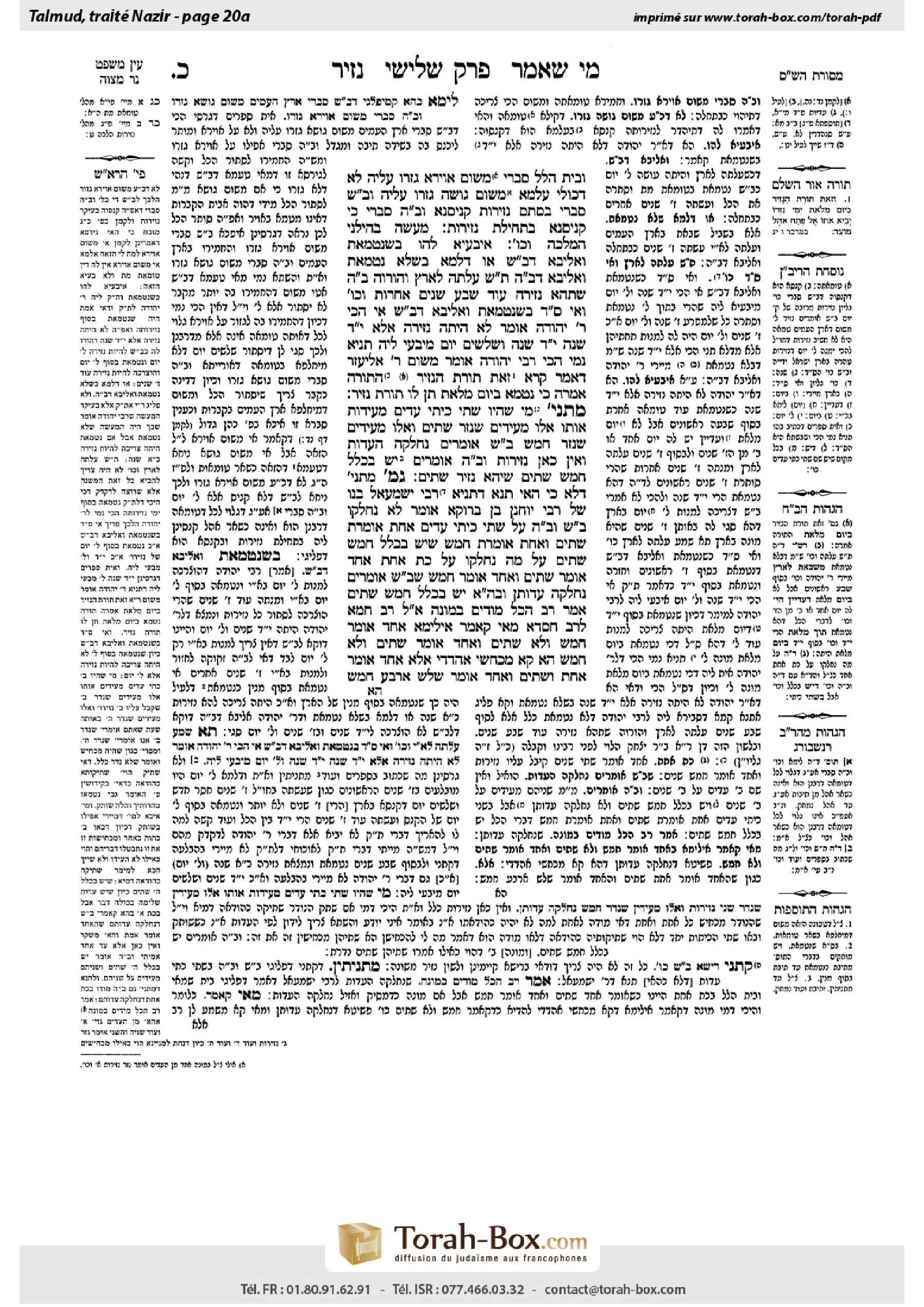
Nazir 20a: Talmud study for Daf Yomi
Daf Yomi is the daily study of one Talmud folio. Explore 37 tractates with scans, Hebrew text, Sefaria English and AI-generated French translations where annotated.
Passage selection and English or AI-generated French translation are available where the scan has annotations. Daf Study is independent of Torah-Box and Sefaria.
Browse Nazir · נזיר · All tractatesNazir 20a text and translations
This page of Nazir includes the Aramaic text, an English translation and an AI-generated French translation, alongside the scan above.
נזיר כ׳ א · Aramaic and Hebrew text
וּבֵית הִלֵּל סָבְרִי: מִשּׁוּם אַוֵּירָא גָּזְרוּ עָלֶיהָ? לָא, דְּכוּלֵּי עָלְמָא מִשּׁוּם גּוּשָׁהּ גָּזְרוּ עָלֶיהָ, וּבֵית שַׁמַּאי סָבְרִי בִּסְתָם נְזִירוּת קָנֵיסְנָא, וּבֵית הִלֵּל סָבְרִי: כִּי קָנֵיסְנָא — בִּתְחִילַּת נְזִירוּת.
מַעֲשֶׂה בְּהֵילֵנִי הַמַּלְכָּה וְכוּ׳. אִיבַּעְיָא לְהוּ: בְּשֶׁנִּטְמֵאת, וְאַלִּיבָּא דְּבֵית שַׁמַּאי? אוֹ דִּלְמָא בְּשֶׁלֹּא נִטְמֵאת, וְאַלִּיבָּא דְּבֵית הִלֵּל?
תָּא שְׁמַע: עָלְתָה לָאָרֶץ, וְהוֹרוּהָ בֵּית הִלֵּל שֶׁתְּהֵא נְזִירָה עוֹד שֶׁבַע שָׁנִים אֲחֵרוֹת וְכוּ׳. וְאִי סָלְקָא דַעְתָּךְ בְּשֶׁנִּטְמֵאת וְאַלִּיבָּא דְּבֵית שַׁמַּאי, אִי הָכִי, ״רַבִּי יְהוּדָה אוֹמֵר לֹא הָיְתָה נְזִירָה אֶלָּא אַרְבַּע עֶשְׂרֵה שָׁנָה״? ״אַרְבַּע עֶשְׂרֵה שָׁנָה וּשְׁלֹשִׁים יוֹם״ מִיבְּעֵי לֵיהּ!
תַּנְיָא נָמֵי הָכִי, רַבִּי יְהוּדָה אוֹמֵר מִשּׁוּם רַבִּי אֱלִיעֶזֶר: דְּאָמַר קְרָא ״זֹאת תּוֹרַת הַנָּזִיר״, הַתּוֹרָה אָמְרָה: כִּי נִטְמָא בְּיוֹם מְלֹאת — תֵּן לוֹ תּוֹרַת נָזִיר.
מַתְנִי׳ מִי שֶׁהָיוּ שְׁתֵּי כִּיתֵּי עֵדִים מְעִידוֹת אוֹתוֹ, אֵלּוּ מְעִידִים שֶׁנָּזַר שְׁתַּיִם, וְאֵלּוּ מְעִידִים שֶׁנָּזַר חָמֵשׁ, בֵּית שַׁמַּאי אוֹמְרִים: נֶחְלְקָה הָעֵדוּת — וְאֵין כָּאן נְזִירוּת, וּבֵית הִלֵּל אוֹמְרִים: יֵשׁ בִּכְלַל חָמֵשׁ שְׁתַּיִם, שֶׁיְּהֵא נָזִיר שְׁתַּיִם.
גְּמָ׳ מַתְנִיתִין דְּלָא כִּי הַאי תַּנָּא, דְּתַנְיָא, רַבִּי יִשְׁמָעֵאל בְּנוֹ שֶׁל רַבִּי יוֹחָנָן בֶּן בְּרוֹקָא אוֹמֵר: לֹא נֶחְלְקוּ בֵּית שַׁמַּאי וּבֵית הִלֵּל עַל שְׁתֵּי כִּיתֵּי עֵדִים, אַחַת אוֹמֶרֶת שְׁתַּיִם, וְאַחַת אוֹמֶרֶת חָמֵשׁ, שֶׁיֵּשׁ בִּכְלַל חָמֵשׁ שְׁתַּיִם. עַל מָה נֶחְלְקוּ — עַל כַּת אַחַת, אֶחָד אוֹמֵר שְׁתַּיִם, וְאֶחָד אוֹמֵר חָמֵשׁ, שֶׁבֵּית שַׁמַּאי אוֹמְרִים: נֶחְלְקָה עֵדוּתָן. וּבֵית הִלֵּל אוֹמְרִים: יֵשׁ בִּכְלַל חָמֵשׁ שְׁתַּיִם.
אָמַר רַב: הַכֹּל מוֹדִים בְּמוֹנֶה. אֲמַר לֵיהּ רַב חָמָא לְרַב חִסְדָּא: מַאי קָאָמַר? אִילֵּימָא: אֶחָד אוֹמֵר חָמֵשׁ וְלֹא שְׁתַּיִם, וְאֶחָד אוֹמֵר שְׁתַּיִם וְלֹא חָמֵשׁ — הָא קָא מַכְחֲשִׁי אַהֲדָדֵי! אֶלָּא: אֶחָד אוֹמֵר אַחַת וּשְׁתַּיִם, וְאֶחָד אוֹמֵר שָׁלֹשׁ אַרְבַּע חָמֵשׁ.
Nazir 20a · English translation
and Beit Hillel hold: They decreed with regard to its airspace, and it is a severe level of ritual impurity, so he must start his naziriteship from the beginning once he arrives in Eretz Yisrael. The Gemara rejects this possibility: No, it may be that everyone agrees that they decreed only with regard to its earth, and they disagree merely over the details of the penalty. Beit Shammai hold that we penalize him with an unspecified term of naziriteship, which is thirty days, and Beit Hillel hold that when we penalize, we require him to return to the beginning of his term of naziriteship, and he must observe the entire term of naziriteship afresh.
§ The mishna taught: An incident occurred with regard to Queen Helene. A dilemma was raised before them: What is the meaning of Rabbi Yehuda’s statement? Does he hold that the case was one where she became impure in Eretz Yisrael, but after thirty days, and not after seven years, and Rabbi Yehuda spoke in accordance with the opinion of Beit Shammai, who hold that she was required to observe only a further thirty days upon her arrival in Eretz Yisrael, and due to her becoming impure she had to observe again her original term of naziriteship, for a total of fourteen years? Or perhaps the case is one where she did not become impure at the end of the seven years in Eretz Yisrael, and he ruled in accordance with the opinion of Beit Hillel that she had to observe an additional seven years upon her entry to Eretz Yisrael.
The Gemara suggests: Come and hear a proof from the mishna: She ascended to Eretz Yisrael, and Beit Hillel instructed her that she should be a nazirite for an additional seven years, etc. And if it enters your mind that Rabbi Yehuda says that the case is one where she became ritually impure after observing thirty days of naziriteship following her arrival to Eretz Yisrael, and he spoke in accordance with the opinion of Beit Shammai, if so, why does Rabbi Yehuda say she was a nazirite for only fourteen years? He should have said fourteen years and thirty days, as even Beit Shammai obligate her to observe a thirty-day period of naziriteship in Eretz Yisrael. It must be that Rabbi Yehuda holds that she observed seven additional years, in accordance with the opinion of Beit Hillel, and says that she did not become ritually impure.
The Gemara adds: This is also taught in a baraita, that Rabbi Yehuda’s opinion cannot be established in accordance with Beit Shammai: Rabbi Yehuda says in the name of Rabbi Eliezer that the verse states: “This is the law of the nazirite when the days of his consecration are fulfilled” (Numbers 6:13). The Torah states: When he becomes impure on the day of the completion of his naziriteship, even if it was at the end of a lengthy term, give him the law of an unspecified nazirite, and he must observe a thirty-day term. Therefore, if she became impure at the end of those thirty days that Beit Shammai obligates her to observe, she should have been required to observe naziriteship for only thirty additional days, rather than a full seven years. Rather, Rabbi Yehuda certainly accepts the opinion of Beit Hillel, and claims that she did not become ritually impure.
MISHNA: In a case of one who had two sets of witnesses testifying about him that he had taken a vow of naziriteship for a certain period, and these witnesses testify that he took a vow of naziriteship for two terms, and these witnesses testify that he took a vow of naziriteship for five terms. Beit Shammai say: The testimony is divided, i.e., the testimonies contradict each other, and since the testimonies are in conflict they are both rejected entirely and there is no naziriteship here at all. And Beit Hillel say: The testimonies are not completely in conflict with each other, as two terms are included in five terms, and the unanimous testimony, that he is a nazirite for two terms, is accepted.
GEMARA: The Gemara comments: The mishna is not in accordance with the opinion of this tanna, as it is taught in a baraita that Rabbi Yishmael, son of Rabbi Yoḥanan ben Beroka, says: Beit Shammai and Beit Hillel did not disagree with regard to the halakha in the case of two sets of witnesses, one of whom says two terms and one of whom says five terms, that two terms are included in five terms, and he must observe two terms of naziriteship. With regard to what did they disagree? They disagreed with regard to one set of two witnesses, one of whom says two terms and one of whom says five terms, and that Beit Shammai say: In that case their testimony is divided, as the two witnesses are in conflict and there is no testimony here at all. And Beit Hillel say: Since two terms are included in five terms, their testimony is in agreement with regard to two terms, and therefore he must observe two terms.
In relation to the explanation that the dispute is with regard to a single pair of witnesses, Rav said: All concede in a case of counting that the testimonies contradict each other. Rav Ḥama said to Rav Ḥisda: What is he saying; what did Rav mean by this? If we say that he was referring to a case where one witness says: He vowed five terms and not two terms, and one says: He vowed two terms and not five terms, in such a situation they clearly contradict one another, and neither of the testimonies is reliable. Rather, Rav is speaking of one witness who says that he heard the person in question count out only one and two terms when he took a vow of naziriteship, and one says that he heard the person in question count out only three, four, and five terms when he took a vow of naziriteship.
Nazir 20a · Traduction française (IA)
Et Beit Hillel soutiennent : Ils ont décrété au sujet de son espace aérien, qui relève d’un degré sévère d’impureté rituelle ; il doit donc recommencer son naziréat depuis le début lorsqu’il arrive en Eretz Israël. La Guemara rejette cette possibilité : Non, il se peut que tous conviennent qu’ils ont décrété uniquement au sujet de son sol et qu’ils ne divergent que sur les modalités de la sanction. Beit Shammaï soutiennent qu’on le pénalise en lui imposant une période indéterminée de naziréat, soit trente jours, tandis que Beit Hillel soutiennent que, lorsqu’on le pénalise, on exige qu’il reprenne son naziréat depuis le début et observe à nouveau toute sa durée.
§ La Michna a enseigné : Un incident est survenu au sujet de la reine Hélène. Une question leur fut posée : quel est le sens de la déclaration de Rabbi Yehouda ? Pense-t-il que le cas concerne une impureté contractée en Eretz Israël après trente jours, et non après sept ans, et que Rabbi Yehouda s’exprime conformément à l’opinion de Beit Shammaï, selon laquelle elle devait observer seulement trente jours supplémentaires à son arrivée en Eretz Israël et, parce qu’elle était devenue impure, reprendre sa période initiale de naziréat, soit quatorze ans au total ? Ou bien le cas concerne-t-il une femme qui n’est pas devenue impure au terme des sept années en Eretz Israël, et Rabbi Yehouda a-t-il statué conformément à l’opinion de Beit Hillel, selon laquelle elle devait observer sept années supplémentaires à son entrée en Eretz Israël ?
La Guemara propose : Venez entendre une preuve tirée de la Michna : Elle monta en Eretz Israël, et Beit Hillel lui indiquèrent qu’elle devait être naziréenne sept années supplémentaires, etc. Or, si l’on pense que Rabbi Yehouda dit que le cas concerne une femme devenue rituellement impure après avoir observé trente jours de naziréat à la suite de son arrivée en Eretz Israël, et qu’il s’exprime conformément à l’opinion de Beit Shammaï, pourquoi Rabbi Yehouda dit-il qu’elle fut naziréenne pendant seulement quatorze ans ? Il aurait dû dire quatorze ans et trente jours, car même Beit Shammaï l’obligent à observer une période de naziréat de trente jours en Eretz Israël. Il faut donc en conclure que Rabbi Yehouda soutient qu’elle observa sept années supplémentaires, conformément à l’opinion de Beit Hillel, et affirme qu’elle ne devint pas rituellement impure.
La Guemara ajoute : Cela est également enseigné dans une baraïta, qui montre que l’opinion de Rabbi Yehouda ne peut être établie conformément à celle de Beit Shammaï : Rabbi Yehouda dit au nom de Rabbi Eliezer que le verset déclare : « Telle est la loi du naziréen, lorsque les jours de son consécration sont accomplis » (Nombres 6,13). La Torah enseigne : Lorsqu’il devient impur le jour où son naziréat s’achève, même si cela survient au terme d’une longue période, appliquez-lui la loi du naziréat pour une durée indéterminée, et il devra observer une période de trente jours. Par conséquent, si elle était devenue impure au terme des trente jours que Beit Shammaï l’obligeaient à observer, elle aurait dû observer seulement trente jours de naziréat supplémentaires, et non sept années entières. Rabbi Yehouda accepte donc nécessairement l’opinion de Beit Hillel et affirme qu’elle n’est pas devenue rituellement impure.
MICHNA : Dans le cas d’un homme au sujet duquel deux groupes de témoins témoignent qu’il a fait vœu de naziréat pour une certaine durée : l’un affirme qu’il a fait vœu de naziréat pour deux périodes, et l’autre, pour cinq périodes. Beit Shammaï disent : Les témoignages sont partagés, c’est-à-dire qu’ils se contredisent ; puisqu’ils sont en conflit, ils sont tous deux entièrement rejetés et il n’y a ici aucun naziréat. Beit Hillel disent : Les témoignages ne sont pas totalement contradictoires, car deux périodes sont comprises dans cinq périodes ; le témoignage unanime, selon lequel il est naziréen pour deux périodes, est donc accepté.
GUEMARA : La Guemara fait remarquer que la Michna ne suit pas l’opinion de ce tanna, car une baraïta enseigne que Rabbi Yishmaël, fils de Rabbi Yoḥanan ben Beroka, dit : Beit Shammaï et Beit Hillel n’étaient pas en désaccord sur la halakha dans le cas de deux groupes de témoins, dont l’un affirme deux périodes et l’autre cinq : deux périodes sont comprises dans cinq périodes, et l’homme doit observer deux périodes de naziréat. Sur quoi étaient-ils en désaccord ? Ils étaient en désaccord dans le cas d’un seul groupe de deux témoins, dont l’un affirme deux périodes et l’autre cinq. Beit Shammaï disent : Dans ce cas, les témoignages sont partagés, car les deux témoins sont en conflit et il n’y a ici aucun témoignage. Beit Hillel disent : Puisque deux périodes sont comprises dans cinq, leurs témoignages concordent pour deux périodes ; l’homme doit donc observer deux périodes.
À propos de l’explication selon laquelle leur désaccord concerne une seule paire de témoins, Rav dit : Tous conviennent que, dans un cas où les témoins rapportent un décompte, leurs témoignages se contredisent. Rav Ḥama dit à Rav Ḥisda : Que veut-il dire ? Qu’entend Rav par là ? Si l’on suppose qu’il fait référence à un cas où un témoin affirme : « Il a fait vœu pour cinq périodes, et non pour deux », et l’autre : « Il a fait vœu pour deux périodes, et non pour cinq », alors leurs déclarations se contredisent clairement et aucun de leurs témoignages n’est fiable. Rav parle plutôt du cas où un témoin dit avoir entendu la personne en question compter seulement les périodes une et deux lorsqu’elle a fait vœu de naziréat, et où l’autre dit avoir entendu cette personne compter seulement les périodes trois, quatre et cinq lorsqu’elle a fait vœu de naziréat.
Traduction française générée par IA à partir de l’édition anglaise de Sefaria. Vérifie toujours un passage avec le texte source.
Text from Sefaria: William Davidson Edition - Vocalized Aramaic (CC BY NC); William Davidson Edition - English (CC BY NC).