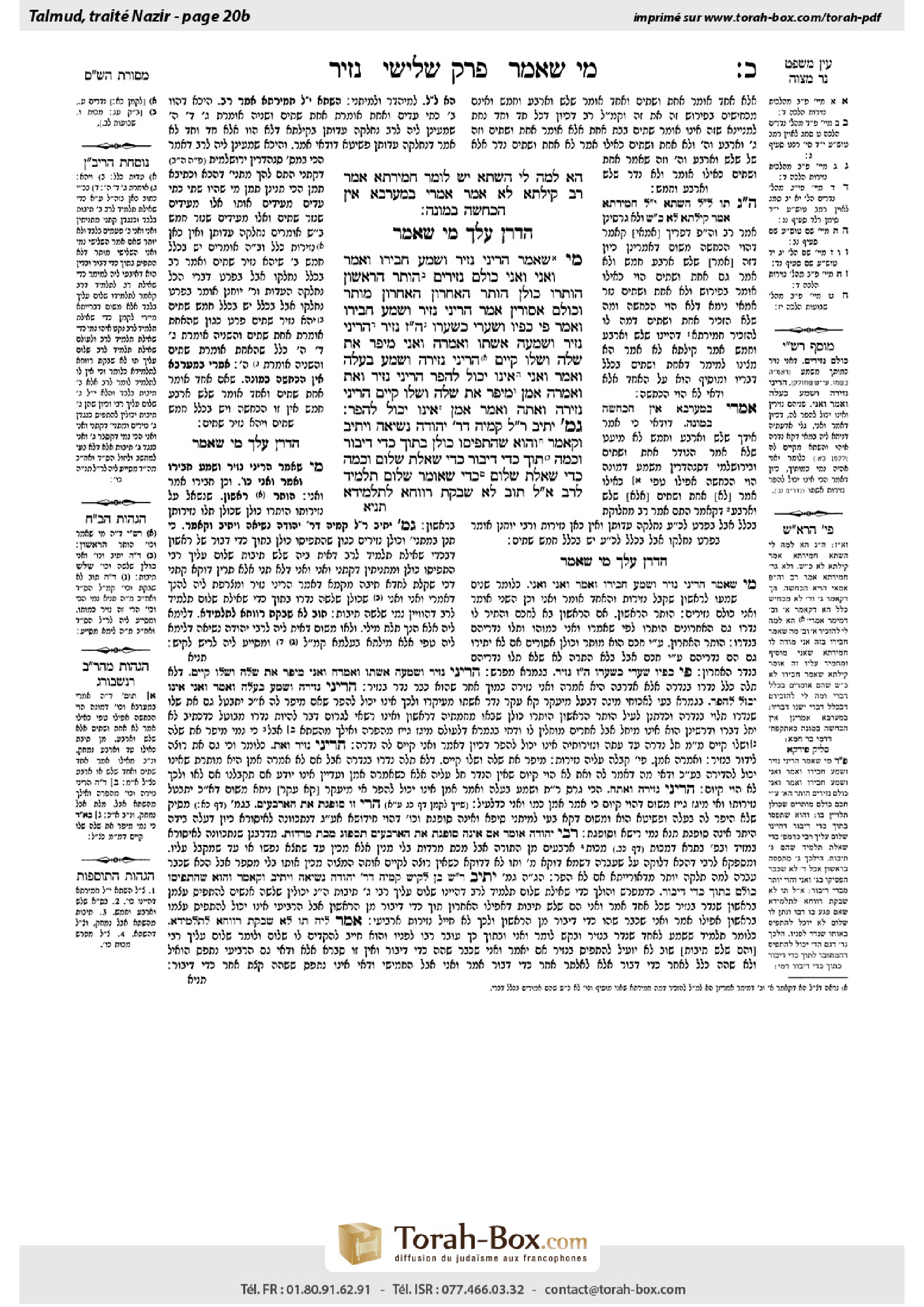
Nazir 20b: Talmud study for Daf Yomi
Daf Yomi is the daily study of one Talmud folio. Explore 37 tractates with scans, Hebrew text, Sefaria English and AI-generated French translations where annotated.
Passage selection and English or AI-generated French translation are available where the scan has annotations. Daf Study is independent of Torah-Box and Sefaria.
Browse Nazir · נזיר · All tractatesNazir 20b text and translations
This page of Nazir includes the Aramaic text, an English translation and an AI-generated French translation, alongside the scan above.
נזיר כ׳ ב · Aramaic and Hebrew text
הָא לְמָה לִי? הַשְׁתָּא יֵשׁ לוֹמַר: חֲמִירְתָּא אָמַר רַב, קִילְּתָא לָא אָמַר?! אָמְרִי בְּמַעְרְבָא: אֵין הַכְחָשָׁה בְּמוֹנֶה.
הַדְרָן עֲלָךְ מִי שֶׁאָמַר
מִי שֶׁאָמַר ״הֲרֵינִי נָזִיר״ וְשָׁמַע חֲבֵירוֹ וְאָמַר ״וַאֲנִי״, ״וַאֲנִי״ — כּוּלָּם נְזִירִים. הוּתַּר הָרִאשׁוֹן — הוּתְּרוּ כּוּלָּן. הוּתַּר הָאַחֲרוֹן — הָאַחֲרוֹן מוּתָּר וְכוּלָּם אֲסוּרִין. אָמַר ״הֲרֵינִי נָזִיר״, וְשָׁמַע חֲבֵירוֹ וְאָמַר ״פִּי כְּפִיו וּשְׂעָרִי כִּשְׂעָרוֹ״ — הֲרֵי זֶה נָזִיר.
״הֲרֵינִי נָזִיר״, וְשָׁמְעָה אִשְׁתּוֹ וְאָמְרָה ״וַאֲנִי״ — מֵיפֵר אֶת שֶׁלָּהּ, וְשֶׁלּוֹ קַיָּים. ״הֲרֵינִי נְזִירָה״, וְשָׁמַע בַּעֲלָהּ וְאָמַר ״וַאֲנִי״ — אֵינוֹ יָכוֹל לְהָפֵר. ״הֲרֵינִי נָזִיר וְאַתְּ״, וְאָמְרָה ״אָמֵן״ — מֵיפֵר אֶת שֶׁלָּהּ, וְשֶׁלּוֹ קַיָּים. ״הֲרֵינִי נְזִירָה וְאַתָּה״, וְאָמַר ״אָמֵן״ — אֵינוֹ יָכוֹל לְהָפֵר.
גְּמָ׳ יָתֵיב רֵישׁ לָקִישׁ קַמֵּיהּ דְּרַבִּי יְהוּדָה נְשִׂיאָה וְיָתֵיב וְקָאָמַר: וְהוּא שֶׁהִתְפִּיסוּ כּוּלָּן בְּתוֹךְ כְּדֵי דִיבּוּר. וְכַמָּה תּוֹךְ כְּדֵי דִיבּוּר — כְּדֵי שְׁאֵלַת שָׁלוֹם, וְכַמָּה כְּדֵי שְׁאֵלַת שָׁלוֹם — כְּדֵי שֶׁאוֹמֵר שָׁלוֹם תַּלְמִיד לָרַב.
אֲמַר לֵיהּ: תּוּב לָא שָׁבְקַתְּ רַוְוחָא לְתַלְמִידָא!
Nazir 20b · English translation
The Gemara asks: Why do I need for Rav to state this at all? Now that it is already said with regard to a stringent case, where there were two sets of witnesses who generally have full credibility yet Rav said that the testimony is considered divided, with regard to a lenient case, involving a conflict within one pair of witnesses, who cannot each obligate him in naziriteship, would he not say that a conflict in their testimony causes it to be disregarded? Of course the testimonies are disregarded if the conflict is within the same set of witnesses. They say in the West, Eretz Yisrael: There is no conflicting testimony in a case of counting, as since one of them counted a smaller number and the second counted a larger number, they do not conflict at all, as the smaller number is included in the larger one.
MISHNA: With regard to one who said: I am hereby a nazirite, and another heard this vow and said: And I, and a third person added: And I, they are all nazirites. If the vow of the first was dissolved by a halakhic authority, they are all dissolved. However, if the vow of the last individual was dissolved by a halakhic authority, the vow of the last individual alone is dissolved, and all the others remain bound by their nazirite vows. If someone said: I am hereby a nazirite, and another heard and said: My mouth is like his mouth and my hair is like his hair, he is a nazirite.
If one said: I am hereby a nazirite, and his wife heard him and said: And I, he can nullify her vow of naziriteship if he so chooses (see Numbers 30:7–16). But his vow remains intact, as his naziriteship is not dependent on hers. However, if the wife said: I am hereby a nazirite, and her husband heard and said: And I, he cannot nullify her vow of naziriteship, as he would thereby be nullifying his own vow, which he made dependent on hers, and he does not have the ability to nullify his own vow. If he said to his wife: I am hereby a nazirite, and you, i.e., you shall be a nazirite as well, and she said: Amen, in acceptance of this vow, he can nullify her vow, and his vow remains intact. However, if the wife said: I am hereby a nazirite, and you, and he said: Amen, he cannot nullify her vow.
GEMARA: Reish Lakish sat before Rabbi Yehuda Nesia, and he sat and said in explanation of the mishna: And this halakha, that they are all nazirites, applies only when they all took a vow by associating themselves with the previous vow within the time required for speaking a short phrase. The Gemara asks: And how much time is included in the measure of: Within the time required for speaking a short phrase? The Gemara answers: It is the time necessary for greeting someone. The Gemara asks: And how much is the time necessary for greeting someone? The Gemara answers that it is the time necessary for a student to say: Peace upon you, my teacher, to his rabbi.
Rabbi Yehuda Nesia said to Reish Lakish: Once again you have provided no advantage to a student who wishes to associate himself with the naziriteship of another. If the student’s rabbi was passing by at the precise moment that his colleague was vowing to be a nazirite, he would have to greet his rabbi first, and therefore he would not be able to respond to his colleague’s vow in time.
Nazir 20b · Traduction française (IA)
La Guemara demande : Pourquoi Rav devait-il énoncer cela ? Puisqu’il l’a déjà dit à propos d’un cas rigoureux, où deux paires de témoins, qui jouissent normalement d’une pleine crédibilité, avaient témoigné et où Rav avait pourtant déclaré que les témoignages étaient considérés comme partagés, à plus forte raison, dans un cas plus indulgent, impliquant une contradiction au sein d’une même paire de témoins, qui ne peuvent pas chacun l’obliger à devenir nazir, n’aurait-il pas dit que la contradiction dans leur témoignage entraîne son rejet ? Il va de soi que les témoignages sont rejetés lorsque la contradiction se trouve au sein d’une même paire de témoins. En Eretz Israël, on dit : Il n’y a pas de témoignages contradictoires dans un cas de décompte, car si l’un a compté un nombre inférieur et le second un nombre supérieur, ils ne se contredisent pas du tout : le nombre inférieur est compris dans le nombre supérieur.
MICHNA : Si quelqu’un dit : « Me voici nazir », qu’un autre entend ce vœu et dit : « Moi aussi », puis qu’une troisième personne ajoute : « Moi aussi », ils sont tous nazir. Si le vœu du premier est annulé par une autorité halakhique, ils sont tous libérés de leurs vœux. En revanche, si le vœu du dernier est annulé par une autorité halakhique, seul le dernier est libéré de son vœu, tandis que tous les autres restent tenus par leurs vœux de naziréat. Si quelqu’un dit : « Me voici nazir », qu’un autre l’entend et dit : « Ma bouche est comme sa bouche et mes cheveux comme ses cheveux », celui-ci est nazir.
Si quelqu’un dit : « Me voici nazir », que sa femme l’entend et dit : « Moi aussi », il peut, s’il le souhaite, annuler son vœu de naziréat (voir Nombres 30, 7–16). Mais son propre vœu demeure intact, car son naziréat ne dépend pas du sien. En revanche, si la femme dit : « Me voici nazir », que son mari l’entend et dit : « Moi aussi », il ne peut pas annuler son vœu de naziréat, car il annulerait ainsi son propre vœu, qu’il a fait dépendre du sien, et il ne peut pas annuler son propre vœu. Si quelqu’un dit à sa femme : « Me voici nazir, et toi aussi », et qu’elle répond : « Amen », acceptant ainsi ce vœu, il peut annuler le vœu de sa femme, tandis que le sien demeure intact. En revanche, si la femme dit : « Me voici nazir, et toi aussi », et que son mari répond : « Amen », il ne peut pas annuler son vœu.
GUEMARA : Reish Lakish était assis devant Rabbi Yehuda Nesia ; il prit la parole et expliqua la Michna : Cette halakha, selon laquelle ils sont tous nazir, ne s’applique que lorsque chacun a formulé son vœu en se joignant au vœu précédent dans le délai nécessaire pour dire une courte phrase. La Guemara demande : Quelle est la durée du délai nécessaire pour dire une courte phrase ? La Guemara répond : C’est le temps nécessaire pour saluer quelqu’un. La Guemara demande : Et quelle est la durée nécessaire pour saluer quelqu’un ? La Guemara répond : C’est le temps qu’il faut à un étudiant pour dire à son maître : « Paix sur toi, mon maître. »
Rabbi Yehuda Nesia dit à Reish Lakish : Une fois encore, tu n’as donné aucun avantage à un étudiant qui souhaite se joindre au naziréat d’un autre. Si le maître de l’étudiant passait précisément au moment où son collègue faisait vœu de devenir nazir, il devrait d’abord saluer son maître ; il ne pourrait donc pas répondre à temps au vœu de son collègue.
Traduction française générée par IA à partir de l’édition anglaise de Sefaria. Vérifie toujours un passage avec le texte source.
Text from Sefaria: William Davidson Edition - Vocalized Aramaic (CC BY NC); William Davidson Edition - English (CC BY NC).